The Week That Was in 103: Cincinnati, Conflict, and a City Caught Between Two Worlds

Sometimes the timing of a unit matters just as much as the content itself.

As the school year winds down, it can be tempting to rush through major topics just to “cover” them before summer. I’ve never believed in that approach. I refuse to sprint through the causes of the Civil War just so I can say I taught it. Especially when I know I’ll have these same students again next year and can teach it the right way with the depth and time it deserves.

Instead, this became the perfect opportunity to slow down and teach something meaningful: local history.

This week in Room 103, we launched a brand new inquiry unit centered around the compelling question: “How was Cincinnati a city caught between two worlds before the Civil War?”

The unit built directly off our previous learning about slavery and abolition, but shifted the focus toward our own city. Too often, students learn history as something distant that happened somewhere else to someone else. I wanted students to understand that Cincinnati was deeply connected to the tensions surrounding slavery, freedom, economics, racism, and division before the Civil War.

I also wanted students to wrestle with an important truth that sometimes gets lost in simplified historical narratives: crossing the Ohio River did not automatically mean freedom in the way many people imagine it today.

Yes, the Ohio River represented hope. It represented possibility. But freedom from slavery did not mean freedom from racism, discrimination, segregation, or violence. Cincinnati had Black Laws designed to oppress African Americans. Slave catchers still roamed the riverbanks. Racial tensions exploded into riots in 1829, 1836, and 1841. The city itself was divided economically, politically, and morally over slavery.

That complexity became the heart of the unit. Instead of teaching Cincinnati as a simple “free city,” students explored the idea that it was a place caught between North and South, freedom and oppression, growth and division.

The entire unit was designed using an Inquiry Design Model structure with supporting questions that built toward that bigger understanding. We ended up focusing on Supporting Questions 1, 2, and 4 this week. I ultimately removed Supporting Question 3 because it started feeling repetitive once the inquiry evolved.

I also revised Supporting Question 2 to better fit the direction of the unit: “How were Cincinnatians divided over slavery?” Students needed to see that the conflict wasn’t just happening nationally. It was happening in neighborhoods, newspapers, businesses, churches, and homes right here in Cincinnati.

One thing I really liked about this week was how naturally local history increased engagement. Students recognized street names. They recognized locations. They recognized connections to places they’ve driven past their entire lives.

The inquiry structure also helped slow students down intellectually. Instead of memorizing disconnected facts, they spent the week analyzing evidence, discussing competing viewpoints, interpreting numbers, comparing perspectives, and building arguments about their own city.

Staging the Question

Number Mania: Cincinnati on the Rise

To begin the unit, we staged the question with a Number Mania paired with a Short Answer Battle Royale. The goal was to immediately establish Cincinnati as a growing and increasingly important city before the Civil War. I wanted students to see Cincinnati not just as a dot on a map, but as a rapidly expanding river city connected to trade, migration, movement, and opportunity because of its location along the Ohio River.

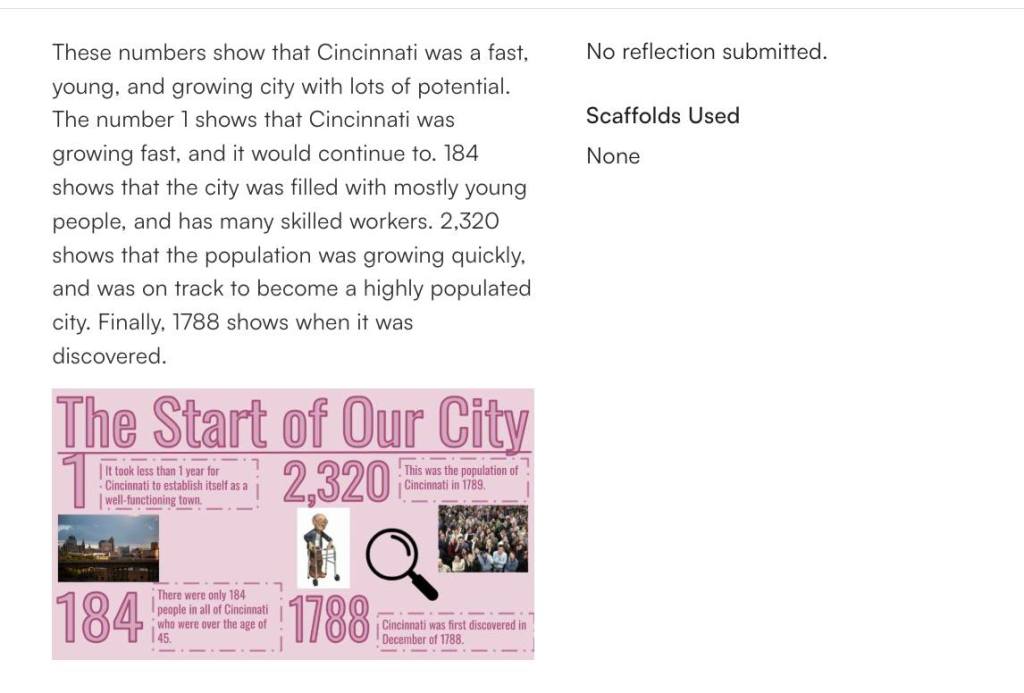
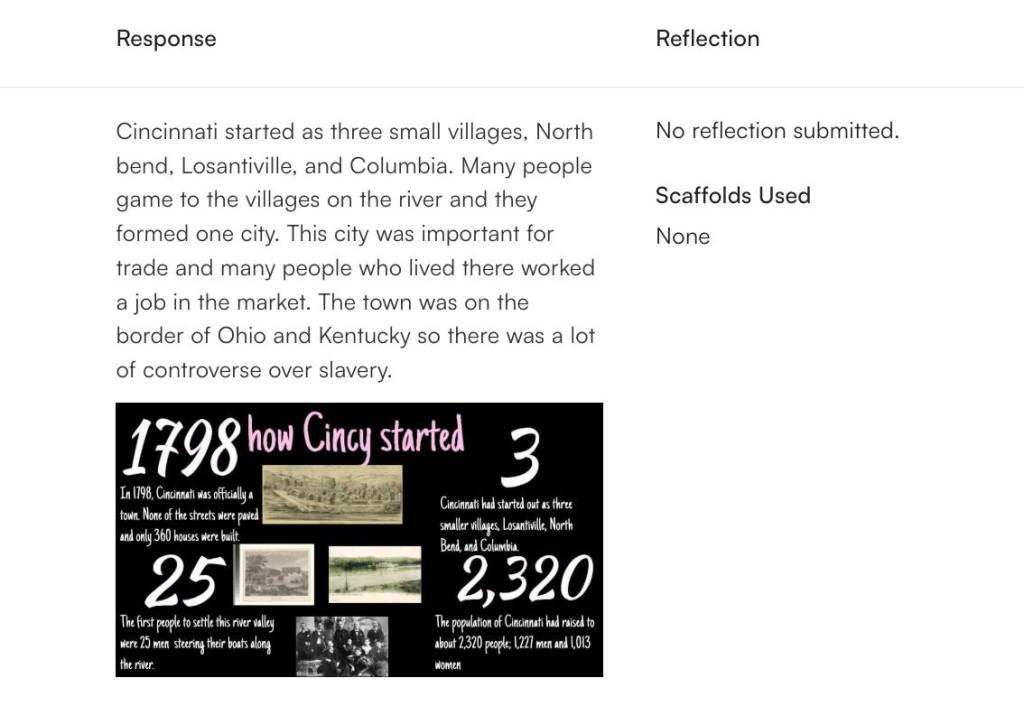
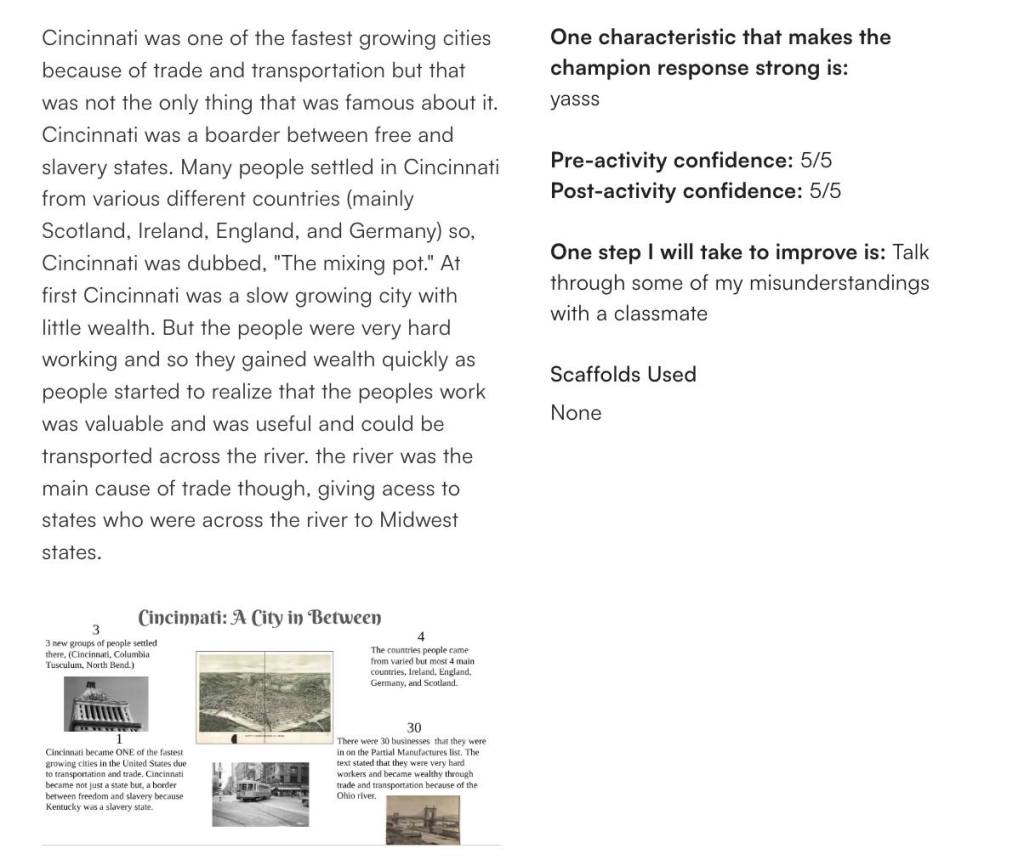
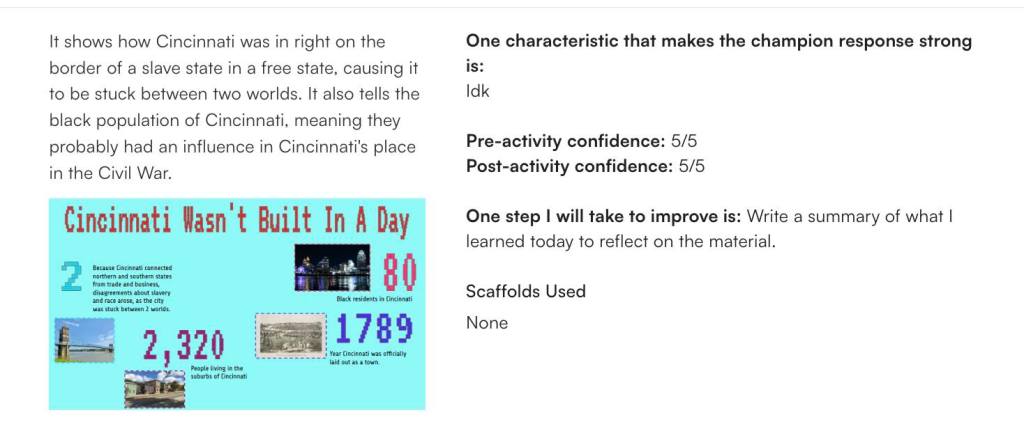
Students analyzed a Number Mania infographic built around the question: “What evidence shows Cincinnati was growing into an important city before the Civil War?”

The infographic included population growth, trade statistics, immigration numbers, housing growth, and other data tied to Cincinnati’s early development. Instead of simply reading about the city’s growth, students had to interpret the numbers and determine what they revealed about Cincinnati’s rise shortly after its founding.

Short Answer Battle Royale

After analyzing the infographic, students moved into Short Answer where they explained how the numbers proved Cincinnati was becoming an important city. Students attached screenshots of their Number Mania directly into their responses so the evidence and explanation were connected together.

One thing I liked about this lesson was that it naturally pushed students beyond just identifying numbers. They had to explain significance. A large population number by itself means nothing unless students can connect it to trade, opportunity, immigration, industry, or geographic importance. To wrap up the activity, we ran a Battle Royale focused on one simple goal: the clearest explanation of the content.

Students compared responses, evaluated clarity, and saw examples of strong historical reasoning from their classmates. It turned what could have been a basic writing response into something far more engaging and discussion-driven.

Student Ownership and Feedback

One thing that stood out to me was that several students actually requested that I set up a Snorkl afterward so they could get feedback on both their Number Mania analysis and their writing. That was a cool moment because it showed students were invested enough in the task that they wanted additional feedback and revision opportunities instead of simply turning something in and moving on. It also reinforced something I’ve talked about a lot this year: when students care about the work, feedback becomes valuable instead of feeling like punishment.

Building the Foundation for the Inquiry

More importantly, the lesson helped establish one of the major ideas for the entire inquiry unit: Cincinnati’s location and growth made it incredibly important before the Civil War, but that same growth also intensified many of the tensions that would divide the city.
Supporting Question #1

What Made Cincinnati an Important City Before the Civil War?

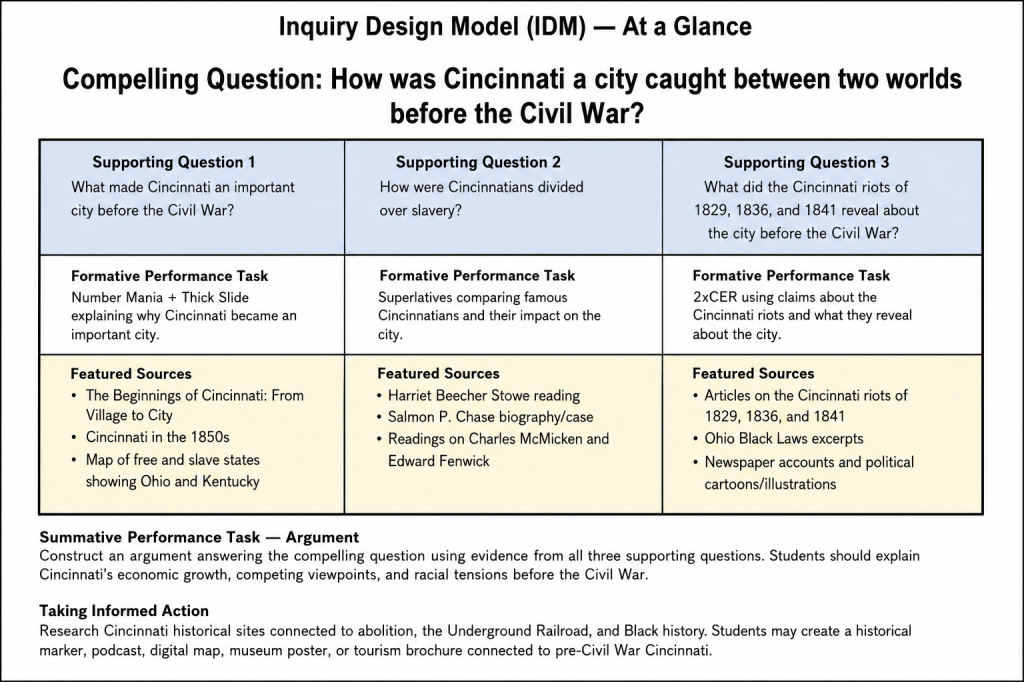
After staging the question with Number Mania, students moved into Supporting Question #1 where they began digging deeper into why Cincinnati became such an important city before the Civil War.

Students worked through a series of sources connected to trade, the Ohio River, Porkopolis, transportation, and Cincinnati’s economic growth.

One thing I wanted students to understand was that Cincinnati’s growth was not random. Geography mattered. The Ohio River mattered. Trade mattered. The city’s location connected it to both the North and the South, which helped Cincinnati grow rapidly into a major economic center.

At the same time, students also began seeing the complicated reality underneath that growth. Cincinnati benefited economically from trade connected to slavery even while existing in a free state. That idea became one of the foundational understandings for the rest of the inquiry unit.

Working Through the Sources

Students answered questions connected to each source before bringing all of their thinking together into a Thick Slide. I’ve found that this process helps students organize their thinking before asking them to synthesize larger ideas. The sources themselves also helped challenge some misconceptions students had about Cincinnati and the Ohio River.

One source focused on Porkopolis and how Cincinnati’s pork industry exploded because of Southern trade and plantation economies. Another examined the Ohio River itself and how different it looked before dams were built. Students were shocked to learn that the river was not always the giant barrier they imagine today and that, during dry periods, some areas became shallow enough to carefully cross on foot.

Too often, students hear simplified Underground Railroad stories that make the crossing sound like an automatic path to freedom. I wanted them to understand the danger, uncertainty, and complexity involved. Crossing the river mattered, but it did not magically erase racism, discrimination, or danger.

Thick Slides as Learning Artifacts

Once students worked through the sources and questions, they summarized their learning using a Thick Slide template.

Students created titles, identified five important facts, added visuals, wrote a summary explaining why Cincinnati was important before the Civil War, and finished with a three word summary that captured the overall idea of the lesson.

I want students leaving each supporting question with something meaningful they can revisit later during the summative assessment. Instead of isolated worksheets or notes that disappear into folders, students are building a collection of evidence and thinking throughout the inquiry.

By the end of the unit, students won’t just have “completed activities.” They’ll have artifacts showing how their understanding evolved across the inquiry itself.

Supporting Question #2

How Were Cincinnatians Divided Over Slavery Before the Civil War?

For Supporting Question #2, students shifted from studying Cincinnati’s growth to studying Cincinnati’s divisions. This part of the inquiry focused on a question that became more and more important as students moved through the sources: “How were Cincinnatians divided over slavery before the Civil War?”

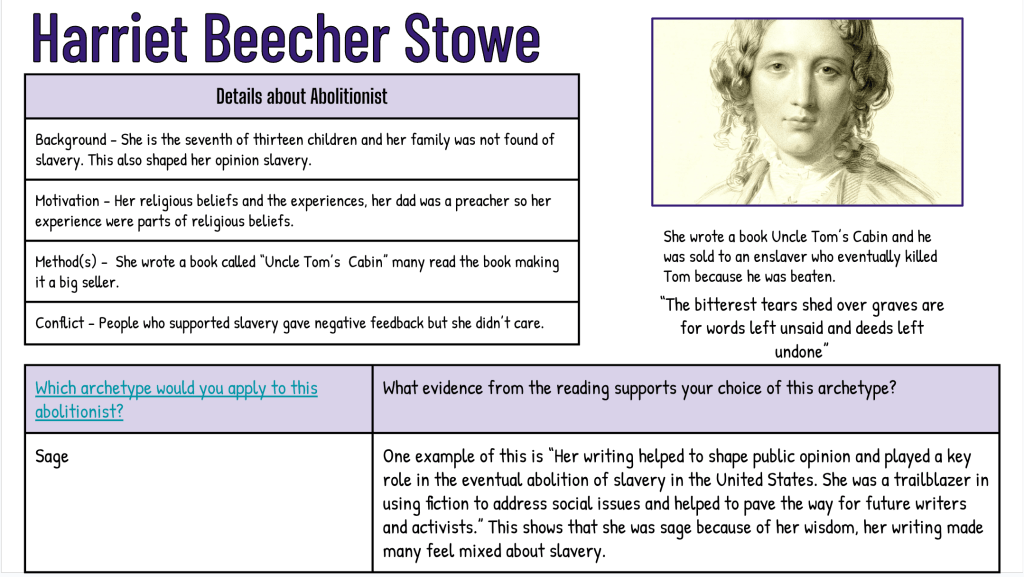
To explore this question, students examined four very different Cincinnati voices and perspectives connected to slavery and abolition. Students analyzed Harriet Beecher Stowe and how her experiences living in Cincinnati helped shape Uncle Tom’s Cabin and spread anti-slavery ideas across the North. They examined Salmon P. Chase and how he defended freedom seekers and challenged slavery in court while living in Cincinnati. Students also studied Charles McMicken and how some wealthy Cincinnati businessmen benefited from systems connected to slavery even while living in a free state.

Finally, students analyzed an article from the Cincinnati Post and Anti-Abolitionist newspaper that argued abolitionists were creating division and threatening the future of the country. I thought this lesson really helped students understand that Cincinnati was not unified in its thinking about slavery. Some people actively fought against slavery. Others economically benefited from it. Others feared abolitionists would destroy the Union itself.

Too often students want history to fit into clear “good side vs. bad side” categories. This lesson forced students to wrestle with the uncomfortable reality that people living in the same city could view slavery in completely different ways.

Thick Slides and Consistency Across the Inquiry

To keep consistency across the inquiry unit, students once again created Thick Slides as their learning artifact for the supporting question. Students summarized four different views over slavery in Cincinnati, added visuals, wrote explanations about why Cincinnatians were divided, and created a three word summary capturing the overall tension within the city.

I’ve found that keeping a consistent structure across the inquiry helps students focus more on the thinking and less on figuring out a brand new activity every day. The consistency also allows students to clearly see how each supporting question connects back to the larger compelling question. By this point in the unit, students were beginning to recognize a major theme: Cincinnati was economically, politically, and morally caught between North and South.

Short Answer Battle Royale

We finished class with another Short Answer Battle Royale where students used evidence from their Thick Slides to answer the supporting question. What I liked about this part was that students already had organized evidence directly in front of them from the learning artifact they created. Instead of scrambling to remember information, students could focus on constructing stronger explanations and arguments.

The discussions were also stronger because students had analyzed multiple perspectives beforehand. They weren’t just repeating one side. They were comparing viewpoints, weighing evidence, and trying to explain why divisions existed in the first place. That’s the kind of historical thinking I want students doing at this point in the year.

Supporting Question #3

What Did the Cincinnati Riots Reveal About the City Before the Civil War?

For this supporting question, we used a CyberSandwich focused on the Cincinnati riots of 1829, 1836, and 1841.

Each student received a different article connected to one of the riots. Students individually read their assigned source, took notes, and prepared to teach their classmates about what happened during that specific riot.

The note taking focused on several major questions:

When did the riot take place?
Who was involved?
What happened during the riot?
Why did the riot happen?
How did leaders or the government respond?
What did the riot reveal about Cincinnati?

The structure worked really well because students became responsible for becoming “experts” on their specific riot before collaborating with others.

Comparing the Riots

After students completed their notes, they worked together to compare all three riots using a Triple Venn Diagram. This led to some incredibly strong discussions. Students started noticing patterns across all three riots. Racism, economic competition, fear, discrimination, weak government responses, and violence appeared repeatedly. They also noticed that the riots evolved over time as tensions surrounding slavery and abolition grew stronger before the Civil War.

One of the most important understandings I wanted students to walk away with was this: Crossing the Ohio River did not mean escaping racism and discrimination. I think sometimes the Underground Railroad gets oversimplified into a happy ending story where freedom automatically meant equality and safety. The reality was much more complicated. African Americans in Cincinnati still faced discriminatory Black Laws, violent mobs, segregation, unequal protection under the law, and the constant threat of slave catchers and racial violence.

Short Answer Battle Royale

After the discussions and note taking, students moved back into Short Answer for another Battle Royale.

Students answered the question: “What did the Cincinnati riots reveal about the city before the Civil War?” I liked ending the lesson this way because students had to synthesize information across all three riots rather than simply summarizing one event. They had to identify larger patterns and explain what the riots revealed about Cincinnati as a whole.

The discussions during the Battle Royale were some of the strongest conversations of the week because students were no longer just talking about isolated events. They were talking about contradictions within the city itself. Cincinnati was free from slavery by law, but not free from racism, discrimination, segregation, or violence.

Summative Assessment

Bringing the Inquiry Together

The summative assessment for this unit will take place next week. One thing I’ve learned over time is that inquiry units like this work best when students create something meaningful with their learning instead of simply taking a traditional test. When students spend days analyzing sources, discussing perspectives, comparing evidence, and building understanding, I want the final assessment to reflect that process.

For this unit, the best assessment options will most likely be either a one pager centered around the compelling question or some type of creative project that allows students to synthesize their learning.

The compelling question students will answer is: “How was Cincinnati a city caught between two worlds before the Civil War?” What I like about this question is that there is no simple answer. Students have to wrestle with contradictions throughout the unit.

Cincinnati was a free city, yet deeply connected to slavery through trade and economics.
The Ohio River represented freedom, yet crossing it did not guarantee safety or equality.
Some Cincinnatians fought against slavery, while others defended systems connected to it.
The city grew rapidly and became economically successful, yet racial tensions repeatedly exploded into violence.

Throughout the inquiry, students have been building learning artifacts tied to each supporting question. Instead of relying on memorization, students now have a collection of evidence, visuals, writing, notes, and summaries they can pull from when constructing their final product.

I think that’s one of the strengths of inquiry based learning. Students are not just “doing activities.” They are building understanding piece by piece over time.

I’m less interested in students memorizing every detail about Cincinnati before the Civil War and more interested in whether they can explain the larger tensions, contradictions, and realities that shaped the city.

If students can walk away understanding that history is often messy, complicated, and deeply connected to the communities around them, then the unit accomplished what it was supposed to do.

Lessons

Staging the Question – Number Mania with Reading Linked

Supporting Question 1 – Sources, Questions, Thick Slide

Supporting Question 2 – Thick Slide, Sources

Supporting Question 3 – CyberSandwich, Sources
The Week That Was in 103

This week in Room 103, we wrapped up a mini-unit centered around one driving question:

How did slavery shape the lives of people in different ways in the United States?

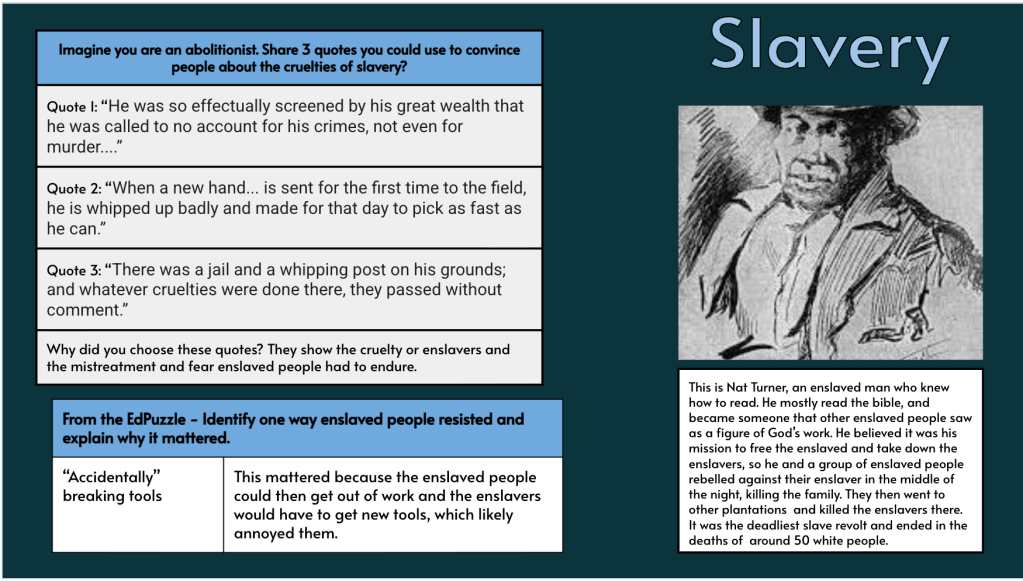
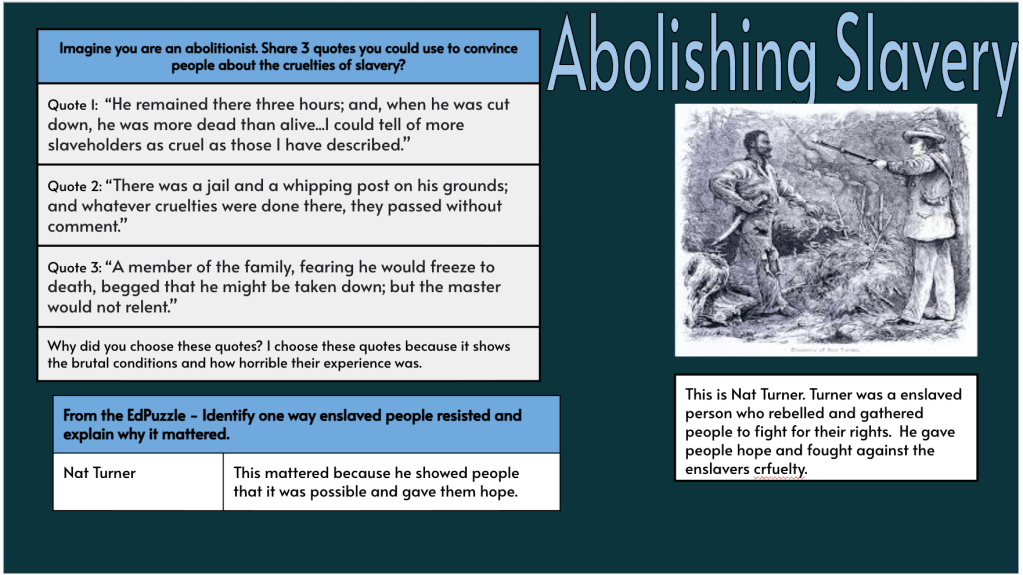
Throughout the week, students explored the impact of the cotton gin, analyzed primary sources from formerly enslaved people, examined the lives and methods of abolitionists, debated historical impact at the whiteboards, and finished the week by building CER responses using evidence gathered across the unit.

As I reflected on the week, I also found myself thinking a lot about my co-author and friend, Dr. Scott Petri. This week marked one year since his passing.

So much of what happened in Room 103 this week connects back to things Scott taught many of us about social studies instruction. He pushed teachers to move beyond lectures and memorization and create classrooms where students discuss, connect, create, compare, and think deeply about history.

Scott helped many of us see social studies through a literacy lens. He emphasized vocabulary, background knowledge, listening, scaffolds, and helping students make connections between ideas. A lot of the structures from this week reflect those ideas. Students worked with primary sources, built connections between concepts, collaborated at the whiteboards, created visual representations of learning, and revisited evidence from multiple lessons to support historical claims.

One year later, his influence is still showing up in classrooms everywhere. It definitely showed up in Room 103 this week.

Monday – The Cotton Gin

This week in Room 103, we kicked off a mini-unit on slavery with a question that sat at the center of everything we did:

How did slavery shape and impact different people within the United States?

Instead of starting with a giant lecture or pages of notes, we started with an invention. One machine. One idea. One decision that changed the course of the country forever.

The cotton gin.

What made this lesson powerful was that students quickly realized this was never really just about a machine. It was about consequences, innovation, economics, human suffering, expansion, profit, power, and perspective. The cotton gin became the entry point into all of it.

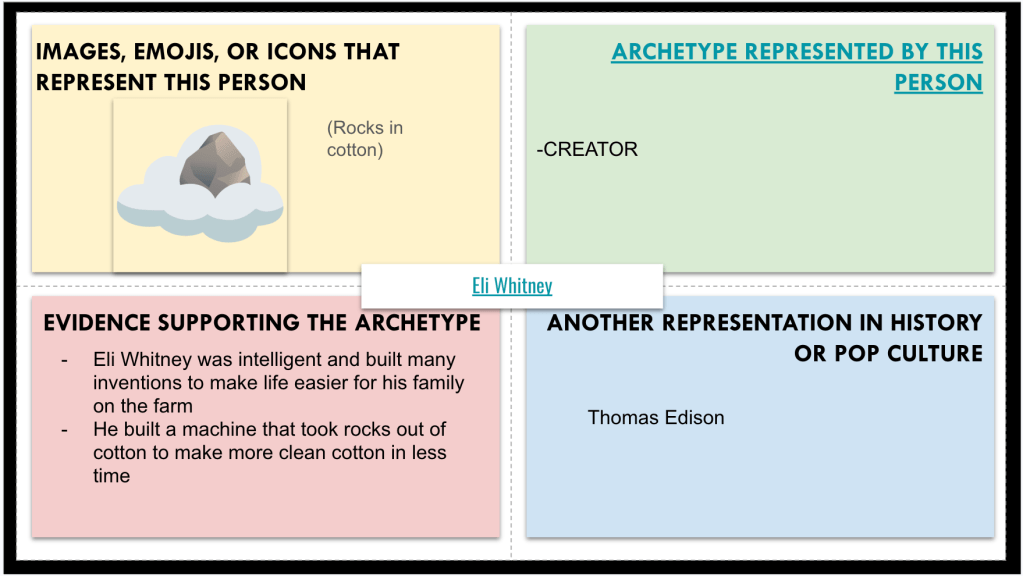
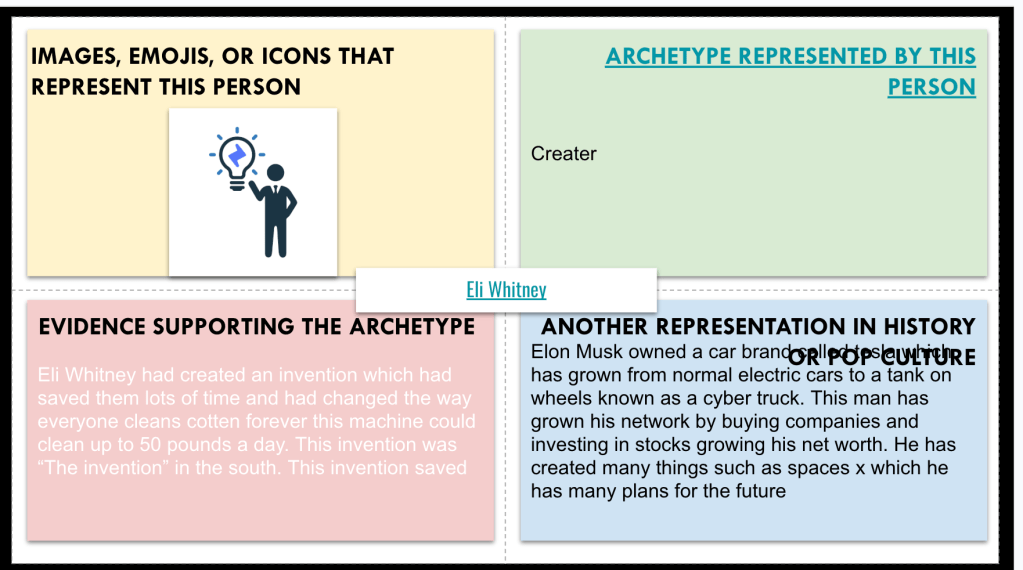
Archetype Four Square: Eli Whitney Beyond “Inventor”

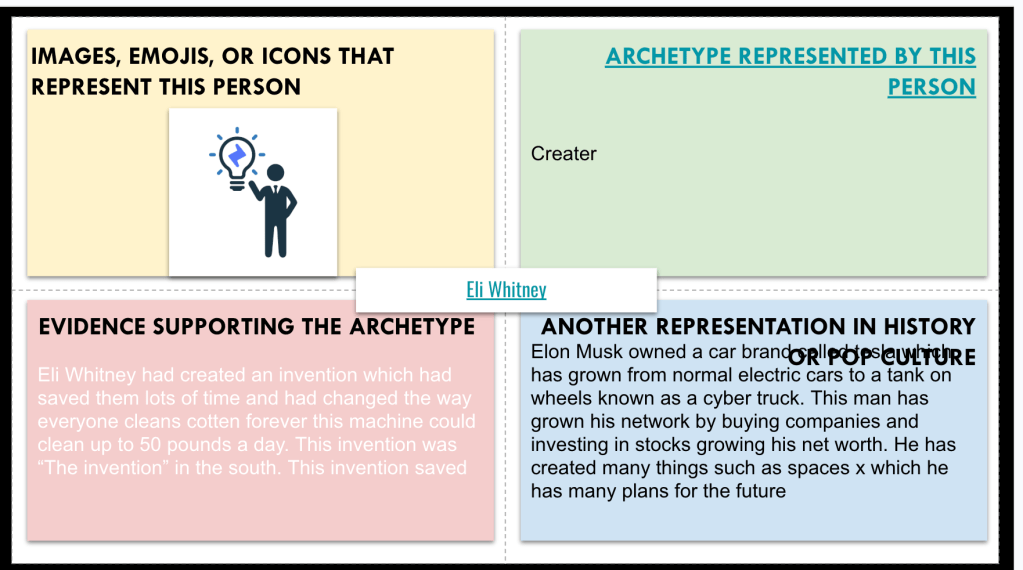
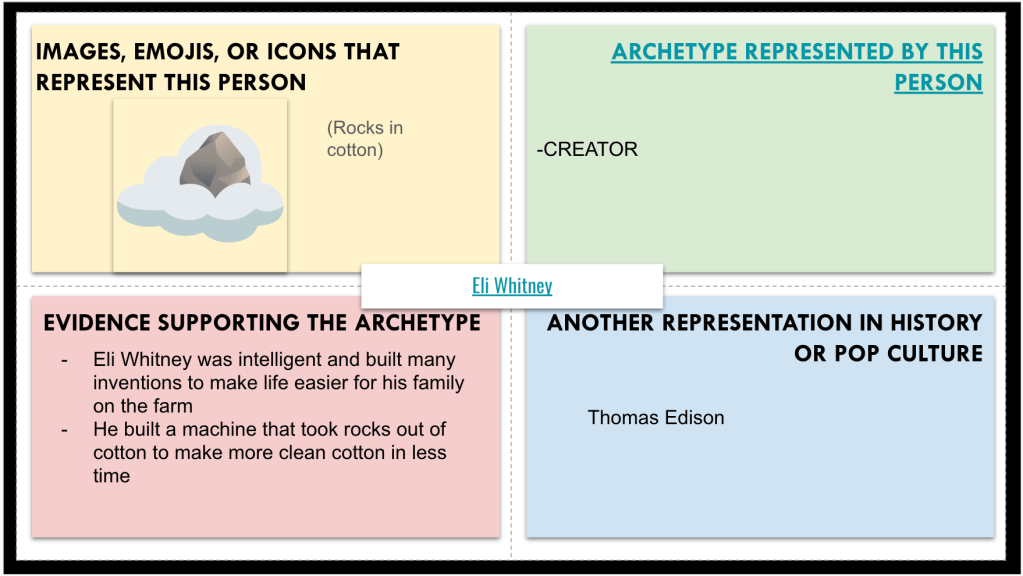
We opened class with an Archetype Four Square over Eli Whitney.

I wanted students thinking beyond the simple “inventor who made life easier” narrative they often hear. Archetypes force students to evaluate people instead of simply memorizing facts. Students debated whether Whitney represented a visionary, a creator, a disruptor, or someone whose invention unintentionally caused harm on a massive scale.

What I like about archetype work is that it pushes students into gray areas. History is rarely clean and simple. Students had to support their thinking with evidence instead of just throwing out opinions.

Some students compared Whitney to modern tech innovators, while others started wrestling with the idea that inventions can help some groups while hurting others. That tension became a theme throughout the lesson.

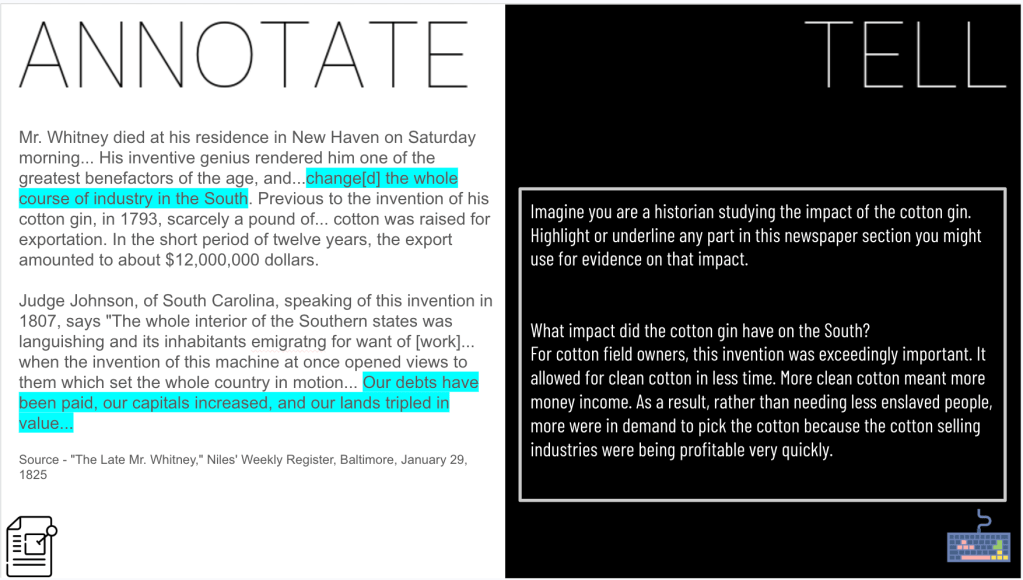
Annotate and Tell with Primary Sources
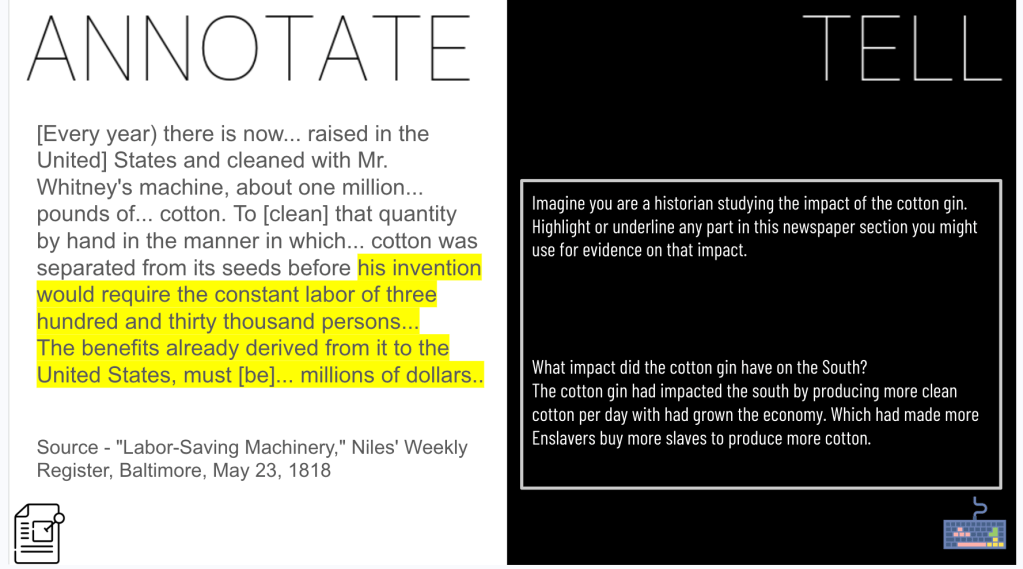
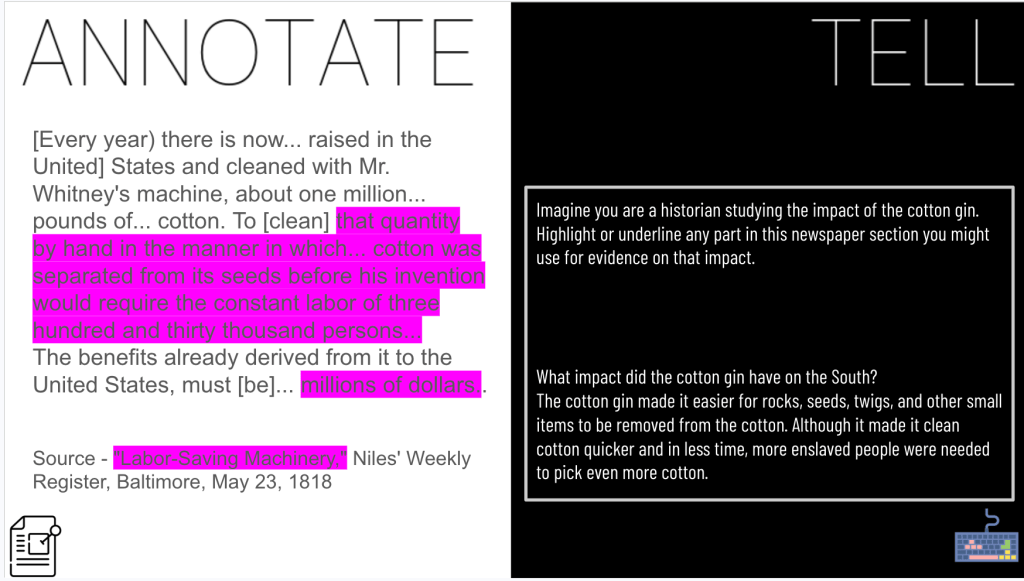
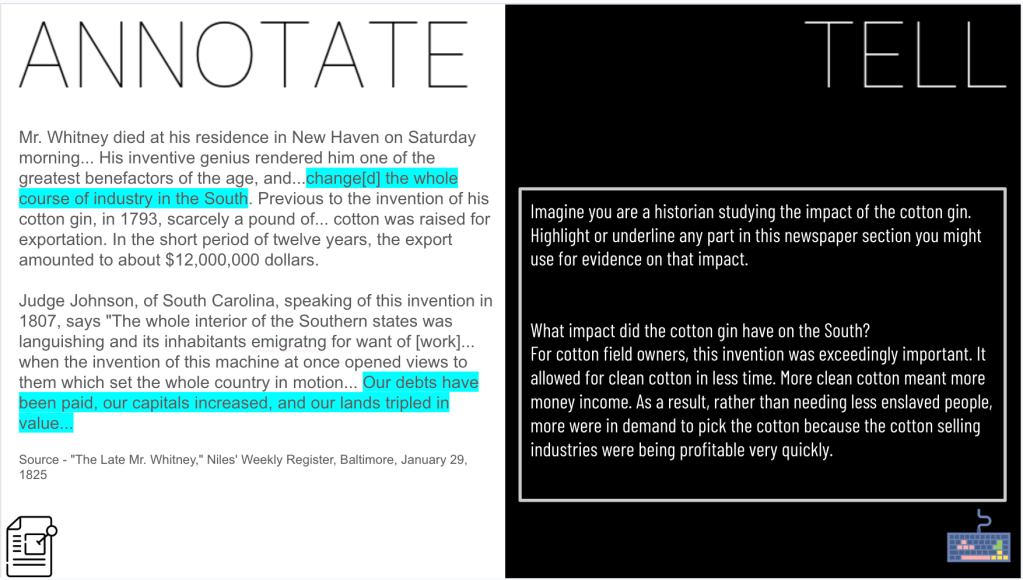
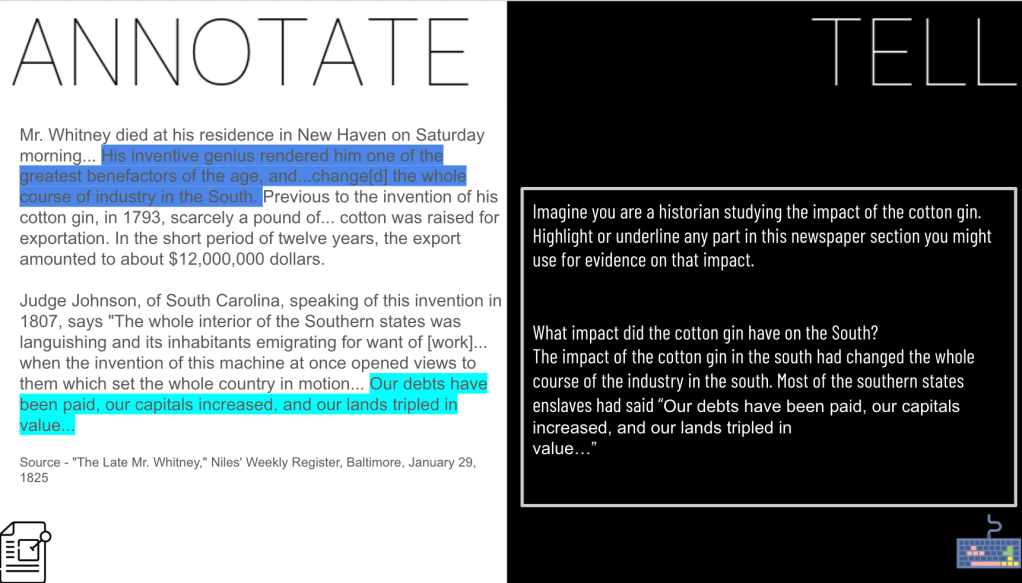
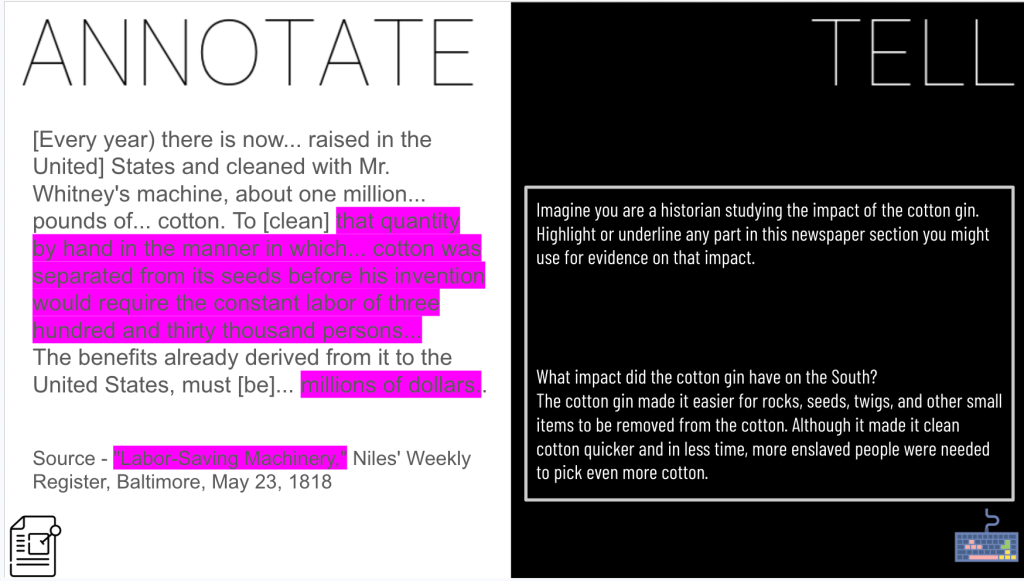
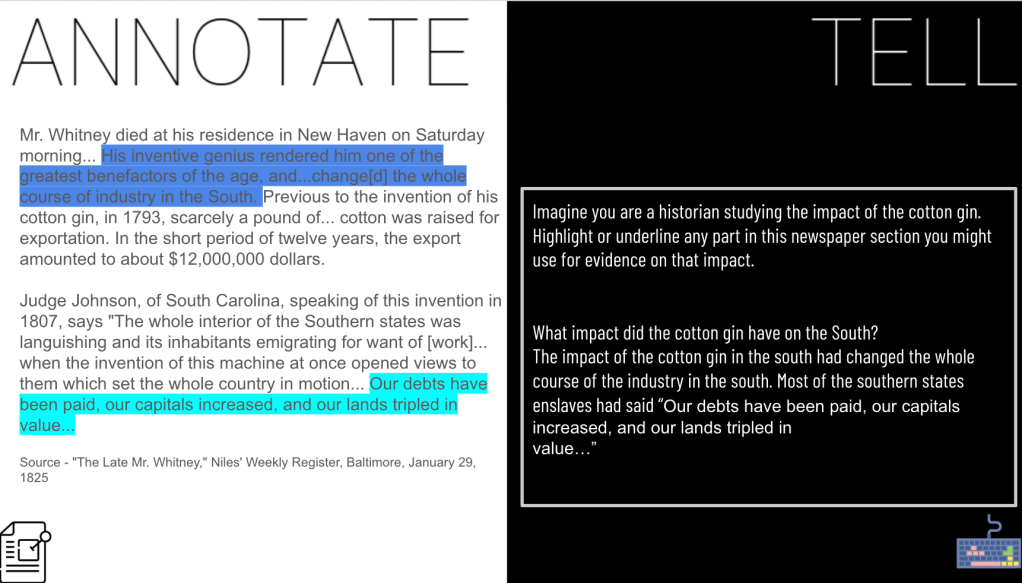
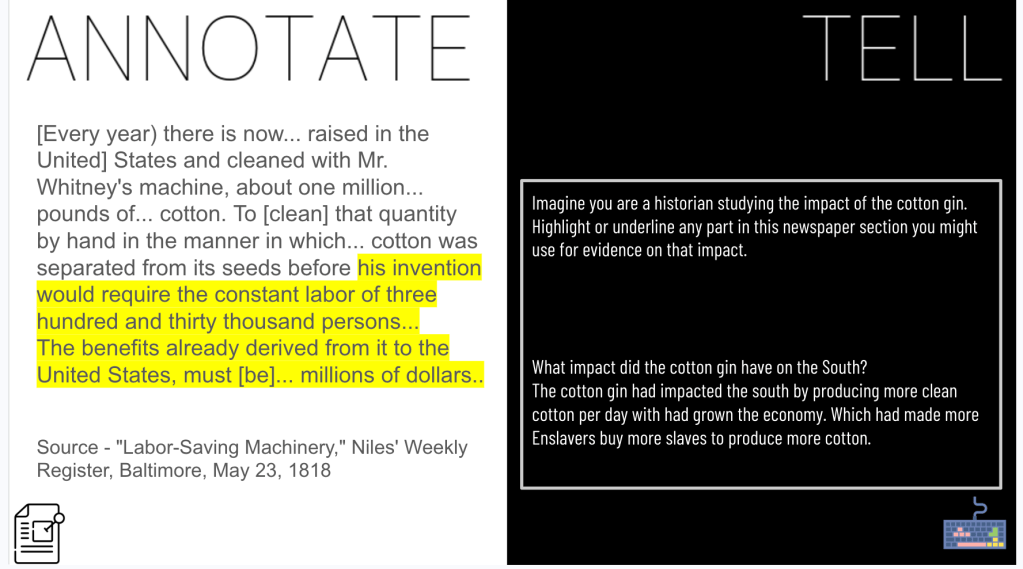
Next came Annotate and Tell using historical newspaper excerpts about the cotton gin.

Students examined how people in the early 1800s praised Whitney’s invention. The sources focused heavily on economic growth, increased cotton production, and Southern prosperity. One source even described Whitney as one of the “greatest benefactors of the age.”

This became a great opportunity to remind students that primary sources are not neutral. They reflect perspective, priorities, and values from a specific moment in time.

Students highlighted phrases showing the positive economic impact, but the deeper conversations started once we asked harder questions. Positive for who? Who benefited from this growth? Who paid the price?

That shift in thinking moved the lesson from surface-level recall into deeper historical analysis.

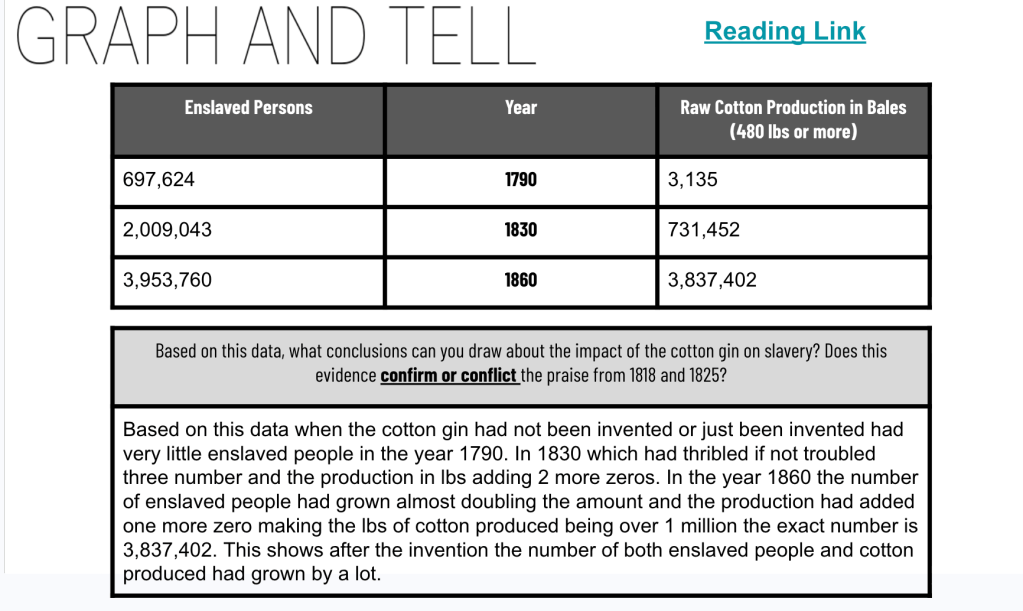
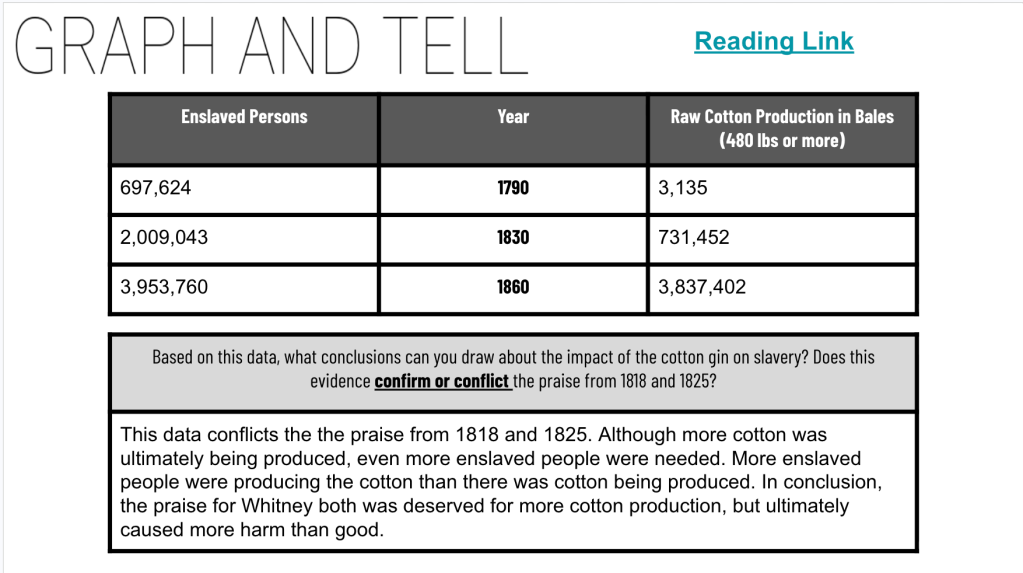
Graph and Tell: Numbers Tell a Story Too

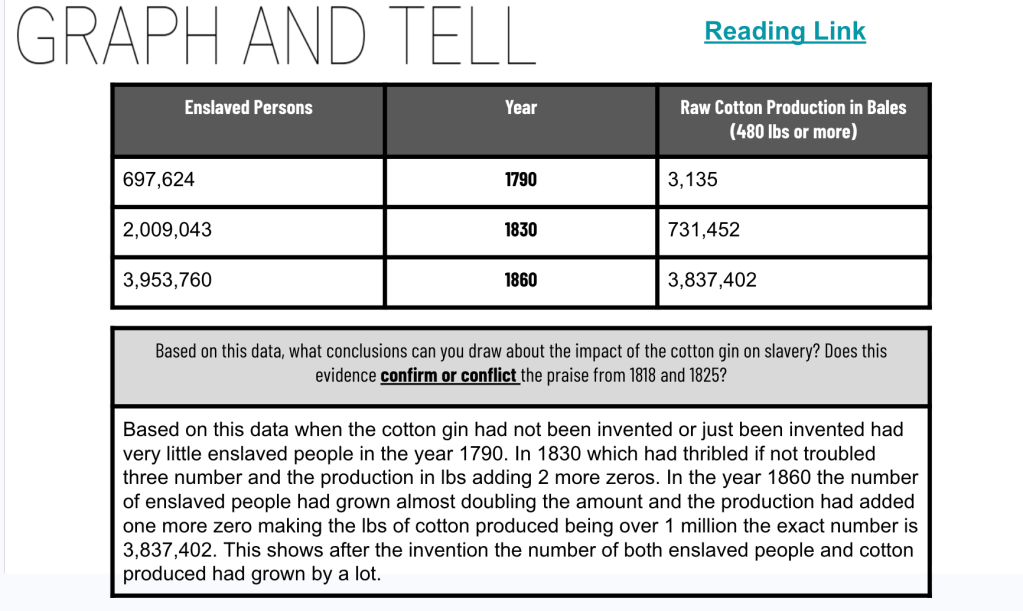
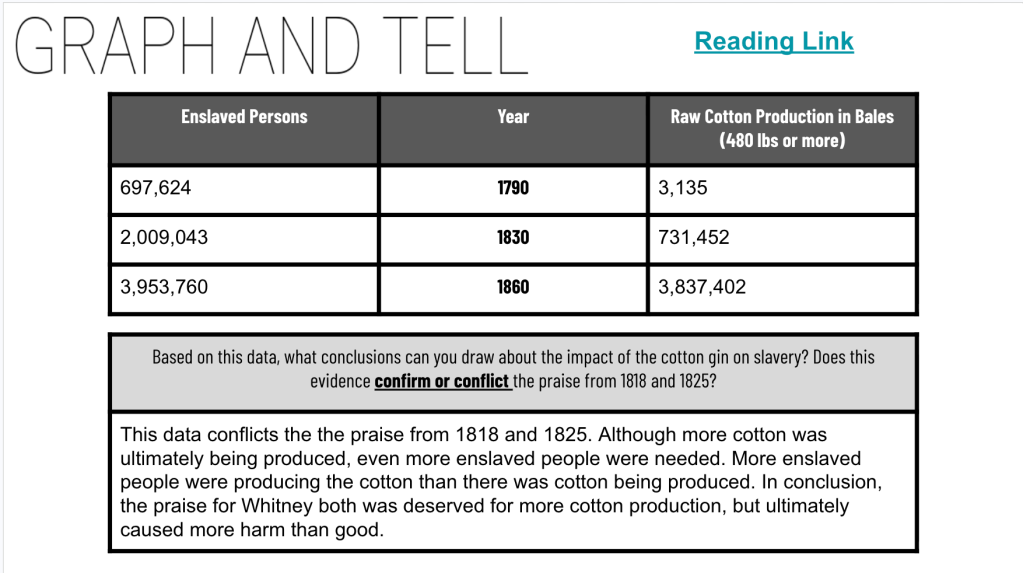
After working through the sources, students moved into Graph and Tell where they analyzed the relationship between cotton production and slavery over time. The graphs and numbers completely changed the conversation. Students could visually see cotton production explode after the invention of the cotton gin while the enslaved population increased dramatically alongside it.

This mattered because many students initially assumed machines reduce labor needs. The cotton gin actually increased the demand for enslaved labor because cotton became so profitable. The graph gave students evidence to challenge the celebratory tone of the earlier sources. It created tension between economic success and human cost, which tied directly back to our unit question.

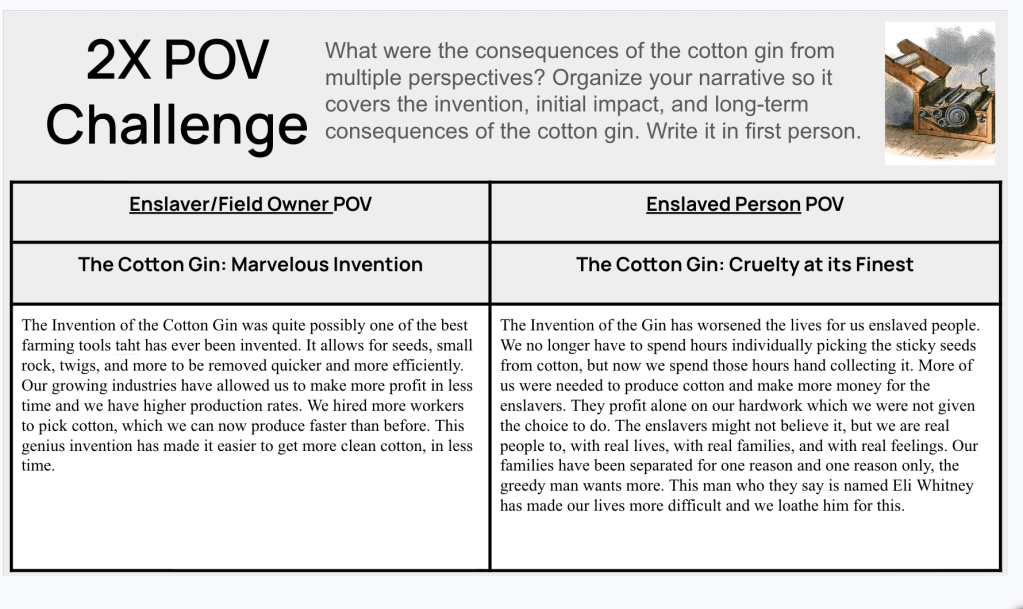
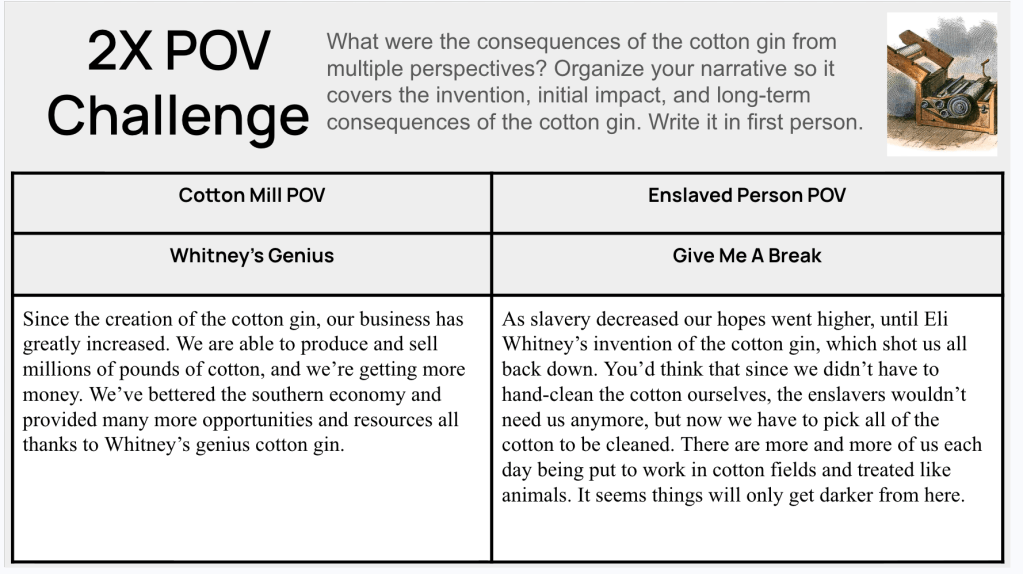
2xPOV: Seeing the Cotton Gin Through Different Eyes

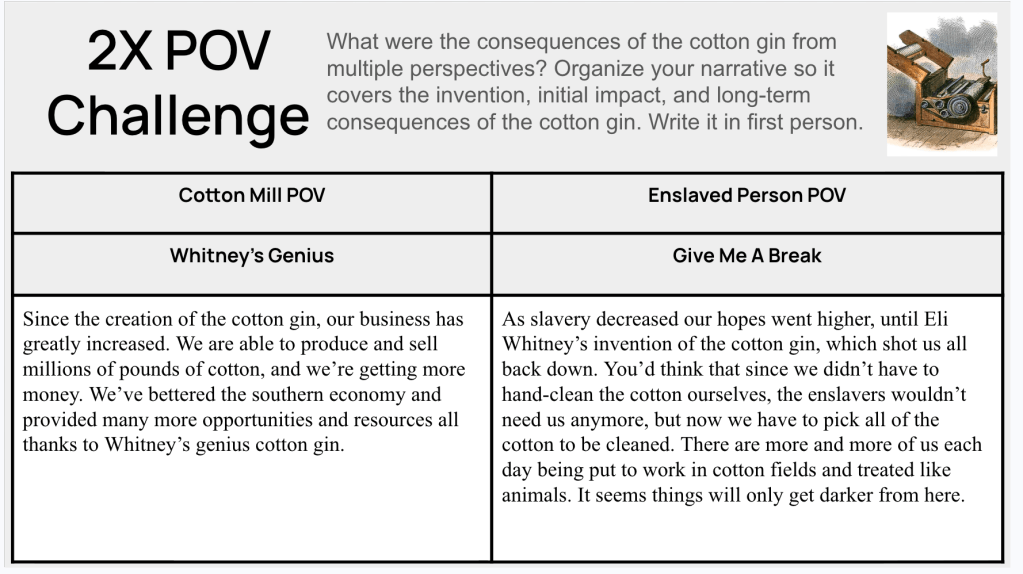
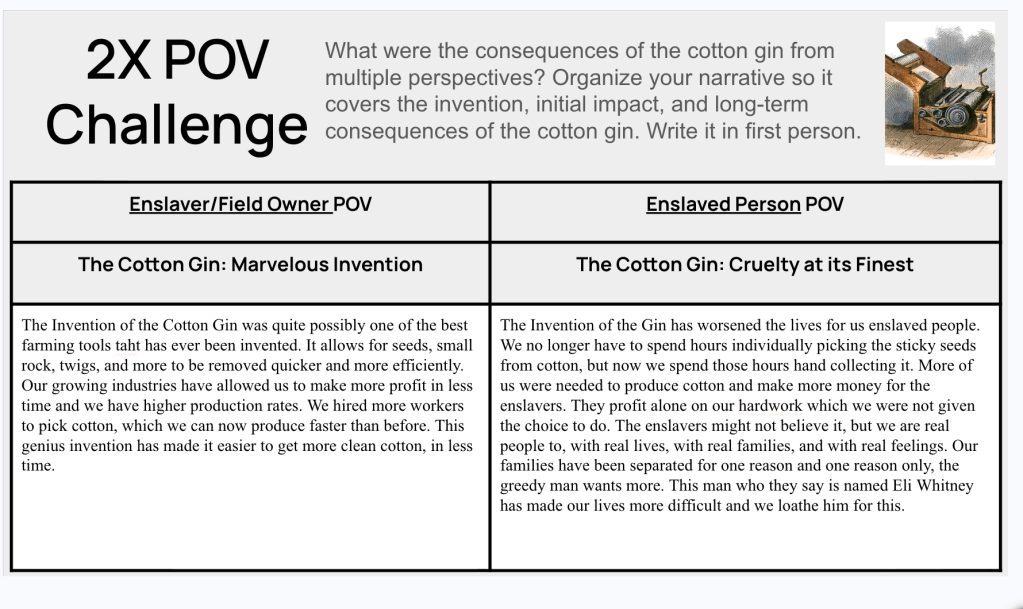
To wrap up the lesson, students created their own 2xPOV narratives.

This may have been my favorite part of the day because students had to step into the perspectives of different people impacted by the cotton gin and write in first person. Some wrote from the perspective of plantation owners excited about profits, while others wrote from the perspective of enslaved people facing increased labor and harsher conditions. A few explored Northern factory workers, small farmers, or merchants connected to the cotton economy.

The activity forced students to move beyond saying “the cotton gin increased slavery” and instead think about how different groups experienced the same event in completely different ways. That is the heart of social studies. It is not simply learning what happened. It is understanding how events shaped real people in very different ways.

Why This Worked

This lesson reminded me why I love stacking EduProtocols together instead of treating them as isolated activities. Each part of the lesson built naturally into the next. Archetype Four Square pushed students to evaluate Eli Whitney. Annotate and Tell grounded students in historical evidence. Graph and Tell helped students interpret trends and data. Finally, 2xPOV moved students into empathy, perspective, and synthesis.

Students were constantly doing something different, but every activity connected back to the same central question. The lesson also balanced retrieval, collaboration, writing, visual analysis, and discussion without overwhelming students cognitively. Instead of front loading everything through lecture, students uncovered the story piece by piece.By the end of class, students were no longer talking about the cotton gin as “just an invention.” They were talking about consequences.

Tuesday: Shifting the Focus to the Lives of the Enslaved

On Tuesday, we shifted our focus from the invention of the cotton gin to the lived experiences of enslaved people themselves. After spending Monday examining the economic impact of slavery, students now had to confront the human side of it.

EdPuzzle: Building Context Through Video

We started class with an EdPuzzle focused on slavery and resistance to slavery. The video helped provide students with background knowledge before they worked directly with primary sources.

I like using EdPuzzle this way because it creates a shared foundation without requiring a long lecture. Students are still actively engaged through embedded questions and checkpoints while building the context they need for the deeper analysis later in class.

The video also introduced students to the idea that enslaved people constantly resisted slavery in both large and small ways. Resistance was not always dramatic. Sometimes it looked like slowing work, preserving culture, learning to read, escaping, or simply surviving another day.

Annotate and Tell: Solomon Northup and Harriet Jacobs

From there, we moved into Annotate and Tell using excerpts from Solomon Northup and Harriet Jacobs. Students worked through the sources carefully, highlighting evidence, annotating important details, and identifying moments that revealed the realities of slavery.

What made this lesson powerful was that students were not reading textbook summaries. They were reading the words of people who actually lived through slavery. Solomon Northup’s account helped students understand the brutality, fear, and dehumanization enslaved people faced daily. Harriet Jacobs added another layer entirely as students examined the unique dangers and struggles enslaved women experienced. Her writing sparked thoughtful conversations because students began realizing slavery impacted people differently depending on age, gender, and circumstance.

As students annotated the sources, they started noticing patterns between the two accounts while also recognizing important differences in experiences and perspectives. Some students focused on examples of resistance, while others highlighted family separation, emotional trauma, survival, or the loss of freedom and identity.

Thick Slide: Pulling the Learning Together

To finish class, students created a Thick Slide where they synthesized everything from the lesson. The Thick Slide pushed students beyond simply repeating details from the readings. Students had to think about the larger story the sources were telling and explain how those experiences connected back to our unit question about how slavery shaped different people within the United States.

The combination of video, primary sources, annotation, discussion, and synthesis created a lesson where students were constantly processing information in different ways without the class feeling repetitive. More importantly, students were engaging directly with human experiences instead of viewing slavery as just another topic in a textbook.

Wednesday and Thursday: Abolitionists, Perspective, and Historical Judgment

By Wednesday, students had spent the first part of the week examining the expansion of slavery and the realities enslaved people faced. The next step was exploring the people who challenged slavery and the different methods they used to push for change.

This lesson sequence became one of my favorite kinds of lessons because students were constantly learning, discussing, comparing, evaluating, and building ideas together without the class ever feeling repetitive.

Thin Slide: Framing the Lesson

We opened with a Thin Slide built around the quote: “Change begins when someone refuses to stay silent.” Students responded using one image and one word or phrase. It was quick, simple, and gave every student an immediate entry point into the lesson.

Before students ever discussed abolitionists, they were already thinking about courage, resistance, speaking out, and standing against injustice. Starting this way helped frame the larger human ideas connected to the lesson before we ever got into historical details.

EdPuzzle: Building Background Knowledge

From there, students completed a short EdPuzzle focused on abolitionism and reform movements.

The goal was not to overload students with information. It was simply to provide enough background knowledge so students could move into the deeper thinking activities confidently.

Sometimes students do not need a lengthy lecture. They need focused context, key vocabulary, and enough information to begin making sense of the topic.

That is exactly what this portion of the lesson accomplished.

Thick Slide: Becoming the Expert

The Thick Slide became the centerpiece of the lesson.

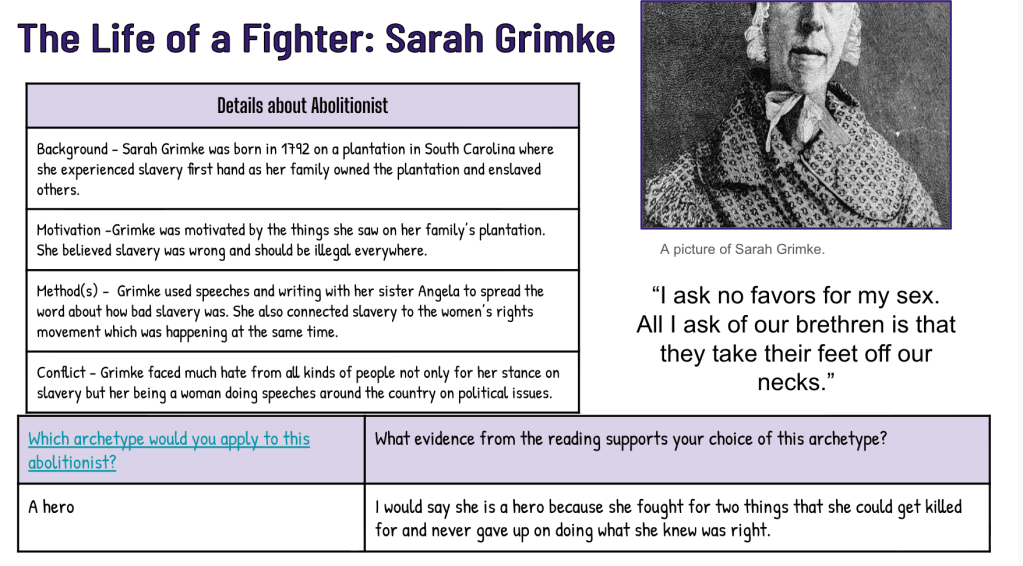
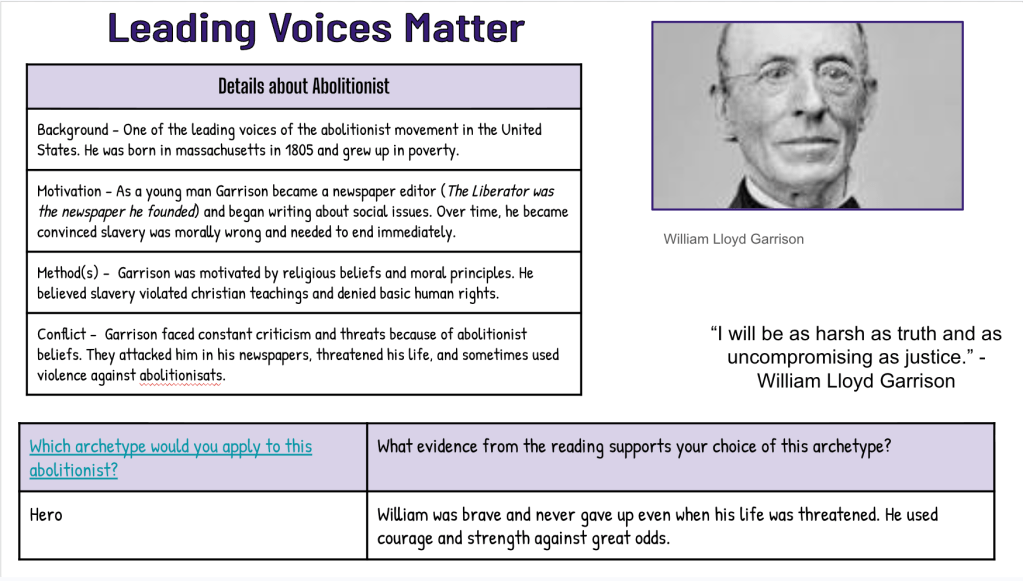
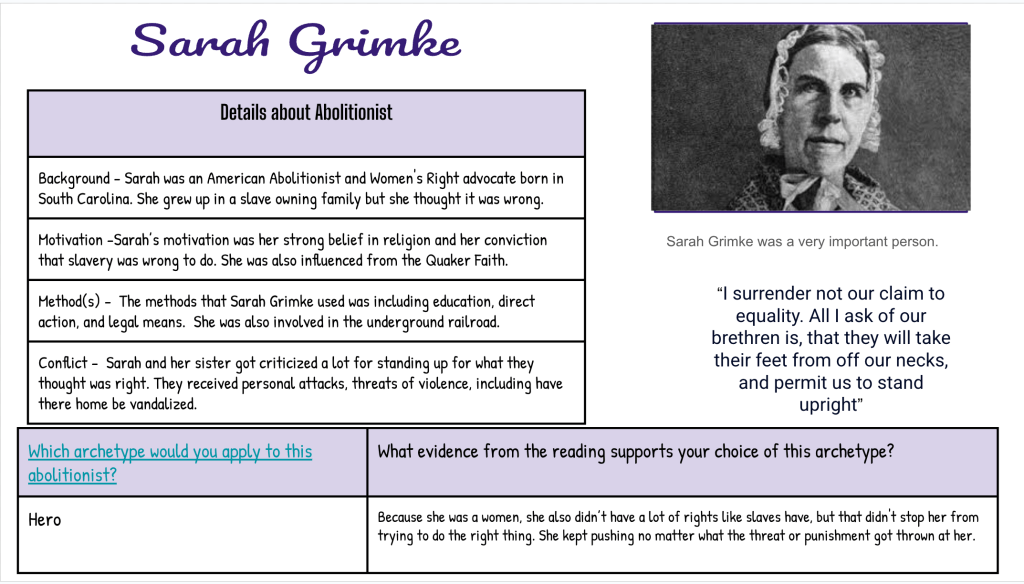
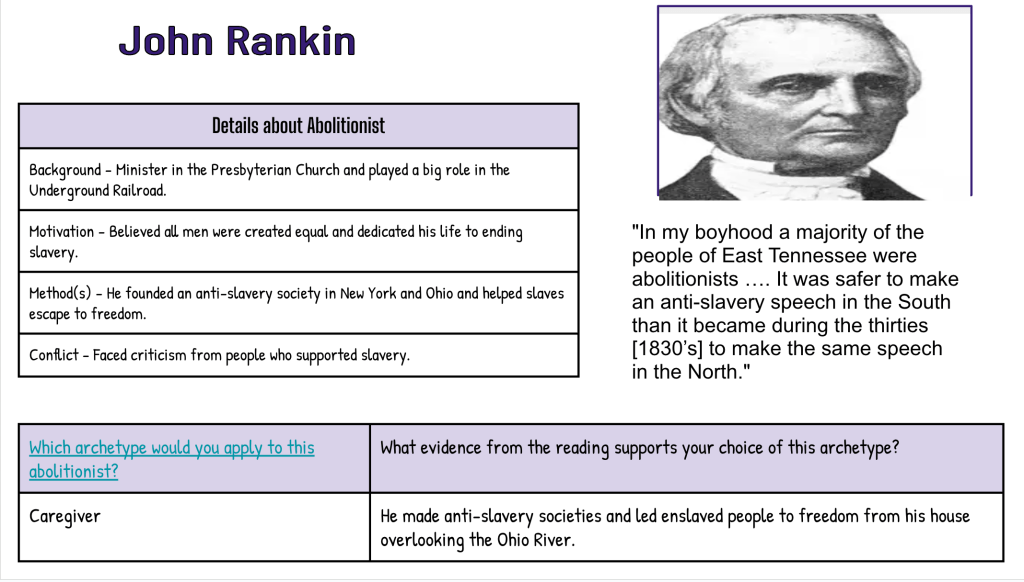
Each student selected an abolitionist and created a slide including:

  • Background information
  • Motivations for ending slavery
  • Methods they used
  • A quote or important moment connected to them

This is where the lesson shifted beyond simple fact collection. Students had to decide what information mattered most and organize it in a way that others could learn from.

Every student became responsible for bringing one abolitionist into the room’s shared understanding. Instead of passively receiving information, students became contributors to the lesson itself.

Sharing and Learning From Each Other

Once students completed their Thick Slides, they shared them with classmates.

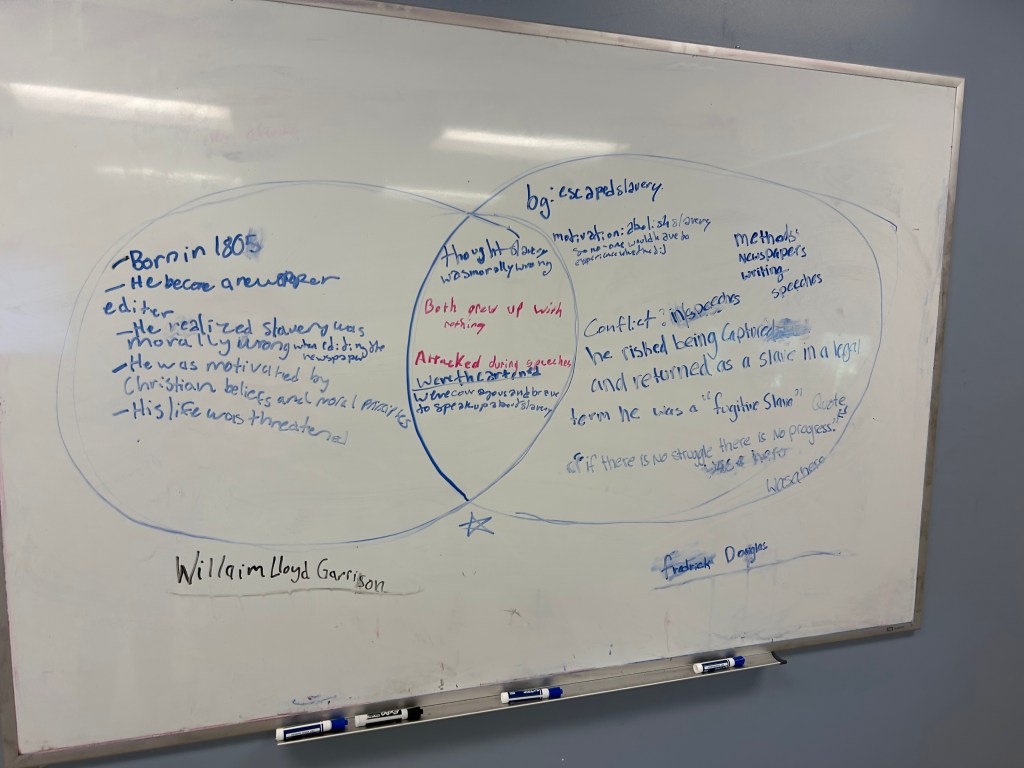
This part of the lesson completely changed the dynamic of the room because students were now learning directly from one another. Students introduced classmates to figures like Frederick Douglass, Harriet Tubman, William Lloyd Garrison, Harriet Beecher Stowe, John Rankin, and James G. Birney. The sharing process also gave students repeated exposure to important ideas while hearing them explained in different ways by their peers.

Frayer Model: Organizing the Learning

After the presentations, students used a Frayer Model to collect notes on four additional abolitionists from their classmates.

Students focused on:

  • Background
  • Motivations
  • Methods
  • Impact

The Frayer Model helped students organize information while also forcing them to compare similarities and differences between abolitionists. By this point in the lesson, students were beginning to recognize patterns in how different people challenged slavery. Some used speeches. Others used writing, newspapers, political action, religion, or direct resistance.

BTC Whiteboards: Comparing Abolitionists

Once students had built enough background knowledge, we shifted into Building Thinking Classrooms style comparisons at the whiteboards.

Students worked in groups comparing two or three abolitionists while discussing questions connected to influence, courage, methods, effectiveness, and long-term impact. The whiteboards immediately raised the level of discussion.

Students debated:

  • Who took the biggest risks
  • Who changed the most minds
  • Which methods were most effective
  • Which abolitionist had the greatest long-term impact

Because students had already completed the Thick Slides and Frayer Models, they actually had evidence to support their arguments. The conversations became much deeper than simple opinions. The visible thinking at the boards also helped students build ideas collaboratively instead of waiting for the teacher to confirm whether they were right or wrong.

Superlatives: Ending With Historical Judgment

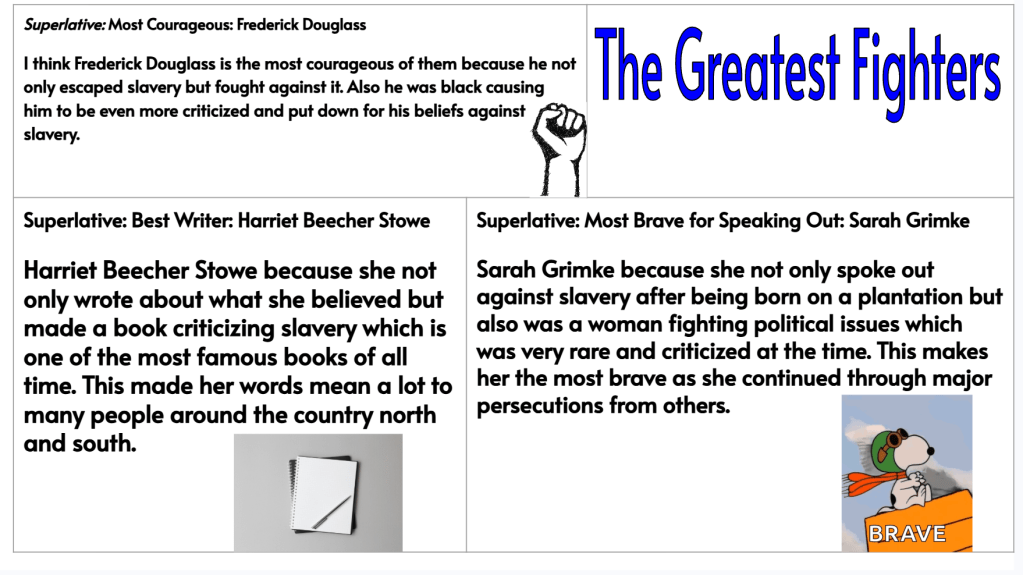
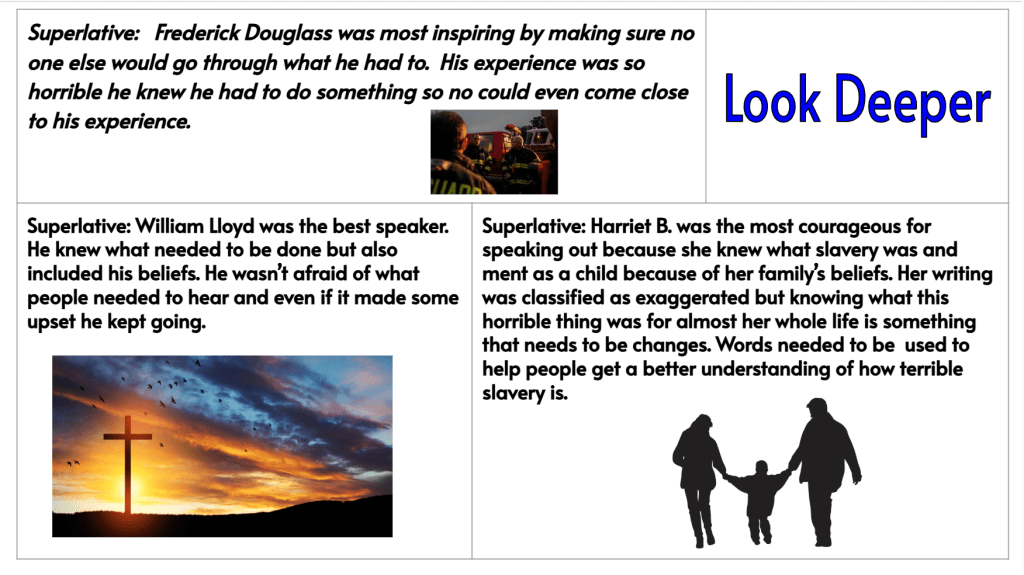
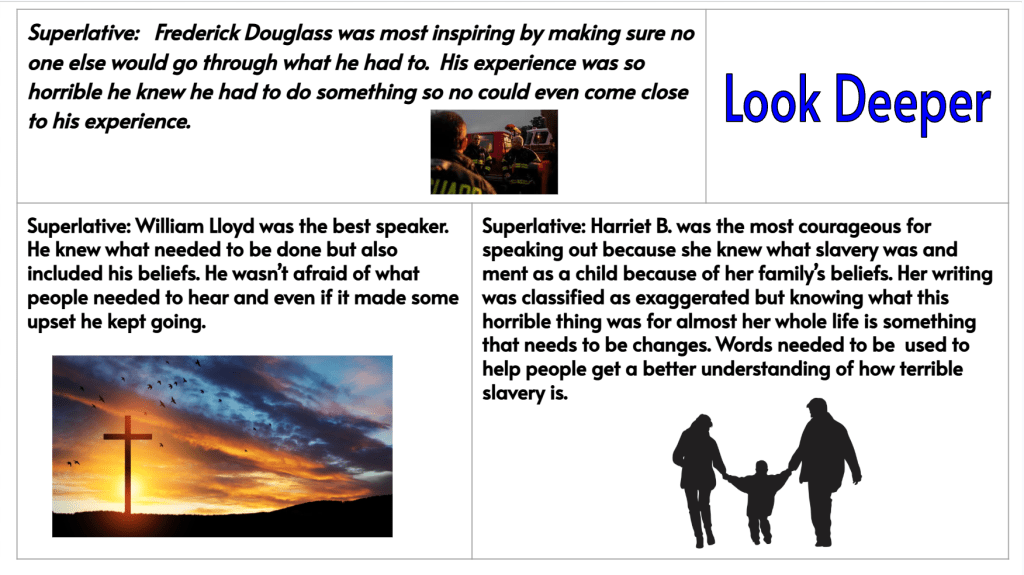
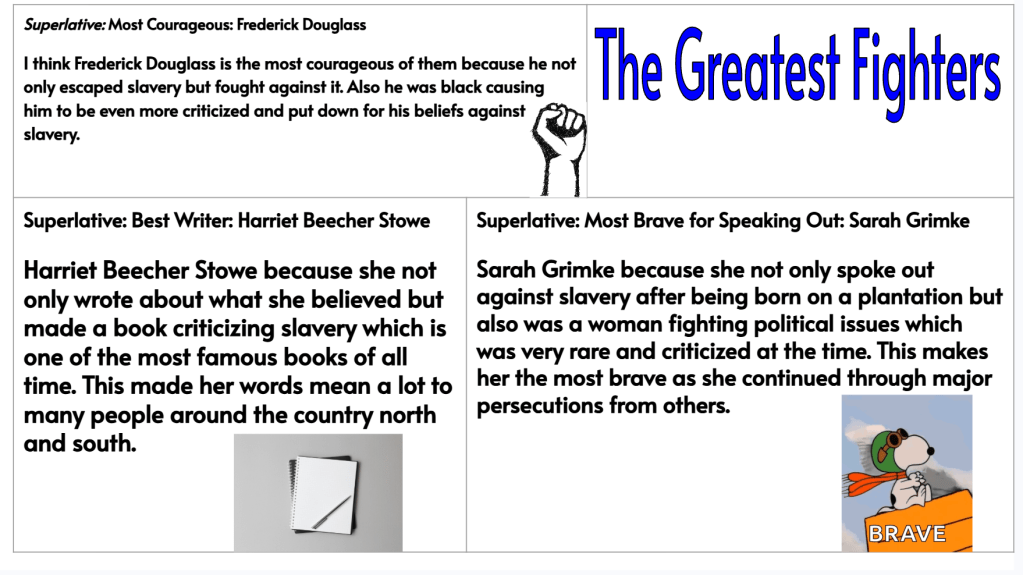
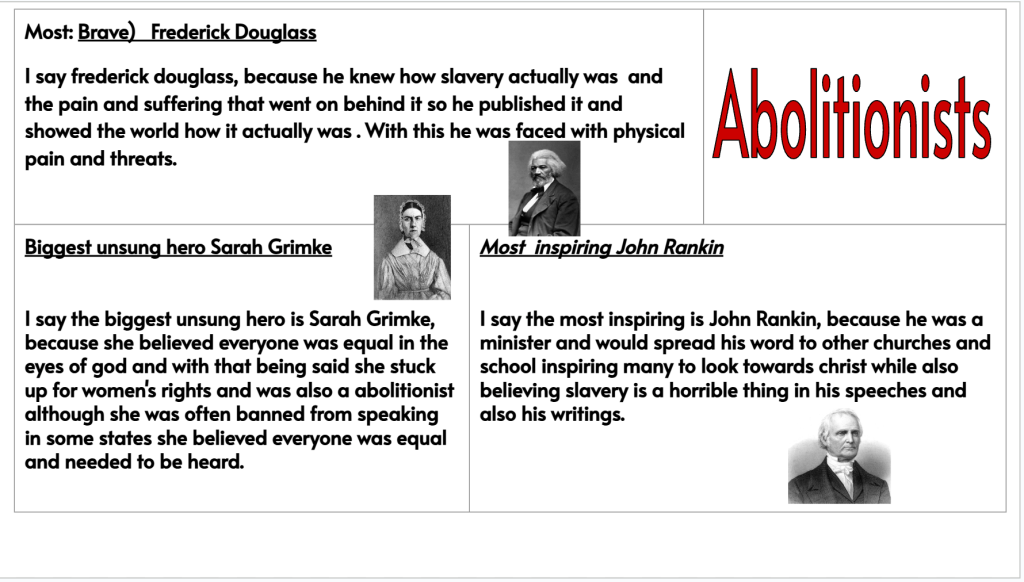
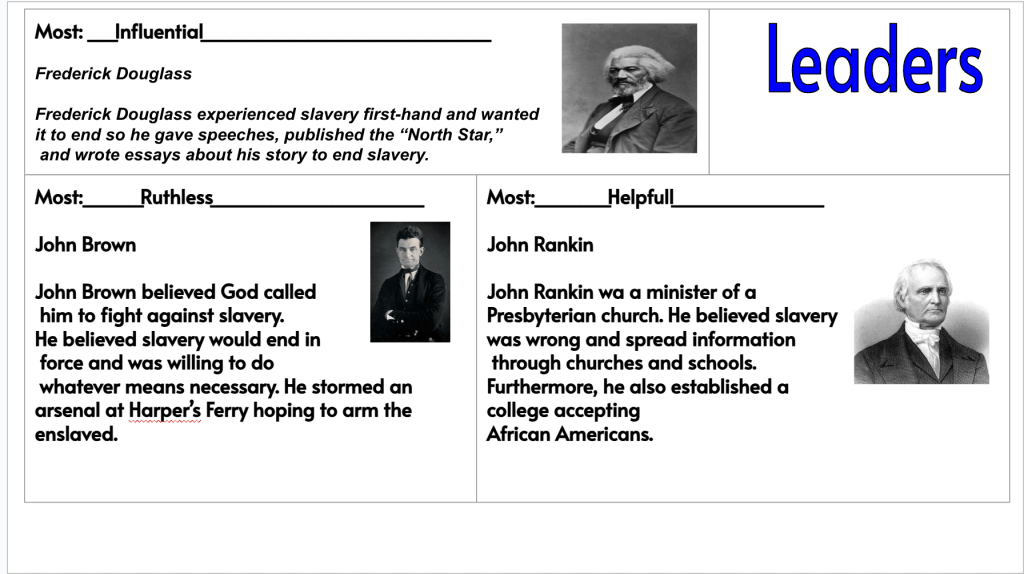
To finish the lesson sequence, students completed a Superlatives activity where they selected abolitionists for categories like:

  • Most Courageous
  • Most Determined
  • Strongest Voice for Change
  • Most Influential

This activity pushed students into historical judgment and evaluation. Students had to weigh evidence, compare people, defend their reasoning, and explain why certain abolitionists deserved specific categories. There were very few easy answers, which made the conversations even better.

The lesson naturally progressed from learning about abolitionists to evaluating them, comparing them, and defending claims with evidence. That progression is what made the sequence work so well. Students were not just memorizing names. They were thinking deeply about how different people attempted to create change and how those efforts shaped the country.

Friday: Pulling the Unit Together With 2xCER

Friday became our day to wrap up the unit and bring everything together.

Students first finished their Superlatives activity from Thursday. The conversations carried over naturally because students were still debating impact, courage, effectiveness, and influence. By this point in the week, students knew the abolitionists well enough to defend their thinking with actual evidence instead of surface-level responses.

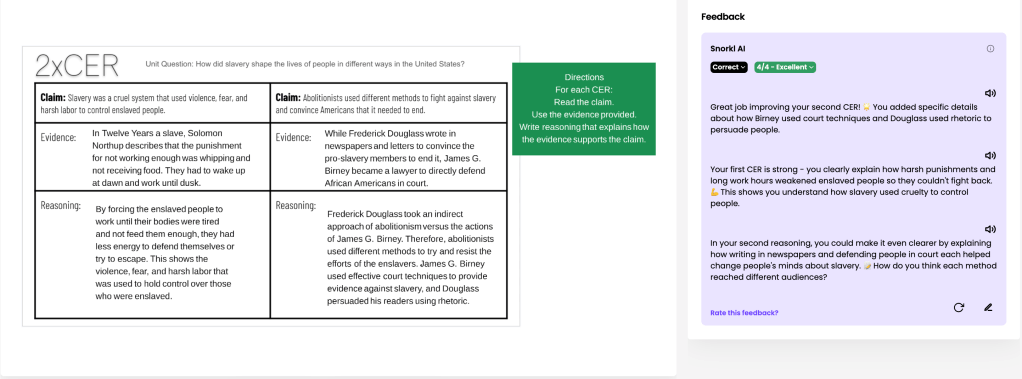
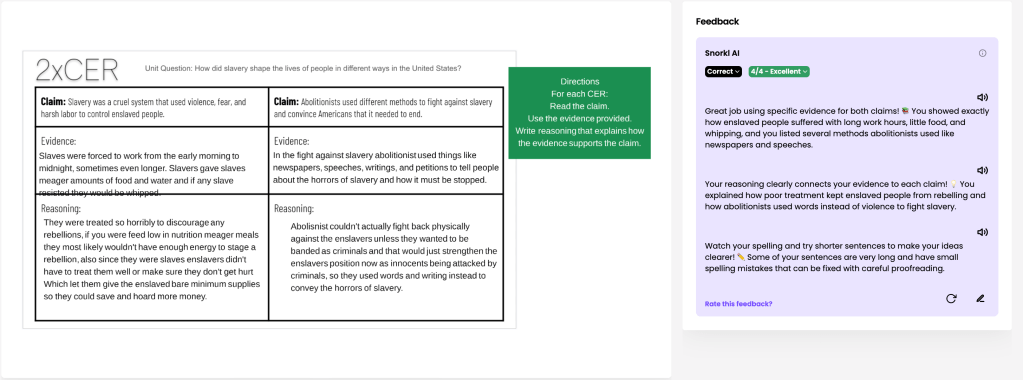
After wrapping up Superlatives, we shifted into the unit assessment piece using Snorkl and a 2xCER activity.

2xCER: Revisiting the Entire Unit

For the 2xCER, I provided students with two claims connected directly to our unit question:

How did slavery shape the lives of people in different ways in the United States?

The first claim focused on the cruelty and realities of slavery:
“Slavery was a cruel system that used violence, fear, and harsh labor to control enslaved people.”

The second claim focused on abolitionists:
“Abolitionists used different methods to fight against slavery and convince Americans that it needed to end.”

Instead of giving students all the evidence, students had to revisit the week’s lessons and pull evidence from their own work, readings, annotations, Thick Slides, Frayer Models, primary sources, and discussions.

That part of the lesson was important because students were not simply answering questions from memory. They had to go back into their learning, locate evidence, determine what best supported the claims, and then create reasoning that connected the evidence back to the argument.

Snorkl: Organizing Evidence and Reasoning

Students completed the activity through Snorkl, where they typed their evidence and reasoning directly into the platform.

What I liked about this structure was how naturally it forced students to revisit the entire week instead of viewing each lesson as disconnected. Students pulled information from multiple activities and sources throughout the unit.

Some students referenced Solomon Northup and Harriet Jacobs when discussing the cruelty and realities of slavery. Others connected back to the cotton gin lesson and explained how the increase in cotton production expanded the demand for enslaved labor. For the abolitionist claim, students brought in evidence connected to Frederick Douglass, Harriet Tubman, William Lloyd Garrison, Harriet Beecher Stowe, and other abolitionists we studied earlier in the week.

The activity also shifted the focus away from simple recall. Students had to think about which evidence best supported each claim and explain why that evidence mattered.

Ending the Week With Synthesis

By Friday, the classroom conversations sounded very different than they did on Monday.

Students were no longer discussing slavery as a single topic with one perspective. They were discussing systems, economics, resistance, perspective, cruelty, activism, and consequences. They were comparing experiences, evaluating impact, and supporting ideas with evidence from multiple lessons and sources.

That progression across the week is what made the unit feel successful.

Every lesson built into the next:

  • The cotton gin introduced consequences and economic expansion
  • Primary sources humanized the realities of slavery
  • Abolitionists showed how people resisted and fought for change
  • The CER brought everything together through evidence and reasoning

Instead of ending the week with a traditional test focused entirely on memorization, students finished the unit by revisiting evidence, connecting ideas, and building historical arguments across the entire week of learning.

Lesson for the Week

Monday – Cotton Gin Rack and Stack

Tuesday – Life of the Enslaved Rack and Stack

Wednesday and Thursday – Abolitionist Thick Slide, Frayer Notes, Superlatives

Locked In: Utopia, Ohio and the Search for a Perfect Society

Why This Lesson Matters

One of the most important things we can do in social studies is help students realize history did not just happen somewhere else. Some of the best stories are sitting right in our own communities. This lesson has become one that is completely locked in for me because it takes a national movement from the 1830s and 1840s and brings it directly into students’ backyard through the story of Utopia, Ohio.

During our reform movements unit, students learn about the Second Great Awakening and how many Americans believed society could be improved or even perfected. Some fought against slavery, others pushed for prison reform or education reform, and some groups went even further. They attempted to build entirely new communities based on their beliefs about what a perfect society should look like.

That is where Utopia, Ohio comes in.

A tiny town along the Ohio River near Cincinnati became the site of multiple attempts to create a “perfect” community. The story is strange, fascinating, local, and perfect for middle school history because students immediately start asking, “Wait… this actually happened here?” That local connection matters. It turns abstract reform movements into something tangible and memorable.

Starting With Student Thinking

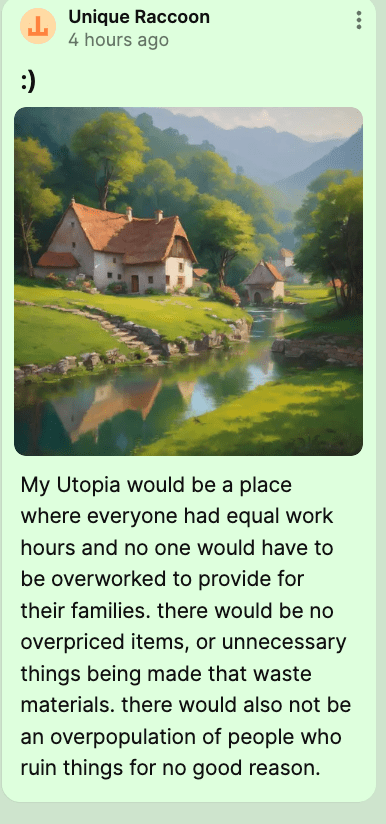
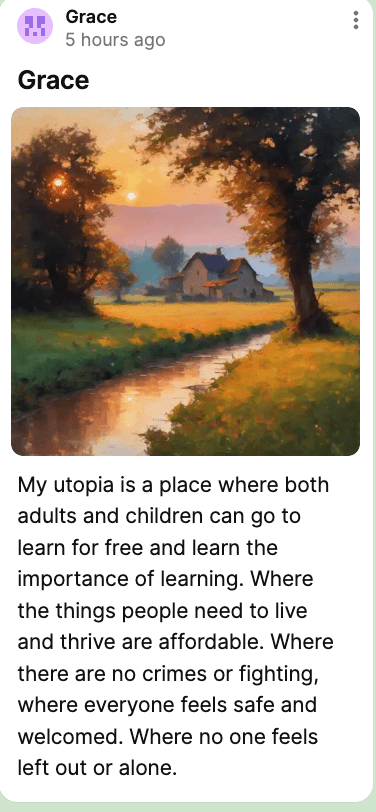
The lesson starts with students thinking about their own version of a perfect society. Sometimes I use a Padlet. Other times I use a Sketch and Tell-O. The prompt is simple: What would make a perfect society?

Students usually bring up fairness, safety, equality, money, laws, freedom, religion, or the absence of conflict. Before we ever touch history content, students are already wrestling with the same ideas reformers debated in the 1800s.

This opening works because students are personally invested before the history even begins. They are not just learning about historical groups. They are comparing those groups’ ideas to their own beliefs about how society should function.

Introducing Utopia, Ohio

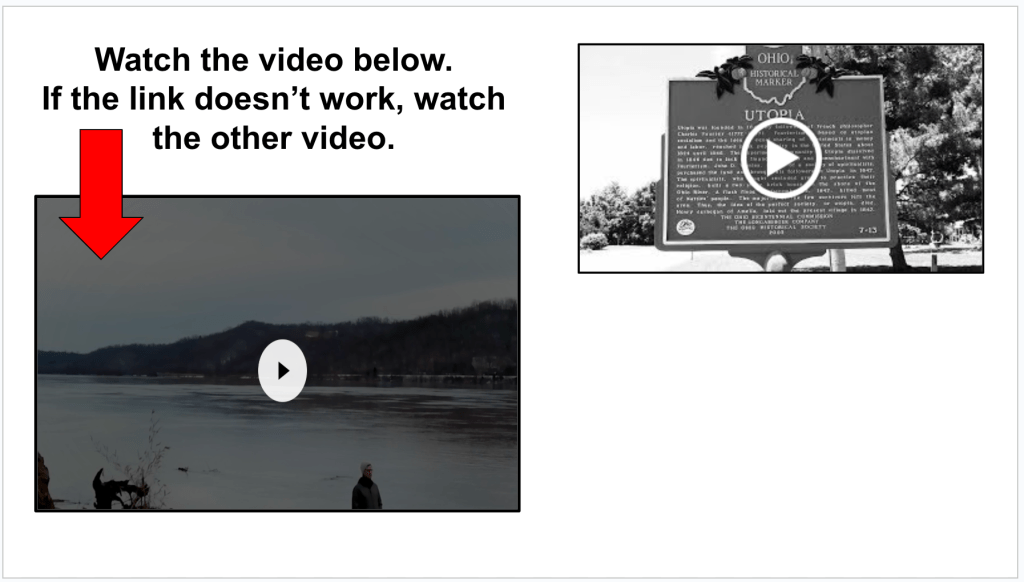
From there, I introduce Utopia, Ohio. I use either a short informational video or a reading about the town and its history. Students learn how different groups moved into the community trying to create their own version of perfection.

The local aspect completely changes the energy of the lesson. Students know the Ohio River. They know Cincinnati. They know Clermont County. Suddenly reform movements stop feeling distant and become something connected to their own community.

Frayers and the CyberSandwich

The core activity revolves around three Frayer-style organizers focused on:

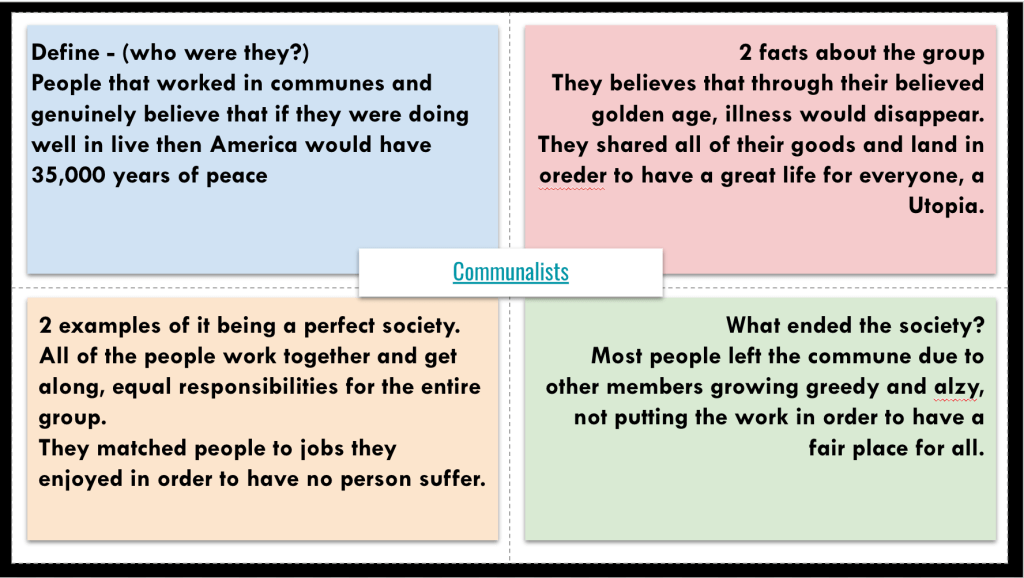
  • Communalists
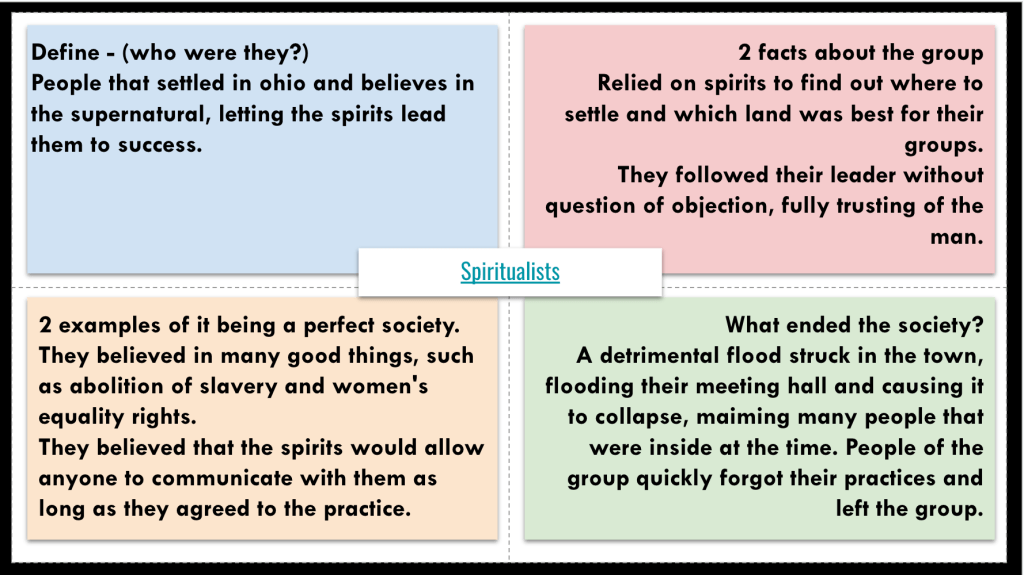
  • Spiritualists
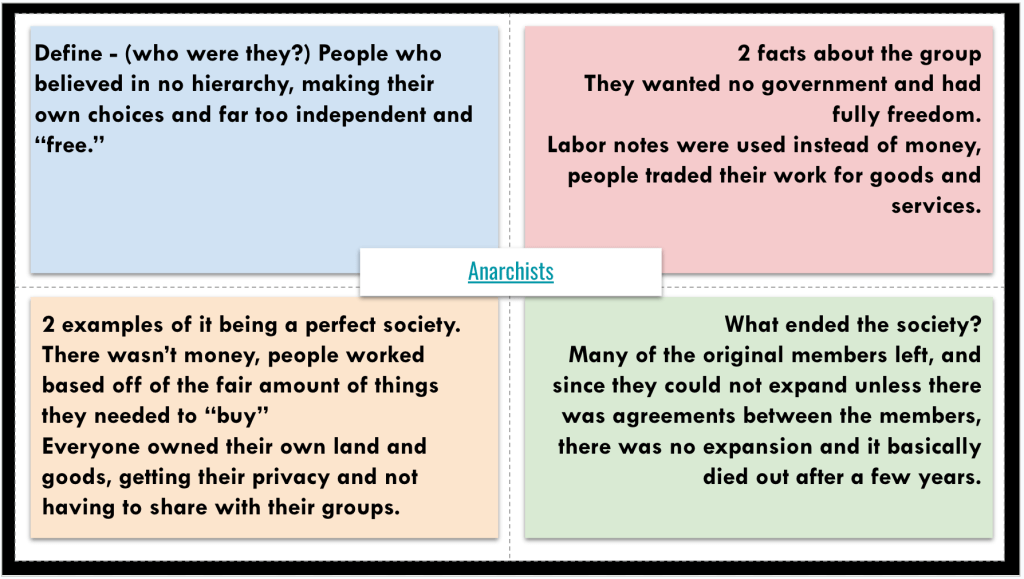
  • Anarchists

Each organizer asks students to define the group, explain important facts, identify examples of how the group attempted to create a perfect society, and explain what ultimately caused problems or collapse.

I also structure this almost like a CyberSandwich. Students become “experts” on one group, then compare, discuss, and share information with classmates.

That discussion piece matters because students quickly realize every group defined “perfect” differently. Some prioritized shared property. Others focused on religion or spiritual communication. Others believed government itself caused problems.

Students start noticing that humans bring different beliefs, priorities, and conflicts into every attempt at building a society.

The Final Question

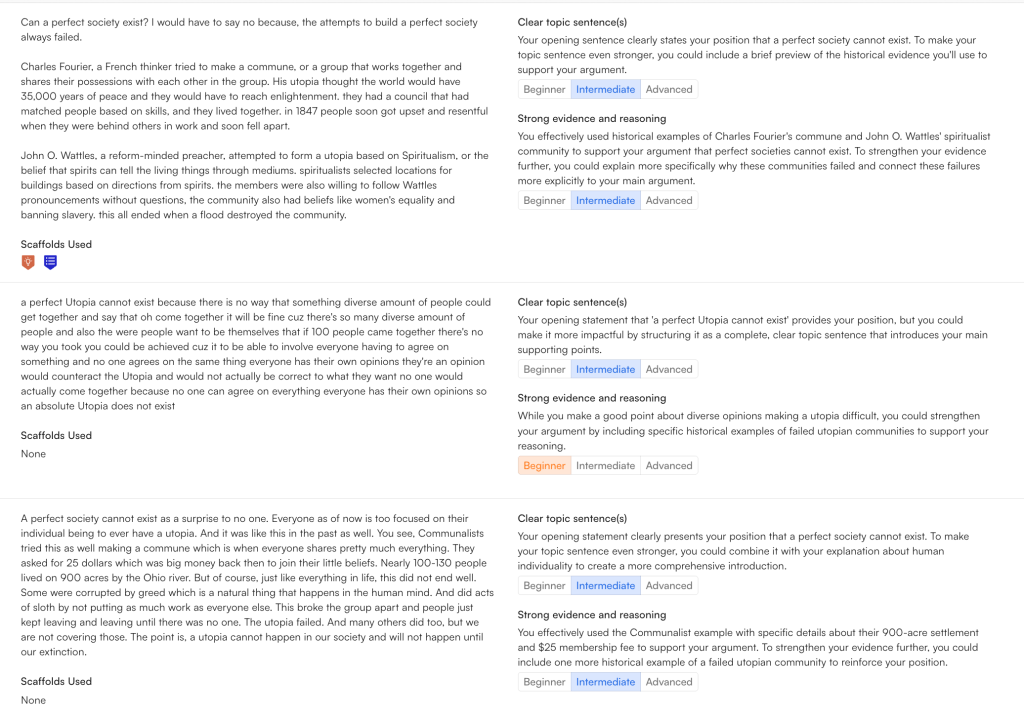
The lesson ends with one final writing task: Can humans ever achieve a perfect society? Why or why not? Use evidence from the case studies of Utopia, Ohio.

I love this final question because it pushes students beyond simple recall. They are making a claim, backing it with evidence, and thinking philosophically about human nature, conflict, and society itself.

Some students argue perfection is impossible because people always disagree. Others argue societies can improve even if perfection is unrealistic. The conversations end up being far deeper than most students expect heading into the lesson.

Why the Lesson Structure Works

What makes this lesson structure work is the progression of thinking.

Students first create their own vision of a perfect society. Then they learn historical examples through structured Frayer work. Next they compare and discuss ideas with others. Finally they synthesize everything into a claim supported with evidence.

The lesson moves from personal thinking, to content acquisition, to collaboration, to argumentation. That sequence helps students build understanding instead of just memorizing facts about a town called Utopia.

The structure also keeps cognitive load manageable. Students are not overwhelmed with one giant reading or lecture. Instead, they build understanding piece by piece while constantly revisiting the core idea of what makes a society “perfect.”

Final Thoughts

At the end of the day, this lesson is also my reminder to teachers to go digging for local stories. Look through old newspapers. Search historical societies. Screenshot old articles and let AI help analyze difficult text or uncover interesting stories buried in scanned archives.

Some of the best classroom moments come from students realizing history happened right where they live. That is what makes lessons stick.

Lesson Link

Utopia Lesson Link

From “Super-Laxative” to Better Thinking: Why I Keep Using Superlatives

First, before anything else, you have to teach middle schoolers how to actually say the word superlative. Every year I hear “super-lative,” “super-laxative,” and a few completely original versions that honestly deserve awards of their own.

Once we get past that, we talk about what a superlative actually means.

A superlative is the extreme of something. The “most,” “best,” “worst,” “biggest,” or “most important.” That’s what makes this EduProtocol so useful in social studies and honestly almost any content area. It pushes students past simply gathering information and into evaluating it.

Superlatives, created by Kim Voge as a spinoff of Number Mania, works especially well at the end of a unit, a lesson sequence, or after students have interacted with a lot of information. By that point, students have enough background knowledge to compare ideas, categorize information, defend opinions, and synthesize what they’ve learned.

The setup is simple:

  • Give students a list of superlatives connected to your content
  • Students choose one or more
  • They match a person, place, event, idea, or geographic feature to the superlative
  • Then they defend their thinking with evidence

At first, I’ll usually use ChatGPT to help generate a list of superlatives tied to the topic. After students get a few reps with the protocol, I’ll start having them create their own superlatives, which raises the level of thinking even more because students begin deciding what matters within the content itself.

Recently, I used it during a lesson on abolitionists. Students had to choose superlatives like:

  • Loudest Voice for Change
  • Most Courageous
  • Boldest Actions Award
  • Best Speaker or Writer
  • Biggest Unsung Hero

Students then selected an abolitionist that fit each category and justified their thinking using evidence from readings, discussions, and notes.

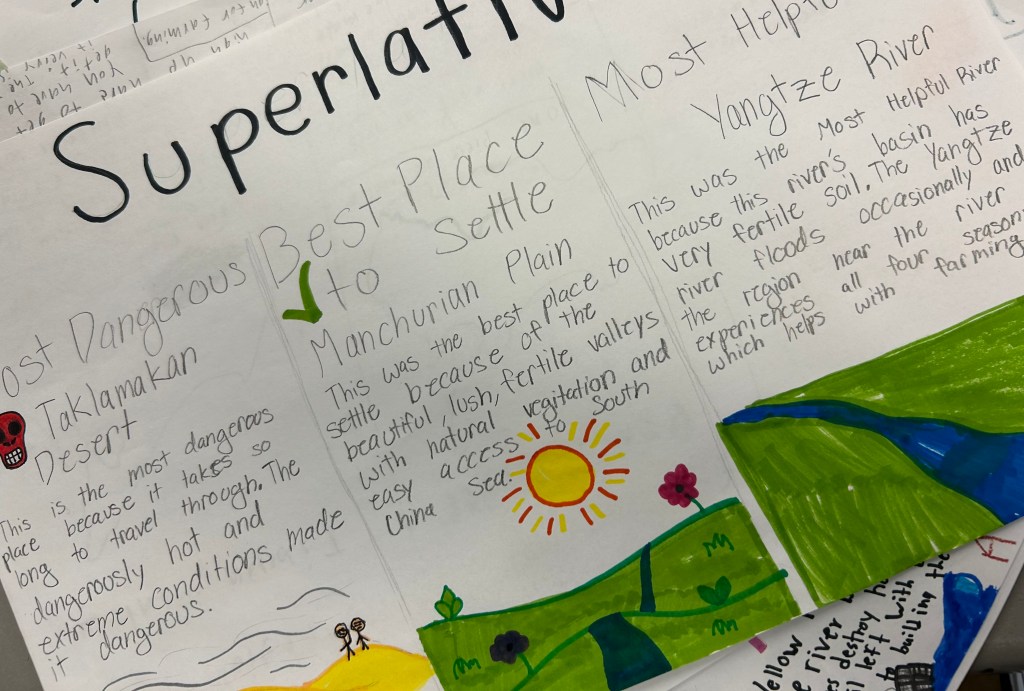
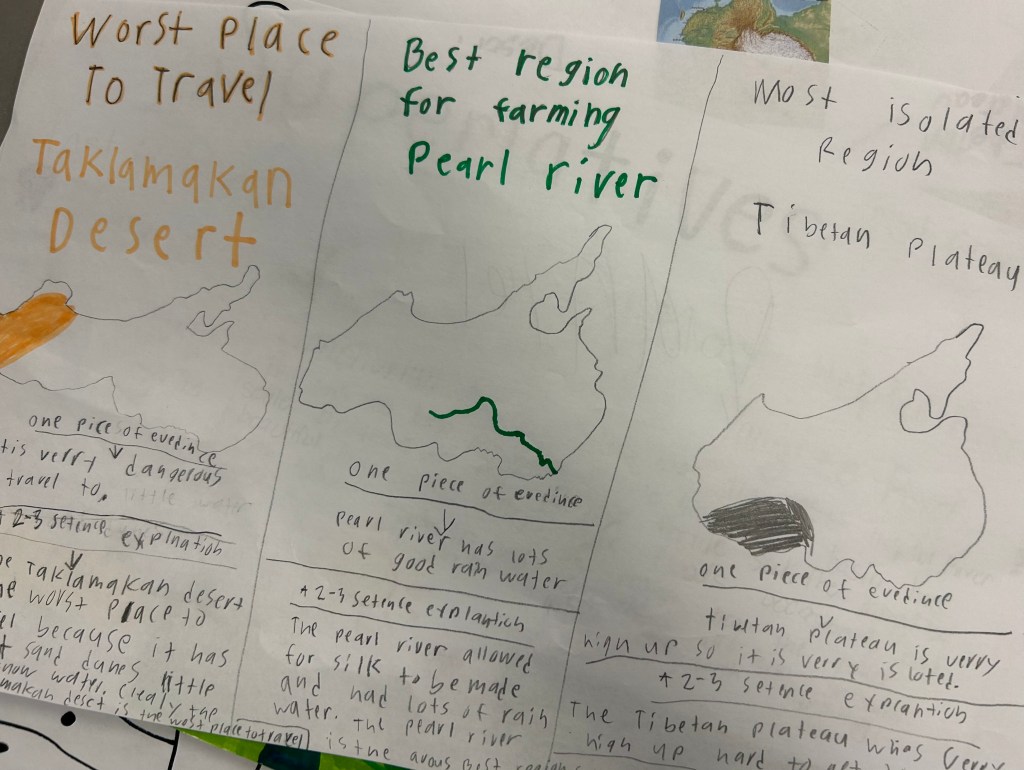
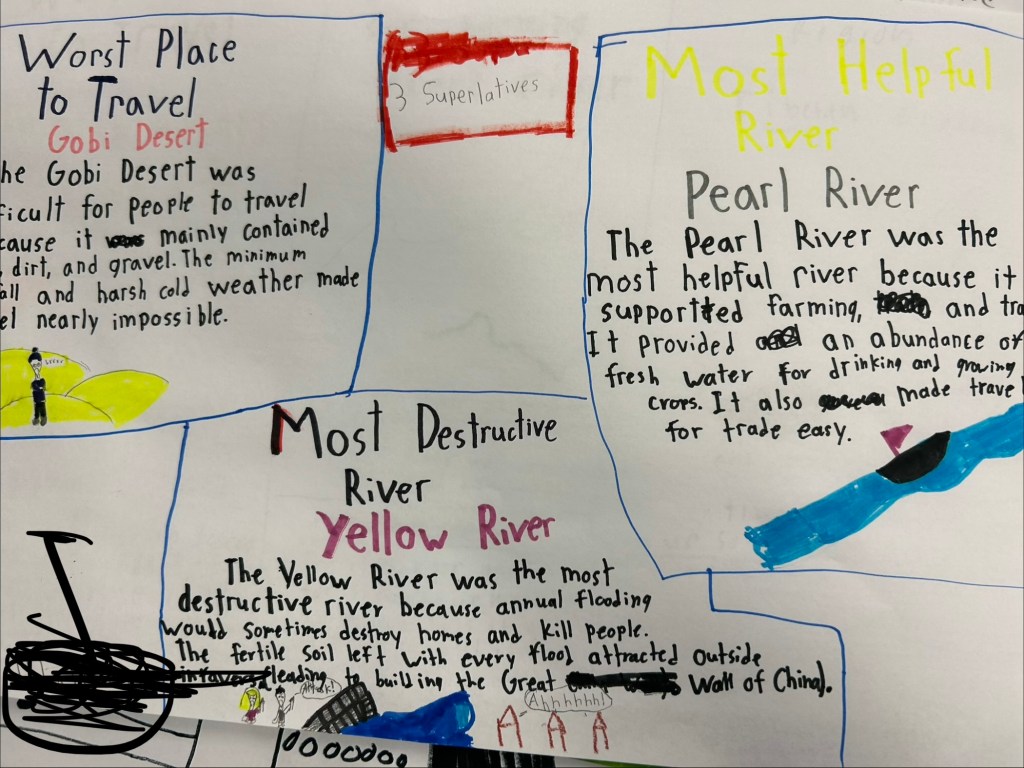
I also used it in 6th grade geography during a China unit. Students rotated through stations on geographic features and then created posters using superlatives like:

  • Most Important Geographic Feature
  • Best Place to Settle
  • Most Valuable for Trade
  • Most Difficult Environment
  • Geographic Feature That Shaped China the Most

Students selected a geographic feature and matched it with multiple superlatives using evidence from the stations.

What I like about this protocol is that there often isn’t one perfect answer. Students naturally start debating and defending ideas:

  • Was the Huang He the most important river or the most dangerous?
  • Was Frederick Douglass the most inspiring or the boldest?

Those conversations are where the thinking starts to deepen.

The protocol is flexible too. It works digitally or on paper. It can be quick or extended. You can use teacher created superlatives or student created ones. It also naturally moves students into higher-level thinking without making the activity feel overly complicated.

Superlatives gives students a reason to evaluate information instead of just repeating it back. And that’s probably why I keep coming back to it.

Lesson Template

Superlatives Template

Locked In – Lessons Worth Running Again (A Lesson About the Cotton Gin)

This lesson works because students are starting from almost nothing. Most of them do not walk in with background knowledge about the cotton gin. In fact, the most common response when I introduce it is something like, “They make gin from cotton?” That actually helps. Instead of correcting misconceptions, I am building understanding from the ground up. The goal is not just to explain what the cotton gin is, but to help students understand how one invention can reshape an economy and deepen an existing problem at the same time.

Language Matters

We start with a short mini lesson on language, and it immediately sets the tone for how we approach the content. We talk about using enslaved instead of slaves, enslaver instead of owner, and freedom seekers instead of runaways. It is a small shift, but it forces accuracy. Students begin to see that the words we use can either clarify or hide what actually happened. This matters because if they do not have the right language, they will not build the right understanding of the system we are about to study

Making It Real

From there, I put raw cotton in their hands. Seeds still stuck in it, pieces tangled together, nothing cleaned up. I show them what cotton looks like on a stalk and let them react to it. There is always a moment where they realize how messy it is and how much work it would take to clean. That is intentional. Before we ever talk about Eli Whitney or the machine itself, students understand the problem that needed to be solved. This step gives them something concrete to anchor their thinking, and it makes the invention feel necessary instead of abstract.

Archetype Four Square

When we move into Archetype Four Square on Eli Whitney, the focus shifts from the problem to the person. Students are not just collecting facts. They are deciding how to categorize him and supporting that choice with evidence. Is he an innovator, a problem solver, or something more complicated? That question matters because it opens the door to thinking about impact. It moves students away from a simple mindset of memorizing and toward a deeper look at what his invention actually led to.

Annotate and Tell

The lesson then moves into Annotate and Tell using primary sources that describe the cotton gin’s impact. Students read closely and pull out evidence about production, labor, and economic growth. One source explains how machines could clean enormous amounts of cotton compared to hand labor, while another shows how quickly cotton exports increased and how the Southern economy shifted in a short period of time. This part matters because students are not just hearing the story from me. They are seeing the claims and evidence directly from the time period, which makes the learning more grounded.

Graph and Tell

After that, we bring in data with Graph and Tell. Students look at the growth of cotton production alongside the growth of the enslaved population and begin turning those numbers into meaning. This is where things start to click. The machine made cotton easier to process, but instead of reducing the need for labor, it increased it. Students start to notice that connection on their own, which is far more powerful than being told.

Multiple Perspectives (2xPOV)

We close by shifting perspectives and asking students to think about the cotton gin from different points of view. Enslavers, enslaved people, Northern businesses, and Southern farmers all experienced the impact differently. Students have to explain those differences and make sense of how the same invention could be seen as progress by some and harmful by others. This part brings everything together because it forces students to move beyond describing what happened and into explaining why it mattered.

How It All Fits Together

What makes this lesson work is how each part builds into the next. The language shapes how students think about people. The cotton makes the problem real. The archetype builds an understanding of the individual. The sources add evidence. The data creates tension. The perspectives add complexity. Students are not overwhelmed because they are building their understanding step by step.

Why This One Stays

This lesson stays because it changes how students think about cause and effect. They start with very little understanding of the cotton gin and leave with the ability to explain how one invention could increase efficiency while also expanding slavery. They are not just learning what the cotton gin is. They are learning how to think about impact, and that is what makes the lesson worth running again.

The Lesson Link

The Cotton Gin Lesson – What was the impact of the cotton gin?

The Week That Was In 103

This week was about pulling everything together. We moved from understanding why people went west to the risks they faced getting there. With shorter class periods, every lesson had to stay focused and connected. The goal was not just to learn about westward expansion, but to make sense of the decisions, risks, and outcomes that shaped it.

Monday: Pull Factors of Westward Migration

We started Monday by shifting from push factors to pull factors. The guiding question asked students: What factors pulled people out west? With limited time, the focus was on clarity. Students needed to move beyond general ideas and start identifying specific opportunities that drew people west.

EdPuzzle + Source Work (Cybersandwich) + Short Answer

We opened with an EdPuzzle on the Gold Rush, but this was not a separate activity. It was built directly into a Cybersandwich structure. As students watched and worked through sources, they recorded key ideas about opportunity, wealth, and why California became such a strong draw.

Students examined multiple documents that highlighted different pull factors. They looked at opportunities like land ownership through the Homestead Act, which offered 160 acres to settlers willing to move and farm the land. They also analyzed how gold discoveries, high wages, and advertisements like the California Clipper Ship encouraged people to take the risk of moving west.

Using whiteboards and visibly random groups, students compared their notes with a partner, added new ideas, and challenged each other’s thinking in real time. This made the Cybersandwich more than just note taking. It became a space where students refined their understanding of what actually pulled people west.

We closed with a short answer response to the guiding question. Students had to cite specific examples from the sources, which pushed them to be precise in their thinking. By the end of the lesson, most students were not just saying people moved for a better life. They were explaining exactly what that better life looked like and why it was worth the risk.

Tuesday: The Hero’s Journey

With shortened classes, the goal was not to push new content but to build a structure students could use later in the week. We focused on introducing the Hero’s Journey and helping students understand how stories are built.

TED-Ed + Commercial Analysis + Mapping

We opened with a TED-Ed video that introduced the stages of the Hero’s Journey. This gave students a basic framework, but the real focus was on applying it.

Instead of jumping into history right away, we used commercials. Students watched the Chef Boyardee commercial and the Melissa McCarthy Kia commercial and mapped each one using the Hero’s Journey structure.

Students were able to identify the call to adventure, challenges, and transformation in a setting that felt familiar. It lowered the barrier and helped them focus on the structure instead of getting lost in content.

By the end of class, students were not just watching videos. They were breaking them down, identifying patterns, and starting to see how stories follow a predictable path. That structure will carry into Wednesday.

Wednesday: Risks of Westward Migration

Wednesday turned into a bit of an EduProtocols smash. The goal was to take the Hero’s Journey from Tuesday and apply it to real historical situations.

Cybersandwich + Hero’s Journey + Short Answer

We focused the lesson around one question: What were the risks of migrating west?

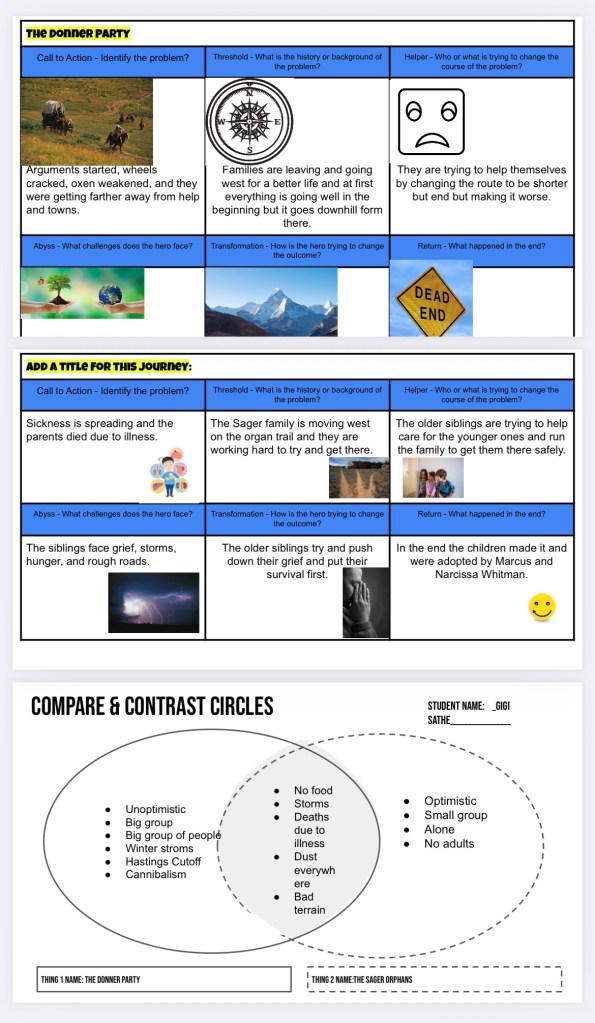
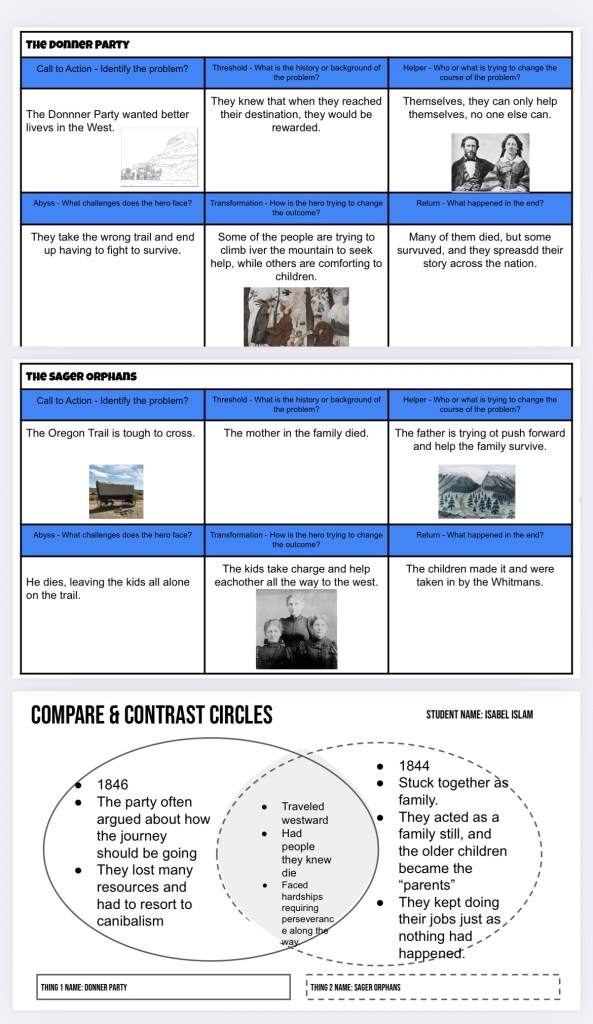
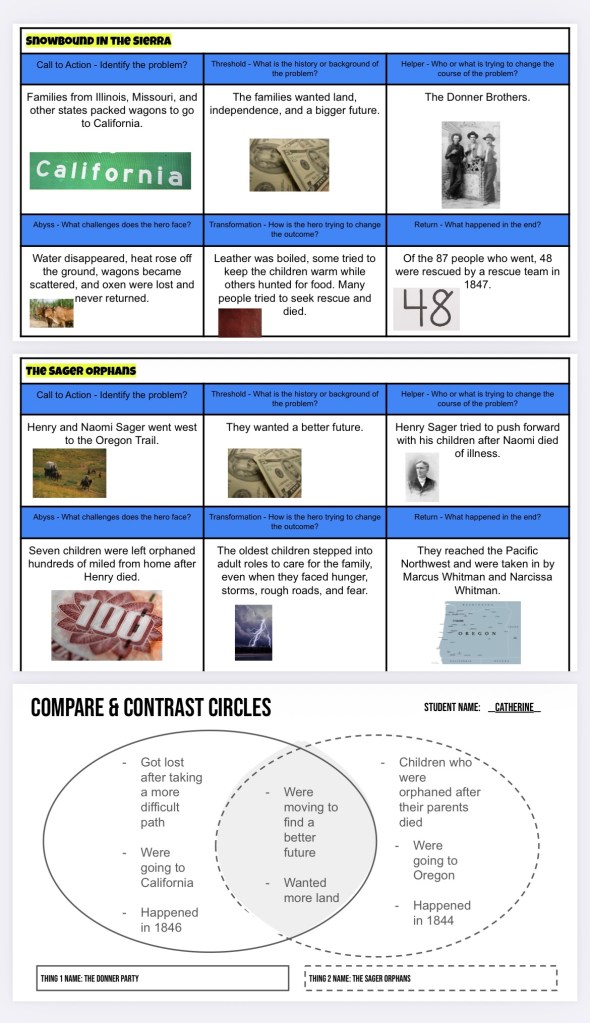
Students worked with eight different stories of people and groups who went west, including the Donner Party, the Whitmans, the Latter-day Saints, and Lewis and Clark. Instead of reading everything, students chose two stories to focus on.

They mapped each story using the Hero’s Journey structure. This forced them to think about more than just what happened. They had to consider why people went, what challenges they faced, and what risks showed up along the way.

After mapping, students partnered up and compared their stories. This is where the Cybersandwich came in. Students shared, added to each other’s thinking, and looked for patterns across different groups.

The focus of those conversations stayed tight:

  • Why did people go west?
  • How did they get there?
  • What risks did they face?

Students started to see common threads. Harsh weather, lack of resources, difficult terrain, and unexpected challenges came up across multiple stories.

We closed with a short answer response to the guiding question. Students had to cite evidence from their stories, which pushed them to ground their thinking in specific examples instead of general statements.

By the end of the lesson, students were not just listing dangers. They were explaining the risks of westward migration through real experiences.

Thursday: Oregon Trail Simulation

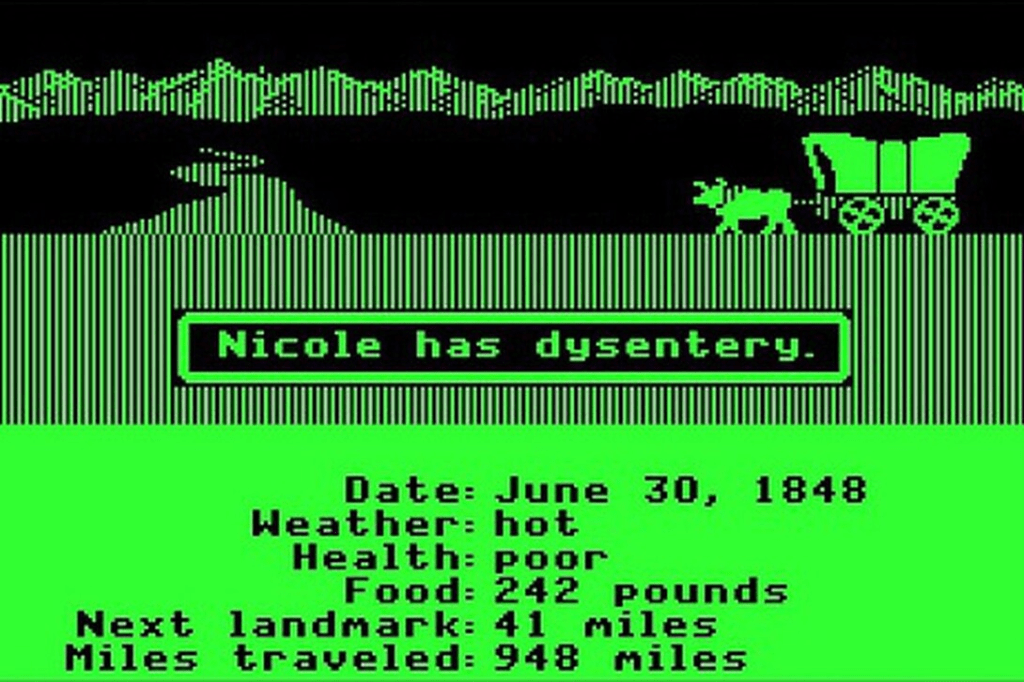
After spending the week focused on why people moved west and the risks involved, Thursday was about experiencing it. We played the original Oregon Trail game the entire class period. That was it. No extra layers. No added tasks. Just the game.

What made it work is that students already had the background. They understood pull factors, they had analyzed risks, and they had worked through real stories of people going west. The game gave them a chance to see those ideas play out.

Decisions mattered. Supplies ran out. People got sick. Progress was not guaranteed. Students started connecting back to what we had already done without being prompted. They recognized the challenges, the trade-offs, and the unpredictability of the journey.

It was simple, but it hit. Sometimes the best follow-up is letting students experience the content in a different way.

Friday: Netflix Summary Assessment

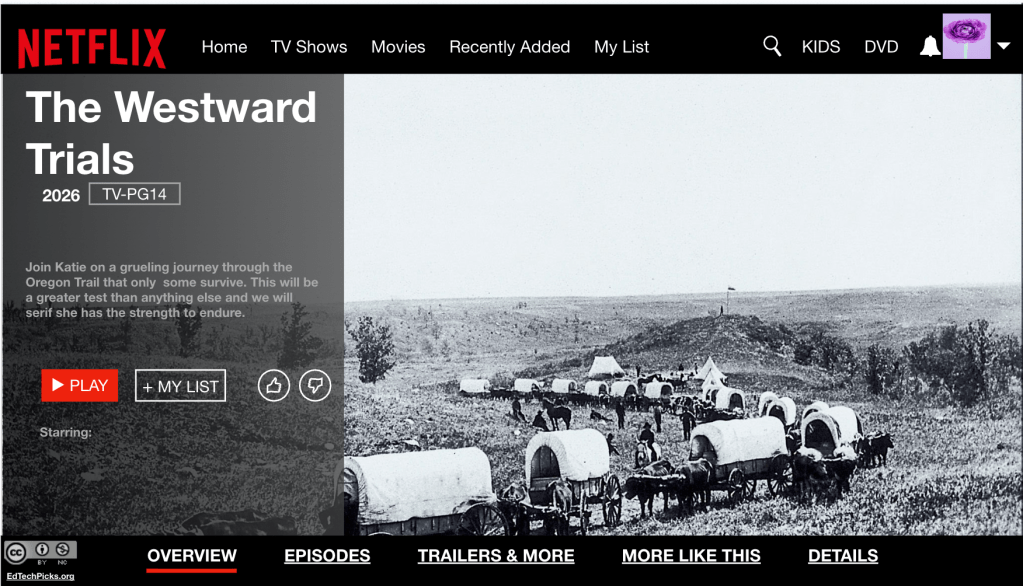
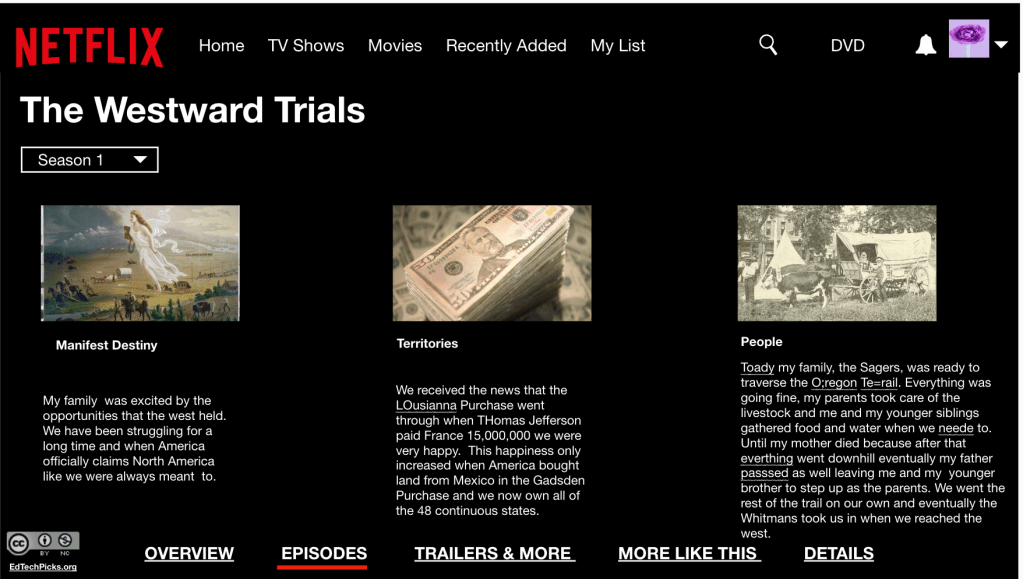
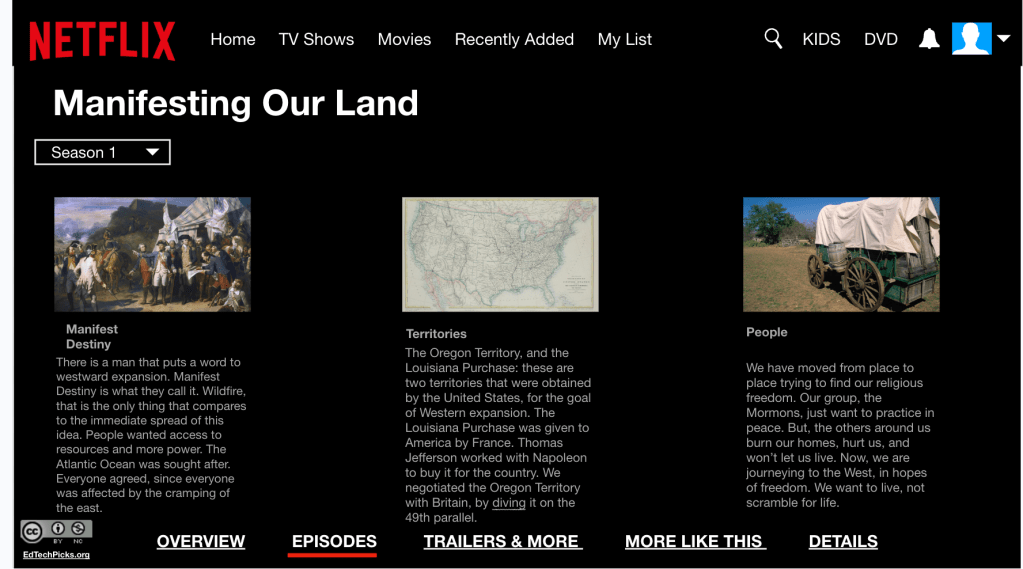
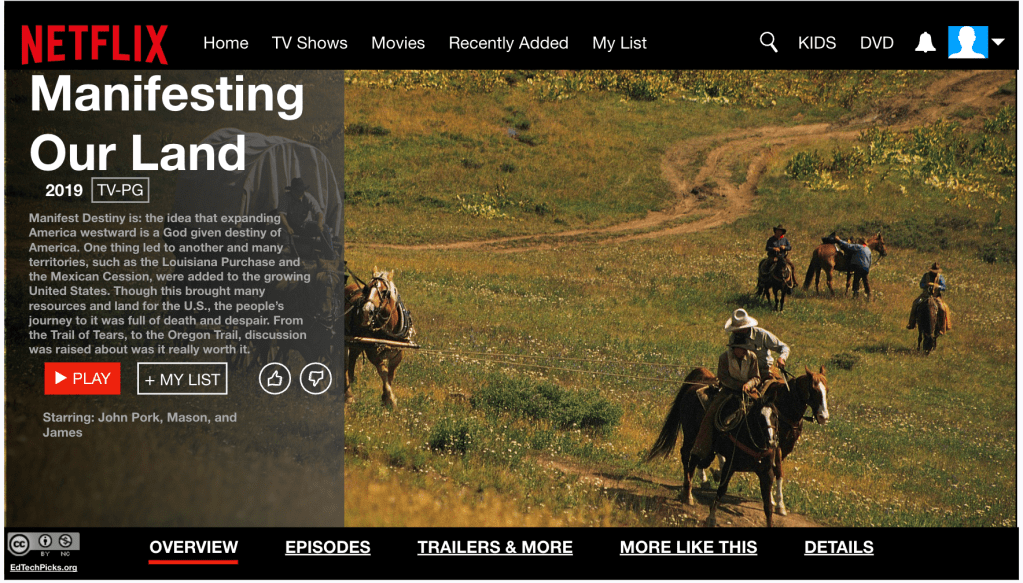
We wrapped up the unit by bringing everything together through a Netflix-style summary.

Netflix Template + Summative Assessment

Students created a three-episode series that answered the unit question: How did Manifest Destiny change America’s map and affect the lives of people?

They had the option to choose their format. Some went with a straightforward documentary, focusing on explaining events clearly. Others created a historical story, building a narrative around a character experiencing westward expansion.

Each episode had a clear focus:

  • Episode 1 centered on Manifest Destiny and why people believed in expansion
  • Episode 2 focused on territories and how the United States acquired land
  • Episode 3 highlighted the people who went west and the impact it had on their lives

This structure mattered. It forced students to organize their thinking across the entire unit instead of treating each topic separately.

What stood out was how much they were able to pull in from the week. Students referenced pull factors, risks, and real groups as they built their episodes. Some leaned into the opportunity side of expansion. Others focused more on conflict and consequences.

By the end, students were not just summarizing westward expansion. They were making sense of it.

Lessons for the Week

Monday – Pull Factors CyberSandwich, Pull Factors Documents

Wednesday – Hero’s Journey

Friday – Netflix Template

Locked In – Lessons Worth Running Again (A Lesson About Abolitionists)

I don’t usually run the same lesson twice. Every year I’m changing things, adjusting parts, trying new ideas, and figuring out what works best for the students in front of me. That’s always been part of how I teach. But every once in a while, a lesson keeps finding its way back into the rotation. Not because I’m out of ideas, but because it does what a good lesson should do. Students are engaged, they’re thinking, and the flow of the class just makes sense. This abolitionist sequence is one of those lessons. It blends structure, retrieval, student voice, and deeper thinking in a way that feels natural, and that’s why I know I’ll keep using it.

Thin Slide: Setting the Tone

We opened with a Thin Slide built around the quote, “Change begins when someone refuses to stay silent.” Students had to respond using one image and one word or phrase. It was quick, simple, and gave everyone an entry point right away. Before we ever got into names, dates, or historical facts, students were already thinking about courage, resistance, and the power of using your voice. That matters. Too often we rush straight into content and miss the chance to frame the bigger human ideas behind it. This gave the lesson a purpose from the start and helped students connect emotionally before they connected academically.

EdPuzzle: Building Background Fast

From there, we moved into a short EdPuzzle. This wasn’t meant to carry the lesson or replace teaching. It simply gave students enough background knowledge to move forward with confidence. Sometimes students don’t need a long lecture. They need a few focused minutes that activate memory, introduce key people, and clear up confusion before the real thinking begins. That’s exactly what this did. It refreshed prior knowledge, added some context, and helped students feel ready for the next task.

Thick Slide: Contributive Learning

The Thick Slide was the core of the lesson. Each student selected one abolitionist and created a slide that included background information, their motivations for ending slavery, the methods they used, and one quote or moment that showed who they were. This is where the lesson moved beyond copying facts. Students had to make choices. They had to decide what mattered most, organize ideas clearly, and present them in a way others could learn from.

Even better, every student became responsible for bringing one important figure into the room’s shared understanding. Instead of waiting to receive information, they were contributing it.

Frayer Model: Learning From Others

After students shared their Thick Slides, classmates used a Frayer Model to gather information on several abolitionists. They focused on things like background, motivations, methods, and impact. This is where the room shifted from individual learning to collective learning. Students were no longer depending only on me for information. They were learning from one another.

A student who studied Frederick Douglass helped classmates understand his influence. Another student who studied Harriet Beecher Stowe added her story to the room. Others brought in local voices like John Rankin or James G. Birney. That kind of learning feels different because students see themselves as part of the process.

Fast and Curious: Strengthening Memory

The next round began with Fast and Curious on Quizizz. Students reviewed vocabulary and key ideas connected to reform movements such as abolitionism, suffrage, and reform goals. Nothing complicated. Just another rep with important content.

Retrieval practice is powerful because it strengthens memory, boosts confidence, and gets students mentally active right away. Sometimes teachers underestimate how valuable these quick review moments are, but they matter. Students need repeated exposure to ideas if we want those ideas to stick.

Superlatives: Moving Beyond Recall

After that, students completed a Superlatives activity. They selected abolitionists and gave out categories like Most Courageous, Most Determined, Most Visionary, or Strongest Voice for Change. This is where the lesson moved into comparison and judgment. Students had to weigh evidence, compare people, and defend their reasoning.

Who took the greatest risks? Who changed the most minds? Who had the biggest long-term impact?

Those questions force students to think deeper than recall ever could. It also gave them room to disagree respectfully and explain their thinking, which is always a win in a history classroom.

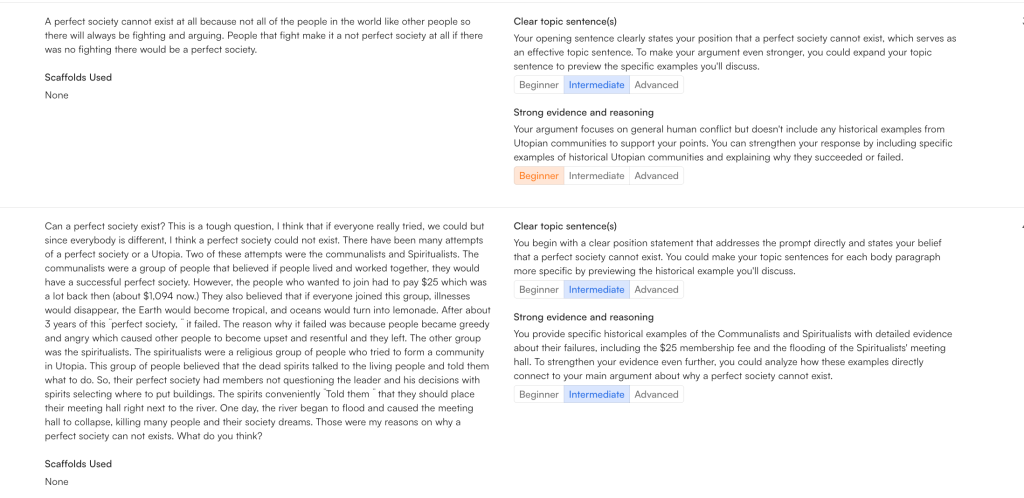
AI Feedback: Evaluating What Matters

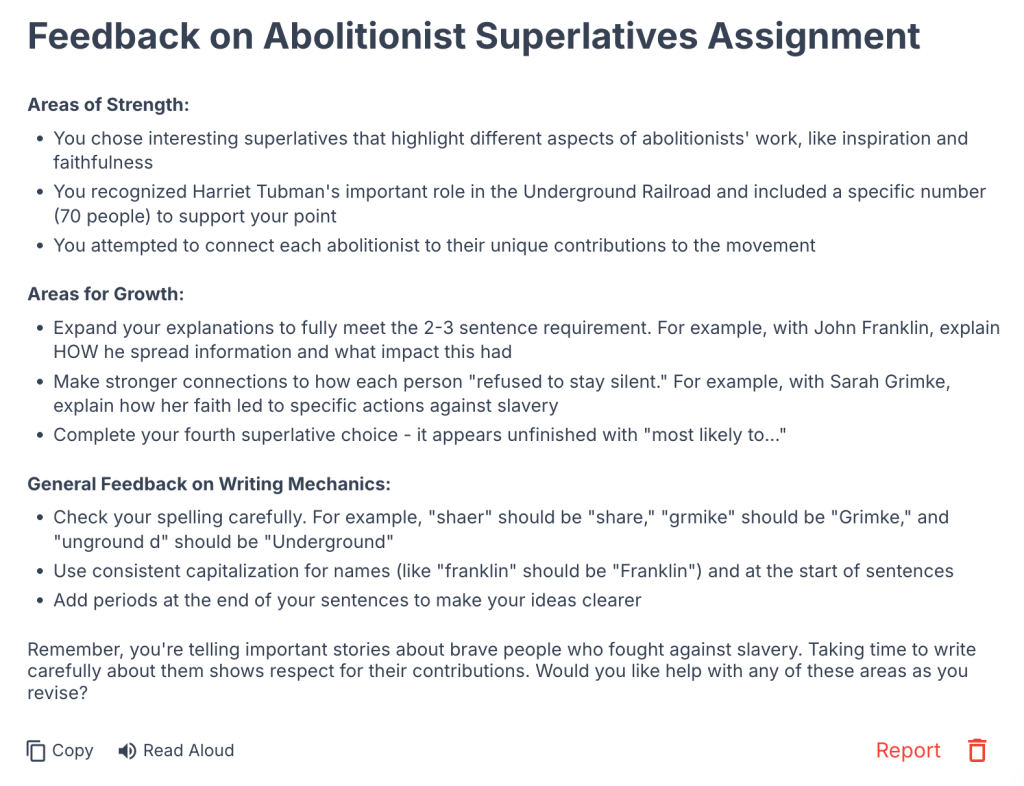
After students completed their work, they used MagicSchool’s feedback tool by uploading screenshots of what they created. Then we talked about the feedback itself. What suggestions were useful? Which ones could be ignored? What would actually improve the work?

That conversation matters because students don’t just need feedback anymore. They need to know how to evaluate feedback. In a world where tools can generate endless suggestions, judgment becomes the real skill. Students need practice deciding what is worth listening to and what is not.

Next time I run this lesson, I will use Snorkl. I like the feedback with Snorkl because it asks questions and helps the students reflect on their work.

How the Lesson Worked Together

What made this sequence strong was how each part supported the next. The Thin Slide created the theme and emotional lens. The EdPuzzle built quick background knowledge. The Thick Slide gave students ownership. The Frayer Model turned classmates into resources. Fast and Curious strengthened memory. Superlatives pushed analysis. AI feedback encouraged reflection and revision.

Nothing felt random or thrown together. Every move had a purpose, and each part helped students succeed in the next one. That kind of sequencing is what makes lessons feel smooth and effective.

Why This One Stays

This lesson stays because it does what good lessons should do. It gets students involved quickly. It builds understanding step by step. It asks students to think instead of just copy. It gives structure without making the room feel rigid. Most importantly, it creates a classroom where students contribute to the learning rather than passively sit through it.

It also reminds me of something worth saying right now. There is a lot of frustration aimed at technology in education. Some of it is understandable. But technology itself is not what makes a lesson shallow or meaningful. The deciding factor is how we use it.

In this lesson, the tools were never the point. They helped students retrieve knowledge, create something original, receive feedback, and think more deeply. They supported strong teaching instead of replacing it.

That is the difference.

The problem is rarely the tool. The problem is when the tool has no purpose.

When used with intention, technology can strengthen great teaching. And when teaching is already strong, it becomes one more way to help students learn.

Lesson Links

  1. Abolitionist Thick Slide
  2. Superlatives

The Week That Was In 103

Some weeks are about covering ground. Others are about slowing down and helping students see how events connect. With 30-minute classes all week, there was no room for wasted time. Every lesson had to be clear, focused, and built around thinking. Our goal this week was to take territorial acquisitions deeper and move beyond memorizing names, dates, and maps.

Monday: Texas Independence

We began Monday with Texas Independence. The guiding question asked students how Americans moving to Texas helped cause Texas to become independent and later join the United States. I handed students a Mini-Report that gave structure to the lesson. In a shortened class period, structure matters. Students knew what information to gather, where to place it, and what they would eventually do with it.

EdPuzzle + Mini-Report + Snorkl

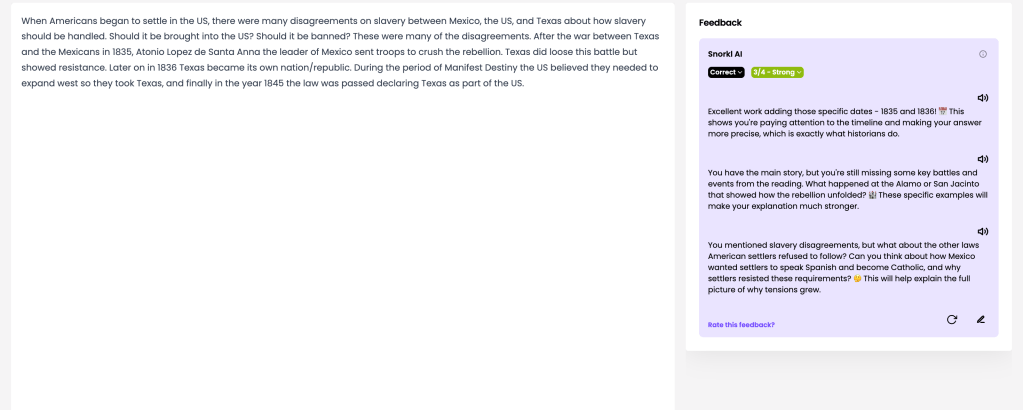
We opened with an EdPuzzle on Texas Independence. As students watched, they recorded two key notes on their Mini-Report. This gave them a foundation before moving into a reading that added more context. Students explored why settlers moved to Texas, why tensions grew with Mexico, why independence happened, and why annexation followed.

Too often, students learn history as isolated events. Texas becomes independent. Texas joins the United States. Move on. This lesson pushed students to see cause and effect instead.

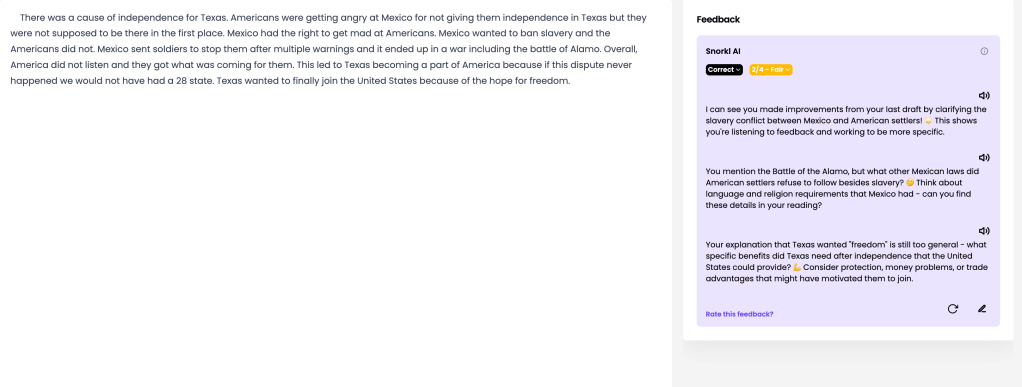
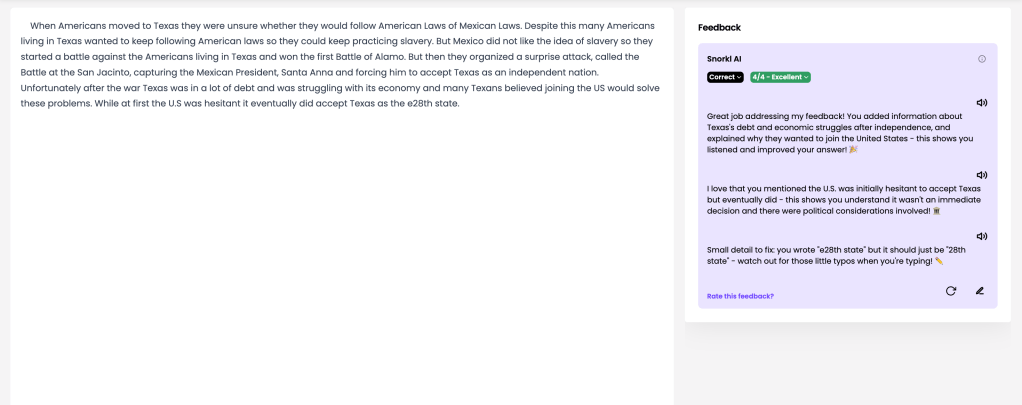
We finished with writing using the new beta writing platform on Snorkl. I added our source reading, created the prompt, and students typed directly into the response space. Snorkl provided immediate feedback that reminded me a lot of Class Companion. Students had a chance to think, write, revise, and improve while the learning was still fresh.

Tuesday: Mexican-American War

Tuesday usually would have been Oregon Territory because that is the next step chronologically. Instead, I changed the order on purpose. I wanted students to see how the annexation of Texas directly led to the Mexican-American War. Sometimes chronology matters less than helping students understand relationships between events.

Map and Tell + Annotate and Tell + Sketch and Tell + Snorkl

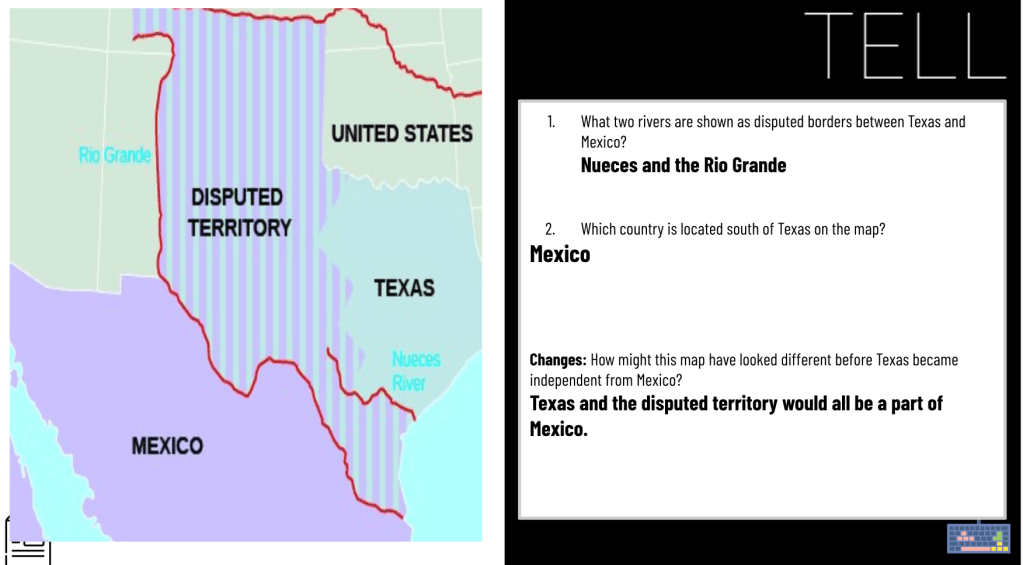
We opened with a Map and Tell focused on the border dispute between the United States and Mexico. Students examined the disputed territory between the Rio Grande and Nueces River and thought about how maps reflect conflict, claims, and power.

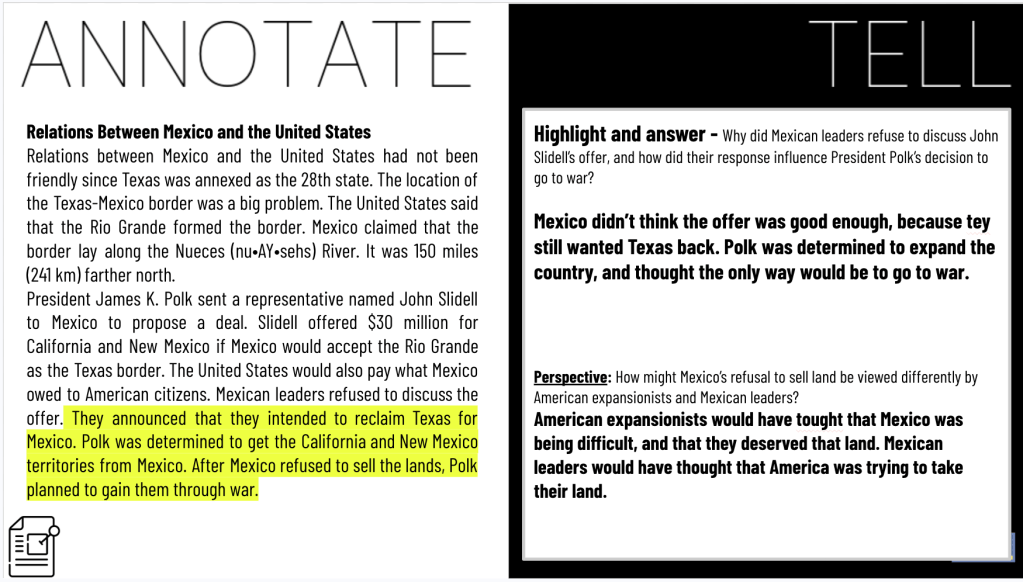
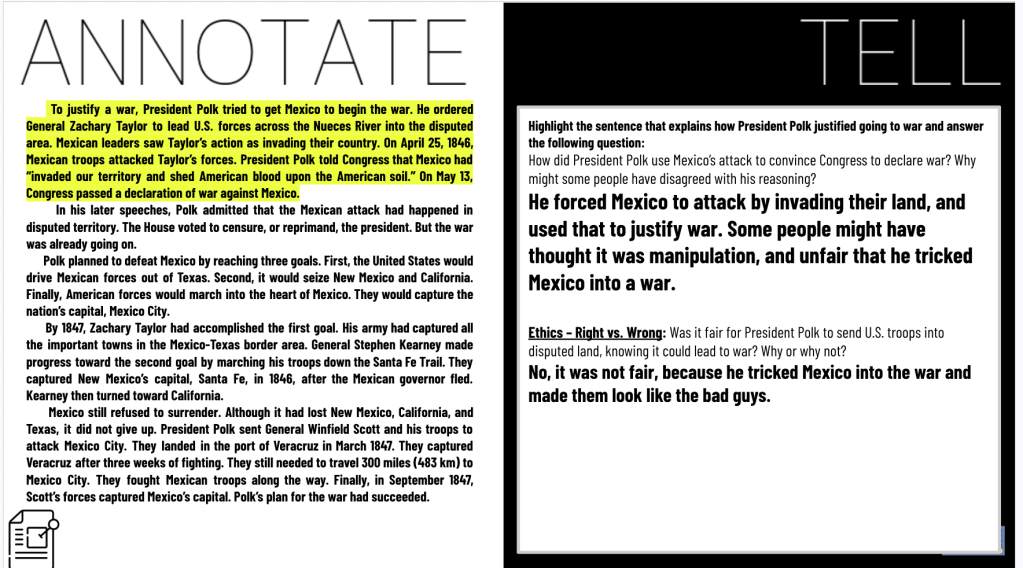
From there, students completed two Annotate and Tells focused on the causes of war. They examined failed diplomacy, Polk’s attempt to purchase land, Mexico’s refusal, and the decision to send troops into disputed territory. These activities helped students slow down and analyze motives, decisions, and perspective instead of just rushing to outcomes.

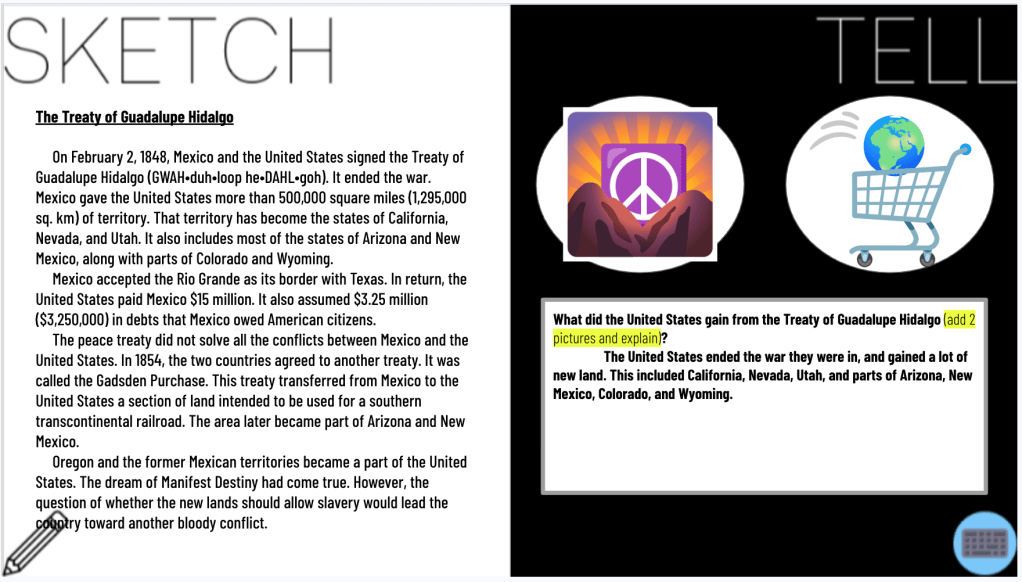
We closed the content portion of class with a Sketch and Tell on the Treaty of Guadalupe Hidalgo. Students showed what land the United States gained and explained why the treaty mattered. They recognized that the war helped the United States expand dramatically, but it also opened a new debate over whether slavery would spread into those territories.

If time allowed, students responded in Snorkl to the question: How did the Mexican-American War help the United States grow while also creating new disagreements over slavery and power?

Wednesday: Oregon Territory

Wednesday we moved into Oregon Territory and focused on how the United States gained this land. Students were beginning to see that westward expansion was not one single event. Different territories came through different paths, negotiations, and conflicts.

EduProtocol Smash + Map and Tell

I may have invented something new here.

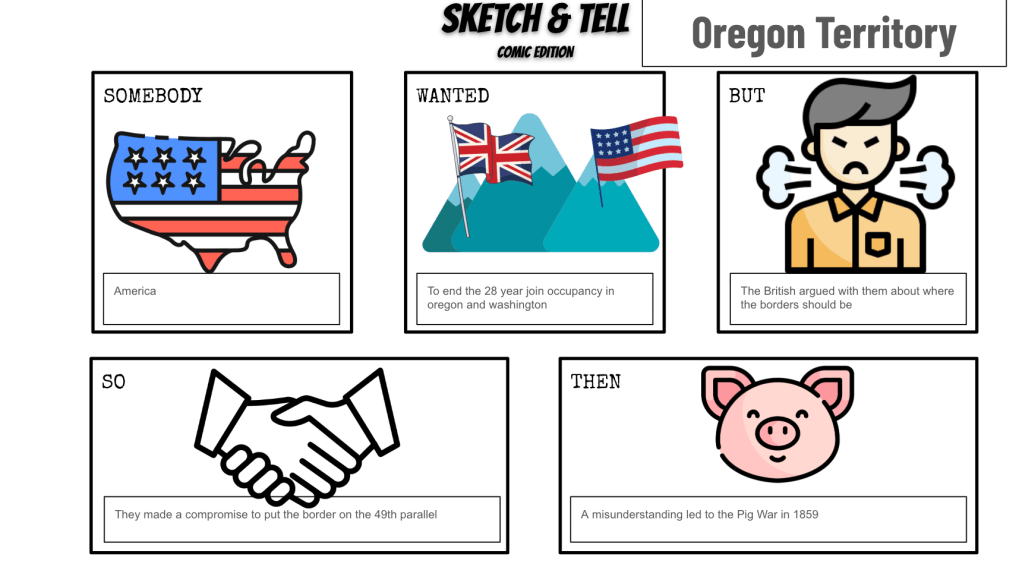
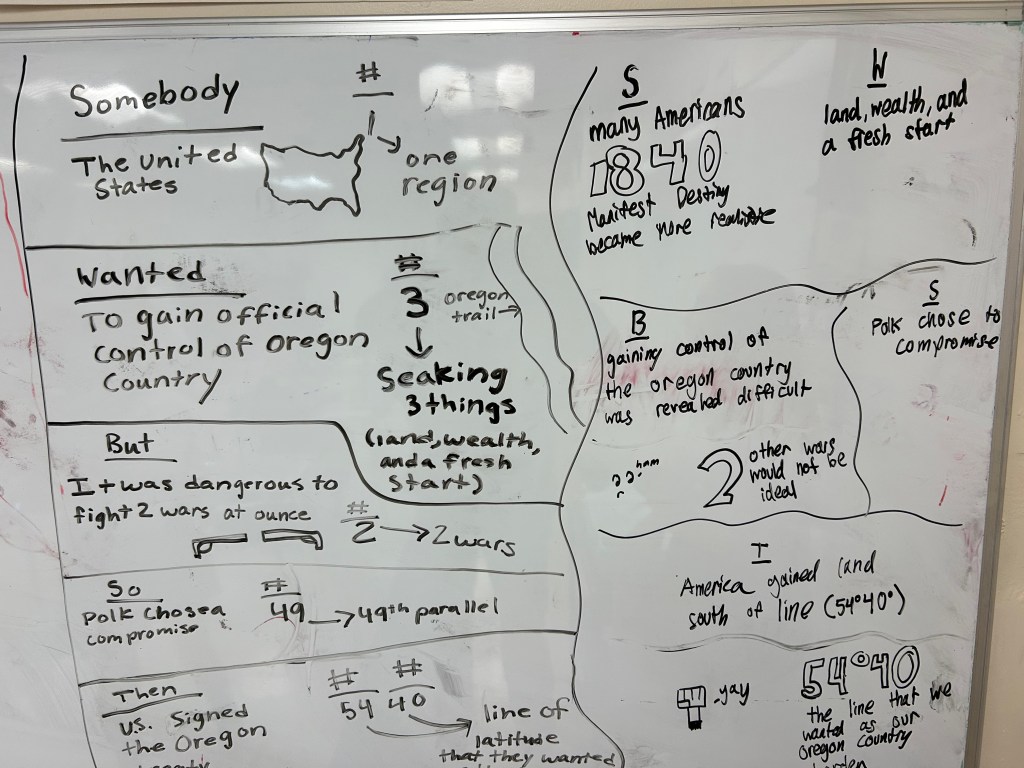
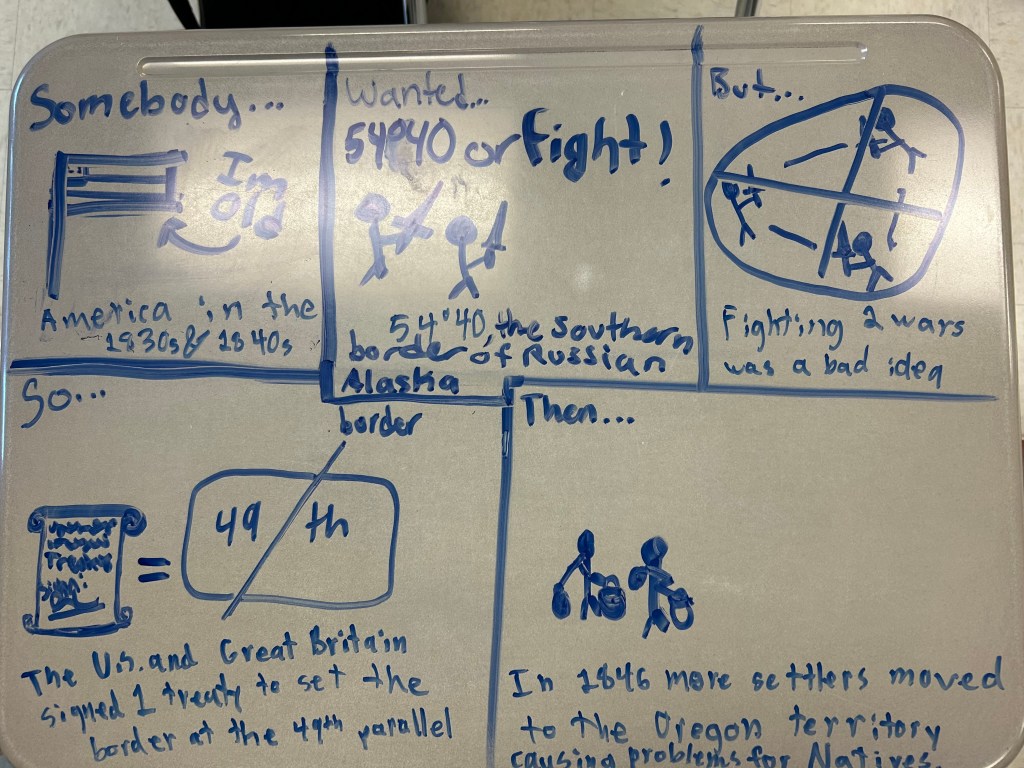
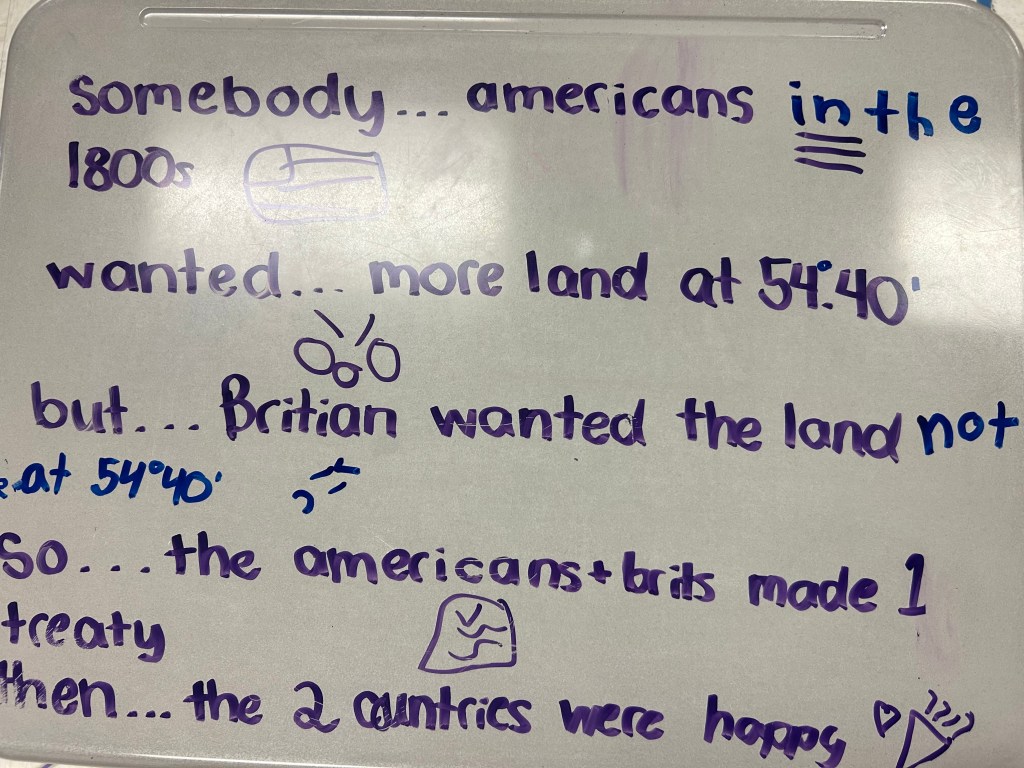
Students read about Oregon and the Oregon Treaty, then we followed it up with a Building Thinking Classrooms style activity that smashed together SWBST Sketch and Tell with Number Mania.

Students had to retell the story using Somebody, Wanted, But, So, Then. The twist was that every caption needed a number and every caption needed a picture.

That small change created a lot of thinking. Students had to ask themselves, “How can I use a number here?” Sometimes that meant using dates. Sometimes it meant latitude lines. Sometimes it meant quantities, years, or distances. Sometimes it meant reworking their sentence entirely.

That is productive struggle. When students have to adapt knowledge instead of copy knowledge, the thinking gets better.

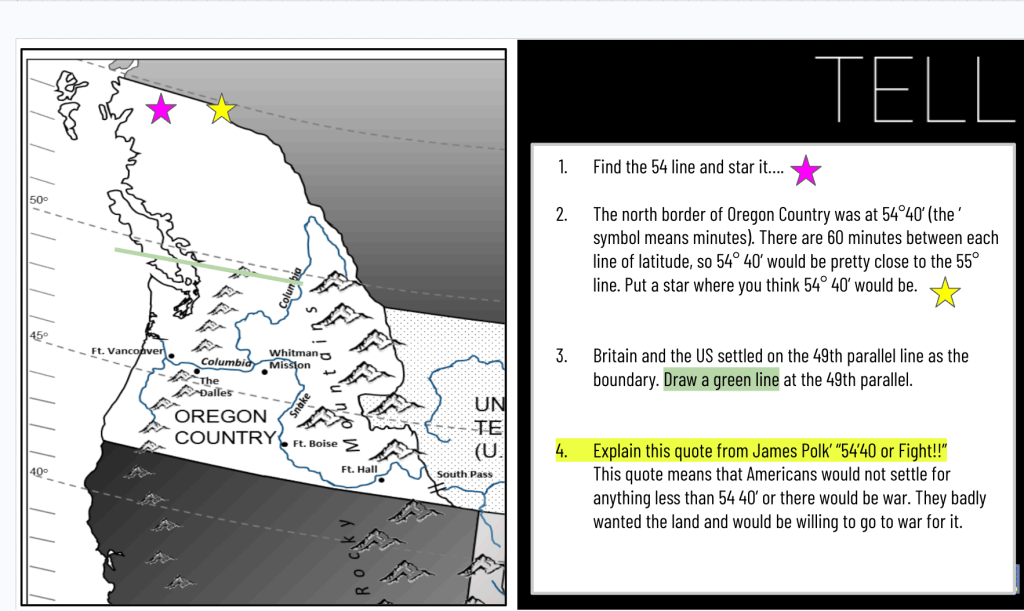
We followed that with a Map and Tell focused on the slogan 54°40′ or Fight and what it meant. Students had to locate the 54°40′ line and wrestle with the idea of minutes within lines of latitude. Then they had to locate the 49th parallel, and parallel itself was a new academic term for several students.

Thursday: A Strong Start and a New Inquiry

Thursday began with a Quizizz over westward expansion territories and Manifest Destiny. The class averages were 90%, 95%, 97%, 95%, and 98%. Well done.

Those scores showed me students were retaining the content from earlier in the week, but more importantly, they were starting to connect the bigger ideas behind expansion.

Mini Inquiry Launch

After the Quizizz, we began a mini inquiry unit built around a compelling question: What drives people to move, and is the risk worth the reward? We started with Day 1 and focused on push factors, or the reasons people felt they needed to leave home.

CyberSandwich + Primary Sources + BTC Whiteboards
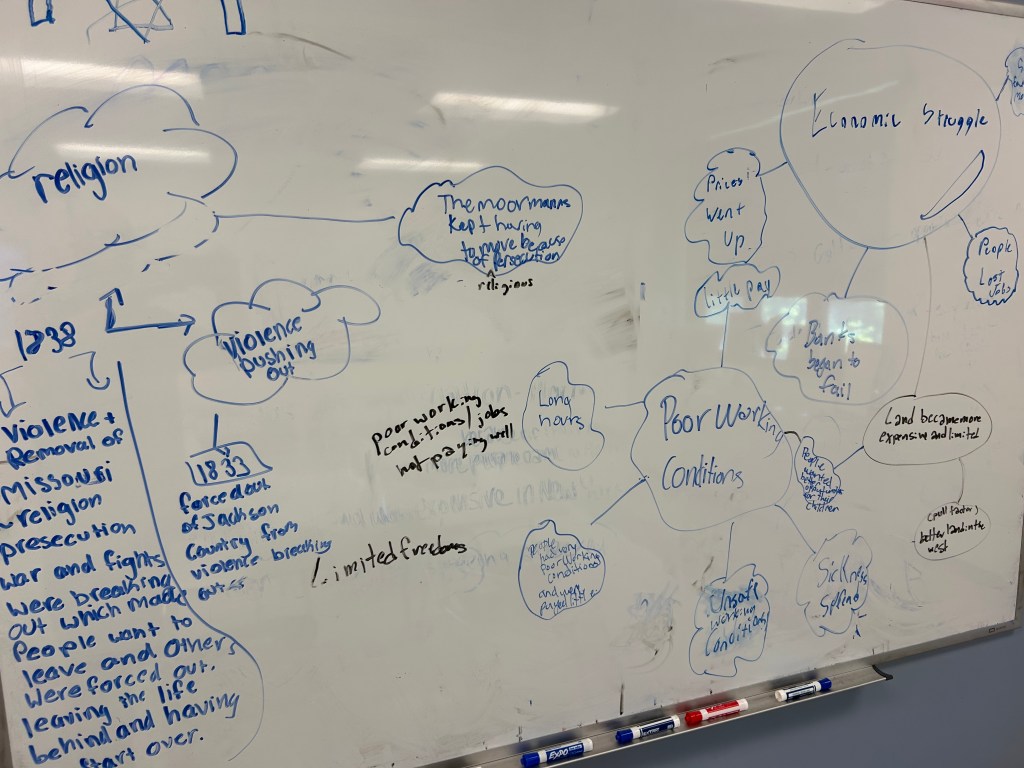
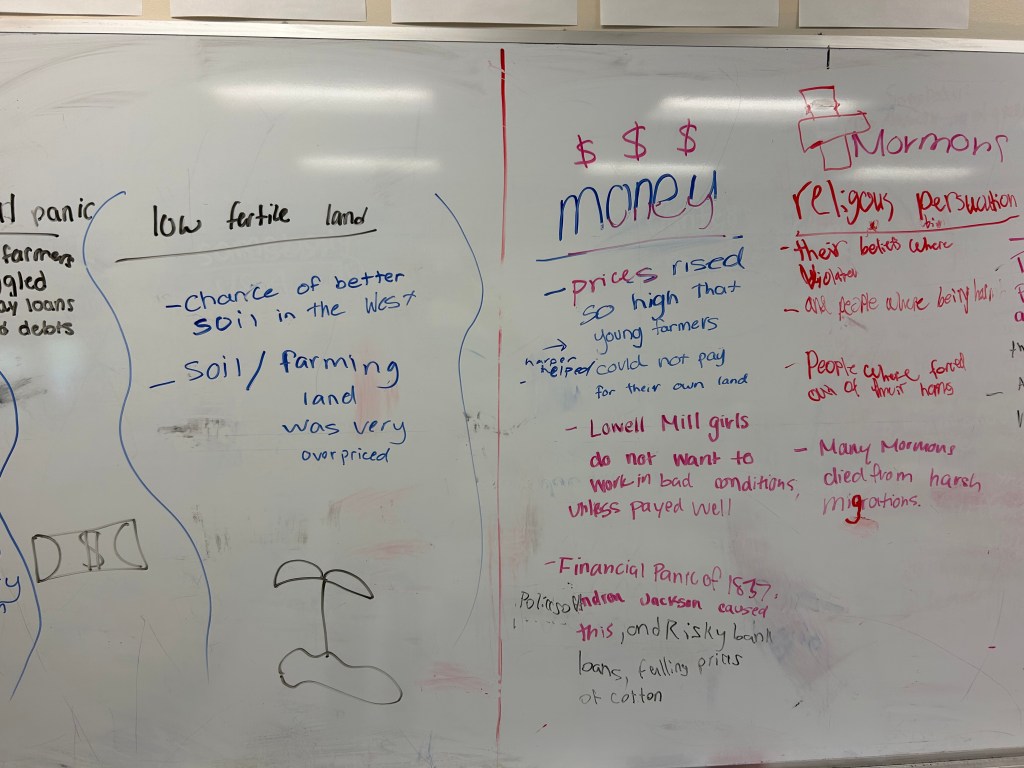
I turned the sources into a CyberSandwich using five different pieces of evidence. Students worked through sources connected to Mormon persecution, expensive farmland, overcrowding, poor factory conditions, and economic hardship.
Their task was to answer one question: What pushed people to leave home and head west? Many students struggled at first because they wanted answers stated directly in the source. They were hunting for exact words instead of reading between the lines. One example came from the Lowell Mill Girls protest song. Some students said people would not want to move west because they were treated like slaves. I pushed them further. What do you think working conditions were like? What do you think pay was like? What do you think quality of life was like?

After reading and note taking, students moved to the whiteboards Building Thinking Classrooms style. Groups compared notes, added ideas, and talked through evidence together. After five or six minutes, students returned to their seats and wrote a brief summary.

I really liked this structure because students were surrounded by the thinking of the room. As they wrote, they looked around at the boards, borrowed evidence, reconsidered ideas, and strengthened their responses.

That is what a classroom should feel like. Ideas visible. Thinking shared. Learning active.

Lessons for the Week

Monday – Texas Independence MiniReport

Tuesday – Mexican American War Rack and Stack

Wednesday – Oregon Territory

Thursday – Westward Migration Inquiry

The Week That Was In 103

Spring break is always an interesting reset point. Students come back needing structure, movement, review, and something fresh to pull them back in. This week became a strong example of how routines, retrieval, and purposeful lesson design can help students re-enter quickly while also launching a brand new unit.

We moved from reviewing foundational civics ideas into beginning our westward expansion unit with the compelling question:

How did Manifest Destiny change America’s map and affect the lives of people?

The week blended retrieval practice, vocabulary building, inquiry, source analysis, mapping, comparison thinking, and AI-supported feedback. It also required some pivots when I had to be out later in the week. Sometimes the best planning is adjusting without losing the learning goal.

Monday: Retrieval With Energy

The first day back from break needed to be active. Students had been away from school routines, so I wanted them talking, moving, and remembering what we had learned earlier in the year.

We ran a Resource Rumble from EMC2Learning. Around the room were eight review questions tied to key standards and concepts students still need to know. Topics included federalism, the Great Compromise, causes of the American Revolution, and Jacksonian Democracy.

There were no Chromebooks allowed.

Students worked with their groups, discussed answers, and relied on memory rather than searching online. After completing each question, they brought their paper to me for feedback. If the answer was solid, they rolled a six-sided die to determine how many Jenga blocks they earned. The tallest free-standing tower at the end won.

This was one of those lessons where students probably felt like they were playing a game, but underneath it was serious retrieval practice. They were discussing content, correcting misconceptions, and rebuilding old knowledge after time away.

That is exactly what I wanted on Day 1 back.

Tuesday: Launching Westward Expansion

Tuesday introduced our new unit and gave students a roadmap for where we were headed. I broke the unit into three parts:

  1. Understanding Manifest Destiny
  2. Understanding how the United States acquired western territories
  3. Understanding the groups of people who moved west and why

We began by introducing 15 key vocabulary terms through a Fast and Curious Blooket. Students played for four minutes, received feedback, and then immediately played again for three more minutes.

Every class improved dramatically.

That quick cycle matters. Students gain confidence when words stop feeling unfamiliar. Once vocabulary becomes more accessible, the rest of the lesson opens up.

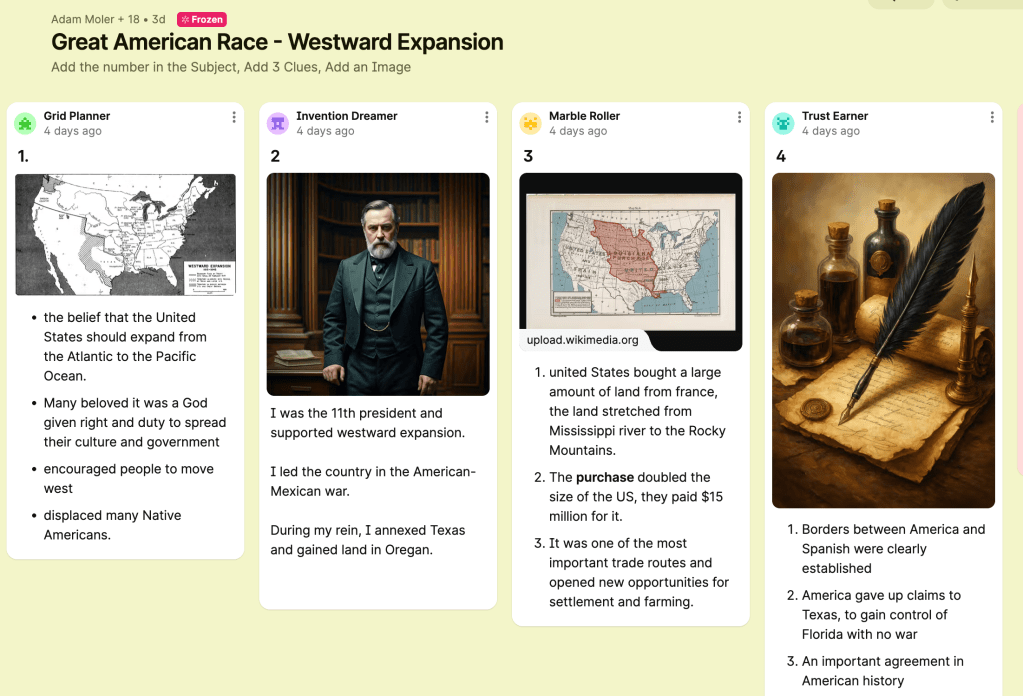
From there, we moved into a Great American Race activity. Students each received a slip containing a numbered vocabulary term with a five-to-six sentence description. Terms included people, events, and concepts such as James Polk, Mexican Cession, and annexation.

Students were told not to share their information.

Instead, they went to Padlet and created a post using:

  • their assigned number as the title
  • three clues from the description
  • a relevant image

I moderated every post so nothing appeared until everyone was ready. Once all clues were approved, students paired up and raced to solve every numbered clue on Padlet.

This became one of my favorite ways to launch the unit because the structure matched the content. Westward expansion was a race for land, influence, opportunity, and movement. Students were literally racing through the ideas that would define the unit.

Wednesday: Manifest Destiny as an Idea to Question

Wednesday focused fully on Manifest Destiny, but not as a simple textbook definition.

Too often students hear the phrase and think it just means “America moved west.” I wanted them to wrestle with it as an idea, a belief system, and something people still debate today.

We started with Fast and Curious using Gimkit to review terms like Manifest Destiny, annexation, expansion, and acquisition. That quick retrieval gave students a base before asking them to think more deeply.

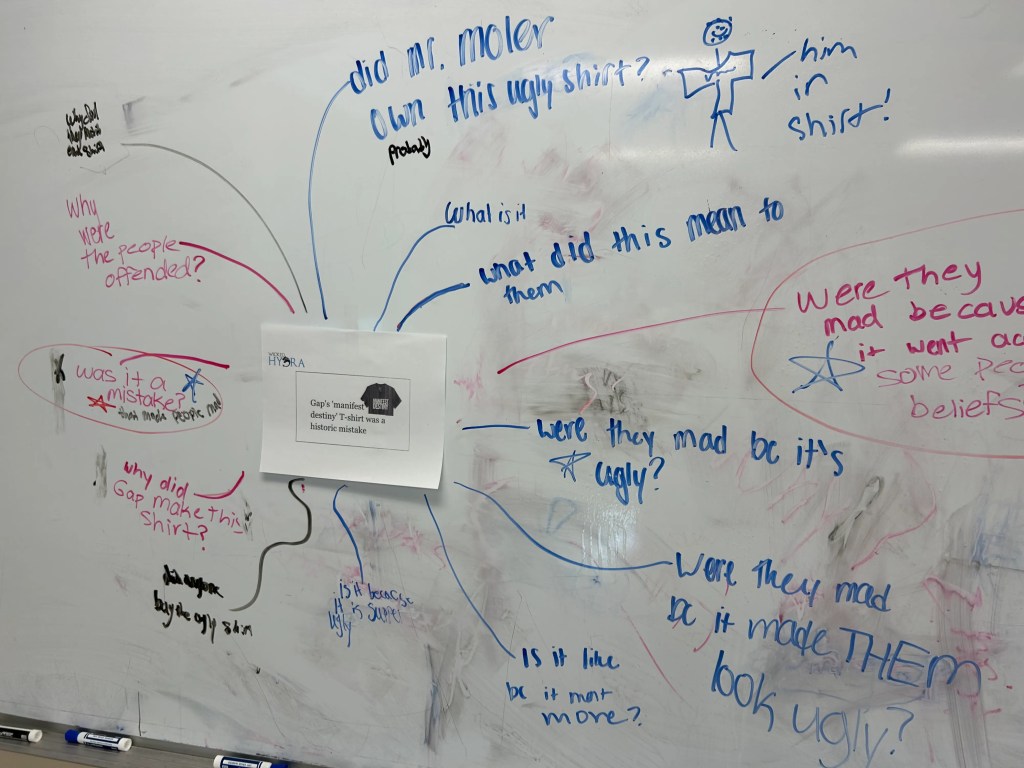
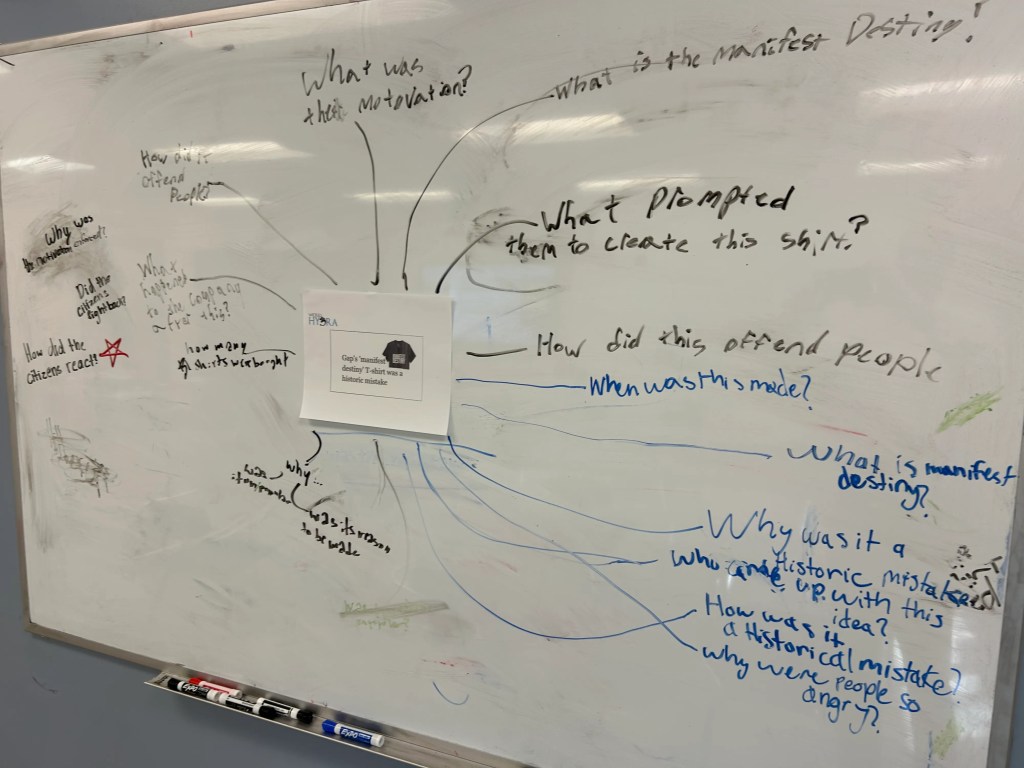
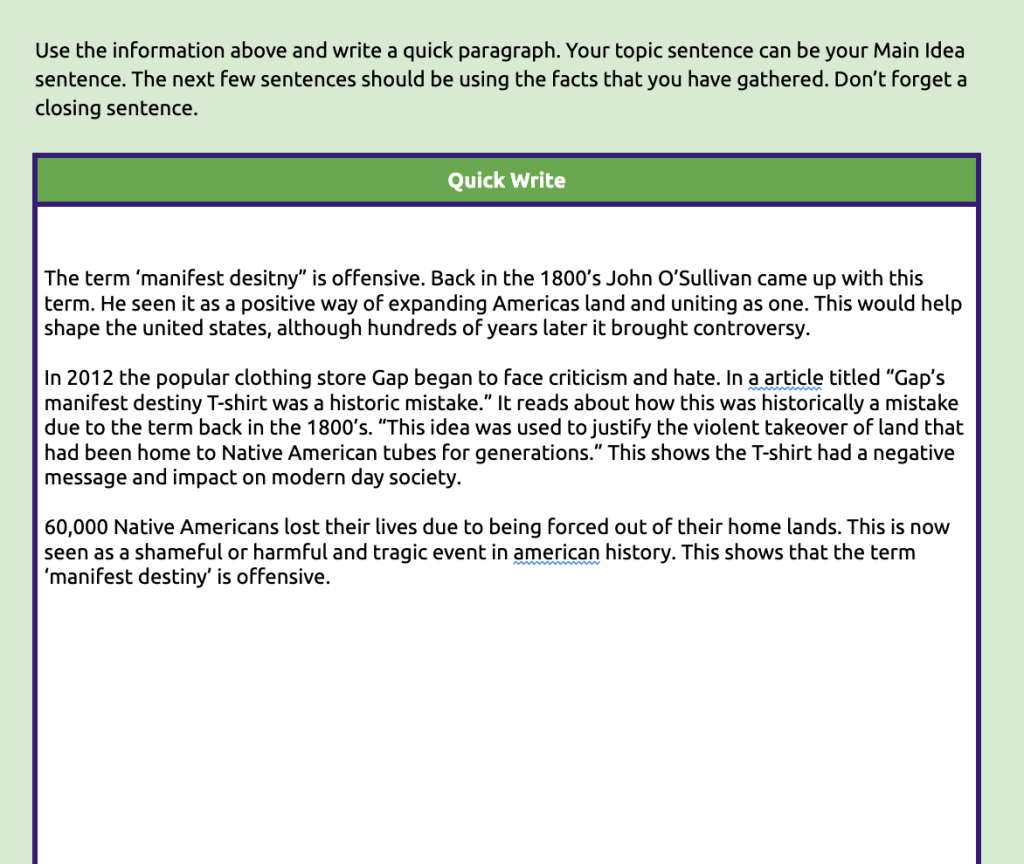
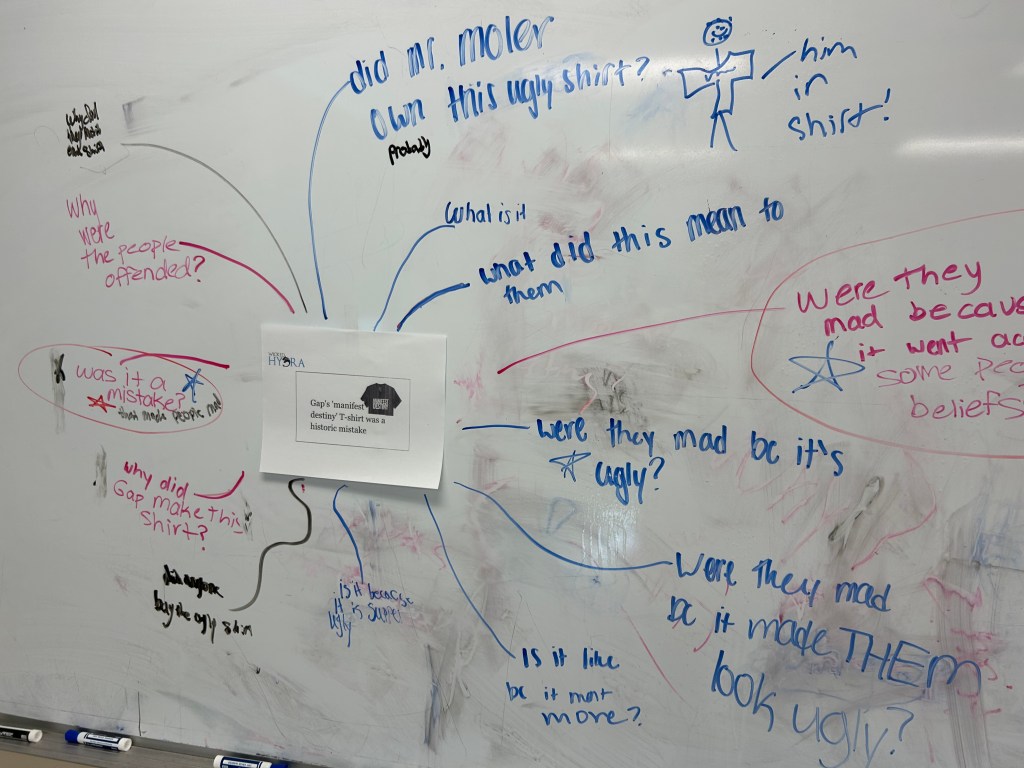
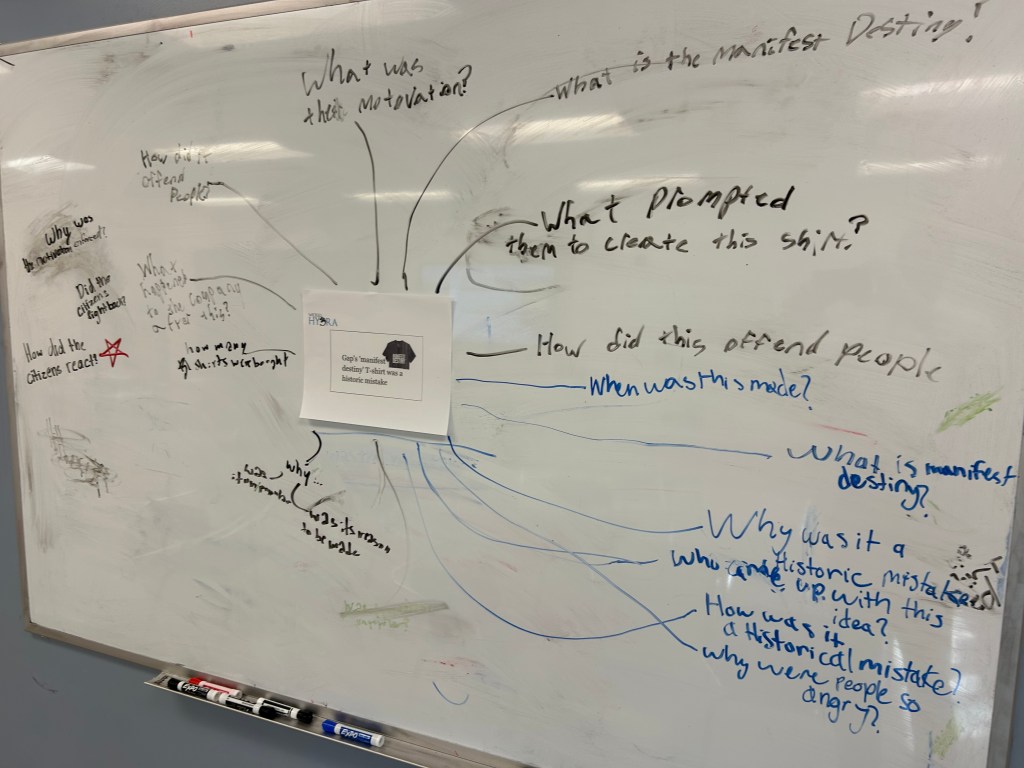
Then we moved into a Wicked Hydra built around the headline:

Gap’s T Shirt Was a Historic Mistake

Students worked in groups at whiteboards generating questions they thought the lesson would answer. At first the questions were surface level. Then they became sharper:

Why would a shirt be controversial?
Who would be upset?
How is history remembered today?

The room changed once students had something real to figure out.

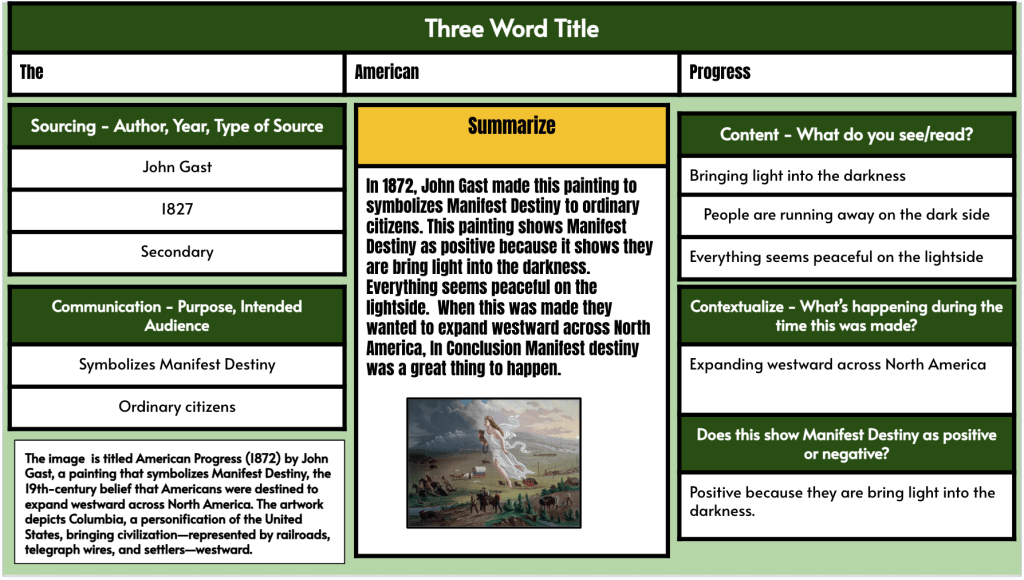
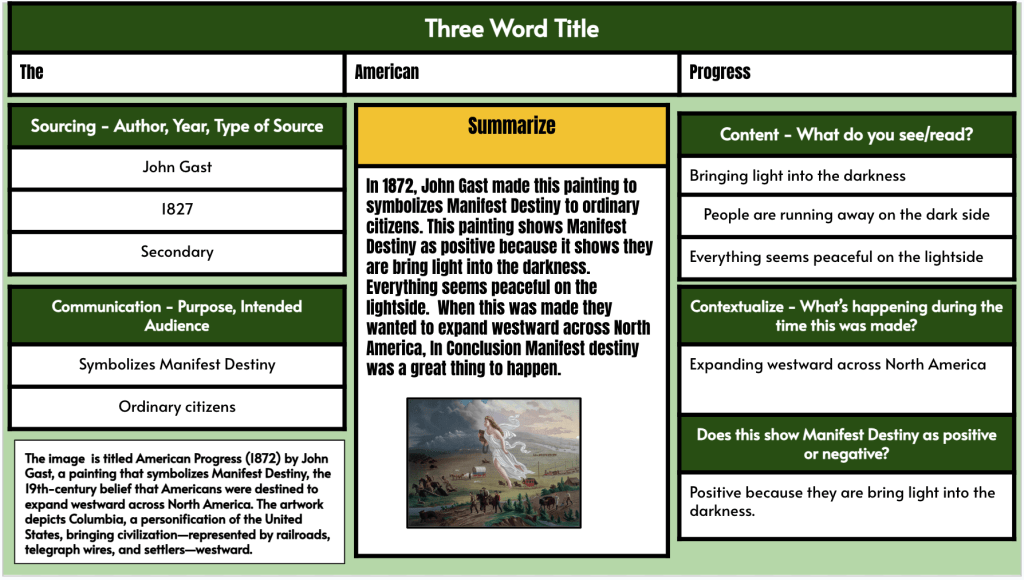
Next came Sourcing Parts using the painting American Progress. Students examined creator, message, audience, and perspective. They quickly noticed symbols of movement and expansion, but deeper discussion centered on who was missing from the image and whose story was being ignored.

That is where the lesson slowed down in a good way.

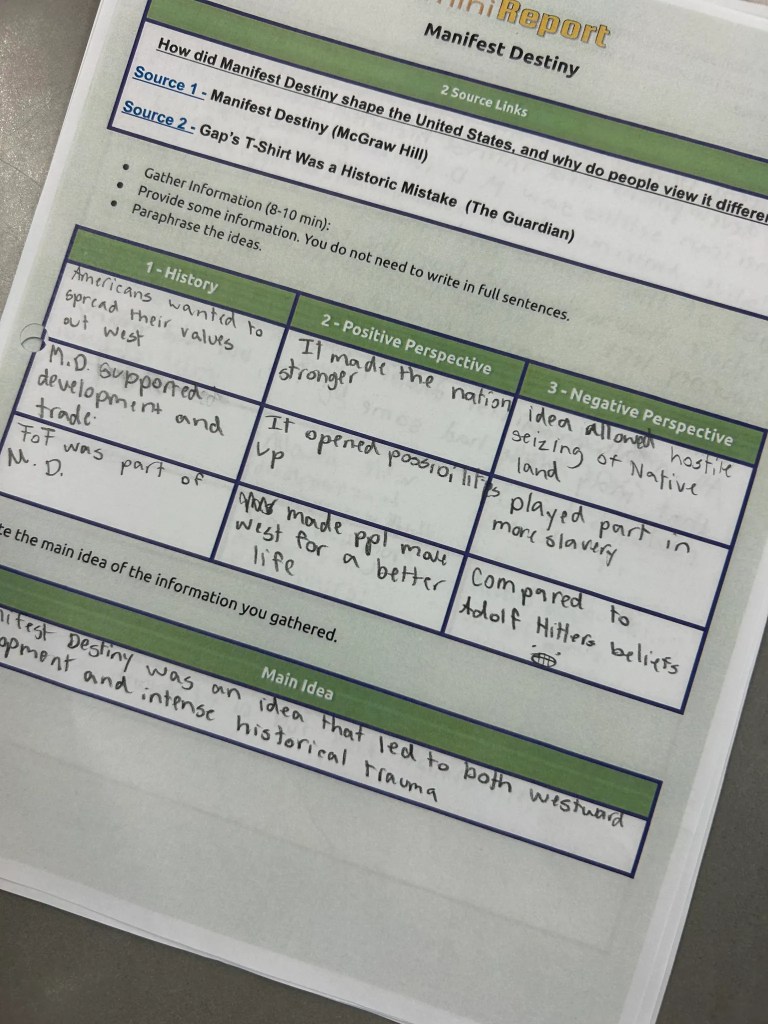
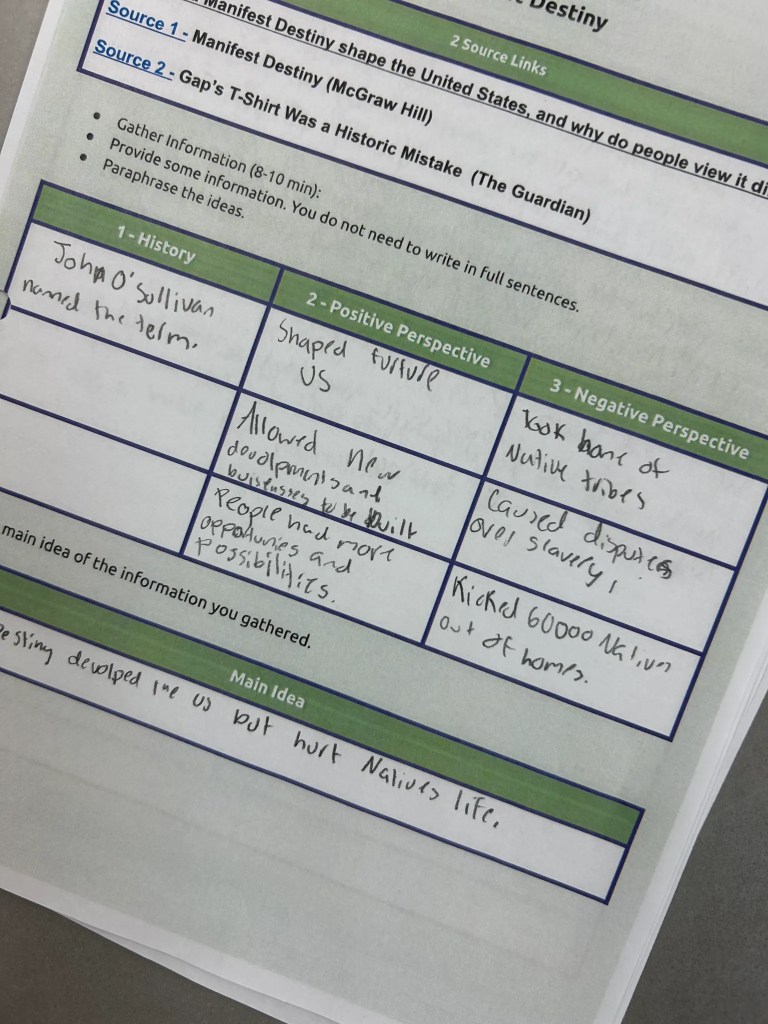
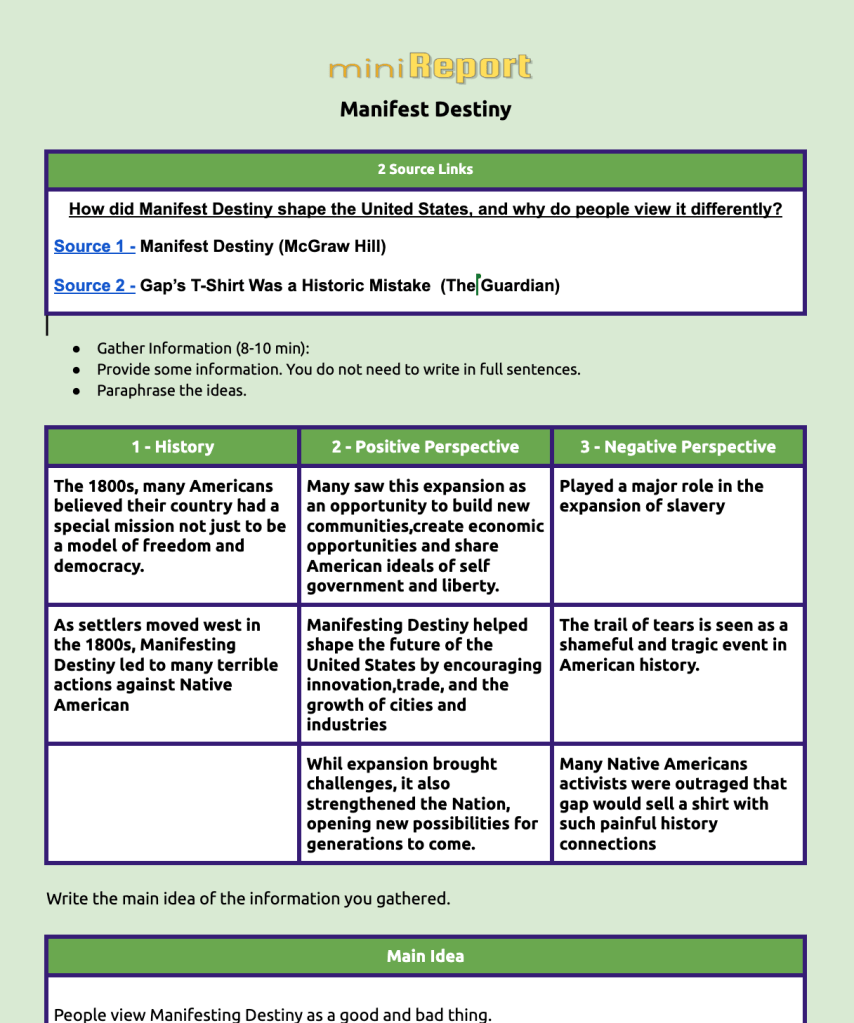
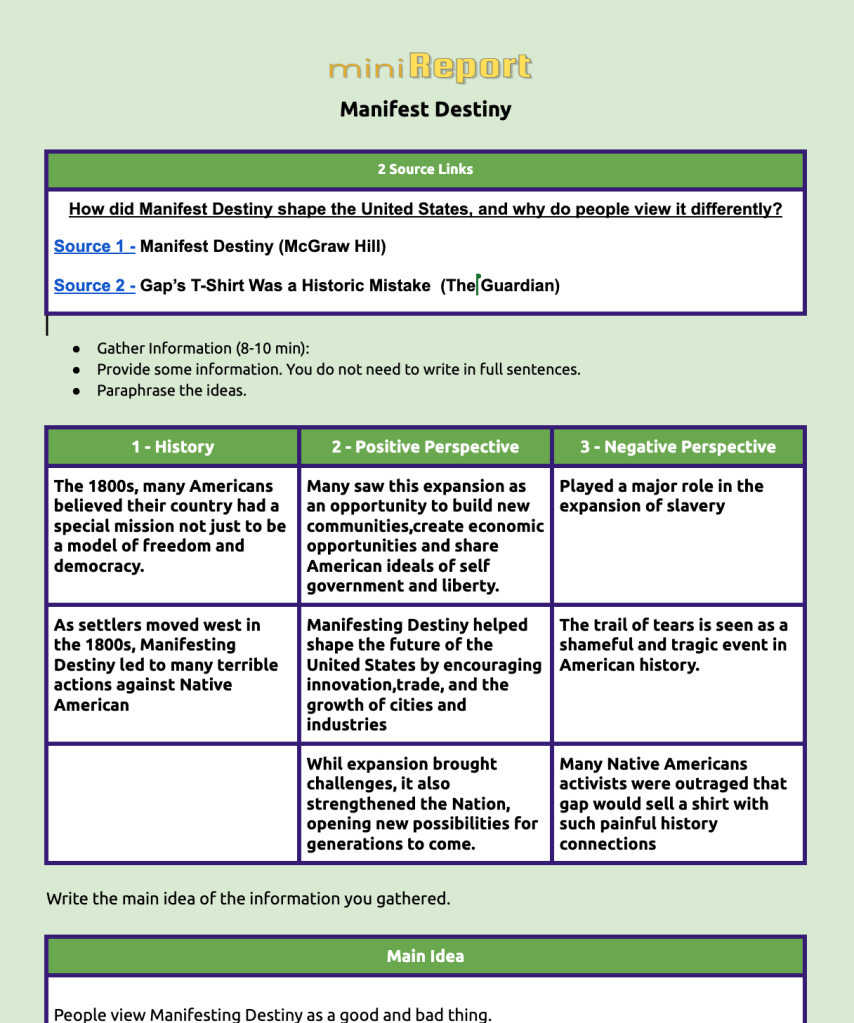
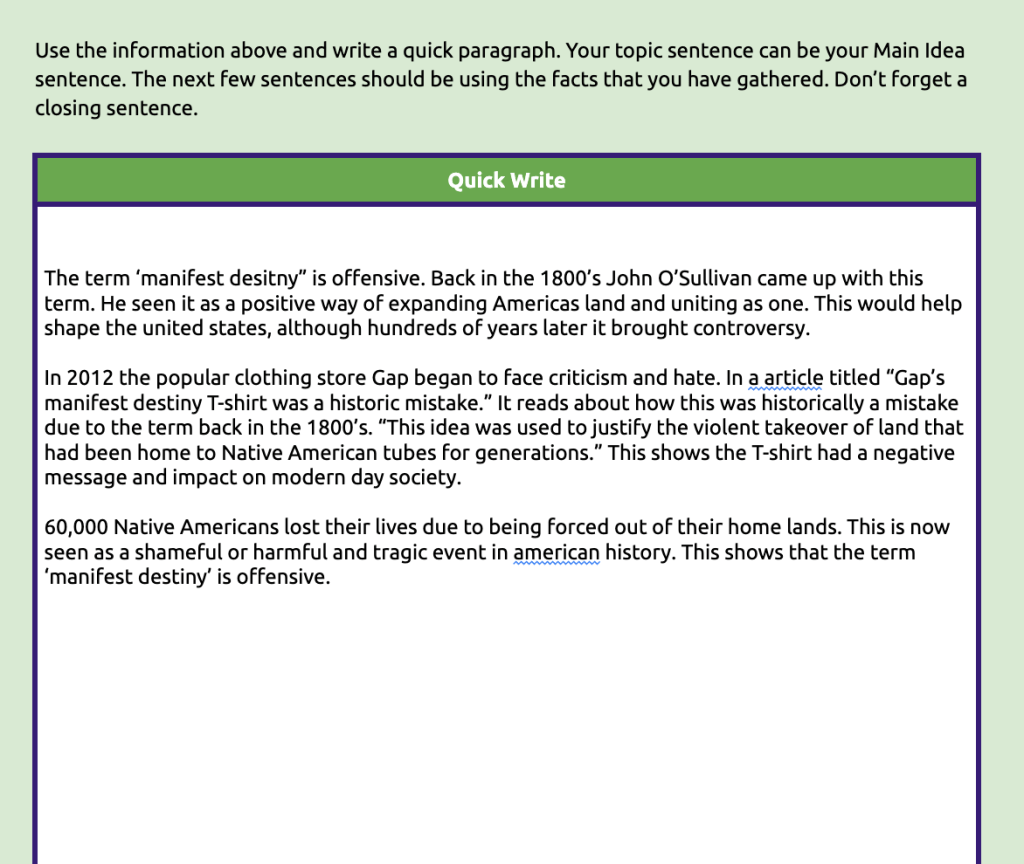
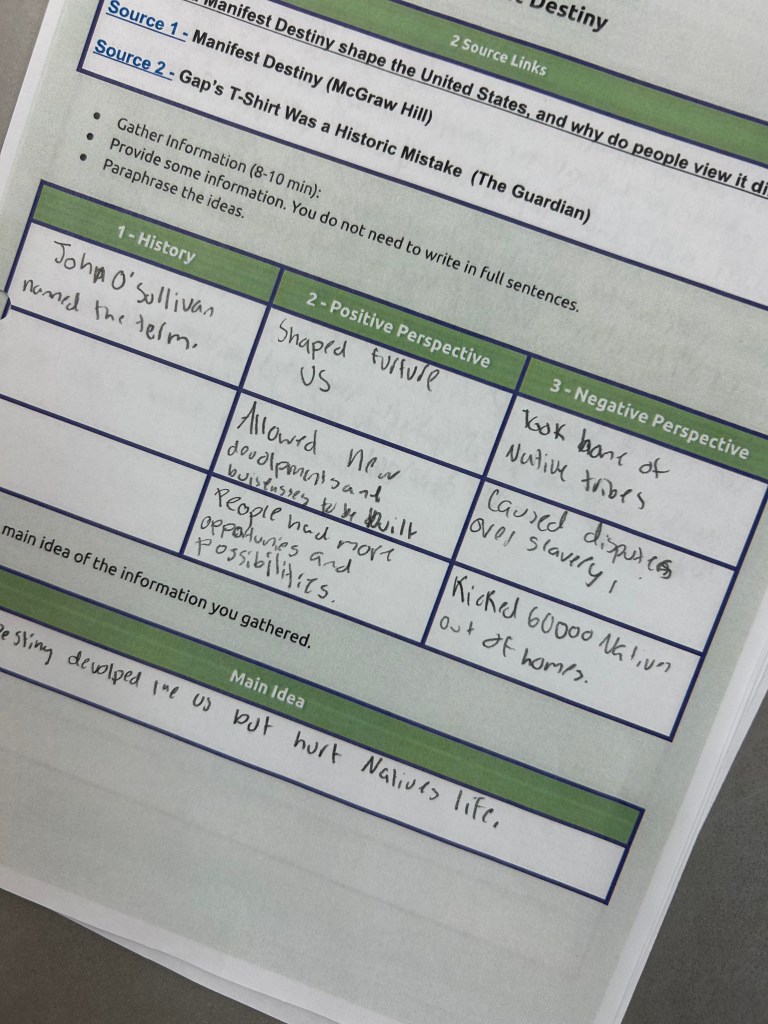
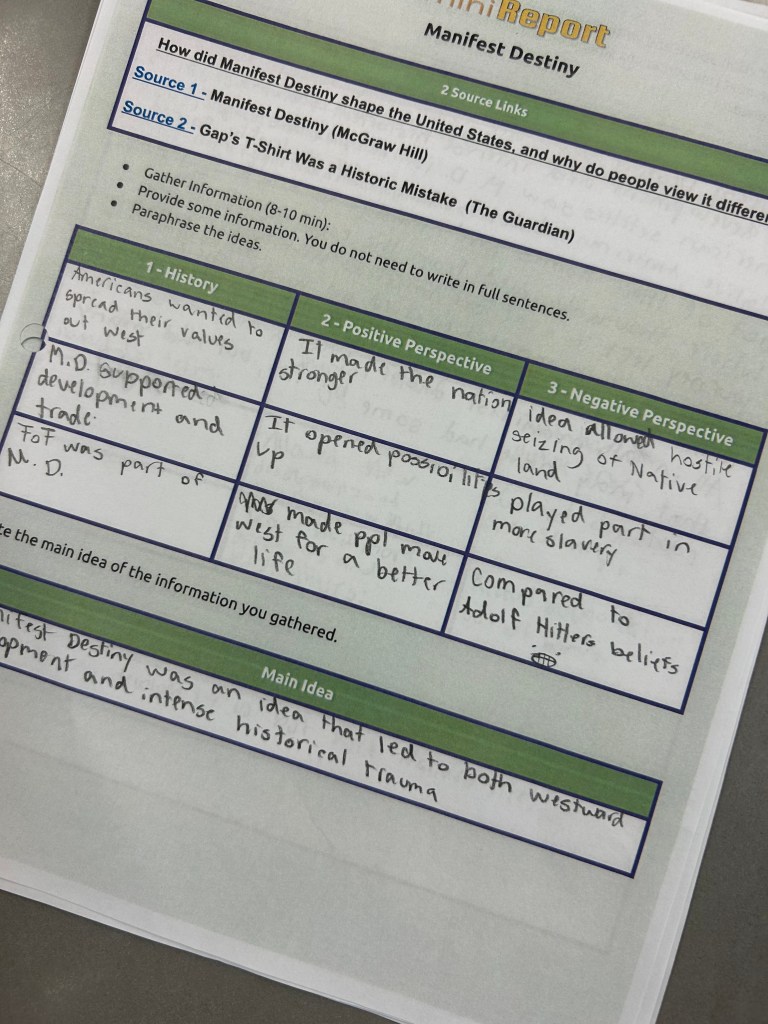
To close, students completed a MiniReport comparing two perspectives:

  • Manifest Destiny as necessary expansion
  • Manifest Destiny as an idea criticized then and now

Students used notes, evidence, and prior discussion to write a paragraph capturing the central tension.

Instead of writing being separate from the lesson, it became the natural finish.

Thursday and Friday: Adjusting Without Lowering Expectations

I had to be out Thursday and Friday with a sick child at home, so lesson planning became about clarity and simplicity without losing rigor.

Normally I run a more hands-on annotated map lesson, but I knew too many moving pieces could create confusion in my absence.
Thursday: Time and Space

Students began with a blank westward expansion map. They labeled territories, added the year each was acquired, and colored the map.

This simple task matters more than people think.

Students often learn names like Louisiana Purchase or Oregon Territory without understanding where these places are or when they happened. Mapping helps anchor content in time and space.
After that, students rotated through stations posted in Google Classroom. Their organizer had Manifest Destiny in the center, with surrounding territories connected to three guiding questions:

  • What land did we get?
  • How did we get it?
  • Why was it important?

Straightforward, focused, and manageable with a substitute.

Friday: From Recall to Comparison

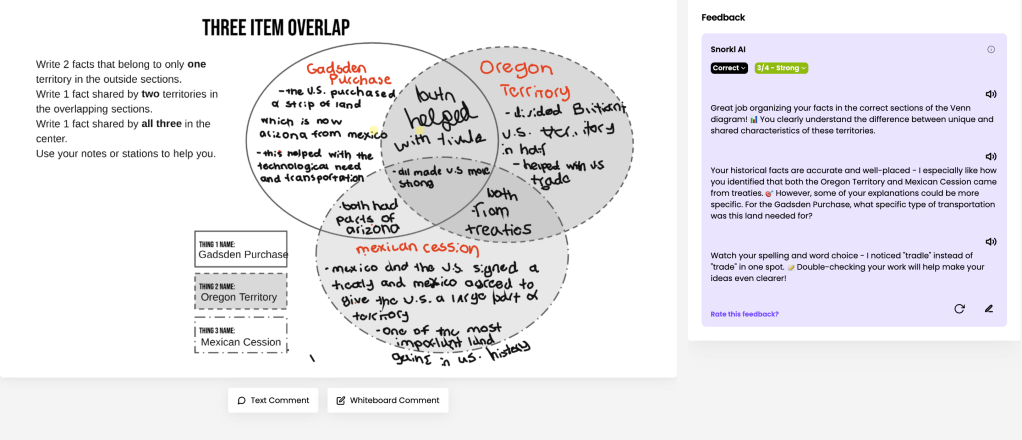
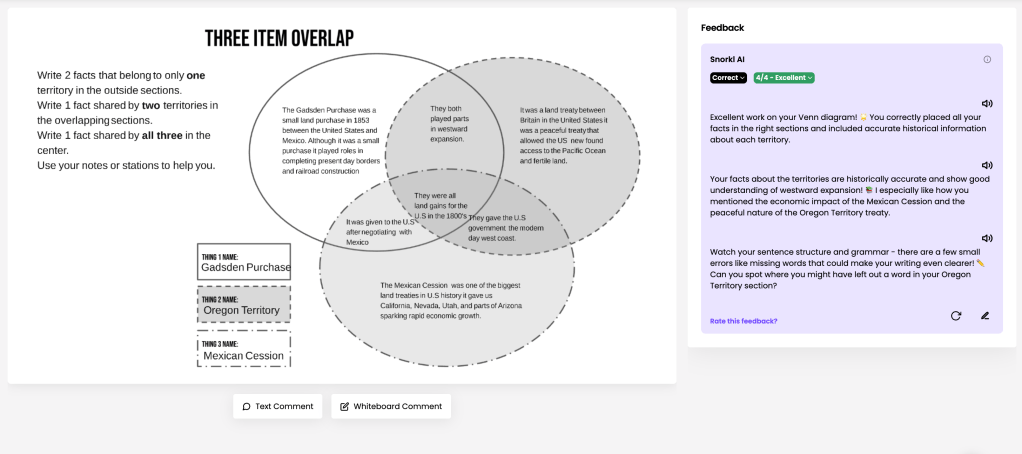
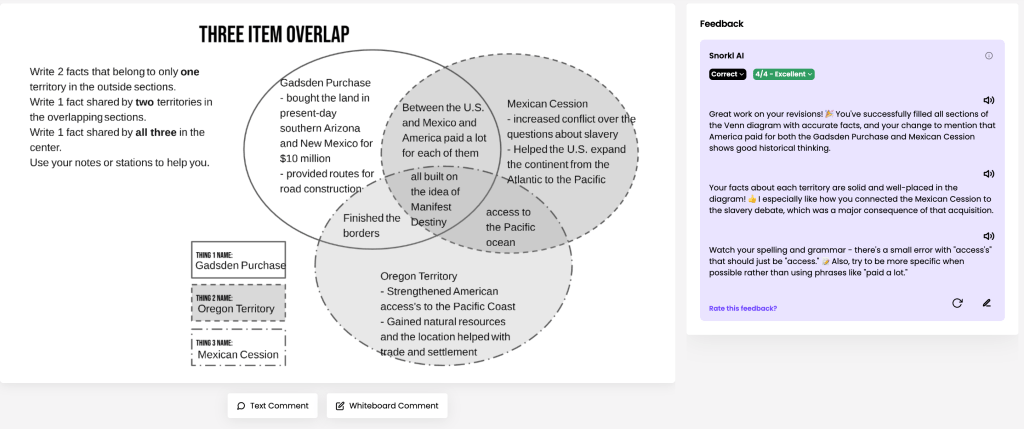
Friday began with finishing Thursday’s work. Then students moved into Snorkl, where I assigned a triple Venn diagram comparing three territories.

This was intentional.

I like pushing learning from:

  • DOK 1: identify and recall
  • DOK 2: compare, organize, explain
  • DOK 3: justify and evaluate when possible

The Venn diagram immediately raised the level of thinking because students had to sort similarities and differences rather than copy facts.

To finish, students completed a Quizizz/Wayground review with map labeling, acquisition questions, and short-answer responses that provided AI-supported feedback.

Even while I was out, students were still receiving guidance instead of completing isolated tasks and wondering if they were correct.

That matters.

Final Thought

This week was a reminder that good instruction is not about flashy one-off lessons. It is about sequencing experiences that build knowledge and confidence over time.

We reviewed old learning.
We launched a new unit with curiosity.
We questioned historical narratives.
We built geographic understanding.
We compared ideas and territories.
We used AI as feedback, not as a shortcut.

Most importantly, students kept thinking all week.

That is always the goal.

Lessons for the Week

Tuesday’s Lesson is Linked Here

Locked In – Lessons Worth Running Again (A Lesson On Manifest Destiny)

I don’t usually run the same lesson twice. Every year I’m changing things, trying something new, seeing what works and what doesn’t. That’s just how I’ve always approached teaching.

But over time, there are a few lessons that keep finding their way back into my classroom. Not because I’m out of ideas, but because they actually work. Students are into them. They’re talking, thinking, and the lesson just flows the way it’s supposed to.

When I step back and look at those lessons, there’s a reason behind it. They’re built a certain way. They’re sequenced in a way that makes sense. Nothing feels random, and each part leads into the next.

This series is me breaking those lessons down. What they look like in the classroom, how they play out, and why I keep coming back to them.

Setting the Stage

This lesson came at the start of our westward expansion unit, and most students were coming in with very little background beyond the idea that the United States moved west. They had heard the term Manifest Destiny before, but it did not really mean anything to them yet. The goal was not just to define it, but to get them thinking about it as both a historical idea and something that still connects to how people think today. I wanted them to see that this was not just something to memorize, but something to question.

Fast and Curious – Building the Base

We started with a Fast and Curious using Gimkit to review key vocabulary, focusing on terms like Manifest Destiny, annexation, expansion, and acquisition. Students played, saw their results, and then played again. It was quick, but it did exactly what it needed to do. The repetition helped them start to recognize the terms and feel more comfortable with the content before we asked them to do anything deeper.

That part matters more than it seems. When students do not understand the words, they check out fast. When they do understand them, even at a basic level, they are more willing to engage with the lesson. By the time we moved on, they had a base to work from, and that made everything else go smoother.

Wicked Hydra – Driving Inquiry

From there, we moved into a Wicked Hydra using the headline “Gap’s T Shirt Was a Historic Mistake.” Students worked in groups at whiteboards and started generating questions, focusing on the ones they thought would actually be answered during the lesson. That small shift in direction made a big difference in the quality of what they came up with.

The questions started simple, but they did not stay there. Students began asking why something like a T shirt would be controversial, who would be upset, and what it says about how history is remembered today. At that point, the lesson stopped being about me introducing content and started becoming something they were trying to figure out themselves. The energy in the room changed because they had a reason to care. They were not just going through the motions, they were looking for answers.

Sourcing Parts – Slowing Down the Thinking

After that, we moved into Sourcing Parts with the painting American Progress, and this is where the thinking really started to deepen. Students began by identifying who created the image and what message it was sending, but the conversation shifted once we pushed into who was included and who was left out.

At first, they noticed the obvious parts of the image, but once they started thinking about purpose and perspective, they began to see it differently. It was no longer just a painting. It was a message about expansion, about progress, and about who benefits from that story. At the same time, they started to recognize what was missing, especially the experiences of Indigenous people. This part slowed everything down in a good way and forced students to actually think about what they were seeing instead of just moving on.

MiniReport – Bringing It All Together

To finish, we used a MiniReport to compare two perspectives on Manifest Destiny. One source framed it as a natural and necessary part of expansion, which is often the version students are most familiar with. The other focused on the backlash to the Gap T shirt and how people today view that idea differently.

Students took notes, organized their thinking into categories, and wrote a paragraph that captured the main idea. By this point, they were not starting from scratch. They had the vocabulary from the beginning, the questions they generated, and the analysis from the image. The writing became a way to pull everything together instead of something separate from the lesson. It also gave them practice with two source thinking and writing, but it felt like a natural ending rather than forced test prep.

How the Protocols Worked Together

What made this lesson work was how the protocols built on each other. Fast and Curious gave students the vocabulary they needed to participate, Wicked Hydra created inquiry and gave them a reason to care, Sourcing Parts pushed their thinking deeper, and MiniReport gave them a way to organize and express what they understood.

Each part had a purpose, and each part set up the next. The lesson was not about any one activity. It was about how they all connected to create a flow where students were constantly building on what they had already done.

Why This One Stays

I like this lesson because it comes full circle. It starts with building background, but it ends with students thinking about how the past connects to the present. The headline is not just there to hook them. It becomes something they come back to and understand in a different way by the end of the lesson.

It also helps them understand why knowing history matters. We live in a time where people are quick to say others are too offended, but sometimes there is a real reason behind that. If you do not know the history, you miss the why. This lesson gives students a chance to see different perspectives and start building some empathy, not just learning what happened, but understanding how and why people see it differently.

That is what makes this one worth running again.

The Lesson

  1. The Mini-Report
  2. Sourcing Parts and Gap Headline