Most weeks, this space leans heavily into what is happening in 8th-grade American History. This week, I’m heading down a grade level to share what has been happening in 7th-grade World History.
In Ohio, 7th grade covers a lot of ground—from Ancient Greece to the First Global Age. Before jumping into all of that history, though, I wanted students to spend some time thinking about the kind of classroom we want to build together. Instead of handing them a list of expectations, we built our own.
Monday: From Sketches to Statements
We started with a Sketch and Tell-O. I asked students to visualize what they felt was most important in a classroom environment. They had four minutes to sketch their ideas, followed by a quick explanation. Then, each student narrowed everything they had drawn down to a single word.
They shared their words with a partner and began looking for common threads. What ideas kept showing up? What did people seem to value? What kind of classroom were they describing?
Next came an index-card version of a Thin Slide. On one side, students wrote three or four words they believed were essential to a successful classroom. On the back, they used those words to draft a personal classroom mission statement. I modeled one first, but many students had already written personal mission statements before, so the transition to a classroom mission came naturally.
Then came my favorite part.
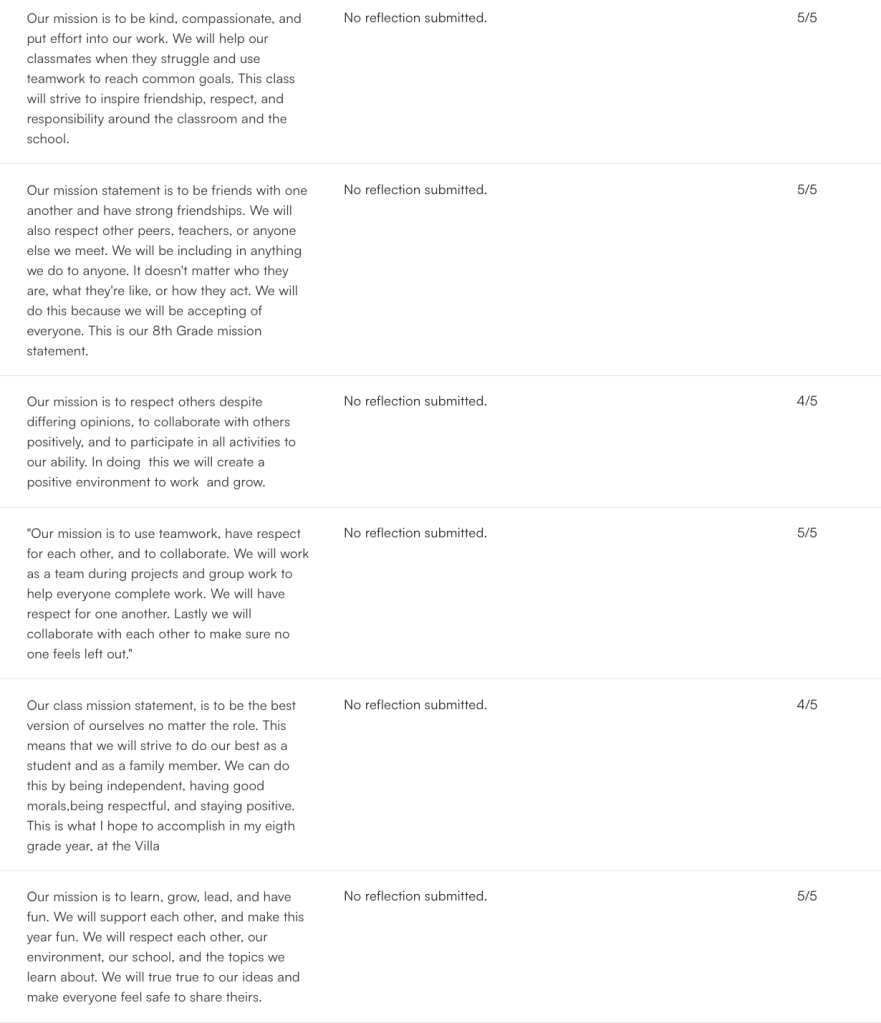
Students entered their mission statements into Scriblit, and we held a battle royale. They read the statements, discussed them, and narrowed the field round by round until one remained at the top. I could have written a classroom mission statement myself and put it on the wall, but that would have missed the point. The discussion, debate, and collective ownership were what mattered.
We closed with a Frayer Model of the winning mission statement. Students considered what the mission should look like in four different relationships:
- Student to student
- Teacher to student
- Student to teacher
- Student to classroom
By the end of class, the words were theirs. The mission was theirs. Most importantly, the expectations were theirs.
Tuesday and Wednesday: Building Better Paraphrasers
Tuesday and Wednesday were connected by one goal. I wanted students to practice taking information, putting it into their own words, and recognizing what makes a strong summary.
Cyber Sandwich: Ancient Greek Olympians
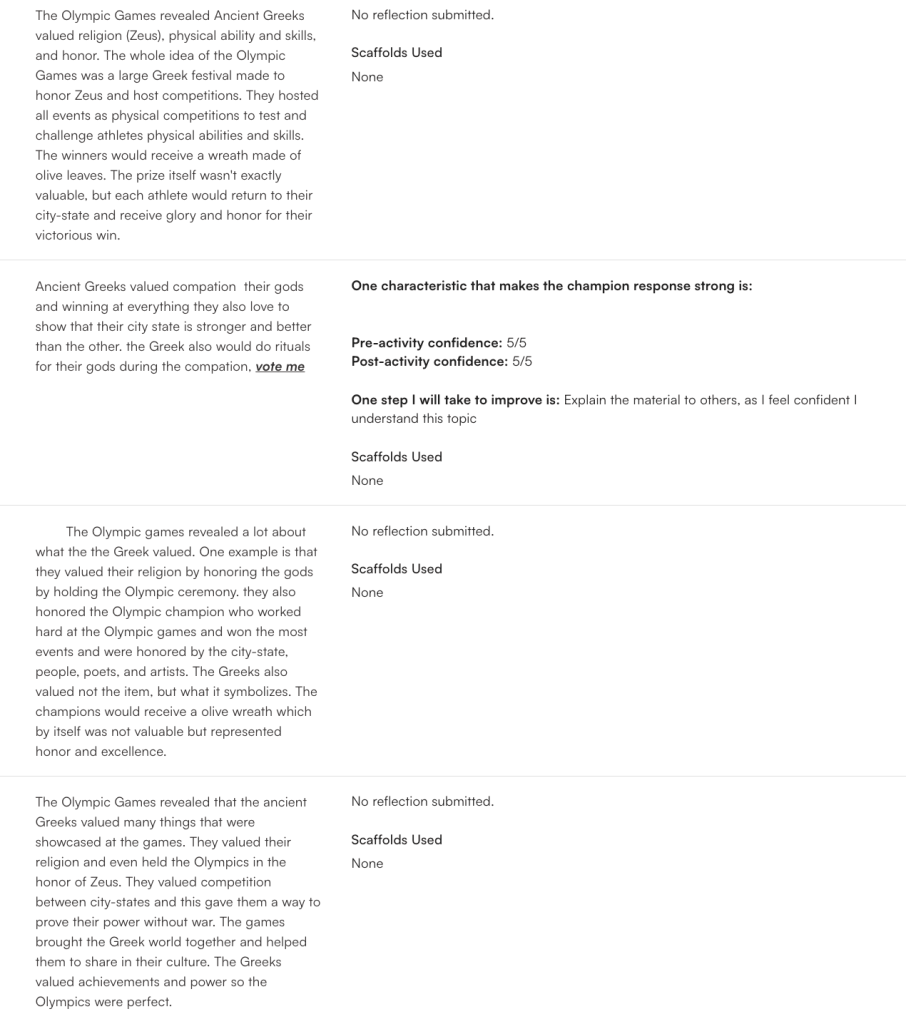
On Tuesday, I introduced students to the process of a Cyber Sandwich. We used a half-page article about athletes in the ancient Greek Olympics. It explained how hard the athletes trained, how winners were celebrated, and how their prize was a wreath made from leaves.
Since this was our first Cyber Sandwich, the focus was more on learning the process than mastering the content. Students had 10 minutes to read and take notes. Then, they had five minutes to compare and discuss their notes with a partner. Finally, they used their notes and conversation to write a summary.
Battle Royale: The Strongest Summary
Students entered their summaries into Scriblit, and we finished with a battle royale. They read the different summaries and voted round by round until one was left. This gave students a chance to see what other people wrote and think about what made one summary stronger than another.
Parafly: Weird Facts Edition
On Wednesday, we focused entirely on practicing Parafly, but I added a small twist. I used ChatGPT to generate weird facts that were one, two, or three sentences long. I copied the facts into Socrative, and students had one or two minutes to paraphrase each one.
ChatGPT Feedback
After each round, I copied all the anonymous student responses into ChatGPT along with the original fact. I asked ChatGPT to choose the strongest paraphrase and explain why it was effective. Students immediately saw a strong example and heard feedback they could use during the next round. Then, we tried it again with a new fact.
Hi-Chews and Cheesy Bracelets
Of course, we needed prizes. Each winner could choose a Hi-Chew or a cheesy bracelet. The prizes were small and a little ridiculous, but the practice was real. Students paraphrased, looked at a strong example, received immediate feedback, and tried again. Each round gave them another chance to improve.
Thursday: How Did Geography Shape Ancient Greece?
On Thursday, we officially started our Ancient Greece unit. Our compelling question for the unit is: How does Ancient Greece still impact our world today? Before students can answer that question, they need to understand the land where Greek civilization developed. Our supporting question for the day was: How did geography shape life in Ancient Greece?
Fast and Curious: Greek Geography
We started with a Fast and Curious using Gimkit. Students had four to five minutes to answer 30 questions correctly. This gave students an early introduction to the vocabulary and ideas they would encounter throughout the lesson. They did not need to know everything yet. This was simply their first exposure.
Frayer: Peninsula and City-State
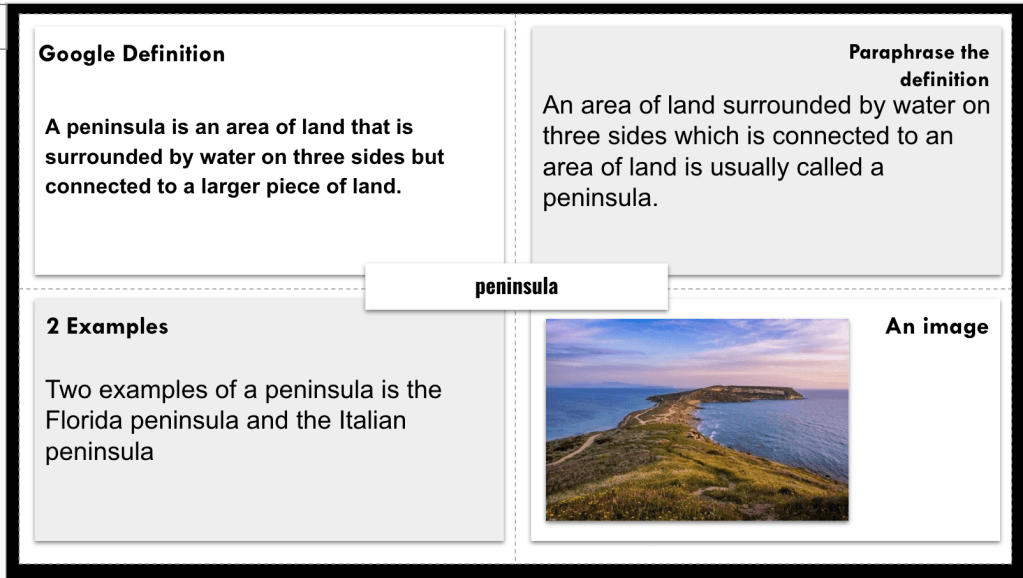
Next, students completed Frayer Models for peninsula and city-state. For peninsula, students paraphrased the definition, identified two examples, and created an image. For city-state, they created their own definition, paraphrased the provided definition, identified two examples, and added an image. This took about 10 minutes and gave students the vocabulary they needed to understand the reading that came next.
Parafly: Mountains and Seas
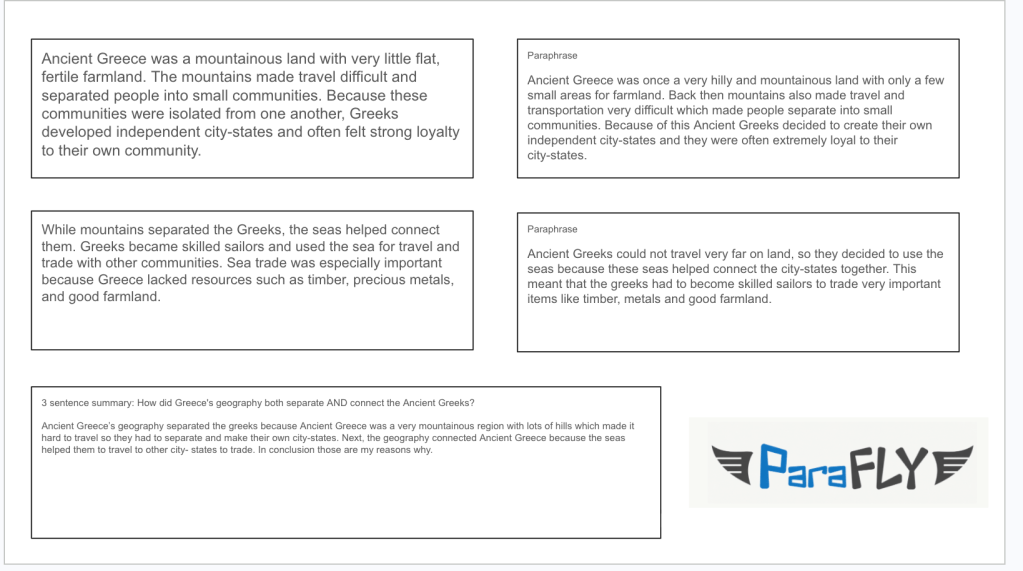
Students then completed a six-minute Parafly about the geography of Ancient Greece. The first paragraph explained how mountains made travel difficult, separated communities, and contributed to the development of independent city-states.
The second paragraph explained how the seas connected the Greeks through travel and trade. Sea trade was especially important because Greece lacked resources such as timber, precious metals, and good farmland.
Students paraphrased each paragraph and then wrote a three-sentence summary answering this question: How did Greece’s geography both separate and connect the ancient Greeks?
Map and Tell: Finding the Evidence
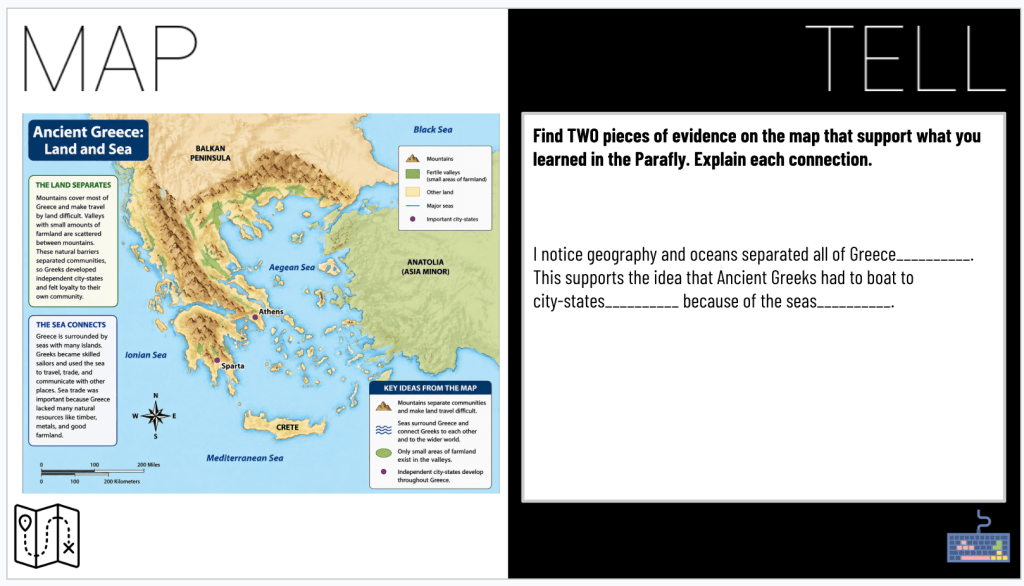
We finished with a Map and Tell. Students studied a map of Ancient Greece and found two pieces of evidence that supported what they had learned during the Parafly.
For each piece of evidence, they completed this statement:
I notice __________. This supports the idea that __________ because __________.
This final step pushed students beyond simply identifying mountains, islands, or bodies of water on a map. They had to connect what they could see on the map to what they had just read and paraphrased.
The lesson moved from vocabulary, to reading, to paraphrasing, and finally to applying the information to a map. Each activity prepared students for the next one while keeping the focus on a single question: How did geography shape life in Ancient Greece?
Friday: Seeing Geography Through Different Perspectives
Friday was about taking what students learned on Thursday and doing something with it. We stayed with the same supporting question: How did geography shape life in Ancient Greece?
Fast and Curious: One More Round
We started with another round of the Greek geography Gimkit. Students had already seen the vocabulary and basic ideas on Thursday, so this gave them another chance to build their background knowledge and improve their scores.
Reading: Geography Shapes Greek Life
Next, students read Geography Shapes Greek Life. The reading added more detail about how the mountains, seas, islands, and limited farmland affected where Greeks lived, how they traveled, and how they made a living.
Sketch and Tell-O: Four Effects of Geography
After reading, students completed a Sketch and Tell-O on paper. For the sketch, they showed four ways geography shaped life in Ancient Greece. For the tell, they wrote at least four sentences explaining how those parts of Greece’s geography affected the ancient Greeks. This gave students a chance to process the same information in two ways. First, they had to visualize it. Then, they had to explain it in writing.
3xPOV: Life in Ancient Greece
We finished with a 3xPOV. Students used what they learned from the reading to imagine how three different people might have experienced life in Ancient Greece. First, they wrote from the perspective of a Greek farmer. They considered what the farmer could grow, the challenges the land created, and the choices a farming family might have to make. Next, they became a Greek merchant. They thought about where the merchant would travel, how they would get there, and which resources they might need to trade for. Finally, they wrote from the perspective of someone who was extremely loyal to their city-state. They explained how Greece’s geography might have shaped that person’s community, daily life, and connection to other Greeks.
The 3xPOV moved students beyond listing geographic features. They had to think about how the same mountains, seas, and limited farmland could affect people differently depending on how they lived. Students turned in both their Sketch and Tell-O and their 3xPOV at the end of class. It was a solid way to close our first look at Ancient Greece and move from simply learning the geography to understanding how people experienced it.
Lessons for the Week
Thursday – Ancient Greece Rack and Stack
Friday – Ancient Greece Rack and Stack (SKATO and 3xPOV)


