A new year begins. This week was a lot of reflecting on some new practices I wanted to implement in my classroom. One of those practices was a new approach to classroom rules and procedures. Oftentimes, teachers talk about preparing students for the “real world.” We say things like we are teaching students a life lesson by not giving them a pencil or helping them when they forget something. I don’t know. That rarely works. Sorry.
Instead, I started thinking about my own life and what the “real world” actually looks like. I have a lot of different roles in my life. I’m a dad, husband, teacher, coach, and a bunch of other things. I have routines that help me get through my day. I have rights and I have responsibilities. The more I thought about these things, the more I realized they naturally belong in a classroom too. The result was four things: roles, routines, rights, and responsibilities.
I literally wrote each word on a piece of paper and taped them up in my classroom. Under roles, students are learners, leaders, teachers, writers, thinkers, listeners, mistake makers, and more. We also have our learning routines. For us, those routines are EduProtocols. The content will constantly change throughout the year, but students will become familiar with how we learn.
Students also have rights in my classroom. They have the right to learn, the right to feel safe, the right to make mistakes, and the right to ask questions. With those rights come responsibilities. Students have a responsibility to manage themselves and their space, manage their Chromebook, show up on time, listen while others are speaking, and contribute to the learning of others. None of these things are groundbreaking, but I like how they naturally connect back to how I structure my classroom with EduProtocols and learning.
Wednesday
The Marker Game
For the first day of school, I stole a Dominic Helmstetter classic. I wanted to begin class with a Fast and Curious, but we didn’t have working Chromebooks yet. Instead, Fast and Curious became the Marker Game. The Marker Game is pretty simple. Students partner up, face their desks toward each other, and stand a dry erase marker between them. I read a statement about myself or the classroom that is either true or false. If students think the statement is true, they try to grab the marker before their partner. If they think it’s false, they don’t touch it.
It’s fun, active, loud, and there were a lot of laughs. It was also an easy way for students to learn some things about me and the classroom.
The 90s Thin Slide
Next, we moved into a Thin Slide, except we didn’t use a slide. Students used an index card. I used AI to create some pictures of myself in the 90s doing things that either don’t really exist anymore or might seem completely strange to kids today. I showed students the pictures and gave them three minutes to synthesize what they thought life was like in the 90s. Just like a Thin Slide, they could use one picture and one word.
I got words like “weird,” “slow,” “colorful,” and a bunch of others.
Sketch and Tell-O: Your Generation
From there, we went into a Sketch and Tell-O. I gave students a scenario: The year is 2056 and a historian is studying your generation. What four things would they think were weird? Students had to draw and label four things that they thought would stand out to someone studying their lives 30 years from now.
When they finished drawing, they discussed their ideas with a partner for one minute and then spent three minutes writing about their choices.
Overall, it was a solid first day. The students got to know a little about me, I got to see a little of their personalities, and we were able to get some early reps with learning routines we will use throughout the year. We didn’t spend the entire class going through a syllabus or talking about rules. Instead, the students were doing some of the things I want them doing all year. They looked at information, made some decisions, created something, talked to each other, and wrote.
Thursday
What Should Learning Look and Sound Like?
On Thursday, we began class with a Frayer. Instead of using the Frayer for content, I wanted students to think about what learning should actually look and sound like in our classroom. I divided the Frayer into four different situations: independent work, partner work, group work, and whole class work. Students had to describe what each should look like and sound like.
This was a good way to get students to see that there is more than just content to learn in class. There is also more than just me, the teacher, that makes a classroom work. We all have to work together to learn.
This also gave me a chance to connect back to the roles, routines, rights, and responsibilities I introduced earlier. Students have a role in their own learning, but they also have a role in helping others learn. There are going to be times this year when we work independently, with a partner, in a group, or as an entire class. Each of those situations looks and sounds a little different. If we understand our roles and responsibilities, I shouldn’t have to constantly tell students what they should be doing.
Hexagonal Thinking
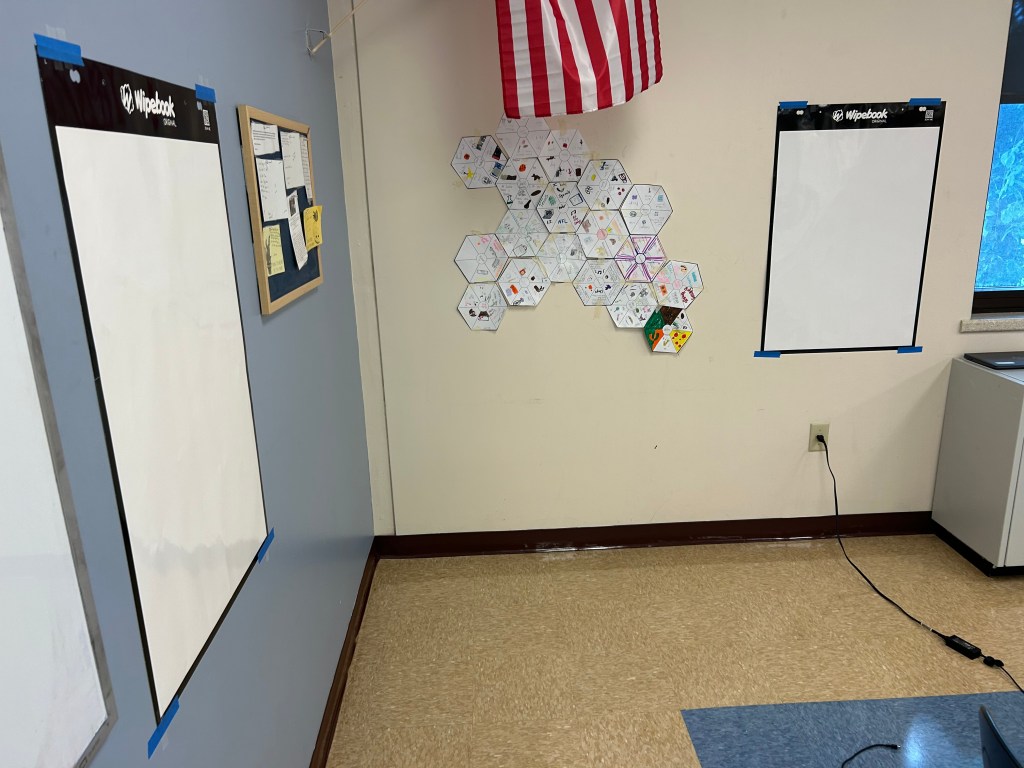
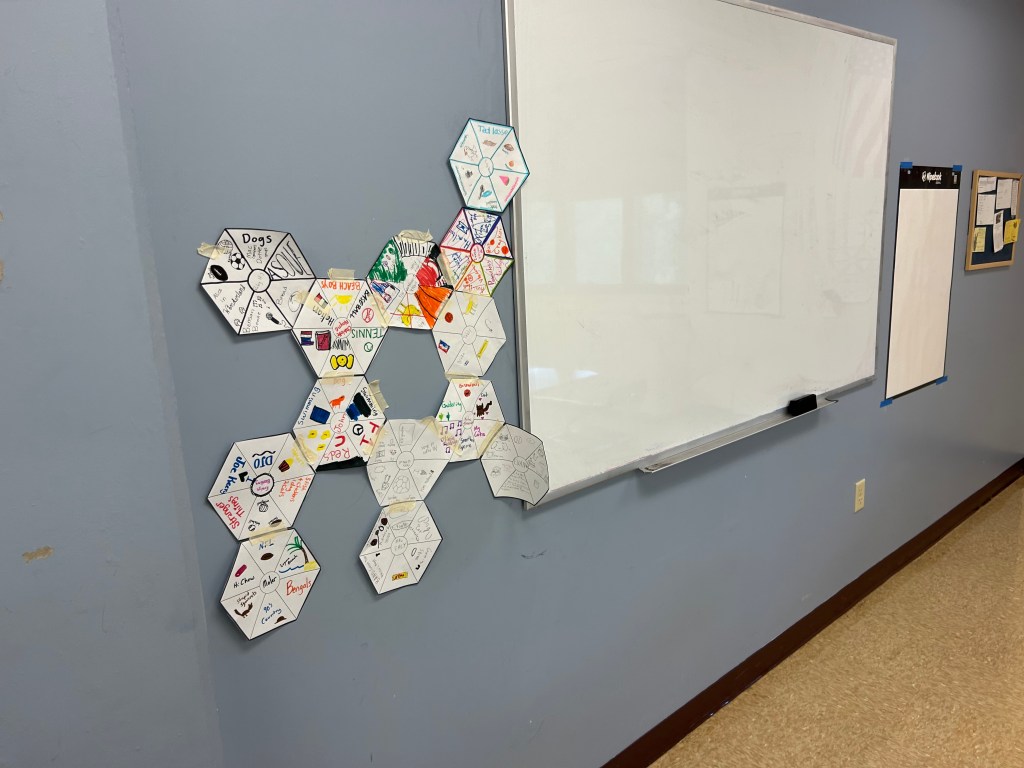
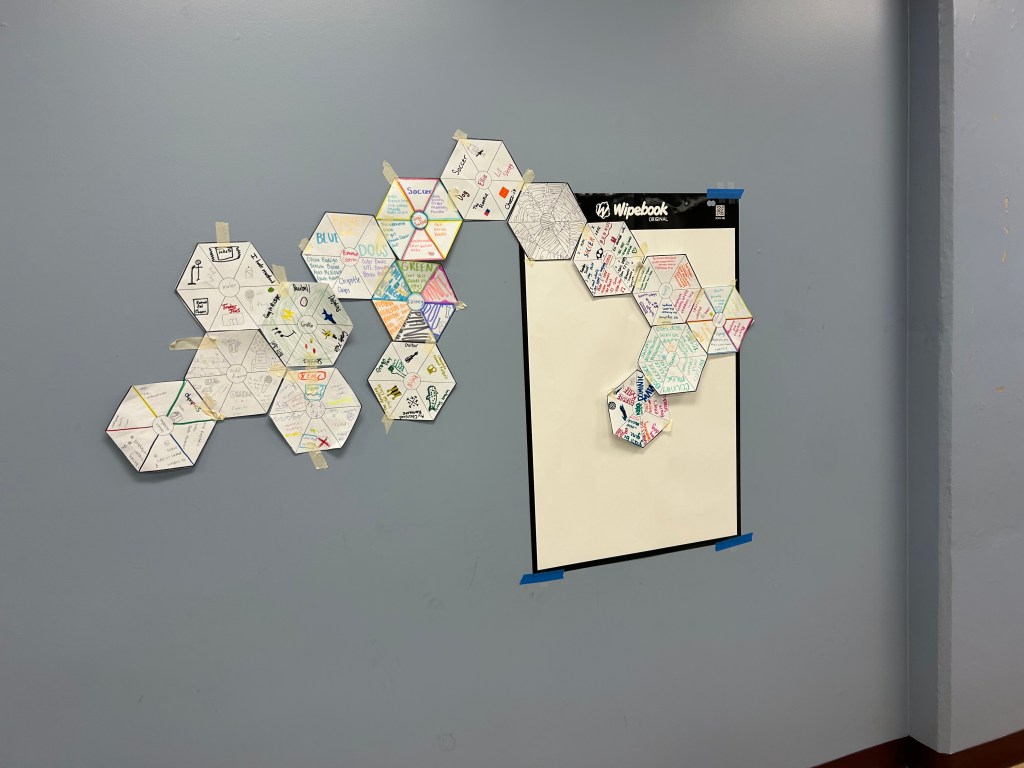
Next, we transitioned into Hexagonal Thinking. I gave every student a hexagon divided into six sections and had them fill it with information about themselves. Once everyone finished their individual hexagon, the challenge became figuring out how everyone in the class connected.
Students had to find connections between their hexagons and tape them together within a confined space. The confined space added a little design thinking element because they couldn’t just spread the hexagons all over the floor. They had to think about where things went, make connections, move things around, and most importantly, talk to each other.
For this part, I sat back and watched. The students ran it. They had until the end of class to figure out how to connect everyone and fit all of the hexagons into the space. There were discussions, disagreements, moving hexagons around, finding new connections, and students trying to figure out where everyone belonged. I didn’t need to jump in and solve it for them.
They did awesome.
What I liked most about the lesson was that it went right back to what we had discussed earlier in the Frayer. The classroom doesn’t work because the teacher tells everyone what to do. Students have roles and responsibilities too. They had to listen to each other, communicate, solve a problem, and help the class accomplish something together. We weren’t really learning social studies content yet, but we were learning how our classroom is going to work.
Friday
Friday Check-In
On Friday, I started class by sharing a Google Form with a Friday check-in. The form had a combination of questions about engagement, including things like what types of lessons have engaged you in the past, along with some other questions that will hopefully help me become a better teacher for these students. I have never taught most of these kids before, so instead of assuming I know what works for them, I figured I should probably ask.
I also added one question that confused a lot of the students:
“Write about a snowman.”
That’s it. Write about a snowman.
Students thought it was a weird question, and I got all kinds of responses. Here are two examples:
- They are made of snow, tall, have a carrot nose, sticks as arms, buttons, and are cold.
- A snowman was lost in the woods. He had been lost for years and years and couldn’t find his way out of the thick forest, until he met another snowman. The other snowman led him out of the forest so he wouldn’t be so lost anymore.
Same directions. Two completely different ways of thinking.
You will have sensing students who tend to be more concrete and to the point. Then you have intuitive students whose minds may immediately go somewhere more creative. Neither student ignored the directions. Neither response was wrong. They just approached the exact same prompt differently.
I think that’s important to remember. The next time you start to feel like students aren’t listening to directions, or you find yourself saying, “I told them three times,” remember that perhaps they are listening. Their mind may just go somewhere different first. We all think differently. That’s why I asked students to write about a snowman.
Sketch and Tell-O the Syllabus
After the check-in, I finally handed out my syllabus. Instead of reading through the entire thing to the students, I paired it with a Sketch and Tell-O. Students read the syllabus and had to sketch and label four things that stood out to them or they thought were the most important.
When they finished, they discussed their choices with a partner for two minutes and then spent another two minutes writing about why they chose those things.
Once they finished, I spent around 5-10 minutes going over a few of the things from the syllabus that I actually needed to explain, including the grading system and a few other important pieces. I didn’t need to read every word to them. They had already read it, decided what they thought was important, discussed it, and wrote about it. I could fill in the gaps.
FlipSwitch
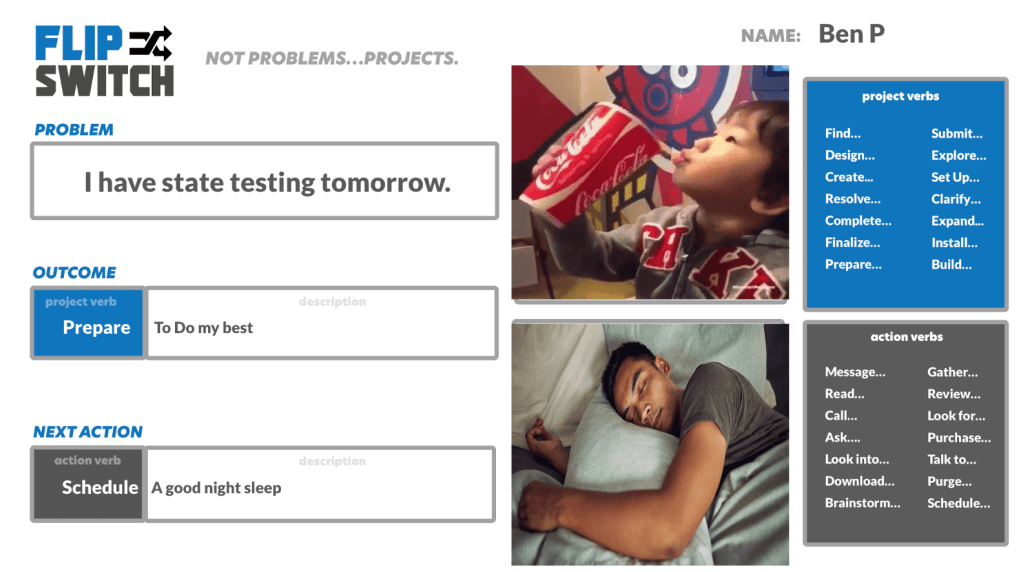
Time permitting, we finished class with a Mark Wallace special, FlipSwitch. FlipSwitch starts with a problem. From there, students identify the desired outcome using an action verb. I like this because oftentimes we know what we want the outcome to be, but we don’t think about what we actually need to do to get there. If we don’t figure out that first action, the problem usually doesn’t get solved.
The next part of FlipSwitch is identifying a next step, again using an action verb. Students can then sketch, write, or even add a GIF showing what solving and not solving the problem would look like.
For our first rep, I gave students a pretty common classroom problem: My Chromebook is dead.
Now what?
The students had to determine the desired outcome and, more importantly, what action they could actually take to begin solving the problem. We had some great conversations and some funny conversations, but underneath all of it students were practicing how to actually respond when a problem comes up instead of just sitting there with the problem.
I really like FlipSwitch for executive functioning skills, and I think there are a lot of places I could take it this year. It could be something we use when common classroom problems come up, but I could also see using it within social studies content. Problems happen. We usually know what we want to happen instead. The hard part is figuring out what we are actually going to do next.
Lessons
Wednesday – Sketch and Tell-O
Thursday – Frayer, Hexagonal Learning
Friday – FlipSwitch Example


