
This week in 103, we built on our work with Greek geography, city-states, and governments by taking a closer look at Athens and Sparta. Monday and Tuesday focused on how life differed between the two, with students moving from maps and partner readings to scenarios and writing about a day in the life of an Athenian, a Spartan, and themselves.
From there, exploring Athenian democracy felt like the natural next step. On Wednesday and Thursday, we worked through what democratic means, sketched the parts of Athens’s government, and began examining primary sources. Those activities gave students a foundation for considering the question that would guide our next few lessons: Was Ancient Athens truly democratic?
Monday: How Different Were Athens and Sparta?
After exploring Greek city-states and their governments, we turned our attention to Athens and Sparta. Both were Greek city-states, but daily life looked different depending on which one you called home.
Fast & Curious and Map & Tell
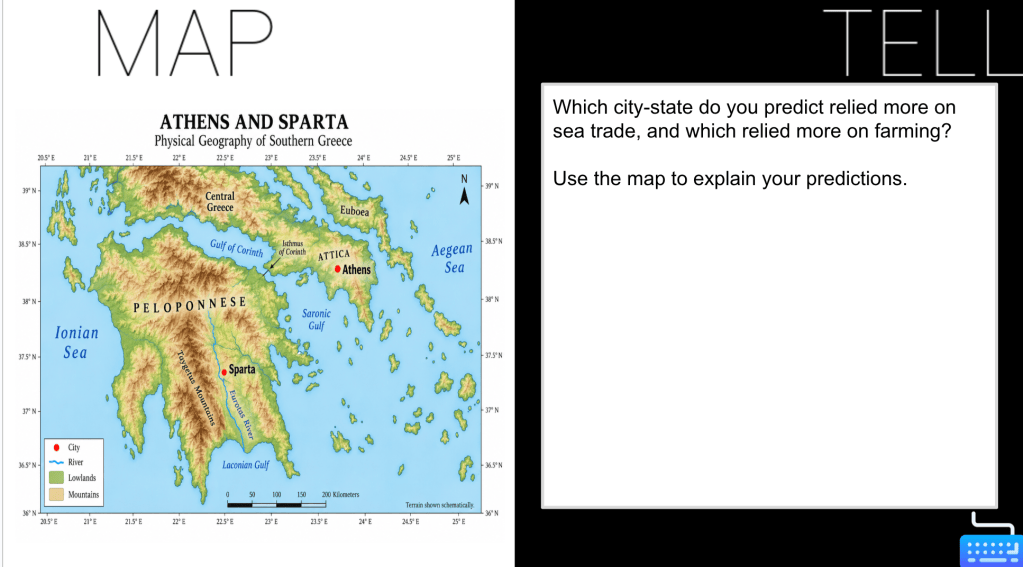
We started with Fast & Curious on Gimkit, followed by a Map & Tell to locate Athens and Sparta. Students used the map to predict which city-state relied more on sea trade and which relied more on farming. This brought us back to our earlier work with geography and how location could shape the way people lived.
CyberSandwich: Two Readings, One Comparison
Then we moved into CyberSandwich. I handed out two different readings, with one partner reading about Athens and the other reading about Sparta. Students read and took notes on their assigned city-state, looking at geography, government, education, and social life.
Partners then compared their notes. Each student brought different information to the conversation, so they needed to share what they had learned while gathering information about the other city-state. The categories helped organize that discussion and gave them specific points to compare.
Writing About Both City-States
From there, students wrote a summary using a compare-and-contrast text structure. Their notes and partner conversations gave them information about both places. Now they needed to organize those details into an explanation of how Athens and Sparta were alike and different.
I like giving the partner discussion a clear purpose. Students needed information from each other to complete the writing, and the comparison gave them a reason to look closely at both readings.
Tuesday: Putting the Details to Work
Monday gave students a foundation for comparing Athens and Sparta. On Tuesday, we returned to that information and asked students to apply it, first through scenarios and then through writing from different perspectives.
Fast & Curious and City-State Scenarios
We started with another round of Fast & Curious on Gimkit. Then, I used ChatGPT to create scenarios about life in each city-state. Students had to decide whether each scenario applied to Athens or Sparta and explain their reasoning.
The explanation mattered here. Students needed to connect details in the scenario to something they had learned about the city-state. That gave us another opportunity to revisit the differences in education, government, geography, and daily life.
3xPOV: A Day in the Life
We finished with a 3xPOV: a day in the life of an Athenian, a Spartan, and themselves. Students used details from their learning to describe life from each perspective.
Including themselves gave students a familiar point of comparison. They could consider their own schooling and daily routines alongside what they had learned about Athens and Sparta.
Across the two days, students kept working with the same information in different ways. They located the city-states, read about one, learned about the other from a partner, and wrote a comparison. The scenarios and 3xPOV then asked them to use those details to explain where a situation belonged and how someone’s daily life could change depending on where they lived.
Wednesday: Was Ancient Athens Truly Democratic?
After comparing Athens and Sparta, exploring Athenian democracy felt like the natural next step. I found a lesson from the Digital Inquiry Group (DIG) and drew some inspiration from Drew Skeeler. The question that would guide our next few days was: Was Ancient Athens truly democratic?
Before students could answer that, we needed to spend some time with the word democratic and learn more about how Athens’s government worked.
Fast & Curious and a Frayer
We started with Fast & Curious on Gimkit to build background knowledge about Athens and introduce vocabulary. Then, we “Frayered” the word democratic.
Students read a brief passage and used it to create a definition, identify examples and non-examples, and predict what a true democracy would look like. That last part gave us something to return to as we examined Athens. What would students expect to see in a democratic government, and how would Athens compare?
Building a Visual
Next, I showed a TED-Ed video about Athenian democracy. I wanted students to begin building a picture of the Assembly, the Council of 500, and the courts before we took a closer look at each one.
The Frayer gave us a starting point for thinking about democracy, and the video introduced the structures we would work with on Thursday.
Thursday: How Did Athenian Democracy Work?
On Thursday, we picked up with the parts of Athenian government students had seen in the video. Now they would read about each one and make decisions about how to represent it.
Sketch & Tell-O: What They Did and How They Were Chosen
We started with a Sketch & Tell-O focused on the Assembly. Students read about it, sketched what it did, and added a caption. Underneath that, they sketched how citizens became part of the Assembly and captioned that drawing, too. I put three minutes on the timer for the round.
Then we repeated the process with the Council of 500 and the courts. Each round asked students to consider the same two things: what that part of government did and how citizens became involved.
I like separating those questions because knowing a group’s job only tells us part of how a government works. Looking at how people become part of that group brings us back to who has access to power.
Two Documents, Two Views of Democracy
We finished class by reading two documents: one from Pericles and one from Aristotle’s Athenian Constitution. Students highlighted details that stood out to them and used the documents to create a Thick Slide.
The slide asked for two facts from each document related to democracy, a quote that stood out, and a comparison of how the two documents portrayed Athenian democracy. Students had to choose details from both sources and consider how those details fit together.
Our question carried through both days. We started by considering what democratic means, looked at how Athens’s government operated, and then began examining documents. Each step gave students more information to work with as they considered whether Ancient Athens was truly democratic.
Lessons for the Week
Monday – Athens vs. Sparta Rack and Stack
Wednesday – DIG Athens Lesson, Day 1 Rack and Stack
Thursday – Day 2 Rack and Stack

 Moler's Musings