
This week in 103, we continued our study of the Roman Republic. We began with what Roman laws tell us about their society and ended with Julius Caesar and the breakdown of checks and balances. Along the way, students read, sketched, discussed, ranked, and created. Some lessons took longer than I expected. Other days, we accomplished more than I had planned.
Here is how the week came together.
Monday – What Did the Romans Value?
On Monday, we began with a Fast and Curious using Gimkit to review the Roman Republic. From there, we moved into the Twelve Tables and Roman laws. Our focus for the lesson was, “Based on the Twelve Tables, what did the Romans value?”
Students started with a loosely translated version of the Twelve Tables and some basic questions. This part was almost like a scavenger hunt. Students had to find the answer and cite the table it came from. I wanted them getting familiar with the laws and practicing finding evidence before answering our larger question.
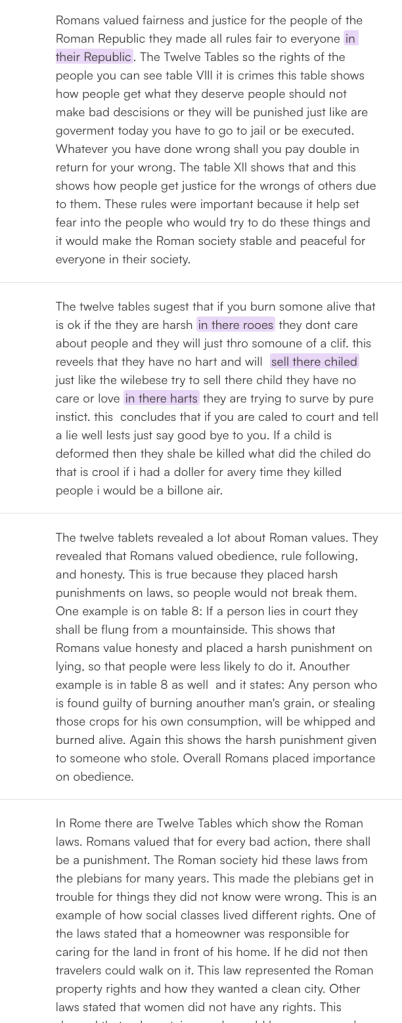
Next, we went to Scriblit, where students used evidence from the tables to explain what the Romans valued. This required them to think about what the laws protected and what the punishments suggested was important to Roman society.
The Twelve Tables questions took longer than I anticipated. The Scriblit response did too. Finding a law is one thing. Explaining what that law tells us about a society takes a little more time.
For classes with time remaining, I had three “dumb criminal” cases ready. These were real-life cases, and students had to use their knowledge of Roman law to explain how the criminal would have been charged and punished in ancient Rome. They also had to cite the table that supported their answer.
I like this kind of application because it gives students another reason to return to the reading. They have to figure out which law applies and explain how they would use it in a different situation.
Tuesday – Cincinnatus and Civic Duty
Tuesday’s lesson was fairly simple. We focused on civic duty and the story of Cincinnatus. I wanted students thinking about what it means to serve your community and how someone’s actions can show that responsibility.
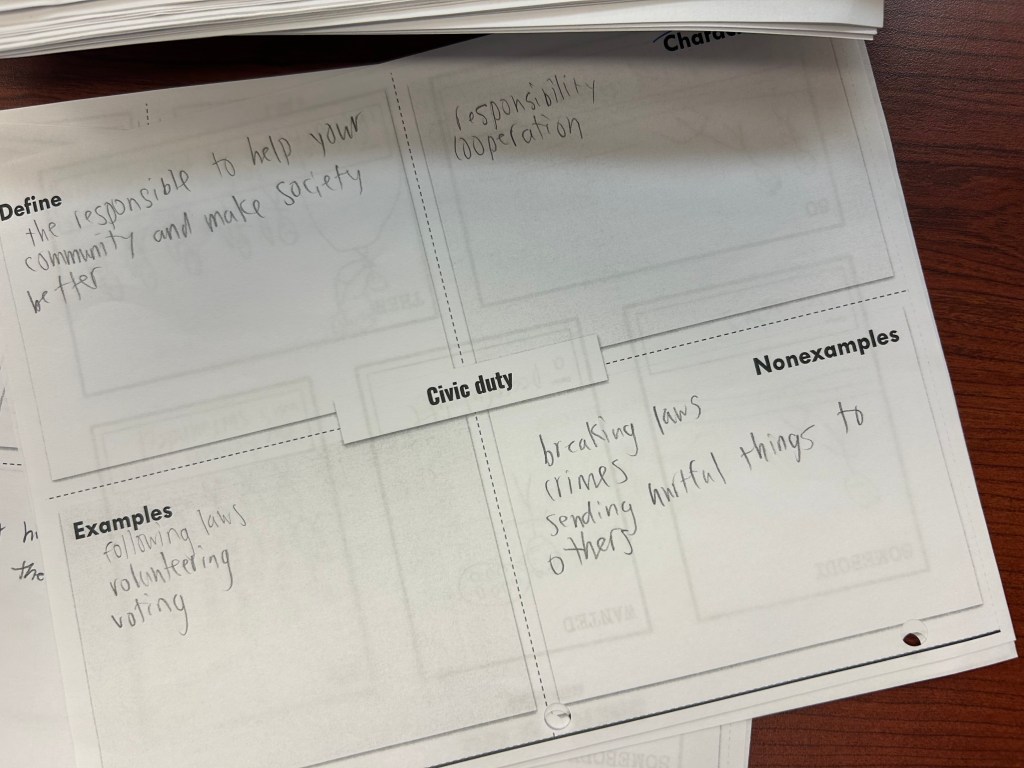
We began with a Frayer for civic duty. I like using a Frayer before a reading because it gives students a chance to work through a concept they will need to understand the story. Examples are especially helpful with something like civic duty. Students need to think about what it looks like when someone takes responsibility for helping their community.
After the Frayer, we read about Cincinnatus. His story centers on accepting power during an emergency and then giving it up when the job was finished. This gave us a specific example of civic duty to consider.
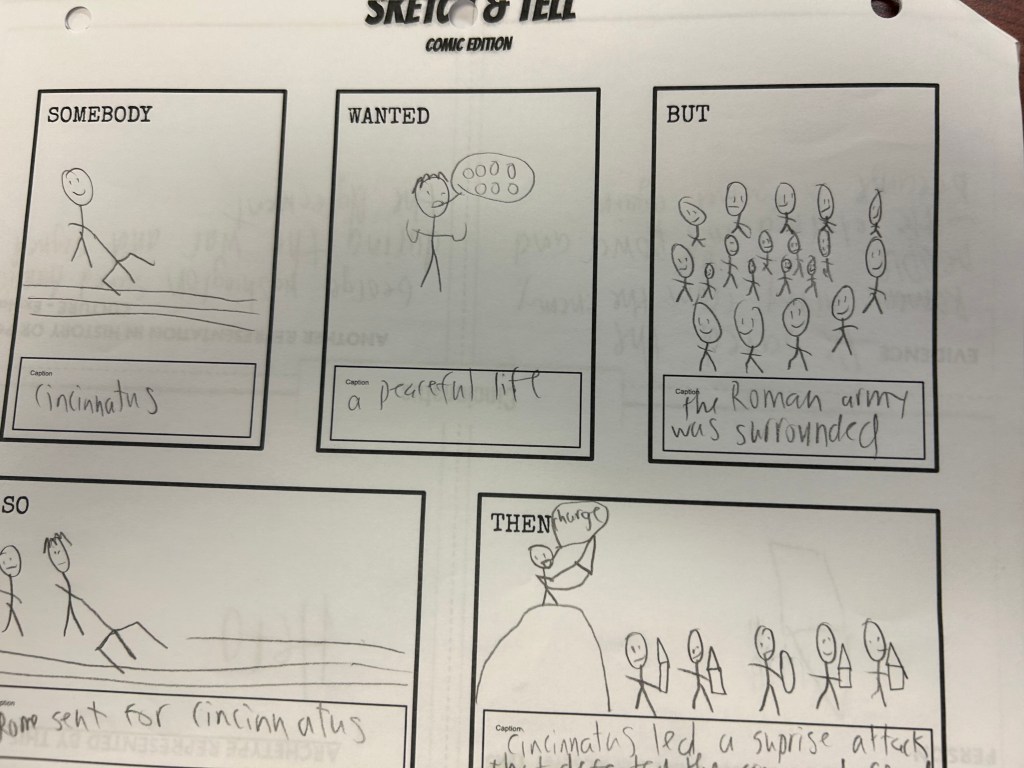
Students mapped out the reading with a Somebody-Wanted-But-So-Then Sketch and Tell. They had to identify the important parts of the story, put them into a summary, and create a picture to go with it. I like this format because it gives students a structure for organizing a story without asking them to retell every detail.
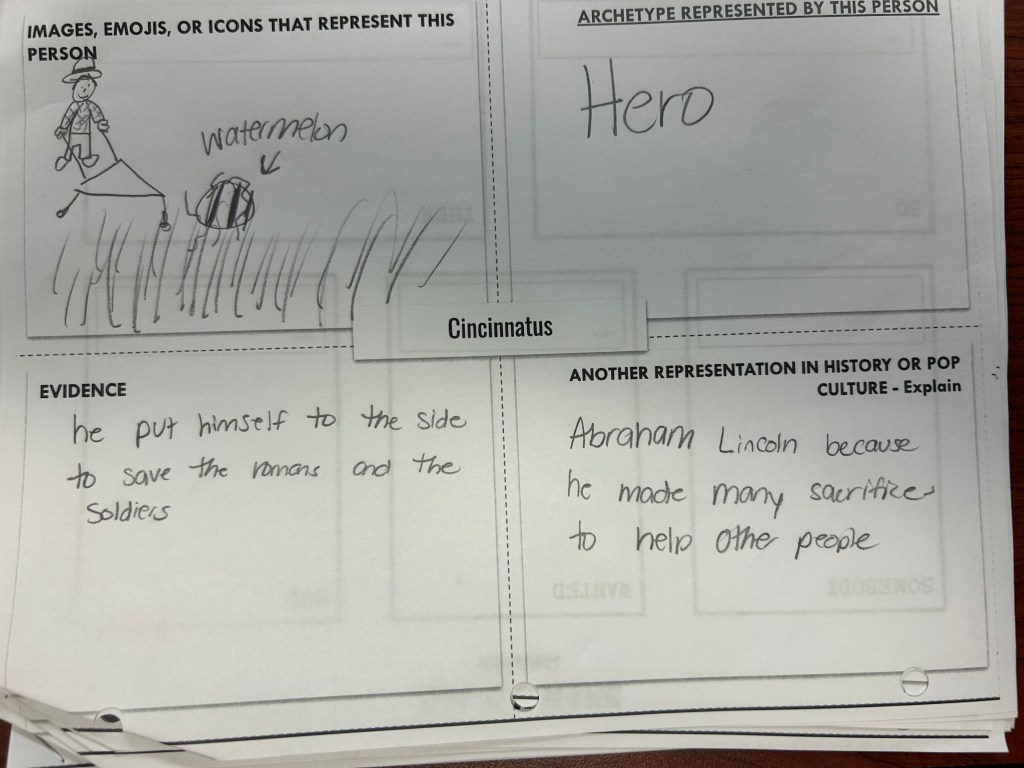
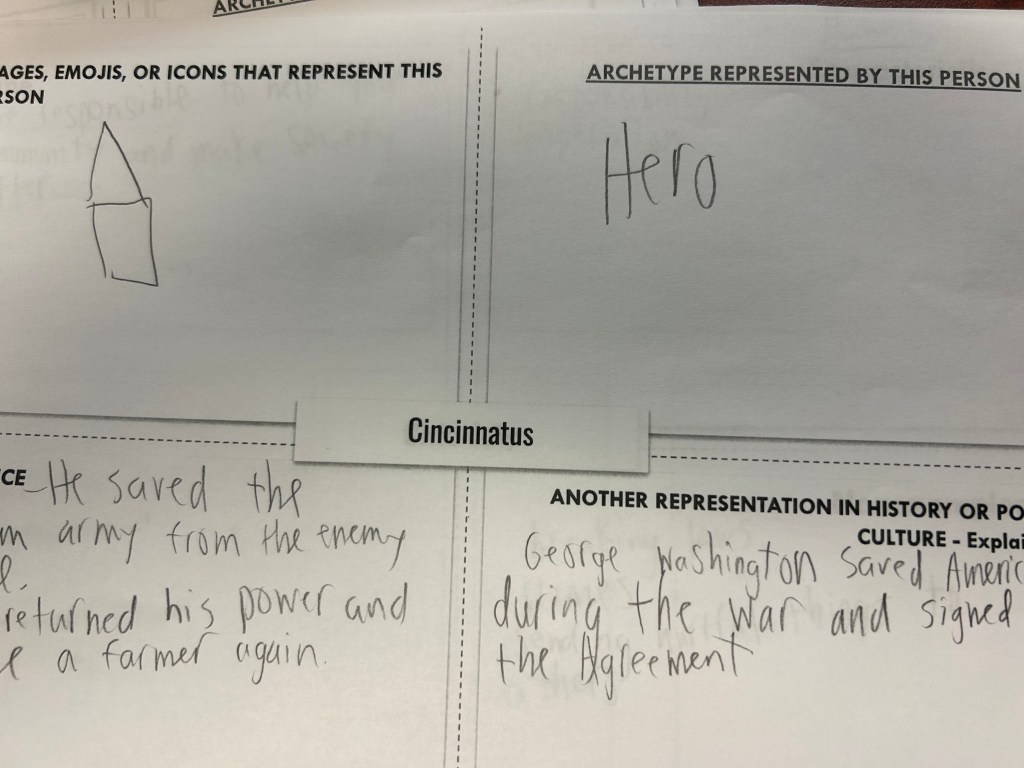
We then returned to the same reading for an Archetype Four Square. Students had to decide which archetype best fit Cincinnatus and explain their choice using his actions from the story. They also had to relate him to someone else who shared those characteristics.
This is the part I like about using archetypes. Students have to make a choice and explain it. Calling someone a hero is easy. Explaining which actions make that person a hero, and connecting those actions to another person or character, requires more thought.
The sequence gave us three ways to work with the same idea. The Frayer introduced civic duty, the Sketch and Tell helped students organize Cincinnatus’s story, and the Archetype Four Square asked them to think more closely about his character.
It also gave us someone to return to later in the week. Cincinnatus gave up power when his job was finished. That decision would be useful to remember when we got to Julius Caesar.
Wednesday – The Punic Wars in 30 Minutes
Wednesday was a 30-minute class, so I needed a sequence that would get students into the Punic Wars and give them time to do something with what they learned. We used a Wicked Hydra, Sketch and Tell-O, and a Tier List.
We began with an image and three minutes to ask questions. I did not introduce the Punic Wars or explain what students were looking at. I put them into groups and told them to ask questions.
The image gave them plenty to work with. Students asked why people were riding elephants, why buildings were on fire, what body of water they were looking at, and why some people appeared larger than others.
I like starting this way because students can participate before they know the content. They can look closely, notice something unusual, and ask about it. The elephants certainly helped.
Sketch and Tell-O
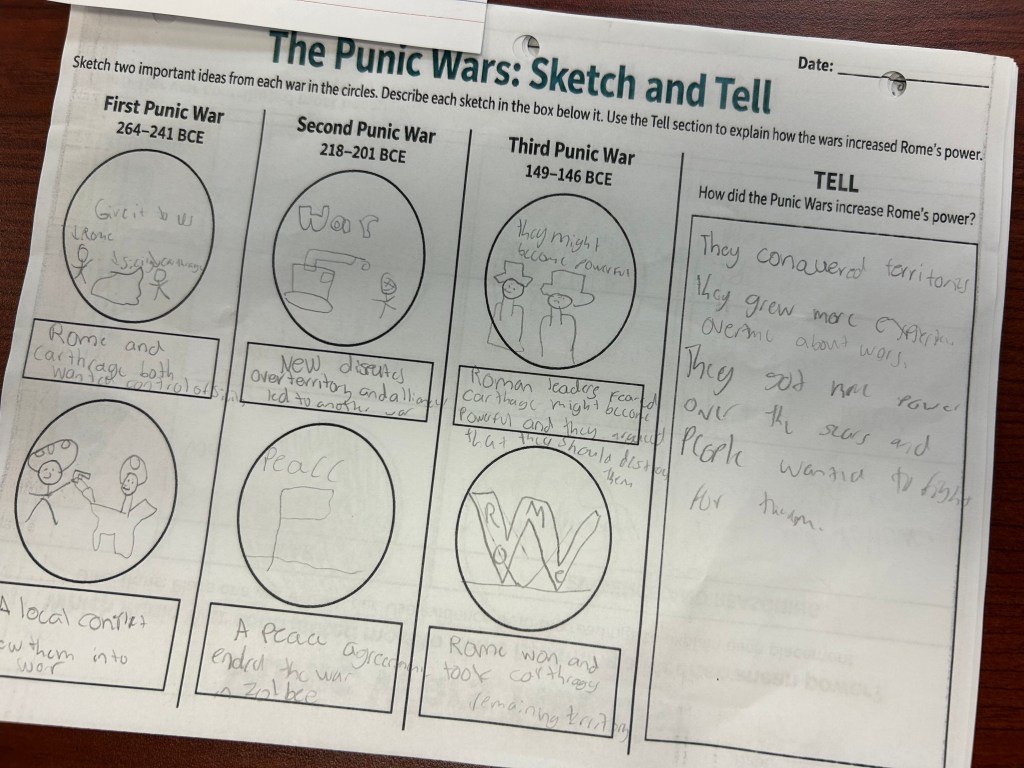
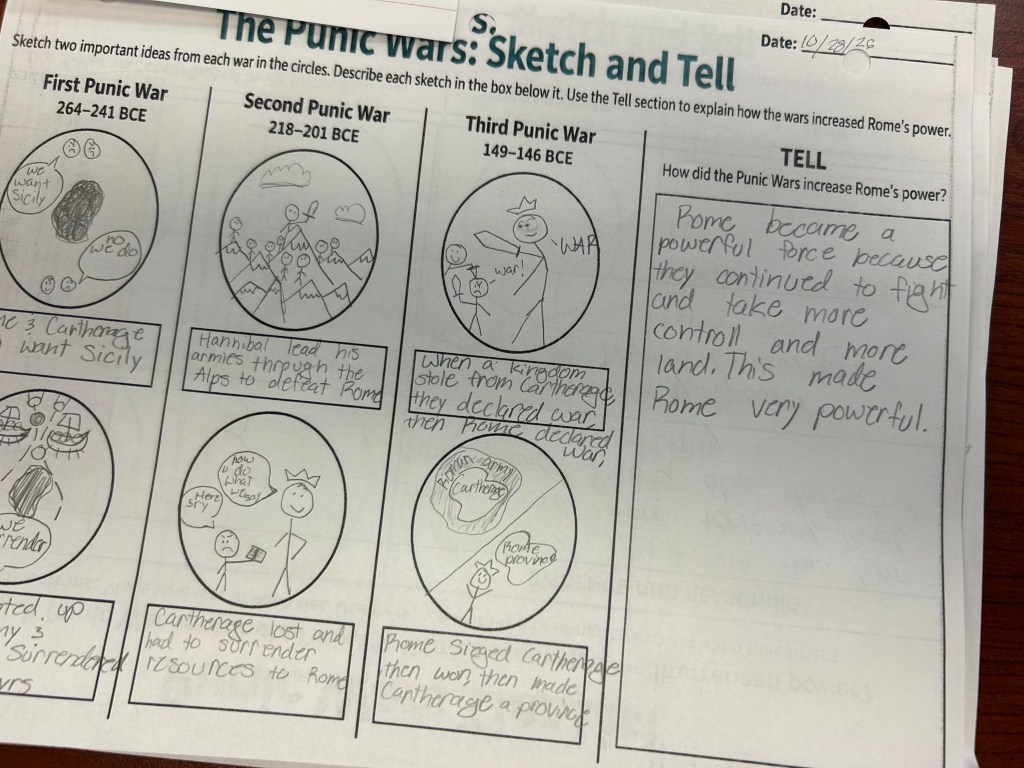
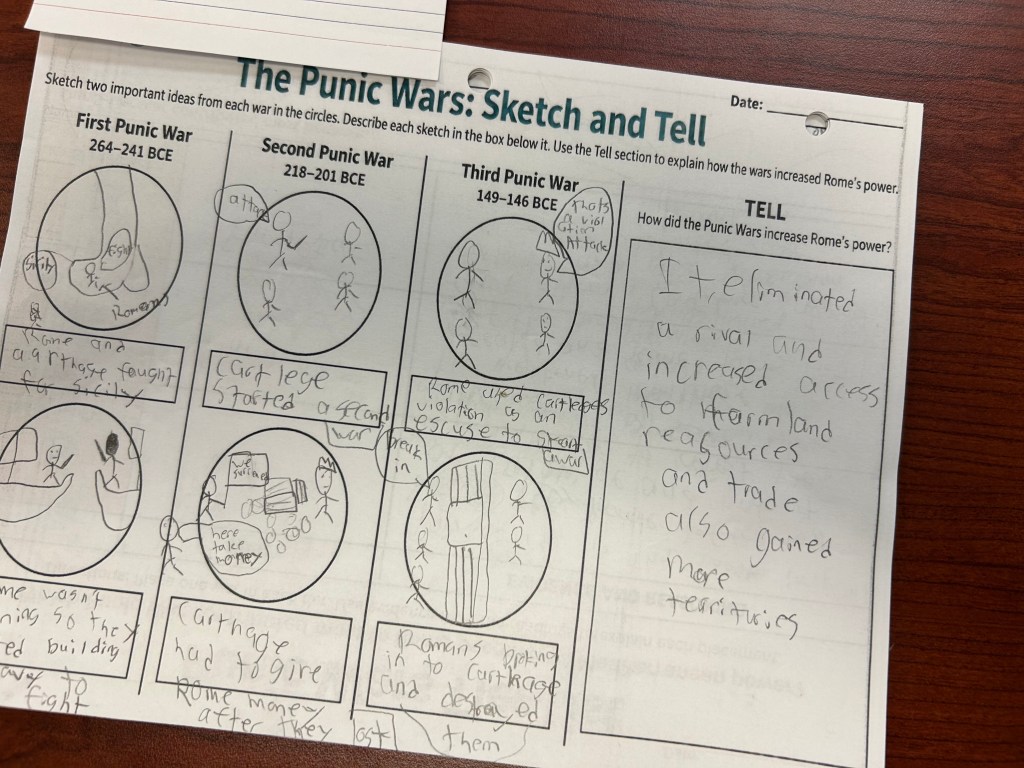
Next, students worked through three chunked readings, one for each Punic War. We paired the readings with a Sketch and Tell-O, spending about 15–20 minutes reading, sketching, sharing, and explaining.
Students sketched two important ideas from each war and described their sketches in the boxes underneath. At the end, they answered the larger question: “How did the Punic Wars increase Rome’s power?”
Splitting the reading into three sections helped keep the wars organized. Students could work through one war at a time while building toward an explanation of how all three changed Rome.
I also like having students sketch what they read. They have to decide which ideas are important and figure out how to represent them. The written explanation gives them a chance to make the meaning of the drawing clear. Artistic ability is not what I am looking for here. I want to see what students understood from the reading.
Tier List – Which War Mattered Most?
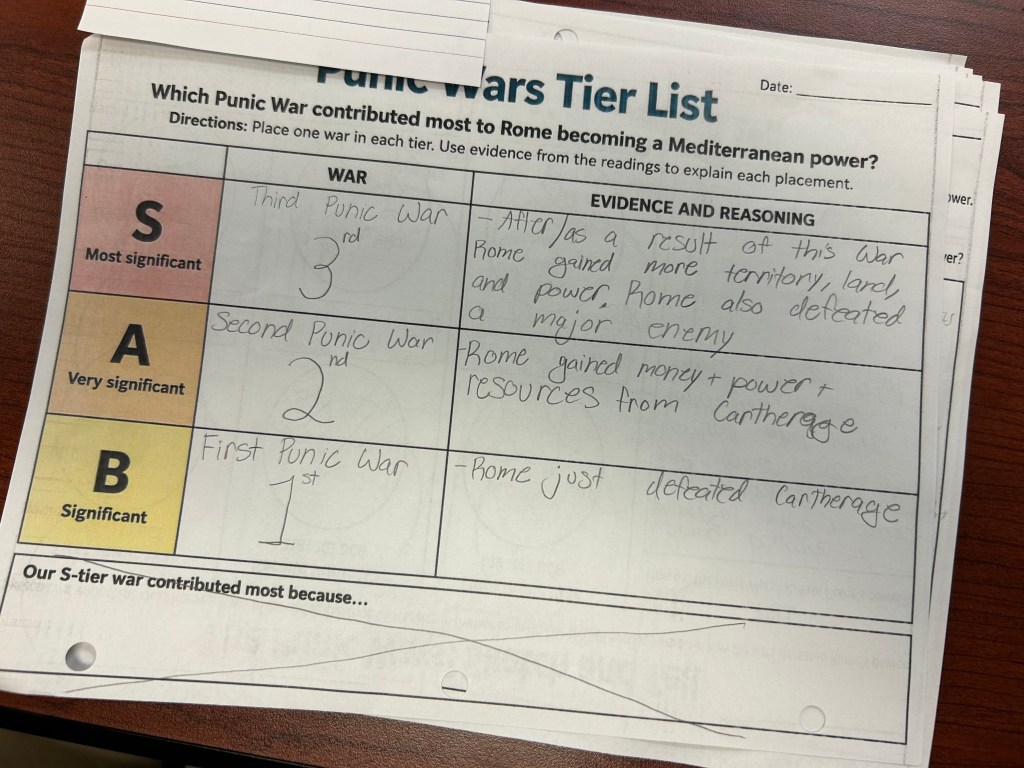
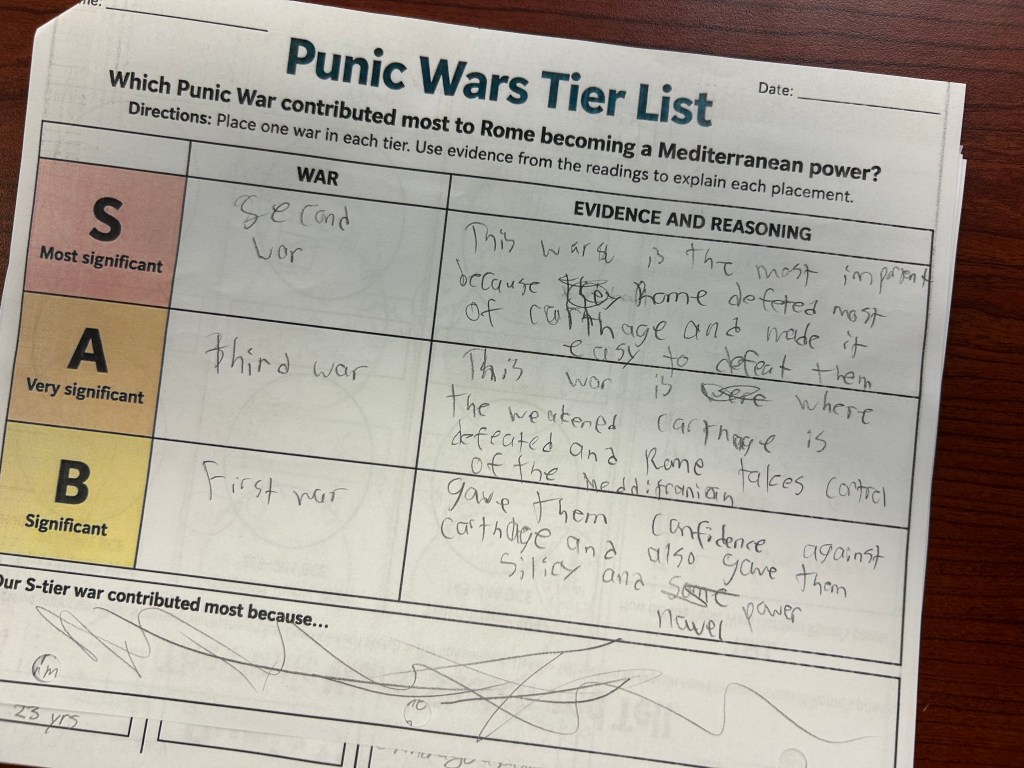
We finished with a Tier List. Students ranked the three Punic Wars based on their significance to Rome becoming a Mediterranean power. They placed the wars in S, A, and B tiers and used evidence from the readings to explain their choices.
This led to some great discussions and debate. Students had the same three wars and the same readings, but they still had to decide what counted as the strongest reason for placing one war above another.
I like a Tier List for this kind of task because it gives students a decision to make. They cannot put everything at the top. They have to compare the wars, return to the information, and explain why one contributed more than another.
For a 30-minute class, this sequence gave us a lot to work with. Students began by asking questions about an unfamiliar image, organized information through sketches and explanations, and finished by making an argument about Rome’s growing power.
Thursday – Why Was the Republic Falling Apart?
Thursday was one of those days where we accomplished more than I expected. We worked through the problems facing the Roman Republic, collected notes from whiteboards, and used the Gracchus brothers for another Archetype Four Square. We even had about 10 minutes left for a Gimkit review.
After Wednesday’s lesson on the Punic Wars, I wanted students thinking about what happened as Rome grew. Rome was becoming more powerful, but what did that mean for the people living there?
Iron Chef Whiteboards
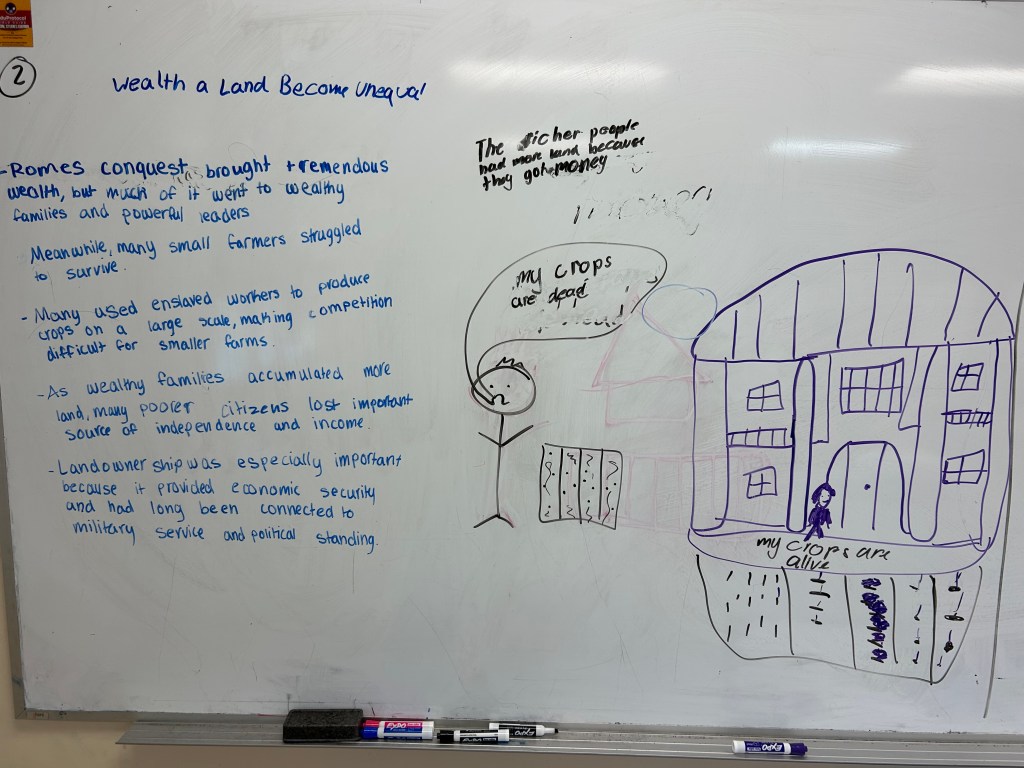
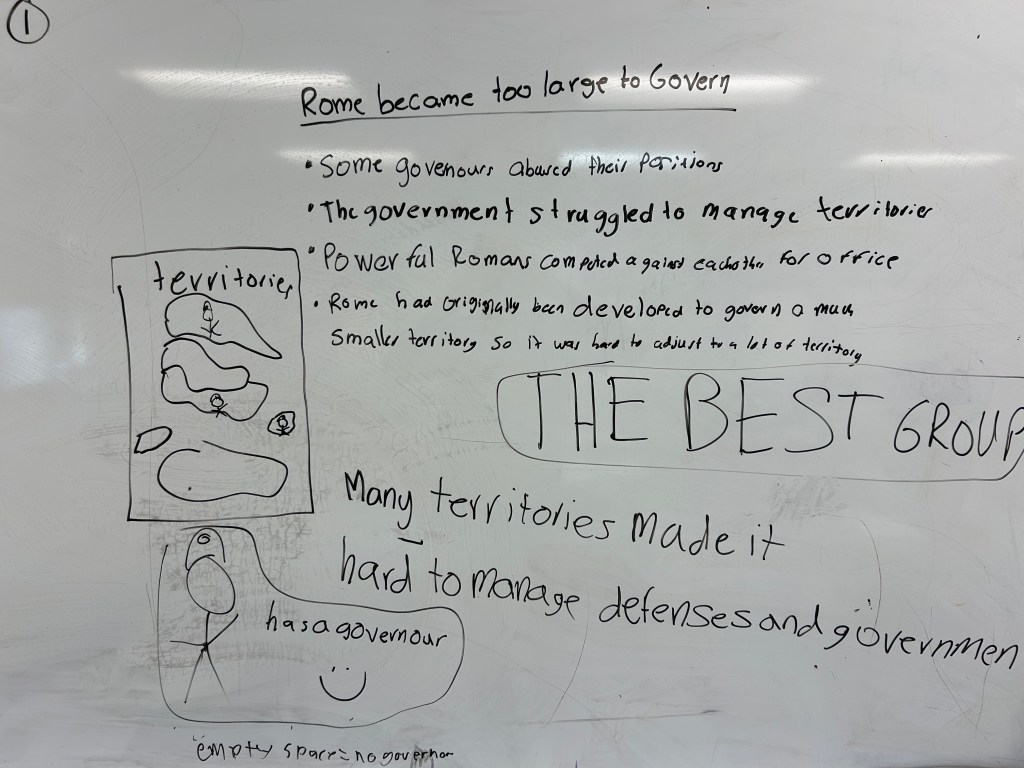
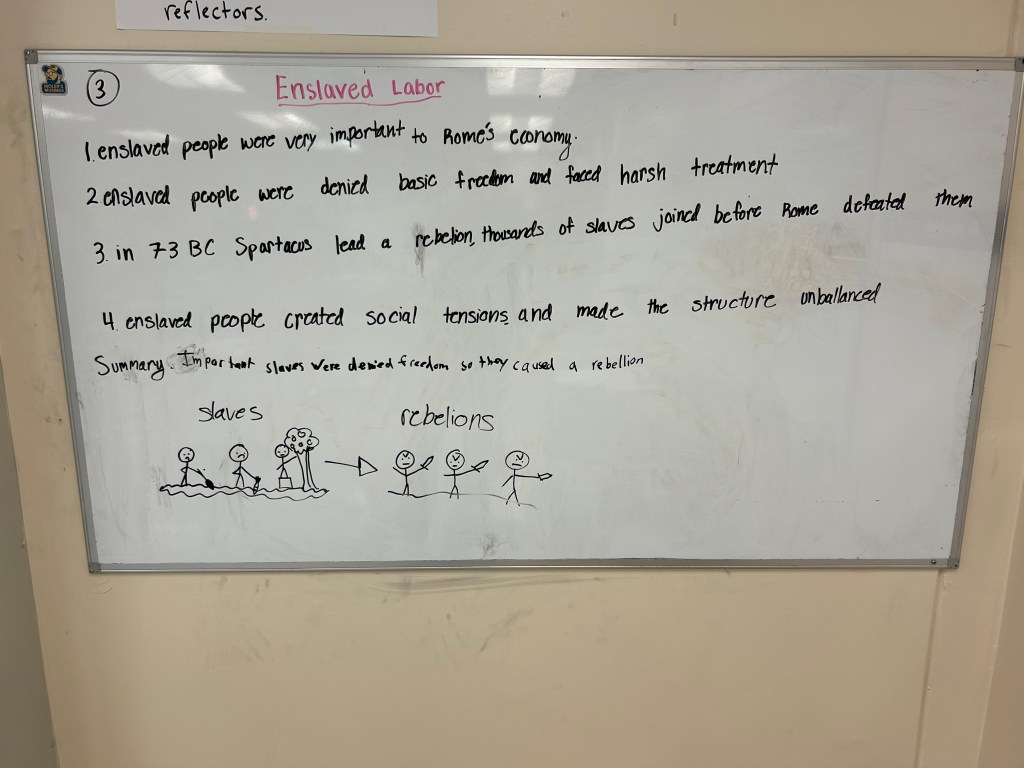
We began with an Iron Chef on whiteboards. I handed out four different readings about reasons for the Republic’s decline. Students had two minutes to read and eight minutes to create a board with four important facts, a title, a picture, and a 10-word summary.
I like using whiteboards for this because students have to work together and make decisions fairly quickly. They need to decide which facts matter, how to illustrate the topic, and how to summarize it in exactly 10 words. That last part can take some negotiating.
The picture also gives students another way to explain the reading. One board about unequal wealth and land showed a struggling farmer beside a much larger farm. The drawing helped communicate the problem students were describing in their facts.
A Frayer and a Walk Around the Room
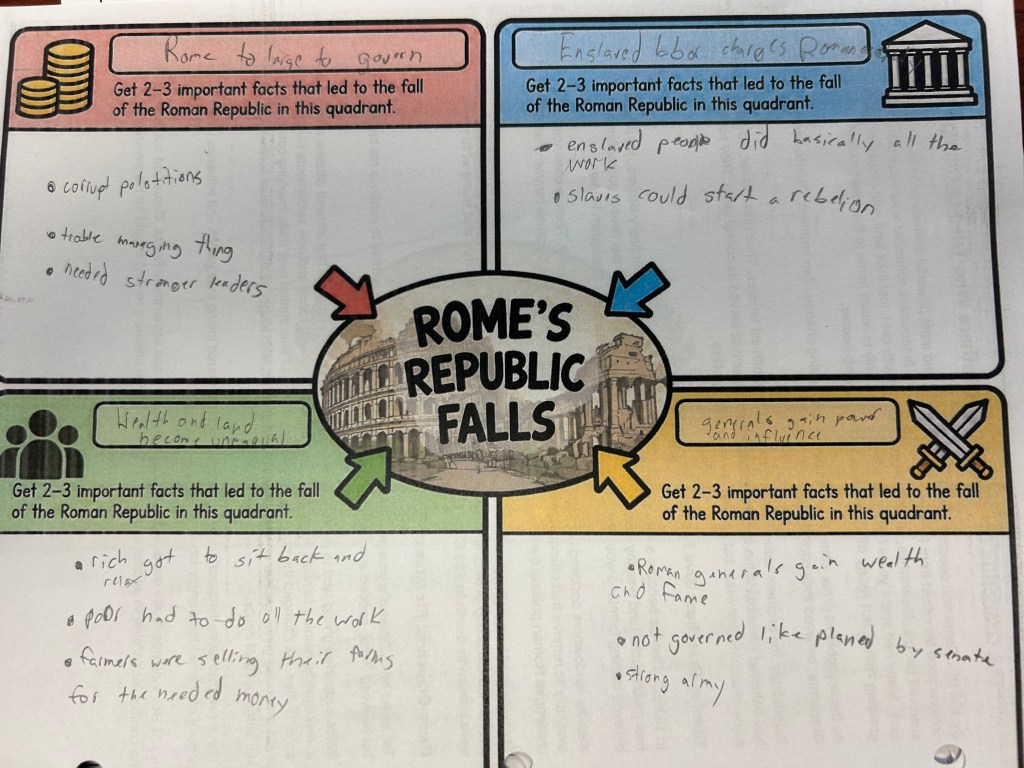
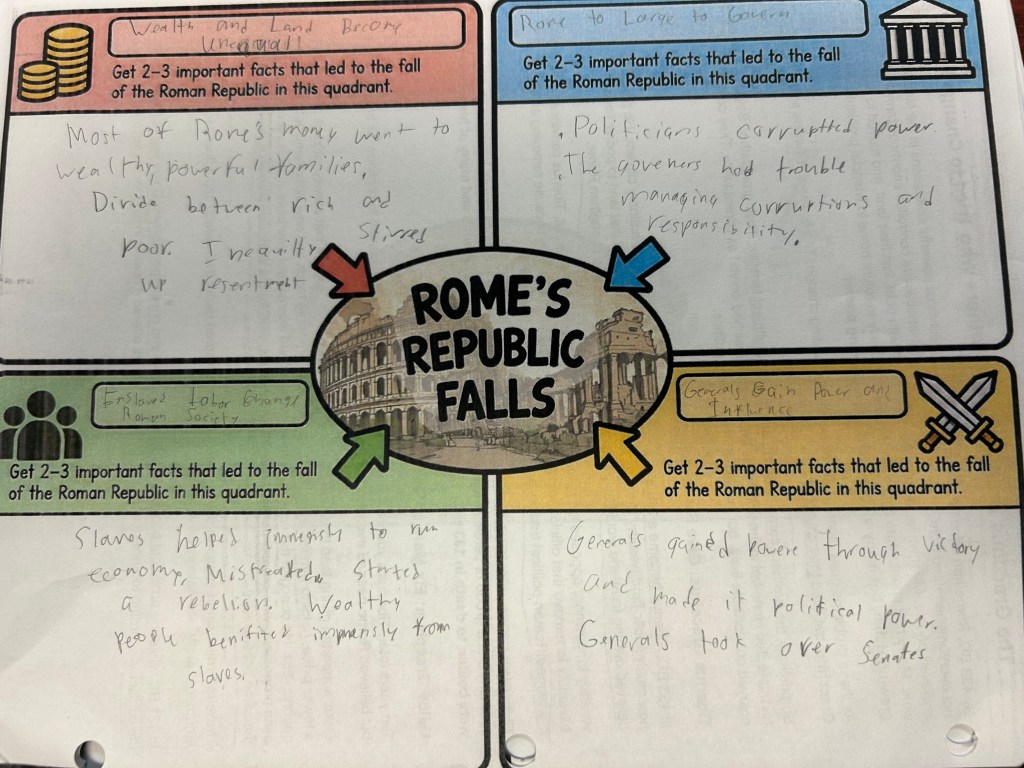
After completing the boards, students spent about eight to 10 minutes walking around and collecting information on a Frayer-style organizer. Each section gave them a place to record facts about one of the problems facing the Republic.
I have used the Frayer this way before. The four boxes make it easy to organize information from different topics, and students leave with notes from all four readings.
The whiteboards also had a purpose beyond the group that created them. Other students needed to read them and learn from them. Choosing clear facts and creating a useful picture mattered because classmates were using that work to build their own understanding.
Which Problem Would Affect People Most?
Once students had collected their notes, we debriefed with a question: “Which of these problems would affect people the most?”
I wanted students to look back at the information and think about what these problems meant for someone living in Rome. This gave us a transition into the Gracchus brothers. Students had some background on the problems before reading about two people who tried to address them.
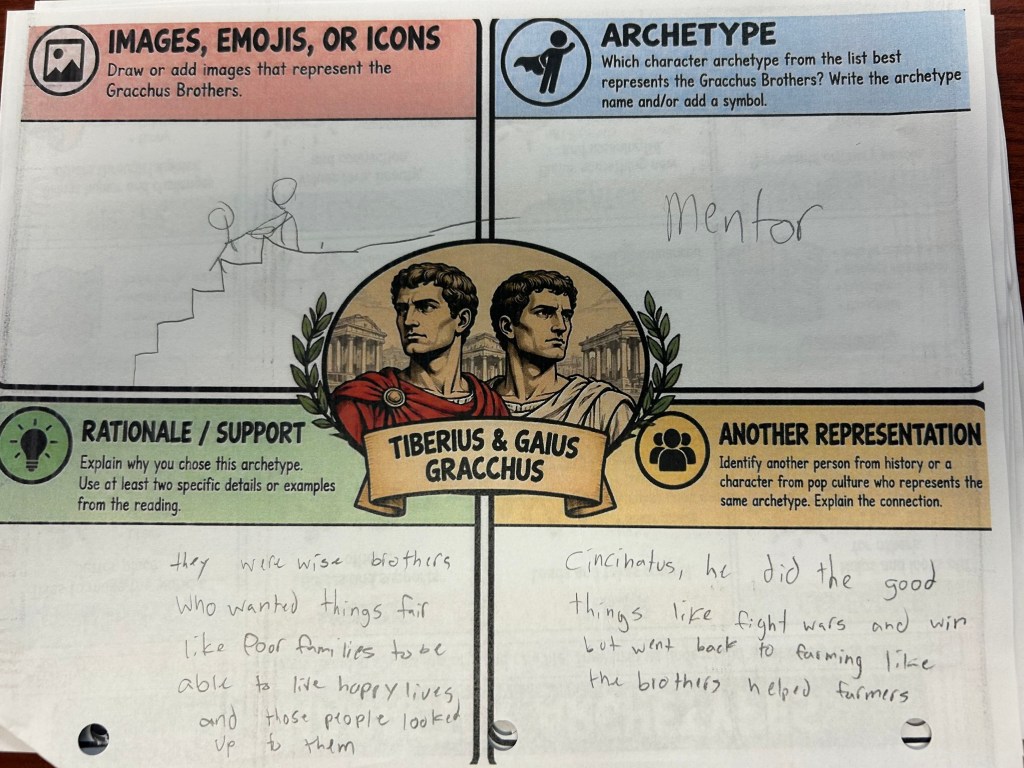
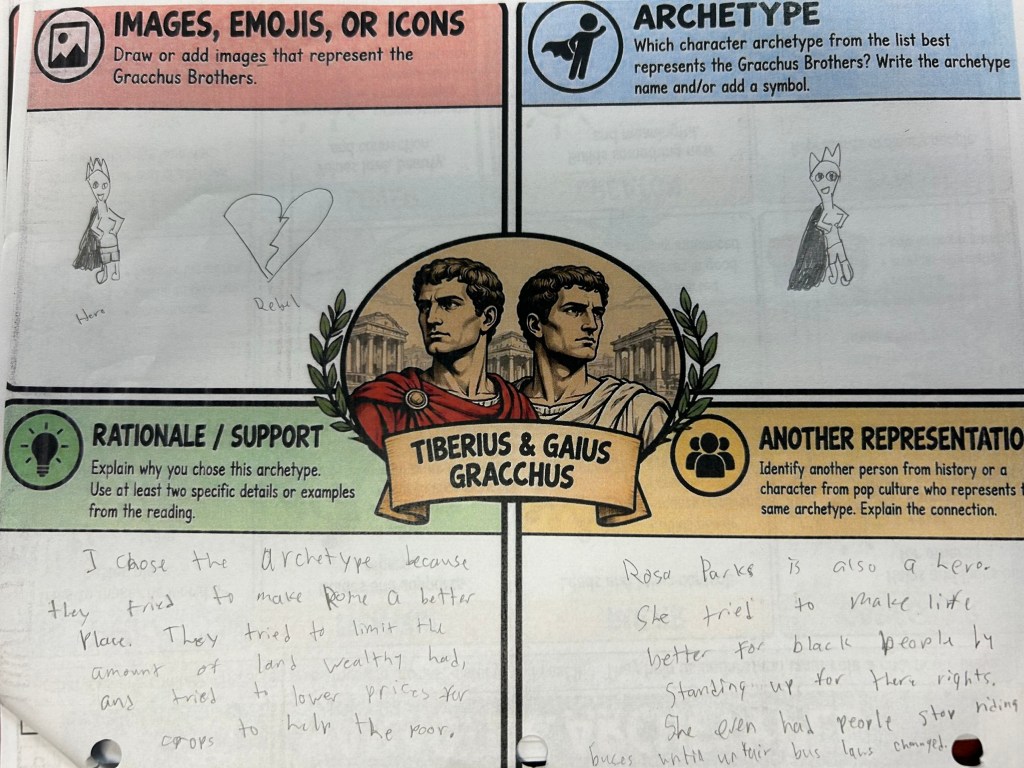
Students read about the brothers and completed an Archetype Four Square. They chose an archetype, supported it with evidence, created a visual, and connected the brothers to another person or character. We then shared their ideas.
We had used this same format with Cincinnatus on Tuesday. I like returning to a familiar structure because students already know what to do with the boxes. They can spend more time thinking about the people in the reading and explaining their choices.
One student connected the Gracchus brothers to Cincinnatus because of their efforts to help others. Students were returning to an earlier reading and using it to make sense of someone new.
We finished with Gimkit to review. After Monday’s lesson took longer than I anticipated, it was nice to have a day where the timing worked out and we had room to revisit earlier content.
Friday – Checks and Balances and a Julius Caesar Costume
Friday was a continuation of our work on the decline of the Roman Republic. It was also the day before Halloween, so I wanted to work in something creative while keeping us moving forward with the content.
We began with a Frayer for checks and balances. I compared the concept to a game of rock, paper, scissors. Each choice can beat another choice, but each can also be beaten. There is no single choice that wins every time.
This gave students a starting point for thinking about how different parts of a government can limit one another’s power. Students paraphrased a definition and came up with examples and nonexamples. I like including nonexamples because students have to think about what would happen if those limits were missing or stopped working.
From there, we transitioned to Julius Caesar. I asked students to think about how Caesar broke down checks and balances as we worked through the reading.
We also connected this to Thursday’s lesson. One of the problems students had studied was generals gaining too much power. Now we had a specific person to help us follow that problem and see how it contributed to the Republic’s decline.
Cyber Sandwich with a Halloween Ending
We used a Cyber Sandwich to read about Julius Caesar. Students had categories to guide their note-taking, and I gave them 10 minutes to read and collect information.
I like giving students categories when there are several things I want them paying attention to in a reading. It gives their notes some organization and helps them find information they can use in the discussion afterward.
After the 10 minutes, students shared and discussed their notes with a partner. This gave them a chance to compare what they had written, explain their ideas, and see what they might have missed.
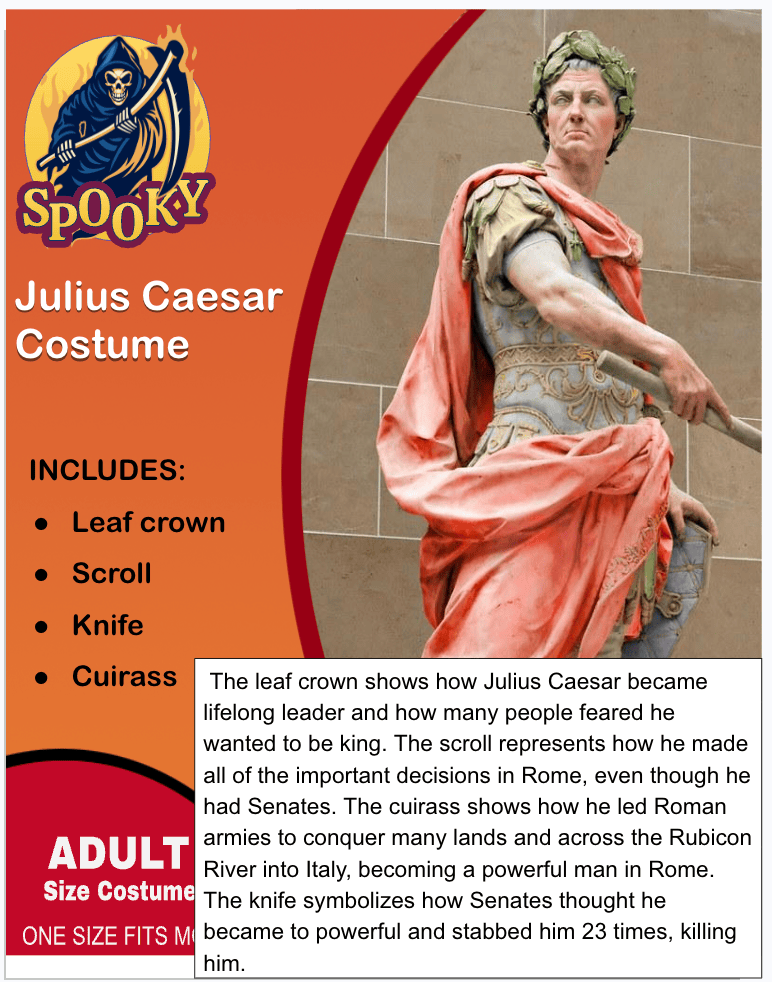
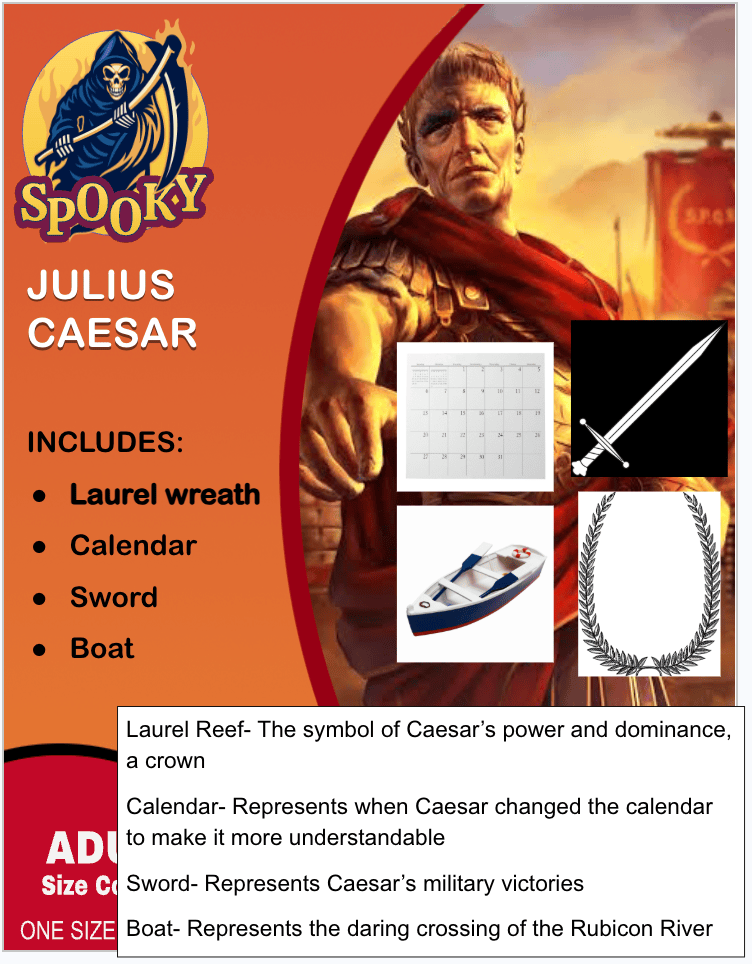
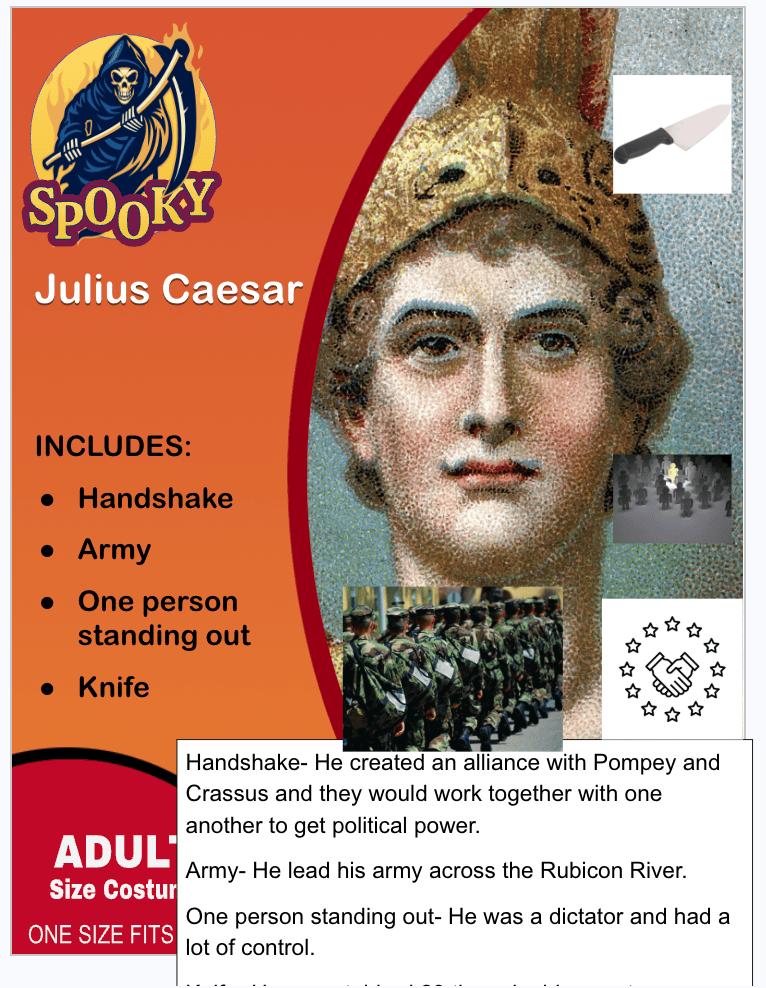
Usually, we would finish the Cyber Sandwich with a written summary. For this lesson, I changed the final task to connect it to Halloween. Students had to design a Julius Caesar costume with accessories related to his life and actions.
The accessories gave students a reason to return to their notes. They had to decide which details about Caesar were important enough to include and figure out how to represent them as part of a costume.
I like making changes like this to a familiar activity. The reading, note-taking, and discussion still gave students the information they needed, but the final task offered a different way to use it. It was a fun, creative way to finish our work for the week and fit the day before Halloween.
Lessons for the Week
Tuesday – Cincinnatus Rack and Stack, Reading
Wednesday – Punic Wars Rack and Stack, Reading
Thursday – Decline of the Roman Republic, All Readings
Friday – Caesar CyberSandwich, Reading


