Sometimes the timing of a unit matters just as much as the content itself.
As the school year winds down, it can be tempting to rush through major topics just to “cover” them before summer. I’ve never believed in that approach. I refuse to sprint through the causes of the Civil War just so I can say I taught it. Especially when I know I’ll have these same students again next year and can teach it the right way with the depth and time it deserves.
Instead, this became the perfect opportunity to slow down and teach something meaningful: local history.
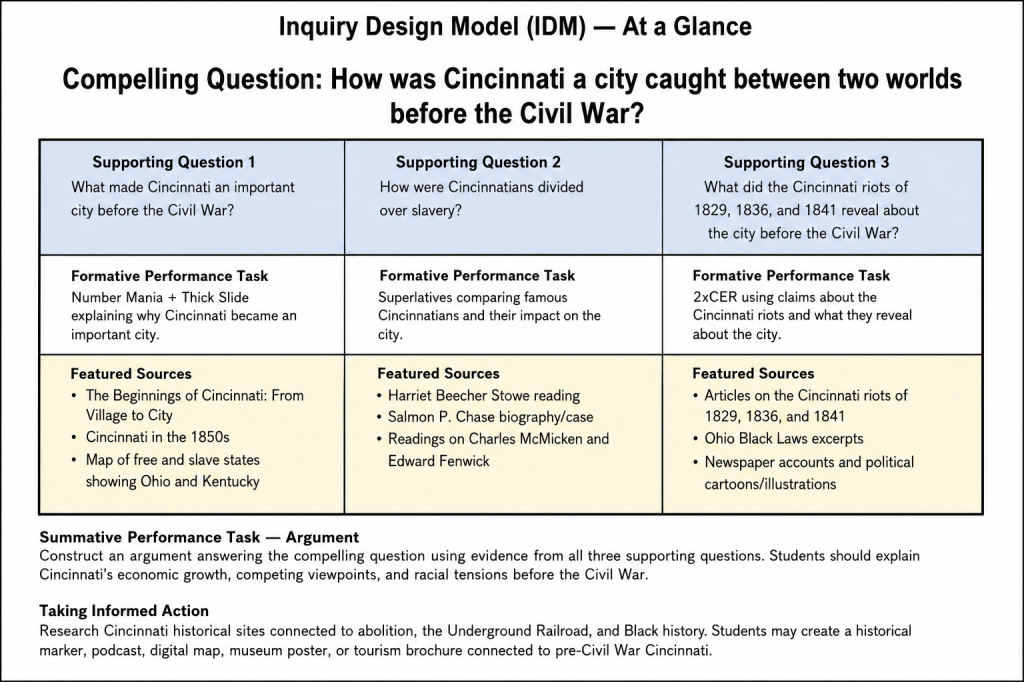
This week in Room 103, we launched a brand new inquiry unit centered around the compelling question: “How was Cincinnati a city caught between two worlds before the Civil War?”
The unit built directly off our previous learning about slavery and abolition, but shifted the focus toward our own city. Too often, students learn history as something distant that happened somewhere else to someone else. I wanted students to understand that Cincinnati was deeply connected to the tensions surrounding slavery, freedom, economics, racism, and division before the Civil War.
I also wanted students to wrestle with an important truth that sometimes gets lost in simplified historical narratives: crossing the Ohio River did not automatically mean freedom in the way many people imagine it today.
Yes, the Ohio River represented hope. It represented possibility. But freedom from slavery did not mean freedom from racism, discrimination, segregation, or violence. Cincinnati had Black Laws designed to oppress African Americans. Slave catchers still roamed the riverbanks. Racial tensions exploded into riots in 1829, 1836, and 1841. The city itself was divided economically, politically, and morally over slavery.
That complexity became the heart of the unit. Instead of teaching Cincinnati as a simple “free city,” students explored the idea that it was a place caught between North and South, freedom and oppression, growth and division.
The entire unit was designed using an Inquiry Design Model structure with supporting questions that built toward that bigger understanding. We ended up focusing on Supporting Questions 1, 2, and 4 this week. I ultimately removed Supporting Question 3 because it started feeling repetitive once the inquiry evolved.
I also revised Supporting Question 2 to better fit the direction of the unit: “How were Cincinnatians divided over slavery?” Students needed to see that the conflict wasn’t just happening nationally. It was happening in neighborhoods, newspapers, businesses, churches, and homes right here in Cincinnati.
One thing I really liked about this week was how naturally local history increased engagement. Students recognized street names. They recognized locations. They recognized connections to places they’ve driven past their entire lives.
The inquiry structure also helped slow students down intellectually. Instead of memorizing disconnected facts, they spent the week analyzing evidence, discussing competing viewpoints, interpreting numbers, comparing perspectives, and building arguments about their own city.
Staging the Question
Number Mania: Cincinnati on the Rise
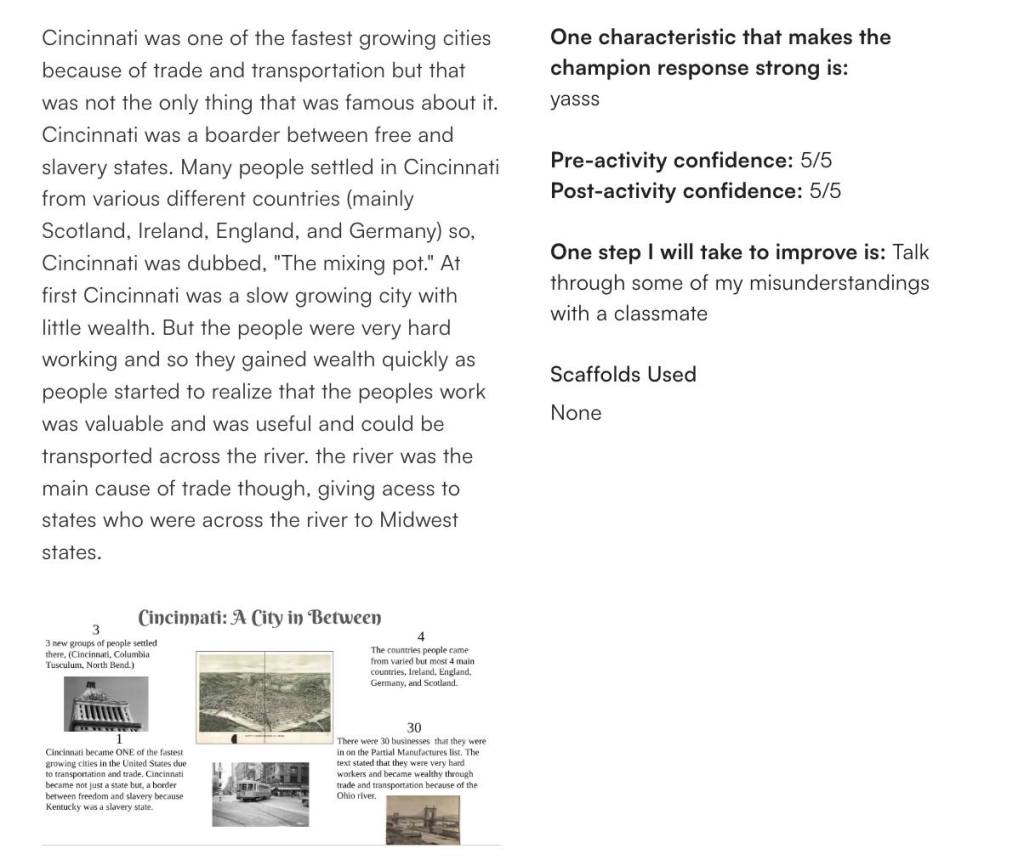
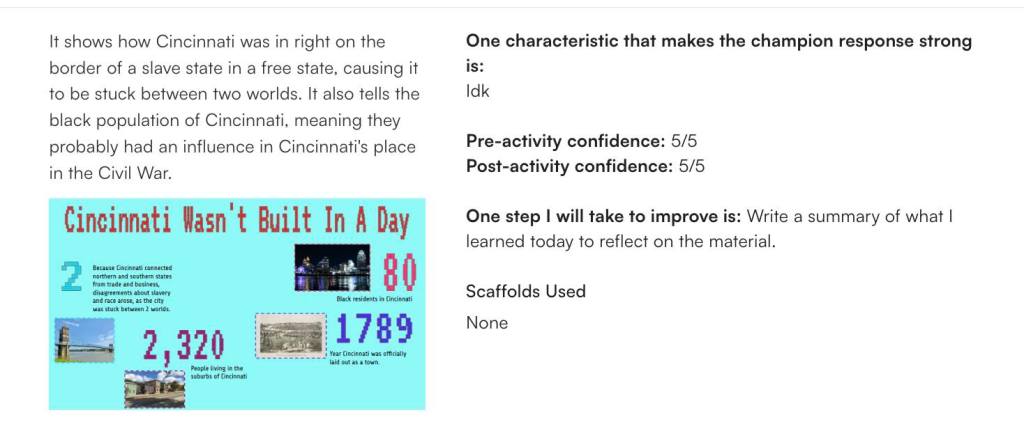
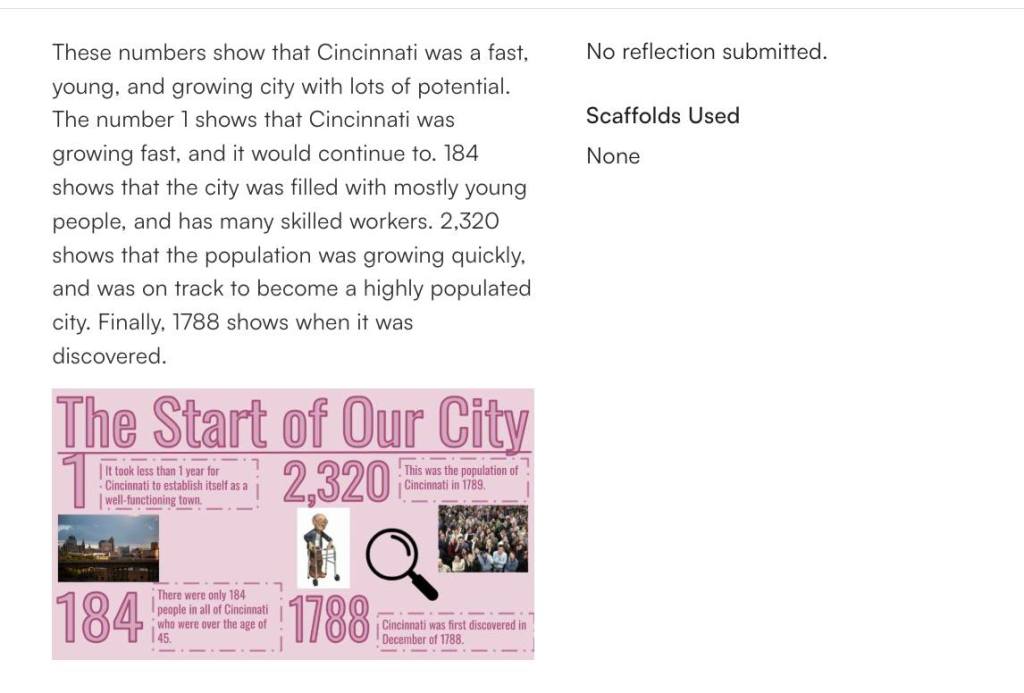
To begin the unit, we staged the question with a Number Mania paired with a Short Answer Battle Royale. The goal was to immediately establish Cincinnati as a growing and increasingly important city before the Civil War. I wanted students to see Cincinnati not just as a dot on a map, but as a rapidly expanding river city connected to trade, migration, movement, and opportunity because of its location along the Ohio River.
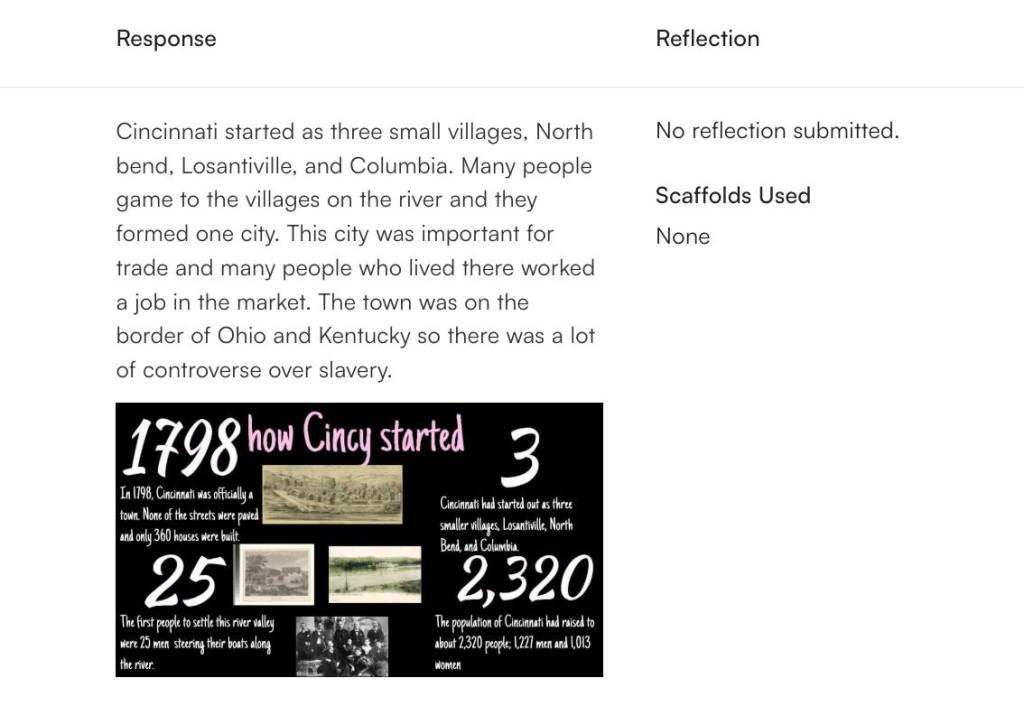
Students analyzed a Number Mania infographic built around the question: “What evidence shows Cincinnati was growing into an important city before the Civil War?”
The infographic included population growth, trade statistics, immigration numbers, housing growth, and other data tied to Cincinnati’s early development. Instead of simply reading about the city’s growth, students had to interpret the numbers and determine what they revealed about Cincinnati’s rise shortly after its founding.
Short Answer Battle Royale
After analyzing the infographic, students moved into Short Answer where they explained how the numbers proved Cincinnati was becoming an important city. Students attached screenshots of their Number Mania directly into their responses so the evidence and explanation were connected together.
One thing I liked about this lesson was that it naturally pushed students beyond just identifying numbers. They had to explain significance. A large population number by itself means nothing unless students can connect it to trade, opportunity, immigration, industry, or geographic importance. To wrap up the activity, we ran a Battle Royale focused on one simple goal: the clearest explanation of the content.
Students compared responses, evaluated clarity, and saw examples of strong historical reasoning from their classmates. It turned what could have been a basic writing response into something far more engaging and discussion-driven.
Student Ownership and Feedback
One thing that stood out to me was that several students actually requested that I set up a Snorkl afterward so they could get feedback on both their Number Mania analysis and their writing. That was a cool moment because it showed students were invested enough in the task that they wanted additional feedback and revision opportunities instead of simply turning something in and moving on. It also reinforced something I’ve talked about a lot this year: when students care about the work, feedback becomes valuable instead of feeling like punishment.
Building the Foundation for the Inquiry
More importantly, the lesson helped establish one of the major ideas for the entire inquiry unit: Cincinnati’s location and growth made it incredibly important before the Civil War, but that same growth also intensified many of the tensions that would divide the city.
Supporting Question #1
What Made Cincinnati an Important City Before the Civil War?
After staging the question with Number Mania, students moved into Supporting Question #1 where they began digging deeper into why Cincinnati became such an important city before the Civil War.
Students worked through a series of sources connected to trade, the Ohio River, Porkopolis, transportation, and Cincinnati’s economic growth.
One thing I wanted students to understand was that Cincinnati’s growth was not random. Geography mattered. The Ohio River mattered. Trade mattered. The city’s location connected it to both the North and the South, which helped Cincinnati grow rapidly into a major economic center.
At the same time, students also began seeing the complicated reality underneath that growth. Cincinnati benefited economically from trade connected to slavery even while existing in a free state. That idea became one of the foundational understandings for the rest of the inquiry unit.
Working Through the Sources
Students answered questions connected to each source before bringing all of their thinking together into a Thick Slide. I’ve found that this process helps students organize their thinking before asking them to synthesize larger ideas. The sources themselves also helped challenge some misconceptions students had about Cincinnati and the Ohio River.
One source focused on Porkopolis and how Cincinnati’s pork industry exploded because of Southern trade and plantation economies. Another examined the Ohio River itself and how different it looked before dams were built. Students were shocked to learn that the river was not always the giant barrier they imagine today and that, during dry periods, some areas became shallow enough to carefully cross on foot.
Too often, students hear simplified Underground Railroad stories that make the crossing sound like an automatic path to freedom. I wanted them to understand the danger, uncertainty, and complexity involved. Crossing the river mattered, but it did not magically erase racism, discrimination, or danger.
Thick Slides as Learning Artifacts
Once students worked through the sources and questions, they summarized their learning using a Thick Slide template.
Students created titles, identified five important facts, added visuals, wrote a summary explaining why Cincinnati was important before the Civil War, and finished with a three word summary that captured the overall idea of the lesson.
I want students leaving each supporting question with something meaningful they can revisit later during the summative assessment. Instead of isolated worksheets or notes that disappear into folders, students are building a collection of evidence and thinking throughout the inquiry.
By the end of the unit, students won’t just have “completed activities.” They’ll have artifacts showing how their understanding evolved across the inquiry itself.
Supporting Question #2
How Were Cincinnatians Divided Over Slavery Before the Civil War?
For Supporting Question #2, students shifted from studying Cincinnati’s growth to studying Cincinnati’s divisions. This part of the inquiry focused on a question that became more and more important as students moved through the sources: “How were Cincinnatians divided over slavery before the Civil War?”
To explore this question, students examined four very different Cincinnati voices and perspectives connected to slavery and abolition. Students analyzed Harriet Beecher Stowe and how her experiences living in Cincinnati helped shape Uncle Tom’s Cabin and spread anti-slavery ideas across the North. They examined Salmon P. Chase and how he defended freedom seekers and challenged slavery in court while living in Cincinnati. Students also studied Charles McMicken and how some wealthy Cincinnati businessmen benefited from systems connected to slavery even while living in a free state.
Finally, students analyzed an article from the Cincinnati Post and Anti-Abolitionist newspaper that argued abolitionists were creating division and threatening the future of the country. I thought this lesson really helped students understand that Cincinnati was not unified in its thinking about slavery. Some people actively fought against slavery. Others economically benefited from it. Others feared abolitionists would destroy the Union itself.
Too often students want history to fit into clear “good side vs. bad side” categories. This lesson forced students to wrestle with the uncomfortable reality that people living in the same city could view slavery in completely different ways.
Thick Slides and Consistency Across the Inquiry
To keep consistency across the inquiry unit, students once again created Thick Slides as their learning artifact for the supporting question. Students summarized four different views over slavery in Cincinnati, added visuals, wrote explanations about why Cincinnatians were divided, and created a three word summary capturing the overall tension within the city.
I’ve found that keeping a consistent structure across the inquiry helps students focus more on the thinking and less on figuring out a brand new activity every day. The consistency also allows students to clearly see how each supporting question connects back to the larger compelling question. By this point in the unit, students were beginning to recognize a major theme: Cincinnati was economically, politically, and morally caught between North and South.
Short Answer Battle Royale
We finished class with another Short Answer Battle Royale where students used evidence from their Thick Slides to answer the supporting question. What I liked about this part was that students already had organized evidence directly in front of them from the learning artifact they created. Instead of scrambling to remember information, students could focus on constructing stronger explanations and arguments.
The discussions were also stronger because students had analyzed multiple perspectives beforehand. They weren’t just repeating one side. They were comparing viewpoints, weighing evidence, and trying to explain why divisions existed in the first place. That’s the kind of historical thinking I want students doing at this point in the year.
Supporting Question #3
What Did the Cincinnati Riots Reveal About the City Before the Civil War?
For this supporting question, we used a CyberSandwich focused on the Cincinnati riots of 1829, 1836, and 1841.
Each student received a different article connected to one of the riots. Students individually read their assigned source, took notes, and prepared to teach their classmates about what happened during that specific riot.
The note taking focused on several major questions:
When did the riot take place?
Who was involved?
What happened during the riot?
Why did the riot happen?
How did leaders or the government respond?
What did the riot reveal about Cincinnati?
The structure worked really well because students became responsible for becoming “experts” on their specific riot before collaborating with others.
Comparing the Riots
After students completed their notes, they worked together to compare all three riots using a Triple Venn Diagram. This led to some incredibly strong discussions. Students started noticing patterns across all three riots. Racism, economic competition, fear, discrimination, weak government responses, and violence appeared repeatedly. They also noticed that the riots evolved over time as tensions surrounding slavery and abolition grew stronger before the Civil War.
One of the most important understandings I wanted students to walk away with was this: Crossing the Ohio River did not mean escaping racism and discrimination. I think sometimes the Underground Railroad gets oversimplified into a happy ending story where freedom automatically meant equality and safety. The reality was much more complicated. African Americans in Cincinnati still faced discriminatory Black Laws, violent mobs, segregation, unequal protection under the law, and the constant threat of slave catchers and racial violence.
Short Answer Battle Royale
After the discussions and note taking, students moved back into Short Answer for another Battle Royale.
Students answered the question: “What did the Cincinnati riots reveal about the city before the Civil War?” I liked ending the lesson this way because students had to synthesize information across all three riots rather than simply summarizing one event. They had to identify larger patterns and explain what the riots revealed about Cincinnati as a whole.
The discussions during the Battle Royale were some of the strongest conversations of the week because students were no longer just talking about isolated events. They were talking about contradictions within the city itself. Cincinnati was free from slavery by law, but not free from racism, discrimination, segregation, or violence.
Summative Assessment
Bringing the Inquiry Together
The summative assessment for this unit will take place next week. One thing I’ve learned over time is that inquiry units like this work best when students create something meaningful with their learning instead of simply taking a traditional test. When students spend days analyzing sources, discussing perspectives, comparing evidence, and building understanding, I want the final assessment to reflect that process.
For this unit, the best assessment options will most likely be either a one pager centered around the compelling question or some type of creative project that allows students to synthesize their learning.
The compelling question students will answer is: “How was Cincinnati a city caught between two worlds before the Civil War?” What I like about this question is that there is no simple answer. Students have to wrestle with contradictions throughout the unit.
Cincinnati was a free city, yet deeply connected to slavery through trade and economics.
The Ohio River represented freedom, yet crossing it did not guarantee safety or equality.
Some Cincinnatians fought against slavery, while others defended systems connected to it.
The city grew rapidly and became economically successful, yet racial tensions repeatedly exploded into violence.
Throughout the inquiry, students have been building learning artifacts tied to each supporting question. Instead of relying on memorization, students now have a collection of evidence, visuals, writing, notes, and summaries they can pull from when constructing their final product.
I think that’s one of the strengths of inquiry based learning. Students are not just “doing activities.” They are building understanding piece by piece over time.
I’m less interested in students memorizing every detail about Cincinnati before the Civil War and more interested in whether they can explain the larger tensions, contradictions, and realities that shaped the city.
If students can walk away understanding that history is often messy, complicated, and deeply connected to the communities around them, then the unit accomplished what it was supposed to do.
Lessons
Staging the Question – Number Mania with Reading Linked
Supporting Question 1 – Sources, Questions, Thick Slide
Supporting Question 2 – Thick Slide, Sources
Supporting Question 3 – CyberSandwich, Sources