This week in Room 103, we wrapped up a mini-unit centered around one driving question:
How did slavery shape the lives of people in different ways in the United States?
Throughout the week, students explored the impact of the cotton gin, analyzed primary sources from formerly enslaved people, examined the lives and methods of abolitionists, debated historical impact at the whiteboards, and finished the week by building CER responses using evidence gathered across the unit.
As I reflected on the week, I also found myself thinking a lot about my co-author and friend, Dr. Scott Petri. This week marked one year since his passing.
So much of what happened in Room 103 this week connects back to things Scott taught many of us about social studies instruction. He pushed teachers to move beyond lectures and memorization and create classrooms where students discuss, connect, create, compare, and think deeply about history.
Scott helped many of us see social studies through a literacy lens. He emphasized vocabulary, background knowledge, listening, scaffolds, and helping students make connections between ideas. A lot of the structures from this week reflect those ideas. Students worked with primary sources, built connections between concepts, collaborated at the whiteboards, created visual representations of learning, and revisited evidence from multiple lessons to support historical claims.
One year later, his influence is still showing up in classrooms everywhere. It definitely showed up in Room 103 this week.
Monday – The Cotton Gin
This week in Room 103, we kicked off a mini-unit on slavery with a question that sat at the center of everything we did:
How did slavery shape and impact different people within the United States?
Instead of starting with a giant lecture or pages of notes, we started with an invention. One machine. One idea. One decision that changed the course of the country forever.
The cotton gin.
What made this lesson powerful was that students quickly realized this was never really just about a machine. It was about consequences, innovation, economics, human suffering, expansion, profit, power, and perspective. The cotton gin became the entry point into all of it.
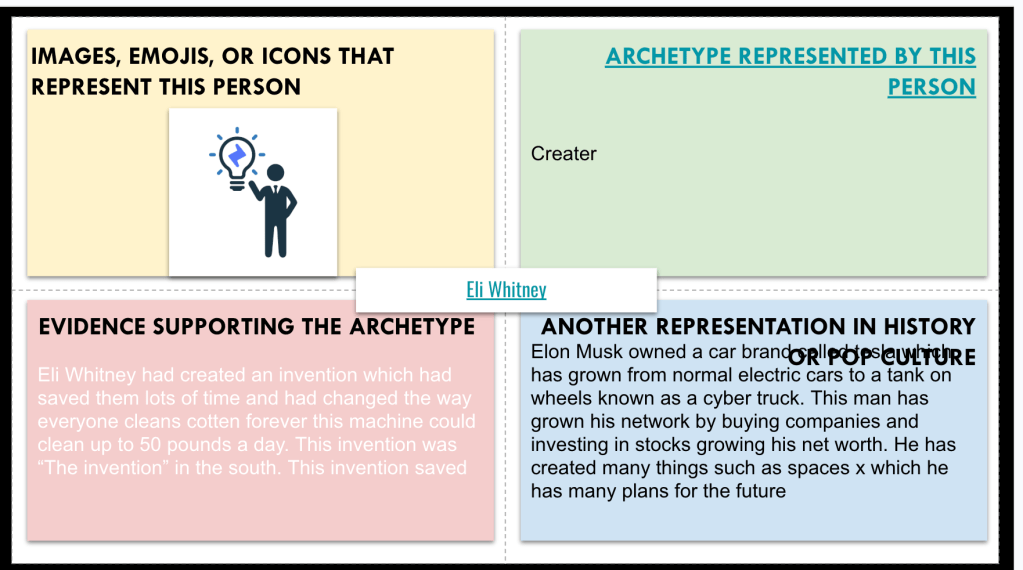
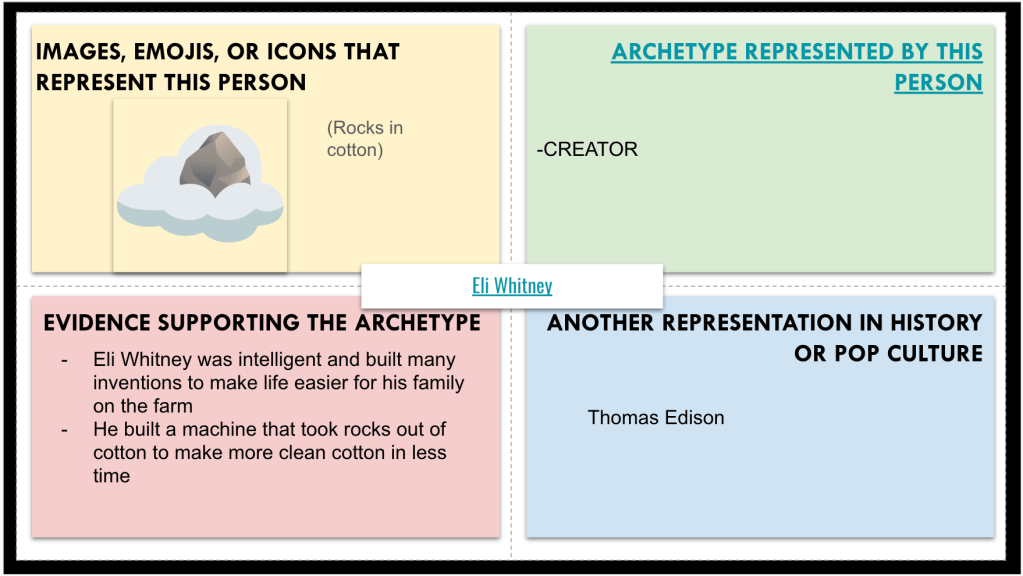
Archetype Four Square: Eli Whitney Beyond “Inventor”
We opened class with an Archetype Four Square over Eli Whitney.
I wanted students thinking beyond the simple “inventor who made life easier” narrative they often hear. Archetypes force students to evaluate people instead of simply memorizing facts. Students debated whether Whitney represented a visionary, a creator, a disruptor, or someone whose invention unintentionally caused harm on a massive scale.
What I like about archetype work is that it pushes students into gray areas. History is rarely clean and simple. Students had to support their thinking with evidence instead of just throwing out opinions.
Some students compared Whitney to modern tech innovators, while others started wrestling with the idea that inventions can help some groups while hurting others. That tension became a theme throughout the lesson.
Annotate and Tell with Primary Sources
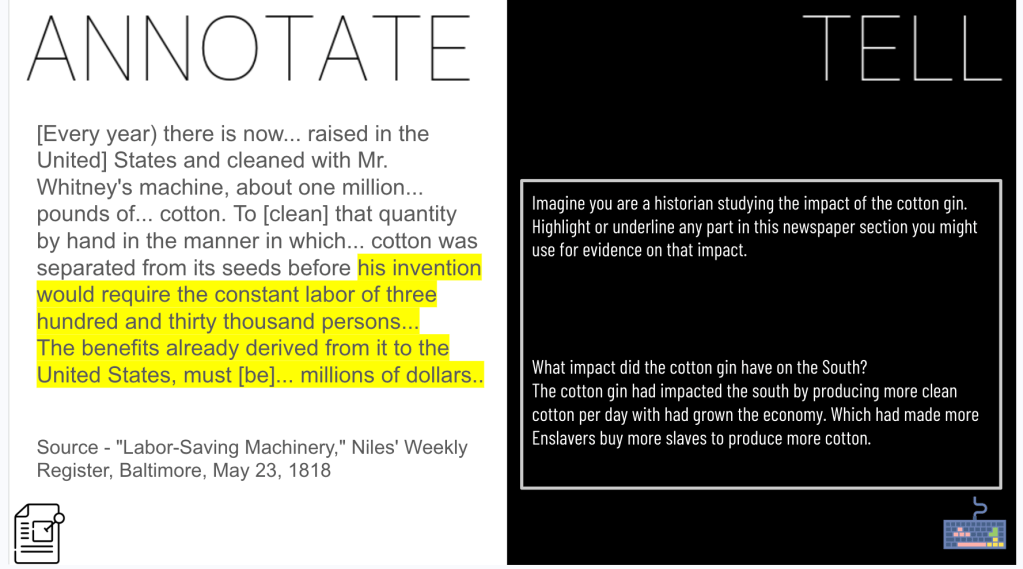
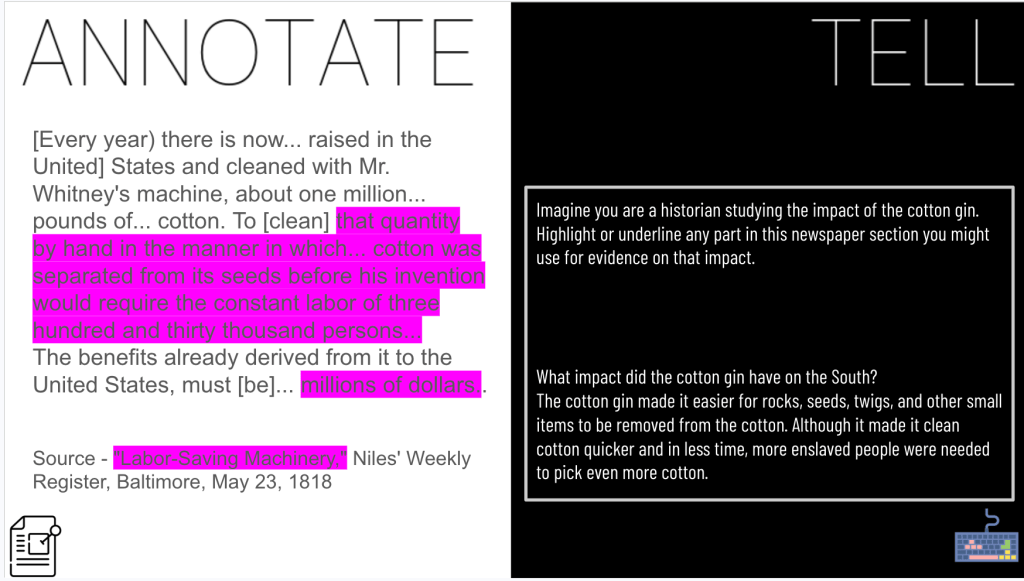
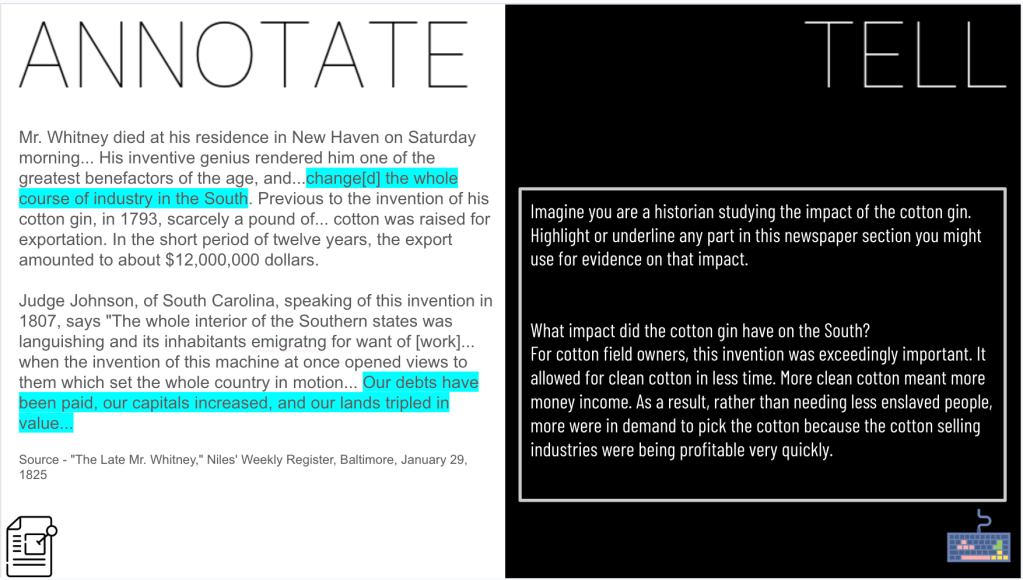
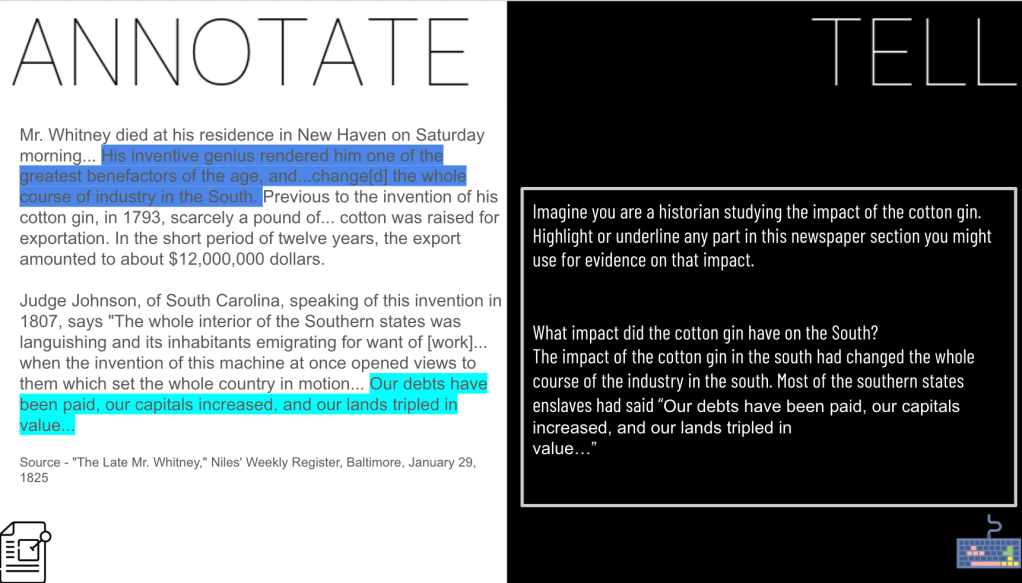
Next came Annotate and Tell using historical newspaper excerpts about the cotton gin.
Students examined how people in the early 1800s praised Whitney’s invention. The sources focused heavily on economic growth, increased cotton production, and Southern prosperity. One source even described Whitney as one of the “greatest benefactors of the age.”
This became a great opportunity to remind students that primary sources are not neutral. They reflect perspective, priorities, and values from a specific moment in time.
Students highlighted phrases showing the positive economic impact, but the deeper conversations started once we asked harder questions. Positive for who? Who benefited from this growth? Who paid the price?
That shift in thinking moved the lesson from surface-level recall into deeper historical analysis.
Graph and Tell: Numbers Tell a Story Too
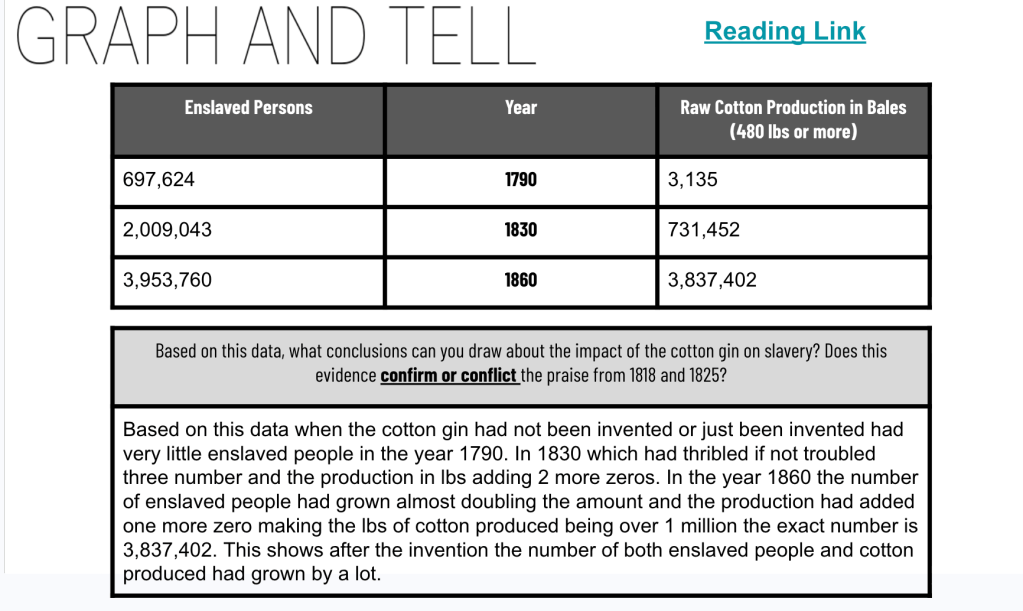
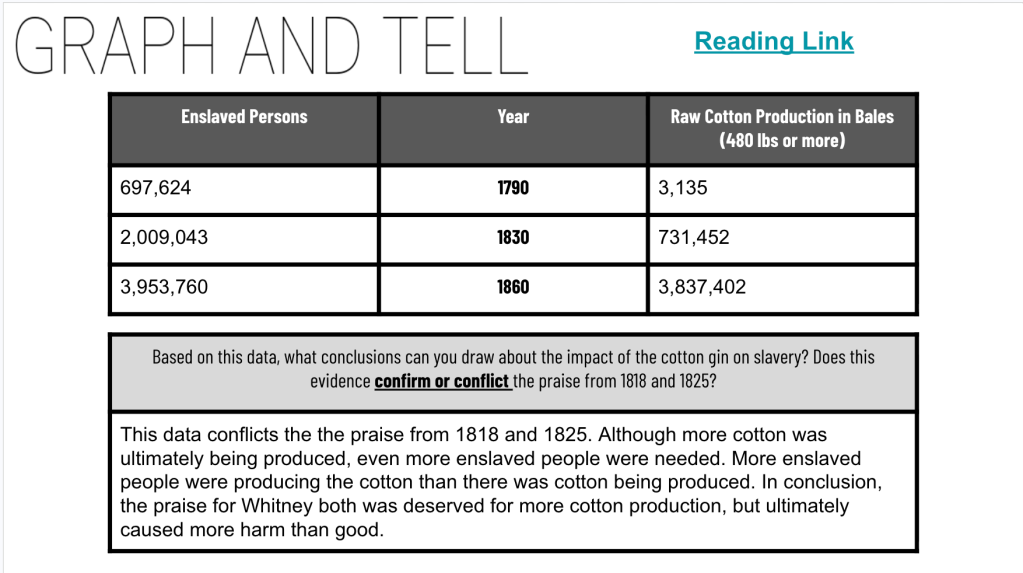
After working through the sources, students moved into Graph and Tell where they analyzed the relationship between cotton production and slavery over time. The graphs and numbers completely changed the conversation. Students could visually see cotton production explode after the invention of the cotton gin while the enslaved population increased dramatically alongside it.
This mattered because many students initially assumed machines reduce labor needs. The cotton gin actually increased the demand for enslaved labor because cotton became so profitable. The graph gave students evidence to challenge the celebratory tone of the earlier sources. It created tension between economic success and human cost, which tied directly back to our unit question.
2xPOV: Seeing the Cotton Gin Through Different Eyes
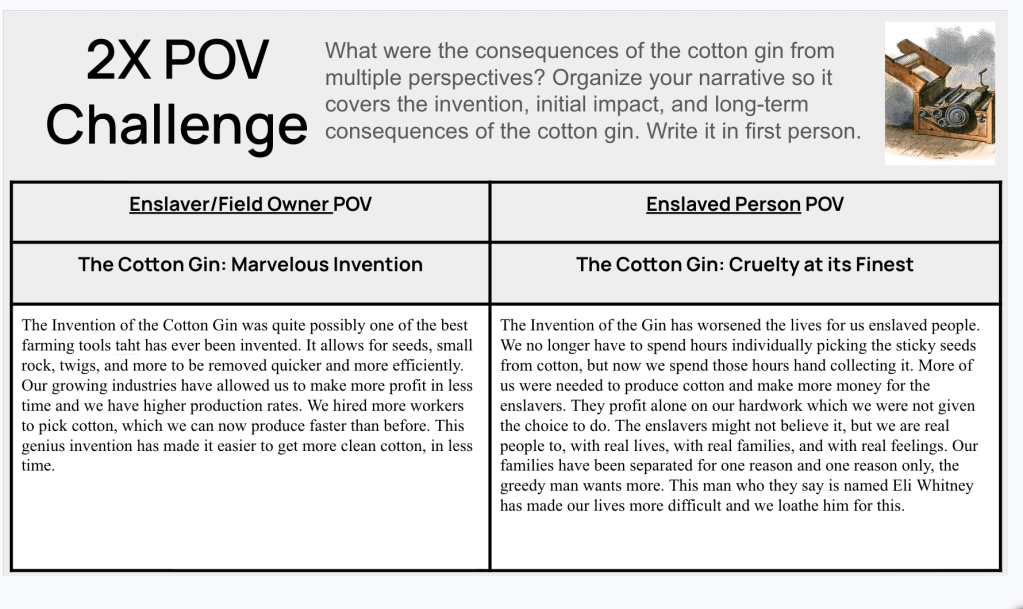
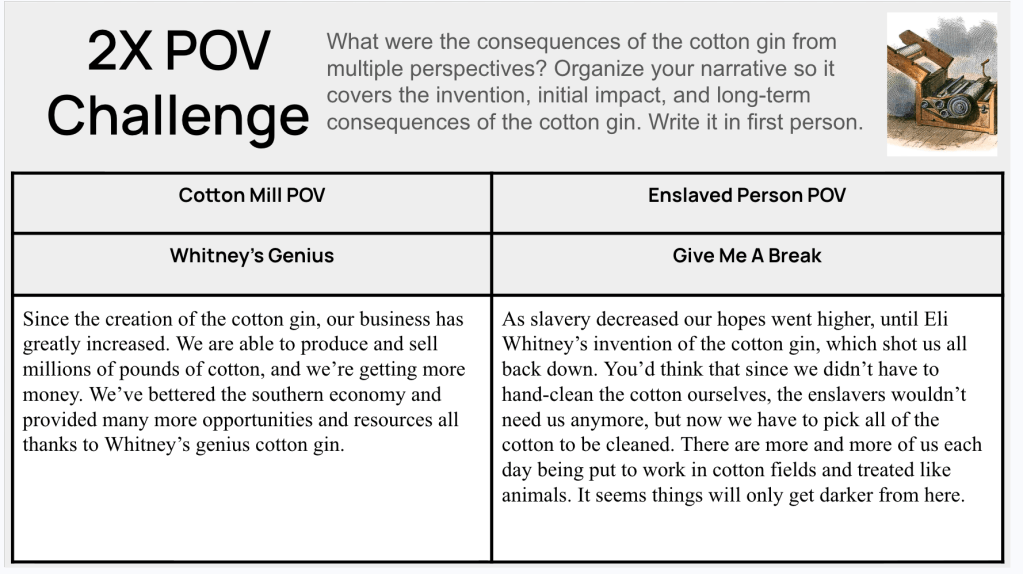
To wrap up the lesson, students created their own 2xPOV narratives.
This may have been my favorite part of the day because students had to step into the perspectives of different people impacted by the cotton gin and write in first person. Some wrote from the perspective of plantation owners excited about profits, while others wrote from the perspective of enslaved people facing increased labor and harsher conditions. A few explored Northern factory workers, small farmers, or merchants connected to the cotton economy.
The activity forced students to move beyond saying “the cotton gin increased slavery” and instead think about how different groups experienced the same event in completely different ways. That is the heart of social studies. It is not simply learning what happened. It is understanding how events shaped real people in very different ways.
Why This Worked
This lesson reminded me why I love stacking EduProtocols together instead of treating them as isolated activities. Each part of the lesson built naturally into the next. Archetype Four Square pushed students to evaluate Eli Whitney. Annotate and Tell grounded students in historical evidence. Graph and Tell helped students interpret trends and data. Finally, 2xPOV moved students into empathy, perspective, and synthesis.
Students were constantly doing something different, but every activity connected back to the same central question. The lesson also balanced retrieval, collaboration, writing, visual analysis, and discussion without overwhelming students cognitively. Instead of front loading everything through lecture, students uncovered the story piece by piece.By the end of class, students were no longer talking about the cotton gin as “just an invention.” They were talking about consequences.
Tuesday: Shifting the Focus to the Lives of the Enslaved
On Tuesday, we shifted our focus from the invention of the cotton gin to the lived experiences of enslaved people themselves. After spending Monday examining the economic impact of slavery, students now had to confront the human side of it.
EdPuzzle: Building Context Through Video
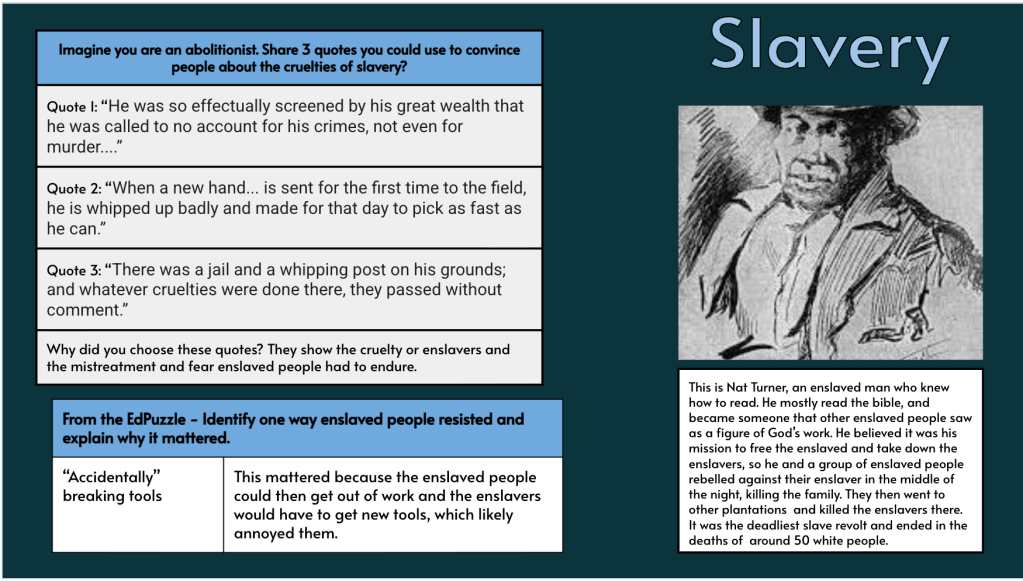
We started class with an EdPuzzle focused on slavery and resistance to slavery. The video helped provide students with background knowledge before they worked directly with primary sources.
I like using EdPuzzle this way because it creates a shared foundation without requiring a long lecture. Students are still actively engaged through embedded questions and checkpoints while building the context they need for the deeper analysis later in class.
The video also introduced students to the idea that enslaved people constantly resisted slavery in both large and small ways. Resistance was not always dramatic. Sometimes it looked like slowing work, preserving culture, learning to read, escaping, or simply surviving another day.
Annotate and Tell: Solomon Northup and Harriet Jacobs
From there, we moved into Annotate and Tell using excerpts from Solomon Northup and Harriet Jacobs. Students worked through the sources carefully, highlighting evidence, annotating important details, and identifying moments that revealed the realities of slavery.
What made this lesson powerful was that students were not reading textbook summaries. They were reading the words of people who actually lived through slavery. Solomon Northup’s account helped students understand the brutality, fear, and dehumanization enslaved people faced daily. Harriet Jacobs added another layer entirely as students examined the unique dangers and struggles enslaved women experienced. Her writing sparked thoughtful conversations because students began realizing slavery impacted people differently depending on age, gender, and circumstance.
As students annotated the sources, they started noticing patterns between the two accounts while also recognizing important differences in experiences and perspectives. Some students focused on examples of resistance, while others highlighted family separation, emotional trauma, survival, or the loss of freedom and identity.
Thick Slide: Pulling the Learning Together
To finish class, students created a Thick Slide where they synthesized everything from the lesson. The Thick Slide pushed students beyond simply repeating details from the readings. Students had to think about the larger story the sources were telling and explain how those experiences connected back to our unit question about how slavery shaped different people within the United States.
The combination of video, primary sources, annotation, discussion, and synthesis created a lesson where students were constantly processing information in different ways without the class feeling repetitive. More importantly, students were engaging directly with human experiences instead of viewing slavery as just another topic in a textbook.
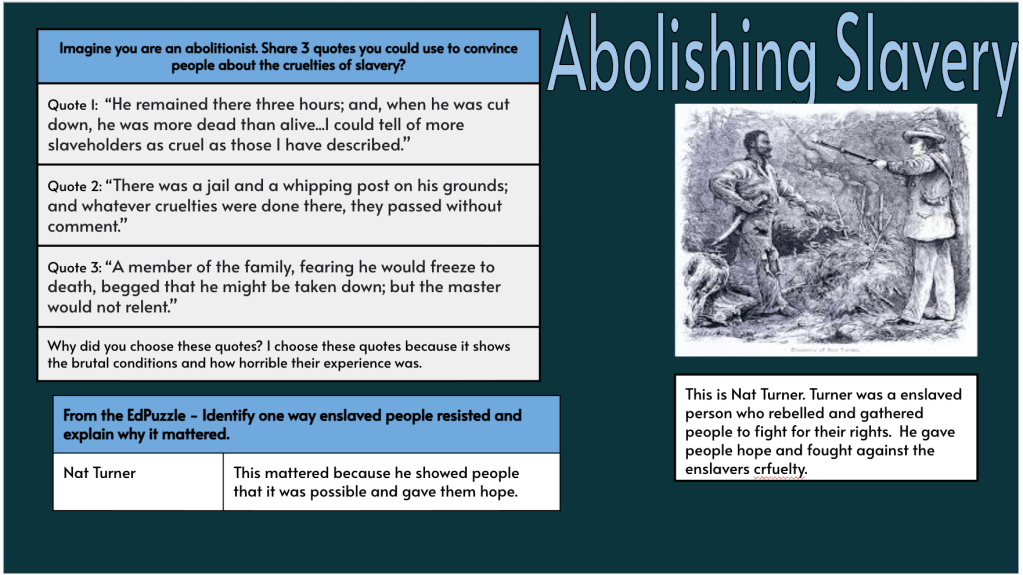
Wednesday and Thursday: Abolitionists, Perspective, and Historical Judgment
By Wednesday, students had spent the first part of the week examining the expansion of slavery and the realities enslaved people faced. The next step was exploring the people who challenged slavery and the different methods they used to push for change.
This lesson sequence became one of my favorite kinds of lessons because students were constantly learning, discussing, comparing, evaluating, and building ideas together without the class ever feeling repetitive.
Thin Slide: Framing the Lesson
We opened with a Thin Slide built around the quote: “Change begins when someone refuses to stay silent.” Students responded using one image and one word or phrase. It was quick, simple, and gave every student an immediate entry point into the lesson.
Before students ever discussed abolitionists, they were already thinking about courage, resistance, speaking out, and standing against injustice. Starting this way helped frame the larger human ideas connected to the lesson before we ever got into historical details.
EdPuzzle: Building Background Knowledge
From there, students completed a short EdPuzzle focused on abolitionism and reform movements.
The goal was not to overload students with information. It was simply to provide enough background knowledge so students could move into the deeper thinking activities confidently.
Sometimes students do not need a lengthy lecture. They need focused context, key vocabulary, and enough information to begin making sense of the topic.
That is exactly what this portion of the lesson accomplished.
Thick Slide: Becoming the Expert
The Thick Slide became the centerpiece of the lesson.
Each student selected an abolitionist and created a slide including:
- Background information
- Motivations for ending slavery
- Methods they used
- A quote or important moment connected to them
This is where the lesson shifted beyond simple fact collection. Students had to decide what information mattered most and organize it in a way that others could learn from.
Every student became responsible for bringing one abolitionist into the room’s shared understanding. Instead of passively receiving information, students became contributors to the lesson itself.
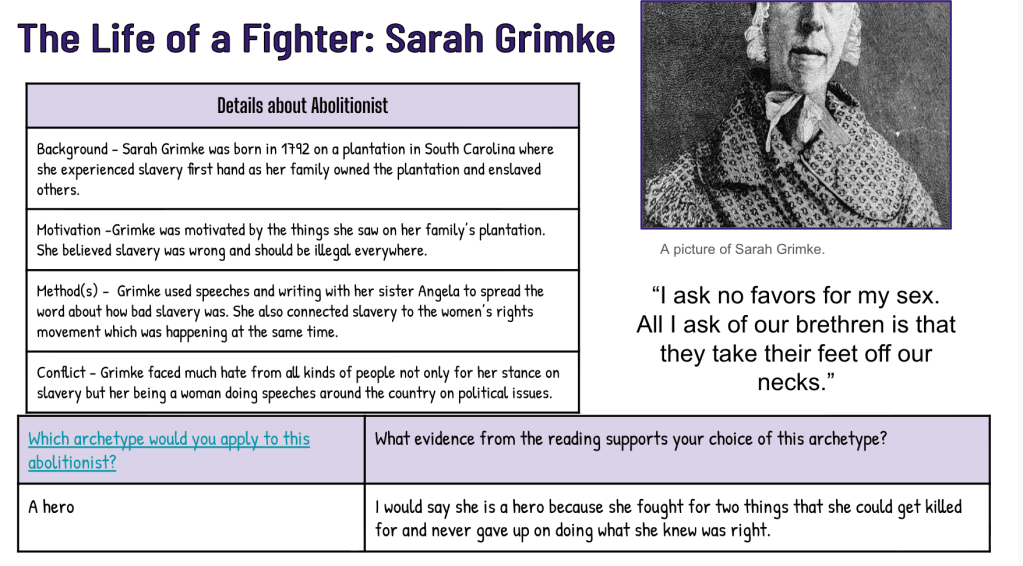
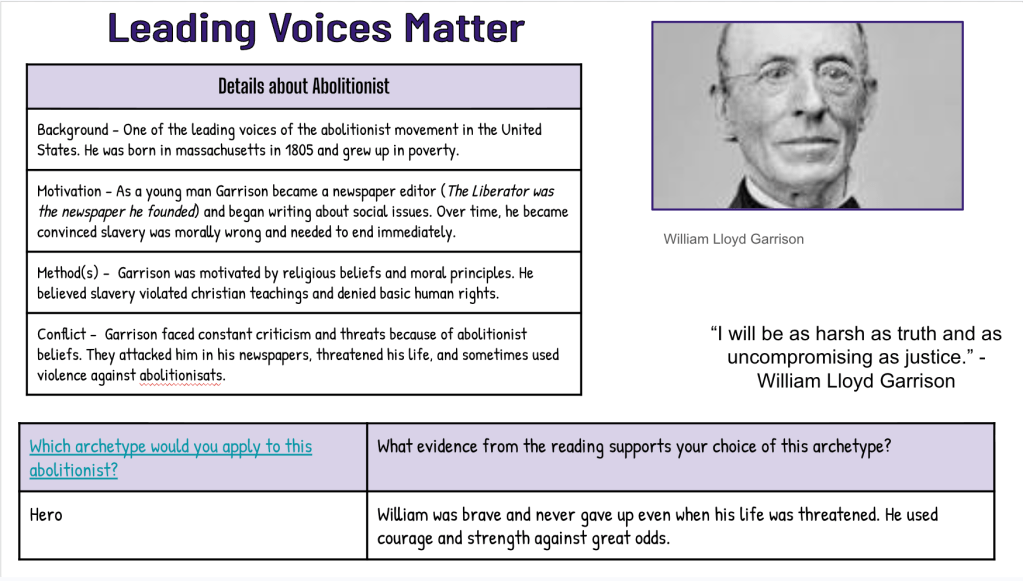
Sharing and Learning From Each Other
Once students completed their Thick Slides, they shared them with classmates.
This part of the lesson completely changed the dynamic of the room because students were now learning directly from one another. Students introduced classmates to figures like Frederick Douglass, Harriet Tubman, William Lloyd Garrison, Harriet Beecher Stowe, John Rankin, and James G. Birney. The sharing process also gave students repeated exposure to important ideas while hearing them explained in different ways by their peers.
Frayer Model: Organizing the Learning
After the presentations, students used a Frayer Model to collect notes on four additional abolitionists from their classmates.
Students focused on:
- Background
- Motivations
- Methods
- Impact
The Frayer Model helped students organize information while also forcing them to compare similarities and differences between abolitionists. By this point in the lesson, students were beginning to recognize patterns in how different people challenged slavery. Some used speeches. Others used writing, newspapers, political action, religion, or direct resistance.
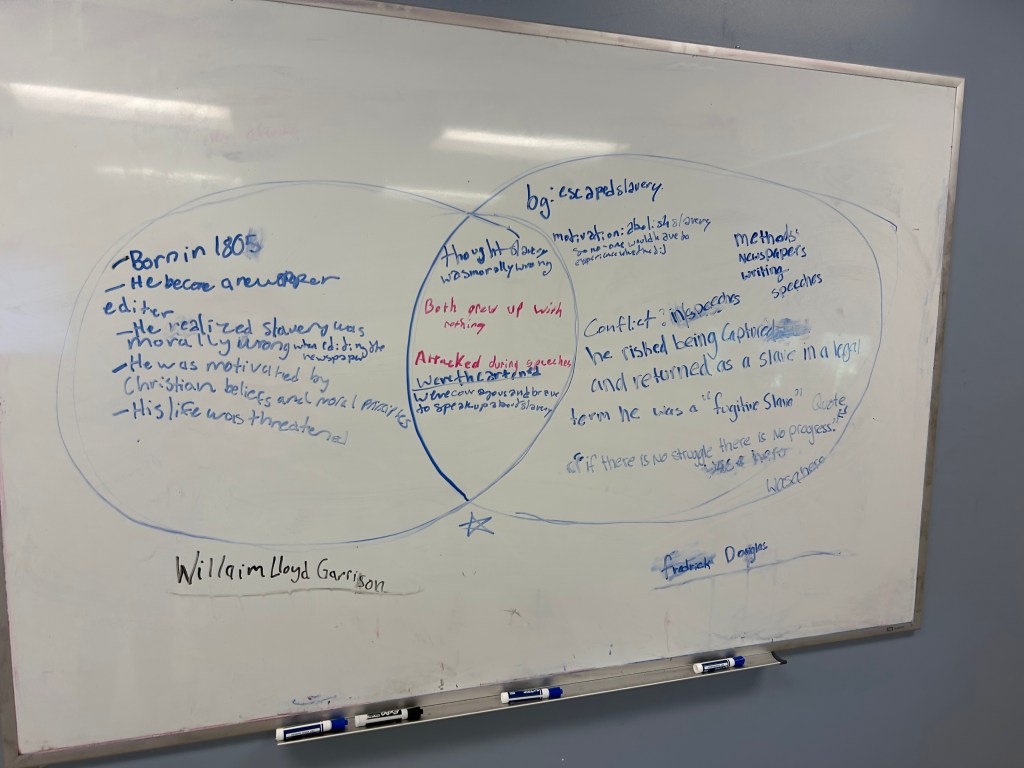
BTC Whiteboards: Comparing Abolitionists
Once students had built enough background knowledge, we shifted into Building Thinking Classrooms style comparisons at the whiteboards.
Students worked in groups comparing two or three abolitionists while discussing questions connected to influence, courage, methods, effectiveness, and long-term impact. The whiteboards immediately raised the level of discussion.
Students debated:
- Who took the biggest risks
- Who changed the most minds
- Which methods were most effective
- Which abolitionist had the greatest long-term impact
Because students had already completed the Thick Slides and Frayer Models, they actually had evidence to support their arguments. The conversations became much deeper than simple opinions. The visible thinking at the boards also helped students build ideas collaboratively instead of waiting for the teacher to confirm whether they were right or wrong.
Superlatives: Ending With Historical Judgment
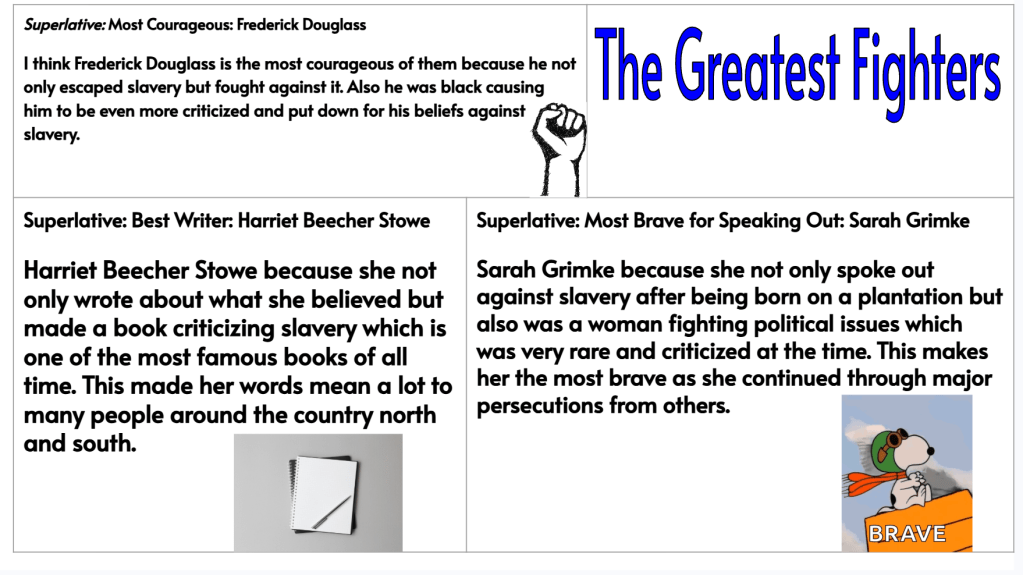
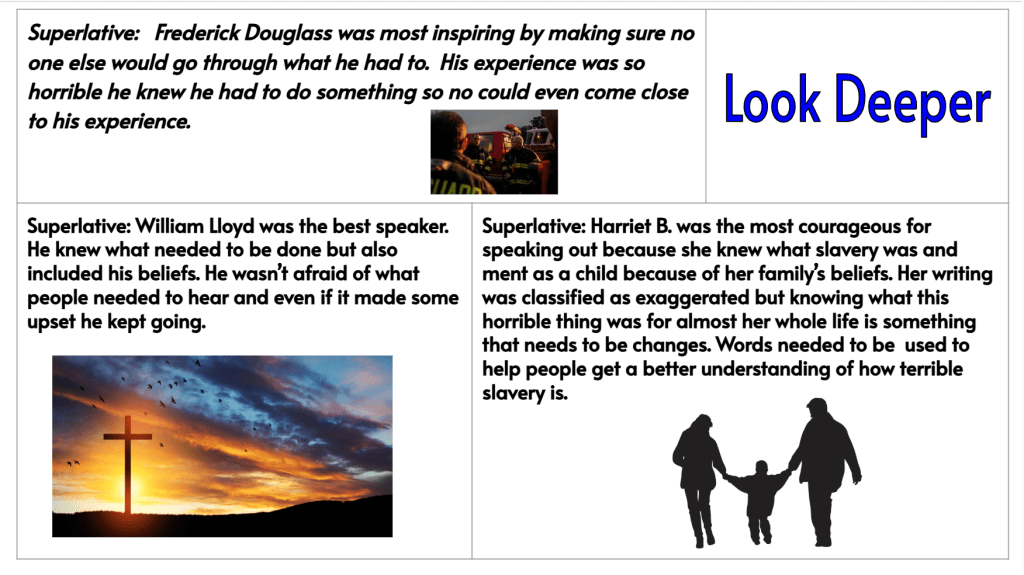
To finish the lesson sequence, students completed a Superlatives activity where they selected abolitionists for categories like:
- Most Courageous
- Most Determined
- Strongest Voice for Change
- Most Influential
This activity pushed students into historical judgment and evaluation. Students had to weigh evidence, compare people, defend their reasoning, and explain why certain abolitionists deserved specific categories. There were very few easy answers, which made the conversations even better.
The lesson naturally progressed from learning about abolitionists to evaluating them, comparing them, and defending claims with evidence. That progression is what made the sequence work so well. Students were not just memorizing names. They were thinking deeply about how different people attempted to create change and how those efforts shaped the country.
Friday: Pulling the Unit Together With 2xCER
Friday became our day to wrap up the unit and bring everything together.
Students first finished their Superlatives activity from Thursday. The conversations carried over naturally because students were still debating impact, courage, effectiveness, and influence. By this point in the week, students knew the abolitionists well enough to defend their thinking with actual evidence instead of surface-level responses.
After wrapping up Superlatives, we shifted into the unit assessment piece using Snorkl and a 2xCER activity.
2xCER: Revisiting the Entire Unit
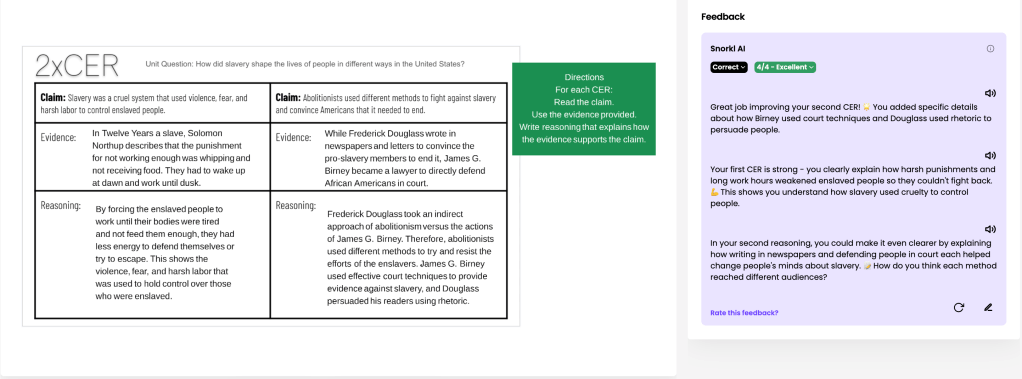
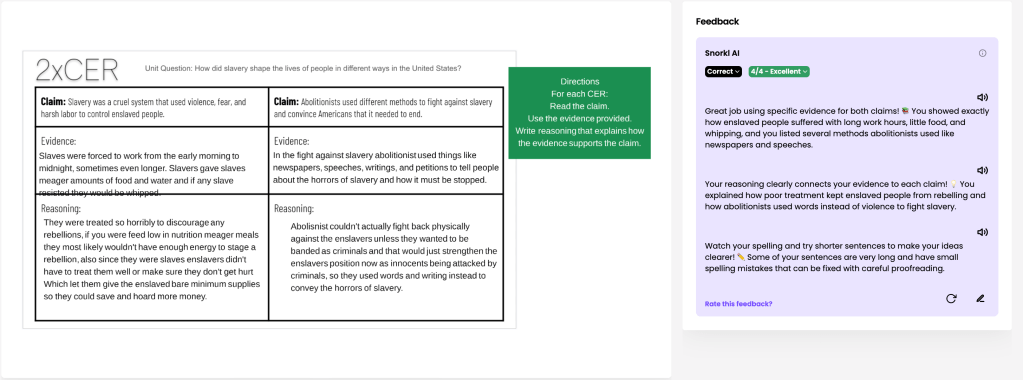
For the 2xCER, I provided students with two claims connected directly to our unit question:
How did slavery shape the lives of people in different ways in the United States?
The first claim focused on the cruelty and realities of slavery:
“Slavery was a cruel system that used violence, fear, and harsh labor to control enslaved people.”
The second claim focused on abolitionists:
“Abolitionists used different methods to fight against slavery and convince Americans that it needed to end.”
Instead of giving students all the evidence, students had to revisit the week’s lessons and pull evidence from their own work, readings, annotations, Thick Slides, Frayer Models, primary sources, and discussions.
That part of the lesson was important because students were not simply answering questions from memory. They had to go back into their learning, locate evidence, determine what best supported the claims, and then create reasoning that connected the evidence back to the argument.
Snorkl: Organizing Evidence and Reasoning
Students completed the activity through Snorkl, where they typed their evidence and reasoning directly into the platform.
What I liked about this structure was how naturally it forced students to revisit the entire week instead of viewing each lesson as disconnected. Students pulled information from multiple activities and sources throughout the unit.
Some students referenced Solomon Northup and Harriet Jacobs when discussing the cruelty and realities of slavery. Others connected back to the cotton gin lesson and explained how the increase in cotton production expanded the demand for enslaved labor. For the abolitionist claim, students brought in evidence connected to Frederick Douglass, Harriet Tubman, William Lloyd Garrison, Harriet Beecher Stowe, and other abolitionists we studied earlier in the week.
The activity also shifted the focus away from simple recall. Students had to think about which evidence best supported each claim and explain why that evidence mattered.
Ending the Week With Synthesis
By Friday, the classroom conversations sounded very different than they did on Monday.
Students were no longer discussing slavery as a single topic with one perspective. They were discussing systems, economics, resistance, perspective, cruelty, activism, and consequences. They were comparing experiences, evaluating impact, and supporting ideas with evidence from multiple lessons and sources.
That progression across the week is what made the unit feel successful.
Every lesson built into the next:
- The cotton gin introduced consequences and economic expansion
- Primary sources humanized the realities of slavery
- Abolitionists showed how people resisted and fought for change
- The CER brought everything together through evidence and reasoning
Instead of ending the week with a traditional test focused entirely on memorization, students finished the unit by revisiting evidence, connecting ideas, and building historical arguments across the entire week of learning.
Lesson for the Week
Monday – Cotton Gin Rack and Stack
Tuesday – Life of the Enslaved Rack and Stack
Wednesday and Thursday – Abolitionist Thick Slide, Frayer Notes, Superlatives

 Moler's Musings