I don’t usually run the same lesson twice. Every year I’m changing things, trying something new, seeing what works and what doesn’t. That’s just how I’ve always approached teaching.
But over time, there are a few lessons that keep finding their way back into my classroom. Not because I’m out of ideas, but because they actually work. Students are into them. They’re talking, thinking, and the lesson just flows the way it’s supposed to.
When I step back and look at those lessons, there’s a reason behind it. They’re built a certain way. They’re sequenced in a way that makes sense. Nothing feels random, and each part leads into the next.
This series is me breaking those lessons down. What they look like in the classroom, how they play out, and why I keep coming back to them.
Setting the Stage
This lesson came at the start of our westward expansion unit, and most students were coming in with very little background beyond the idea that the United States moved west. They had heard the term Manifest Destiny before, but it did not really mean anything to them yet. The goal was not just to define it, but to get them thinking about it as both a historical idea and something that still connects to how people think today. I wanted them to see that this was not just something to memorize, but something to question.
Fast and Curious – Building the Base
We started with a Fast and Curious using Gimkit to review key vocabulary, focusing on terms like Manifest Destiny, annexation, expansion, and acquisition. Students played, saw their results, and then played again. It was quick, but it did exactly what it needed to do. The repetition helped them start to recognize the terms and feel more comfortable with the content before we asked them to do anything deeper.
That part matters more than it seems. When students do not understand the words, they check out fast. When they do understand them, even at a basic level, they are more willing to engage with the lesson. By the time we moved on, they had a base to work from, and that made everything else go smoother.
Wicked Hydra – Driving Inquiry
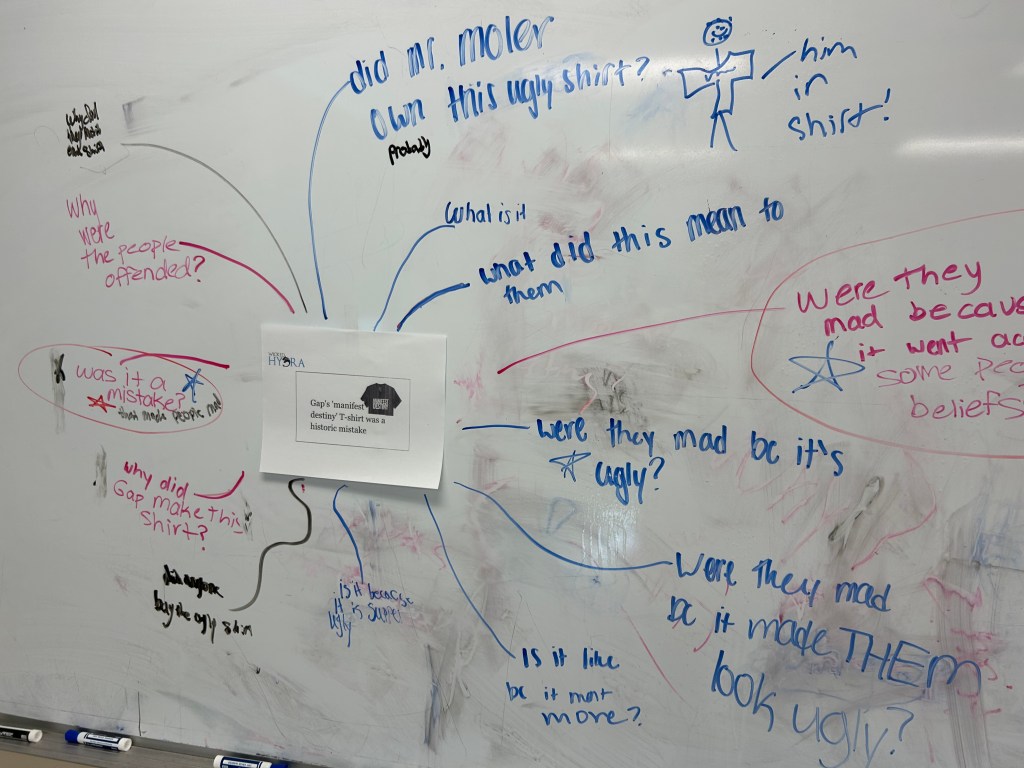
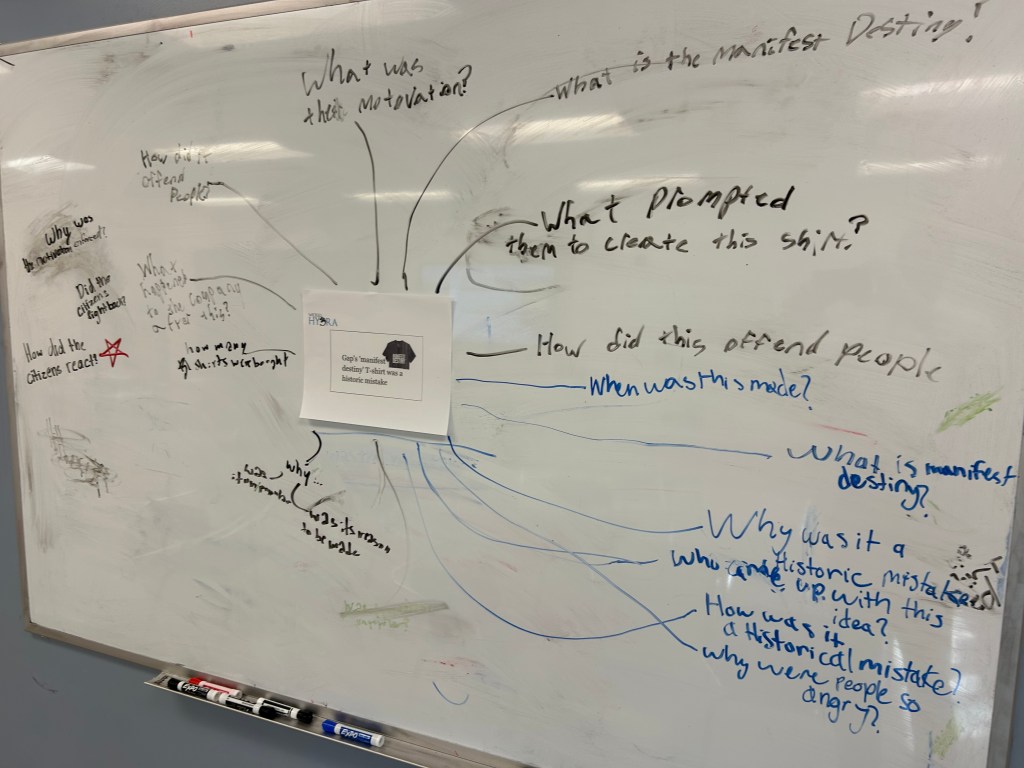
From there, we moved into a Wicked Hydra using the headline “Gap’s T Shirt Was a Historic Mistake.” Students worked in groups at whiteboards and started generating questions, focusing on the ones they thought would actually be answered during the lesson. That small shift in direction made a big difference in the quality of what they came up with.
The questions started simple, but they did not stay there. Students began asking why something like a T shirt would be controversial, who would be upset, and what it says about how history is remembered today. At that point, the lesson stopped being about me introducing content and started becoming something they were trying to figure out themselves. The energy in the room changed because they had a reason to care. They were not just going through the motions, they were looking for answers.
Sourcing Parts – Slowing Down the Thinking
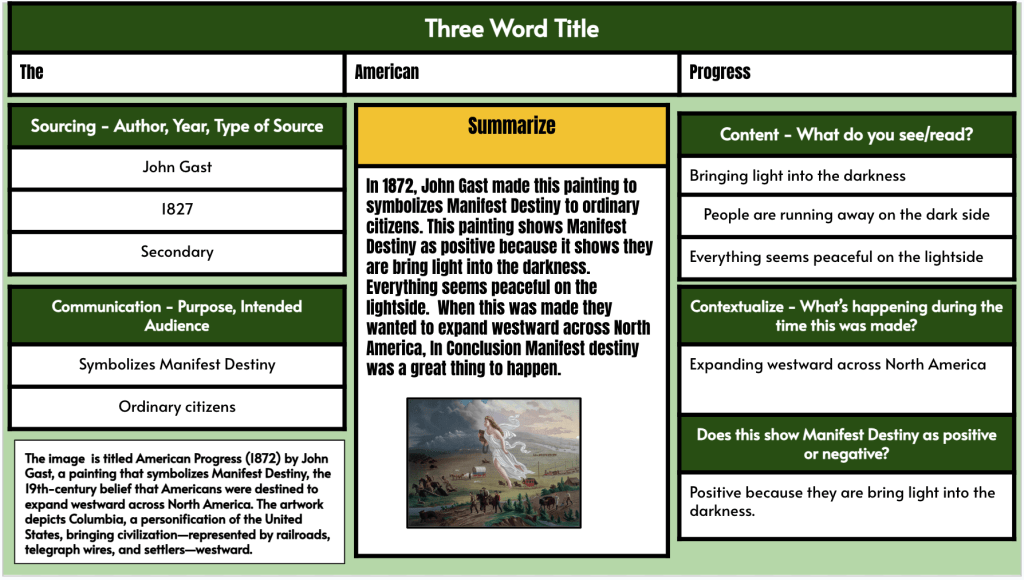
After that, we moved into Sourcing Parts with the painting American Progress, and this is where the thinking really started to deepen. Students began by identifying who created the image and what message it was sending, but the conversation shifted once we pushed into who was included and who was left out.
At first, they noticed the obvious parts of the image, but once they started thinking about purpose and perspective, they began to see it differently. It was no longer just a painting. It was a message about expansion, about progress, and about who benefits from that story. At the same time, they started to recognize what was missing, especially the experiences of Indigenous people. This part slowed everything down in a good way and forced students to actually think about what they were seeing instead of just moving on.
MiniReport – Bringing It All Together
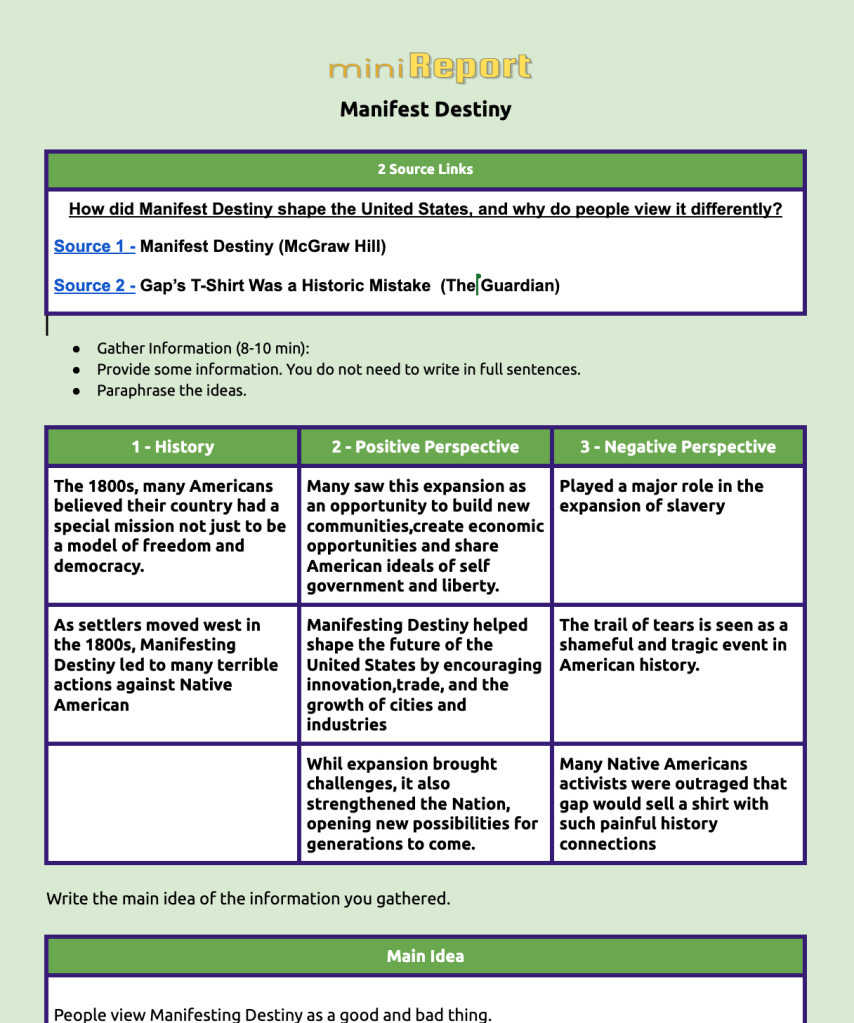
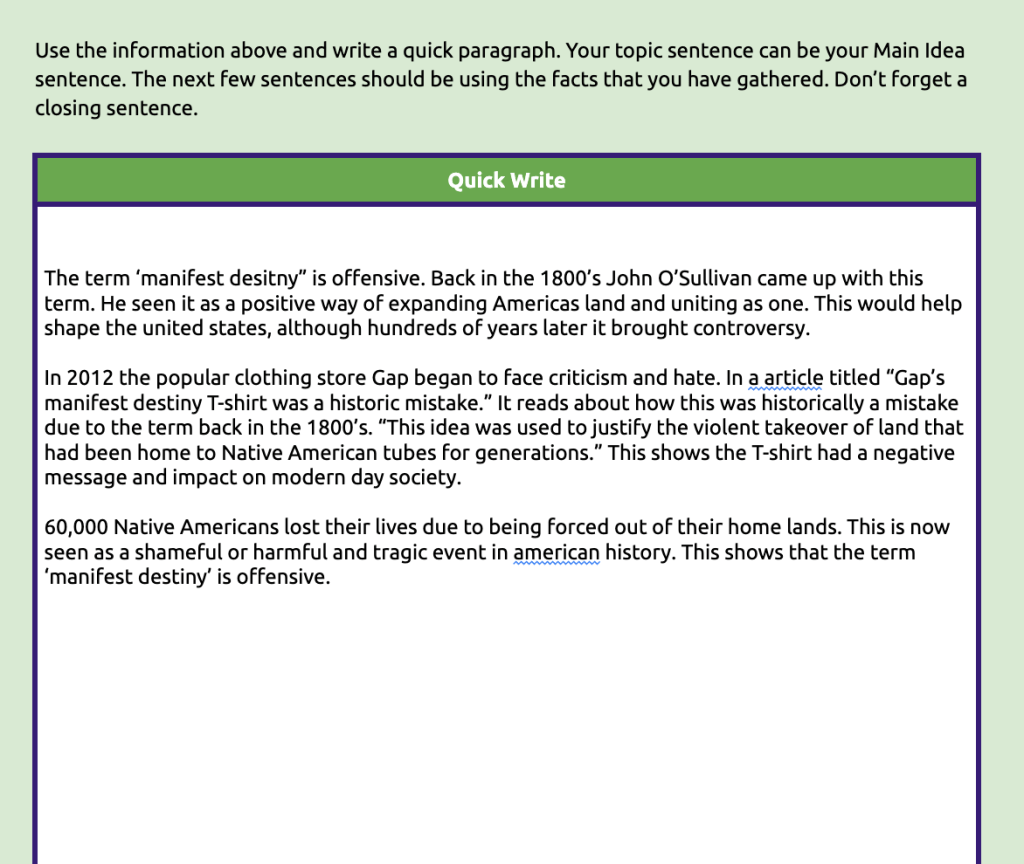
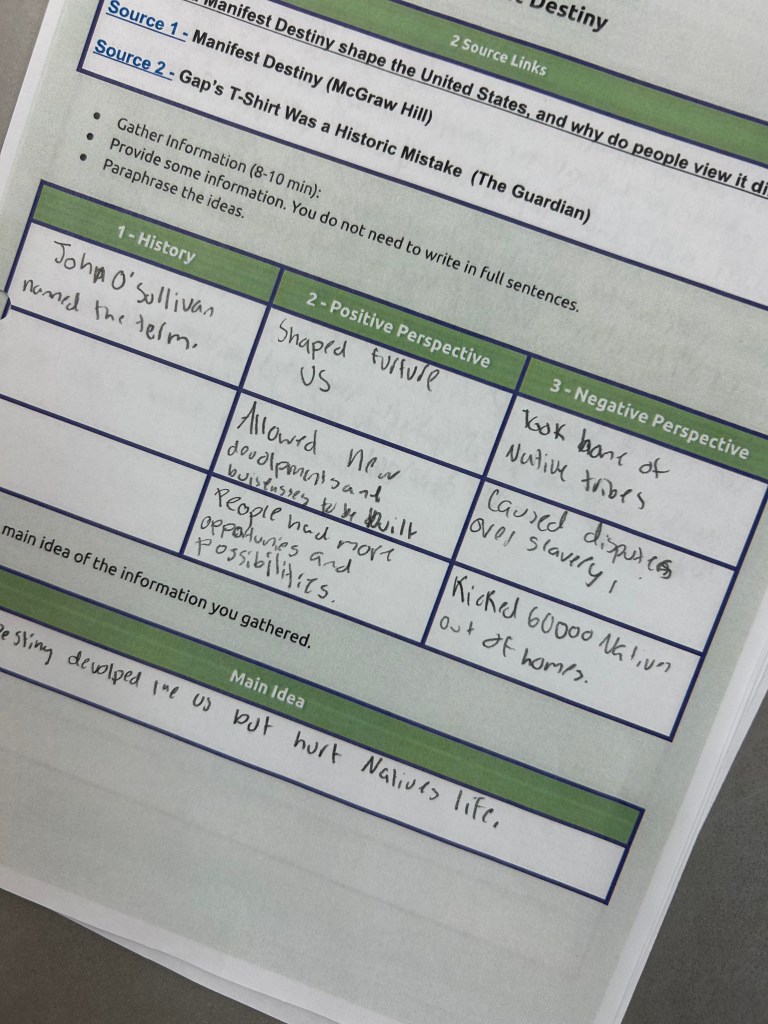
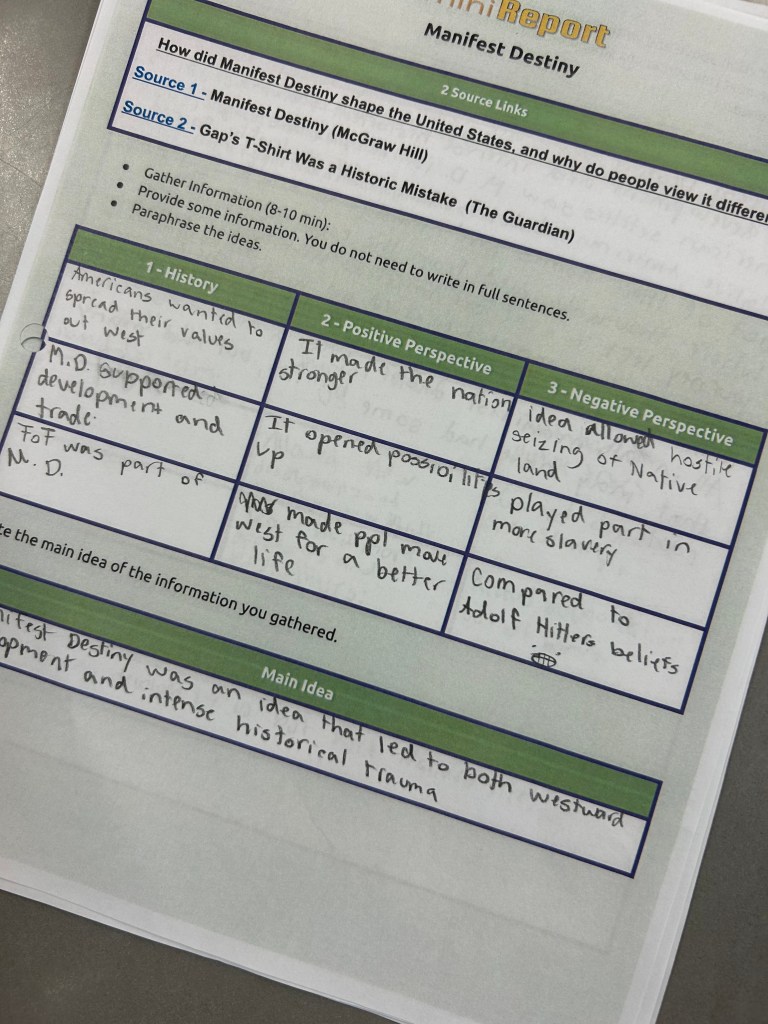
To finish, we used a MiniReport to compare two perspectives on Manifest Destiny. One source framed it as a natural and necessary part of expansion, which is often the version students are most familiar with. The other focused on the backlash to the Gap T shirt and how people today view that idea differently.
Students took notes, organized their thinking into categories, and wrote a paragraph that captured the main idea. By this point, they were not starting from scratch. They had the vocabulary from the beginning, the questions they generated, and the analysis from the image. The writing became a way to pull everything together instead of something separate from the lesson. It also gave them practice with two source thinking and writing, but it felt like a natural ending rather than forced test prep.
How the Protocols Worked Together
What made this lesson work was how the protocols built on each other. Fast and Curious gave students the vocabulary they needed to participate, Wicked Hydra created inquiry and gave them a reason to care, Sourcing Parts pushed their thinking deeper, and MiniReport gave them a way to organize and express what they understood.
Each part had a purpose, and each part set up the next. The lesson was not about any one activity. It was about how they all connected to create a flow where students were constantly building on what they had already done.
Why This One Stays
I like this lesson because it comes full circle. It starts with building background, but it ends with students thinking about how the past connects to the present. The headline is not just there to hook them. It becomes something they come back to and understand in a different way by the end of the lesson.
It also helps them understand why knowing history matters. We live in a time where people are quick to say others are too offended, but sometimes there is a real reason behind that. If you do not know the history, you miss the why. This lesson gives students a chance to see different perspectives and start building some empathy, not just learning what happened, but understanding how and why people see it differently.
That is what makes this one worth running again.


