Locked In – Lessons Worth Running Again (A Lesson About the Cotton Gin)

This lesson works because students are starting from almost nothing. Most of them do not walk in with background knowledge about the cotton gin. In fact, the most common response when I introduce it is something like, “They make gin from cotton?” That actually helps. Instead of correcting misconceptions, I am building understanding from the ground up. The goal is not just to explain what the cotton gin is, but to help students understand how one invention can reshape an economy and deepen an existing problem at the same time.

Language Matters

We start with a short mini lesson on language, and it immediately sets the tone for how we approach the content. We talk about using enslaved instead of slaves, enslaver instead of owner, and freedom seekers instead of runaways. It is a small shift, but it forces accuracy. Students begin to see that the words we use can either clarify or hide what actually happened. This matters because if they do not have the right language, they will not build the right understanding of the system we are about to study

Making It Real

From there, I put raw cotton in their hands. Seeds still stuck in it, pieces tangled together, nothing cleaned up. I show them what cotton looks like on a stalk and let them react to it. There is always a moment where they realize how messy it is and how much work it would take to clean. That is intentional. Before we ever talk about Eli Whitney or the machine itself, students understand the problem that needed to be solved. This step gives them something concrete to anchor their thinking, and it makes the invention feel necessary instead of abstract.

Archetype Four Square

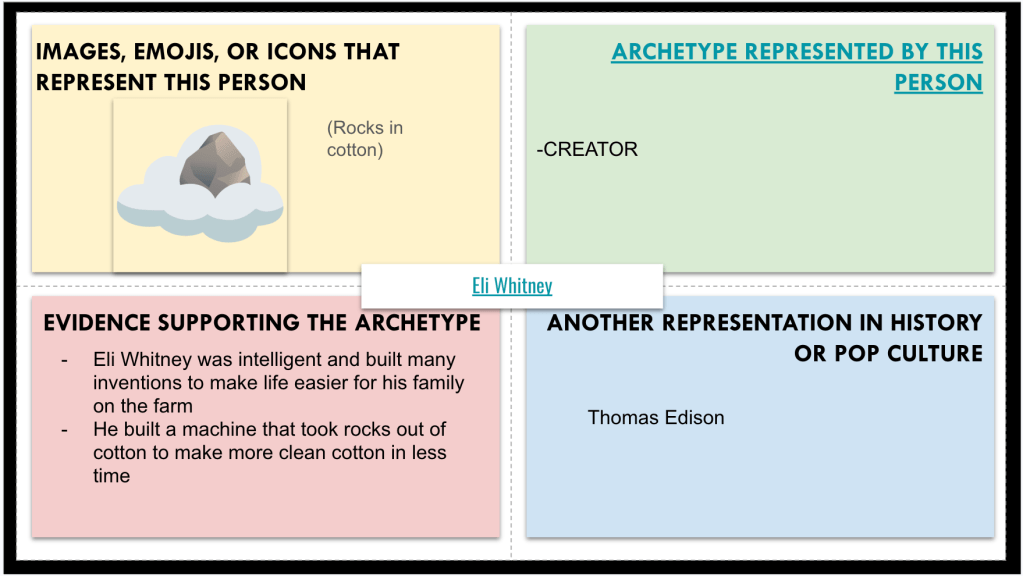
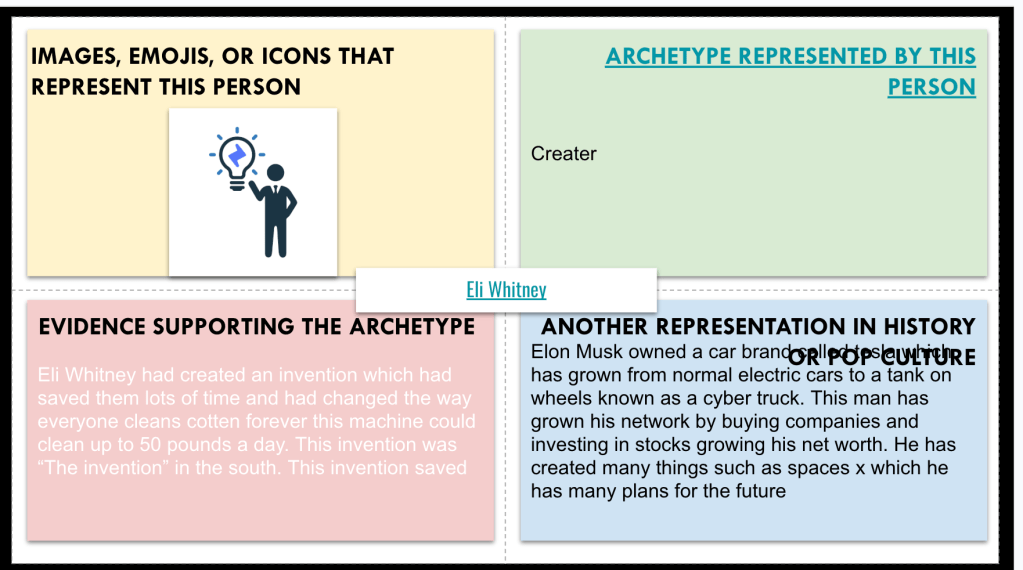
When we move into Archetype Four Square on Eli Whitney, the focus shifts from the problem to the person. Students are not just collecting facts. They are deciding how to categorize him and supporting that choice with evidence. Is he an innovator, a problem solver, or something more complicated? That question matters because it opens the door to thinking about impact. It moves students away from a simple mindset of memorizing and toward a deeper look at what his invention actually led to.
Annotate and Tell

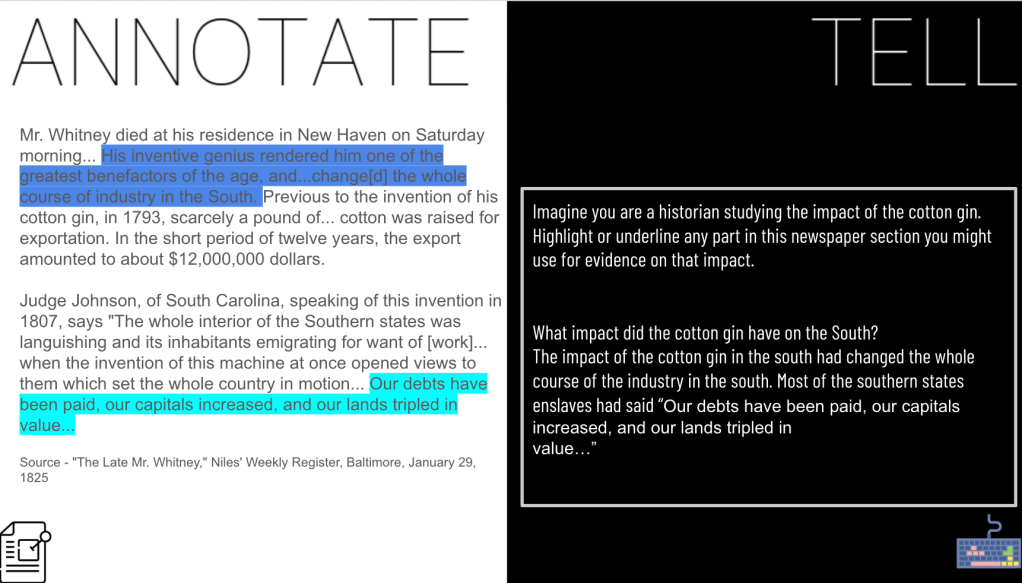
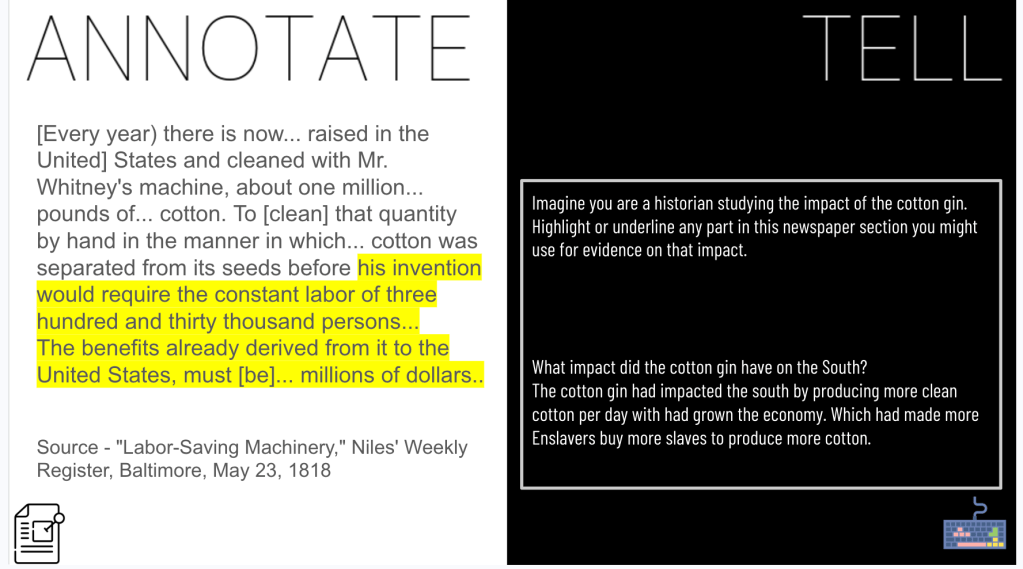
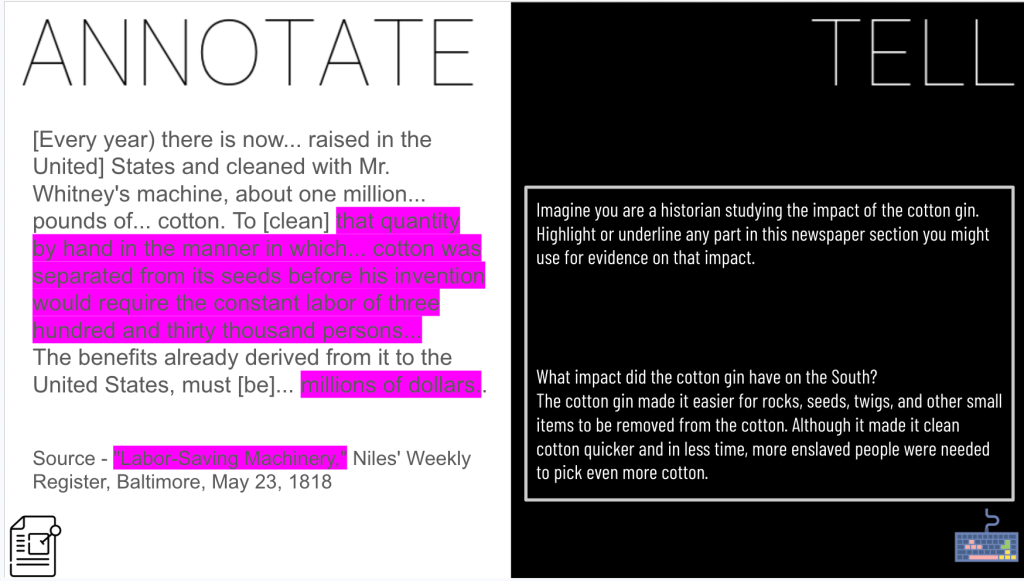
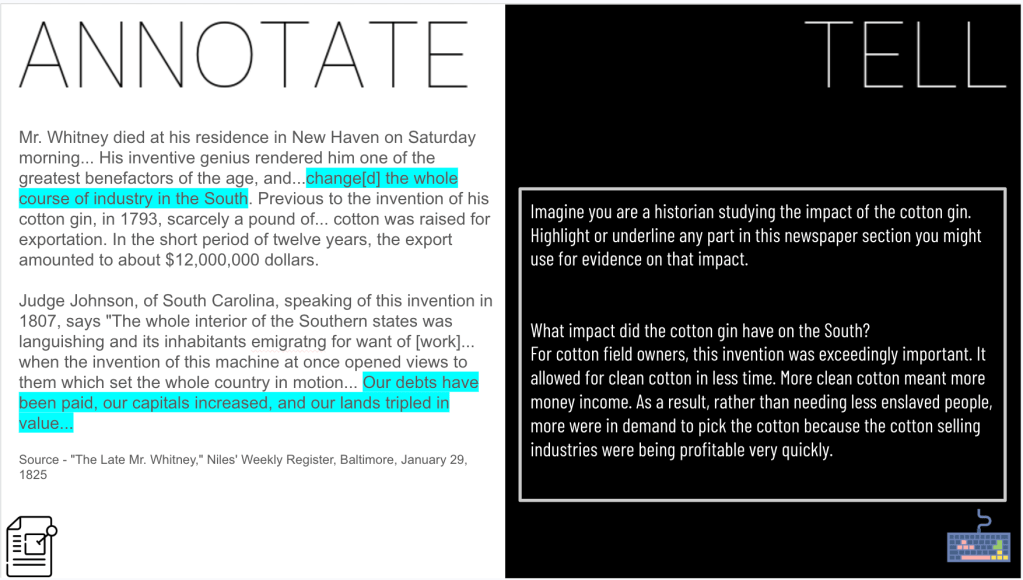
The lesson then moves into Annotate and Tell using primary sources that describe the cotton gin’s impact. Students read closely and pull out evidence about production, labor, and economic growth. One source explains how machines could clean enormous amounts of cotton compared to hand labor, while another shows how quickly cotton exports increased and how the Southern economy shifted in a short period of time. This part matters because students are not just hearing the story from me. They are seeing the claims and evidence directly from the time period, which makes the learning more grounded.
Graph and Tell

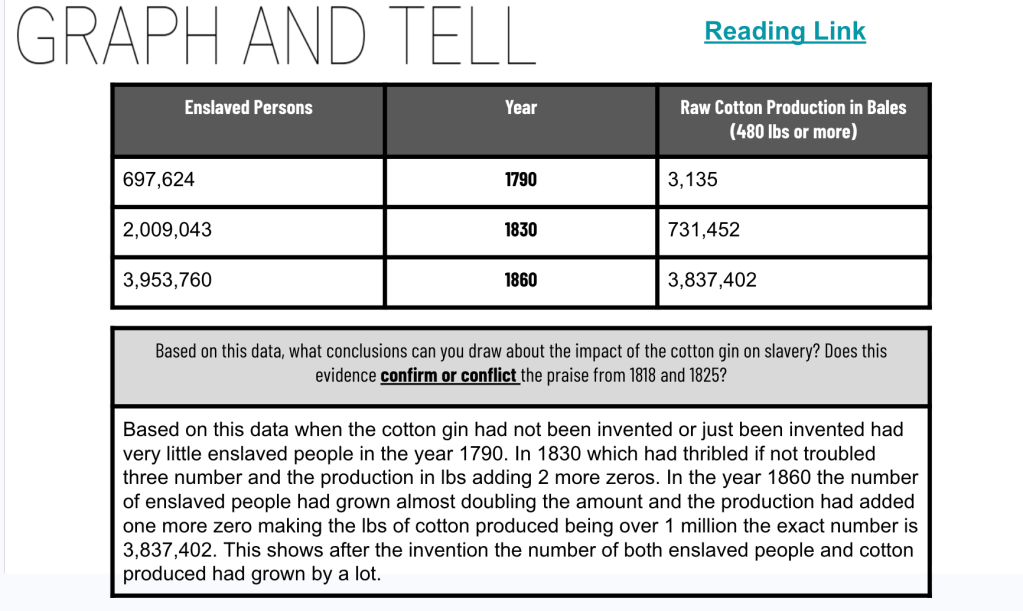
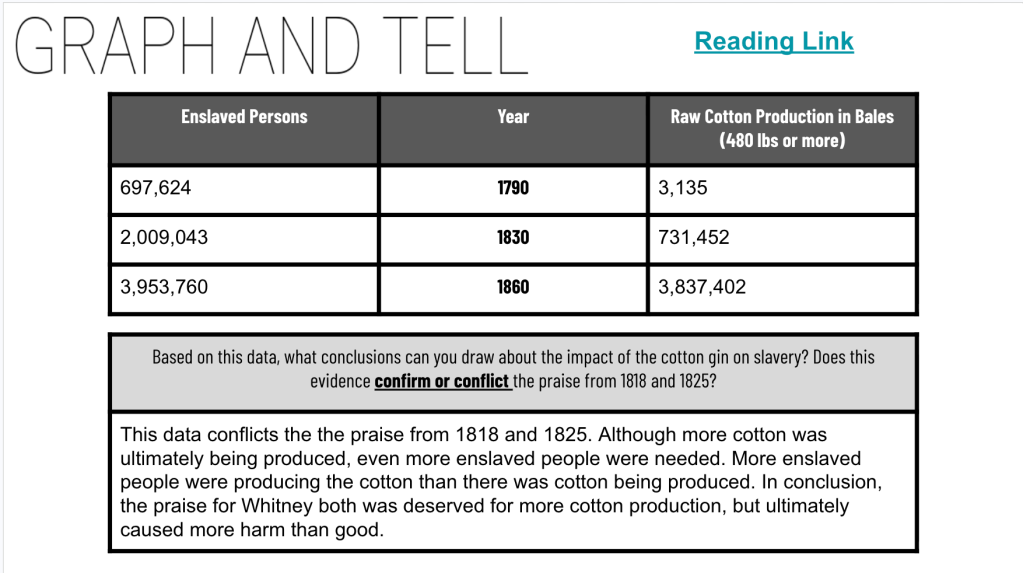
After that, we bring in data with Graph and Tell. Students look at the growth of cotton production alongside the growth of the enslaved population and begin turning those numbers into meaning. This is where things start to click. The machine made cotton easier to process, but instead of reducing the need for labor, it increased it. Students start to notice that connection on their own, which is far more powerful than being told.
Multiple Perspectives (2xPOV)

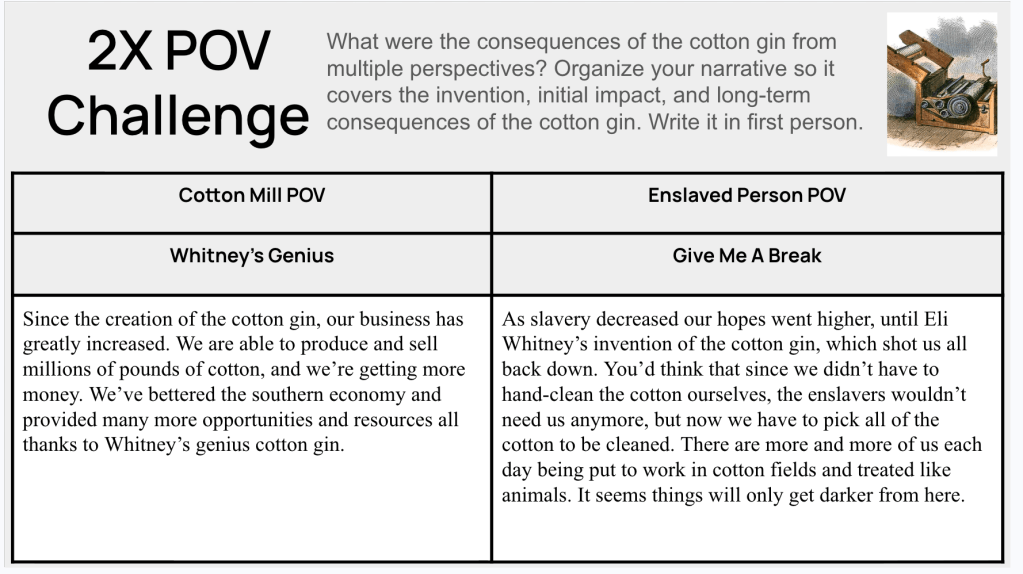
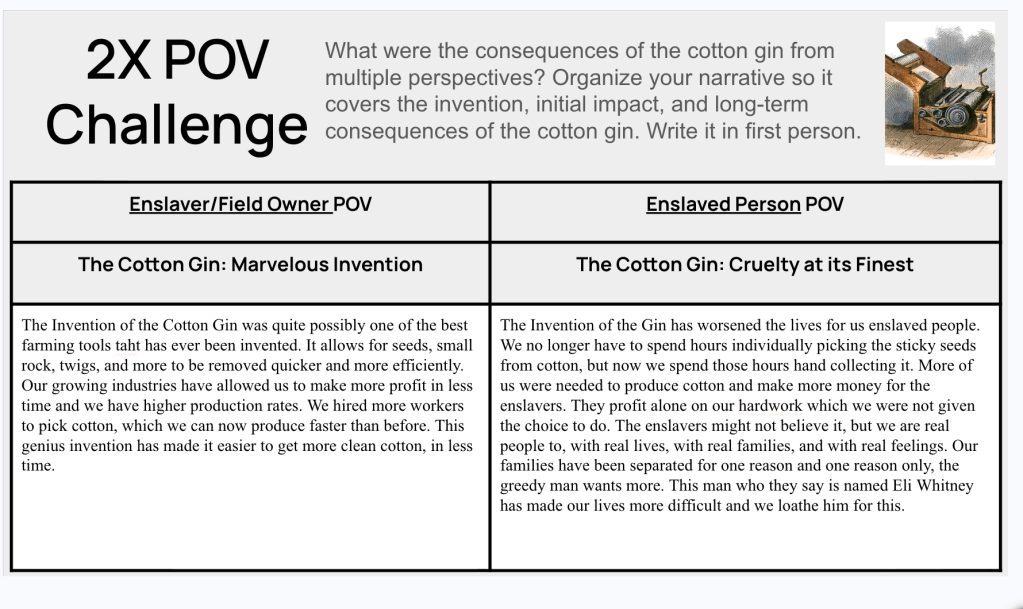
We close by shifting perspectives and asking students to think about the cotton gin from different points of view. Enslavers, enslaved people, Northern businesses, and Southern farmers all experienced the impact differently. Students have to explain those differences and make sense of how the same invention could be seen as progress by some and harmful by others. This part brings everything together because it forces students to move beyond describing what happened and into explaining why it mattered.
How It All Fits Together

What makes this lesson work is how each part builds into the next. The language shapes how students think about people. The cotton makes the problem real. The archetype builds an understanding of the individual. The sources add evidence. The data creates tension. The perspectives add complexity. Students are not overwhelmed because they are building their understanding step by step.

Why This One Stays

This lesson stays because it changes how students think about cause and effect. They start with very little understanding of the cotton gin and leave with the ability to explain how one invention could increase efficiency while also expanding slavery. They are not just learning what the cotton gin is. They are learning how to think about impact, and that is what makes the lesson worth running again.

The Lesson Link

The Cotton Gin Lesson – What was the impact of the cotton gin?
The Week That Was In 103

Spring break is always an interesting reset point. Students come back needing structure, movement, review, and something fresh to pull them back in. This week became a strong example of how routines, retrieval, and purposeful lesson design can help students re-enter quickly while also launching a brand new unit.

We moved from reviewing foundational civics ideas into beginning our westward expansion unit with the compelling question:

How did Manifest Destiny change America’s map and affect the lives of people?

The week blended retrieval practice, vocabulary building, inquiry, source analysis, mapping, comparison thinking, and AI-supported feedback. It also required some pivots when I had to be out later in the week. Sometimes the best planning is adjusting without losing the learning goal.

Monday: Retrieval With Energy

The first day back from break needed to be active. Students had been away from school routines, so I wanted them talking, moving, and remembering what we had learned earlier in the year.

We ran a Resource Rumble from EMC2Learning. Around the room were eight review questions tied to key standards and concepts students still need to know. Topics included federalism, the Great Compromise, causes of the American Revolution, and Jacksonian Democracy.

There were no Chromebooks allowed.

Students worked with their groups, discussed answers, and relied on memory rather than searching online. After completing each question, they brought their paper to me for feedback. If the answer was solid, they rolled a six-sided die to determine how many Jenga blocks they earned. The tallest free-standing tower at the end won.

This was one of those lessons where students probably felt like they were playing a game, but underneath it was serious retrieval practice. They were discussing content, correcting misconceptions, and rebuilding old knowledge after time away.

That is exactly what I wanted on Day 1 back.

Tuesday: Launching Westward Expansion

Tuesday introduced our new unit and gave students a roadmap for where we were headed. I broke the unit into three parts:

  1. Understanding Manifest Destiny
  2. Understanding how the United States acquired western territories
  3. Understanding the groups of people who moved west and why

We began by introducing 15 key vocabulary terms through a Fast and Curious Blooket. Students played for four minutes, received feedback, and then immediately played again for three more minutes.

Every class improved dramatically.

That quick cycle matters. Students gain confidence when words stop feeling unfamiliar. Once vocabulary becomes more accessible, the rest of the lesson opens up.

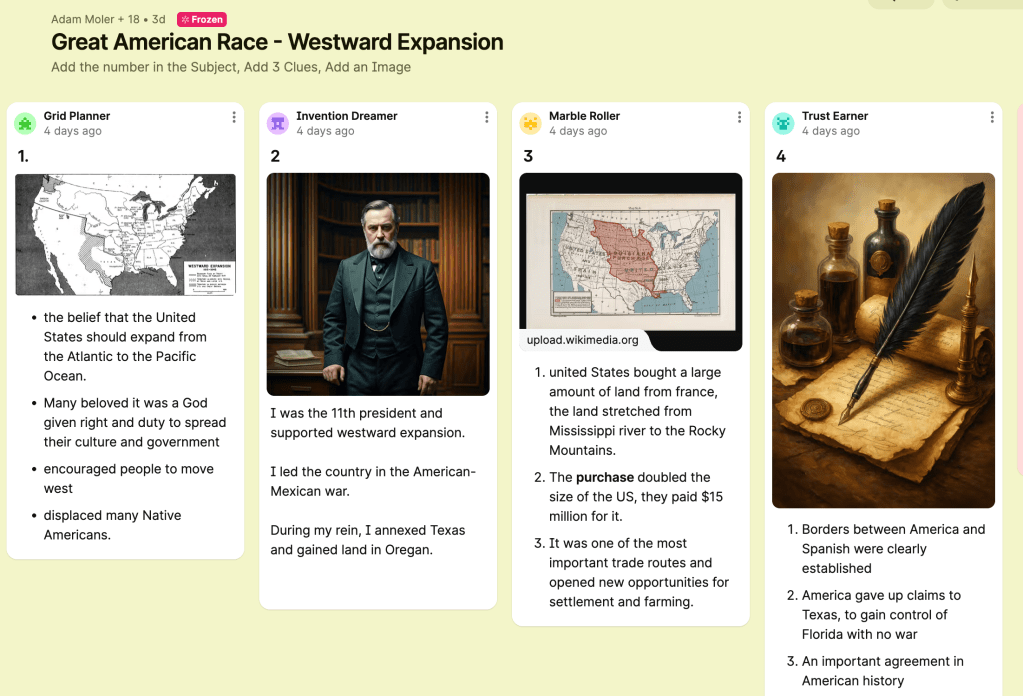
From there, we moved into a Great American Race activity. Students each received a slip containing a numbered vocabulary term with a five-to-six sentence description. Terms included people, events, and concepts such as James Polk, Mexican Cession, and annexation.

Students were told not to share their information.

Instead, they went to Padlet and created a post using:

  • their assigned number as the title
  • three clues from the description
  • a relevant image

I moderated every post so nothing appeared until everyone was ready. Once all clues were approved, students paired up and raced to solve every numbered clue on Padlet.

This became one of my favorite ways to launch the unit because the structure matched the content. Westward expansion was a race for land, influence, opportunity, and movement. Students were literally racing through the ideas that would define the unit.

Wednesday: Manifest Destiny as an Idea to Question

Wednesday focused fully on Manifest Destiny, but not as a simple textbook definition.

Too often students hear the phrase and think it just means “America moved west.” I wanted them to wrestle with it as an idea, a belief system, and something people still debate today.

We started with Fast and Curious using Gimkit to review terms like Manifest Destiny, annexation, expansion, and acquisition. That quick retrieval gave students a base before asking them to think more deeply.

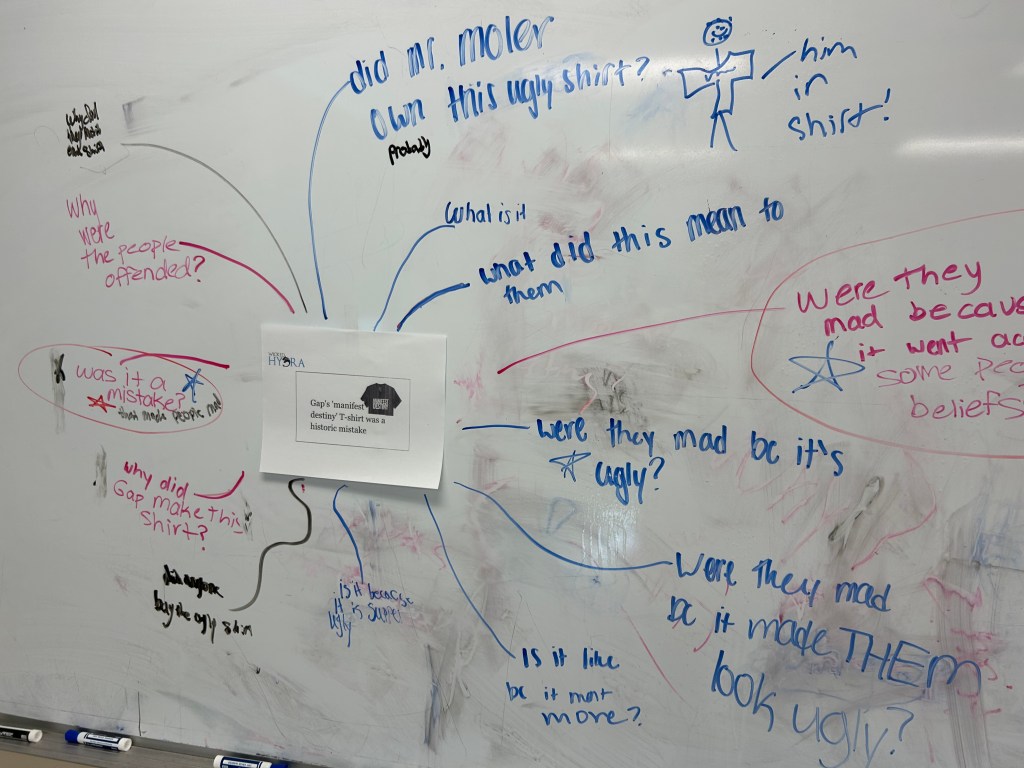
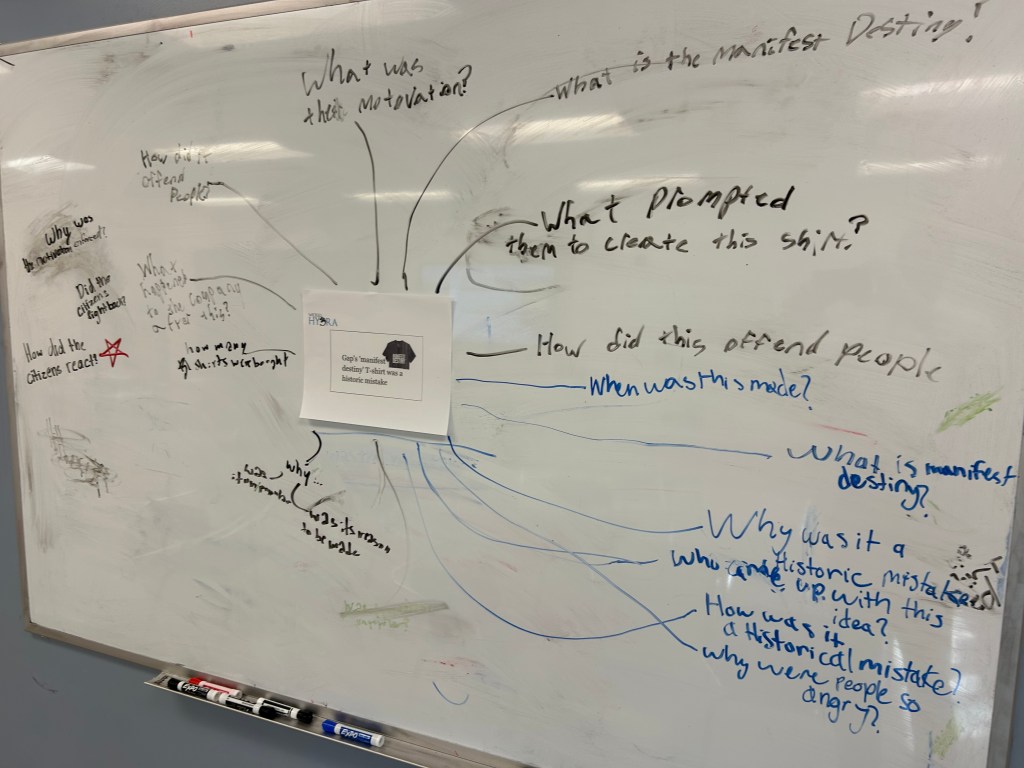
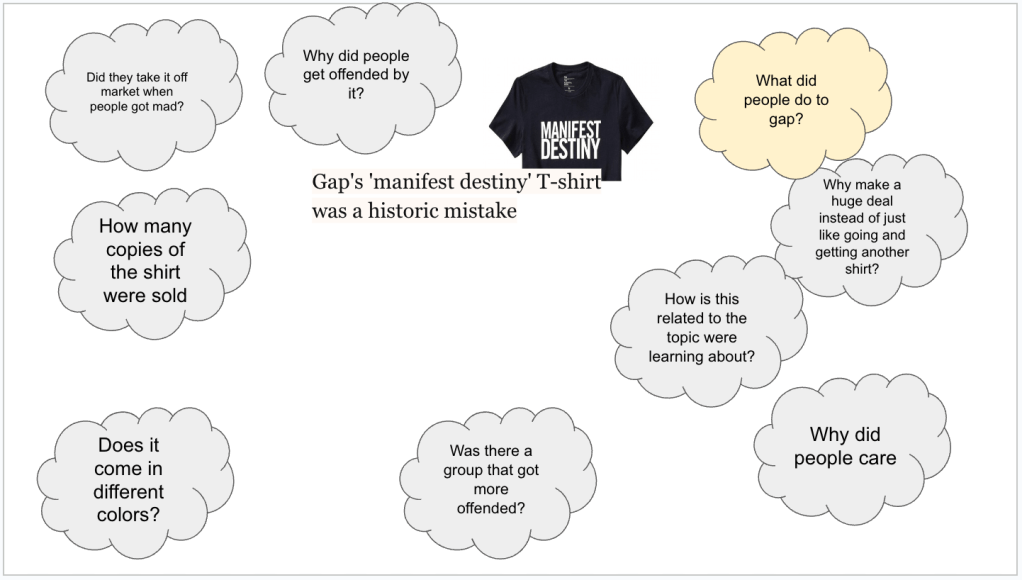
Then we moved into a Wicked Hydra built around the headline:

Gap’s T Shirt Was a Historic Mistake

Students worked in groups at whiteboards generating questions they thought the lesson would answer. At first the questions were surface level. Then they became sharper:

Why would a shirt be controversial?
Who would be upset?
How is history remembered today?

The room changed once students had something real to figure out.

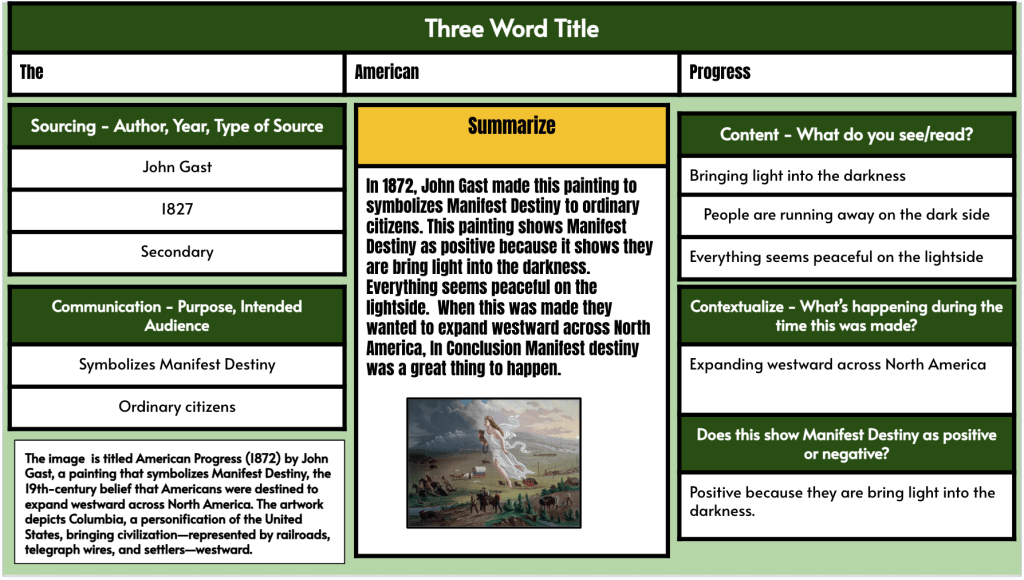
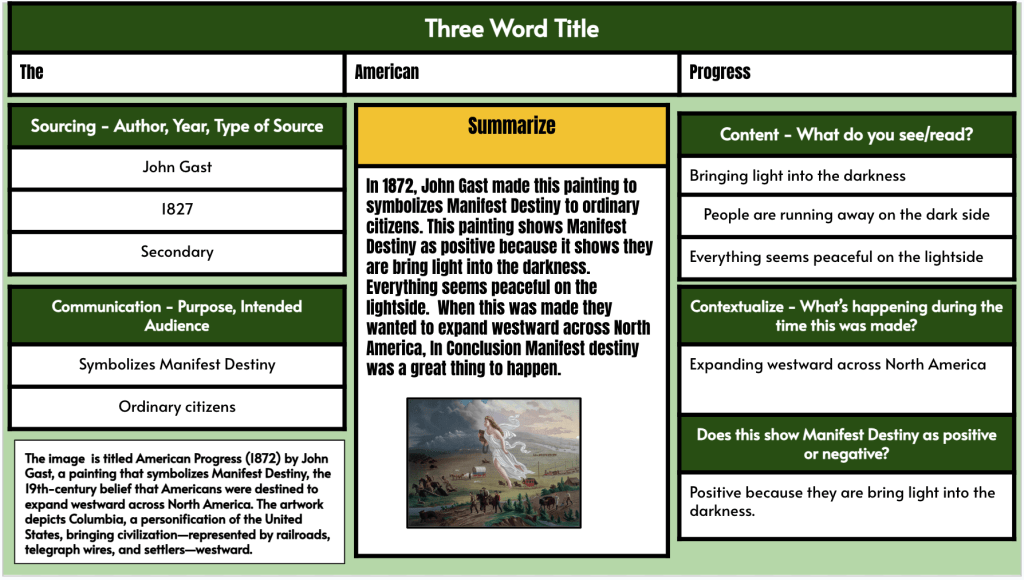
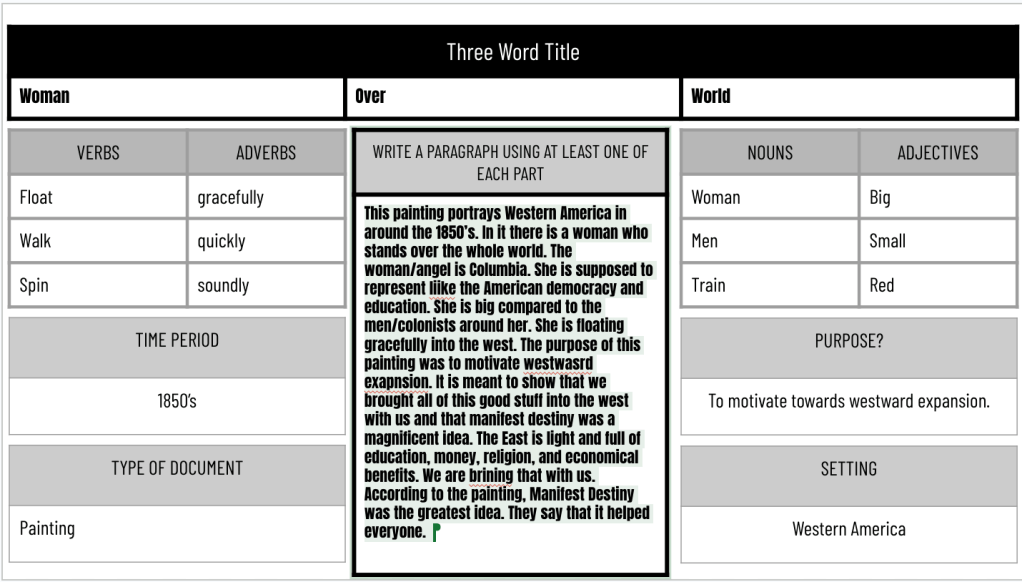
Next came Sourcing Parts using the painting American Progress. Students examined creator, message, audience, and perspective. They quickly noticed symbols of movement and expansion, but deeper discussion centered on who was missing from the image and whose story was being ignored.

That is where the lesson slowed down in a good way.

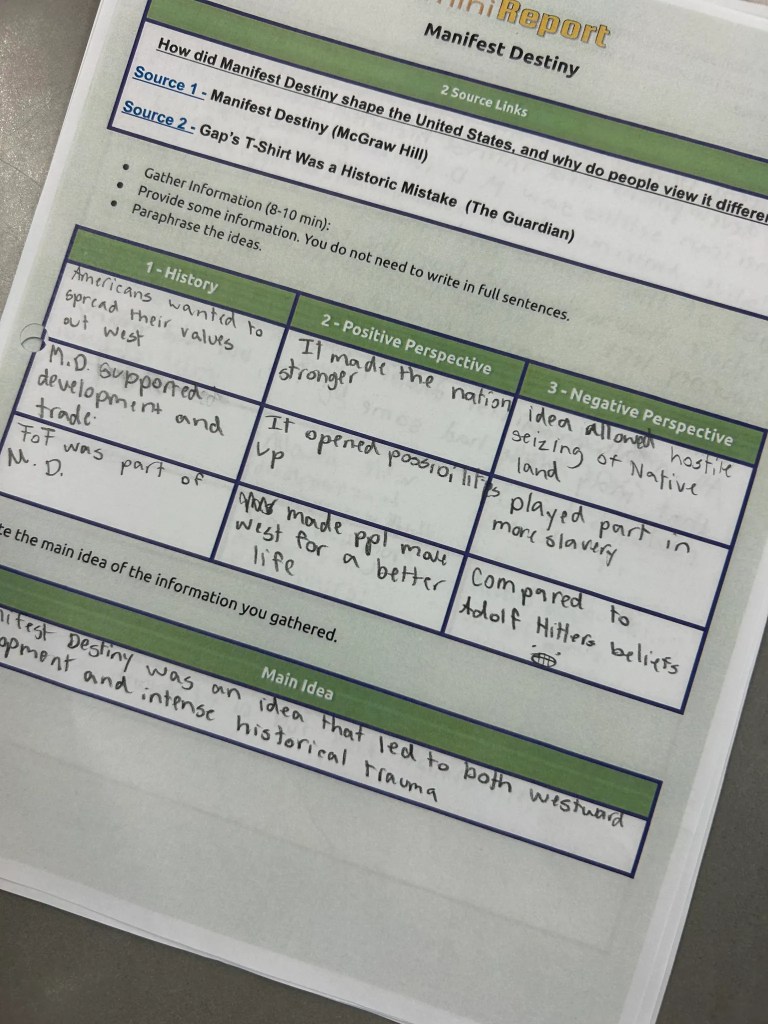
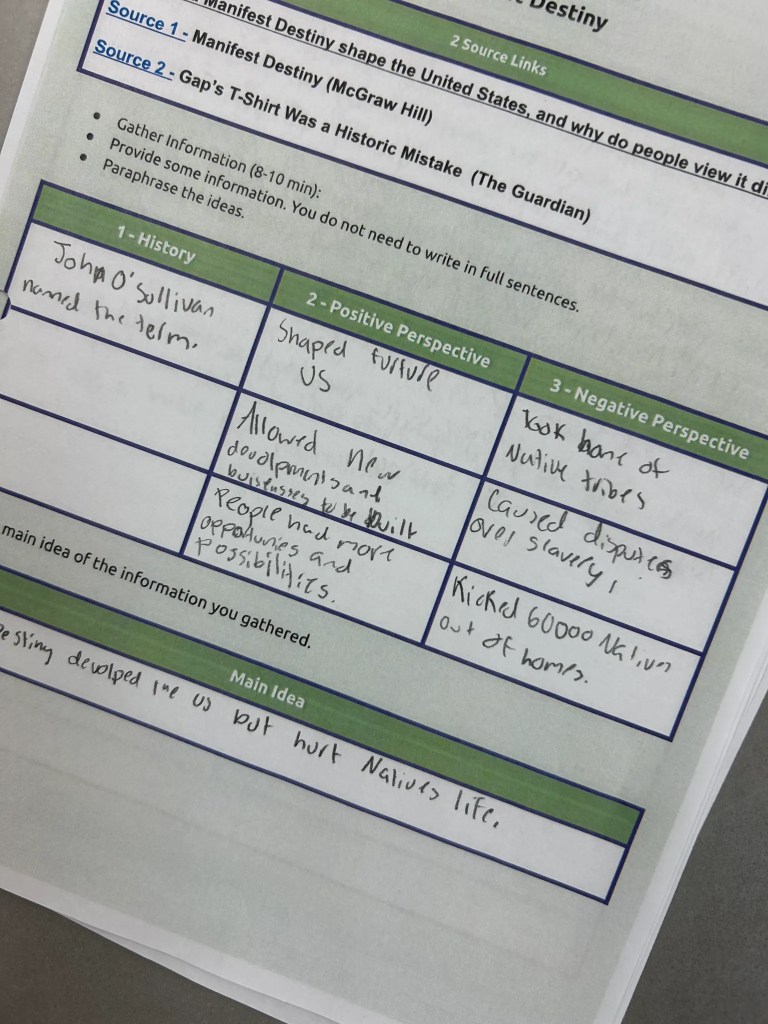
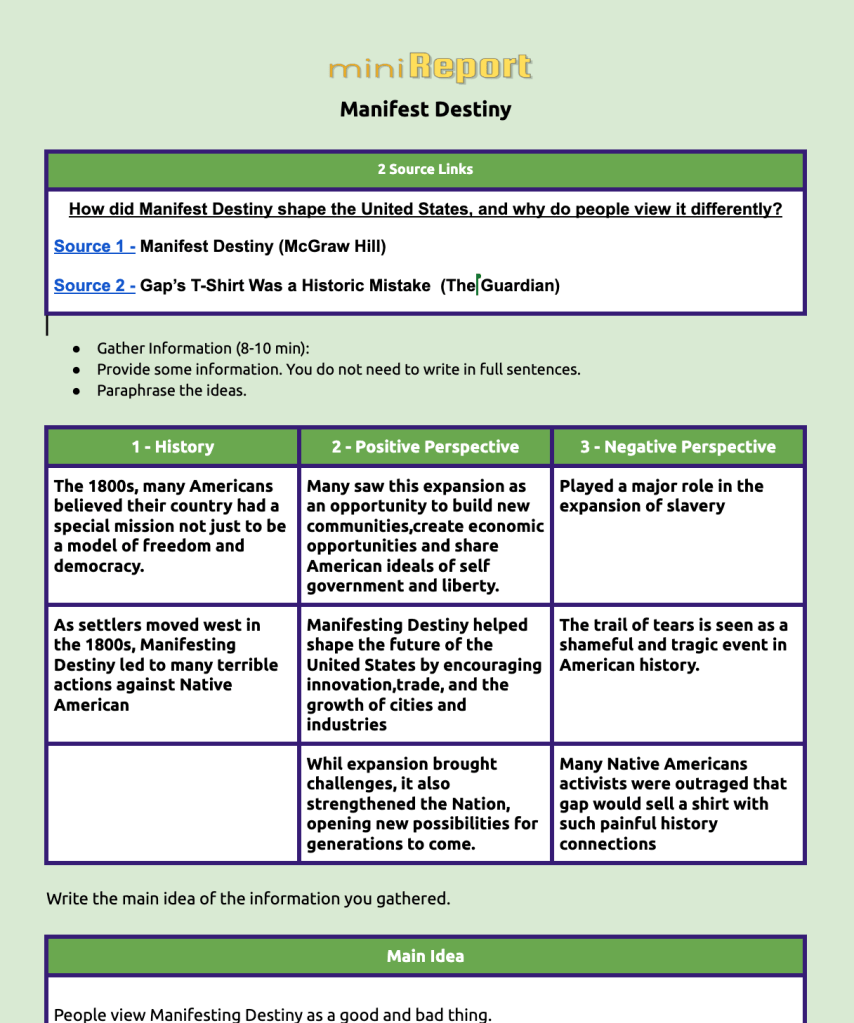
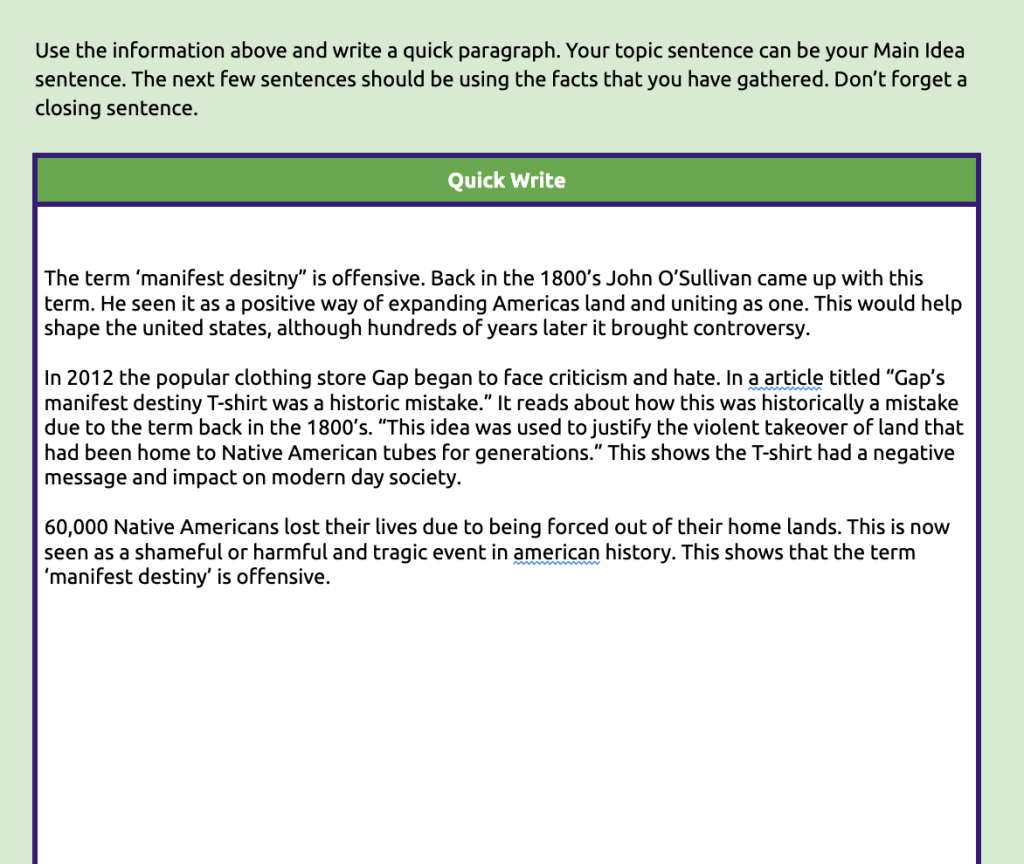
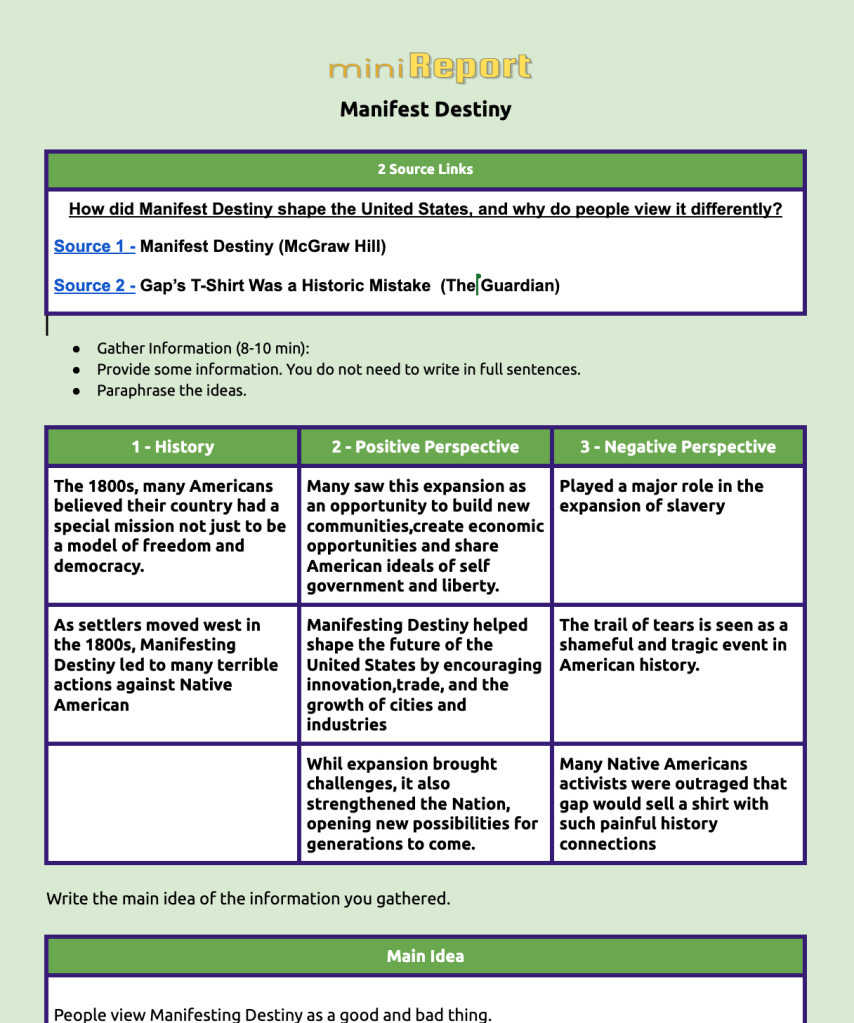
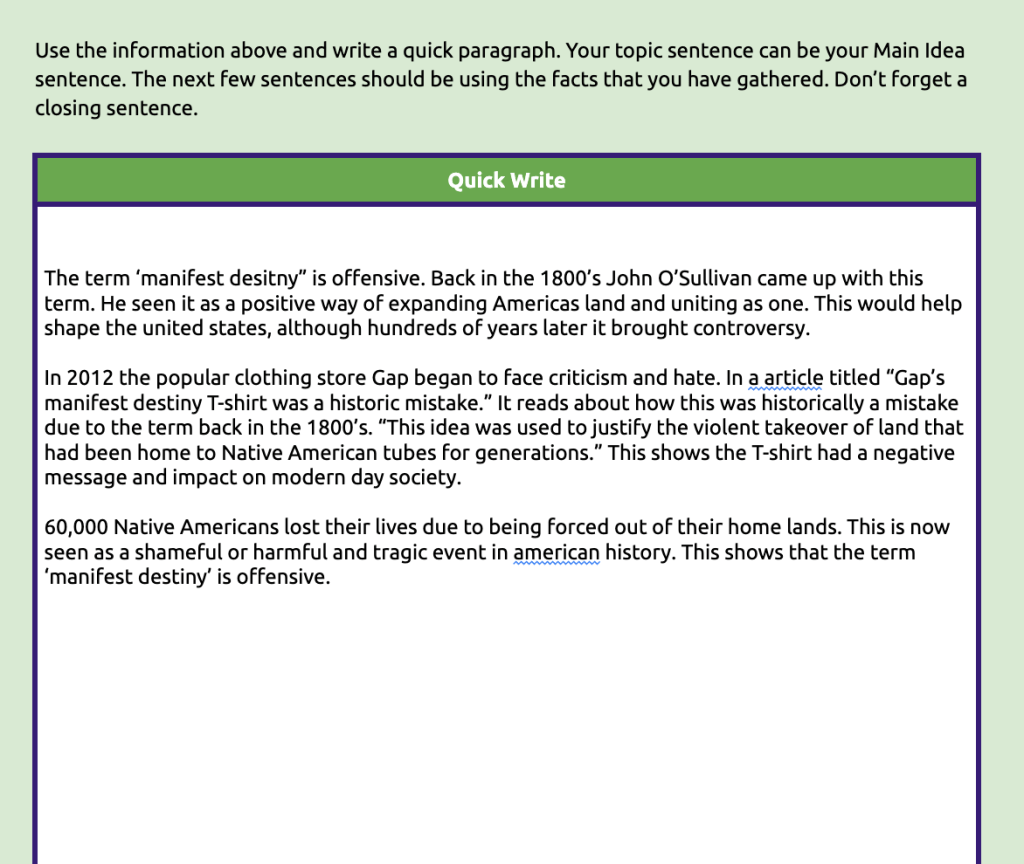
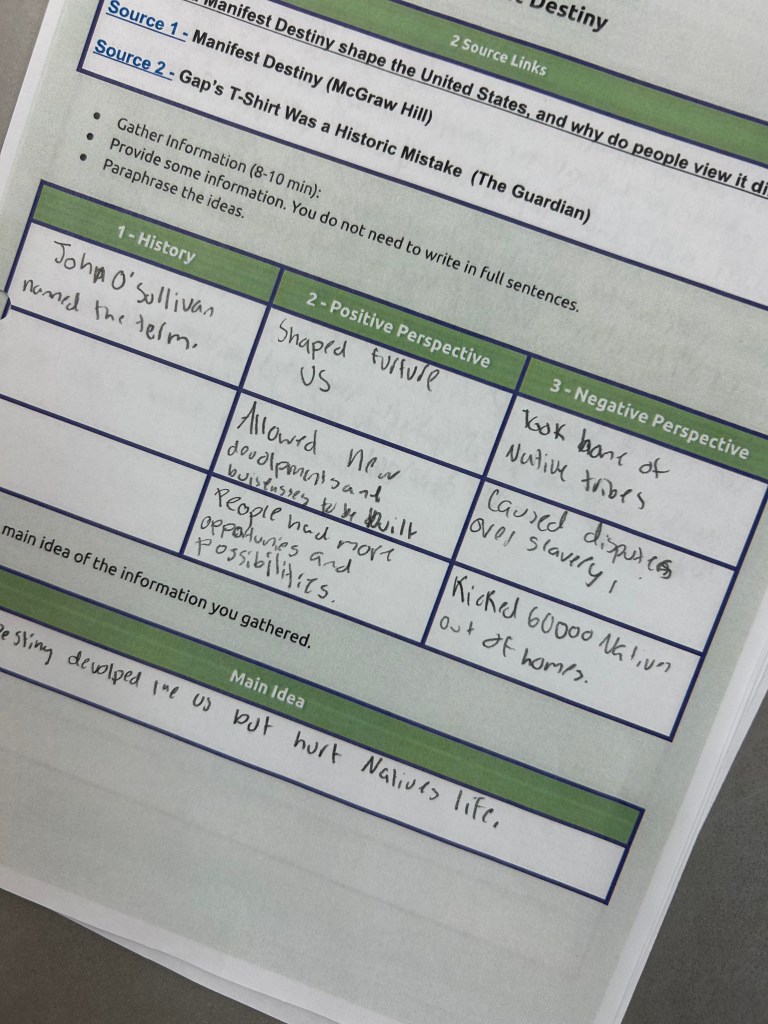
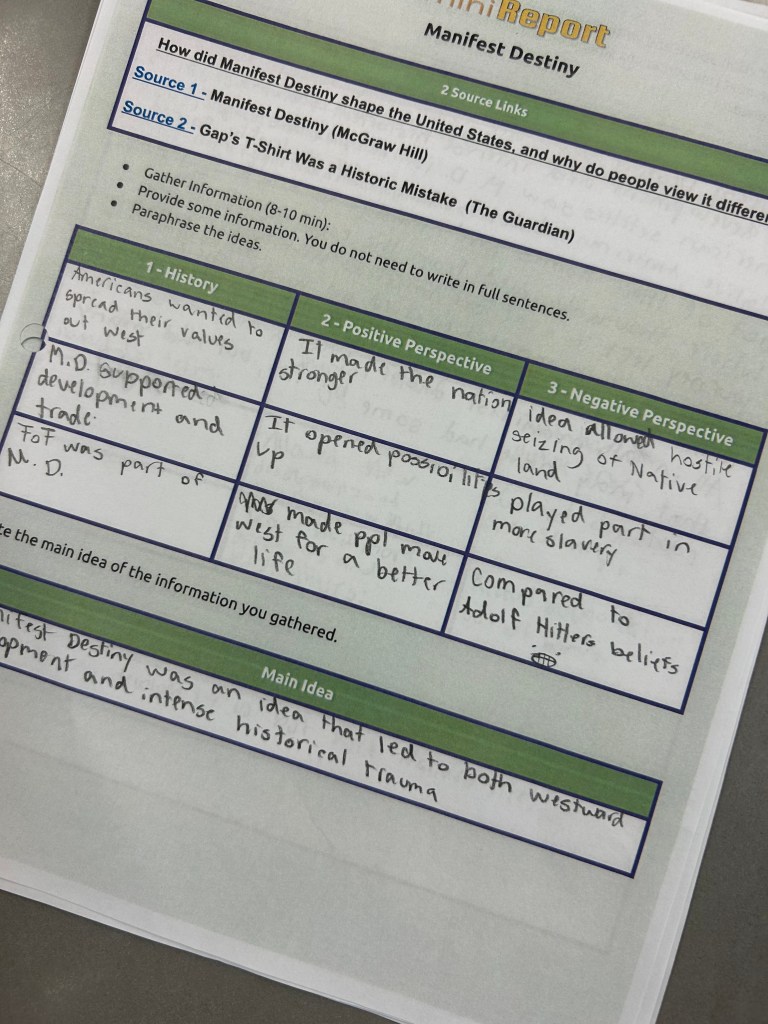
To close, students completed a MiniReport comparing two perspectives:

  • Manifest Destiny as necessary expansion
  • Manifest Destiny as an idea criticized then and now

Students used notes, evidence, and prior discussion to write a paragraph capturing the central tension.

Instead of writing being separate from the lesson, it became the natural finish.

Thursday and Friday: Adjusting Without Lowering Expectations

I had to be out Thursday and Friday with a sick child at home, so lesson planning became about clarity and simplicity without losing rigor.

Normally I run a more hands-on annotated map lesson, but I knew too many moving pieces could create confusion in my absence.

Thursday: Time and Space

Students began with a blank westward expansion map. They labeled territories, added the year each was acquired, and colored the map.

This simple task matters more than people think.

Students often learn names like Louisiana Purchase or Oregon Territory without understanding where these places are or when they happened. Mapping helps anchor content in time and space.

After that, students rotated through stations posted in Google Classroom. Their organizer had Manifest Destiny in the center, with surrounding territories connected to three guiding questions:

  • What land did we get?
  • How did we get it?
  • Why was it important?

Straightforward, focused, and manageable with a substitute.

Friday: From Recall to Comparison

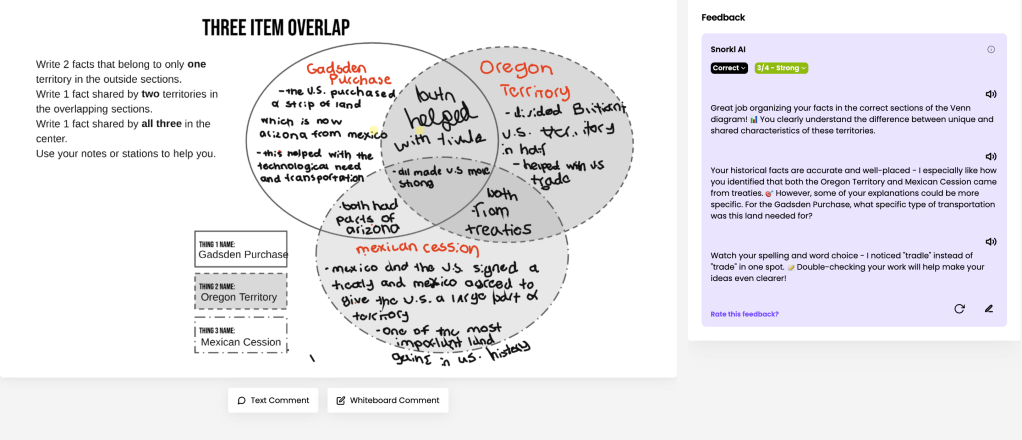
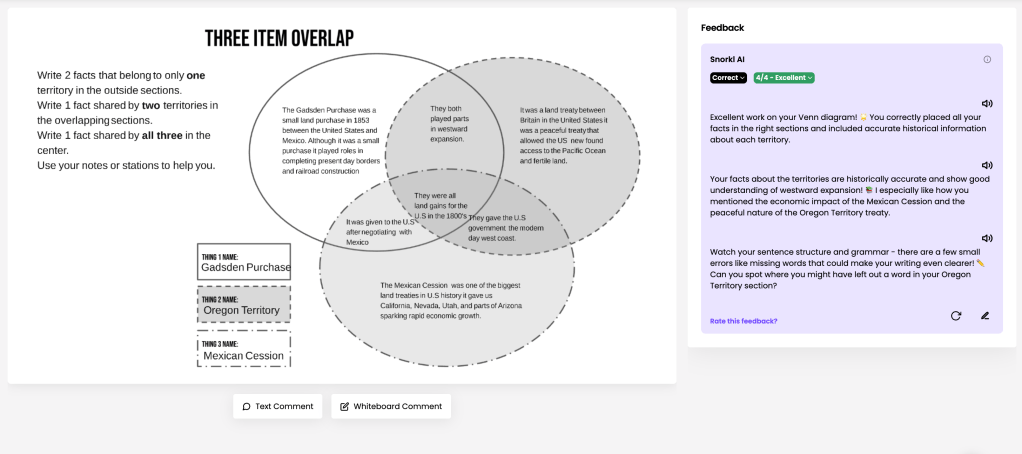
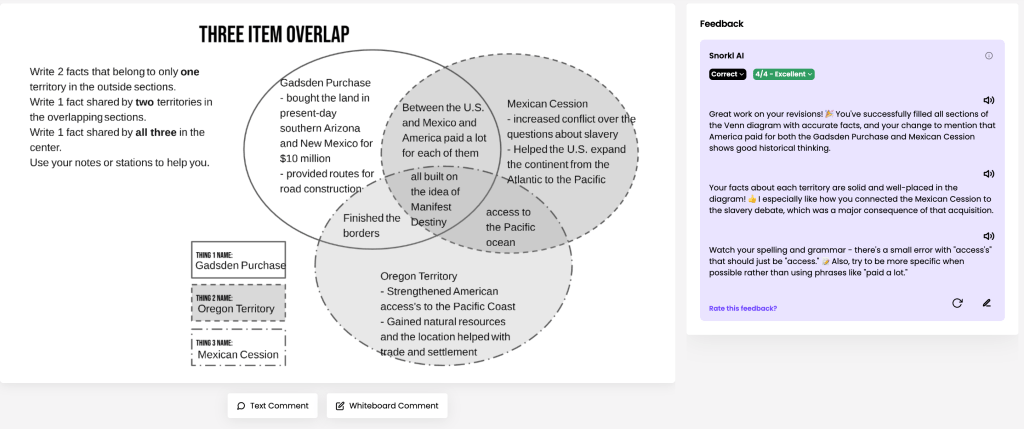
Friday began with finishing Thursday’s work. Then students moved into Snorkl, where I assigned a triple Venn diagram comparing three territories.

This was intentional.

I like pushing learning from:

  • DOK 1: identify and recall
  • DOK 2: compare, organize, explain
  • DOK 3: justify and evaluate when possible

The Venn diagram immediately raised the level of thinking because students had to sort similarities and differences rather than copy facts.

To finish, students completed a Quizizz/Wayground review with map labeling, acquisition questions, and short-answer responses that provided AI-supported feedback.

Even while I was out, students were still receiving guidance instead of completing isolated tasks and wondering if they were correct.

That matters.

Final Thought

This week was a reminder that good instruction is not about flashy one-off lessons. It is about sequencing experiences that build knowledge and confidence over time.

We reviewed old learning.
We launched a new unit with curiosity.
We questioned historical narratives.
We built geographic understanding.
We compared ideas and territories.
We used AI as feedback, not as a shortcut.

Most importantly, students kept thinking all week.

That is always the goal.

Lessons for the Week

Tuesday’s Lesson is Linked Here

Locked In – Lessons Worth Running Again (A Lesson On Manifest Destiny)

I don’t usually run the same lesson twice. Every year I’m changing things, trying something new, seeing what works and what doesn’t. That’s just how I’ve always approached teaching.

But over time, there are a few lessons that keep finding their way back into my classroom. Not because I’m out of ideas, but because they actually work. Students are into them. They’re talking, thinking, and the lesson just flows the way it’s supposed to.

When I step back and look at those lessons, there’s a reason behind it. They’re built a certain way. They’re sequenced in a way that makes sense. Nothing feels random, and each part leads into the next.

This series is me breaking those lessons down. What they look like in the classroom, how they play out, and why I keep coming back to them.

Setting the Stage

This lesson came at the start of our westward expansion unit, and most students were coming in with very little background beyond the idea that the United States moved west. They had heard the term Manifest Destiny before, but it did not really mean anything to them yet. The goal was not just to define it, but to get them thinking about it as both a historical idea and something that still connects to how people think today. I wanted them to see that this was not just something to memorize, but something to question.

Fast and Curious – Building the Base

We started with a Fast and Curious using Gimkit to review key vocabulary, focusing on terms like Manifest Destiny, annexation, expansion, and acquisition. Students played, saw their results, and then played again. It was quick, but it did exactly what it needed to do. The repetition helped them start to recognize the terms and feel more comfortable with the content before we asked them to do anything deeper.

That part matters more than it seems. When students do not understand the words, they check out fast. When they do understand them, even at a basic level, they are more willing to engage with the lesson. By the time we moved on, they had a base to work from, and that made everything else go smoother.

Wicked Hydra – Driving Inquiry

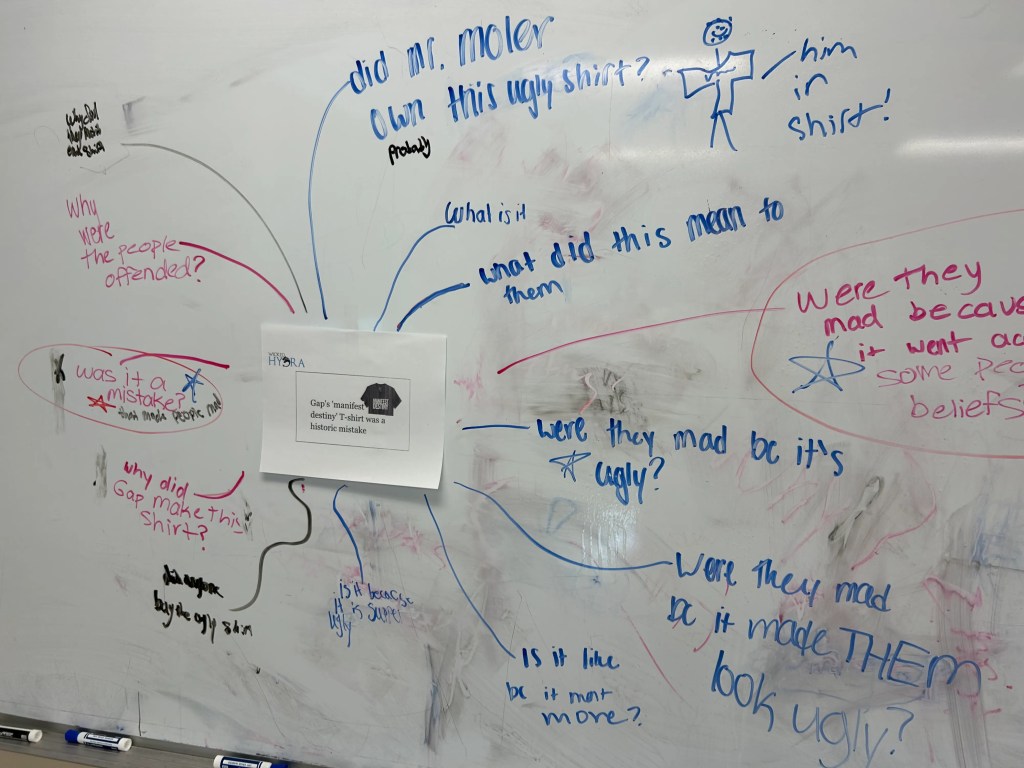
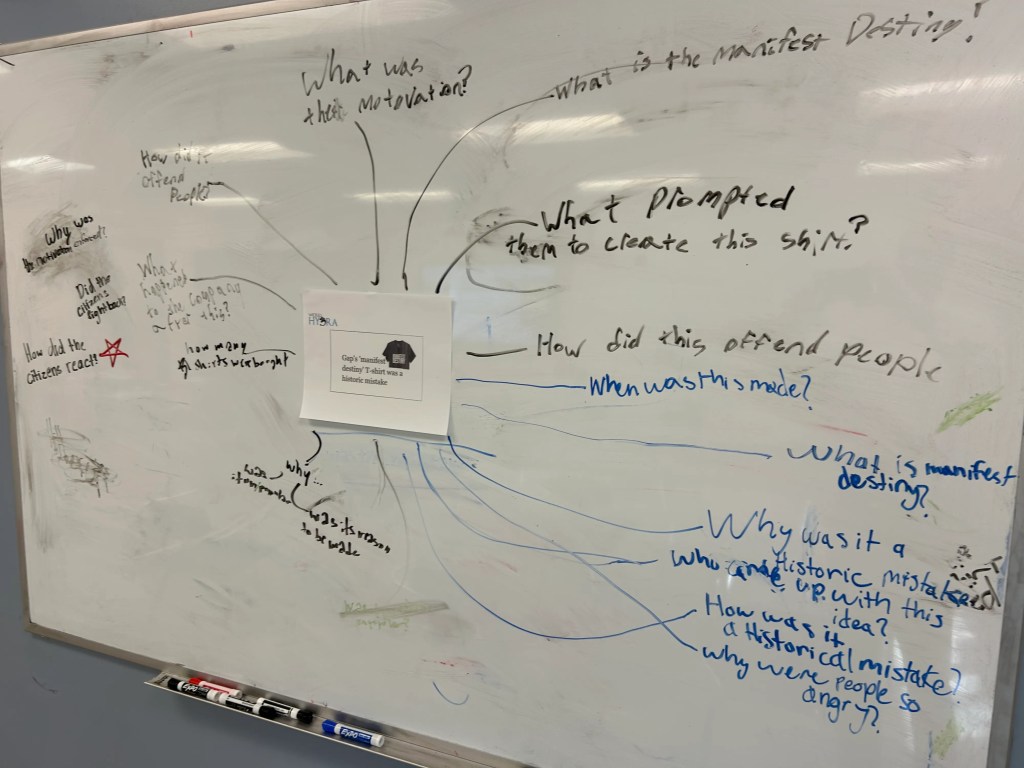
From there, we moved into a Wicked Hydra using the headline “Gap’s T Shirt Was a Historic Mistake.” Students worked in groups at whiteboards and started generating questions, focusing on the ones they thought would actually be answered during the lesson. That small shift in direction made a big difference in the quality of what they came up with.

The questions started simple, but they did not stay there. Students began asking why something like a T shirt would be controversial, who would be upset, and what it says about how history is remembered today. At that point, the lesson stopped being about me introducing content and started becoming something they were trying to figure out themselves. The energy in the room changed because they had a reason to care. They were not just going through the motions, they were looking for answers.

Sourcing Parts – Slowing Down the Thinking

After that, we moved into Sourcing Parts with the painting American Progress, and this is where the thinking really started to deepen. Students began by identifying who created the image and what message it was sending, but the conversation shifted once we pushed into who was included and who was left out.

At first, they noticed the obvious parts of the image, but once they started thinking about purpose and perspective, they began to see it differently. It was no longer just a painting. It was a message about expansion, about progress, and about who benefits from that story. At the same time, they started to recognize what was missing, especially the experiences of Indigenous people. This part slowed everything down in a good way and forced students to actually think about what they were seeing instead of just moving on.

MiniReport – Bringing It All Together

To finish, we used a MiniReport to compare two perspectives on Manifest Destiny. One source framed it as a natural and necessary part of expansion, which is often the version students are most familiar with. The other focused on the backlash to the Gap T shirt and how people today view that idea differently.

Students took notes, organized their thinking into categories, and wrote a paragraph that captured the main idea. By this point, they were not starting from scratch. They had the vocabulary from the beginning, the questions they generated, and the analysis from the image. The writing became a way to pull everything together instead of something separate from the lesson. It also gave them practice with two source thinking and writing, but it felt like a natural ending rather than forced test prep.

How the Protocols Worked Together

What made this lesson work was how the protocols built on each other. Fast and Curious gave students the vocabulary they needed to participate, Wicked Hydra created inquiry and gave them a reason to care, Sourcing Parts pushed their thinking deeper, and MiniReport gave them a way to organize and express what they understood.

Each part had a purpose, and each part set up the next. The lesson was not about any one activity. It was about how they all connected to create a flow where students were constantly building on what they had already done.

Why This One Stays

I like this lesson because it comes full circle. It starts with building background, but it ends with students thinking about how the past connects to the present. The headline is not just there to hook them. It becomes something they come back to and understand in a different way by the end of the lesson.

It also helps them understand why knowing history matters. We live in a time where people are quick to say others are too offended, but sometimes there is a real reason behind that. If you do not know the history, you miss the why. This lesson gives students a chance to see different perspectives and start building some empathy, not just learning what happened, but understanding how and why people see it differently.

That is what makes this one worth running again.

The Lesson

  1. The Mini-Report
  2. Sourcing Parts and Gap Headline

Primary Sources, Forgotten Warnings, and Why I Keep Posting Old Quotes

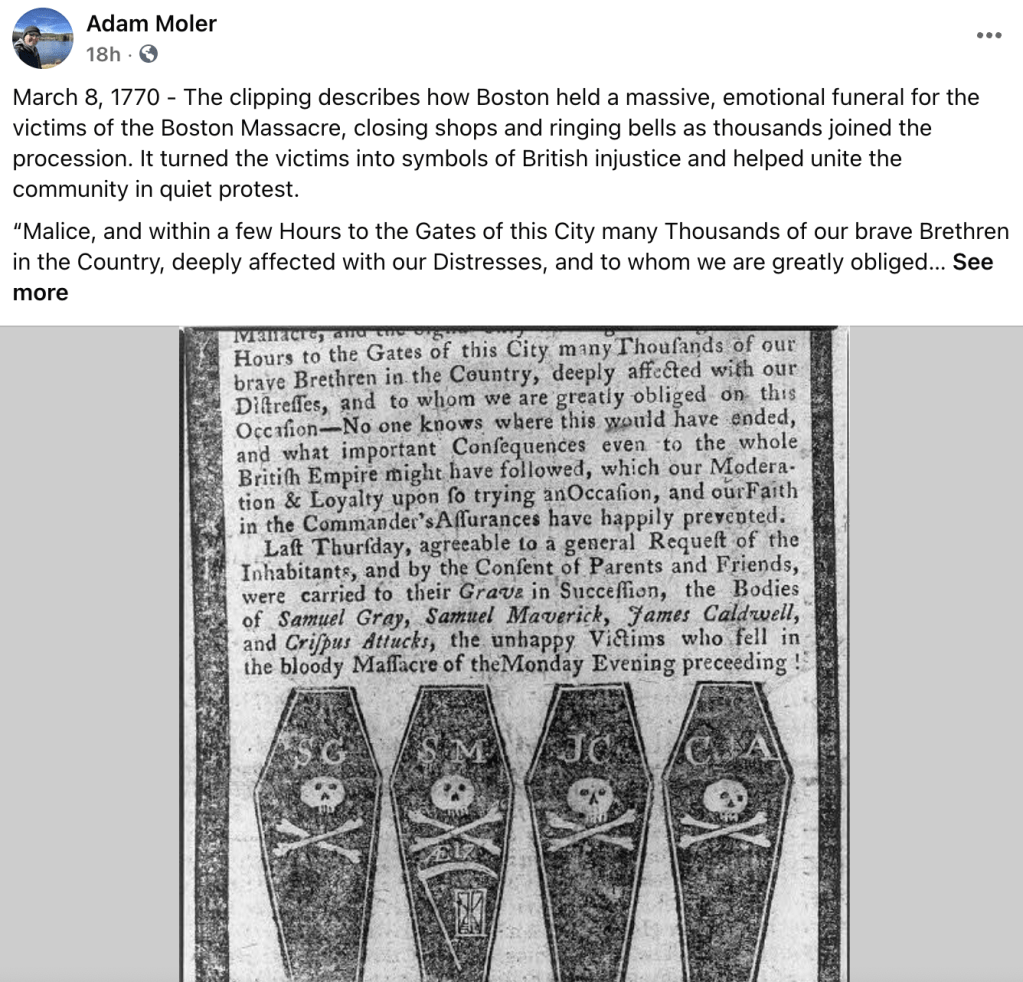
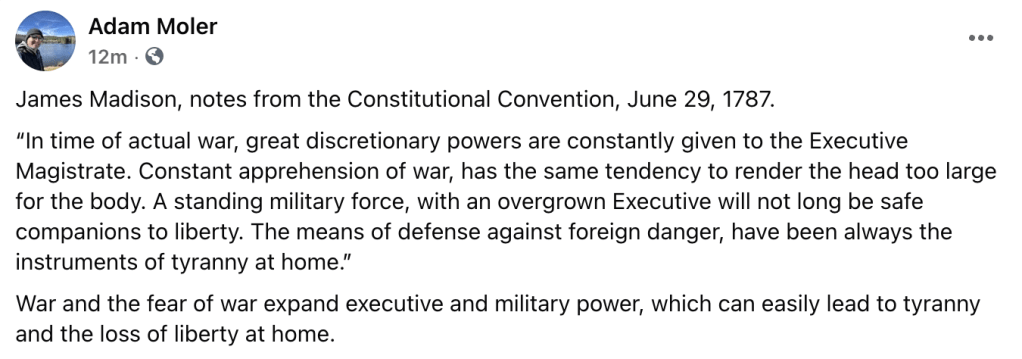
Lately I have been posting quotes from the Founders and early American history. Not to sound smart and not to start a fight. I do it because there is a clear line between what they wrote then and what we are living through now. The irony is obvious once you actually read the words. The warnings are sitting right there in plain English. The problem is most of us have drifted so far from those original ideas that we barely recognize where they came from.

As a social studies teacher, that bothers me.

The Founders and reformers already talked about power, justice, education, rights, and corruption. Most Americans have never seen those original words. We often skip the originals and jump straight to watered down summaries. That is how a country forgets where it came from.

This year I made it a point to give students more real documents. We read the Massachusetts Circular Letter. We looked at John Adams describing the Boston Tea Party. We went through the Stamp Act from the British Parliament. We read the Articles of Confederation. We tackled Federalist 68 to understand the Electoral College. We read the Declaration of Independence and analyzed the common sensical words of Thomas Paine. When kids get the real text, they react differently. They ask better questions. They make stronger connections. They see that history was not neat or predictable. It was debated and argued and built by humans.

My co-author and friend Dr. Scott Petri used to joke with me and say, “Do not turn your class into death by a thousand primary sources, Moler.” He was right. You cannot bury kids in documents just because you think it looks academic. But there are documents that spark curiosity and are worth the effort.

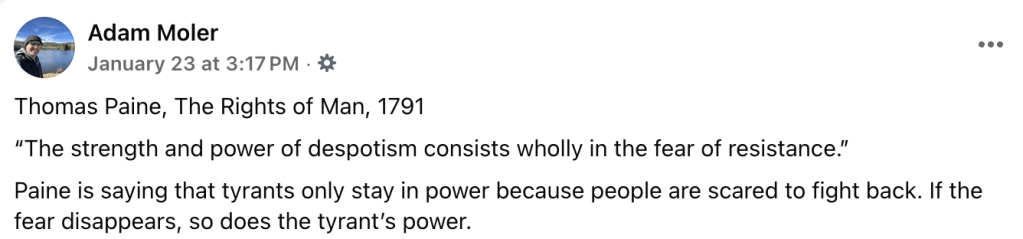
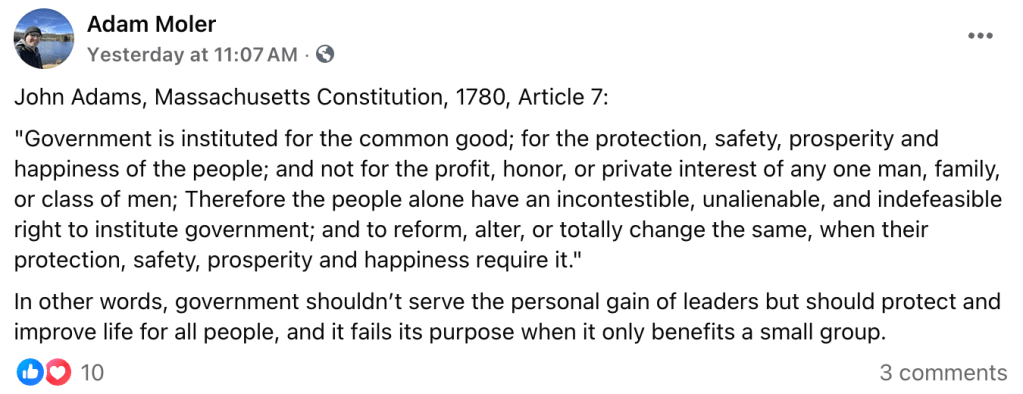
The quotes I have been posting on my own page are the same idea. Thomas Paine warned that leaders raised to rule often become arrogant because they do not understand ordinary people. John Adams said government exists for the common good, not for the private interest of a few. Paine wrote that tyranny survives on fear and collapses when people stop being afraid. Jefferson argued that a nation cannot stay ignorant and free at the same time. Frederick Douglass warned that when justice is denied and poverty is enforced, nobody is safe and society starts to tear itself apart.

These writers did not agree on everything. They had flaws. They had blind spots. They also understood how fragile liberty is. They understood how quickly the public forgets, how easily leaders overreach, and how important an informed citizenry really is.

I worry that we are losing that understanding. The decline of civic knowledge is not an accident. The shrinking time for social studies education is not an accident. If you reduce the time spent on history and government long enough, you get citizens who do not know what their country is supposed to be doing. If nobody knows the original arguments, then there is no standard to measure the present against.

This is why I refuse to sugarcoat or sprint through the curriculum just so I can say I reached the Civil War before May. That approach is meaningless. I would rather have students understand why Paine attacked monarchy, why Adams defended the concept of the common good, and why Douglass demanded justice. I would rather have them see how these ideas connect to today. That has value.

The truth is simple. Countries forget. Foundations rot when nobody checks them. Someone always benefits when the public stops knowing how things are supposed to work.

So I will keep teaching primary sources. I will keep posting the quotes. Not because I want to live in the eighteenth century, but because those old words still matter. They are not coming from pundits or influencers. They are coming from people who built the country we are still trying to maintain.

If we stop reading them, we stop remembering. And once we stop remembering, someone else gets to rewrite the story.

The Week That Was In 103

I’m learning quickly that my school has a rhythm all its own—one filled with odd schedules, unexpected interruptions, and lots of moving parts. Some days it feels like just when I find my teaching groove, the bell schedule changes or half the class disappears for a shadow day. Other days, Mass, assemblies, or leadership experiences shift the tempo in ways that make planning a clean, flowing lesson nearly impossible. It’s a challenge, but I’m adjusting.

At the same time, I keep reminding myself that these “interruptions” are actually experiences that matter. Students are getting chances to lead, to serve, to worship, to see other schools, and to grow in ways that reach far beyond my classroom walls. So while it can make teaching messy and sometimes frustrating, the bigger picture is that it’s giving kids experiences they’ll carry with them. This week was one of those jumbled weeks, and instead of a day-by-day recap, I’m sharing the themes and highlights of what we managed to pull off in between it all.

Early Week – Columbus Lesson

Mid Week – England, France, Netherlands

Late Week – Resistance Reading

Early In The Week

Columbus: Did He Know?

Early in the week, we took on a classic history question: Did Columbus die believing he had reached Asia? I used a packet from Mr. Roughton’s site as the backbone, but I also added in a secondary source I thought was interesting. It suggested Columbus probably knew he wasn’t in Asia at all but kept fudging numbers and stretching the truth so the ships, money, and prestige would keep coming his way.

Working Through the Sources

Students analyzed a mix of evidence: a textbook passage that claimed Columbus never realized he had found a new land, letters where he signed himself as “Governor of Asia,” writings from his later voyages describing a “new heavens and new earth,” and even a map drawn under his direction that labeled South America as the “New World.” Adding in the secondary source about him lying for funding gave students a new angle to wrestle with.

Why It Mattered

By the end, the room was buzzing with debate. Was Columbus simply mistaken all the way to his death in 1506, or did he know he had discovered something new but lied to protect his reputation and keep the support rolling? For me, the highlight was seeing students not just memorize a textbook claim but weigh conflicting pieces of evidence, argue their case, and realize that even “famous facts” from history are not always so simple.

Mid Week

By the middle of the week, we shifted focus to how other European powers followed Spain into the Americas. I kicked things off with a map showing land claims from Spain, England, the Netherlands, and France. But I had some fun with it first. I scrubbed off five key details using the cleanup.pictures site, including “1682” from the title, the word “New,” and even Jamestown. What was funny is that in every class, students noticed “1682” last, even though the year was sitting right there in the title. It was a good reminder that sometimes students need to be pushed to read titles and pay attention to the little things.

Big Picture Pinpoint with a Twist

Next, we dove into an EMC2Learning lesson called Big Picture Pinpoint. I broke the reading into four sections, placed our lesson question in the center of a bullseye, and set up four surrounding boxes. Each round, two students rolled dice. The first roll determined how many bullet points they could write, the second determined how many words per bullet point. The dice added an element of pressure and fun, but the real goal was to force students to boil down the text to its most important details. After four rounds, they had a tight set of notes ready to go.

Processing and Comparing

To make sense of the information, students then created a Sketch and Tell-o. Each circle represented one of the four reading sections, and they had to sketch an image tied to the content. After sketching, they circled back to answer the lesson question. The next day, we built on that foundation with a triple Venn diagram. Students compared and analyzed why Spain, France, and the Netherlands colonized North America, identifying both similarities and differences in motives and impacts.

Why It Mattered

This sequence worked because it layered skills: map analysis, summarizing under constraints, visual processing, and finally comparison. The dice game kept things light, but the students still had to think carefully about what mattered most in the text. By the time they hit the Venn diagram, they weren’t just recalling facts. They were analyzing patterns across different nations and weighing how those choices affected Native Americans and the landscape of North America.

Late Week

I think it is important for students to understand and learn how marginalized groups fight back. Too often textbooks gloss over this or only mention resistance in passing. I wanted students to see that Native peoples were not passive victims of colonization, but active defenders of their communities and ways of life.

Doubling Details

We began class with a Doubling Details warm up using the lesson question from 2.6: Why did England, France, and the Netherlands follow Spain into the Americas, and what effects did they have on Native Americans and North America? Students had one minute to respond in exactly eight words. Then they had two minutes to find a partner and build their response into sixteen words. Finally, I gave them four minutes to find two other partners and expand it into thirty-two words. Each group shared, and I picked the best one. This quick routine gave students practice in stretching their thinking and refining their ideas before we dug into new content.

Reading and Questions

We worked through a reading that traced Native resistance from the Taíno in the Caribbean to the Pueblo Revolt in New Mexico, the Powhatan at Jamestown, and Metacom’s coalition in New England. Students saw how different groups used different strategies: revolts, cutting off food supplies, burning towns, building alliances, and even blocking trade routes. The questions in the packet pushed them to think not only about what happened, but why these strategies mattered and how different groups chose different paths of resistance.

Empathy Map

To process what they read, students used an empathy map. At the center of the map was the same North America map we began the unit with, showing the many Native groups that had built their own cultures across the continent. Now students were adding the layer of how those groups fought and resisted when Europeans arrived. Around the edges of the empathy map, students considered what Native peoples might have seen, felt, thought, and done. This activity helped them shift from memorizing events to stepping into the perspective of the people living through them.

Why It Mattered

By the end, students recognized that resistance was a natural human response to being threatened, exploited, or pushed off land. They also started to connect that resistance to larger patterns in history, realizing that marginalized groups have always found creative ways to fight back. For me, the highlight was seeing students connect the map they started the unit with to this empathy exercise, tying together culture, conflict, and agency in a way that made the history feel more alive.

Something New: I’m Now on Substack Too

If you follow my blog, you know I’ve been writing a lot lately—reflections, ideas, quick thoughts, lessons, frustrations, the works. And while I’m still posting everything to Moler’s Musings like always, I’ve decided to start sharing on Substack too.

It’s, flexible, I can still write like I always do, and I can also post short audio or video pieces when the mood hits. It’s all in one place, easy to use, and honestly just gives me more ways to share and connect.

I learned about Substack from Jake Carr, and he’s doing some really cool things with it. If you’re into teaching, AI, and new ideas that push your thinking, check out his podcast What Teachers Have to Say—definitely worth a listen.

Check out my Substack here:
👉 https://substack.com/@adammoler

And Jake’s:
👉 https://substack.com/@whatteachershavetosay

Same reflections, new space. Thanks for riding along.

Balancing Cognitive Load in Social Studies

I’ve been reading Do I Have Your Attention? by Blake Harvard. It blends cognitive science with practical classroom ideas—nothing too wild, just enough to make you stop and rethink some things. One part that really stuck with me was on cognitive load theory, especially the idea of intrinsic and extraneous load. It got me thinking about how I’ve been planning, what I prioritize, and how I sometimes try to do too much when maybe I just need to step back.
So Much Goes Into Planning

When I plan, it’s not just about covering content. It’s about thinking through what I want my students to know and be able to do, what skills I want them to build, what vocabulary they need, how to keep them engaged, and how I’m going to support the students who need more help—all while keeping things moving for the kids who are ready to fly.

And now, I’ve started asking myself: what kind of cognitive load are my students carrying into this lesson? Is this content already hard and layered (intrinsic load)? If so, I probably don’t need to add too much else (extraneous load). But if the content is simpler or more familiar, maybe I can push a bit further creatively.
Easy and Hard Topics in Social Studies

I’ve realized that not all content is created equal when it comes to complexity. Some social studies topics are naturally easier for kids to access, while others require more mental lifting.

Examples of Easier (Lower Intrinsic Load) Topics:

  • Reasons for European exploration
  • Life in the 13 colonies
  • Westward expansion and Manifest Destiny
  • Types of colonial economies (New England, Middle, Southern)
  • Comparing daily life in the North and South

These topics are usually centered around people, places, or causes. They’re concrete, familiar, and easier to visualize or connect to.

Examples of Harder (Higher Intrinsic Load) Topics:

  • The Constitution and its principles (separation of powers, checks and balances, federalism)
  • The Bill of Rights and application of amendments
  • Judicial review and landmark Supreme Court cases
  • Economic systems like mercantilism or capitalism
  • The causes of the Civil War (beyond just slavery)

These are abstract, layered topics that require deeper processing and strong academic vocabulary. When I’m teaching these, I simplify everything else so students can focus on the core idea.

When the Content Is Hard, Keep It Clean

In those higher-load lessons, I’ve learned that I don’t need to pile on the extras. A Frayer Model to build background, an Annotate and Tell to help break the reading down, and a Thick Slide to wrap it up. That’s enough. I’ve made the mistake of overdoing it before, and kids just got lost in the fluff. The content already asks a lot of them.

When the Content Is Familiar, You Can Stretch

But when the topic is easier to grasp, that’s when I can have some fun and go big with design. That’s where protocols like these come in:

  • Sketch and Tell: Have kids visualize big ideas and translate them into drawings.
  • Map and Tell: Great for tracking movement or showing change over time.
  • 3xPOV: When multiple perspectives matter (like Manifest Destiny or American Revolution).
  • 3xGenre: Having kids write in narrative, informative, and argument formats helps them go deep.

These aren’t just fun—these are meaningful ways to deepen thinking when the topic allows for it.

Final Thoughts

I’ve definitely fallen into the trap of thinking more stuff equals better. But lately, I’m realizing the real challenge is in matching the lesson design to the complexity of the content. I can’t always make everything exciting. And not every topic calls for elaborate activities.

Know the content. Know your students. Know the load they’re carrying.

Still figuring it out, but this helps me take a breath and rethink what good lesson design actually looks like.

The Role of Vocabulary and Working Memory

This year, one of the biggest challenges in my classroom has been students’ limited knowledge of Tier 1, Tier 2, and, no surprise, Tier 3 vocabulary. It’s had a major impact on their ability to learn and engage with content. The textbook we use is packed with unfamiliar words, even in the instructions or basic sentences, which only adds to the struggle.

I believe in challenging students and keeping expectations high, but when vocabulary knowledge is shaky, it affects everything else—reading comprehension, class discussions, writing, and even their confidence. That’s where I’ve had to rethink how I approach instruction, especially when introducing complex concepts like federalism.

Here’s how I’ve been using vocabulary strategies and the Fast and Curious EduProtocol to help students not just survive, but grow.

What Is Working Memory?

Working memory is the space in the brain where students process information they’re learning in the moment. But it’s limited—students can only juggle a few pieces of information at once before their brains become overwhelmed.

How Vocabulary Impacts Learning

If a student is unfamiliar with a term like federalism, which is a Tier 3, subject-specific word, and they’re also unsure about related Tier 2 academic words like authority, system, or structure, their working memory fills up quickly. Instead of chunking the idea into one meaningful unit, they’re stuck trying to decode every word. That’s a recipe for overload, and learning often shuts down.

What It Looks Like in Class

Let’s say you show students this sentence:

“Federalism is a system of government in which power is divided between a national and state government.”

A student who lacks vocabulary support might be thinking:

  • What’s federalism?
  • What does system mean here?
  • Divided how?
  • What’s a state goverment?

By the time they work through those questions, the main idea is lost.

Strategy: Use Fast and Curious to Build Vocabulary

Start with Fast and Curious. Use a platform like Quizizz to introduce and repeat vocab words daily. It only takes five to seven minutes, and the repetition helps move those terms into long-term memory. This frees up working memory to focus on learning. and helps students feel more confident going into the lesson.

Build a quiz that includes a mix of terms:

  • Tier 1: law, rule
  • Tier 2: authority, system, divide
  • Tier 3: federalism, goverment, Constitution

This supports students at different vocabulary levels and helps build a foundation they can use during lesssons.

Use Visuals and Analogies

Pair federalism with a simple image, like a pizza split between friends or a tug-of-war between state and national goverments. These visual anchors make abstract concepts more concrete and easier to understand.

Make Connections to Their Lives

Connect new terms to students’ own experiences. For example, ask: “Do you have rules at home and rules at school? That’s kind of like federalism—different groups in charge of different things.” When students can relate to the vocabulary, they’re more likely to remember and apply it. And it’s also a good chance to build some trust and engagment.

Repeat and Revisit the Words

Don’t expect mastery after one lesson. Keep using the terms throughout the week—in review games, warm-ups, and writing prompts. Every time students hear and use a word, they build confidence and free up space in working memory for deeper thinking.

Final Thought

When students know the words, they can hold more ideas in their minds. That frees up their working memory to think critically, participate in discussions, and make meaningful connections. If federalism doesn’t stick the first time, don’t give up. Slow down, build vocab intentionally, and give students the space they need to succeed.

The Week That Was In 505

This was the last week before Spring Break and I needed to finish the westward expansion unit. The main focus of this unit was having students understand how we acquired territories, the implications of manifest destiny, and the motivations and legacies of groups that went west. A short and simple 3 week unit.

Monday – Explore Trail of Tears

Tuesday – Inspirations to Go West

Wednesday – Groups That Went West

Thursday – Dividing the Pie

Friday – Quizizz, Bento Box

Monday

Last Friday I left a lesson about the Trail of Tears while I was making my way to Madison, Wisconsin. The engagement level among all my classes was 85% – to me, this means 85% of students at least opened the assignment and attempted something with it. This does not mean they finished, and I didn’t expect them to finish everything.

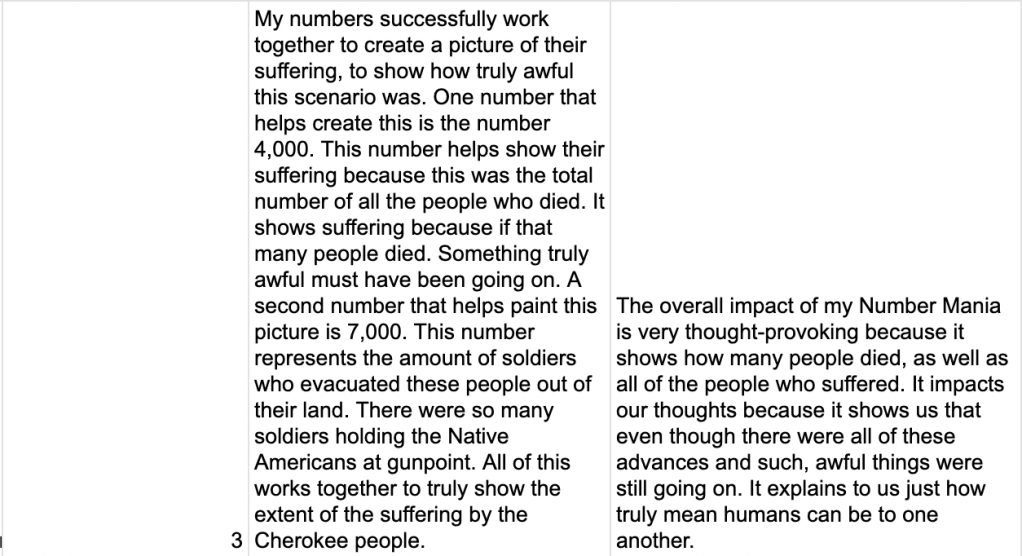
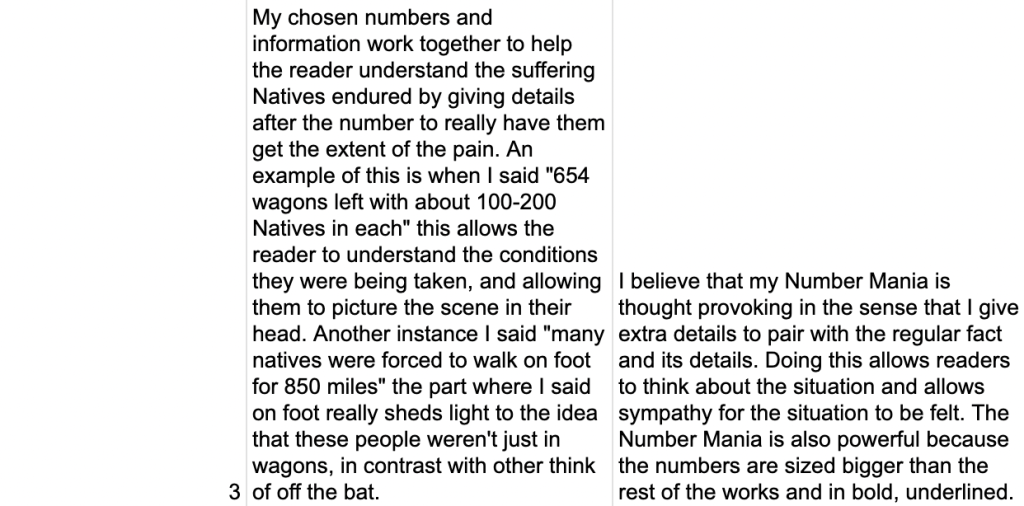
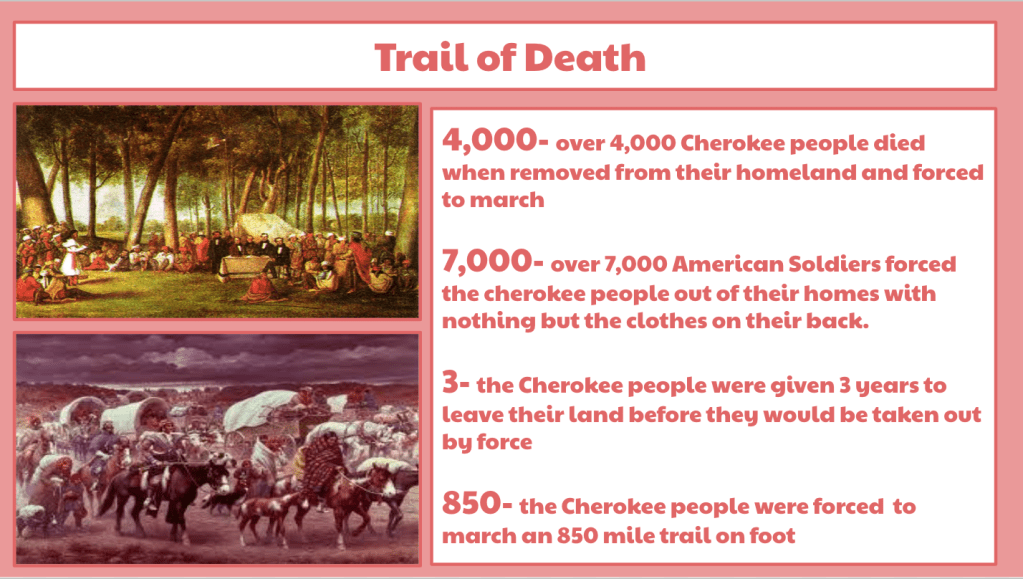
As a result, Monday was used to finish the Number Mania about the Trail of Tears. For this activity, I provided a quote to students, “…the sufferings of the Cherokees were awful. The trail of the exiles was a trail of death,” and students had to find 4 numbers from the article to prove that quote true. I love using Number Mania numbers and facts as textual evidence as it gives the students a purpose for the numbers they share.

On Monday, I used a Dr. Scott Petri trick and asked the students to analyze their Number Mania infographics. I extracted all the numbers that could prove the quote true and had the students share the amount of numbers they had correct. I also asked the students to reflect, “How do your chosen statistics and information work together to paint a picture of the suffering endured by Native Americans during this period? Is the overall impact of your infographic powerful and thought-provoking?” I didn’t want this Number Mania to be a one and done activity. I love this extension that Scott does with his students. Overall, the reflections were okay. Considering I’ve only done this a few times this year, I need to make reflecting a regular aspect of my class for the future.

Tuesday

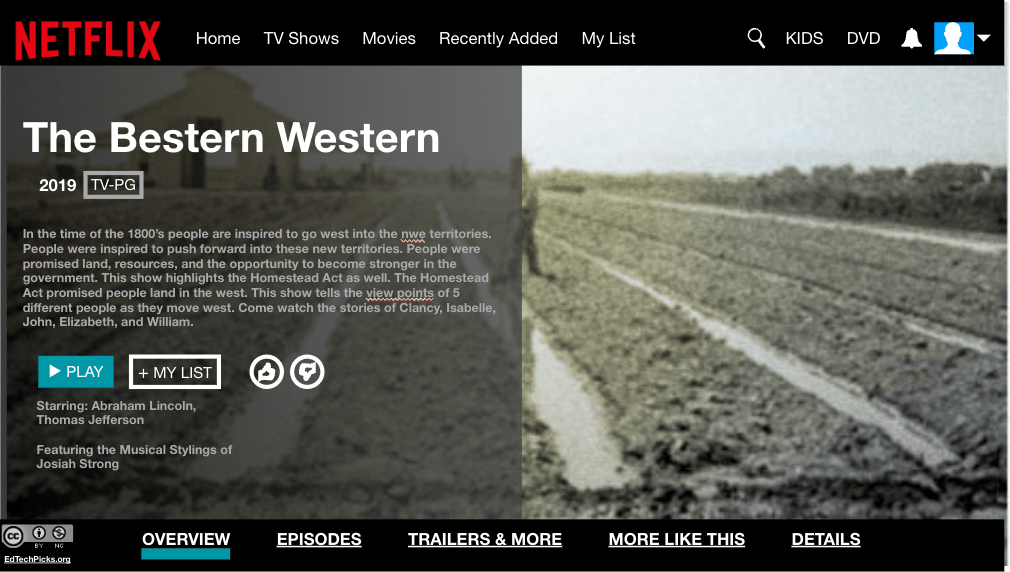
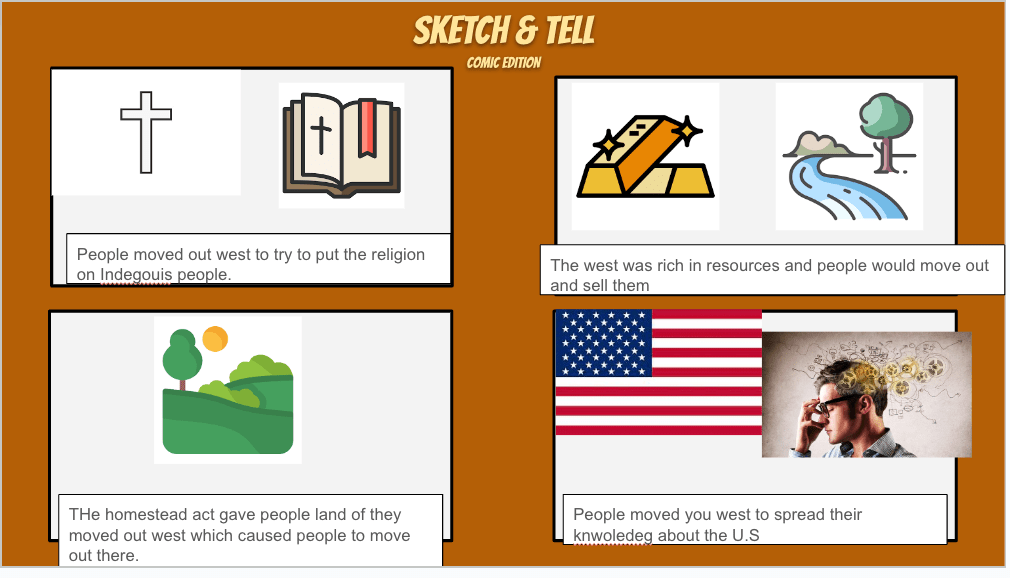
On Tuesday, I asked the question, “What inspired people to go west?” This is a lesson that I took from TCI and wrapped some Eduprotocols around it for more engagement. The materials for the lesson worked perfectly with a Frayer, 3xCER, and a Sketch and Tell comic or Netflix template.

This particular lesson has a combination of secondary source background information paired with primary sources. The sources include:

  1. Thomas Jefferson letter to Lewis and Clark to explore the Louisiana territory.
  2. Excerpts from Josiah Strong’s book, Our Country: Its Future and Its Present Crisis.
  3. An explanation of the Homestead Act and the song, I Will Go West, by JP Barrett.

I like the Thomas Jefferson source because it refers back to the Louisiana Purchase which we have discussed from the perspective of Federalists and Democratic Republicans. We also looked at it from the perspective of Lewis and Clark exploring from the Mr. Roughton Culture Shock lesson.

To begin this lesson, I had students Frayer the Homestead Act. I linked a brief reading that AI created and they had 4 minutes to define it, list 3 characteristics, use it in a sentence, and include a picture.

The next part of the lesson was the 3xCER. At first students struggled with pulling a claim from the Jefferson article and letter to Lewis and Clark. They struggles with this because it wasn’t directly stated – they had to process it themselves and figure it out. After noticing the struggles, we read the article and letter together and I mentioned that 4 possible claims could be pulled from the reading. We discussed as a class and this seemed to help with the other two readings.

The last piece of the lesson was creating a Netflix show description based on an inspiration or creating a Sketch and Tell comic using a Justin Unruh template. For the Sketch and Tell comic students could identify 4 inspirations or create a story about what inspired someone to go west. This was an awesome one day lesson.

Wednesday

Wednesday we built off of Tuesday’s lesson and focused on the groups that went west:

  1. Explorers because it mentioned Lewis and Clark.
  2. Pioneer Women because I like to include women’s history whenever I can.
  3. 49er’s because most students understand gold and people trying to strike it rich.
  4. Mormons because it’s a fascinating story.
  5. Missionaries – because it ties to the idea of manifest destiny and expanding religion and forcing natives to convert to christianity.

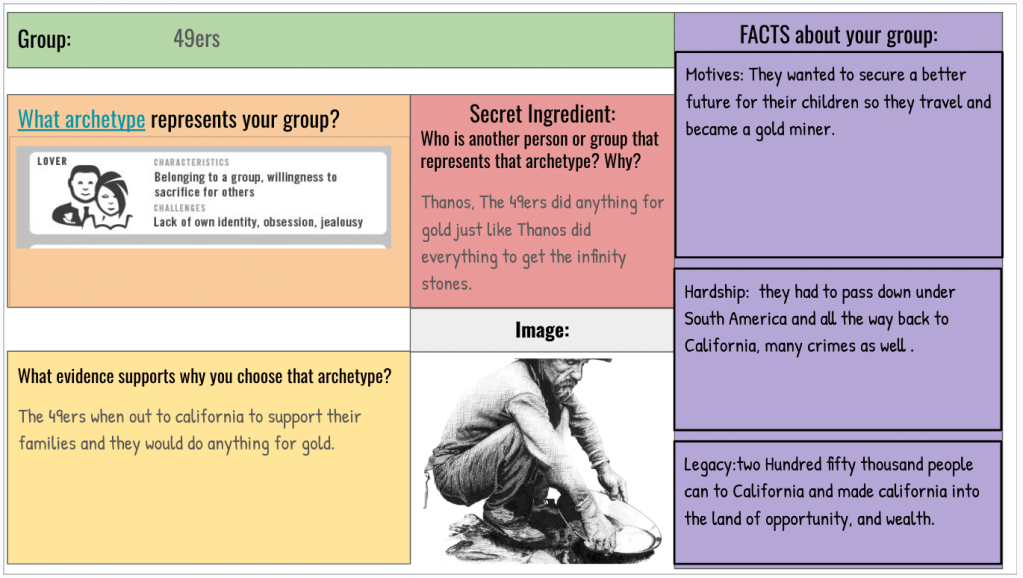
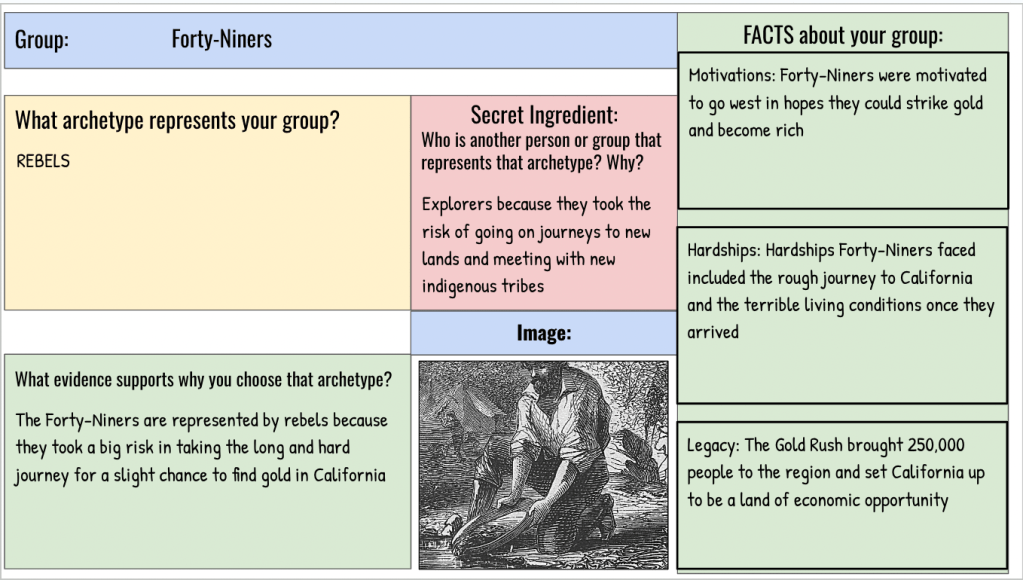
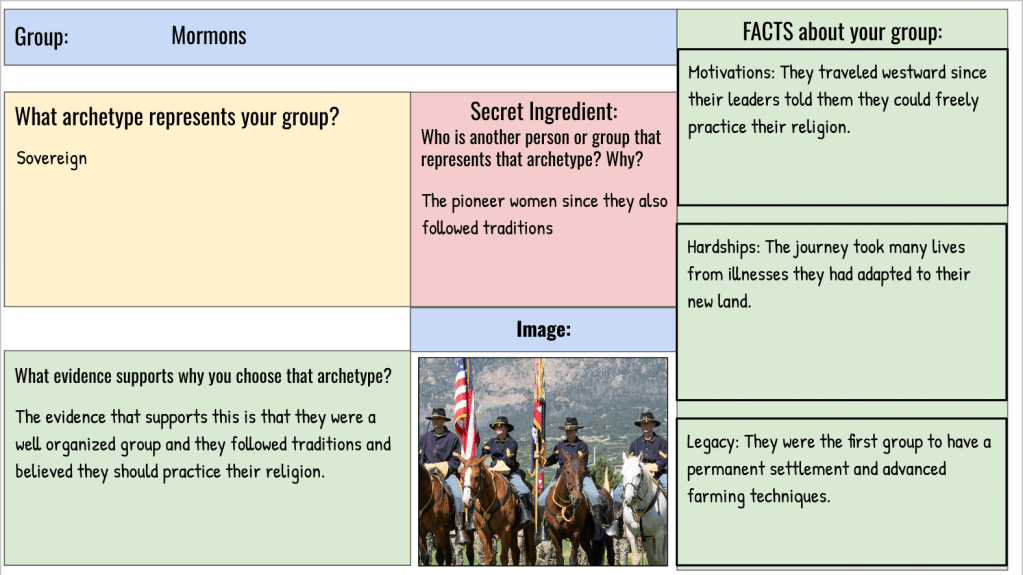
Students chose one group to read about and they used a Brianna Davis template for an Iron Chef – Archetype smash. Students had to list out the motivations, hardships, and legacies left by their chosen group. They had 20 minutes to read and make their slide – BUT there was a catch. I rolled 4 dice and that’s how many words they could use for their motivations, hardships, and legacies. I like this because it’s fun and the students end up paraphrasing the information. Some classes could use 24 words whereas other classes could only use 8 or 10.

After 20 minutes, students shared their slides through a Google Form. The next phase of the lesson was having the students read about the four other groups they didn’t make their slide about. The different word amounts ended up being a good thing because I mentioned to them, “When you are going through everyone’s slides, you need to be the judge and determine what’s good information versus not. A slide with 8 to 10 words might not be good so find a better source.” The different word amounts created this source analysis piece that I like.

Thursday

On Thursday, after the students read about the different groups, we finished up the lesson with an activity I saw on Twitter from Mr. Cline – Dividing the Pie. Lucas George did this activity for his westward expansion lesson as well.

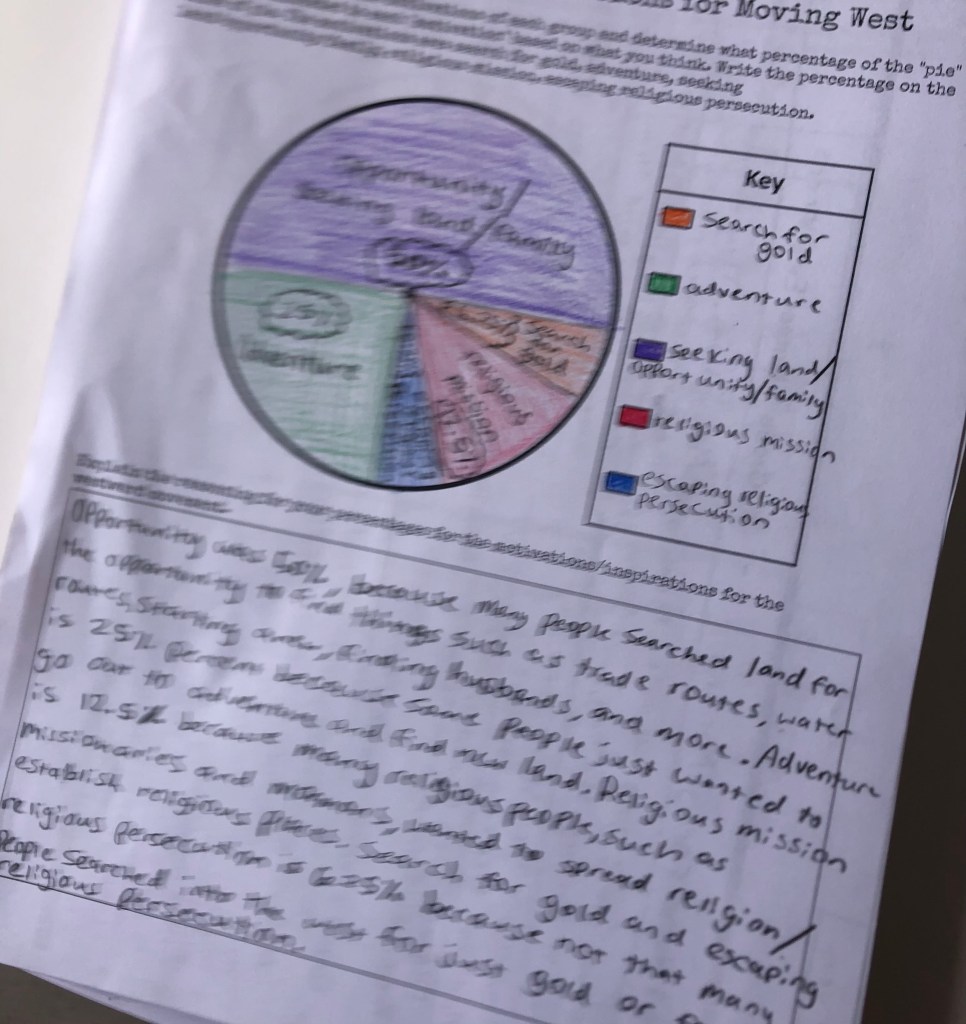
Students had a pie chart and had to divide the pie chart up into sections based on the different motivations and inspirations for what drove people west. The options were: gold, adventure, new opportunity, spreading christianity, and escaping religious persecution. Based on their percentages, students then had to justify why they divided up the pie for the different motivations. I timed this 25 minutes and collected it after the timer ended.

After the timer ended, it was time to wrap up the unit. I like to do two-part assessments. I asked students if they wanted to begin part one (Quizizz) or part two (Bento Box) of the end of unit assessment. They chose the Quizizz – 28 questions and the same quiz they have been doing off and on for the last three weeks. All class averages combined were 92%.

Friday

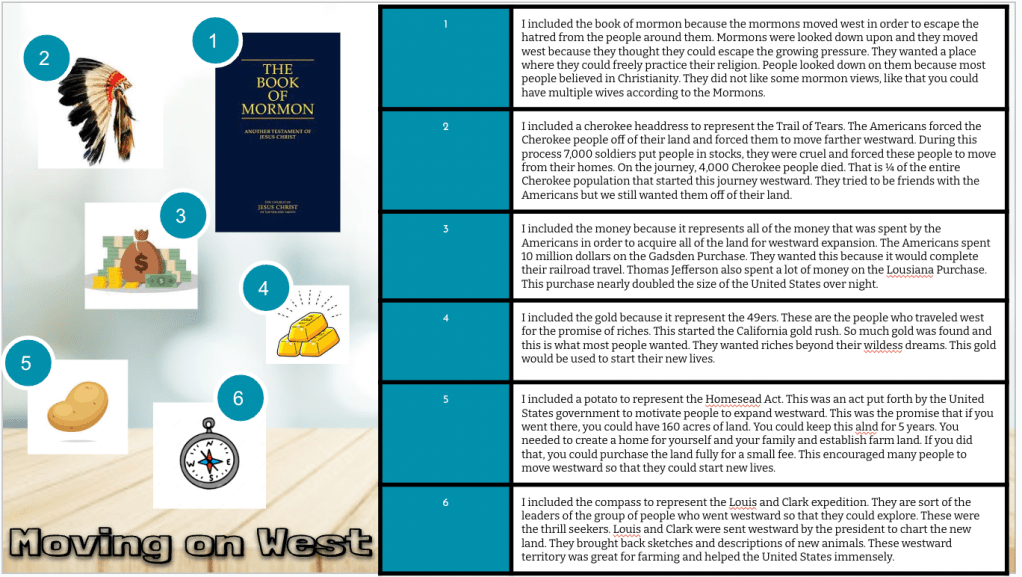
Heading into Spring Break I thought an Amanda Sandoval creation, the Bento Box, would be a great way to finish the unit. With the Bento Box students find pictures of icons, artifacts, images, etc and relate the symbolism to things they learned in the unit. It’s like a mini museum curation of items with explanations. I thought this would be great because it would allow the students to share multiple artifacts and open ended enough for students to share anything they learned from our westward expansion unit. I gave the students the entire class period to finish the Bento Box and submit. These turned out awesome…

The Week That Was In 505

I’m currently writing this from the O’Hare Airport in Chicago as I make my way to Madison, Wisconsin for the WCSS Conference. I’m looking forward to this conference as I will meet up with my friend, and co-author, Dr. Scott Petri. We are doing multiple sessions on EduProtocols and I’m doing an extra session on utilizing AI within the classroom. I was lucky enough to meet up with Jon Corippo in O’Hare! (Thanks for the popcorn, Jon!!)

This week we continued our unit on Westward Expansion. We began the week with having the students finish their Annotated maps from the previous week. I always underestimate how long it take to complete an annotated map. Then we followed up the maps with Manifest Destiny. I looked at last year’s lesson on this topic and I didn’t like it. I revamped my Manifest Destiny lesson to something I did 10 years ago when I first began teaching social studies.

Following the lesson on Manifest Destiny, I left a mini lesson on the Trail of Tears. I assigned this lesson because some of the readings about Manifest Destiny included references to the Trail of Tears. I assigned this lesson last year and really liked the outcomes of the lesson.

Monday – Mad Lib, Quizizz

Tuesday and Wednesday – Manifest Destiny – Part 1 and Part 2

Thursday – Dublin Details EMC2Learning

Friday – Trail of Tears

Monday

For Monday’s class I noticed many students needed to finish their annotated maps on westward expansion. Some needed 10 minutes while others needed 20 to 30 minutes. In times like this, I always have some supplemental things ready to go.

The best way to include supplemental activities when students finish at different times involve Quizizz, Gimkit, EMC2Learning Penny Pedagogies, EduProtocols, or utilizing AI. In this case, I had a Quizizz ready to go with questions from the previous week’s lesson. I also had a Mad Lib I created with AI.

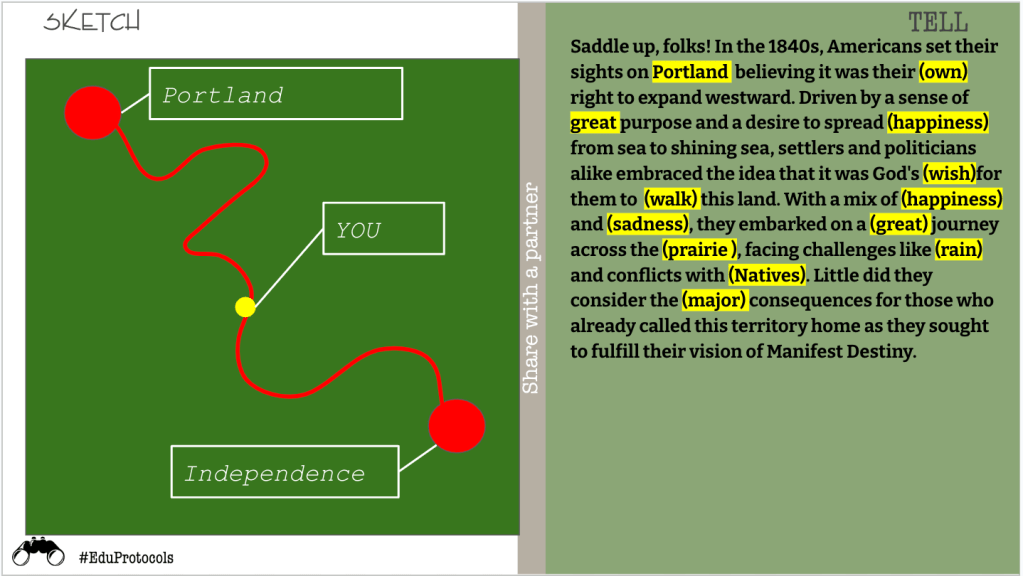
For the Mad Lib, I got on Claude AI and asked it to, “Write a one paragraph Mad Lib that blends westward expansion with the concept of manifest destiny.” It was a decent paragraph that I copied and pasted to a Sketch and Tell. The students that were able to do the Mad Lib seemed to enjoy it as it was something different. A nice mix up and change of pace. For those of you thinking, “How did they do with the noun, adjectives, and verbs??” The students did great with this because we have been practicing these skills recently with some 8pArts.

By the end of class, 90% of students completed their annotated map, some completed the Quizizz, and some completed the Mad Lib. Below are some examples.

Tuesday

On Tuesday we began the concept of Manifest Destiny. I looked at last year’s lesson and wanted to do something different. I began to think about a lesson I did with manifest destiny about 10 years ago…Below is my sequence…

Wicked Hydra

My lesson started off with a Wicked Hydra. In the middle of a Google Slide I typed a headline that read, “Gap’s ‘manifest destiny’ T-shirt was a historic mistake,” and placed this with a picture of the shirt. I had students working together asking questions about this headline. They have no background on manifest destiny or the Gap. Students were asking questions such as, “Why was it a mistake? What is the Gap? Why were people mad? What is manifest Destiny?” I wanted to see these types of questions. The Wicked Hydra immediately creates interest.

Thin Slide

Next in the lesson was a Thin Slide. I linked a short section of the textbook to thin slide and asked two questions, “According to the textbook what is Manifest Destiny? and If this is all people knew about Manifest Destiny, would they still be mad about the shirt?” Students read the textbook section to quickly gain some background information on manifest destiny. I set this lesson up to visit the textbook section again.

8pArts

For the 8pArts I had students analyze the American Progress painting by John Gast. Students looked through image finding nouns, adjectives, guessing the time period, and the purpose. At the end of it all they wrote a brief summary of the image. We debriefed with a short discussion of the symbolism within the painting. I told the students, “If Manifest Destiny was an image, this is it.” Slowly I was building this idea of manifest destiny in their minds.

Wednesday

On Wednesday we continued our lesson on Manifest Destiny. I was hoping the Thick Slide would have been done on Tuesday, but we didn’t get that far.

Thick Slide

On the Thick Slide I shared a link to an article about manifest destiny. On the slide I included a table that asked students to list 3 reasons people might be offended by the Gap shirt. Students also had to share a quote from the article and explain its connection to manifest destiny. They had to include a picture that related to manifest destiny and they had to redefine manifest destiny from the Thin Slide. The article I included with Thick Slide was a combination of primary source quotes and analysis of Manifest Destiny.

Gap News Article and Compare

Next I had the students read the news article I grabbed the headline from. I paired this with a comparison slide from a CyberSandwich. Students read and compared the news article with the information from their Thick Slide.

Textbook Section

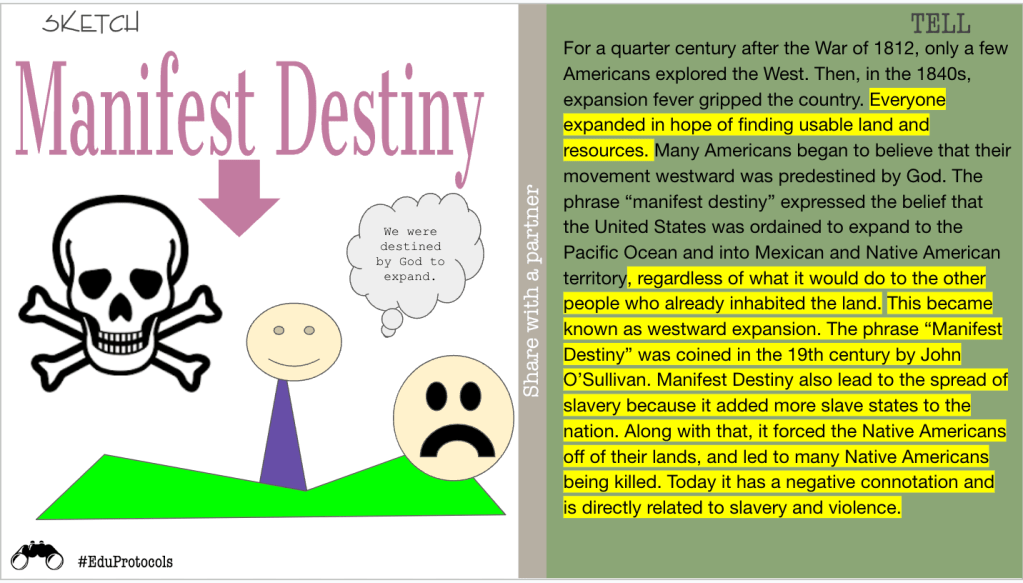
The last part of the lesson I had the students revisit the textbook section from the Thin Slide. I put this on a Sketch and Tell because I was out of town on Wednesday and wanted something to look familiar. I asked the students, “What else could you add to this textbook section to better inform people about Manifest Destiny? Highlight anything new you added.” They did an awesome job adding in more details. By the end of the lesson they had a better understanding of why the Gap t-shirt was offensive.

Thursday

Thursday’s class I began with giving the students an option – finish adding to the textbook section from Wednesday or take the Quizizz I had posted. At the end of 10 minutes we played a game from EMC2Learning called Dublin Details.

In this game I gave the students a topic and they had 2 minutes to write an 8 word sentence about that topic. No more, no less. When the timer went off, they found a partner. In the second round, they had two minutes and combined ideas with a partner to make a new 16 word sentence. For the final round, students created groups of four and had five minutes to combine their ideas into a 32 word mini-paragraph. At the end of of round 3, I had each group submit their mini-paragraph through Socrative. I chose the winning paragraph, explained why, and gave feedback.

This is my new favorite thing from EMC2Learning. We did a round on a random topic. Then we did a round on Manifest Destiny. This was truly an engaging activity.

Friday

On Friday I wasn’t at school as I flew out to Madison, Wisconsin for the WCSS Conference. Again, I wanted to leave a familiar lesson – this is why EduProtocols rock!! The articles from manifest destiny mentioned the Trail of Tears and Indian Removal. So, I left a lesson on the Trail of Tears.

I adapted a lesson from TCI called, The Trail Where They Cried. I copied and pasted the article to a Google Doc and linked it to the lesson. I also provided a differentiated copy of the reading. Plus, I recorded myself reading the article and linked the recording to the Google Doc.

The first part of the lesson I had the students read and put the events from the reading into a sequential order. The second part of lesson students fill out thought bubble from John Ross and Andrew jackson. What were the Cherokees and the American government trying to achieve.

The familiar part of the lesson is a Number Mania. I like to set up Number Mania’s with a quote. I then have the students prove the quote true with number and facts from the article. For this particular lesson, students had to prove true this quote, “…the sufferings of the Cherokees were awful. The trail of the exiles was a trail of death.” This helps focus the students and the information. The students did an awesome job with their Number Manias and this lesson!