Why Parafly Matters
One lesson that has become completely locked in for me over the years is Parafly. It can work with any grade level, any subject, and honestly almost any type of content. The reason is simple. Students struggle with paraphrasing far more than we think they do.
I have now been at three different schools, and every single year I ask students about paraphrasing. Every year I get the same response:
“What’s paraphrasing?”
Not “I’m bad at it.” Not “I don’t like it.” Just flat out confusion about what the skill even is. That should probably tell us something about education right now. We assume students know how to paraphrase because they have heard teachers say “put it in your own words” for years. But hearing directions and actually knowing how to do something are two very different things.
I have made the same mistake over and over again myself.
Last school year in 2024, I did not really start using Parafly until November. This past school year in 2025, I somehow waited even longer and did not really start until January. I assumed students already knew how to paraphrase. We all know what happens when you assume.
The reality is students need direct practice with this skill. Especially now. Copying and pasting has become second nature for students. AI has made it even easier. Will Parafly completely solve copying and pasting? No. But it absolutely helps when students feel confident enough to take information and process it in their own words instead of feeling stuck staring at a blank screen.
A lot of students copy because they genuinely do not know what else to do. They panic when they see text. They think writing means changing two random words and hoping nobody notices. Parafly helps students realize they are capable of processing information themselves.
Starting Small and Building Confidence
When I introduce Parafly, I usually do not even start with class content. In years past, I have used ChatGPT and Socrative together to build the routine first before moving into actual social studies content.
I will use ChatGPT to generate one, two, or three sentence animal facts, random funny facts, weird facts, or anything lighthearted enough to lower the pressure. Then I copy and paste those facts directly into Socrative. Students join the room, read the fact, and paraphrase it in their own words. They get one minute. Then I lock it in.
We immediately look at responses together and talk through what students did well. We discuss what stayed too close to the original, what wording changed, how students reorganized information, and what paraphrasing actually looks like. Then we move onto another one. And then another one. Reps. Reps. Reps.
That repetition is the entire point. Students need repeated exposure to the process in a low-stakes environment before they ever apply it to actual class content. What always surprises me is how quickly middle school students start buying into it. Every single year, without fail, a student eventually says: “This is actually fun.”
Paraphrasing. Fun.
Middle school students saying paraphrasing is fun probably sounds ridiculous, but I really think the structure is why it works. The pressure is low. The tasks are short. Students receive immediate feedback. They are not buried under a giant assignment or a massive writing task. They are simply practicing one skill over and over until they start building confidence.
Why the Structure Works
Parafly works because it isolates one important skill and gives students repeated low-stakes practice with immediate feedback. Students are not trying to analyze content, organize an essay, write a paragraph, and cite evidence all at once. They are simply focused on learning how to process information and restate it clearly.
That matters because a lot of students become overwhelmed when too many skills are stacked together immediately. Parafly reduces cognitive overload by narrowing the focus to one manageable task. Students can fully focus on sentence structure, synonyms, shortening ideas, reorganizing information, and understanding meaning without feeling buried by everything else.
Over time, students naturally begin experimenting with writing. They start noticing patterns. They try different sentence structures. They begin combining ideas together or simplifying information more efficiently. Most importantly, they start understanding that paraphrasing is not simply replacing random words with synonyms. It becomes processing meaning.
From a science of learning standpoint, Parafly naturally supports several important areas:
- Retrieval practice
- Immediate feedback cycles
- Low-stakes repetition
- Cognitive rehearsal
- Elaboration through sentence restructuring
- Building automaticity with writing
- Reducing cognitive overload by isolating one skill
- Active processing instead of passive copying
Students are actively doing something with information instead of simply transferring words from one place to another. That processing helps students remember information better because they are interacting with meaning instead of memorizing surface-level wording.
Moving Into Actual Content
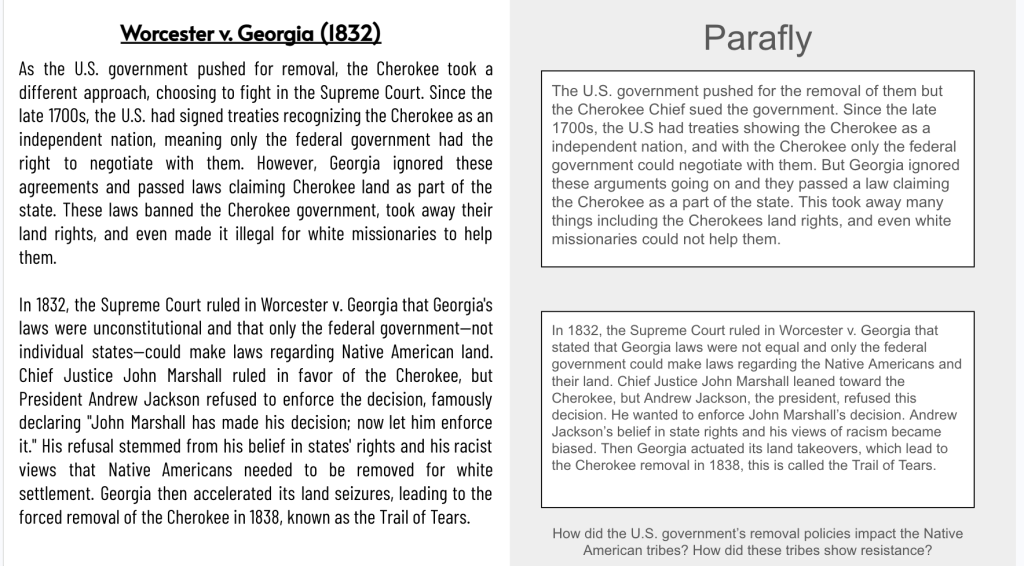
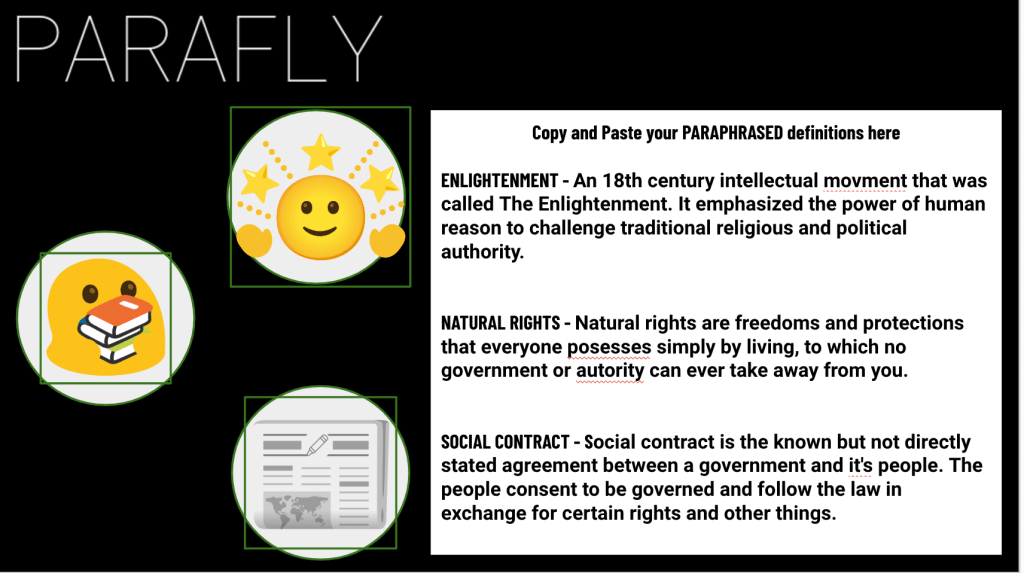
After students build confidence with the random facts, we transition into actual class content. I will have students paraphrase lines from the United States Declaration of Independence, simplify sections of primary sources, or paraphrase chunks from the textbook.
One pairing that works especially well is combining Parafly with Sketch and Tell. Students paraphrase a section, then sketch an image that represents their paraphrase. The sketch forces students to actually process the meaning instead of just swapping words around. Students have to visualize the content and think about what the text is really saying.
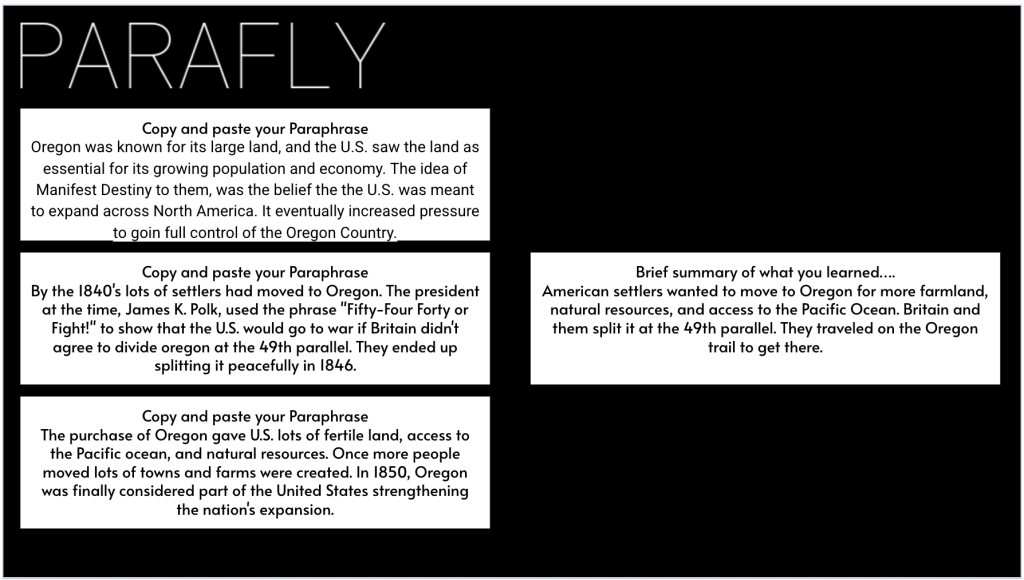
I also like having students paraphrase three or four sections from a reading and then use those paraphrases to build a final summary. Suddenly a difficult textbook section feels much more manageable because students are chunking information into smaller pieces instead of trying to summarize everything all at once.
The lesson can honestly be done in ten to fifteen minutes, which is another reason I like it so much. It does not require complicated preparation. It does not require some giant project. It is simple, structured, and repeatable. And the reps add up quickly.
Connecting Parafly to Other EduProtocols
What I also like about Parafly is how naturally it fits into other EduProtocols. It rarely feels like a standalone activity. Instead, it becomes part of the larger learning process throughout the unit.
Students might Parafly information before transferring it into Number Mania. They might use paraphrased notes while building Thick Slides. They might directly paraphrase during Iron Chef. Students can use paraphrases to prepare for summaries, discussions, or even larger writing assignments later in the week.
One strategy I especially like is pairing Parafly with concise writing challenges. Sometimes I will have students paraphrase information and then limit them to a certain number of words. That structure forces students to think carefully about word choice and clarity while removing unnecessary details.
The options really are endless because paraphrasing is not just an English skill or a writing skill. It is a thinking skill. Once students become more comfortable putting ideas into their own words, almost every other classroom activity becomes stronger too.
Final Thoughts
At the end of the day, Parafly is locked in for me because it solves a real problem students have. Students need confidence with writing. Students need opportunities to process information in their own way. Students need structured practice with summarizing and rewording ideas. And honestly, students need to realize they are more capable writers than they think they are.
Parafly helps build that confidence one repetition at a time. Sometimes the best lessons are not the flashy ones. Sometimes the lessons that stay locked in are the ones that quietly build foundational skills students desperately need.


