I started a new unit I have never done before – Survivor Renaissance – inspired by Michael Matera. The unit has students studying and learning about the Renaissance, Reformation, and Exploration. In Ohio, the standards covered are this:
- The decline of feudalism, the rise of nation-states and the Renaissance in Europe introduced revolutionary ideas, leading to cultural, scientific,
and social changes - The Reformation introduced changes in religion including the emergence of Protestant faiths and a decline in the political power and social influence of the Roman Catholic Church.
- European economic and cultural influence dramatically increased through explorations, conquests, and colonization
This unit is still ongoing, but I wanted to reflect on the work completed so far. I broke up this unit into 3 missions.
Mission 1 – Meet and Greet
Mission 1 has students getting into teams and choosing their Renaissance Influencer from a unique group. Each team had their own list of Renaissance influencers to choose from to ensure that the same person wouldn’t be picked twice. Examples of people included: Galileo, Petrarch, Johannes Gutenberg, or Leonardo DaVinci. Students spent 2 days researching, and becoming experts, about their chosen Renaissance person. They used some cornell notes found here. During the Research process I had students keep their Renaissance person a secret because they were going to design a slide for our Great American Race Competition.
Mission 1 – The Great American Race
After the research was completed, students made slides about their chosen Renaissance Influencers. They featured characteristics of the person’s early life, what they were famous for (artwork, voyages, inventions), and some random facts. I emphasized not putting the Renaissance person’s name on the slide because we were going to have a competition. My next step was compiling students created slides into a Google slide deck. I created a “copy” link and pasted it into a Google Form. Students opened the shared form, created a copy of the Great American Race slide deck and submitted their answers. An example can be found here. After the Great American Race, I averaged the amount of correct answers per team to determine the winner.
I like the Great American Race because students assume it’s easy. They always say, “We have to Google answers? That all?” However, students quickly learn that Googling answers can be an art. They have to choose the correct key words when searching. This lesson also teaches students to design slides with quality information. When I made the slide decks for each class, I included every slide no matter how great or bad the information. It created nice discussions of designing slides with good, credible information for others.
Mission 2 – Diving into the Renaissance, Reformation and Exploration
What changes occurred with arts and science during the Renaissance? Why did Martin Luther, and others, challenge the Catholic Church? Why did European countries begin exploring? I brought teams back together and shared 3 different Iron Chef slides designed around these questions. One team had Renaissance, one team had Reformation, and another team took on Exploration.
In one class period, teams worked together to design slides to teach others about these topics. Each slide included a link to a short reading and I gave success criteria for a good presentation. Here is that success criteria: 4-5 important facts, 2-3 relevant images, and the secret ingredient question answered. Here are some examples here:
Up to this point, I was using past tense because we completed the Iron Chefs. However, this next step I haven’t had a chance to get to because I had to leave school early. The next step in this process is having students create a presentation video with Flipgrid over their information. They will record their screens and tesch other classmates. I will hand out Frayer models students so they can watch other presentation videos and collect information. The final step in the process will be a Quizizz with student created questions.
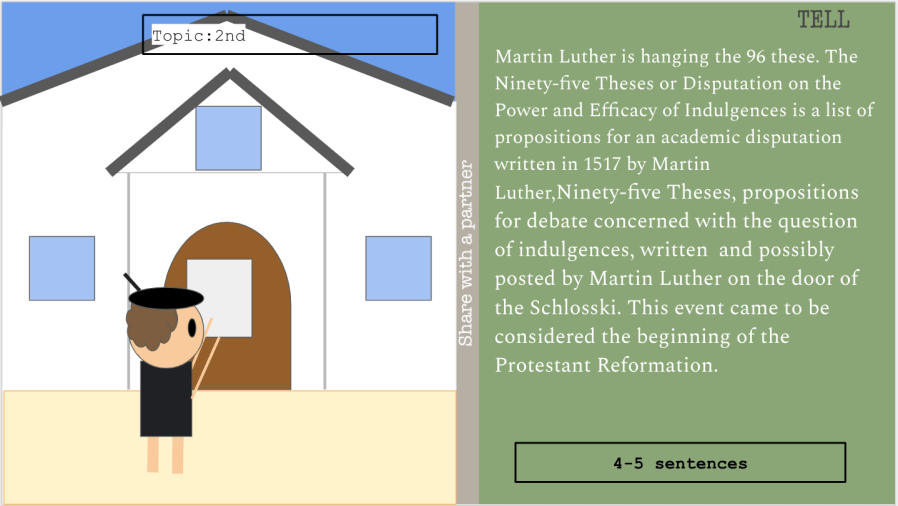
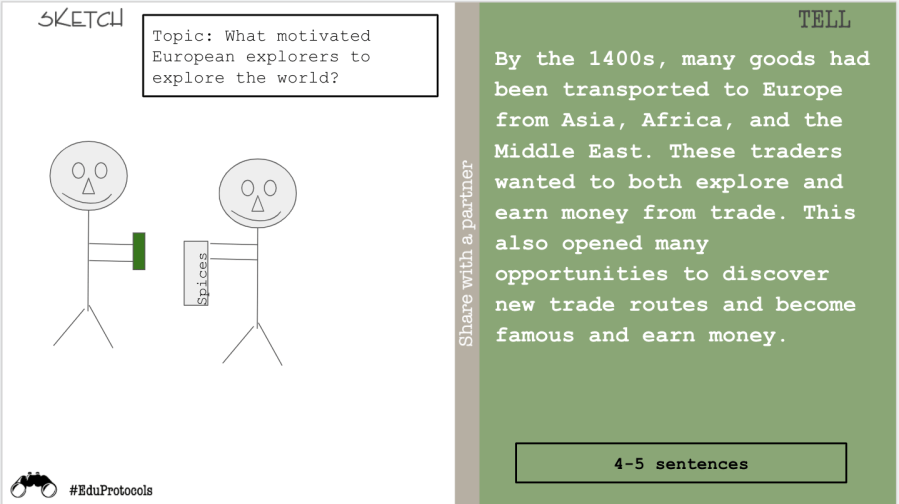
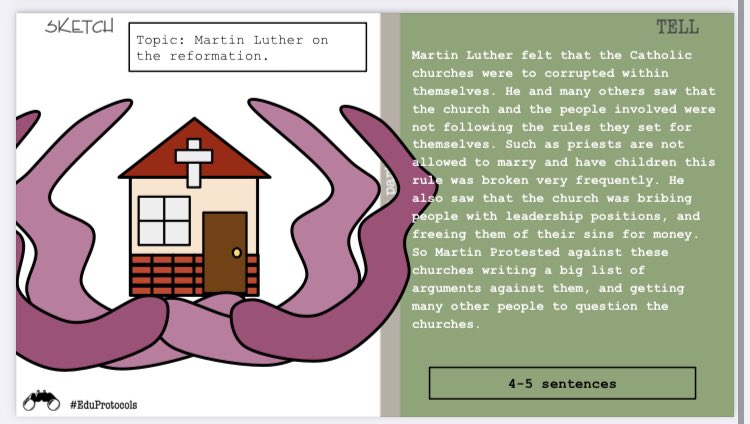
Since I had to skip a day and skip the Flipgrid, I had students create a Sketch and Tell about their slides. Here is why I like this idea…..
- I could read their Sketch and Tell explanations while I was out and look for any misunderstandings.
- I could provide quick feedback.
- A lot of the students wrote their sketch and tell explanations in a way they could read and record for their Flipgrid.
- The Sketch and Tell is something the students are familiar with.
- The Sketch and Tell provided a way that students didn’t have a gap in learning before making their presentations.
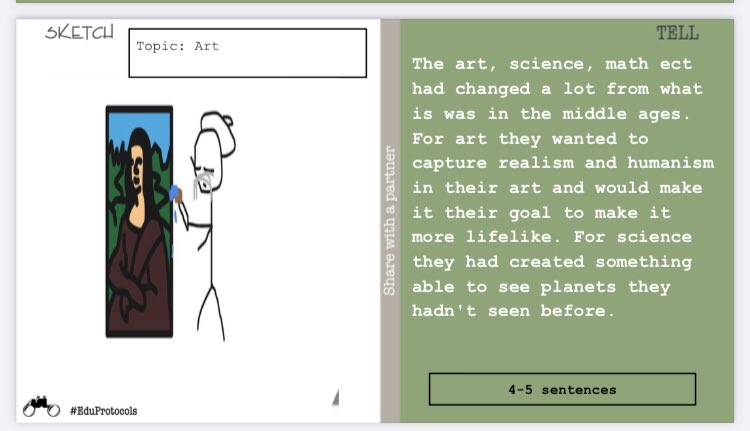
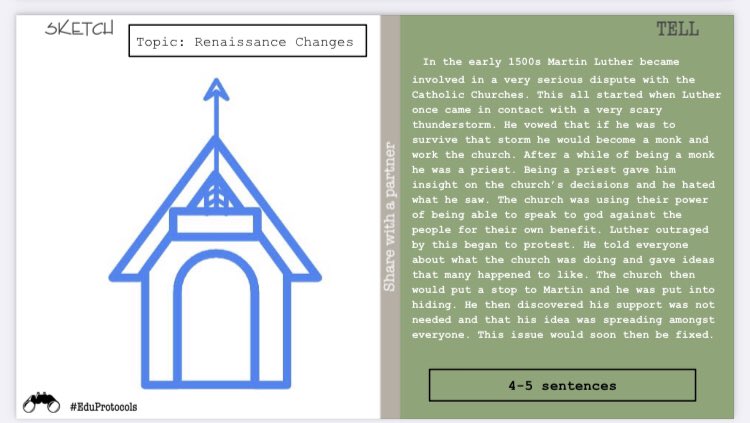
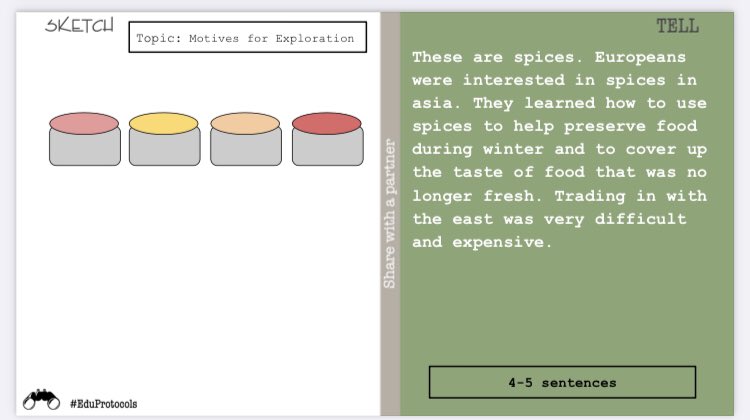
Here are some Sketch and Tell examples:
Next steps (literally typing and thinking out loud):
As this unit progresses, I need to build in some review competitions to keep up the gamification and team aspect of the Survivor Renaissance format. I also need to plan out how to set up the tribal council to vote off Renaissance people.
- Maybe have students vote on the best sketch and tell.
- Turn the Quizizz paired with the Iron chef into a competition – highest team average wins.
- Lego or Playdoh build competition.
- Review game competition – mystery boxes, Gimkit paired with apples to apples, tower builder review game.
- Empathy Maps – do before tribal council?
- Alphabet Battle
- Sudoku Learning to show relationships between people, concepts, etc…
- Linking logs to show relationships between concepts
More to come……


