I’ve been thinking about how much time I spend trying to get better at teaching. I’ll change a lesson because the discussion fell flat or try something different because I want more kids doing the thinking. Then I get to the end of a unit, and I wonder if I’ve put that same kind of thought into how I’m going to find out what they learned.
Does the way we assess our students actually reflect the kind of learning we value in our classrooms?
I wrapped up the Civil War with my 8th graders recently. We researched Civil War soldiers from around Cincinnati and tried to figure out the story behind a headstone. We studied battles and asked what changed because of them. We read the Gettysburg Address and spent time on a question that sounds pretty simple at first. Why did Lincoln start with 1776? After all that, I could have handed out a test and asked who the president of the Confederacy was or what year the Battle of Gettysburg took place. I’d know who remembered those answers. I’d still be wondering who could explain why any of it mattered.
If I spend two or three weeks asking students to think like historians, why would I assess them at the end like contestants on a trivia show?
I want kids to know what happened. If they misunderstand what the Emancipation Proclamation actually did, that’s going to affect how they explain its impact. I need to see whether they have the facts straight and whether they can use those facts to make sense of something bigger. If I say I teach content through skills, I ought to be able to point to where those skills show up on the summative. And if I can find them on the assignment, can I find them in the way I give out the points?
The Civil War Bento Box
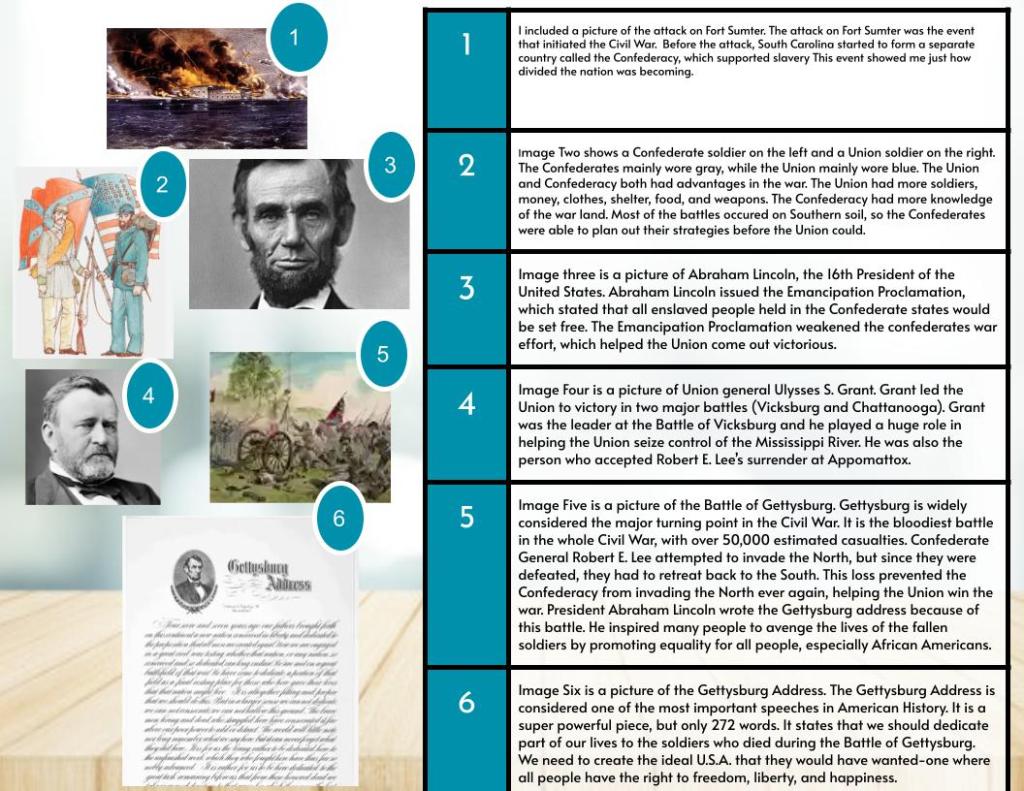
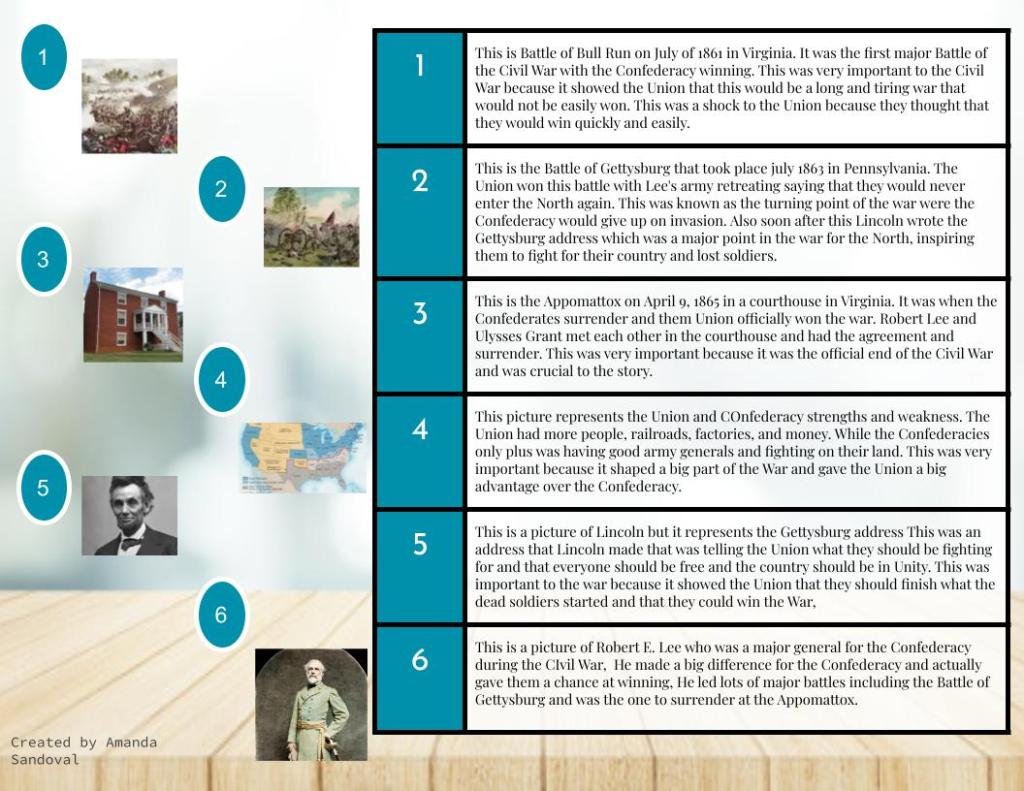
For our summative, I had students put together a Civil War Bento Box around this question.
How did the people, events, and decisions of the Civil War shape its course and meaning?
Students chose six historical images from at least four topics we studied. For each image, I asked them to identify what it showed, describe what happened, and explain why it mattered. I liked that kids could tell different parts of the story. One student could spend more time on the battles, while another could use the contributions of Black soldiers and the Gettysburg Address to explain how the war changed. I wanted to see what each student could do with the details they chose.
Here’s where it got interesting for me. A student could pick an image of Lincoln at Gettysburg, tell me he gave a speech at a cemetery in 1863, and move on to the next box. That’s two parts of the assignment done. The third part is where I wanted them to spend some time. Why bring up 1776 at a cemetery in the middle of a war? If a student could connect that opening to the Declaration of Independence and explain how Lincoln used the idea of equality to give Americans a reason to keep fighting, I could see what they understood about the speech. We’d worked on that kind of thinking together in class. I wanted to see what they could do on their own.
What I Saw in the Student Work
When I looked through the Bento Boxes, I could see kids who knew what happened and could describe it pretty well but got stuck when I asked why it mattered. Other kids were already connecting events and explaining how they changed the direction or the meaning of the war. I needed to see that difference. A kid who gets the facts right but stops at “it was a turning point” needs help using those facts to explain what changed. A kid who connects two developments and explains how they affected the war has given me something else to work with. I’d have a hard time figuring out where to go next with either kid if all I had in front of me was a total score.
It also got me thinking about a gap in my own directions. My essential question asked kids how the war changed. My directions asked them to explain why six separate things mattered. Some kids made connections across their boxes on their own. A kid could also do a good job in every box and still leave me to put the pieces together. Next time I’d like to ask students to pick two of their boxes and explain what they show together about how the war changed. I’d be curious to see what a kid does with the Emancipation Proclamation and the Gettysburg Address when I ask them to put the two together. That would give me a better look at how they answer the bigger question.
What Am I Actually Grading?
I’ll be honest, a good-looking Bento Box is fun to open. Somebody found six great images and figured out how to fit everything on one slide. I can appreciate the time that went into it. Then I have to read what they wrote. If a student gives me six accurate descriptions and stops there, I can say they know quite a bit about the Civil War. How much can I say about their ability to explain why those things mattered? That’s the validity question for me. I want the score to reflect what the student showed me about history. The second I start giving points because I like the way the slide looks, that score gets a little harder to explain.
I think this is worth asking even if the assignment has a rubric and everybody knows what’s on it. Imagine I give most of the points for six images, six captions, and a finished slide. A kid could pick up nearly all of those points by doing exactly what the rubric asks and still give me very little reasoning. I’d have a clear record of who completed the assignment. If I sent that score home and called it historical understanding, what would a parent reasonably think their kid had shown me? The more I think about it, the more I want to look at where the points actually go. The biggest idea in the directions can turn out to be the smallest part of the grade.
Then there’s reliability. Can I grade the first Bento Box and the last Bento Box using the same standard? Let’s say one kid writes, “Gettysburg was a turning point,” and another writes, “Black soldiers helped the Union win.” I know what both kids are getting at, and it’s tempting to fill in the rest of the thought because we talked about it in class. But did the first student explain what changed after Gettysburg? Did the second student explain how Black soldiers strengthened the Union’s ability to fight? I have to look for that next step in both answers. Six different pictures, four different topics, same expectation.
That’s a spot where I can get better. “Explain why it mattered” is easy for me to put on a rubric. It’s a lot harder to use when I’m reading an answer that’s ALMOST there. Next time I’d like to have a couple of examples in front of me while I grade. One could show a student making a claim about why something mattered. The other could show a student using a historical detail to explain that claim. I’d like kids to see both before they start, too. Sometimes I say “explain” and assume we all have the same thing in mind. Looking through these Bento Boxes reminded me that we don’t always.
I also wonder what would happen if I gave the same two boxes to another social studies teacher. Would we both see the same difference between a kid who says Gettysburg was important and a kid who explains what the Union victory meant for Lee’s campaign in the North? If we disagreed, I’d want to hear what each of us counted as reasoning. That conversation might tell me where the rubric leaves too much up to the person reading it. It might also tell me I need to spend more time showing kids what that difference looks like before I ask them to do it six times on their own.
What Thinking Carries Over?
Some days during the Civil War unit we were at the whiteboards. Some days we were reading or writing. The summative looked different from those lessons, but I was still asking kids to do something they’d practiced over and over. Take a detail from history and show me what it helps you understand.
The thinking we practice in class should carry over to the summative.
John Biggs called the connection between what we want students to learn, what we do in class, and what we assess constructive alignment. Grant Wiggins also wrote about designing assessments that give students a chance to show their understanding. I keep coming back to what a student actually has to do to earn the points. I can write a multiple-choice question that makes a kid weigh evidence. I can also make a project that takes two days and mostly tells me who can find pictures.
I could take that same Gettysburg Address example and build a test question around it. Give students a short excerpt, ask which part best supports the idea that Lincoln was tying the war to the country’s founding ideals, then have them explain their choice in a sentence or two. Now I can see which words they picked and what they think those words have to do with the claim. If I only look at the option they picked, I have less to go on when I’m trying to figure out where a kid got stuck. Did they miss the reference to 1776? Did they see it and struggle to make the connection? Those are two different conversations I could have with a kid the next day.
That question about format came up in a study by Mark Smith, Joel Breakstone, and Sam Wineburg. They looked at how students answered written and multiple-choice questions meant to assess historical thinking. Both formats got students thinking about history. In the tasks they studied, the written answers gave them a clearer view of that thinking, while the multiple-choice questions more often got students using test-taking strategies. I can see why that matters in my classroom. When a kid writes “Gettysburg was a turning point,” I can see exactly where the explanation stopped. That gives me something specific to work on with them the next time we write.
What Would Your Students Say Counts?
Kids figure out pretty quickly what counts in our classrooms. If I spend two weeks asking them why things happened and why they mattered, then put most of the points on names and dates, I’d expect them to study names and dates. I probably would, too. They might have spent a whole class period debating why Lincoln brought up equality at Gettysburg. When they sit down to study, though, the questions they expect to see will shape what they spend their time on. The same goes for my Bento Box. If the first thing kids ask me is whether they have enough pictures, I wonder what I’ve made clearest about the assignment. They should be able to tell me what makes the explanation in one box stronger than the explanation in another. If they can do that before they turn it in, they have something they can use to make their own work better.
The next time I sit down to plan a unit, I want to put the final task and the rubric next to the lessons. I’d start by circling the part of the assessment that asks students to do the thinking I spent the most time teaching. Then I’d look at how many points that part is worth and read a couple of responses from kids who earned about the same score. Did those kids show me about the same level of understanding? Or did one kid get there by explaining an idea while another got there by completing more of the assignment? I’d rather have that conversation with a colleague while there’s still time to change the assessment.
Here’s the question I’d love to hear other teachers answer. If I looked at the last summative you gave and worked backward from what earned the most points, what would I think mattered most in your classroom? I’d have been quick to answer that about my own class before I sat down with these Bento Boxes. Now I’d want to pull up the rubric and a couple of kids’ explanations first.
References
Biggs, J. (1996). Enhancing Teaching Through Constructive Alignment. Higher Education, 32, 347–364.
Wiggins, G. (1996). Practicing What We Preach in Designing Authentic Assessments. Educational Leadership.
Smith, M. D., Breakstone, J., & Wineburg, S. (2019). History Assessments of Thinking: A Validity Study. Cognition and Instruction.


