
This week, we continued our study of Ancient Rome, focusing on the rise of the Roman Empire, its emperors, and what everyday life looked like for the people living there. We used gallery walks, Tier Lists, a Roman election, some targeted review, and finished the week creating Roman citizens and bringing them together in a comic. There were plenty of opportunities for students to work with historical information, make decisions, defend their thinking, and learn from each other.
Monday: What Made the Roman Empire Successful?
We started the week by moving from the decline of the Roman Republic into the Roman Empire. Students had already learned about Julius Caesar and the problems facing the Republic, so I wanted them to see what changed under Augustus and how Rome managed to control such a large territory. We used a six-station gallery walk followed by a Tier List to explore which developments had the greatest impact on Rome’s success.
Roman Empire Gallery Walk
I set up six stations around the room, each focused on a different part of the Roman Empire: Augustus and the birth of the empire, the Pax Romana, emperors and imperial government, the Roman army and its frontiers, life across the empire, and trade and connections. Each station included a short reading, images, and two questions. The first question focused on understanding the information, while the second pushed students to think about its importance.
For example, students examined how Augustus brought stability to Rome after years of civil war, but also considered why Romans might have welcomed his rule even though it meant losing much of their political power. At another station, students explored the Pax Romana and considered how political stability could improve everyday life. They also examined the challenges of defending an empire that stretched across three continents. I like using gallery walks for this type of lesson because students can work through several related topics without sitting through one long reading. The questions also give them something specific to look for at each station.
Tier List: Which Developments Mattered Most?
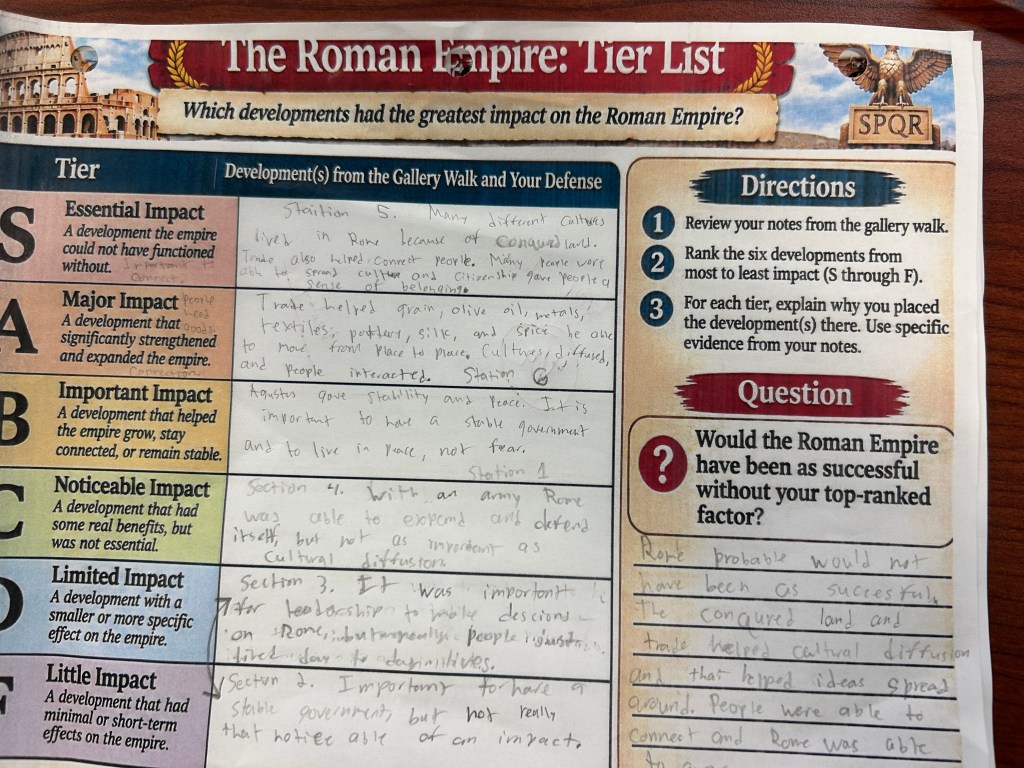
After completing the gallery walk, students used their notes to rank the six developments from S Tier to F Tier based on their impact on the Roman Empire. Each tier had a description, ranging from something the empire could not have functioned without to something with a more limited impact. Students had to place each development in a tier and explain their reasoning using evidence from the gallery walk.
I like having students rank information after a gallery walk because it gives their notes another purpose. They aren’t just collecting facts. They have to go back through the information, compare the developments, and make decisions about which ones mattered most. We finished with one more question: “Would the Roman Empire have been as successful without your top-ranked factor?” This pushed students to think about what would have happened if Rome had been missing one of the developments they considered essential.
Tuesday: Election Day in Ancient Rome
With Tuesday being Election Day, I wanted to connect our study of Roman emperors to the process of evaluating leaders and making informed decisions. We used another gallery walk, but this time students were examining six individual emperors before casting a vote for the person they believed would be the most effective leader of Rome.
Roman Emperors Gallery Walk
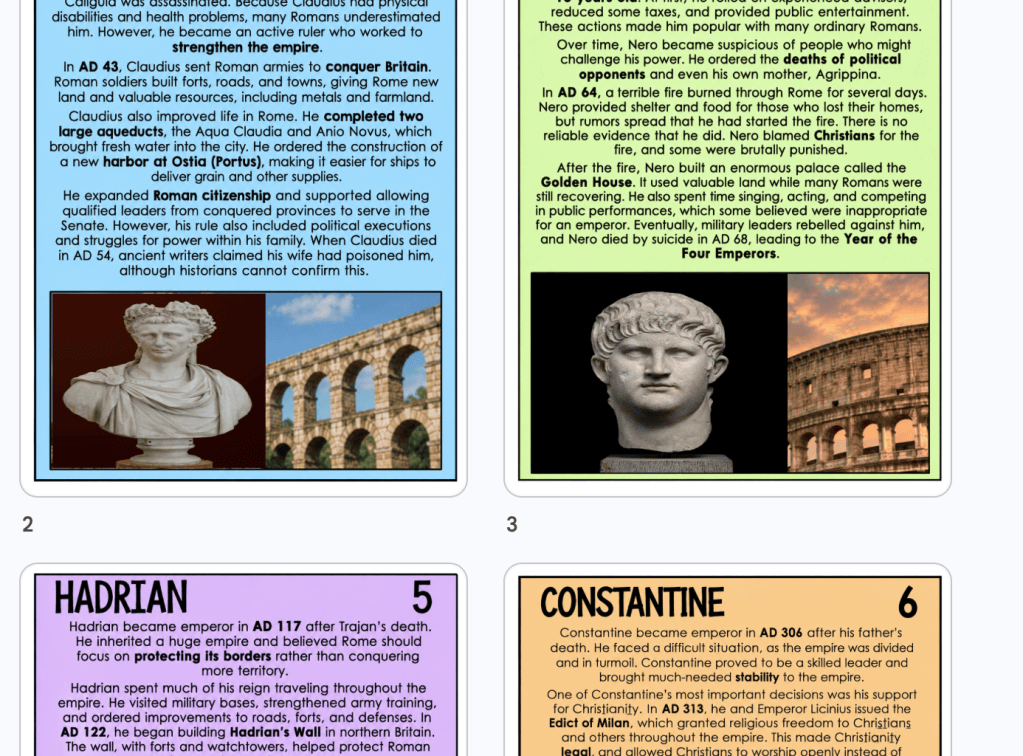
I created six stations featuring Augustus, Claudius, Nero, Trajan, Hadrian, and Constantine. Each station included a short reading and images highlighting the emperor’s accomplishments, leadership decisions, and challenges. Students collected notes about each emperor’s accomplishments, leadership strengths, and weaknesses.
There was plenty for students to consider. Augustus brought stability after years of civil war, Claudius expanded Roman territory and improved infrastructure, and Trajan expanded the empire to its greatest size. Hadrian focused more on defending its borders, while Constantine made decisions that changed the future of Christianity and the empire. Nero gave students a different kind of leader to evaluate. I wanted students to see that emperors made different decisions about how to use their power. Some focused on expansion, others on stability or improving life within the empire. Their accomplishments also came with consequences.
Election Day: Cast Your Vote
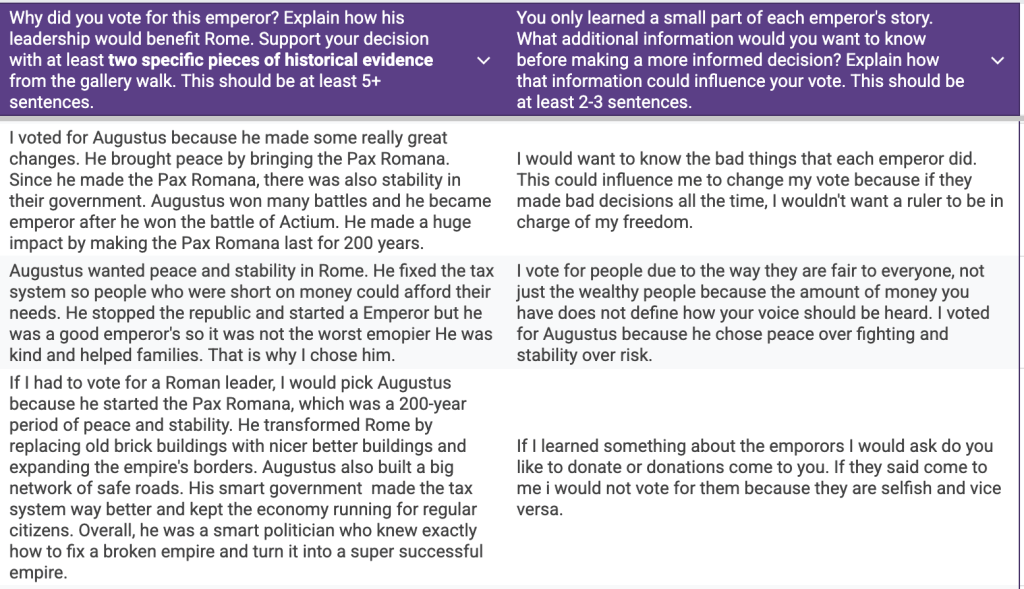
Once students had completed the gallery walk, they were ready to vote. I created a Google Form titled Election Day in Ancient Rome: Who Should Lead the Empire? Students imagined that all six emperors were running for office and had to select the person they believed would be the best leader. Of course, we discussed that Roman emperors weren’t actually elected by ordinary citizens. The election was simply a way to get students evaluating leadership.
Students couldn’t just select an emperor and submit their vote. They had to explain their choice in at least five sentences, using two specific pieces of historical evidence from the gallery walk. I also included a second question: “You only learned a small part of each emperor’s story. What additional information would you want to know before making a more informed decision?” I liked this question because students had to recognize the limits of the information they were given. They could make a decision based on the evidence available, but what else might they need to know? That seemed like a worthwhile connection to make on Election Day.
Wednesday: Using Gimkit Data to Guide Review
We’ve been using an ongoing Fast & Curious Gimkit throughout our Rome unit. As we learn new information, I continue adding questions to the same game. This gives students repeated opportunities to review earlier material, but it also gives me a chance to see which questions are being missed consistently. I’ve noticed some patterns in the responses, particularly with the structure of the Roman Republic’s government and how Rome transitioned from a republic into an empire. Rather than simply reviewing the answers in Gimkit again, I put together two activities to revisit those topics.
Frayer: Roman Republic Government
We started with a Frayer focused on four parts of the Roman Republic’s government: consuls, Senate, assemblies, and tribunes. Students used each quadrant to record the roles and responsibilities of one part of the government. This was an area where students were confusing who did what. Some were mixing up the Senate and assemblies, while others were having trouble remembering the responsibilities of consuls and tribunes.
The four boxes gave students a way to organize the information and see the different responsibilities side by side. I like using a Frayer this way because it’s a familiar structure that can be adapted to different topics. Instead of using the traditional definition, characteristics, examples, and nonexamples, each quadrant becomes a separate category students need to understand.
Sketch & Tell-O: From Republic to Empire
Next, we returned to the question: “How did Rome change from a republic into an empire?” Students read a short passage and identified three important ideas that helped explain the transition. They created a sketch for each idea and wrote an explanation underneath describing what the sketch represented and why it mattered.
I like pairing sketches with written explanations because students have to make decisions about the information. They need to determine which ideas are important enough to represent and then explain how those ideas answer the larger question. The drawing doesn’t need to be impressive. I’m more interested in whether the student can explain what happened and why it was significant. Wednesday was really about using what I had been noticing in our Gimkit reviews to make some instructional decisions. Instead of moving on or just playing another review game, we spent time working through the concepts that needed more attention.
Thursday: Life in Ancient Rome, Wealthy vs. Ordinary Romans
We finished the week with a lesson I borrowed from fellow teacher Justin Unruh. I made a few adjustments to fit what we had been learning, and it turned into one of my favorite parts of the week. After spending so much time studying emperors, government, and military expansion, I wanted students to think about what everyday life was like for the people living in the empire. Our focus question was: “How was everyday life different for wealthy and ordinary Romans?”
CyberSandwich: Two Different Roman Experiences
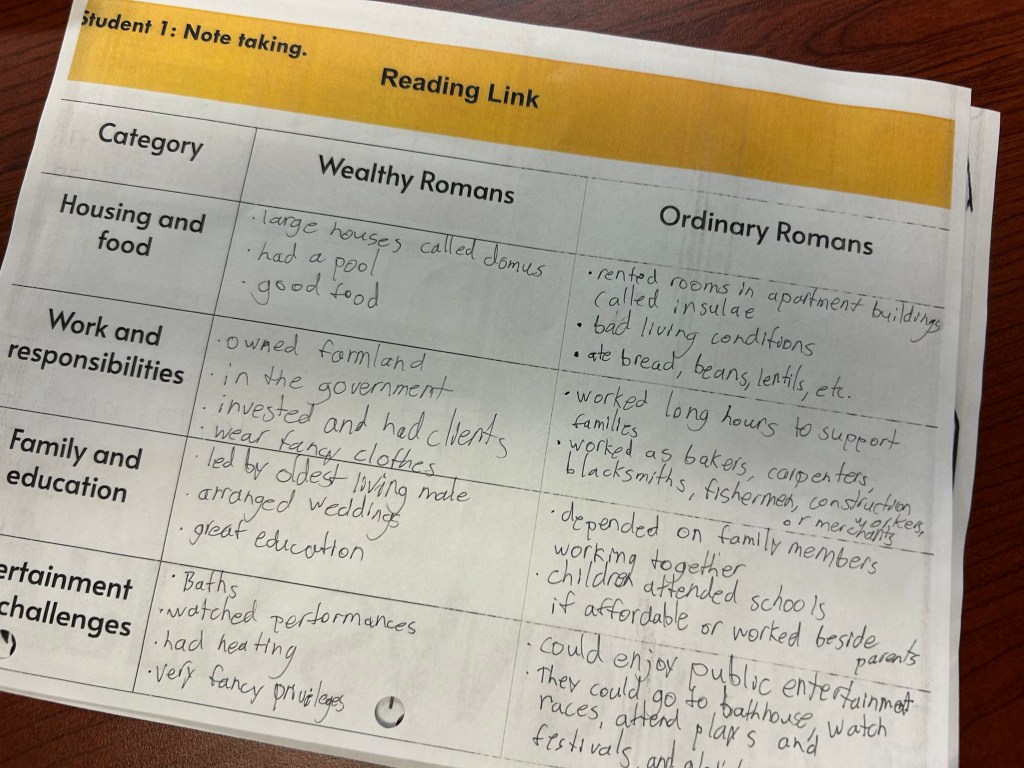
We started with a CyberSandwich using two different readings. Half the students received a reading about wealthy Romans, while the other half received a reading about ordinary Romans. Students read independently and collected information about housing and food, work and responsibilities, family and education, and entertainment and challenges. After taking their notes, students paired up with someone who had the opposite reading and took turns sharing what they learned while helping each other fill in the missing information on their organizers.
I like this setup because students need to communicate with each other. They each have information their partner doesn’t have, so they have to explain what they learned rather than simply copy answers from the same reading. The comparisons were also important because students could see how people living in the same city or empire could have very different experiences depending on their wealth and social position.
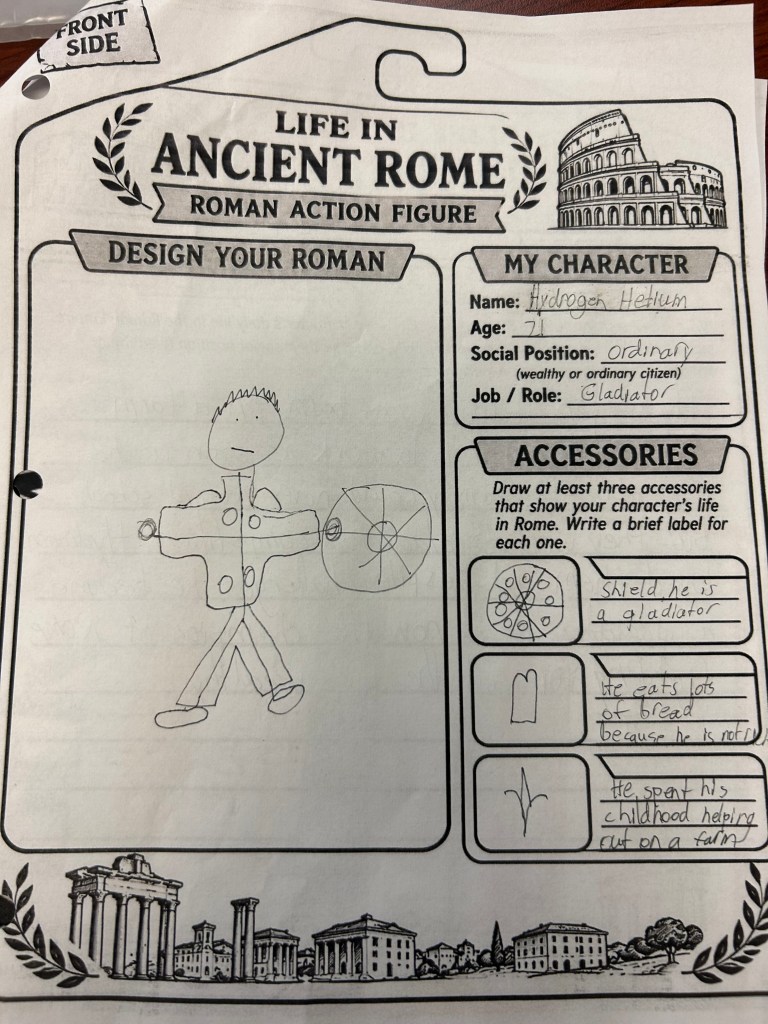
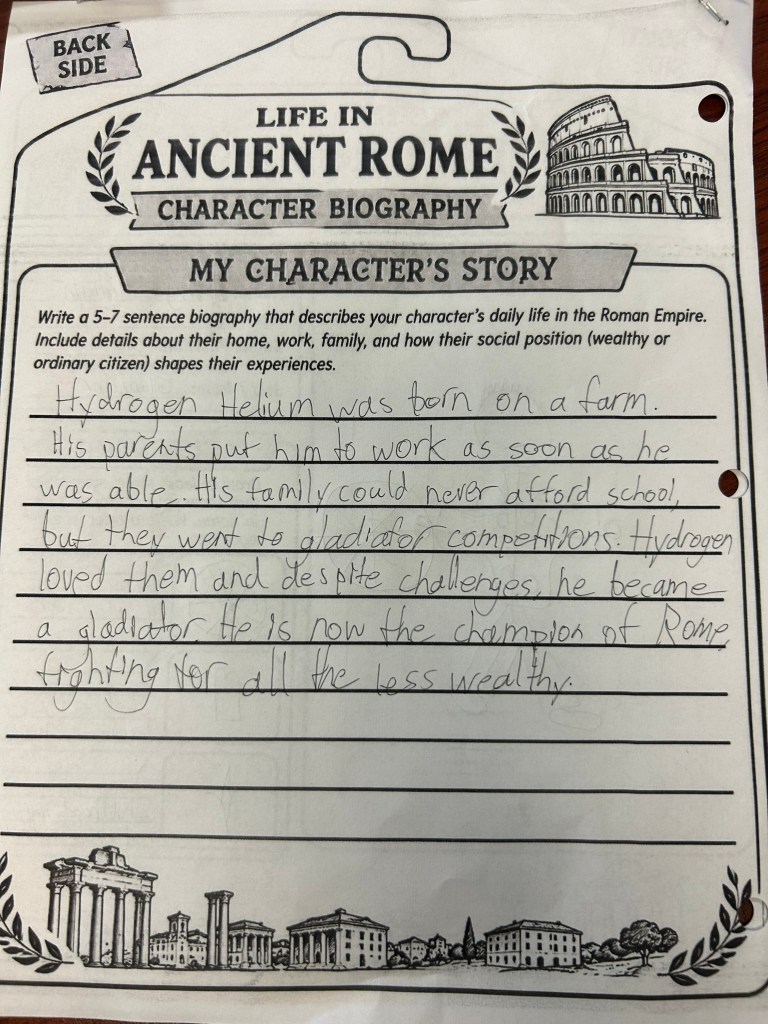
Create a Roman Citizen
After completing the CyberSandwich, students used what they learned to create their own Roman citizen action figure. Their character needed to reflect the information from their reading, so students had to think about what their person might wear, what kind of work they might do, where they might live, and what their everyday life would look like.
This gave students a chance to take information from a reading and apply it to a specific person. The characters also served another purpose because we were going to use them for a comparison activity on Friday.
Friday: Roman Citizen Face-Off and Sketch & Tell Comics
Friday was probably my favorite day of the week. Students brought their Roman citizens back together, compared their lives, and then created comics showing what might happen if their characters met in Ancient Rome. The conversations were awesome, and the kids really seemed to enjoy the activities.
Thin Slide Face-Off
We started by having students pair up and compare the Roman citizens they had created on Thursday. They used a Thin Slide divided into three sections. Each student selected one picture, word, or phrase that best represented their own character, while the middle section was used to represent an important similarity or difference between the two citizens. Under each section, students explained their choices and connected them to information from the CyberSandwich readings.
The goal was to keep the slide thin while making the explanations meaningful. I like this format because students have to narrow their thinking. They can’t include every detail about their characters, so they have to decide what best represents each person and what comparison is most important. It also gave students a reason to talk through their ideas before moving into the final activity.
Sketch & Tell: Comic Edition
For our final activity, students created a five-panel comic based on a simple situation: “Your two Roman citizens have just crossed paths in Ancient Rome. What happens when they meet?” The comic had to include both characters, at least two historically accurate details about everyday life, and dialogue or captions explaining what was happening. Students could make their stories funny, serious, or completely unexpected.
This is where the conversations really took off. Students were discussing how their characters might interact, what they would say to each other, and how their different lifestyles might affect the situation. Some of the ideas were pretty funny, but students were also using what they learned from the readings to make their stories work. I enjoyed listening to the discussions as students tried to figure out how their characters would respond to each other. They were comparing their lives, negotiating what would happen in the story, and finding ways to include accurate details about Roman society.
The kids loved this activity, and what I liked most was that the creativity didn’t replace the history. Students still needed to understand the differences between wealthy and ordinary Romans to create a story that made sense. It was a great way to finish the week, and I’ll definitely be using this format again.
Looking Back at the Week
One thing I liked about this week was how we kept returning to the information students had learned and asking them to do something different with it. Monday’s gallery walk led to a Tier List, Tuesday’s emperor readings led to an election, and Wednesday’s review came directly from patterns I had been noticing in our Gimkit questions. Thursday’s CyberSandwich gave students the information they needed to create Roman citizens, and Friday’s activities brought those characters together for comparisons and storytelling.
The Thursday and Friday activities were probably the highlight for me. There were some great discussions, plenty of creativity, and students were genuinely interested in what their classmates had created. It was a good reminder of how much students can do with historical information when we give them a reason to talk about it, make decisions, and use it in a new way.
Lessons for the Week
Monday – Tier List, Empire Stations I do not have permission to share.
Tuesday – Roman Emperors (the stations) – put into AI and generate your own questions
Wednesday – Review (Frayer and Sketch and Tell-o), Readings
Thursday – Roman Life CyberSandwich, Readings


