History teacher at New Richmond Middle School. Tennis coach at SUA, Beechmont Racquet and Fitness, Lunken Playfield, and KCC. Striving to learn, create, and innovate one day at a time.
Things are getting expensive. Teachers don’t wanna pay for stuff. Free versions are usually watered down or full of ads. I’m just here to share some tools that have useful free versions. These are ones I’ve been using and they’ve helped me plan better, save time, and still give students solid feedback and learning experiences.
I’ll keep it simple: what it is, why I like it, and how I use it (with a solid teaching idea thrown in—usually paired with EduProtocols that make sense).
Even with the free version, Class Companion gives your students feedback like a champ. It tracks writing progress over time, breaks feedback down into categories like organization and evidence, and gives consistent scoring. You can assign short-answer questions or extended responses, turn off copy/paste (huge during state testing season), and export their progress.
Why I like it: I don’t have to manually grade everything and I still get useful data. Feedback is fast and targeted. It’s perfect for helping kids write better without burning myself out.
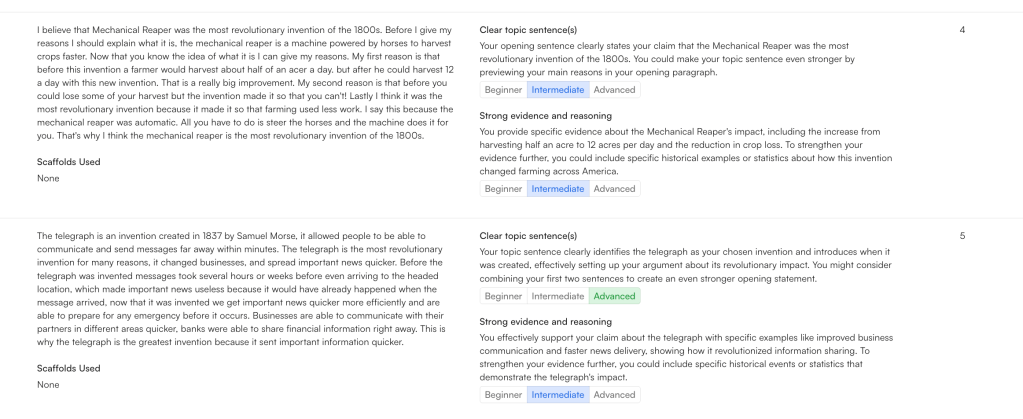
Teaching Idea: Pair with Nacho Paragraph. After doing a Number Mania, reading, or Frayer-based content build, have students write a one-paragraph response that argues a claim. Class Companion gives AI feedback on the claim, evidence, and reasoning. It’s also great after a MiniReport—combine two sources, write a response, and let AI provide revision tips. Great test prep without being test prep.
Brisk is like having an AI sidekick built right into Google Docs and Slides. You can highlight text and ask it to simplify or raise the reading level, turn a website into a quick Google Slide presentation, or even generate questions. You can use it to leave AI-generated feedback on student work, but I mostly use it for materials prep.
Why I like it: It’s fast, doesn’t take me to a new platform, and it helps me tailor materials for students at different levels in seconds.
Teaching Idea: Use Brisk to level a source before a Cyber Sandwich. Take a tough article, simplify it for one group of students, and leave the original for another. Have them annotate, partner-share, and write a summary. You can even ask Brisk to generate questions for a thin slide or fast and curious warm-up.
This is my go-to when I want a fast, interactive lesson that looks good but doesn’t take hours to make. Curipod lets you create engaging, Nearpod-style lessons. You can add open-ended questions, quick polls, drag-and-drop, even AI-generated reflections or historical figure Q&A simulations. The drawing and writing feedback features are a huge bonus.
Why I like it: I can turn a warmup into a 20-minute meaningful discussion with a couple clicks. Students actually enjoy the format and get to respond anonymously or collaboratively.
Teaching Idea: One way you could try using Curipod is by adding a few Sketch and Tell prompts throughout the lesson. Students draw and write a quick response, and the platform gives them feedback right away. After the Curipod, you might follow it up with a Thick Slide—have students share four important facts, two visuals, and a comparison. It’s a simple way to turn the lesson into something more student-centered and reflective.
Final Thoughts
These three AI tools won’t replace your teaching—but they do make it faster, easier, and more manageable. You don’t need 12 tools, and you definitely don’t need to drop $25/month to get value.
Try one this week. Layer it into an EduProtocol you already use. Let the AI handle some of the prep or feedback so you can focus more on the conversations and connections that matter.
When I was putting together my “Turning Whatever Into Wow” presentation, I kept coming back to one truth: don’t let AI create your lesson. Use it to support your thinking, not replace it.
You are the human in the loop. You know your students. You know your standards. You know what they need to know and be able to do by the end of a lesson.
That’s how every lesson should start—with the end in mind. What skill are we building? What misconception are we clearing up? What connection are we hoping they make? Once I know that, then I bring AI into the process—not to do the work for me, but to help sharpen the work I’m already doing.
AI is powerful, but your thinking still drives everything.
Teachers are often put in situations where we’re expected to react quickly. And let’s be honest—most of us are pretty reactionary by nature. We think we know how we’d handle a situation, and sometimes we even rehearse those responses in our heads. But when the moment actually happens? It’s never exactly like you imagined.
Today I was thinking about a student I had who wore a camping bracelet. I didn’t think much of it until I saw him sparking it—yes, like actual sparks. Turns out, it had flint and a small knife hidden in it. In my head, I could hear the imagined reactions of others: panic, write-ups, sending him out immediately, maybe even calling security.
But instead, I just stood there, and took it in. A few minutes later, I walked back and asked him calmly to tell me what it was. As he explained, I texted the right people behind the scenes. Admin came down, had a quiet conversation, and that was that. The student left. No spectacle. No scene. I never saw him again.
That moment stuck with me. Because yeah, I could’ve reacted. But I didn’t need to. Not every situation requires a high-stakes response. Sometimes it’s not about how you want to react—it’s about how you need to respond. There’s a difference.
This isn’t about being passive. It’s about being thoughtful. Teaching is hard, and every kid, every situation, every choice is different. We don’t always have to meet intensity with intensity. Sometimes the best thing you can do is pause, listen, and make your move quietly.
This week was all about variety, structure, and student voice—anchored by a solid lineup of EduProtocols. I leaned on Fast & Curious for foundational vocab, layered in Annotate & Tell to break down complex readings, used Number Mania to push students toward using evidence, and wrapped lessons with Short Answer and Nacho Paragraphs to bring writing and thinking together. We even threw in some creative fun with Thin Slides, Craft-a-Cola, and a few MagicSchool tools to help students prompt and produce in more engaging ways. It wasn’t just about covering content—it was about designing experiences that stuck.
We kicked off the week with a lesson on industrialization and how it changed the northern states—and I tried a Rack and Stack combo I was really happy with. It wasn’t flashy, but it had purpose at every step. Each EduProtocol built on the last, and everything came back to our guiding question: How did industrialization change the northern states?
Fast and Curious: Vocab First
We opened with a Gimkit Fast and Curious using vocabulary that kids were likely to struggle with—rivers, factories, mass production, loom, spinning, sewing machine. A lot of times I assume kids know basic words, but they don’t. After the first round, I gave feedback and cleared up confusion around things like loom and mass production. Then we ran it again. By the second round, scores had gone way up—evidence that repetition and feedback work.
Thin Slide: Why the North?
Next, I used a Thin Slide variation I learned from Justin Unruh. Students were asked to answer the question: Why did industrialization occur more in the North? using the keywords rivers and factories. They found or created an image and gave a one-sentence explanation. They had 8 minutes total—then they shared live, 8 seconds per student. This was a great way to preview the bigger concepts without overwhelming them.
Annotate and Tell: 3 Phases of Industrialization
We moved on to an Annotate and Tell with a short reading on the three phases of industrialization. Students highlighted the three phases in yellow and highlighted any inventions or machines in blue. The reading wasn’t long, but it was packed with information. I asked them two big questions to process:
What are the three phases of industrialization, and how did each one change the way goods were made?
How did machines like looms and sewing machines change the way people worked in factories?
Kids worked in partners to discuss and respond, and I was impressed with how well they broke it down.
Sketch & Tell Comic Edition: Visualizing the Phases
After the reading, I had students create a 3-frame comic using the Sketch and Tell Comic Edition to show how the three phases changed life and work. I got this idea from Justin Unruh again, and it’s become one of my favorite go-to protocols for visual processing. Instead of just retelling, students visualized each stage and added one sentence of explanation. This helped students slow down and make sense of how the shift happened over time—from breaking down tasks, to building factories, to powering machines.
Padlet Thin Slide: Bringing It Back to the Big Question
To wrap it up, we returned to our original question—How did industrialization change the northern states?—with a final Thin Slide posted on Padlet. I gave them 5 minutes to respond using what they had just learned, and they had to include at least one piece of evidence from the comic or Annotate and Tell. This helped me see who really got it and who might need more support.
It was a solid Rack and Stack, and I loved how each piece of the lesson connected. The goal wasn’t to cover everything—it was to build background, layer the concepts, and give students multiple ways to process. That’s what makes EduProtocols work.
Tuesday
I’ll be honest—Monday didn’t go how I hoped. The engagement across all my classes hovered around 25%, and that’s not something I’m used to. It frustrated me, and it forced me to take a step back. I told the students on Tuesday that I intentionally design lessons to build on familiar ideas. I don’t want them to feel overwhelmed—but I also don’t want them to zone out.
So I had to flip the script.
Fast and Curious: Quizizz Rebound
We opened class with a Fast and Curious on Quizizz using questions tied directly to industrialization in the North. This wasn’t just vocab—it was context-based. Words like steamboat, reaper, plow, and telegraph were sprinkled in. I noticed how often students missed even basic terms. Sometimes we assume students know what words like “petition” or “shift” mean, but they don’t. The data from Quizizz told me exactly where to go next.
Frayer Models With a Twist
We jumped into a Frayer activity using the textbook reading on four major inventions of the 1800s: the steamboat, the mechanical reaper, the steel plow, and the telegraph. But this wasn’t just a regular Frayer. I added some chaos—two dice rolls per invention. The first determined how many bullet points they had to write, the second decided how many words each bullet needed. This created structure, accountability, and a layer of challenge.
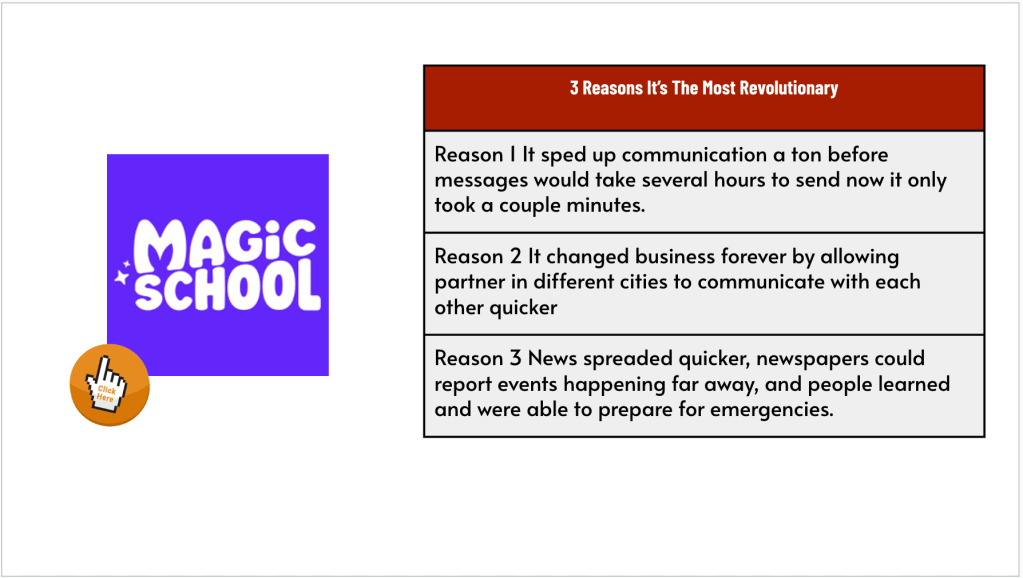
Chatbot Collaboration: Magic School AI
Next, I had students select the invention they thought was the most revolutionary. Using Magic School’s chatbot, they prompted the AI to speak as if it were that invention. They asked follow-up questions and gathered more support. This was one of my favorite moments—watching students debate themselves through the screen, pushing AI for deeper evidence.
Short Answer: Writing With a Purpose
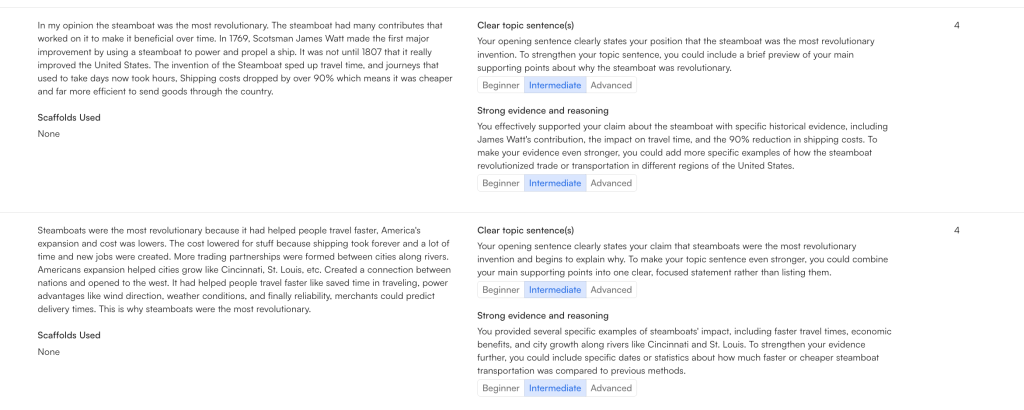
We wrapped up with a Quick Write on ShortAnswer. This tool has been a game-changer. I selected two rubric elements: clear use of evidence and strong conventions. The AI gave instant feedback and categorized responses as beginner, intermediate, or advanced. Then it added up class scores to see if we hit our class goal. Three of my four classes crushed it.
But the best part? I disabled copy and paste. The words they wrote were their own.
I told them if they hit the class goal, I’d wipe away their Monday mess. They locked in and crushed it. Students were writing. For real. Because the task had structure, purpose, and a chance to improve.
Wednesday
Today’s lesson was all about one sentence: “The Lowell Mill Girls had an extraordinary opportunity.” That was it. That was the line that carried us through the whole class. My goal? Get students to keep circling back to that claim—support it, refute it, challenge it, reframe it. Think about it, talk about it, write about it.
I used a Rack and Stack of familiar EduProtocols, but I tried to tweak the flow a little to hit a rhythm. And honestly, it worked.
Fast and Curious: Start with What They Don’t Know
We kicked things off with a Fast and Curious using Gimkit. Vocabulary was pulled straight from the lesson: boardinghouse, wage, petition, strike, shift. You’d be surprised how many students don’t know what a “shift” is. Or “petition.” Or “boardinghouse.” After one 3-minute round and some direct feedback, we ran it again—and it made a big difference. The repetition and immediate correction helped lock it in. And it gave us a foundation to move forward.
EdPuzzle + Thin Slide = Instant Reflection
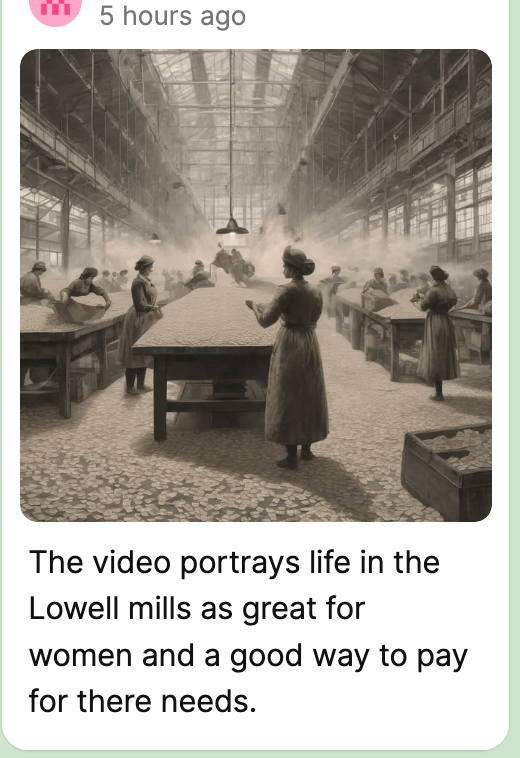
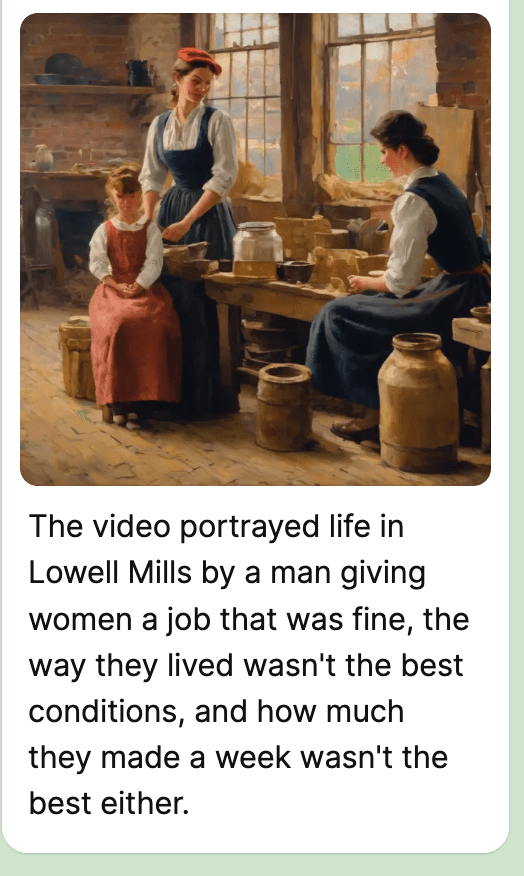
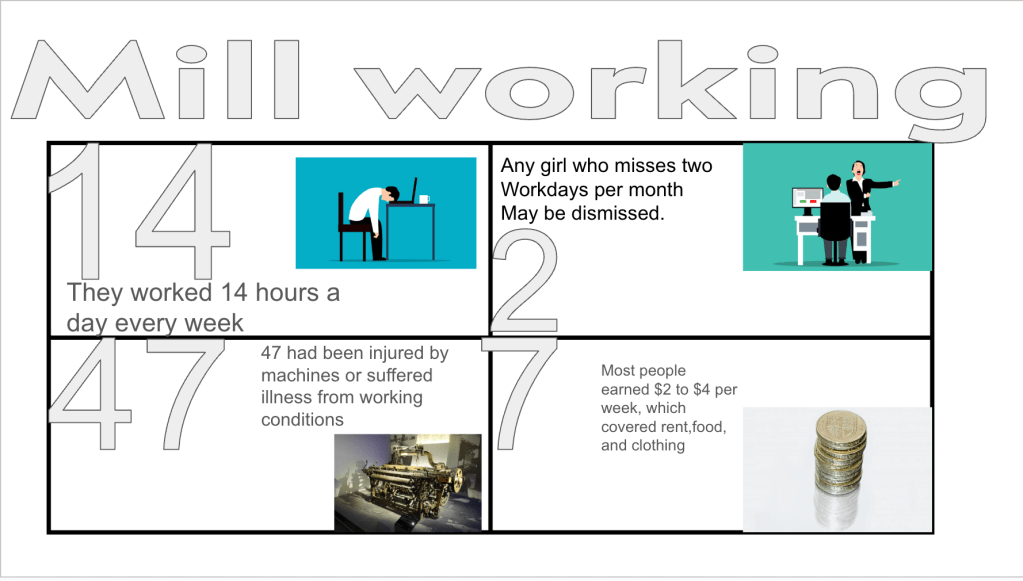
Next, we watched a 4-minute EdPuzzle about the Lowell Mill Girls. I embedded a Thin Slide right in the middle and brought the original claim back: “Did this video support that statement or not?” Some said yes—they got paid, they had housing. Others said no—the pay was awful, the work was grueling, and the living conditions weren’t great either. It was cool to see students start forming opinions and backing them up with specific parts of the video. The Thin Slide forced them to pick a side and start thinking critically before we even got to the meat of the lesson.
Number Mania: Let the Numbers Talk
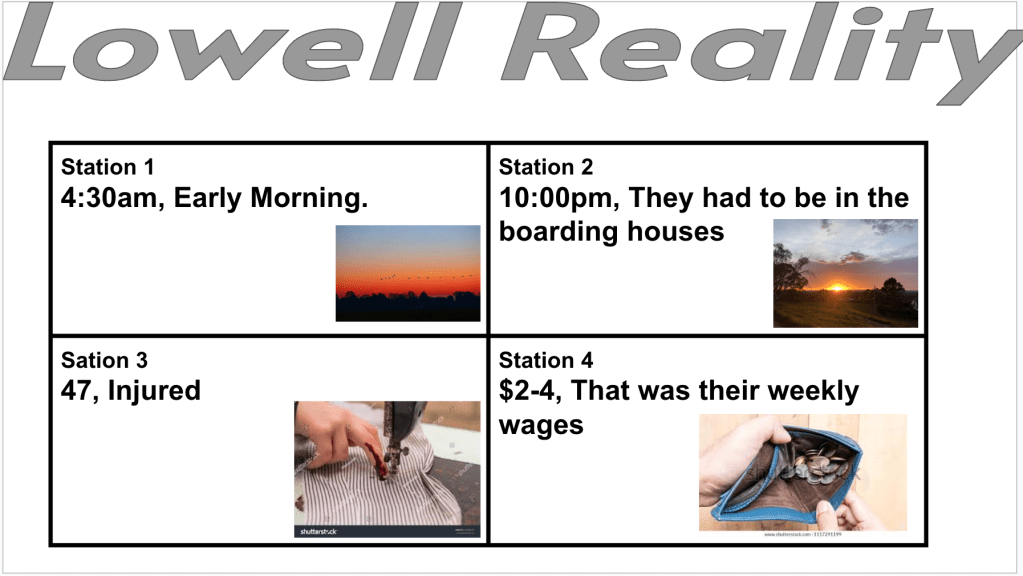
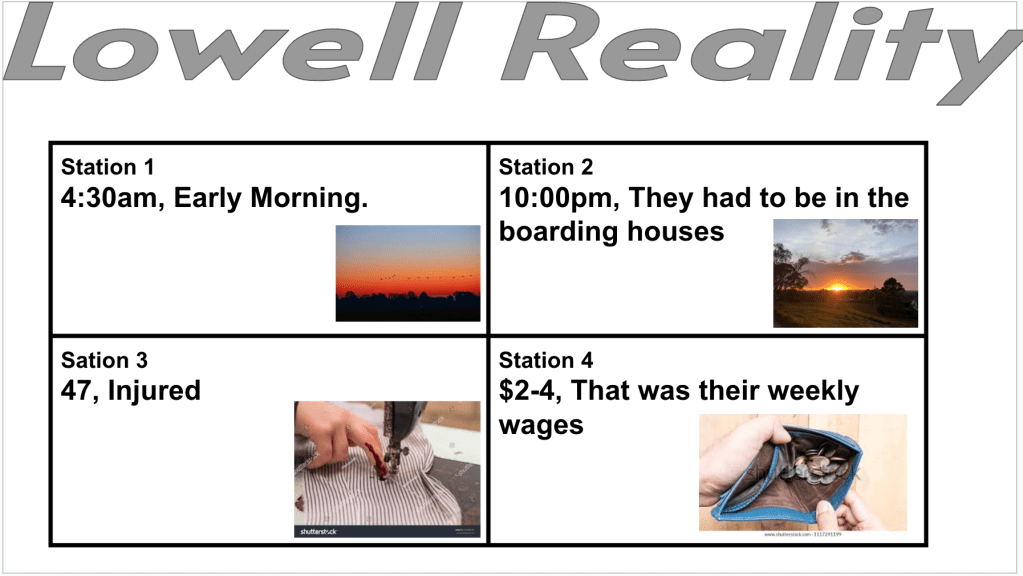
Then we moved into Number Mania. Originally, I had six stations planned, each with a short reading—some primary, some secondary. But after thinking about cognitive load (and remembering that part in Blake Harvard’s book), I cut it down to four. Best decision I made all week.
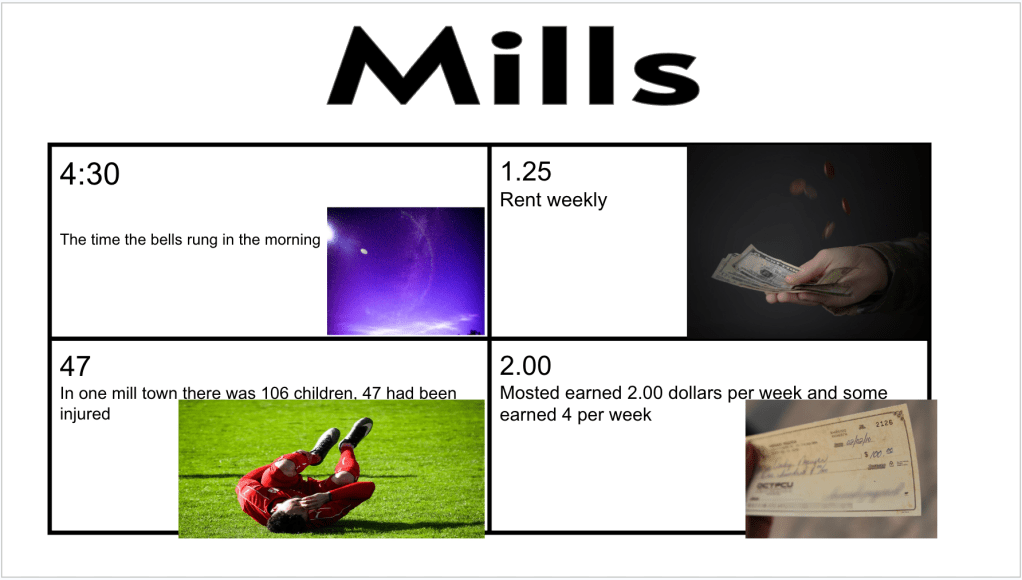
At each station, students had to pick a number from the reading that could be used to refute the original statement. Of course, we had to stop and break down what “refute” actually meant—another word straight off the state test that most students didn’t know.
To make it even more fun (and to fight copy-paste laziness), I rolled dice. The first die told them how many words they had to use. That forced them to be intentional and selective with their evidence. Every station, every round, they got better at it.
Short Answer x Nacho Paragraph: Final Hit
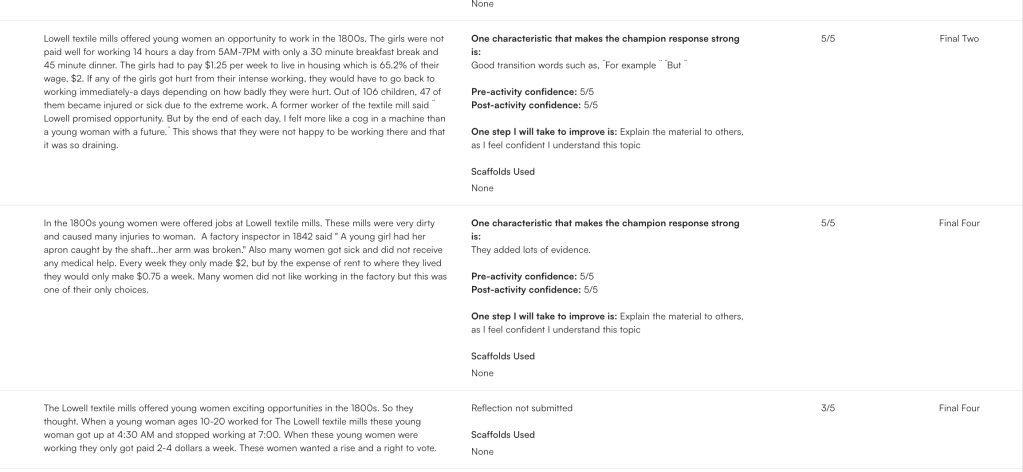
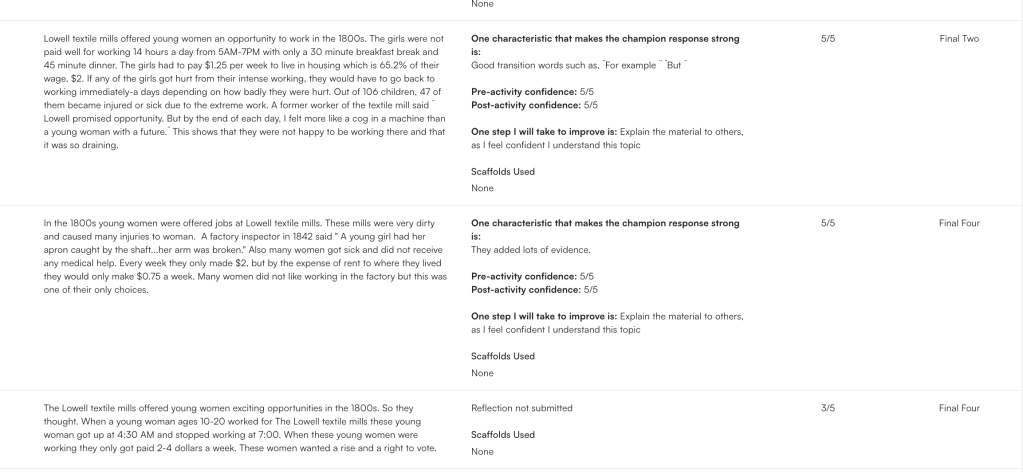
To bring it all together, we used the Nacho Paragraph protocol inside Short Answer. I told students to copy and paste the original statement and revise it. Fix it. Refute it. Use the numbers and facts they just found in the Number Mania.
We ran it Battle Royale style. They saw each other’s answers. They compared. They got feedback. And most importantly, they thought.
They were engaged. They weren’t writing because I told them to. They were writing because they had something to say.
Thursday
After a deep dive into the Lowell Mill Girls earlier in the week, I wanted to extend the conversation—this time with a focus on labor unions and how the legacy of early industrial labor still echoes today.
We kicked things off with a short, one-page reading about the Lowell Mill Girls and labor unions. The reading did a solid job tying the historical context to modern labor movements. Students answered five questions to check comprehension and pull key ideas.
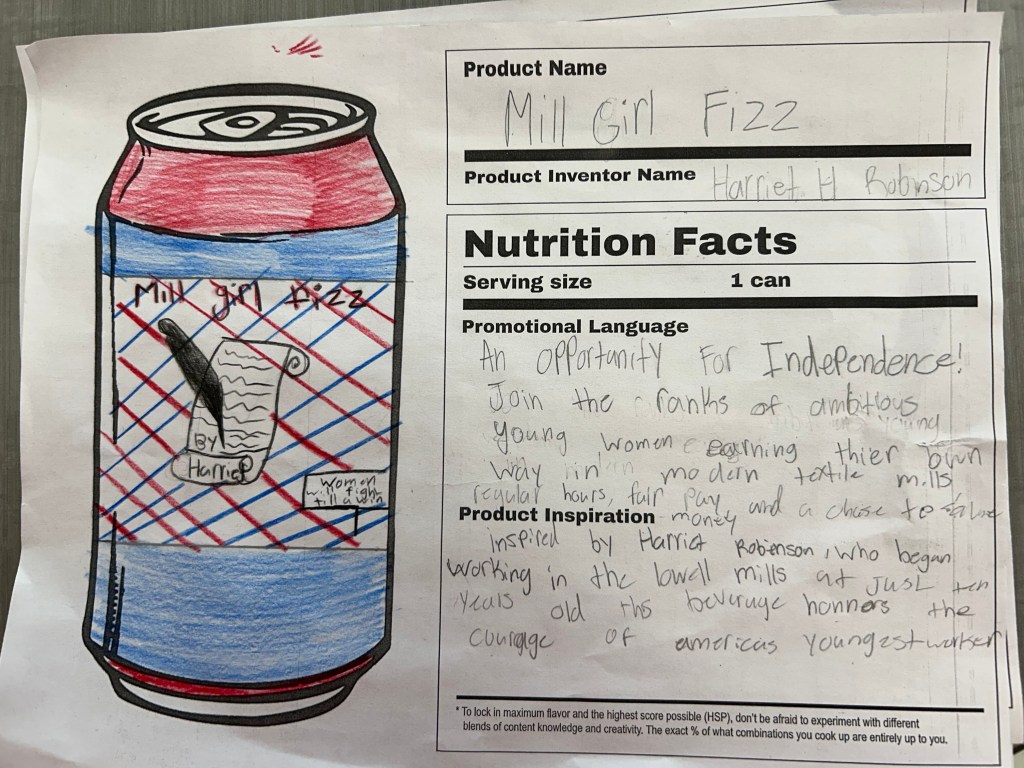
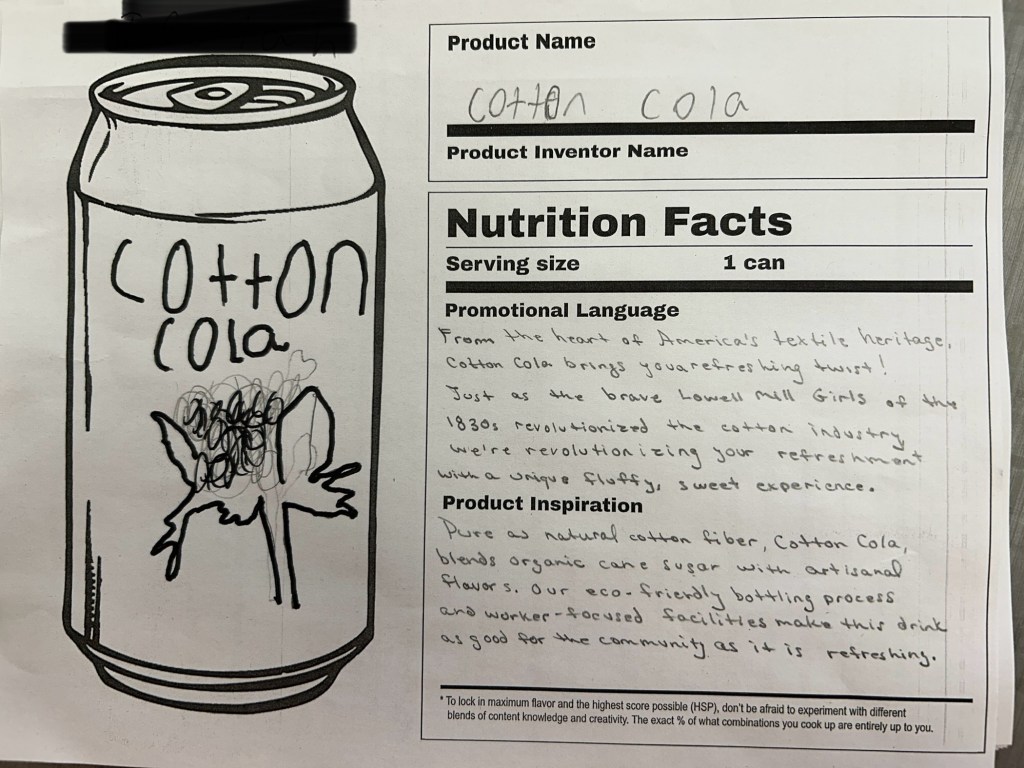
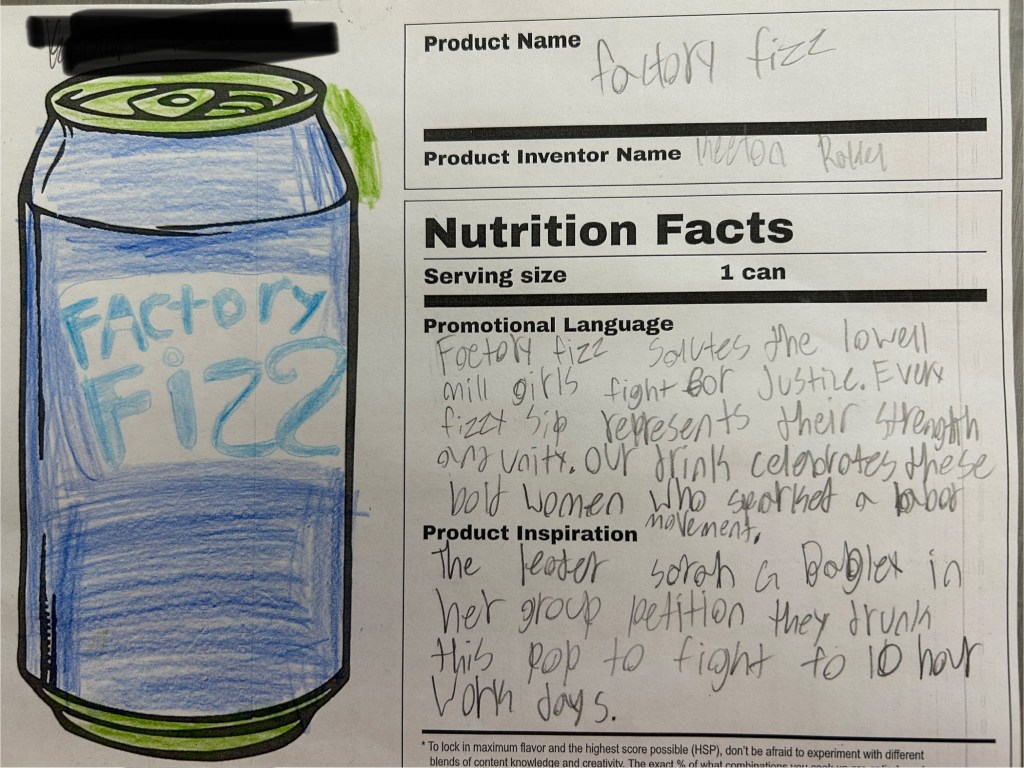
Then we pivoted into something a little more creative: a template from EMC² Learning called Craft-a-Cola.
Here’s the setup: Students had to design a pop can inspired by the Lowell Mill Girls and the rise of labor unions. Their can needed:
A creative soda name
A slogan or promotional phrase
A short write-up explaining the historical inspiration behind their product
This was a fun twist, but I knew right away some students would struggle with generating ideas. So I built a Magic School classroom with a custom idea generator chatbot. Students used it to brainstorm potential pop names and promotional language.
Here’s what I learned: 8th graders don’t always know how to prompt clearly. At first, a lot of the results were pretty off—or the bot responded with something like “I can’t do that, but here’s a suggestion…” It turned into an unexpected mini-lesson on how to write better prompts.
We took a few minutes to break down what makes a good prompt, rewrote some together, and suddenly the ideas started flowing.
What I liked most about today’s lesson:
It gave students a new way to process content they’ve been learning about all week
It tied creative thinking to historical understanding
It sneakily taught them better AI prompting skills without me planning for that to happen
Some of their designs were pretty awesome. A few were flat-out hilarious. But all of them reflected some understanding of how labor unions began and why they mattered—proof that even a pop can can tell a powerful story.
Today, I ran a new Rack and Stack using some familiar EduProtocols but with a fresh flow. The whole lesson was built around this opening statement: “The Lowell Mill Girls had an extraordinary opportunity.” That one sentence carried us through the entire class. I wanted students to come back to it over and over again, thinking critically about whether or not it was actually true.
Here is the flow:
Fast and Curious
EdPuzzle with Thin Slide
Number Mania
Nacho Paragraph with Short Answer
Starting with Vocabulary: Fast and Curious
We began with a Gimkit Fast and Curious. I pulled vocab straight from the lesson—boardinghouse, wage, petition, strike, shift. It’s honestly surprising how many words kids just don’t know anymore. I can’t assume anything. The most missed were boardinghouse, petition, and shift. After two rounds with some feedback in between, their accuracy shot up. We had a solid foundation for the rest of class.
EdPuzzle with a Thin Slide Twist
Next up was a 4-minute EdPuzzle about the Lowell Mill Girls. I embedded a Thin Slide with the same opening statement—did this video support it or not? Some kids thought it did, to a point. The video showed that the girls got paid and had housing, but others quickly pointed out the poor conditions and low wages. The Thin Slide was great for capturing those first reactions and making them back it up.
Number Mania with a Purpose
Then we hit the main chunk of the lesson—Number Mania. I had originally planned 6 stations, each with primary and secondary sources about different aspects of mill life. But after a dry run and thinking about cognitive load (shoutout to Blake Harvard’s book), I trimmed it to 4 stations. That made a huge difference.
The task was to find numerical evidence to refute the original statement. Of course, we had to go over the word “refute” first. That word shows up on the Ohio state test, and about 90% of my students didn’t know what it meant. Each station had a brief source. After reading, students picked a number that could be used to argue against the idea that the Lowell Mill Girls had some amazing opportunity. I rolled dice to determine how many words their explanation had to be. That added a fun twist and helped prevent kids from copying straight from the text. They had to think.
Short Answer + Nacho Paragraph
The finale was awesome. I pulled up Short Answer and ran it Battle Royale style using the Nacho Paragraph protocol. Each student copied and pasted the original statement and rewrote it, fixing it using the numerical evidence from the Number Mania. Their job was to refute the original sentence with facts. It brought everything together perfectly.
Short Answer gave them a sense of audience, let them see others’ responses, and motivated them to write better. They knew their classmates would see it, and that made all the difference.
Why This Worked
This lesson flowed. It began and ended with the same prompt, but by the time we got to the end, students had real evidence and a better understanding of both the content and how to structure their thinking. It wasn’t just about mill life—it was about challenging assumptions, reading multiple types of sources, interpreting data, using key vocab, and writing for a real purpose.
I also liked that I was able to scale the cognitive load. The vocab and EdPuzzle built some schema. The stations weren’t too long, and the dice kept the kids engaged. The writing had structure. Every part had purpose.
It’s not always about doing something big and flashy. Sometimes it’s about connecting pieces in a way that feels meaningful and builds momentum. Today, it worked.
I’ve been reading Do I Have Your Attention? by Blake Harvard. It blends cognitive science with practical classroom ideas—nothing too wild, just enough to make you stop and rethink some things. One part that really stuck with me was on cognitive load theory, especially the idea of intrinsic and extraneous load. It got me thinking about how I’ve been planning, what I prioritize, and how I sometimes try to do too much when maybe I just need to step back.
So Much Goes Into Planning
When I plan, it’s not just about covering content. It’s about thinking through what I want my students to know and be able to do, what skills I want them to build, what vocabulary they need, how to keep them engaged, and how I’m going to support the students who need more help—all while keeping things moving for the kids who are ready to fly.
And now, I’ve started asking myself: what kind of cognitive load are my students carrying into this lesson? Is this content already hard and layered (intrinsic load)? If so, I probably don’t need to add too much else (extraneous load). But if the content is simpler or more familiar, maybe I can push a bit further creatively.
Easy and Hard Topics in Social Studies
I’ve realized that not all content is created equal when it comes to complexity. Some social studies topics are naturally easier for kids to access, while others require more mental lifting.
Examples of Easier (Lower Intrinsic Load) Topics:
Reasons for European exploration
Life in the 13 colonies
Westward expansion and Manifest Destiny
Types of colonial economies (New England, Middle, Southern)
Comparing daily life in the North and South
These topics are usually centered around people, places, or causes. They’re concrete, familiar, and easier to visualize or connect to.
Examples of Harder (Higher Intrinsic Load) Topics:
The Constitution and its principles (separation of powers, checks and balances, federalism)
The Bill of Rights and application of amendments
Judicial review and landmark Supreme Court cases
Economic systems like mercantilism or capitalism
The causes of the Civil War (beyond just slavery)
These are abstract, layered topics that require deeper processing and strong academic vocabulary. When I’m teaching these, I simplify everything else so students can focus on the core idea.
When the Content Is Hard, Keep It Clean
In those higher-load lessons, I’ve learned that I don’t need to pile on the extras. A Frayer Model to build background, an Annotate and Tell to help break the reading down, and a Thick Slide to wrap it up. That’s enough. I’ve made the mistake of overdoing it before, and kids just got lost in the fluff. The content already asks a lot of them.
When the Content Is Familiar, You Can Stretch
But when the topic is easier to grasp, that’s when I can have some fun and go big with design. That’s where protocols like these come in:
Sketch and Tell: Have kids visualize big ideas and translate them into drawings.
Map and Tell: Great for tracking movement or showing change over time.
3xPOV: When multiple perspectives matter (like Manifest Destiny or American Revolution).
3xGenre: Having kids write in narrative, informative, and argument formats helps them go deep.
These aren’t just fun—these are meaningful ways to deepen thinking when the topic allows for it.
Final Thoughts
I’ve definitely fallen into the trap of thinking more stuff equals better. But lately, I’m realizing the real challenge is in matching the lesson design to the complexity of the content. I can’t always make everything exciting. And not every topic calls for elaborate activities.
Know the content. Know your students. Know the load they’re carrying.
Still figuring it out, but this helps me take a breath and rethink what good lesson design actually looks like.
This year, one of the biggest challenges in my classroom has been students’ limited knowledge of Tier 1, Tier 2, and, no surprise, Tier 3 vocabulary. It’s had a major impact on their ability to learn and engage with content. The textbook we use is packed with unfamiliar words, even in the instructions or basic sentences, which only adds to the struggle.
I believe in challenging students and keeping expectations high, but when vocabulary knowledge is shaky, it affects everything else—reading comprehension, class discussions, writing, and even their confidence. That’s where I’ve had to rethink how I approach instruction, especially when introducing complex concepts like federalism.
Here’s how I’ve been using vocabulary strategies and the Fast and Curious EduProtocol to help students not just survive, but grow.
What Is Working Memory?
Working memory is the space in the brain where students process information they’re learning in the moment. But it’s limited—students can only juggle a few pieces of information at once before their brains become overwhelmed.
How Vocabulary Impacts Learning
If a student is unfamiliar with a term like federalism, which is a Tier 3, subject-specific word, and they’re also unsure about related Tier 2 academic words like authority, system, or structure, their working memory fills up quickly. Instead of chunking the idea into one meaningful unit, they’re stuck trying to decode every word. That’s a recipe for overload, and learning often shuts down.
What It Looks Like in Class
Let’s say you show students this sentence:
“Federalism is a system of government in which power is divided between a national and state government.”
A student who lacks vocabulary support might be thinking:
What’s federalism?
What does system mean here?
Divided how?
What’s a state goverment?
By the time they work through those questions, the main idea is lost.
Strategy: Use Fast and Curious to Build Vocabulary
Start with Fast and Curious. Use a platform like Quizizz to introduce and repeat vocab words daily. It only takes five to seven minutes, and the repetition helps move those terms into long-term memory. This frees up working memory to focus on learning. and helps students feel more confident going into the lesson.
Build a quiz that includes a mix of terms:
Tier 1: law, rule
Tier 2: authority, system, divide
Tier 3: federalism, goverment, Constitution
This supports students at different vocabulary levels and helps build a foundation they can use during lesssons.
Use Visuals and Analogies
Pair federalism with a simple image, like a pizza split between friends or a tug-of-war between state and national goverments. These visual anchors make abstract concepts more concrete and easier to understand.
Make Connections to Their Lives
Connect new terms to students’ own experiences. For example, ask: “Do you have rules at home and rules at school? That’s kind of like federalism—different groups in charge of different things.” When students can relate to the vocabulary, they’re more likely to remember and apply it. And it’s also a good chance to build some trust and engagment.
Repeat and Revisit the Words
Don’t expect mastery after one lesson. Keep using the terms throughout the week—in review games, warm-ups, and writing prompts. Every time students hear and use a word, they build confidence and free up space in working memory for deeper thinking.
Final Thought
When students know the words, they can hold more ideas in their minds. That frees up their working memory to think critically, participate in discussions, and make meaningful connections. If federalism doesn’t stick the first time, don’t give up. Slow down, build vocab intentionally, and give students the space they need to succeed.
This week was all about using EduProtocols to deepen understanding and get students thinking critically about history. From Parafly for paraphrasing complex texts to Thick Slides for sequencing and comparing key events, we focused on meaningful engagement. ShortAnswer’s Quick Write gave students real-time AI feedback on their writing, while Map & Tell helped visualize territorial disputes. Sketch & Tell-O and Annotate & Tell made sure students weren’t just memorizing but actually processing history. Layering these protocols together made for a strong week of learning!
Monday was all about preparing for the Westward Expansion test. I originally planned a standard review, but a Sunday afternoon phone call with my friend Dominic Helmstetter changed that. He wanted to share with me what his understanding was of the the Great American Race. His idea—the Great American Race was a rapid-fire series of EduProtocols with Five-minute bursts of Parafly, Thin Slides, Annotate and Tell, and more, followed by a Quizizz mastery check where students had to get 100%. My response? That’s not how I’ve done the Great American Race before… but I love it.
So, I ran with it. I lined up five different EduProtocols, each tied to a major concept in the unit:
Parafly → Mormon migration
Annotate and Tell → Texas independence
Sketch and Tell-O → Oregon Trail
Frayer Model → Manifest Destiny
Cause & Effect Organizer → Mexican-American War
Each round lasted 6-8 minutes. I encouraged students to complete as much as they could from memory before checking resources. To support them, I had AI generate concise readings summarizing key points from our lessons. We wrapped up the period with a Quizizz practice test, and the class averages landed between 44% and 65%. Not great.
At first, it felt discouraging. But my friend Corbin Moore reminded me—it’s not about achievement, it’s about growth. That shifted my mindset.
Test Day
Tuesday was test day, and I kept my usual grading system:
Multiple-choice (content knowledge) → Taken on McGraw Hill’s site
Short answer/extended response (writing/critical thinking) → Completed on Class Companion
The results?
Multiple-choice averages: 89%, 74%, 85%, and 89%
Short answer growth: Huge improvement from the pre-test
It’s easy to get caught up in numbers, but seeing how much my students progressed from struggling with the concepts on Monday to confidently tackling the test on Tuesday was a win.
This version of the Great American Race might not have been the original, but it was an exciting, high-energy way to cycle through multiple ways of processing information—and it’s something I’ll definitely refine and try again.
Wednesday
Wednesday, I wanted to mix things up and bring in local history. There’s a tiny town in Clermont County called Utopia, OH—a place I’ve been fascinated with since I was a kid. It’s right on the river, barely noticeable, but packed with history. Why was it called Utopia? What made people think they could build a perfect society there?
I connected this lesson to westward expansion by framing it around the Panic of 1837. Many Americans were financially struggling and had to make tough choices—head west for a new start, scrape by where they were, or try to create a utopia, a so-called perfect society. That’s exactly what happened in Utopia, OH, where three different groups attempted (and failed) to build their ideal communities.
Thin Slides: Creating a Utopia
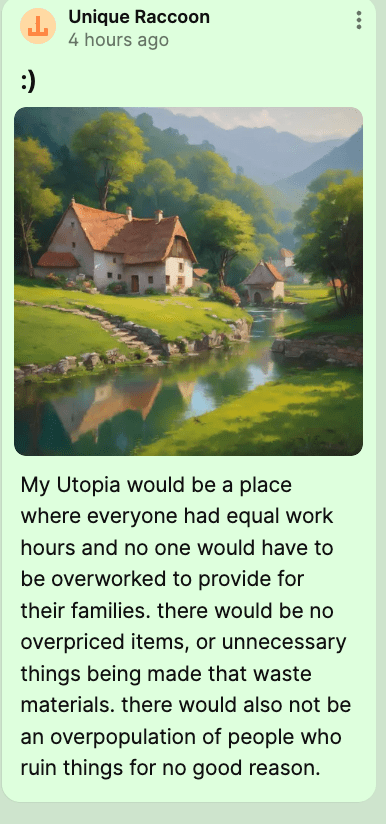
We kicked things off with a Thin Slide on Padlet, where I asked students:
What would your ideal utopia or perfect society look like?
They had to describe it and generate an AI image to represent their vision. The responses were fantastic—some created futuristic cities, others imagined peaceful rural communities, and of course, some just wanted an unlimited pizza society.
Video & Frayer Models: Learning the History of Utopia, OH
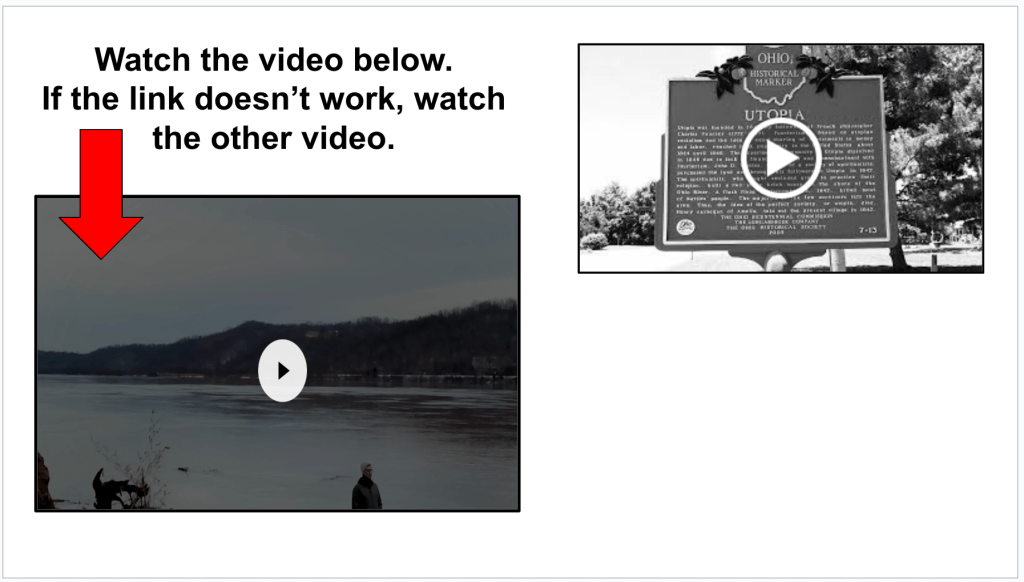
Next, we watched a video about Utopia, OH, which connected the town’s origins to the Declaration of Independence and the pursuit of happiness. The video broke down the three groups who tried (and failed) to build a perfect society in Utopia:
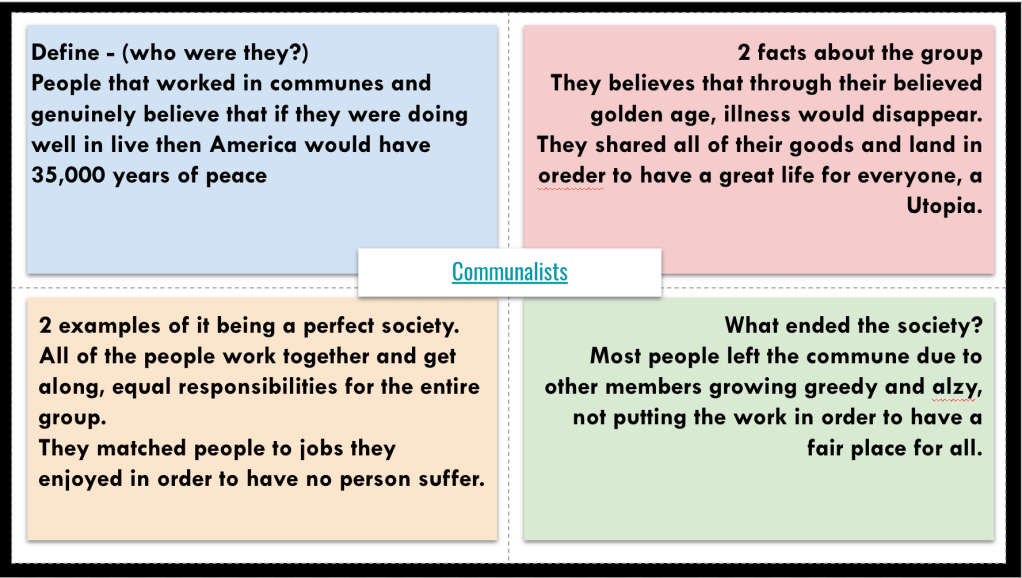
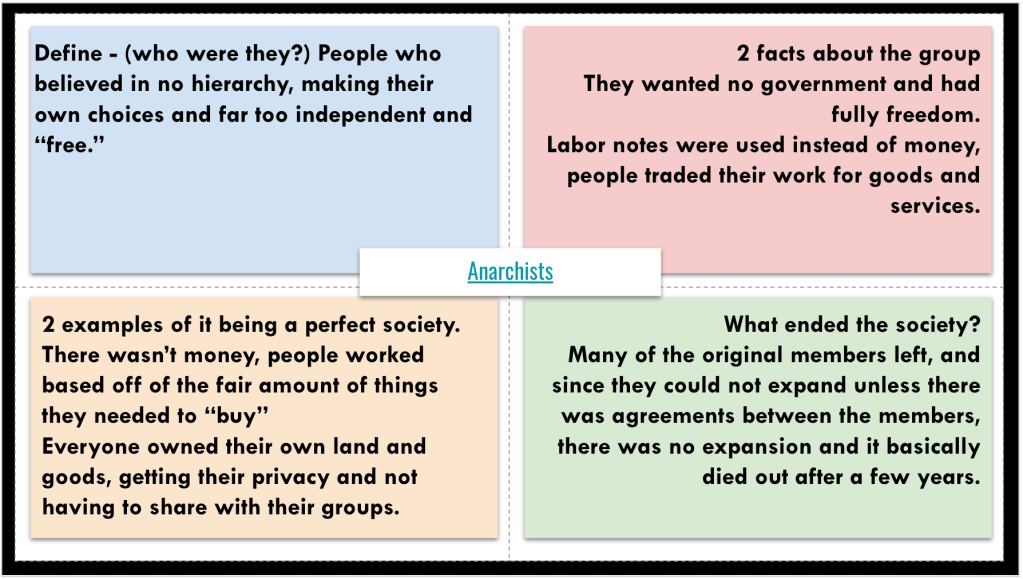
Communalists – A group who shared everything but fell apart due to financial struggles.
Spiritualists – Believed in connecting with spirits but were wiped out in a flood.
Anarchists – Tried to live without rules, but well… that didn’t work.
Students then read about these groups and took notes using a Frayer Model, categorizing each society’s beliefs, goals, struggles, and ultimate failure.
ShortAnswer Quick Write: Can a Perfect Society Exist?
To wrap up the lesson, I had students respond to the question:
Can a perfect society ever exist?
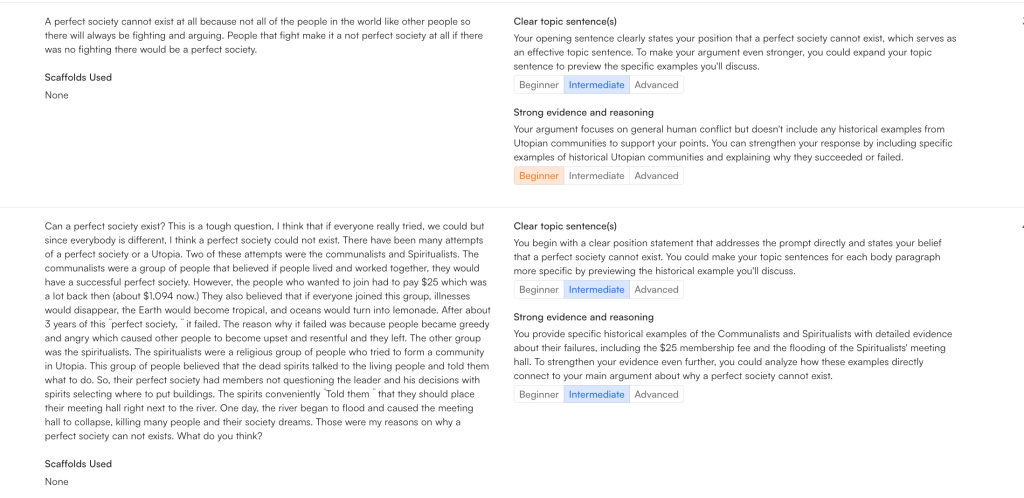
We used ShortAnswer’s Quick Write feature, which is currently in beta. This tool gives AI-generated feedback based on selected writing components—in this case, I chose “use of clear evidence and reasoning.”
Students submitted their responses.
AI provided instant feedback and a score (1 = Beginner, 2 = Intermediate, 3 = Advanced).
The class saw their combined goal score (though I still wish I knew how it was calculated or if I could set it myself).
At the end, students reflected on their feedback, making it a true learning experience rather than just another assignment.
I loved seeing how engaged students were with creating their own utopias, analyzing failed ones, and debating whether perfection is even possible. This lesson combined local history, critical thinking, and writing practice in a way that made students care about a little town they had never even heard of before.
Thursday
On Thursday, we kicked off our new unit on the differences between the North and South. I wanted to start with a local history story that powerfully illustrates these divisions—one that is both shocking and deeply revealing. That story was the case of Margaret Garner, an enslaved woman who escaped across the Ohio River to Cincinnati with her family in 1856. When slave catchers arrived to capture them, Margaret made the heartbreaking decision to end her daughter’s life rather than see her forced back into slavery.
This case wasn’t just about one woman—it reflected the moral and legal conflicts between the North and South. Abolitionists argued she should be put on trial for murder, as this would acknowledge her personhood, while pro-slavery forces demanded her return as property. In the end, the Ohio courts ruled in favor of the South, reinforcing how fragile “freedom” really was in free states.
Framing the Lesson
To get students thinking about the significance of this case, I opened with a quote from the story, prompting them to reflect on the thin line between freedom and slavery. I asked: What does Margaret Garner’s story tell us about the differences between North and South?
From there, we moved into a series of activities designed to break down this historical event in ways that encouraged deep thinking.
Thick Slide: Mapping the Story
Students read the Margaret Garner story and summarized the sequence of events using a Thick Slide with the Somebody, Wanted, But, So, Then format. They added:
A title summarizing the event
Two images representing key aspects of the story
A comparison chart between the North and South, based on what they learned
This helped students visualize the story and understand how it reflected broader sectional tensions.
Annotate & Tell: Comparing Perspectives
We then examined two primary sources—one from an abolitionist newspaper and the other from a pro-slavery newspaper. Both presented vastly different takes on Margaret Garner’s actions.
Students highlighted:
Abolitionist Source: Phrases that framed Margaret as a victim of slavery, reinforcing how Northern abolitionists viewed her as proof of slavery’s horrors.
Pro-Slavery Source: Language that depicted her as a criminal, showing how Southerners justified slavery and the Fugitive Slave Act.
They answered the question: How does this case show that the North and South were no longer just two regions but two completely different societies?
Archetype Four Square: Margaret Garner’s Legacy
To wrap up, students engaged in an Archetype Four Square, deciding how Margaret Garner should be remembered. They had to choose an archetype—Martyr or Murderer—and justify their decision with historical evidence.
Short Answer: Bringing It All Together
Since we had time, students processed their thoughts using ShortAnswer’s Quick Write feature. The AI gave feedback on their use of conventions and explanation of content. This tool allowed students to refine their responses and see how small improvements could strengthen their arguments.
Friday
For Friday’s lesson, we focused on the economic, technological, and social differences that shaped the North and South before the Civil War.
EdPuzzle for Background Knowledge
We started with an EdPuzzle video on sectionalism to provide students with foundational knowledge. This helped set the stage for analyzing the growing divide between the two regions.
Close Read & Annotate and Tell
Students then moved into a Close Read & Annotate and Tell activity. They highlighted key words and phrases from the reading that helped answer questions about the U.S. economy, the expansion of slavery, and the Industrial Revolution. Using guiding questions, students made connections between economic changes and sectionalism.
Padlet Discussion
Next, we took the discussion to Padlet, where students answered the big question: How did economic growth, new technology, and slavery shape the early United States? This allowed them to see and build on each other’s responses, making their thinking more visible.
This year has been tough. New school. New curriculum. A constant balancing act between using what I know works and keeping people happy. My students this year are mostly on IEPs or not on track to pass the state ELA test. I’ve spent so much time worrying about whether they’ll pass that I lost sight of something more important—growth.
That should have been my focus all along.
I only realized this thanks to my friend Corbin Moore. It hit me that I’ve been measuring success by the wrong metric. Sure, scores matter, but the real victory is in progress—the moments when students engage, when they connect with history, when they improve, even just a little.
I’m refocusing. Instead of stressing over test results, I’m leaning into what I know works: structured, meaningful learning experiences that meet students where they are and push them forward. If they grow, if they leave my class better than they came in, that’s the win. That’s what matters.
Why do people think rigor only comes from weirdly worded questions with hard vocabulary? Or that multiple pages of reading automatically equate to a challenging learning experience?
Rigor isn’t just about making things hard—it’s about making learning meaningful.
I’ve seen a one-page reading with well-designed tasks lead to deeper thinking than a five-page article with a set of dry comprehension questions. The secret? The tasks we ask students to do with the content.
Instead of throwing long passages at students and calling it rigorous, we should be designing engaging, thought-provoking activities that push them to think critically and apply what they’ve learned. Here are a few ways to shift the focus:
3xPOV or 3xGenre – Instead of just summarizing, have students rewrite the same historical event from three different perspectives or in three different genres (e.g., news article, journal entry, poem). This forces them to deeply engage with the content and consider different viewpoints.
Thick Slides – Give students a small piece of reading and have them generate key takeaways, add two images to represent the ideas, and correct a common misconception about the topic. This helps them move beyond surface-level understanding.
Sketch & Tell-O – Rather than just answering a comprehension question, students sketch a concept, label key elements, and write a brief explanation. This encourages deeper processing and makes abstract ideas more concrete.
It’s not about how much they read or how difficult the vocabulary is—it’s about what they do with the information. If we truly want rigor, we have to focus less on making learning harder and more on making it better.