
This past week was filled with innovative lessons and activities as I taught my 8th graders key concepts in social studies and civics. I tried to make each day interesting and interactive as we covered checks and balances, the Bill of Rights, Supreme Court cases, and the importance of limiting government power.
On Monday, I facilitated an engaging escape room activity to reinforce students’ understanding of checks and balances. Tuesday involved fun skits and memorization techniques to help the amendments really stick. By Wednesday, we were applying that Bill of Rights knowledge to analyze real Supreme Court cases. Thursday we explored the power of judicial review and how the courts check other branches. Finally, Friday challenged students to examine threats to democracy when governments hold unchecked power.
I continuously tweaked activities and materials to fit my students best. My goal was to promote active learning, collaboration, and engagement with civics across the week. The students seemed to enjoy the variety of lessons and games as much as I enjoyed creating them! It was a week full of creativity and insight in my 8th grade social studies class.
- Monday – Checks and Balances Escape Room
- Tuesday – Bill of Rights Quizizz, Sketch and Tell-O
- Wednesday – Supreme Court Answer Sheet, Supreme Court Stories
- Thursday – Vox Video (edpuzzle), Judicial Review
- Friday – Limited Government
Monday
I started this week needing an engaging new activity to reinforce checks and balances concepts for my 8th graders. While I easily could have done a standard lecture or game review, I wanted something that would get students actively collaborating, communicating, and moving around.
I suddenly remembered that my friend and fellow teacher Dominic Helmstetter shared an awesome escape room activity on Twitter that he does with his freshman. Eureka! I quickly located the files and decided to customize the escape room to best fit my students’ needs.
Dominic’s original escape room had some great components – review content, guided notes, an assessment, and a series of four locks to solve through a Google form. I adapted these elements by tweaking the guided notes sheet, simplifying some assessment questions, and reworking the Google form lock combinations.
The end result was a polished, 3-step escape room process for my class:
- Fill-in-the-blank Clues/Notes Sheet: Paired checks and balances concepts with the answers that would unlock the Google form
- Assessment: Evaluated student understanding of branches of government and checks/balances
- Google Form Locks: Provided the lock combinations from unscrambled words in the assessment for students to break out
I also set up my lockbox with a Congress-related question to spur some friendly competition. If students successfully passed all the escape room steps, they could compete to unlock the box.
On Monday morning, I gave a quick briefing then let my students loose for 40 minutes of engaging critical thinking, teamwork, and fun. The escape room format facilitated so much energetic learning and collaboration. What a way to begin an exciting week of lessons!
Tuesday
I kicked off class on Tuesday with a 10-question Quizizz to assess students’ baseline knowledge of the Bill of Rights amendments. As expected, most remembered the 1st two then got fuzzy on the rest. Class averages were fairly low: 39%, 33%, 45% and so on. Time for a memorable amendment upgrade!
I handed out a Sketch and Tell-O template with 10 empty circles for sketching or jotting amendment concepts. Then I dove into the engaging amendments mnemonic devices and activities I learned from the brilliant Dave Burgess.
For each amendment, I share an animated story, song, or physical prop/gesture to help cement understanding. For the 3rd Amendment, I describe Goldilocks making herself at home in the Three Bears’ house, linking it to soldiers improperly being “quartered.” For the 6th Amendment, I show a clip of an NFL player’s quick “pick six” interception for the idea of a speedy trial.
The students love these zany strategies and anecdotes! They are fully engaged as I coach them to listen for the memory aids that correspond with each amendment. Lots of laughter all around too – though I can’t share all Dave’s secrets here. 😉
After completing the amendment “show,” I had students tuck away their new sketches and notes. I launched the same Quizizz again to see growth. This time, class averages jumped way up: 82%, 80%, 82% and so on. The memory tricks worked! Of course, the scores were actually lower than last year, so I may tweak a few things for next time. But overall, active learning FTW!
Wednesday
Now that my students had built foundational knowledge of the Bill of Rights amendments, I wanted them to apply that learning to real-world Supreme Court cases. Specifically, I curated a selection of landmark cases related to students and school issues that would resonate with their 8th grade experiences.
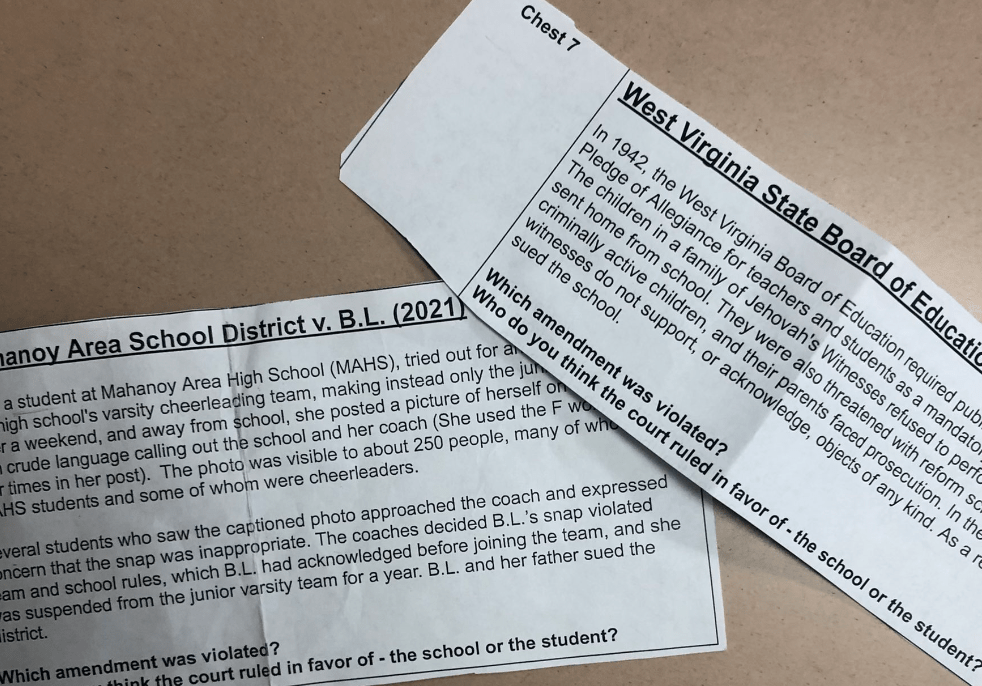
The cases I pulled focused on timely topics like the Pledge of Allegiance, social media speech, school punishment policies, and praying in school. I printed each case summary onto cards and placed them into envelopes around the room, along with one envelope that contained a bonus Bill of Rights Quizizz (which the classes now averaged 91% on!).
I put students into small groups and gave them 40 minutes to circulate and analyze as many Supreme Court case envelopes as possible. Their tasks were to:
- Guess which Constitutional amendment was in question for each case.
- Predict how they thought the Supreme Court ruled on the case.
The student groups did a great job picking out the relevant amendments that applied to each situation. But when I shared the actual Supreme Court rulings, the students were shocked! The decisions often surprised them or conflicted with their assumptions and personal opinions. This made for rich discussion and insight into how amendments are interpreted.
As an added bonus, I had the groups piece together a question which they then used to try unlocking a box filled with QR codes. Only 1 winning code scored them extra credit points! However, some groups somehow chose the 1 winner among 9 losers – I still don’t know how they beat those odds.
I did tweak the lockbox question and code throughout the day knowing how much students love sharing intel. The alternative question was: “Which amendment limits the president to two terms?”
Overall, it was extremely rewarding to see my students connect classroom knowledge of rights and freedoms to real court cases impacting students just like themselves. The relevance and surprise factors made for deep engagement and critical thinking.

Thursday
After Wednesday’s deep dive into intriguing Supreme Court cases, I wanted to zoom in on the key concept of judicial review for my 8th graders. Rather than just lecture at them about this pillar of our government system, I strived to make it interactive and tangible.
I started class with an edited EdPuzzle video introducing how cases ascend to the Supreme Court – crucial context. Then, I had students complete a Frayer Model for the terms “writ of mandamus” and “judicial review” to cement shared vocabulary.
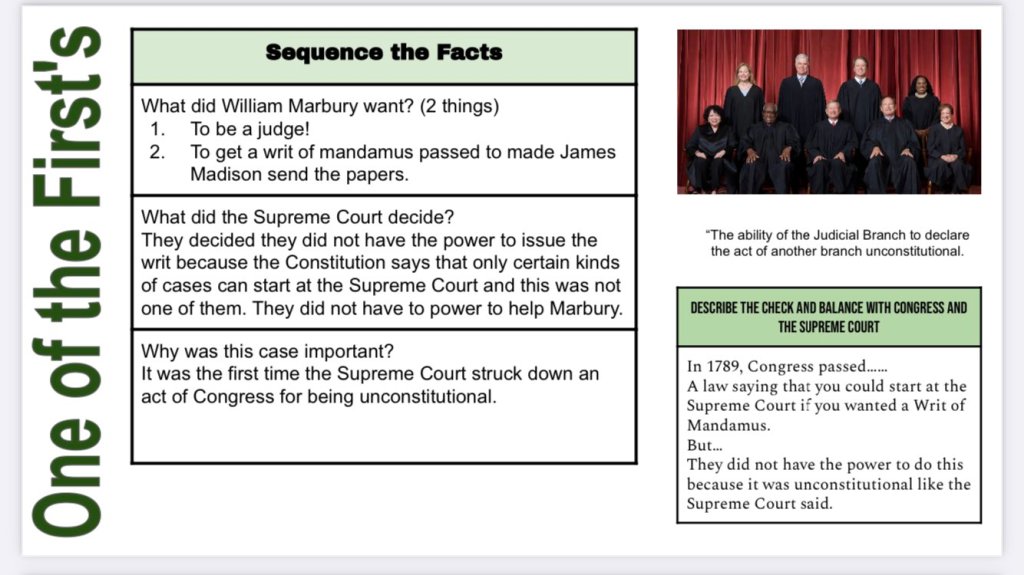
Next, we analyzed the landmark Marbury v. Madison case which established judicial review in 1803. I actually tweaked the reading to optimize for 8th grade comprehension – rewording sentences, adding clarifications, highlighting key subtleties. This ensured students could grasp the significance of the ruling.
After a timed reading and highlighting session, I had students recall and share out critical case details: What did Marbury want? How did the Court respond? Why was the decision so impactful? We documented responses on a visual Thick Question slide to emphasize the role judicial review plays in the system of checks and balances.
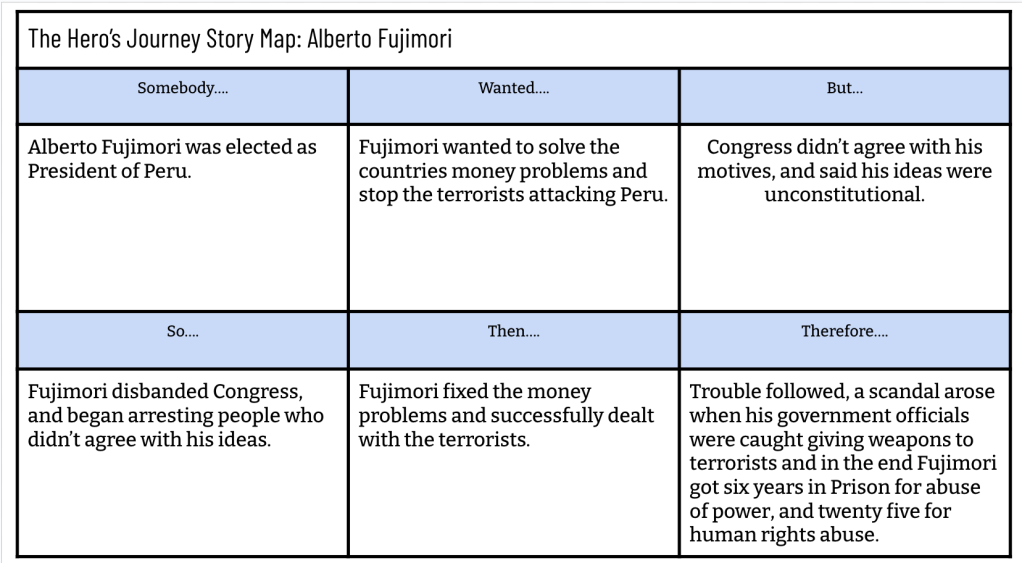
For one section that was a day behind, I also had them map out the story on an engaging “Somebody, Wanted, But, So, Then” template to practice comprehension and sequencing.
While light on flashy games today, the lesson offered an essential dive into judicial review using multiple learning modalities from video to vocabulary building to customized reading.


Friday
While I was out on a field trip with some students, I left meaningful civics content and activities for my remaining 8th graders focused on the question: “Why is limiting government power so vital?”
I curated a reading from iCivics on Peru’s alarming Fujimori saga in the 1990s. Students first categorized healthy ways democracies constrain authority to establish rule of law norms. This grounded context made the subsequent reading detailing Fujimori’s authoritarian power grab even more stark.
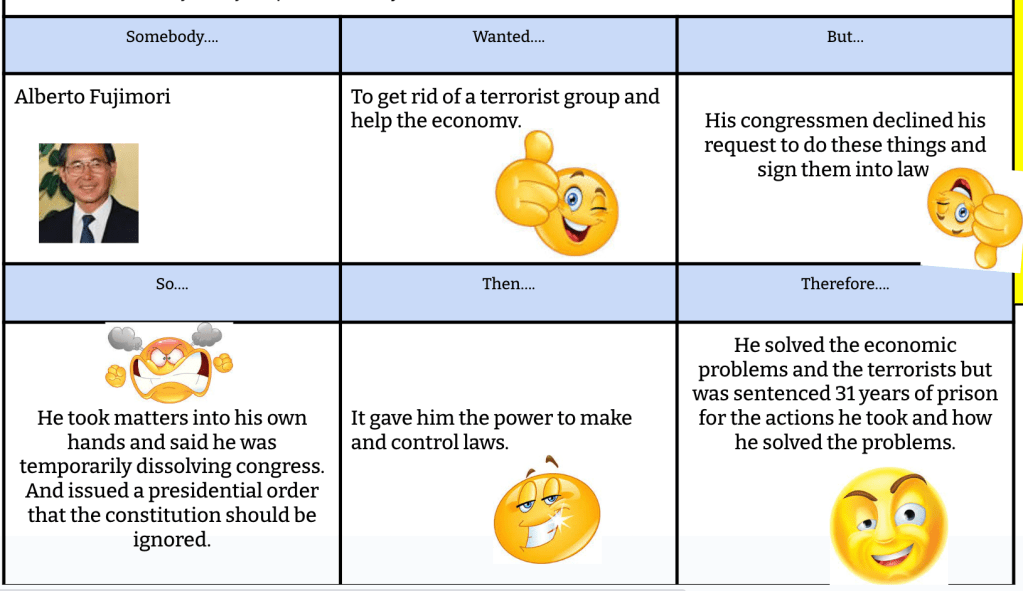
The profile revealed how, once elected president, Fujimori slowly seized near-dictatorial control: dissolving Congress, rewriting the constitution, and severely curtailing civil liberties. To process this complex chain of events, students mapped out Fujimori’s escalating actions on a template I customized for narrative sequencing.
Specifically, I reframed the standard storytelling “Hero’s Journey” format into a more explicit “Somebody – Wanted – But – So – Then – Ultimately” flow. Organizing the details this way enabled students to methodically break down how concentrating unchecked rule in one man’s hands enabled corruption and tyranny.
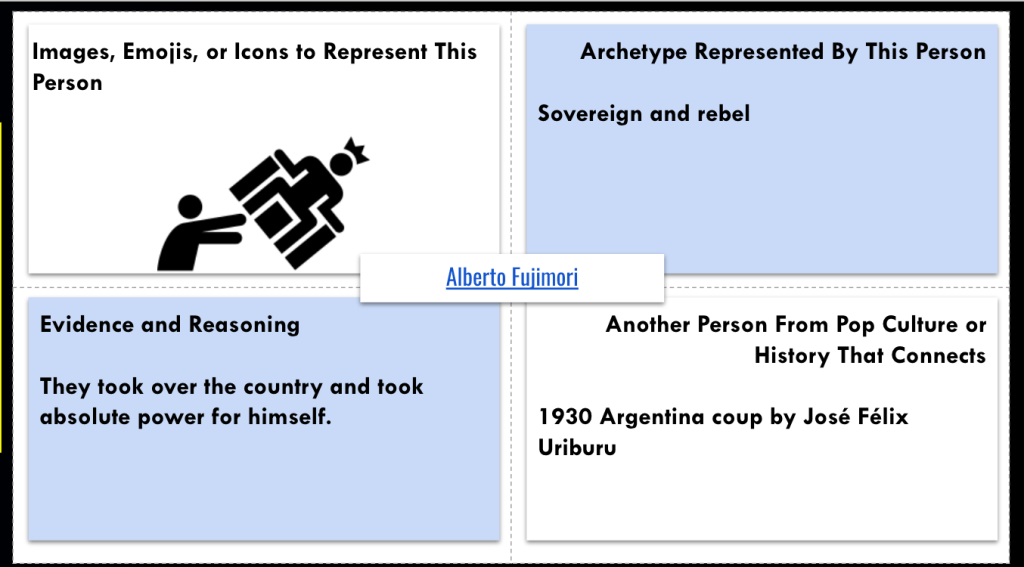
As a final analysis task, I had students assign Fujimori an archetype to encapsulate his spirit and actions, citing specific evidence to justify their categorization. Many comparisons emerged between Fujimori and iother people throughout history.
Though less flashy than my Supreme Court games or Bill of Rights dramatizations, Friday’s lesson served up vital perspective. By examining a real-world account of governance gone awry, students glimpsed the founding fathers’ wisdom in crafting checks and balances to distribute power. Understanding the threats unchecked authority poses to liberty is essential context for engaged citizenship.


 Moler's Musings
Good Morning! I have a question on how you teach the Bill of Rights & how much time you spend on them. So you quickly lecture about them & then delve into the Supreme Court cases? Normally I have “lectured” about each one & there’s alot of discussion about what they can/can’t do & how that amendment relates to them. It takes forever & a day & I feel some of my students tune out. Have you ever used an Iron Chef or SKAT for them? I guess I want them to quickly know them/become familiar with them & then start applying them. Thanks for your help!
Tammy
LikeLike
I spend one day teaching the students about the Bill of Rights – I give a 10 question quizizz at the beginning of class. They bomb it. I act out all the amendments (it gets crazy, but they remember them). I give the same quizizz again. Usually classes go from 40% to 80% or higher. The next day I give the same quizizz again and reinforce it. Then I have them walk around the room reading supreme court cases and applying the amendments to the cases – guessing which ones were in question. I also have them guess which way the supreme court ruled. All the court cases involved schools. If I were to go in depth on any amendments it would be the first. I actually may go in depth with the first because some students are interpreting it in a wrong way (that lesson is on the horizon). Using a sketch and tell for the amendments would be a good use of that EduProtocol. You could also use a iron chef jigsaw style and have the students teach each other.
LikeLike
Thank you for your help! I did a thin slide today on “what their life would be like without the 1st Amendment?” Also a sketch & tell on “fight for one”. If they could only choose one of the 5 to fight for, which would they choose?” That went pretty well! I like your idea of the Supreme Court rulings….
LikeLiked by 1 person
I love that Thin Slide idea. Thanks for sharing
LikeLike