Introduction
In the world of education, change is often a breath of fresh air, a chance to infuse new life and excitement into the classroom. As a teacher, I’m constantly on the lookout for innovative ways to engage my 8th-grade social studies students. This week, I felt a strong desire to shake things up.
My quest for new teaching methods led me to EMC2Learning, a resource that promised to add a thrilling twist to my lessons through gamification. With a membership in hand, I embarked on a journey that would bring the Declaration of Independence to life in ways I’d never imagined.
As we dove into the week, we explored the rich history of the United States, delving into the meaning and significance of the Declaration of Independence. The Super Sentence Smackdown from EMC2Learning became our guiding star. It was an opportunity for my students to not only analyze and paraphrase this historic document but to do so in a way that made learning fun.
The enthusiasm and success of this approach varied from class to class, and I had to adapt, switching to a more explicit style of teaching in some instances. Along the way, we seamlessly integrated Eduprotocols, transforming our learning into an exciting adventure filled with fast-paced challenges and quizzes.
From vocabulary work with the resource ‘Rumble’ to the incorporation of Legos into our lessons, our journey was marked by a blend of creativity and traditional teaching methods. We explored the strengths and weaknesses of the Continental and British armies during the Revolutionary War, culminating in an engaging Iron Chef activity.
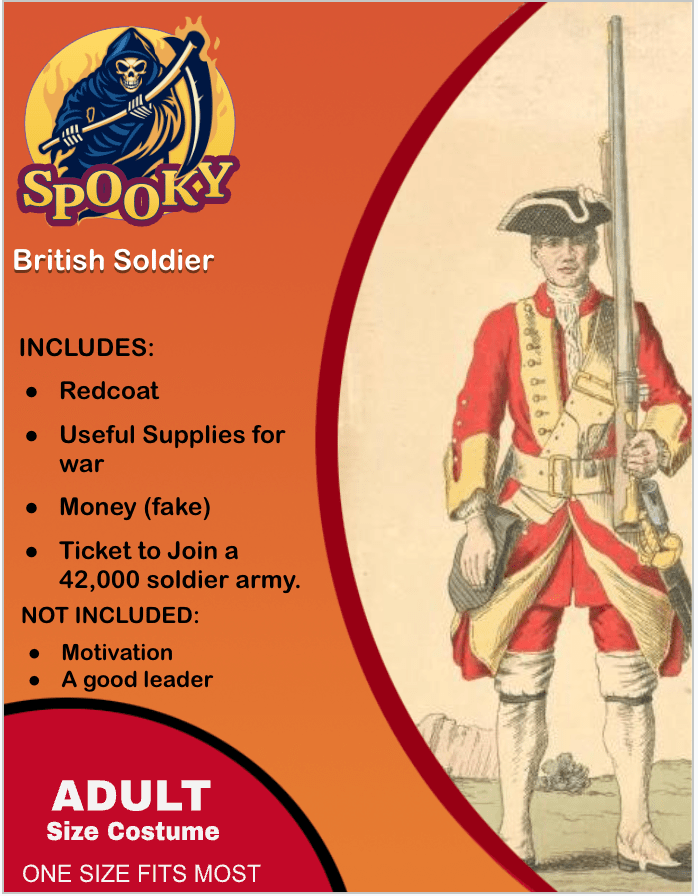
But the week didn’t stop there. We wrapped it up with an assessment where students created costume sets for Continental and British soldiers. The students weren’t ready to say goodbye to the Halloween spirit, pointing out that it was also the time for the Day of the Dead on November 1st and 2nd.
As we bid farewell to this action-packed week, we couldn’t resist one more innovative twist. Instead of a traditional lesson, we engaged in a retrieval practice activity using AI, setting the tone for a week filled with discovery, fun, and a deeper understanding of the Declaration of Independence, the vocabulary associated with the Revolutionary War, and the strengths and weaknesses of British and Continental soldiers.
Monday – Super Sentence Smackdown
Tuesday – Fast and Curious Quizizz, Nearpod
Wednesday – Resource Rumble
Thursday – Fast and Curious Quizizz, Iron Chef, Halloween Costume
Friday – Scribble Diffusion
Monday: Delving into the Declaration of Independence
As the week kicked off, I knew I wanted to infuse some excitement into my 8th-grade social studies class. My goal was to dive deep into the Declaration of Independence and help my students understand the concept of natural rights and the social contract it represents. To do this, I turned to a resource I recently acquired: EMC2Learning. This paid platform provided me with a fantastic tool known as the Super Sentence Smackdown.
I began by selecting excerpts from the Declaration of Independence and divided them into six different rounds. To aid my students in comprehending the text, I turned to ChatGPT for help, and it identified key vocabulary words, such as ‘unalienable,’ ‘endowed,’ ‘political bands,’ ‘instituted,’ and ‘Independence.’ I displayed these excerpts on separate slides, and each round allowed the students three to four minutes to paraphrase or translate the excerpt into modern language. To support their understanding, I provided them with a worksheet containing these vocabulary words and their definitions.
My intention was for students to use these vocabulary words as context clues, helping them make sense of the text. However, I soon realized that some students were struggling to do so, despite the vocabulary list containing the underlined words from the excerpts.
After paraphrasing each excerpt, I paired up students, allowing them to engage in friendly competition as they compared their paraphrases and discussed which one was better. To make it even more exciting, I introduced a monetary aspect to the game, with each round being worth different amounts of ‘money.’ The winner of each round rolled a dice, multiplying the round’s money value by the number they rolled, and then recorded their total. This activity spanned several classes and turned out to be a fun and engaging way for students to explore the Declaration of Independence.
Tuesday: Mastering the Declaration of Independence
On Tuesday, we continued with the Super Sentence Smackdown for most of my classes, wrapping up the rounds. We also had some time to explore further through a ‘Fast and Curious’ activity using Quizizz to test their understanding of the words and concepts within the Declaration of Independence.
Based on the Quizizz results from the previous week, where all classes began with an average score of 54%, we had seen improvement, with averages increasing to 68%. However, the real breakthrough came when we attempted the ‘Mastery Peak’ mode. This time, answering every question, our class average soared to 77%, and all classes achieved over 90% mastery of the Declaration of Independence. The questions revolved around understanding the document’s meaning, purpose, and how natural rights and the social contract influenced its contents.
In some of my classes, I noticed that the Super Sentence Smackdown wasn’t as effective as I had hoped. To address this, I created a Nearpod presentation with excerpts from the Declaration of Independence, focusing on explicit teaching and a controlled pace. This approach seemed to help these particular classes grasp the document’s meaning more effectively.
For classes that finished early, I introduced an empathy map activity. I played the song “You’ll Be Back” from the musical Hamilton, explaining that it represented King George III’s reaction to the Declaration of Independence during the Revolutionary War. The students listened to the song and filled out empathy maps, trying to imagine how King George might have responded to the colonists upon receiving the Declaration. I always find that empathy maps are a valuable tool to help students put themselves in someone else’s shoes and understand different perspectives.
Wednesday: Revolutionary War Vocabulary and Legos
Wednesday marked a significant shift in our focus from the Declaration of Independence to the Revolutionary War. In Ohio, the state standards require students to grasp key battles from the Revolutionary War, such as the Battle of Bunker Hill, Battle of Saratoga, Valley Forge, and the Battle of Yorktown, along with understanding the contributions of various groups during the Revolutionary War.
We began the day with vocabulary related to the Revolutionary War. As it was the day after Halloween, I decided to add a touch of fun and movement to the class by introducing the ‘Resource Rumble.’ For this activity, I used ChatGPT to create 10th-grade-level definitions and examples for eight words associated with the Revolutionary War, including the American Revolutionary War, the Continental Army, minutemen, treaties, and allies. Students collaborated in teams, paraphrasing the definitions, and then collected Legos based on the quality of their paraphrases. The challenge was to build something related to one of the vocabulary words they had just learned and explain its connection to the word. This activity not only got the students moving and engaged but also encouraged them to discuss paraphrases and vocabulary words related to the Revolutionary War.
Thursday: Iron Chef and Deeper Understanding
Thursday began with a Quizizz containing 11 questions, testing both the vocabulary words from the previous day and new content regarding the Continental and British armies during the Revolutionary War. The results showed that students did well with vocabulary questions, indicated by most being marked green and yellow. However, they struggled with the content questions, as most of them appeared red and yellow.
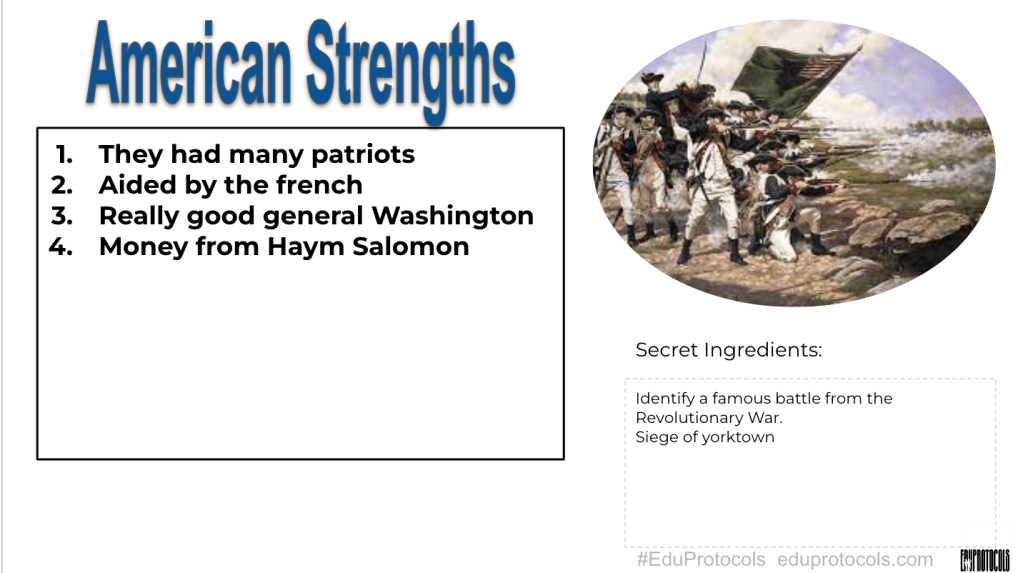
After the Quizizz, we transitioned to an ‘Iron Chef’ activity. This Iron Chef featured four slides: ‘American strengths,’ ‘American weaknesses,’ ‘British strengths,’ and ‘British weaknesses.’ I assigned the first person in each row to share the slide deck with their peers, and they had to decide who would complete each slide. To add an element of unpredictability, I introduced a dice-rolling element: the first roll determined the number of bullet points on each student’s slide, while the second roll dictated the maximum word count allowed per bullet point. Students embraced this twist, which not only made the activity more engaging but also enforced the importance of paraphrasing.
During the Iron Chef, students needed to find information related to their topic on the slides, which was directly linked. I also challenged them to find a famous Revolutionary War battle to include in their presentation. Afterward, each group presented their slides to the class, with each student sharing one thing they had learned in eight seconds or less. As they presented, students recorded this information on their Frayer models.
Following this, I asked the students to design a costume set related to either a British or Continental soldier. I obtained this template from EMC2Learning. However, I observed that students found it challenging to include accessories that related to the information they had just learned. Instead of adding typical accessories like muskets, hats, and uniforms, I encouraged them to think creatively and incorporate items connected to their newfound knowledge. This abstract thinking was a bit challenging for students, but it helped them consolidate their understanding of the material.
We concluded the day with another Quizizz, this time using the Mastery Peak mode, which resulted in all classes achieving an 88% or higher score compared to the first time we used it in that class period.


Friday: Scribble Diffusion Showdown
As the week was drawing to a close, we had shortened class periods on Friday, giving me the perfect opportunity to try something different. I introduced the ‘Scribble Diffusion Showdown,’ a novel activity I had discovered on EMC2Learning.
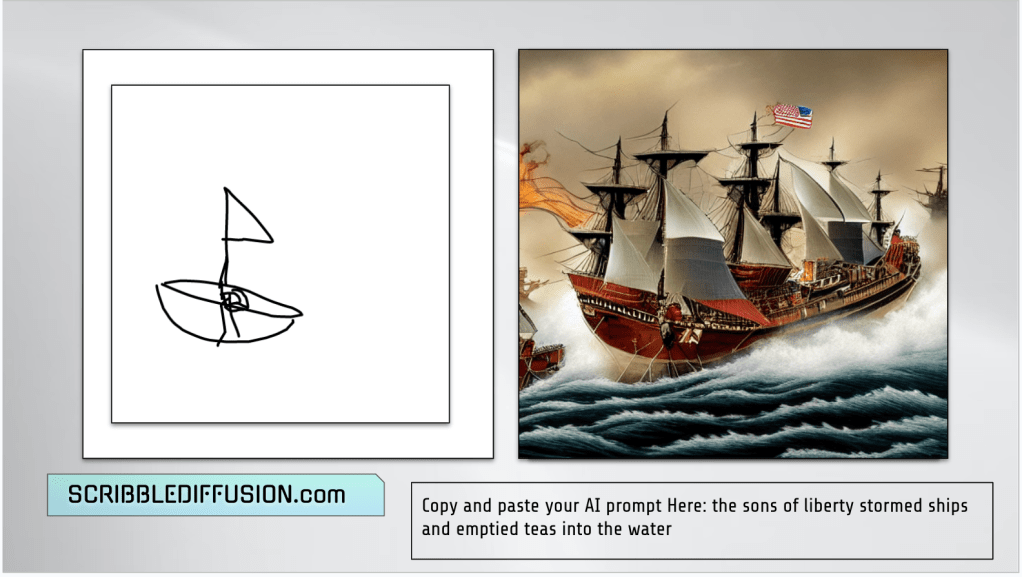
The Scribble Diffusion Showdown was a unique and exciting experience. Scribble Diffusion is an AI-based platform that generates images based on descriptions provided by users. In our showdown, students drew prompts from a bucket, and they had to create the best image based on the description they typed. For example, one prompt might be, “How did the Sons of Liberty react to the Tea Act?” Students would draw their interpretation of this scenario, type their answer, and see what kind of image Scribble Diffusion would generate based on their description.
If students were unsatisfied with the image, they had to rework and reword their descriptions to get the desired results. This activity not only engaged the students but also served as an introduction to the world of artificial intelligence.
In conclusion, it was a week filled with dynamic and engaging activities, from the Super Sentence Smackdown to Iron Chef and the Scribble Diffusion Showdown. By mixing innovative approaches with traditional teaching methods, I was able to make the study of the Declaration of Independence and the Revolutionary War an exciting and meaningful experience for my 8th-grade social studies class. My students not only learned valuable historical content but also developed crucial skills like paraphrasing, critical thinking, and empathy. As a teacher, it was a rewarding week, knowing that my students were not only learning but having fun while doing so.




 Moler's Musings
I’m sorry to bother you! I’m wondering if you can answer a question in regards to the Resource Rumble that you use. My school bought a subscription for the year. I’ve already used the resource “Roast, Toast, Boast.” Anyway, can you tell me what kinds of things you put in fit your questions? The one on EMC2 has things like Alliteration, Allusion, Metaphor, Simile, etc. Do you just put questions in the chests/envelopes, or do you have things they have to create like a Haiku, Acrostic Poem, etc. Thank You for your help!
Tammy
LikeLiked by 1 person
I include vocabulary words/definitions and have have students paraphrase them. Sometimes I have them create a haiku or acrostic poem, sometimes I ask a question with multiple parts to it.
LikeLike
Thank you for your response! I’m excited to try that resource!
Tammy
LikeLike