Introduction
This week we didn’t have students until Tuesday. Monday was a professional day known as Safety Day. I began this week with Triangular Trade and the Middle Passage. Looking back, I wish I started this lesson before I did hexagonal learning last week. It would have made more sense to run things in that sequence with the hexagonal learning to wrap up European colonization and the Middle Passage. You live and learn. My lesson on the Middle Passage and Slavery ended up taking longer than expected, but that’s okay. I’m learning that even if I’m six to seven days behind of last year, that I will eventually catch up. Every year is different with different students. I’m getting more accomplished in class, as a result, I’m adding on more things and doing different lessons. That’s why I’m six days behind. I’m able to go a bit more in depth with the lessons. Wrapping up the week we began learning about colonial regions. Every year I seem to do the same thing with colonial regions, but I’m keeping my focus on the goals I set for room 505. I want to focus on writing and so we finished up the week with some Parafly to work on paraphrasing. The students seem to be really into paraphrasing because I’m trying to present it as an art. Keep the meaning, use some synonyms, simplify – but be creative. We combined the paraphrasing with a sketch and tell and WordWall quiz on colonial regions.
Tuesday – Ted Ed Video, Middle Passage Stations (cannot copy)
Wednesday – Thick Slide
Thursday – Gimkit, WordWall, Retrieval Practice
Friday – Parafly, Sketch and Tell, WordWall
Tuesday and Wednesday – Triangular Trade and the Middle Passage
Our week began with the introduction of Triangular Trade and the Middle Passage. I couldn’t help but think back to the previous week when I introduced hexagonal learning. In hindsight, it would have made more sense to start with Triangular Trade and the Middle Passage before delving into European colonization. But as they say, you live and learn.
To set the stage for this lesson, I emphasized the importance of using person-first language when discussing slavery. Instead of “slave,” we used “enslaved person,” and we replaced terms like “master” or “owner” with “enslaver.” It’s a crucial lesson that I’ve learned needs explicit teaching for students to grasp fully.
For this lesson, I designed a station rotation activity based on the essential question, “How did Europeans exploring North America for trade, religious reasons, and competition with each other affect the history of the continent and the people who lived there?” This question has been guiding our exploration of European colonization’s impact on North America.
At each station, students engaged with different aspects of the Triangular Trade and Middle Passage:
- Edpuzzle Video: We started with a 5-minute Edpuzzle video of a Ted Ed lesson on the Middle Passage, followed by questions to ensure comprehension.
- SlaveVoyages.org: At the second station, we utilized the remarkable SlaveVoyages.org database, which provided a timelapse map of ships leaving West Africa for the New World through the Middle Passage. This interactive map allowed us to explore the journeys of individual ships, their cargo, and survival rates. The database was a treasure trove of information, a testament to the collaborative efforts of many dedicated individuals.
- Slavery Statistics: The third station focused on statistics related to slavery, tying them back to our previous lesson on Number Mania. I wanted students to understand that these numbers and statistics had a real context, and they could see how they matched up with the data from the Slave Voyages database.
- Northern and Southern Colonies: The fourth station delved into the existence of slavery in both Northern and Southern colonies and how enslaved people managed to build their own culture. We paired this reading with a map illustrating the Triangular Trade routes.
Students worked in pairs at each station, discussing and answering questions. This part of the lesson ended up taking longer than expected, but seeing the students engaged and actively learning was more important than sticking to a rigid schedule. In fact, 98% of the 122 students completed the stations, which was a success in my book.
For assessment, I posted a Thick Slide, challenging students to condense the information from their station activities into essential facts that could answer the question, “How did triangular trade and the Middle Passage transform North America?” As a test of their map manipulation skills, I had them use the Slave Voyages database to find a ship that went to North America and gather relevant statistics. They also had to include a quote from Olaudah Equiano and an image with a caption.

Thursday – A Day of Adaptation
Thursday was one of those days where I had a mix of students at different stages. Some were absent, some were catching up, and some were already ahead in their work. Over the years, I’ve developed a strategy for days like this to ensure every student makes progress within our 47-minute class period.
My priority was to have students complete and turn in their Thick Slides. For those who finished early, I introduced a Retrieval Practice challenge grid created by Lauren Richardson and Ashley Morrison. This challenge involved questions from their 7th-grade year, questions from three weeks ago, questions from two weeks ago, and questions from the current week. It was a way to test their memory and clear up any misconceptions quickly. Students were not allowed to use a Chromebook.

I also set up a live Gimkit review session for the entire class period. I set the Gimkit to run for 47 minutes and students could join it any time. The questions covered content we had learned in the past few weeks. The average score across all classes was an impressive 85%. It was heartening to see the progress we were making.
Additionally, I prepared a WordWall activity related to colonial regions. Colonial regions is the planned lesson for Friday’s class. While some students may have been a bit overwhelmed by the variety of activities for the day, this approach allowed everyone to catch up, review, and even get ahead where possible.
Friday – Colonial Regions and Paraphrasing Mastery
On Friday, we delved into the study of colonial regions and the impact of geography on their respective industries. The overarching question guiding this lesson was, “What are the different colonial regions, and how did geography affect the industries in those regions?”
To make the content more accessible, I had ChatGPT generate three 1500-lexile level paragraphs about the New England, Middle, and Southern regions. These paragraphs covered the geography, economy, and people of each region. I incorporated them into a Parafly slide deck, which we used with Peardeck.
The highlight of the day was the EduProtocol smash, combining Parafly with Sketch and Tell. This combination worked seamlessly, with students creating images that depicted how geography impacted industries in their assigned colonial region. They used Google Shapes or AI and Scribble Diffusion to generate their images. It was truly an engaging and creative exercise that allowed them to visualize historical concepts.
Our lesson started with a Parafly EduProtocol, focusing on paraphrasing skills. I realized that I needed to do a better job of modeling paraphrasing, so I walked the students through it during the first attempt. On the second paraphrase, I had students identify the words and phrases they felt needed to be changed. As students paraphrased in Peardeck, I would shout out feedback. The final attempt at paraphrasing, I took for a grade. After each paraphrase attempt, students copied and pasted their paraphrases to the Sketch and Tell and created an image with Google shapes or Scribble Diffusion AI.


As we wrapped up the lesson, students completed a WordWall activity on colonial regions. It was a pleasant surprise to see the average score jump from 14.9 out of 39 correct on Thursday to 31 correct after the Parafly and Sketch and Tell activities. It was evident that the students had grasped the content more deeply through these engaging exercises.
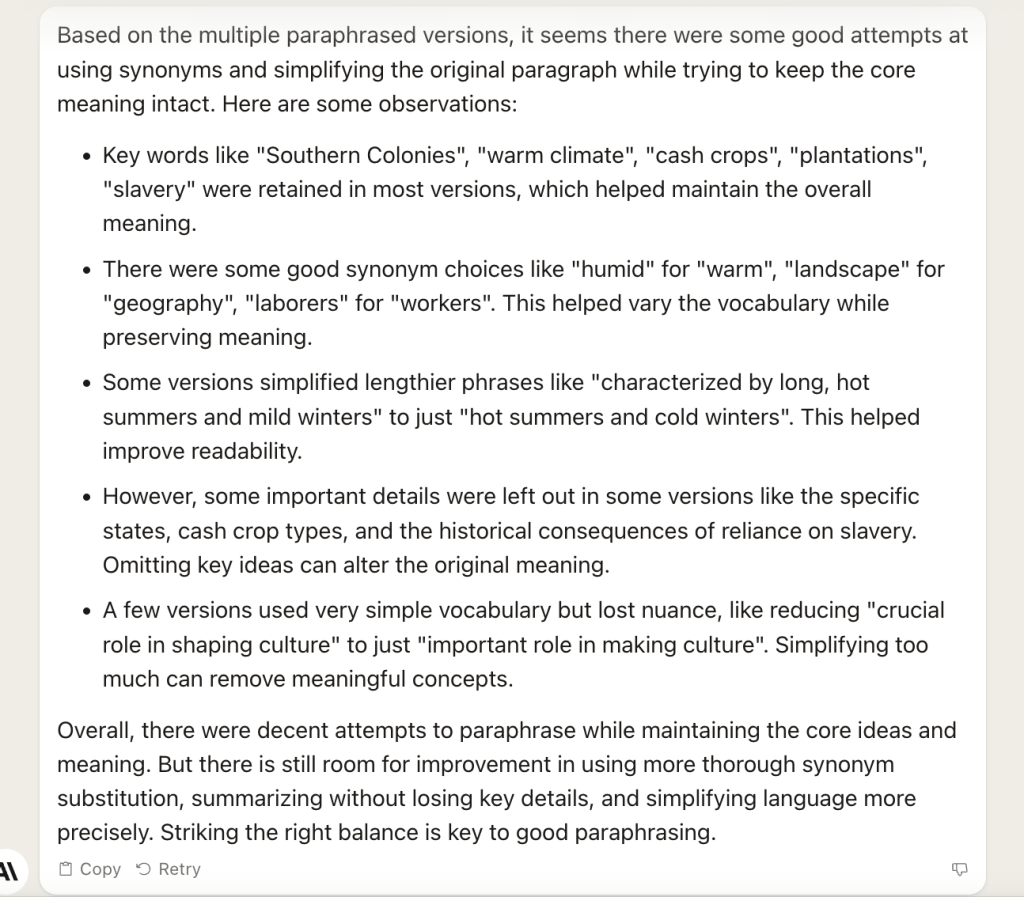
To provide further feedback, I used Claude to analyze their paraphrases based on the use of synonyms, simplification, and maintaining the core meaning. This allowed me to show students how their paraphrasing skills had evolved. The feedback was encouraging, highlighting their effective use of synonyms and simplification to improve readability.
Here is how I used Claude for feedback – I copied and pasted the original paragraph into Claude. I also copied and pasted each student paraphrased paragraph directly from Peardeck and asked it to analyze each one based on the use of synonyms, simplification, and keeping the meaning.
Here is some of the feedback I shared with students:

 Moler's Musings
Hey Adam! I am working on retrieval guides, as well, and wondered what you are doing with the points. Do you have a competition? Treats? Goals?
LikeLike
I don’t offer treats or goals with the retrieval practice. I use it on days when students are at different stages of a lesson.
LikeLike