I have decided the only way all the standards and content for 8th grade social studies can be covered in Ohio is by going a mile wide and an inch deep. Three months ago I was 3 weeks ahead of schedule. Now I’m three or four days behind. As a result, I’m really evaluating last year’s lessons and seeing what stays and what goes.
Last year I did a group playlist on resistance to slavery. The group playlist had 4 parts to it:
- Conditions of enslaved people.
- Methods of Resistance
- Risks of Resistance
- Results of Resistance
I decided to cut this down to conditions of enslaved people and methods of resistance. I ended up finding, and adapting, a lesson on methods of resistance that included the risks of resistance. It ended up working out nicely with some EduProtocols.
The week closed out with the beginning of events that led up to the Civil War. For this lesson I focus on 4 areas:
- Compromises – comparing the Missouri Compromise and the Compromise of 1850.
- Kansas Nebraska Act
- Dred Scott Case
- Uncle Tom’s Cabin
Last year I taught this using an Amada Sandoval inspired Group Playlist and called it The Road to War. This year, I’m separating some things out and using some EduProtocols. My goal is to get to Reconstruction so I’m not having to rush through the content. If it works out then great, if not, oh well…they still move onto 9th grade.
Monday – Resistance to Enslavement Frayer (Zinn Education Lesson)
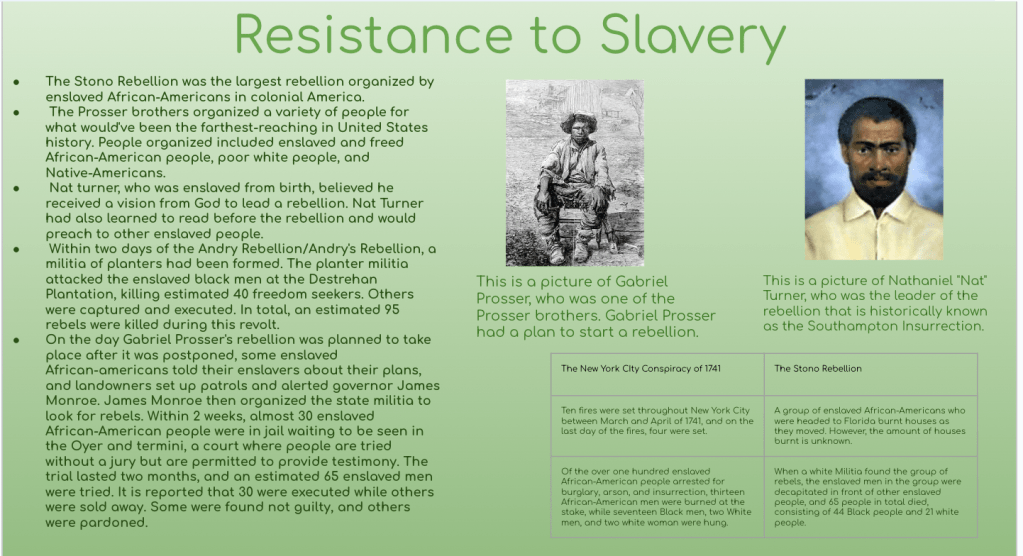
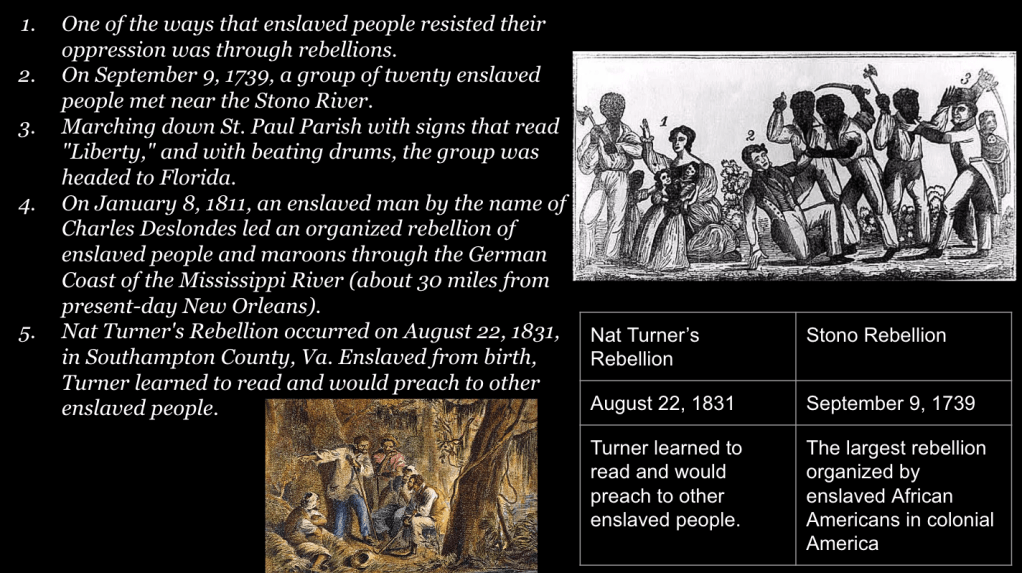
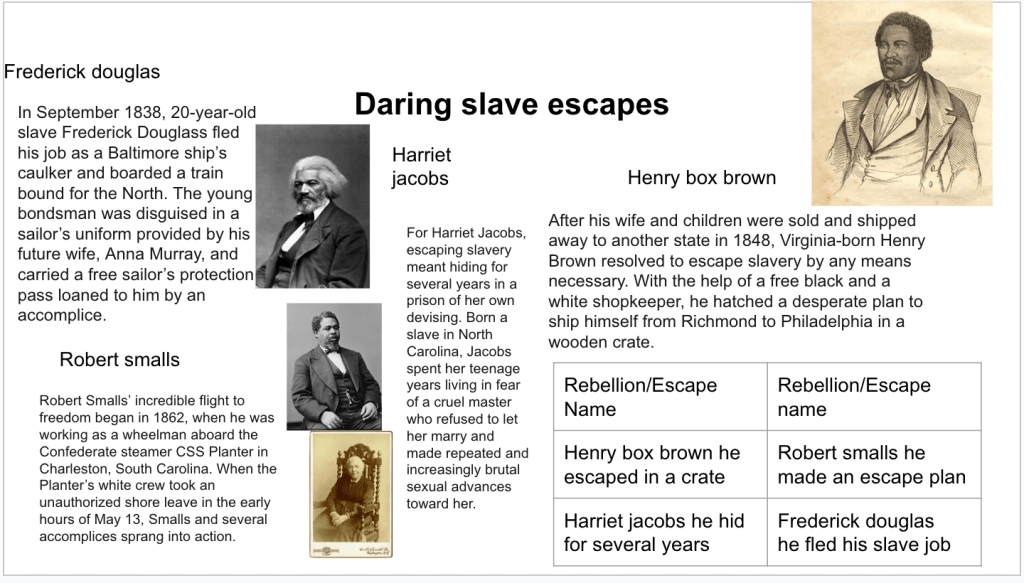
Tuesday – Resistance to Enslavement Thick Slide
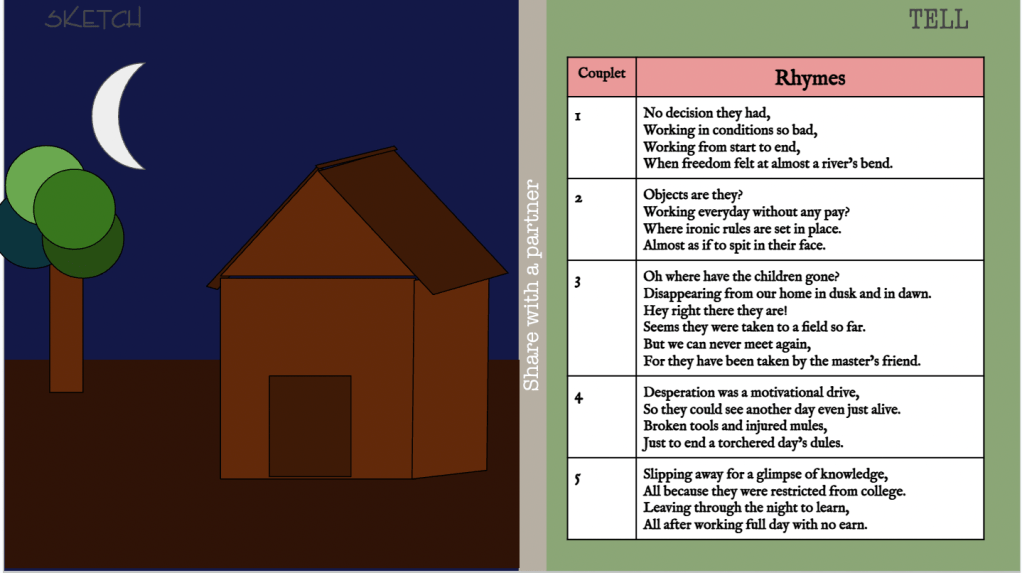
Wednesday – Resistance to Enslavement Sketch and Tell, Thin Slide
Thursday – MapWich Civil War
Friday – Comparing Compromises Thick Slide
Please donate to Samantha Cain’s GoFundMe Page
Monday
In Monday’s engaging lesson, we embarked on a journey to uncover the untold stories of resistance to slavery. Guided by an insightful lesson plan from Zinn Education, we delved into the courageous acts of enslaved individuals who defied their oppressors and fought for their freedom. By examining various forms of resistance, we sought to shed light on the enduring spirit that prevailed amidst the darkness of slavery.
To set the tone for our exploration, I began by sharing a quote from George Fitzhugh, a pro-slavery advocate from the 19th century. I included Fitzhugh’s words on a Thin Slide. His words aimed to portray the lives of enslaved people in a distorted light, emphasizing their supposed happiness and freedom. However, I encouraged our students to critically analyze this perspective and question the validity of such claims. This quote served as a backdrop for the lesson, challenging students to delve deeper into the reality of resistance to slavery.
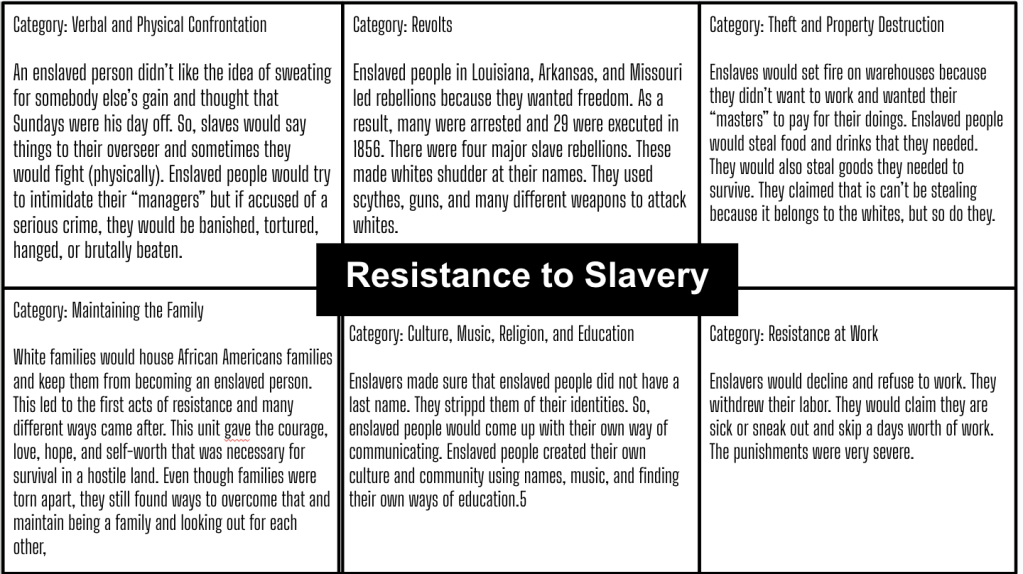
To provide a comprehensive understanding of the various forms of resistance, we divided the concept into distinct categories: music, runaways, physical aggression, revolts, etc. There were 7 different categories. Each category was distributed throughout the room, and the stories of resistance concealed within envelopes. Students formed groups and used a Frayer to collect resistance notes as they went from envelope to envelope. There were over 30 different stories of resistance within the envelopes. As a result, some of the groups had different information.
Initially, I anticipated that students would need 20 minutes to gather their notes. However, as the lesson progressed, it became evident that the significance of the narratives of resistance demanded more time. As a result, I extended the allotted time to 35 minutes, allowing students the opportunity to delve deeper into the narratives.
Throughout the extended exploration time, students actively immersed themselves in the stories of resistance. As they read and discussed the narratives within their groups, they began to comprehend the incredible courage, resilience, and determination displayed by enslaved individuals in their pursuit of freedom. The extended time allocation allowed students to fully appreciate the complexities of resistance, and the discussions that unfolded were filled with passion, empathy, and a desire to honor those who defied the chains of slavery.
Tuesday
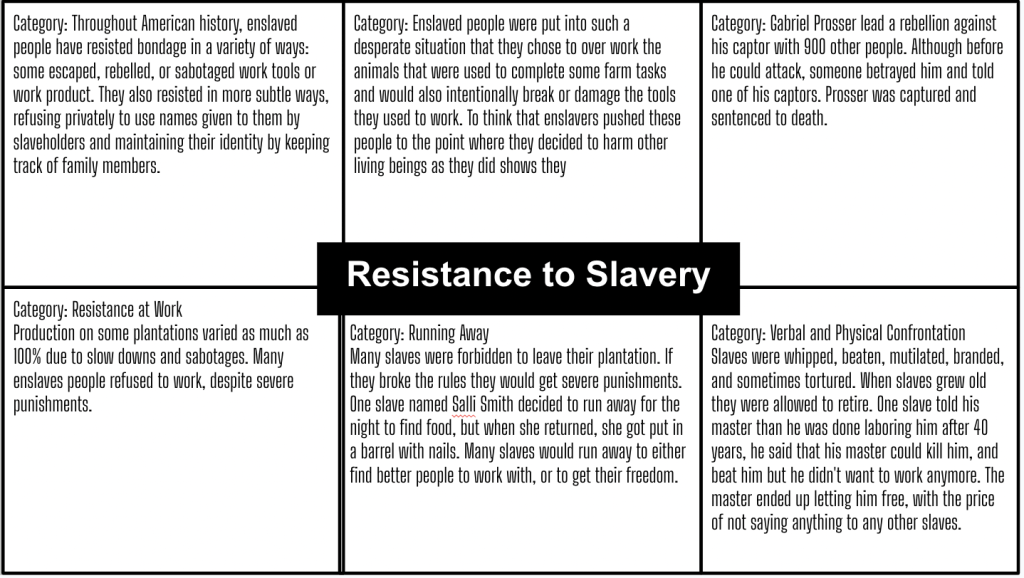
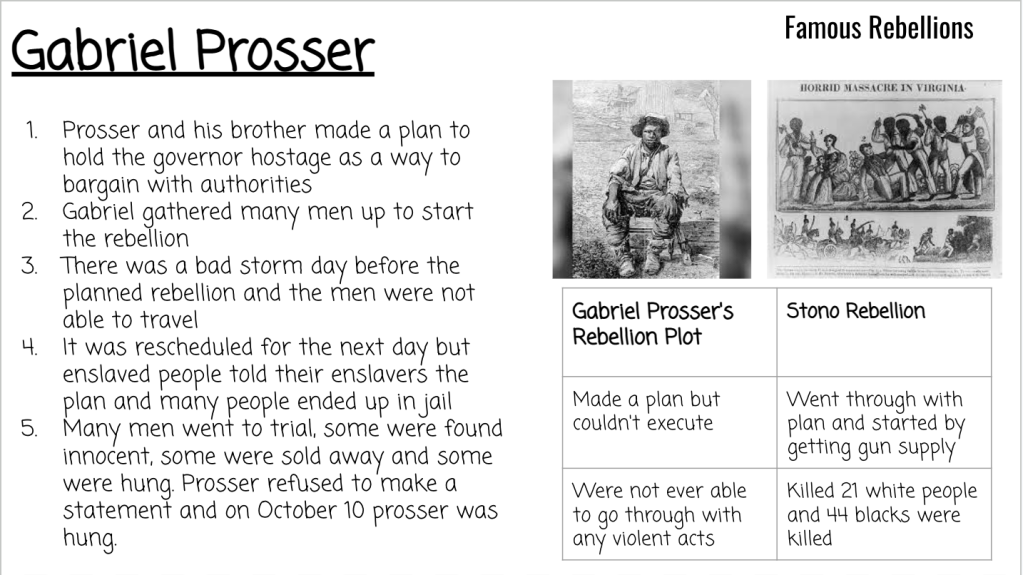
On Tuesday, I had planned to conclude the resistance lesson from Monday, but unfortunately, I wasn’t feeling well and had to leave school early. Determined to continue the lesson despite my absence, I devised a quick activity using a Thick Slide template and entrusted my students with the task of creating engaging presentations on revolt or escape stories.
Given the limited time and resources at hand, I prepared a thick slide template for my students. The goal was to encourage them to choose a story from either the revolts or escapes category. The revolt stories included the Stono Rebellion and Nat Turner’s revolt, while the escape stories encompassed narratives such as Frederick Douglass and Henry “Box” Brown, among others. The template required students to include a quote, five important facts, relevant pictures, and draw comparisons between their chosen story and another.
As I left school due to not feeling well, I was eager to see how my students would rise to the challenge of creating their thick slide. However, upon returning to class the next day, I was greeted with a lower level of engagement than I had anticipated. Usually, when I am absent, the engagement level hovers around 75-80%. This time, it had dropped to 51%.
Despite the decline in engagement, I decided to focus on the positives that emerged from the students’ efforts. As I reviewed their thick slide presentations, I was pleasantly surprised by the creativity and depth of thought displayed by many of them. The chosen quotes were thought-provoking and relevant, capturing the essence of the chosen resistance story. The inclusion of five important facts showcased their research skills and understanding of the historical context. Additionally, the use of visuals and comparisons demonstrated critical thinking and the ability to draw connections between different narratives.

Wednesday
To begin the Wednesday, I openly addressed the previous day’s thick slide activity, explaining its purpose and origin. I shared with my students that it was a quick solution to ensure their engagement during my absence. This candid disclosure set the stage for an authentic and transparent learning environment, allowing students to recognize the limitations of the activity while appreciating the opportunity it presented to showcase their creativity and resourcefulness.
After addressing the thick slide activity, I reminded my students of the George Fitzhugh quote we explored on Monday. We revisited the words that depicted a distorted perspective of enslaved individuals’ lives. To challenge Fitzhugh’s viewpoint, I gave my students an additional task. I asked them to contribute examples of resistance that debunked the quote’s claims. This exercise encouraged critical thinking and provided an opportunity for students to counter the misguided notions propagated during that era.
With the quote discussion setting the stage, I allocated ten minutes for students to finalize their Frayer notes on resistance. This allowed them to consolidate their understanding of resistance, review their previous notes, and ensure that their contributions would effectively counter the misrepresentations conveyed in Fitzhugh’s quote. The time constraint fostered a sense of urgency, encouraging students to focus on the key details and significance of resistance in history.
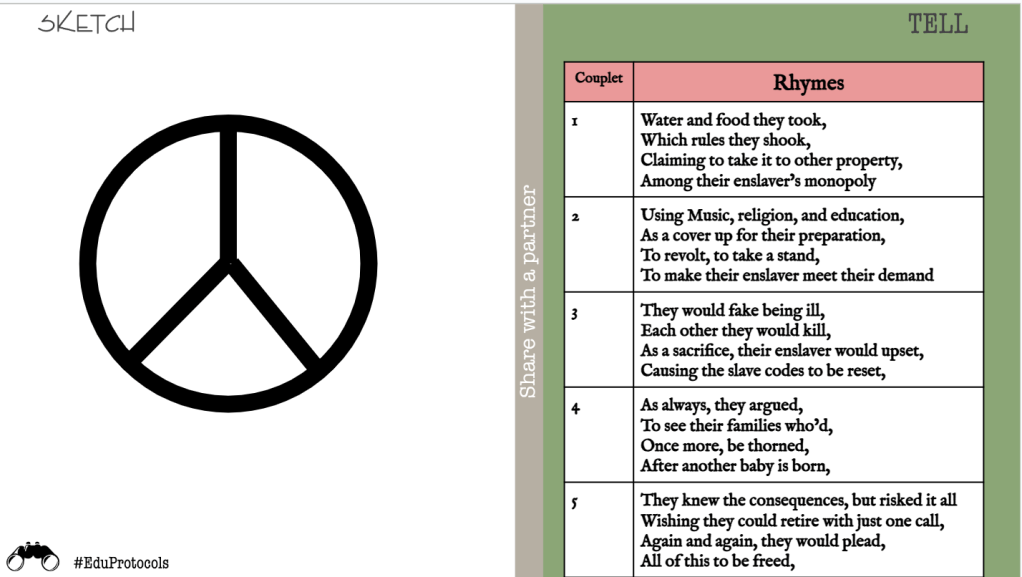
To finalize the lesson I smashed together some Retell in Rhyme and Sketch and Tell. These two protocols seem to fit nicely together. Students were tasked with retelling the stories of resistance using rhyme and then illustrating their poems with visual representations. While Retell in Rhyme promoted creative expression, the Sketch and Tell component enhanced the students’ ability to convey specific details through visual representation.
As the students engaged in Retell in Rhyme and Sketch and Tell, I observed that some of them struggled to incorporate specific details into their rhymes. This presented an unexpected obstacle, highlighting the need for further development in using vivid imagery and precise descriptions. However, it also provided an opportunity for growth and learning. By discussing and sharing their rhymes and illustrations, students were able to offer constructive feedback, learn from one another’s approaches, and develop their skills in incorporating specific details effectively.
By the end of class, I noticed some students were still struggling with their rhymes. Some students weren’t finished. I told them it was okay and that I would give them 15-20 minutes on Thursday to finish everything up.


Thursday
Thursday was filled with engaging activities aimed at reinforcing previous knowledge and delving into the pre-Civil War era. We began with Sketch and Tell Retell in Rhyme Smash To begin the day, I provided students with 15 to 20 minutes to complete their Sketch and Tell Retell in Rhyme EduProtocol Smash on resistance to slavery. This activity allowed students to express their understanding of the topic creatively while incorporating specific details and vivid imagery into their illustrations and rhymes. For students who finished early, I introduced a retrieval practice board to further enhance their learning experience.
The retrieval practice board served as a powerful tool to reinforce previous topics covered in the last three quarters of school. By posing questions related to the Monroe Doctrine, Andrew Jackson, Manifest Destiny, and Westward Expansion, students were encouraged to retrieve information from their memory and actively engage with the material. This practice not only reinforced their knowledge but also provided an opportunity to make connections between different historical concepts.
Students worked with a partner, Chromebooks closed, and worked to score 15 points. Older questions were worth 4 points, and newer content was worth 1 point. I was really impressed with the students’ knowledge of past topics!
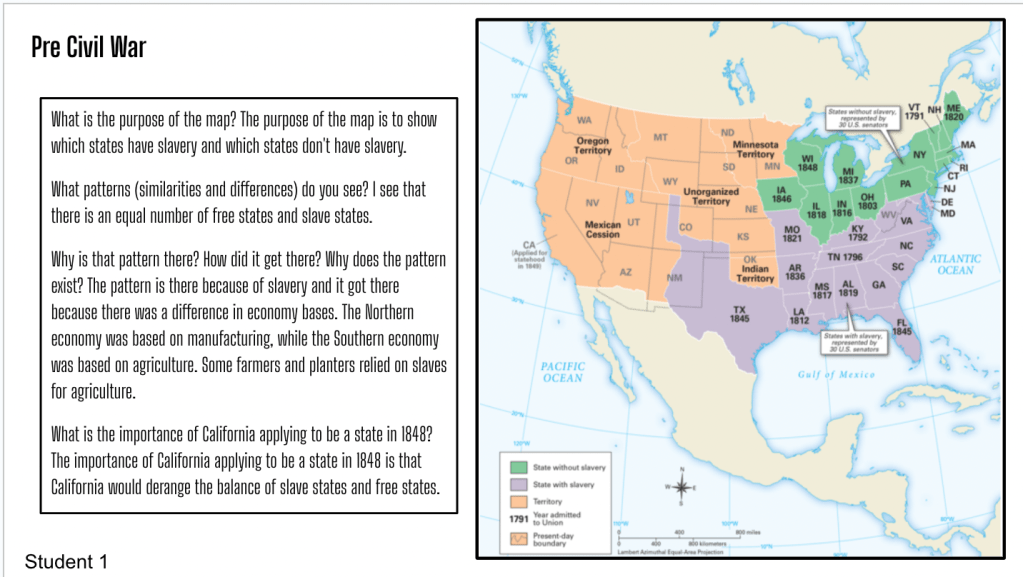
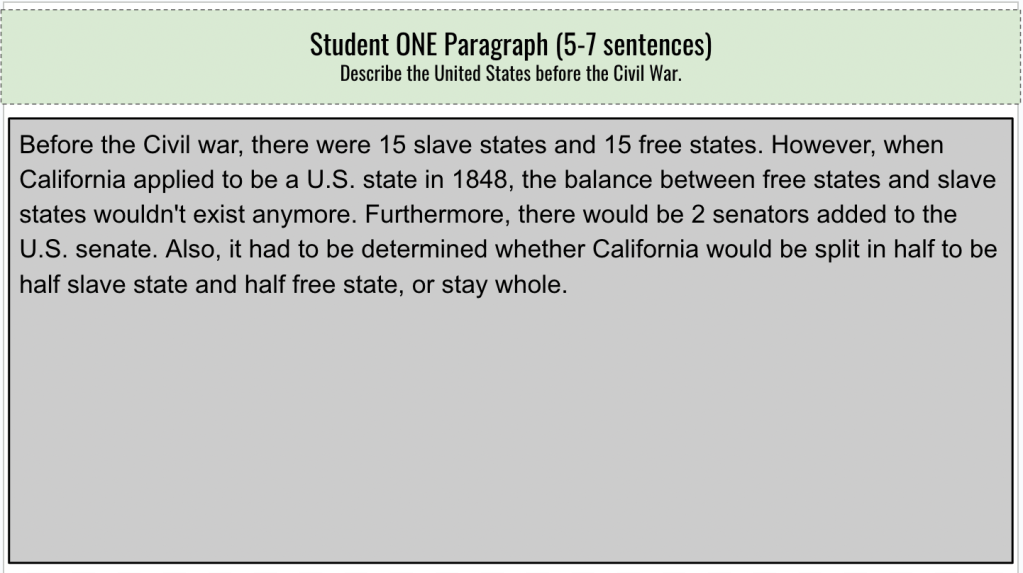
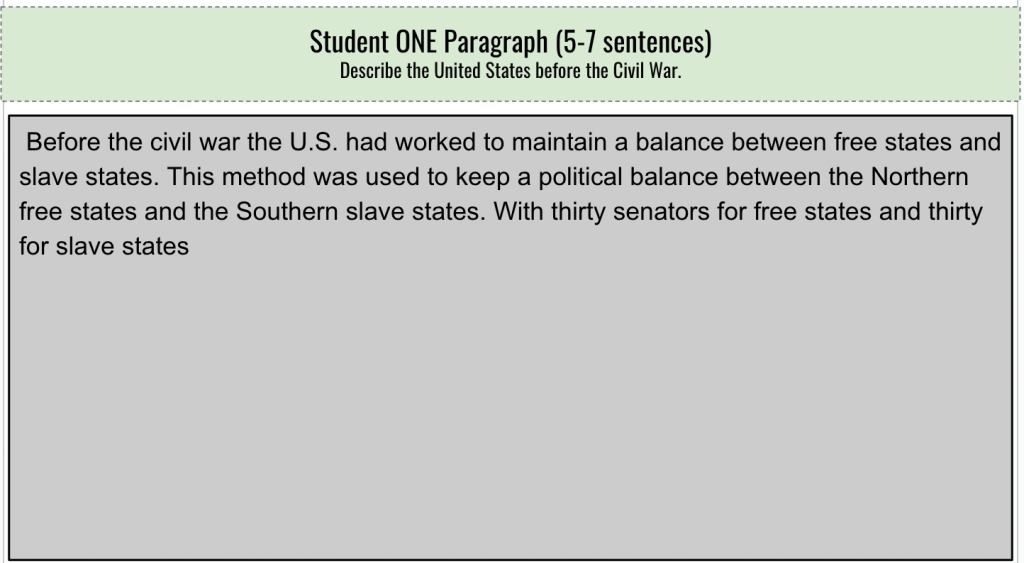
After the 15-20 minute timer went off, we switched gears to delve into the pre-Civil War era. I began by emphasizing the cause of the Civil War was slavery. To deepen their understanding, I introduced a MapWich activity. The map displayed an even distribution of free states and slave states. At some point, I drew a line between “North” and “South” and the students immediately noticed the presence of Missouri above the line and questioned why it was allowed to be a slave state. Additionally, they observed that California’s pending admission would disrupt the delicate balance between free and slave states.
The MapWich activity sparked inquiry and critical thinking as students analyzed the map, identified disparities, and questioned the decisions that shaped the political landscape. By engaging in thoughtful discussions and summarizations, students further solidified their understanding of pre-Civil War tensions, setting the stage for deeper exploration in the coming lessons.
As an educator, I am inspired by the curiosity and insights of my students. By providing opportunities for creativity, retrieval practice, and critical analysis, we embark on a shared journey of discovery, uncovering the historical significance that shapes our present. Together, we foster a passion for inquiry and a deeper understanding of the complexities of the past.


Friday
Friday’s lesson was packed with engaging activities and a focus on understanding compromises related to the Civil War. We began with an interactive Blooket quiz to a collaborative exploration of the Missouri Compromise and the Compromise of 1850 through the innovative Thick Slide EduProtocol.
To kick off the class, I started with a lively Blooket quiz that challenged students’ understanding of compromises surrounding the Civil War. This quiz comprised 15 questions, covering topics such as the Missouri Compromise, the Compromise of 1850, and resistance to slavery. While the resistance questions yielded impressive results, the compromise-related questions posed a greater challenge for the students. This initial assessment helped me gauge their prior knowledge and identify areas that required further exploration.
After the quiz, I displayed Thursday’s MapWich image that visually represented the key aspects of the Missouri Compromise, Maine, and California. In a brief 4 to 5-minute discussion, students actively participated by analyzing the map and posing insightful questions.
For the main lesson, I designed a shareable Thick Slide activity to foster collaboration and enhance understanding of the Missouri Compromise and the Compromise of 1850. Each pair of students was assigned a slide, and one student focused on researching and creating a slide about the Missouri Compromise, while the other student explored the Compromise of 1850. The reading material provided, generated by ChatGPT, presented a comprehensive comparison of the compromises, including the key individuals involved, important provisions, and long-term effects.
Upon completing the Thick Slide activity, students had gained a deeper understanding of the compromises and their implications. To gauge their progress, we revisited the Blooket quiz, focusing on the compromise-related questions. The results were highly encouraging, as the class had raised their averages by 20% or more. This improvement highlighted the effectiveness of the collaborative learning approach and demonstrated the students’ enhanced comprehension of the compromises through active engagement and information sharing.
Friday’s lesson proved to be a productive and engaging experience, with students actively participating in various activities focused on compromises related to the Civil War. The Blooket quiz initially highlighted areas for improvement, motivating students to delve deeper into the topic. The MapWich image prompted thoughtful discussion, setting the stage for a deeper exploration of the compromises.
The Thick Slide activity provided a platform for collaborative learning, allowing students to research, create, and present information about the compromises. This collaborative effort, coupled with the comprehensive comparison provided by ChatGPT, enabled students to gain a nuanced understanding of the compromises and their historical significance.
By revisiting the Blooket quiz, students demonstrated significant improvement, reflecting their enhanced comprehension and retention of the material. This growth is a testament to the power of collaborative learning, engaging activities, and the students’ dedication to expanding their knowledge.
As an educator, witnessing the progress and enthusiasm of my students is immensely gratifying. By fostering an environment that encourages active participation, collaboration, and critical thinking, we empower our students to become lifelong learners and active participants in shaping a better future.


 Moler's Musings
Do not castigate yourself for sprinting along the coverage treadmill when trying to teach all of the standards. Going fewer and deeper were two goals of the Common Core. Unfortunately, state assessment practices have not caught up with those good intentions. It would be nice if Social Studies and ELA teachers could team teach both content and disciplinary literacy skills together. Most schools work against collaboration instead of compacting the curriculum, which is what students need. Keep doing exactly what you are doing. Your use of EduProtocols to increase the amount of student reading in your class will build large-scale vocabulary growth and content knowledge. We need a nationwide repudiation of the test and punish culture that has dominated education over the last few decades. You are headed in the right direction.
LikeLiked by 1 person