About 10 days ago I posted student work on social media that was related to slavery. Immediately a comment was posted that the wording on a slide was incorrect. I took the post down. On one hand, the comments are great because I’m always trying to get better and learn. On the other hand, I wish people would ask questions first, rather than offer immediate corrections.
It turns out the assignment I posted still had a textbook section from last year still linked. In the last year, TCI has changed the wording for most of their textbook chapters. Now they include “enslaved persons”, “enslavers”, “freedom seekers”, etc. I asked the students if they noticed the changes. Most of them didn’t notice. This led to a discussion of language changes and the why behind it.
We discussed the word “slave” leaves the human element out of the word. Therefore, “enslaved persons” focused on the human. The word “masters” or “owners” empowers the enslaver and dehumanizes the enslaved person reducing him/her to a commodity rather than a person who has had slavery imposed upon him or her. Finally we discussed fugitive slaves should be freedom seekers. The term “fugitive” evokes the image of a law breaker requiring capture and punishment, and was used to assert that the law was on the side of slaveholding society. “Freedom seeker” illuminates what is in the hearts and minds of those acting to make freedom a reality.
Through this discussion, I also mentioned that I grew up learning the original terms. I also added that I’m still learning and reminding myself to use the appropriate language.
So, it’s testing week and my class is on to slavery and resistance to slavery. I haven;’t been posting much on social media for fear of backlash and negative comments from people. As I mentioned above, I really am trying to do the right things and teach the right things.
With testing going on this week, we did bits and pieces of a new lesson on resistance to slavery. Last year I used a Group Playlist format, created by Amanda Sandoval, but I decided this would not work for this group of students. I set up each group playlist as a separate assignment on Google Classroom. Here are the questions associated with the resistance to slavery lesson:
- What about the daily life of enslaved people would have prompted resistance?
- What were the means of resistance to slavery?
- What were the risks of resisting slavery?
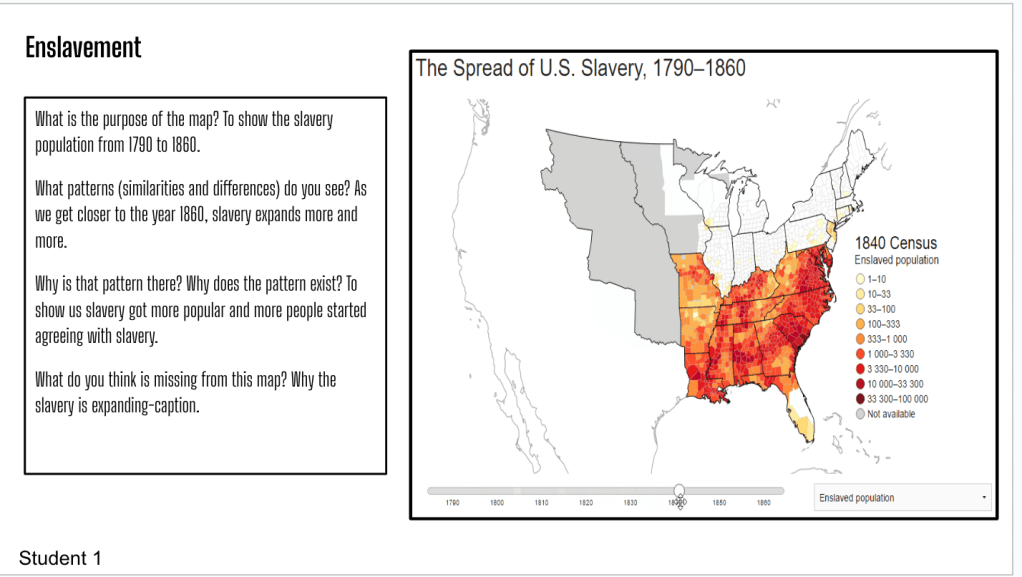
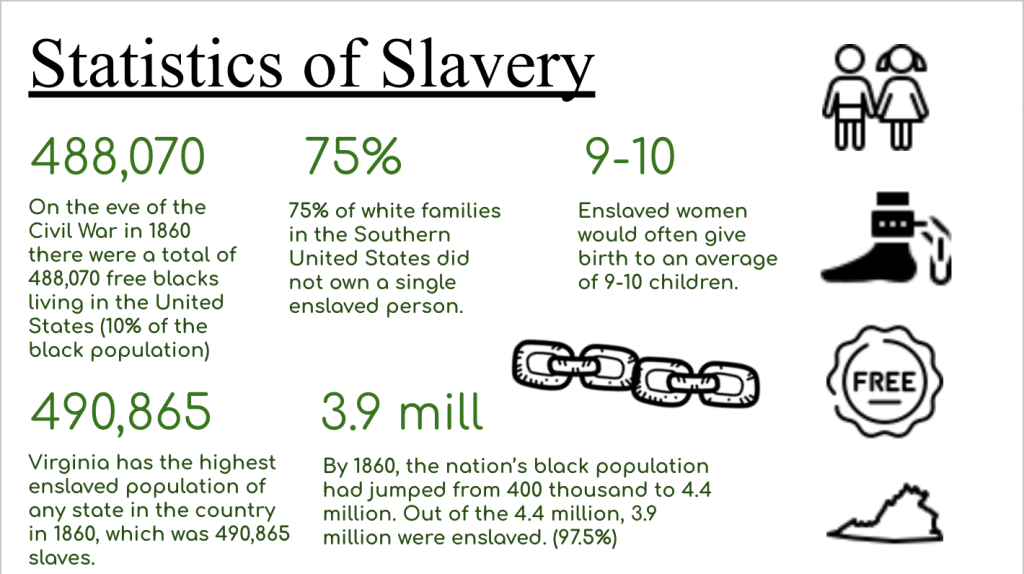
Before beginning this lesson, I introduce slavery by sharing little known statistics from an article written by Henry Louis Gates. I also use a map that shows the expansions of slavery from 1790 to 1860. We accomplished anything we could this week…
Monday and Tuesday – ELA test and we did nothing in class.
Wednesday – MapWich, Number Mania
Thursday and Friday – CyberSandwich
Please donate to Samantha Cain’s GoFundMe Page
Wednesday
On Wednesday I began class with a classic from Robert Mayfield – a MapWich. This is a CyberSandwich, but the students analyze a map, compare, and summarize. I found a GIF map that changed every two seconds and showed the expansion of slavery to the deep south and westward. On the MapWich, I asked these questions:
- What is the purpose of the map?
- What patterns (similarities and differences) do you see?
- Why is that pattern there? Why does the pattern exist?
- What do you think is missing from this map?
I gave students 10 minutes to analyze the map and answer the questions. Then I gave them 5 minutes to discuss and compare. Finally, I gave students 5 minutes to write a summary of their findings.
For the last question, “What do you think is missing from this map,” some students suggested the following:
- The “why” behind the increase in slavery.
- The “why” behind numbers on enslaved persons increasing in the deep south and out west.
Next we switched to a Number Mania with an article of statistics about slavery written by Henry Louis Gates. I gave students 10 minutes to read the article and highlight numbers and facts that surprised them, or challenged something they thought as true. Most students highlighted 7 to 8 numbers. Next, I had students choose their top 5 numbers and facts. I gave students the rest of class to add 5 numbers and facts, and a title to their Number Mania slide.
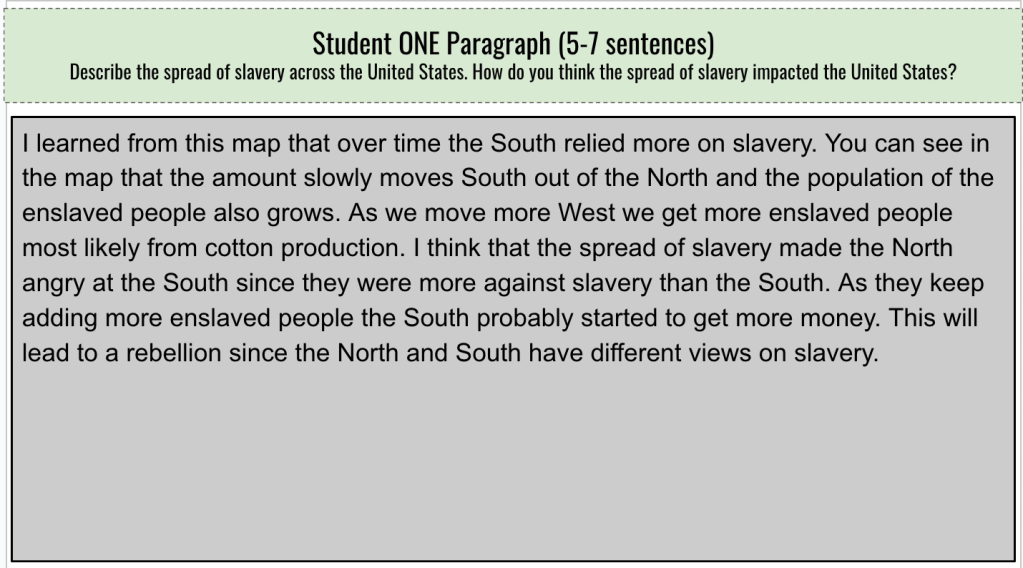



Thursday and Friday
Thursday and Friday were shortened class periods – 30 minute periods. We began out first lesson on resistance to slavery and focused on our first question, “What about the daily life of enslaved people would have prompted resistance?”
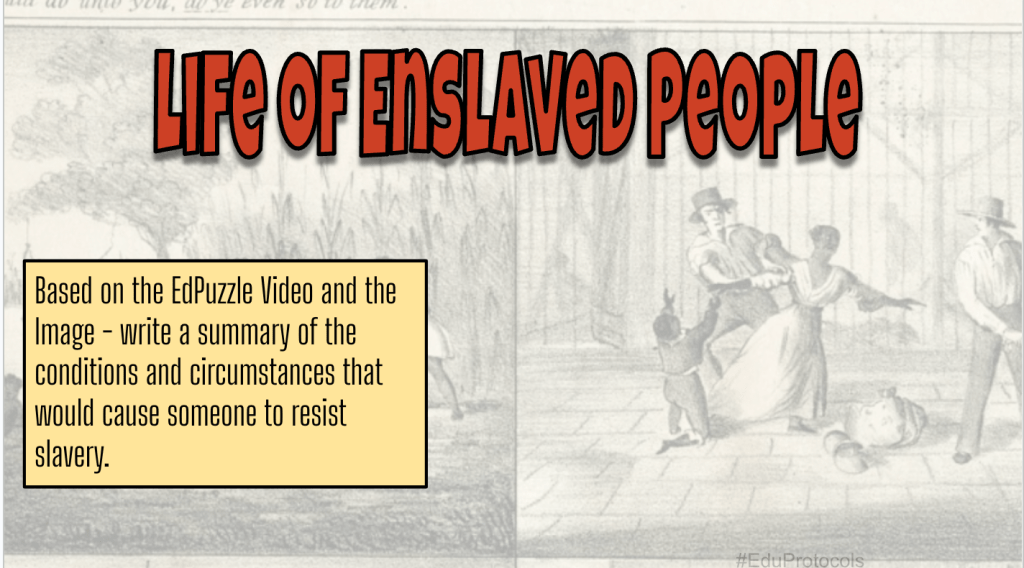
Students watched an EdPuzzle video about the treatment and daily life of enslaved people. Following the EdPuzzle video, students completed a CyberSandwich where they analyzed an image.
The image on the CyberSandwich showed 6 different scenes of the harsh treatment of enslaved people. The image was from 1836. On the notes slide, I included questions for image analysis in social studies. Students analyzed the image for 8 minutes.
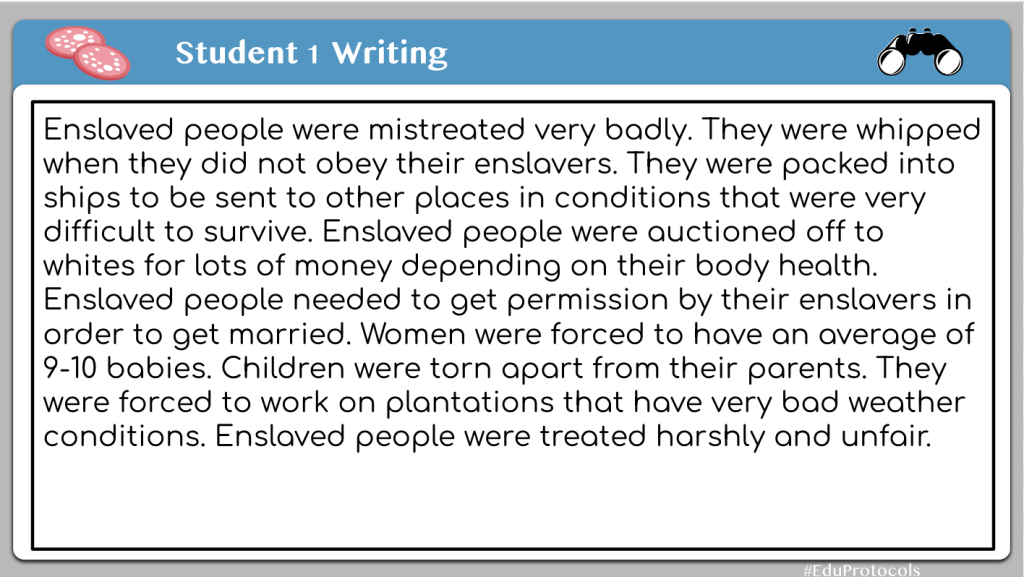
After analyzing the image, students then discussed and compared notes with a partner. As the final piece, students wrote a summary on why the harsh treatment of enslaved people would have prompted resistance. The students used information from the EdPuzzle video along with observations from the image analysis.

 Moler's Musings
Good evening, I really appreciate your sharing your thoughts and learnings on this topic as well as the lessons through your blog (and social media). I was wondering if you wouldn’t mind sharing what the video is that you used from EdPuzzle? Thank you in advance, Kristine 8th grade US History teacher from California
LikeLike