This week was all about keeping engagement high and adapting to student needs with a strong lineup of EduProtocols. We started by wrapping up our government voice inquiry with a Thick Slide summary and fast Gimkit reviews, then dived into Sketch and Tell-o on Loyalist perspectives and Enlightenment ideas with Parafly paraphrasing exercises. Thursday’s Halloween twist saw students using Number Mania for the Declaration of Independence, while Friday’s low attendance turned into a lively Gimkit Draw session and creative Retell in Rhyme exercise on Disney movies and daily topics. EduProtocols once again carried the week!
Monday
Monday Reality Check
After missing Friday, I came back on Monday to discover that my inquiry lesson on the importance of having a voice in government hadn’t gone as planned. I had used AI to simplify the primary sources into 7th-grade-friendly readings, hoping this would keep students engaged and make the sources more accessible. But when I checked Google Classroom, only a handful of students had completed the work. The inquiry went deeper than expected, and without support, the substitute likely couldn’t guide students through the challenge.
Regrouping with Purpose
Rather than diving into low scores or assigning blame, I chose a reset. I’m not one to pass off low marks without offering students a real chance to understand. So, we tackled the primary sources together, discussing the background and importance of each source and connecting them back to our essential question: Why is it important to have a voice in government? We used this discussion to explore representation, power, and fairness—all critical ideas that lay the groundwork for the events leading to the American Revolution.
Thick Slides to Synthesize Learning
For our wrap-up, I had students create a Thick Slide summary on what they’d learned. Thick Slides have proven incredibly effective in helping students distill complex concepts into concise, visual representations, and the students did a fantastic job as usual. The content breakdown clearly helped, and it was rewarding to see them engage with and articulate these foundational concepts in such a clear way.
Reinforcing with Gimkit
We wrapped up with a Gimkit Fast and Curious to reinforce everything we’ve covered, from British taxes to the French and Indian War and the growing tensions with Britain. Class averages hit between 80% and 90%, showing that sometimes all we need is a little extra time to reset and regroup. It was a solid reminder of the power of building understanding, even when things don’t go as planned.


Tuesday
Sketch and Tell-O, Digital Inquiry Group Loyalists
With classes reduced to around 45 minutes, I knew our lesson had to be both quick and effective. This made the Loyalist primary source lesson from the Digital Inquiry group a perfect choice. I adapted the sources with AI, preserving the primary source feel but bringing the language down to a level that worked for 8th graders. My goal was to shift focus and challenge students to consider an often-overlooked question: Why would some colonists choose to stay loyal to Britain, despite rising revolutionary sentiments?
Setting the Scene with Inquiry and Quick Retrieval
We started with an inquiry warm-up: “We’ve been discussing how the Sons of Liberty protested British rule. What do you think might cause someone to stay loyal to King George instead?” After sharing some predictions, we moved into a Gimkit for a brief but focused review of vocabulary like Loyalist, Patriot, and other terms they’d encounter in the readings. I wanted to ensure they had the basics down before diving deeper.
Document Analysis in Action
Students then moved to Document 1, where they filled out an organizer, closely reading the text, sourcing the information, and contextualizing it in terms of its historical moment. We repeated the process with Document 2, helping students see the range of reasons people might remain loyal. Finally, we had them corroborate the two sources to find connections, patterns, and any differences in Loyalist reasoning. This built their analytical skills and brought out critical thinking as they explored motivations and biases.
Wrapping It Up with Sketch and Tell-o
For our final task, students engaged in a Sketch and Tell-o activity, visualizing three reasons for Loyalist loyalty and summarizing each one. This combination of analysis and creativity is really where their understanding shines—they don’t just read; they actively process and illustrate their learning.
We ended with a quick Gimkit for further retrieval, although the class averages varied, thanks to the adjusted schedule and excitement of a different day. The students really took to this shift in perspective and showed curiosity about how Loyalists made their choices. Even in a shorter time, they walked away with a new layer of insight into the diversity of colonial perspectives.
Wednesday
Lesson Link (Frayers, Parafly, and Sketch and Tell-O)
With a return to our usual schedule, we jumped right into two big topics: The Enlightenment and the Declaration of Independence. These foundational ideas helped shape American ideals, and I wanted to make them accessible and memorable for the students using some targeted EduProtocols.
Starting Strong with Fast and Curious
We started class with a Gimkit Fast and Curious, tackling key Enlightenment terms and early concepts from the Declaration of Independence. I kept this session short—just three minutes—and then gave feedback to help clarify terms. It was a quick but effective primer, setting the stage for the day’s deeper dive.
Frayer Fun: Enlightenment and John Locke
Then, we turned to the Frayer Model for the term “Enlightenment.” Students rewrote a definition in their own words, listed characteristics, and found a symbolic image. This helped break down the big concept, and I could tell from their summaries that they were getting it.
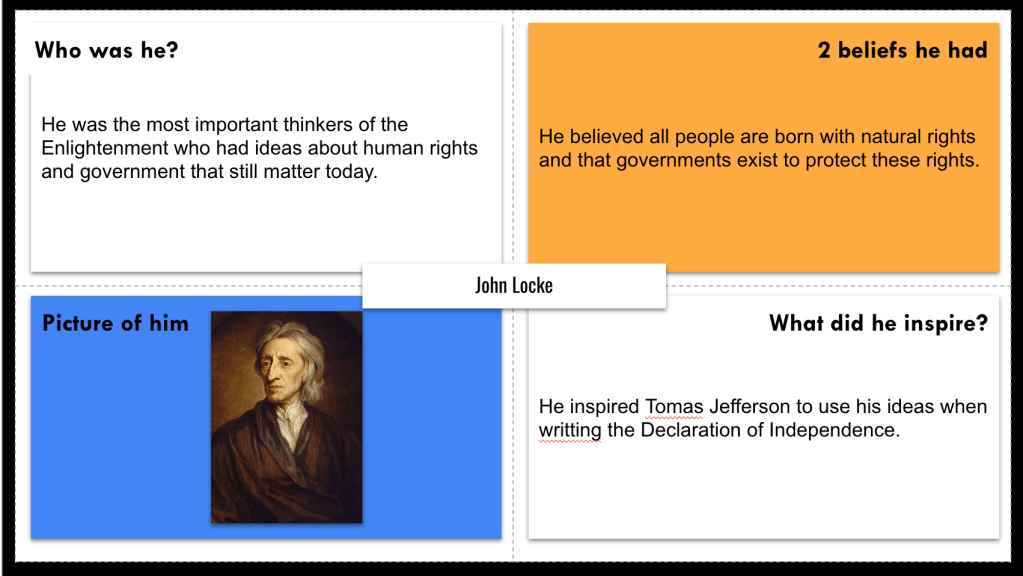
Next, we moved into a Frayer on John Locke. While I usually would bring in the Archetypes protocol to help link Locke’s ideas with Enlightenment ideals, I decided to keep it simple this time. Instead, students listed his beliefs, noted his influence, and added an image to represent him. This exercise anchored Locke as a key influencer on American revolutionary thought.
Parafly Protocol: Making Paraphrasing Fun
Then came Parafly, an EduProtocol that introduces students to paraphrasing in a super engaging way. I used Socrative to share fun sentences about topics like Halloween, quirky facts, and even SpongeBob, to warm them up to the idea. After reviewing strategies like using synonyms, simplifying, and rearranging sentences, I gave them two minutes to submit their paraphrases. Then, we voted on each round, and I provided feedback. The excitement and engagement levels were high. At one point, a student even said, “This is fun. Can we keep doing this?” They were totally absorbed—in paraphrasing, of all things!
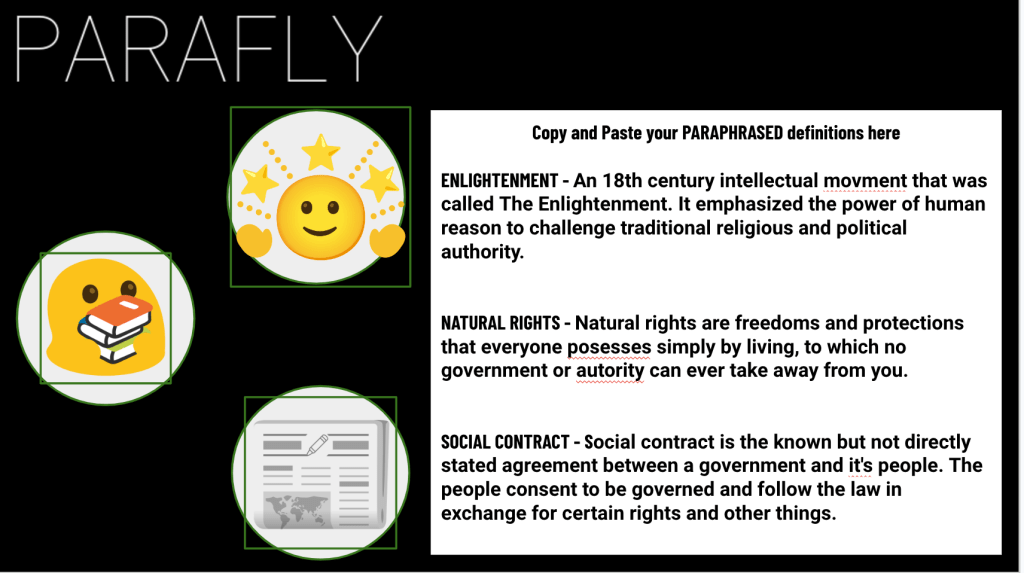
We wrapped up Parafly by shifting focus to key terms like “Enlightenment,” “Natural Rights,” and “Social Contract.” Students paraphrased each term and then brought in some creative flair by using Emoji Kitchen to design custom emojis representing their ideas on a Sketch and Tell slide.
Wrapping with Another Fast and Curious
To end the day, we circled back to the Gimkit Fast and Curious from earlier, this time to see growth after our review of the terms. Seeing their scores rise was the perfect way to close out the lesson, with students clearly connecting to these revolutionary ideas.
This mix of creative, structured, and interactive protocols turned some abstract concepts into tangible understandings, with Parafly paraphrasing emerging as the highlight of the day.

Thursday
Halloween and an observation on the same day? No problem—EduProtocols to the rescue! Two weeks back, I’d casually agreed to a Thursday observation without realizing it fell on Halloween. Despite potential holiday distractions, I knew the structured and interactive protocols would keep us on track and meet the standards for my evaluation.
Kicking Off with a Fast and Curious on Independence
We began with a Gimkit Fast and Curious on the Declaration of Independence. This activity set the stage, refreshing students on key terms and events as we eased into the historical focus of the day. With classes in good spirits, I projected a Google Maps Street View image of Independence Hall to add some context. Seeing the actual site where the Declaration was signed gave everyone a sense of place, grounding our conversation in the moment of 1776 and shifting attention from Halloween to history.
Halloween Twist: A “Declaration Signer” Meme
Keeping things festive, I introduced an activity that blended Halloween fun with historical context. Students created a Halloween costume meme (EMC2Learning) for a “Declaration signer.” We talked through some “accessories” these costumes might need—powdered wigs, quills, maybe even parchment or lanterns. This meme-building activity was a hit! It allowed students to engage with historical figures through a lighthearted lens and provided a creative outlet that still tied back to the Declaration. The students brought some great ideas, and our meme creations lasted about 15 minutes.
Main Event: Number Mania on the Declaration of Independence
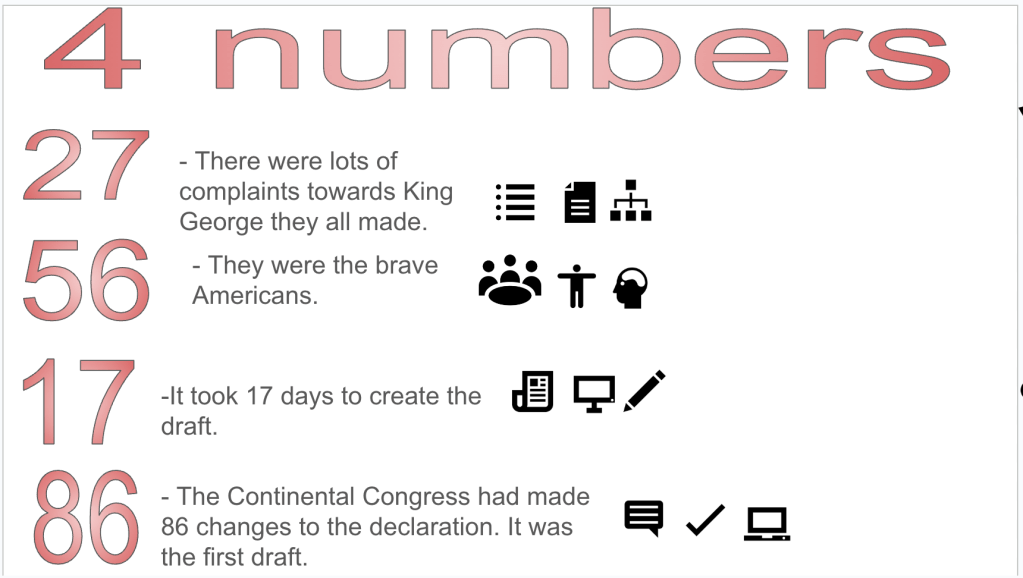
With focus re-centered, we dove into our main EduProtocol for the day: Number Mania. I started by sharing the quote: “The Declaration of Independence showed how the American colonists were willing to risk everything to create a new government that protected people’s rights. They carefully planned a way to explain why they wanted to be free and what they believed about human rights.”
Students read through our text, highlighting four specific numbers or statistics that supported the ideas within the quote. They then designed a visual infographic. Having practiced Number Mania with the Boston Tea Party, students were ready to go and applied themselves well—this time the numbers came together even faster.
Wrapping Up with Fast and Curious
Finally, we circled back to another Gimkit Fast and Curious for a quick review. Students’ Gimkit averages were up across the board—our rounds in the morning paid off with solid comprehension by day’s end. Between Gimkit, our “costume” meme, and Number Mania, EduProtocols helped guide the class from start to finish and make my observation a success. Nothing like a combination of creativity and rigor to wrap up Halloween with history and high engagement!




Friday
With attendance looking rough the day after Halloween, I knew diving deep into the Declaration of Independence wouldn’t hit the mark, so I pivoted to something lighter and more interactive. The goal was to keep students engaged without overwhelming them—sometimes you just have to read the room and adapt.
Gimkit Draw Mode: American Revolution Edition
We kicked things off with a crowd-pleaser—Gimkit Draw mode. This random-student-draws, classmates-guess format brought the energy up immediately. To keep it connected to our content, I had AI generate a list of simple, Revolution-related terms for students to draw, like “stamp,” “tax,” and “musket.” The guessing was quick, and even the less artistic students loved the challenge. This activity was perfect for the post-Halloween lull and reminded everyone that history doesn’t always have to be a quiet read-through.
Rhyming Games with Disney and Rhyme Scheme
Next, we switched gears to a quick exercise on rhyme schemes with a Disney twist. Using rhyming couplets about Disney movie plots (thanks again, AI!), we turned it into a guessing game. This light activity led to a discussion about rhyme schemes and couplets, and everyone had fun trying to guess the movie based on the rhyme.
Retell in Rhyme: The Challenge of Writing in Pairs
Inspired by our Disney activity, I introduced Retell in Rhyme. Students chose a favorite Disney movie and worked in pairs to craft a summary in rhyme with six couplets. Some classes took to it and got really creative; other classes found the rhyming tougher than expected, and I could feel the energy dip. For those groups, I pivoted: instead of summarizing a movie, I had them write couplets about everyday topics like “morning routine,” “making a sandwich,” or “rainy days.” This tweak gave students a familiar foundation and helped them find their flow again.

 Moler's Musings
I love teaching history to middle schoolers 🙂 it sounds like you had some amazing plans and students are lucky to have a teacher who deep dive so thoroughly into such important parts of history. Have a great weekend
LikeLiked by 1 person