This week, I wanted to focus on the second part of our Revolution and Reform unit, specifically on the topic of abolitionism. With only 28 or 29 days of school left, it’s crucial that I carefully select the most important content to cover. Although I would love to delve into all aspects of reform movements, time constraints simply won’t allow for it. Therefore, I chose to concentrate on abolitionism and slavery this week, as it provides a smooth transition into exploring the causes of the Civil War. To build a solid foundation, I began by discussing the impact of the cotton gin, the lives of enslaved people, and the resistance they exhibited. Finally, we concluded the week by examining abolitionist reformers, which ties in nicely with some local New Richmond history.
Monday – Cotton Gin Lesson
Tuesday – Life of Enslaved People
Wednesday – Resistance
Thursday – Abolitionists, Assessment
Friday – Citizens of Sardinia
Monday
On Monday, we wrapped up our lesson on the cotton gin, which we had started the previous Friday. The central question was, “What were the consequences of the cotton gin?” I utilized various activities such as “Annotate and Tell,” “Graph and Tell,” and a “2xPOV” (two points of view) activity. Initially, I had planned a “Sketch and Tell” where students would sketch different viewpoints on the consequences of the cotton gin, but I ultimately decided to switch to the “2xPOV” format to make the summative assessment clearer and more straightforward for the students. I allocated 20-25 minutes for them to complete their work on the consequences of the cotton gin. To reinforce their learning, we concluded with a “Fast and Curious” activity on Gimkit, where class averages ranged from 83% to 95%.
Tuesday
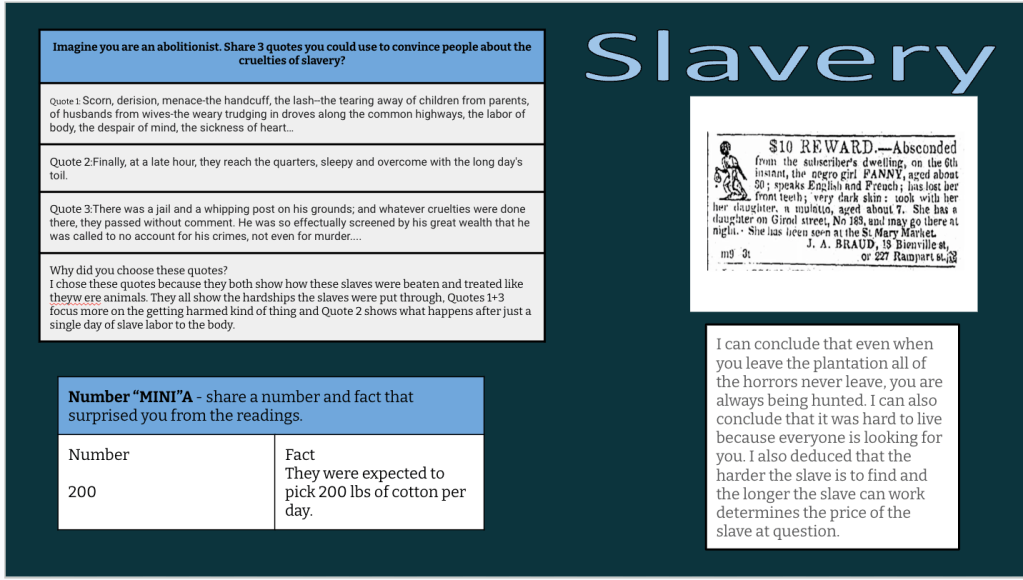
Tuesday marked the beginning of our exploration of the lives of enslaved people. To start, I explained the importance of using person-first language, such as “enslaved person,” “enslaver,” and “freedom seeker.” I then adapted a lesson from a textbook that my co-author, Dr. Scott Petri, contributed to – a resource written for schools in Texas that incorporates background information and primary sources to help students learn history. I was particularly impressed by the selection of primary sources and background information compiled for this lesson on the lives of enslaved people. The lesson included excerpts from Solomon Northup’s “12 Years a Slave,” Fanny Kemball’s diary, and a book written by Harriet Jacobs. These diverse perspectives provided valuable insights into the experiences of enslaved individuals.
For the lesson, I used an “Annotate and Tell” activity where students read the excerpts and highlighted instances of cruelty. To conclude the activity and elevate the depth of knowledge, I incorporated a “Thick Slide” with questions such as, “Imagine you are an abolitionist. Find quotes you could use to show people about the cruelties of slavery.” I explained to the students that during this time period, people primarily obtained news and information through stories and hearsay. Additionally, I included a “Number Mania” activity, asking students to select one number from the excerpts that surprised them. To further engage with primary sources, students were tasked with finding a newspaper advertisement seeking a freedom seeker. In the image caption, they had to explain what they could learn or conclude about slavery from the advertisement. Finally, students were asked to give the slide a title. We ended the class with another “Fast and Curious” activity to reinforce their learning.
Wednesday
On Wednesday, I started class by presenting a quote from George Fitzhugh: “The slaves of the South are the happiest, and in some sense, the freest people in the world. The children and the aged and infirm work not at all, and yet have all the comforts and necessaries of life provided for them. They enjoy liberty, because they are oppressed neither by care or labor. The women do little hard work, and are protected from the despotism of their husbands by their masters.” The students were understandably confused by this quote, especially considering the previous day’s lesson on the harsh realities of enslaved life. They expressed their puzzlement and disagreed with the sentiment expressed in the quote, which I validated. However, I pointed out that this was how information was disseminated and often believed during that era, given the absence of modern media like TV, radio, and social media. I instructed the students to keep this quote in mind throughout our lesson on resistance to slavery, as we would revisit it at the end of the lesson.
For the resistance to slavery lesson, I adapted materials from the Zinn Education Project. The lesson categorized resistance into different forms, such as maintaining family, running away, revolting, or expressing resistance through culture, religion, and music. I cut out various stories of resistance and placed them in seven envelopes around the room, each representing a different category. Students were given a series of questions and had to move around the room, find the appropriate resistance category, and write down an example. This interactive portion of the lesson took approximately 25 minutes.
At the end of class, we revisited Fitzhugh’s quote for a “Thin Slide” activity, which I conducted using Padlet instead of Google Slides. On the Padlet, I displayed the original quote and asked students to share a form of resistance that contradicted the quote’s assertion. I encouraged them to do this from memory, without consulting their notes, and to include a relevant image with their example. One feature I appreciate about Padlet is the “I can’t draw” option, which uses an AI image generator to create images based on a prompt. The students did an excellent job with this portion of the lesson.
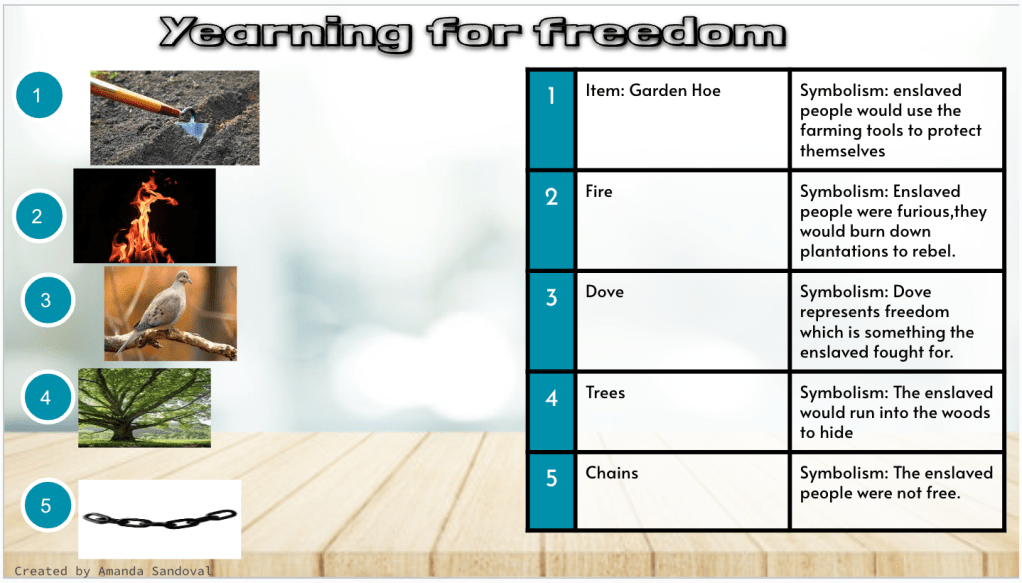
The assessment for the Resistance lesson was a Bento Box template created by Amanda Sandoval. Or the students could create blackout poetry using a biography about Harriet Jacobs I created with AI.


Thursday
Thursday marked the beginning of our lesson on abolitionism, which ties in nicely with local New Richmond history. New Richmond, Ohio, is a town situated along the Ohio River, directly across from Kentucky. The river served as a dividing line between free states and slave states. New Richmond has a rich history of abolitionism and involvement in the Underground Railroad. Having built up the context of slavery throughout the week and discussed the cruelties endured by enslaved people, I wanted students to examine abolitionists and consider the methods and motivations behind their efforts to end slavery.
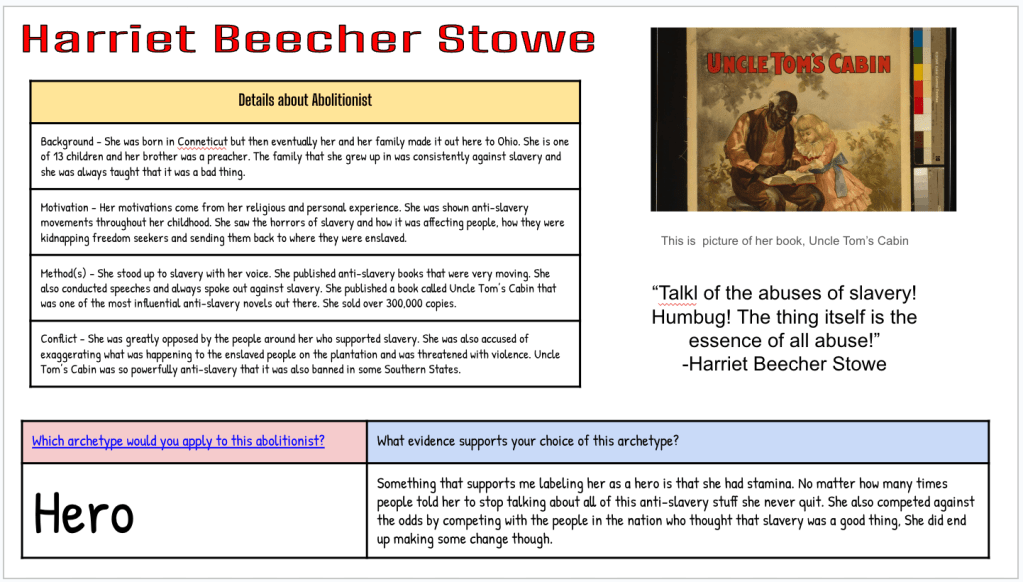
For this lesson, students chose an abolitionist to research, such as Frederick Douglass, Harriet Beecher Stowe, William Lloyd Garrison, Sarah Grimké, or local figures like John Rankin and James G. Birney. They read a one-page summary about their selected abolitionist and designed a “Thick Slide” detailing the methods, motivations, and conflicts faced by that individual. Students then shared their “Thick Slide” with all of my classes through a Google Form. Next, I had students use a Frayer Model to read and take notes on four other abolitionists, focusing on their methods, motivations, and conflicts.
To assess their understanding, students had a choice between three options:
- A “Dinner Party” activity, designed by Amanda Sandoval, where they arranged the abolitionists at a table and discussed the potential conversations they might have.
- Creating sketches depicting the abolitionists’ methods and motivations for wanting to end slavery.
- Designing an “Instastory Abolitionist” post. This lesson spanned two days, extending into Friday.

Friday
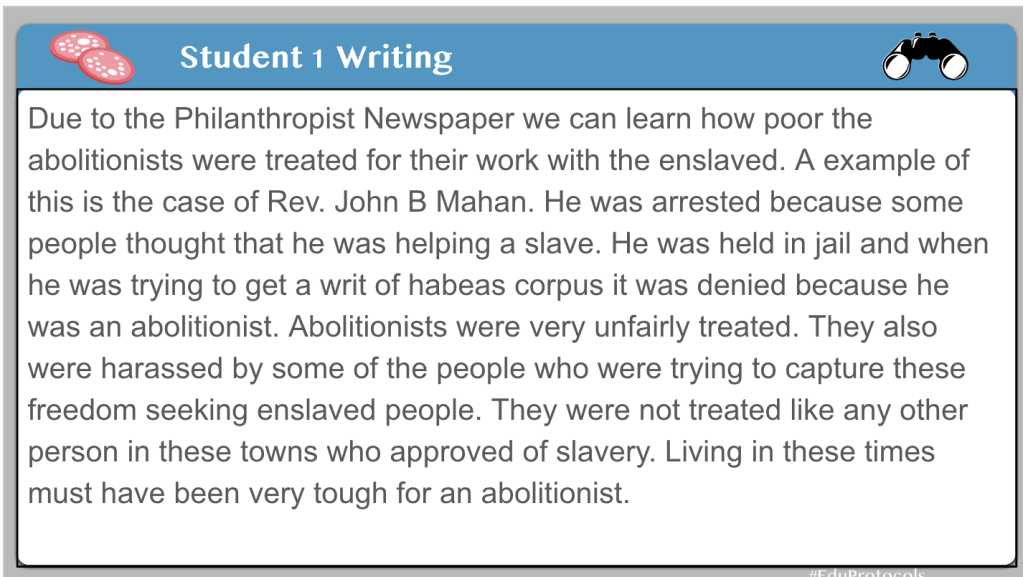
On Friday, most of my classes were working on the Frayer Model and taking notes on four different abolitionists. However, one class was ahead, so I used AI to create a tailored lesson. In our abolitionist lesson, we learned about James G. Birney, a local abolitionist who published an anti-slavery newspaper called “The Philanthropist.” I found a front page of that newspaper from December 18, 1838, and took a screenshot of a portion of it. I then input the image into the Claude AI and asked it to rewrite the article for me.
The AI-generated article discussed a community called Sardinia, Ohio, which most of the students were familiar with. It described an incident where a reverend was taken by slave catchers into Kentucky and put on trial for helping enslaved people. Using the AI, I generated a prompt: “What can we learn about the abolitionists from ‘The Philanthropist’ newspaper?” I turned this into a “Cybersandwich” lesson, with the following prompt for the notes section: “Read the article ‘Citizens of Sardinia’ carefully and identify at least three specific details or events that provide insight into the tensions and conflicts surrounding the issue of slavery in this community in 1838.”
The students were highly engaged with this lesson, as it incorporated local history that they could relate to and tied in with our study of abolitionism. This experience reinforced my appreciation for AI, as it enables me to bring more local history into the classroom using newspapers that might otherwise be challenging for students to read due to the print quality or archaic language.



 Moler's Musings
I’m always impressed with your thinking, lesson planning, and use of Eduprotocols!
LikeLike
Love how you incorporated the primary sources from our Texas book. https://texassocialstudies.com/exploring-the-grade-8-teks-through-primary-sources/ We are trying to broaden the scaffolding of primary source analysis for younger readers. It’s tricky to balance. You don’t want your class to become death by a thousand primary sources, but you want to give your students some experience in decoding stretch texts that are above their reading comprehension levels. Growth comes from pain.
LikeLike
Try the Library of Congress for fugitive slave posters:
https://blogs.loc.gov/headlinesandheroes/2019/10/runaway-fugitive-slave-ads-in-newspapers/
LikeLike