
I’m currently writing this from the O’Hare Airport in Chicago as I make my way to Madison, Wisconsin for the WCSS Conference. I’m looking forward to this conference as I will meet up with my friend, and co-author, Dr. Scott Petri. We are doing multiple sessions on EduProtocols and I’m doing an extra session on utilizing AI within the classroom. I was lucky enough to meet up with Jon Corippo in O’Hare! (Thanks for the popcorn, Jon!!)
This week we continued our unit on Westward Expansion. We began the week with having the students finish their Annotated maps from the previous week. I always underestimate how long it take to complete an annotated map. Then we followed up the maps with Manifest Destiny. I looked at last year’s lesson on this topic and I didn’t like it. I revamped my Manifest Destiny lesson to something I did 10 years ago when I first began teaching social studies.
Following the lesson on Manifest Destiny, I left a mini lesson on the Trail of Tears. I assigned this lesson because some of the readings about Manifest Destiny included references to the Trail of Tears. I assigned this lesson last year and really liked the outcomes of the lesson.
Tuesday and Wednesday – Manifest Destiny – Part 1 and Part 2
Thursday – Dublin Details EMC2Learning
Friday – Trail of Tears
Monday
For Monday’s class I noticed many students needed to finish their annotated maps on westward expansion. Some needed 10 minutes while others needed 20 to 30 minutes. In times like this, I always have some supplemental things ready to go.
The best way to include supplemental activities when students finish at different times involve Quizizz, Gimkit, EMC2Learning Penny Pedagogies, EduProtocols, or utilizing AI. In this case, I had a Quizizz ready to go with questions from the previous week’s lesson. I also had a Mad Lib I created with AI.
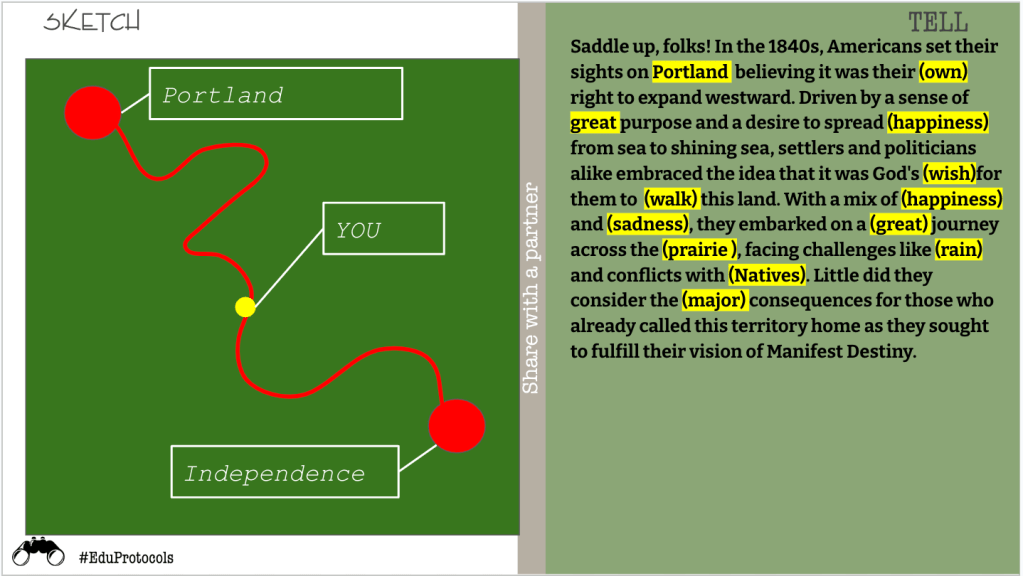
For the Mad Lib, I got on Claude AI and asked it to, “Write a one paragraph Mad Lib that blends westward expansion with the concept of manifest destiny.” It was a decent paragraph that I copied and pasted to a Sketch and Tell. The students that were able to do the Mad Lib seemed to enjoy it as it was something different. A nice mix up and change of pace. For those of you thinking, “How did they do with the noun, adjectives, and verbs??” The students did great with this because we have been practicing these skills recently with some 8pArts.
By the end of class, 90% of students completed their annotated map, some completed the Quizizz, and some completed the Mad Lib. Below are some examples.

Tuesday
On Tuesday we began the concept of Manifest Destiny. I looked at last year’s lesson and wanted to do something different. I began to think about a lesson I did with manifest destiny about 10 years ago…Below is my sequence…
Wicked Hydra
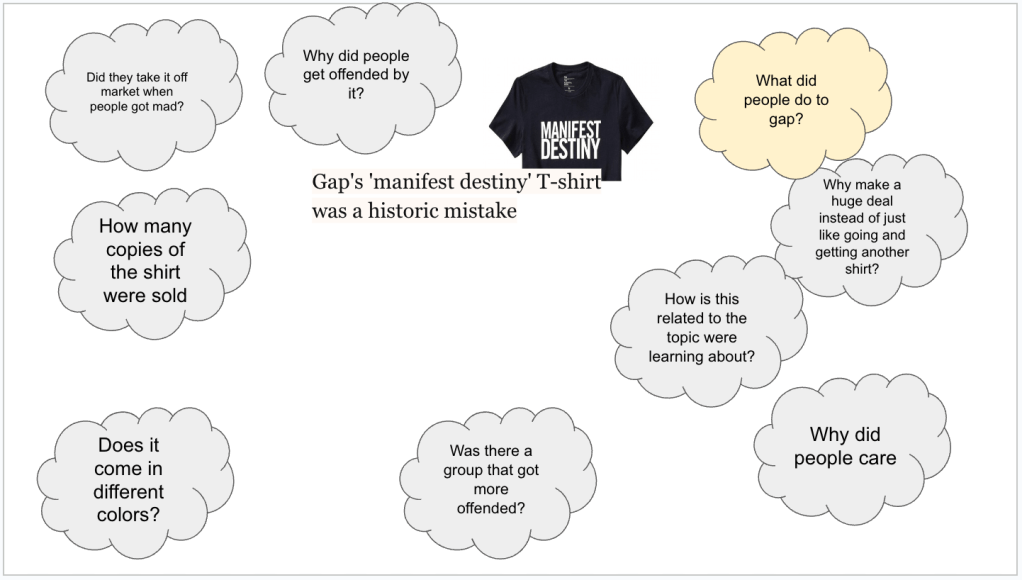
My lesson started off with a Wicked Hydra. In the middle of a Google Slide I typed a headline that read, “Gap’s ‘manifest destiny’ T-shirt was a historic mistake,” and placed this with a picture of the shirt. I had students working together asking questions about this headline. They have no background on manifest destiny or the Gap. Students were asking questions such as, “Why was it a mistake? What is the Gap? Why were people mad? What is manifest Destiny?” I wanted to see these types of questions. The Wicked Hydra immediately creates interest.
Thin Slide
Next in the lesson was a Thin Slide. I linked a short section of the textbook to thin slide and asked two questions, “According to the textbook what is Manifest Destiny? and If this is all people knew about Manifest Destiny, would they still be mad about the shirt?” Students read the textbook section to quickly gain some background information on manifest destiny. I set this lesson up to visit the textbook section again.

8pArts
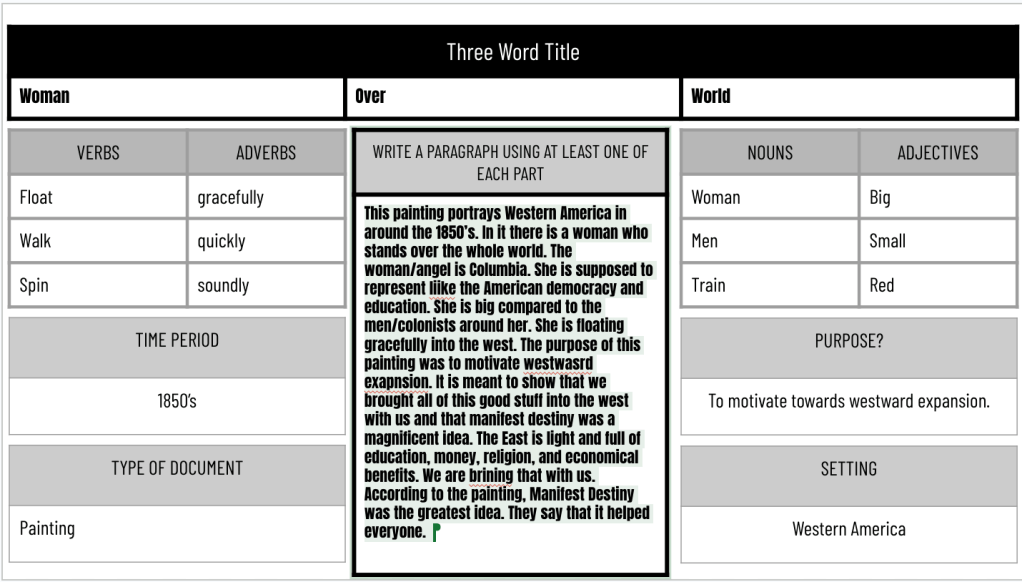
For the 8pArts I had students analyze the American Progress painting by John Gast. Students looked through image finding nouns, adjectives, guessing the time period, and the purpose. At the end of it all they wrote a brief summary of the image. We debriefed with a short discussion of the symbolism within the painting. I told the students, “If Manifest Destiny was an image, this is it.” Slowly I was building this idea of manifest destiny in their minds.

Wednesday
On Wednesday we continued our lesson on Manifest Destiny. I was hoping the Thick Slide would have been done on Tuesday, but we didn’t get that far.
Thick Slide
On the Thick Slide I shared a link to an article about manifest destiny. On the slide I included a table that asked students to list 3 reasons people might be offended by the Gap shirt. Students also had to share a quote from the article and explain its connection to manifest destiny. They had to include a picture that related to manifest destiny and they had to redefine manifest destiny from the Thin Slide. The article I included with Thick Slide was a combination of primary source quotes and analysis of Manifest Destiny.

Gap News Article and Compare
Next I had the students read the news article I grabbed the headline from. I paired this with a comparison slide from a CyberSandwich. Students read and compared the news article with the information from their Thick Slide.

Textbook Section
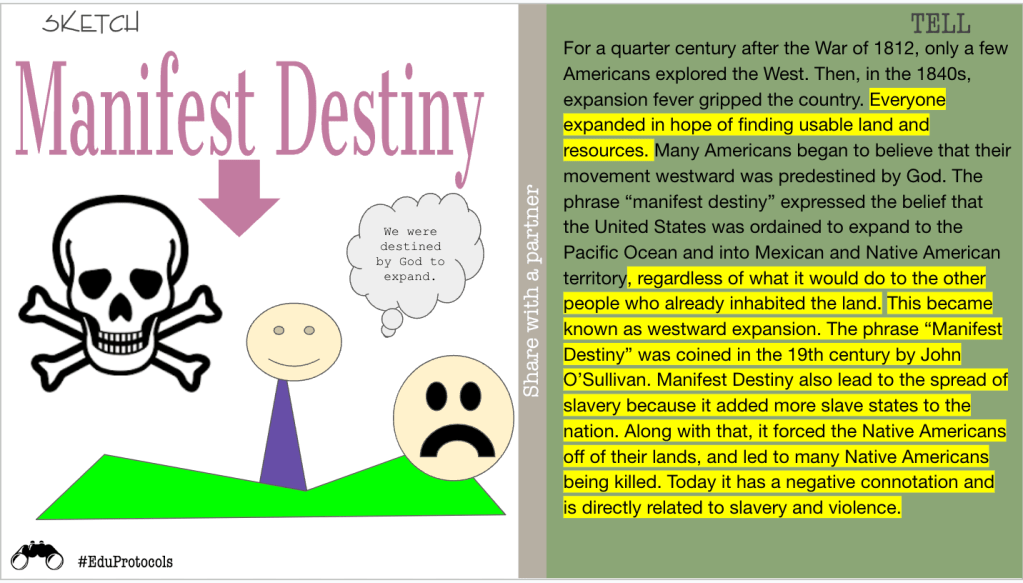
The last part of the lesson I had the students revisit the textbook section from the Thin Slide. I put this on a Sketch and Tell because I was out of town on Wednesday and wanted something to look familiar. I asked the students, “What else could you add to this textbook section to better inform people about Manifest Destiny? Highlight anything new you added.” They did an awesome job adding in more details. By the end of the lesson they had a better understanding of why the Gap t-shirt was offensive.

Thursday
Thursday’s class I began with giving the students an option – finish adding to the textbook section from Wednesday or take the Quizizz I had posted. At the end of 10 minutes we played a game from EMC2Learning called Dublin Details.
In this game I gave the students a topic and they had 2 minutes to write an 8 word sentence about that topic. No more, no less. When the timer went off, they found a partner. In the second round, they had two minutes and combined ideas with a partner to make a new 16 word sentence. For the final round, students created groups of four and had five minutes to combine their ideas into a 32 word mini-paragraph. At the end of of round 3, I had each group submit their mini-paragraph through Socrative. I chose the winning paragraph, explained why, and gave feedback.
This is my new favorite thing from EMC2Learning. We did a round on a random topic. Then we did a round on Manifest Destiny. This was truly an engaging activity.
Friday
On Friday I wasn’t at school as I flew out to Madison, Wisconsin for the WCSS Conference. Again, I wanted to leave a familiar lesson – this is why EduProtocols rock!! The articles from manifest destiny mentioned the Trail of Tears and Indian Removal. So, I left a lesson on the Trail of Tears.
I adapted a lesson from TCI called, The Trail Where They Cried. I copied and pasted the article to a Google Doc and linked it to the lesson. I also provided a differentiated copy of the reading. Plus, I recorded myself reading the article and linked the recording to the Google Doc.
The first part of the lesson I had the students read and put the events from the reading into a sequential order. The second part of lesson students fill out thought bubble from John Ross and Andrew jackson. What were the Cherokees and the American government trying to achieve.
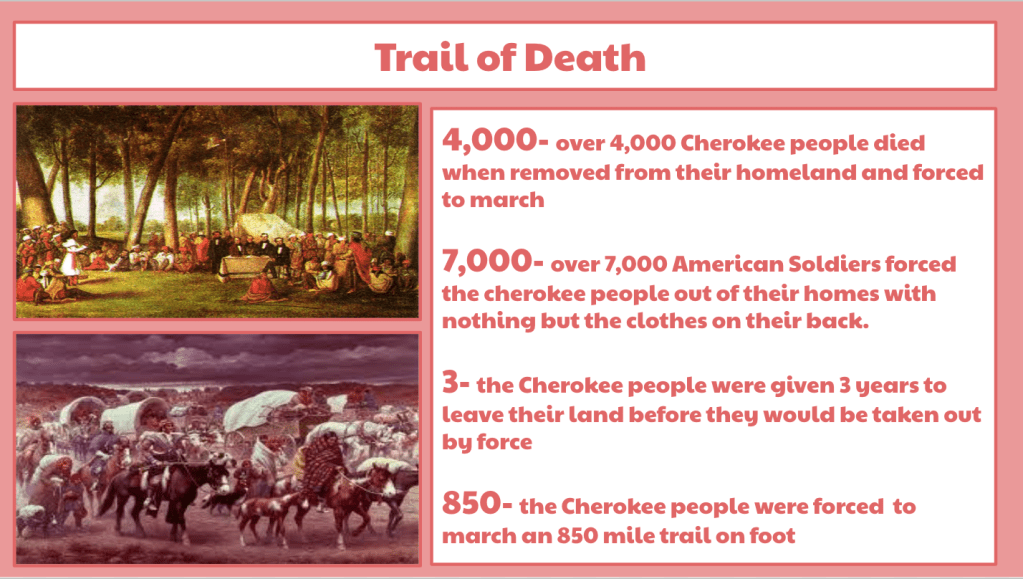
The familiar part of the lesson is a Number Mania. I like to set up Number Mania’s with a quote. I then have the students prove the quote true with number and facts from the article. For this particular lesson, students had to prove true this quote, “…the sufferings of the Cherokees were awful. The trail of the exiles was a trail of death.” This helps focus the students and the information. The students did an awesome job with their Number Manias and this lesson!



 Moler's Musings