
This week we continued with the War of 1812. I used a great lesson from Mr. Roughton called “Weigh the Evidence.” I thought this would be a great follow-up from Friday’s lesson about the War of 1812 and how James Madison responded to British impressment. I like this particular lesson because it was a refresher of the War of 1812 and it had students practicing writing a claim, using evidence, and reasoning.
We followed up this lesson with a lesson on the Monroe Doctrine. However, I had to leave town and needed to leave a self-sufficient lesson. I was also out of town Wednesday and needed to leave a familiar lesson. The goal was to end this unit this week so I can move on to something new. Since I was out, I left some hexagonal learning. This is something we have done at least 5 times this year. Each time my focus is getting the students to add more, be more descriptive rather than just restating the concepts in the hexagons. We also finished up the lesson with a Quizizz.
On Friday we wrapped up with a game. I didn’t feel like starting a new unit and then immediately go into the weekend.
Monday – Weigh the Evidence
Tuesday – Monroe Doctrine
Wednesday and Thursday – Hexagonal Learning, Quizizz
Monday
On Monday I wanted to keep the War of 1812 lesson going and I found a lesson from Mr Roughton’s website called “Weigh the Evidence.” In this particular lesson, there was a series of slides where I presented six artifacts related to the War of 1812 to the students. I then asked the question “Should the War of 1812 be considered a positive event for America?” I then went through the artifacts with the students and they had to determine which was a reliable source, which was useful, and which was not. They then rated each artifact on a scale from -2 to +2, with 0 meaning the evidence was not useful at all. This was a great lesson to work on analyzing primary sources, secondary sources, and thinking about what was decent evidence versus not.
We began by looking at the Treaty of Ghent, a Wikipedia page, an engraving showing the burning of Washington, statistics from a textbook on casualties, a parody movie trailer, and the song “The Battle of New Orleans” written by Johnny Horton. Students gave each artifact a rating and explained why they rated it that way. At the end, they added up their ratings. If they had a negative number they saw the War of 1812 as a negative event. If they had a positive number they saw it as a positive event. And if they ended up with zero, they had a decision to make.
I really like the structure of this lesson and the numerical rating system really helped students make an informed decision before writing their paragraph using claims, evidence, and reasoning. When it was time to write, I had the students type their paragraphs into a Google form to submit. I then downloaded the paragraphs, put them into Claude AI, and gave whole-class feedback. We discovered that our claims were pretty good as they were definitive. The use of evidence was also really good but our reasoning needed some work – it was often not developed enough or too basic. This was great feedback to give the students the next day.

Tuesday
On Tuesday I was only at school for half the day before I had to leave to catch a plane to New York. The last president we covered was James Monroe. With Monroe, we simply learned about the Monroe Doctrine – my goal is for students to understand its purpose before high school. In this lesson, I had students analyzing political cartoons related to the Monroe Doctrine. There were five cartoons I wanted them to examine. They could walk around viewing printed copies, access them on their Chromebooks, or I stapled packets together.
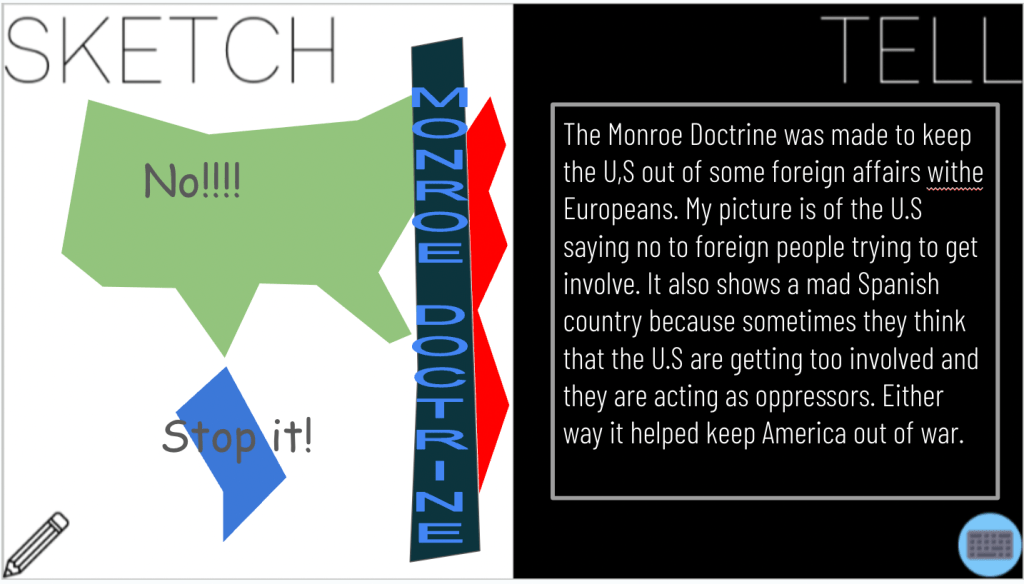
One by one, students looked at the images and made a prediction about what they thought the meaning or purpose of the Monroe Doctrine was based on the cartoon. After predicting, they watched an EdPuzzle video to check their understanding. I followed this up with a “sketch and tell” activity – students had to draw their own political cartoon showing the meaning of the Monroe Doctrine and explain it. We ended with a Thin Slide: “One thing you learned, one image, one word” to wrap up the remaining 8 minutes.




Wednesday and Thursday
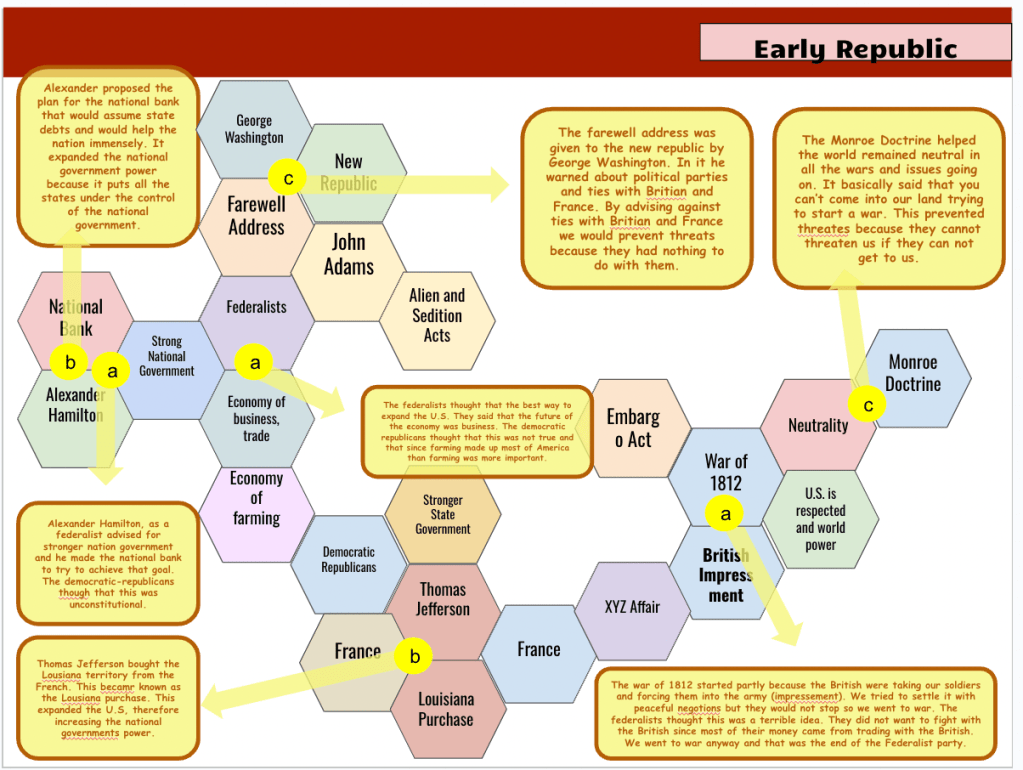
On Wednesday and Thursday, I wanted to wrap up the unit with a familiar activity since I was out on Wednesday attending an AI conference. When I’m gone, I’ve learned students engage better with familiar tasks rather than introducing something brand new. As a result, I left instructions for hexagonal learning. We have done this five times already this year. I like hexagons because the activity is flexible enough to be an assessment allowing students to demonstrate their learning in creative ways. With so many recent absences due to illness, it also works for students at multiple levels – I can tailor it as needed by removing or adding hexagons.
Some students I just asked to connect hexagons, others I asked to connect and share five things they learned. When I returned Thursday, students checked their work against a success criteria checklist I provided. Some criteria included: 3 connections explaining Federalist views, 2 connections showing how a president responded to foreign threats, 2 connections about strengthening national government. I also had a simpler checklist for struggling students: make 5 connections about anything learned.
We also discussed adding more descriptive detail, using transition words like “because” instead of just turning the hexagon text into a sentence. To wrap up, students completed a Quizizz mastery check. They had 10 minutes to earn at least 90% to demonstrate their knowledge.


Friday
On Friday, I found a review game on EMC2Learning rather than start something new before the weekend. The game was like Scattergories. I put up a topic like George Washington, Declaration of Independence, or Bill of Rights. A video scrolled through the alphabet and I stopped it on a random letter. Students had 2 minutes to brainstorm related words starting with that letter. We shared words in groups, some students had to explain connections back to content. It was fun, made them think creatively, and worked on listening skills as groups crossed off duplicate words.

 Moler's Musings