
This week was a 4-day week. We had class Monday through Thursday. There must be a lot of sickness going around because I’ve had a lot of student absences recently. Things just seem scattered and disorganized lately. I need to get myself back on track and find some consistency in my lessons and class structure again.
Much of my class focuses on the experience of being actively present within the class sessions and activities. Even though I am regularly using protocols and structured activities, it seems that when a student misses a day, they miss out on a lot of material, as the old adage goes. Having to create some Differentiated Instruction review articles and activities to catch some students up who have missed classes, it’s a quick and simple way to get them back up to speed.
This week we covered some important content. We examined Washington’s Farewell Address and then delved into learning about John Adams’s presidency, including studying the XYZ Affair and the controversial Alien and Sedition Acts.
Monday – 3xCER Farewell Address
Tuesday and Wednesday – XYZ Affair
Thursday – Alien and Sedition Acts
Monday
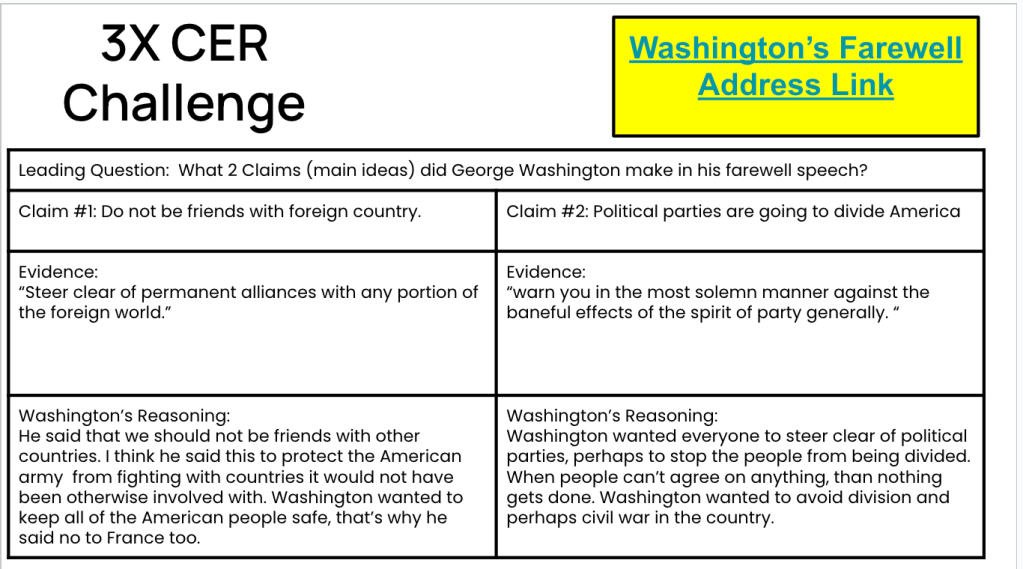
On Monday we analyzed Washington’s Farewell Address using a 3xCER protocol. I often use the 3xCER method when studying primary sources, as it has students focus on writing claims backed by textual evidence, and then explaining their reasoning.
In this particular lesson, we began class with a Thin Slide. In the Thin Slide, students had to look up one specific precedent that George Washington set during his presidency – 1 picture, 1 precedent. They had 3 minutes. I used this quick activity to set the context that Washington’s famous Farewell Address established precedents and advice that endured long after Washington left office.
Next, I gave students excerpts from the lengthy Farewell Address to read and analyze. Their task was to match sections of Washington’s address to comparable modern concepts and ideas. This helped them understand the still-relevant wisdom in Washington’s speech. I specifically pointed out Washington’s warning about the dangers of emerging political parties dividing the fledgling nation, as well as his admonition to avoid questionable “entangling alliances” with other countries.
I gave students 10 minutes to write their own claims about the address, citing textual evidence and explaining the meaning and their analysis in their own words. I incorporate study of the iconic Farewell Address for two key reasons: first, it’s valuable for students to closely read such an influential primary document that is still so often referred to even today; second, Washington’s parting words of wisdom to the nation provide helpful background context about factors that shaped later controversies and debates during the Adams and Jefferson administrations.
Since so many students had missed classes recently, I wanted to incorporate a retrieval practice review activity. We played a creative dice game where I would ask a question about content we’ve learned previously, roll several dice, and the students would then have to accurately summarize their response to my question in the exact number of words as the dice total. For instance, I might roll the dice and get an 18, then ask a question like “Who was George Washington and what was most important about his presidency?” The students then have 18 words to try to answer correctly. This fast-paced activity kept engagement high while reinforcing key knowledge.

Tuesday
On Tuesday we launched into learning about John Adams’s presidency, starting with the infamous XYZ Affair. I began the lesson with a Thin Slide and a linked reading that set the context by reviewing the contentious election of 1796, where Adams and his Federalist Party narrowly defeated Thomas Jefferson’s Democratic-Republican Party. Under the rules at the time, this made Adams President and Jefferson Vice President, even though they held very different visions for governing the young nation.
In the Thin Slide, I asked students to imagine how it would look if we still followed this election model today. They had an amusing time realizing that would put Biden in the White House and Trump right there beside him as VP! I used this as a discussion prompt to illustrate how much has changed, but also to preview the core theme we would keep revisiting: how much impact presidents and political parties had on shaping the nation, both then and now.
Next, students analyzed a short biography summarizing Adams’ early life and career before becoming president. To make this more engaging, they had to apply an archetype lens, examining Adams’ essential character traits, motives, and drivers using a framework often applied to literature characters. Choosing details from Adams’ pre-presidential life, students had to cite textual evidence to explain what archetype he aligned with most closely and why. As an extension, they compared and contrasted Adams’ archetype to someone in their own life exhibiting similar enduring personality characteristics and motivations. This activity prompted some insightful analysis and discussions about Adams and human nature more broadly.
I next introduced the major scandal that erupted during Adams’ term: the infamous XYZ Affair. This complex incident involved intrigue, international extortion plots, and heated political controversy.
To better understand the XYZ Affair and its impacts, I adapted a lesson plan developed by social studies teacher named Susan Gorman. Her approach made the scandal more accessible by having students examine primary source accounts and piece together the story like detectives. I paired her lesson concept with a CyberSandwich.
In my lesson, students had to closely read a set of fragmentary excerpts from witnesses and participants describing their view of events. As they analyzed each slice of the political drama, students filled out a graphic organizer, layering the pieces together into a coherent timeline. They had to deduce such key points as attempting to identify who the cryptically named French agents X, Y and Z were, why they tried to extort a bribe from America, and how the Adams administration responded.
The CyberSandwich provided helpful structure, allowing students to build up their understanding layer by layer as they progressed through the accounts. Once they read, notated and discussed the various perspectives, they then had to synthesize their learning by writing a summary reflecting their understanding of how and why this diplomatic crisis emerged. The interactive analysis and incremental building of knowledge about the XYZ Affair captured student interest while developing crucial historical thinking and primary source analysis skills.


Wednesday
We devoted the first part of Wednesday’s class to completing the XYZ Affair lesson to ensure students had thoroughly grasped the causes and sequence of events. After discussing their XYZ Affair summaries and analyses in small groups, I transitioned into the next phase of learning.
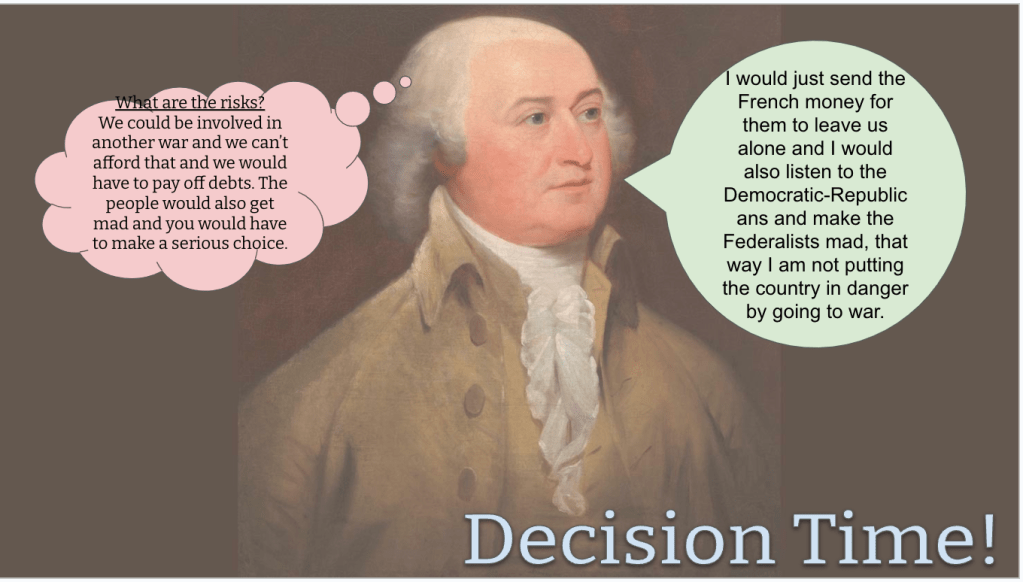
Even with the background factual knowledge from their summaries, students still did not know how President Adams chose to respond to the national crisis and inflammatory public fury sparked by the XYZ revelations. I wanted to simulate the complex decision making challenge faced by Adams to resolve tensions with France without triggering an expensive, risky war that the fragile young America could ill afford.
This reflective judgment activity compelled students to essentially attempt to re-enact Adams’ key decision points regarding the XYZ Affair aftermath. I emphasized that they needed to consider the context Adams faced at the time, based on geostrategic realities, the precedent of neutrality established by Washington, pressure from Adams’ Federalist allies urging war with France, and the perceived need to assert American strength abroad.
With these influential factors in mind, students had to actively debate and judge the wisest course for Adams by closely evaluating multiple options, national priorities, risks and trade-offs. I encouraged them to dig deeply into Adams’ perspective to try to see the situation through his eyes.
In one class, I noticed students racing through this complex deliberation far too quickly, finishing their recommended plan for Adams in just 5 minutes. This signaled they were not truly wrestling with the web of complications Adams had to balance and the judgment call he had to make amidst clashing viewpoints and shaky public morale.
So in the next class section, I deliberately walked students through the full scope of analytical thinking required for sound decision making of this magnitude. I used strategic questioning and patience to incrementally build their context, inquiry and cognitive engagement.
Through this guided interaction, I emphasized that as a Federalist, Adams faced immense pressure from within his own party to enter war against France. Yet he also had to weigh George Washington’s sage advice urging neutrality to give America’s fragile experiment in democracy time to stabilize. I thus set up an insightful realization that Adams was caught in an unenviable lose-lose predicament, with his Federalist allies threatening to desert him even as Republicans continued attacking his policies.
Pushing past knee-jerk solutions, most students dug deeper to thoughtfully grapple with Adams’ impossible situation. They finally realized the complexity of variables, trade-offs and paradoxes facing the president, needing 25-35 minutes of guided decision analysis rather than 5. We debriefed that such deeply consequential decisions require careful execution of critical thinking as much today as then. I ended class having students generate probing questions about the XYZ Affair which their classmates had to answer concisely, putting our debating and judgment skills to work!


Thursday
After analyzing Adams’ impossible decisions on avoiding war with France in the XYZ debacle, on Thursday we transitioned to examining a controversial set of domestic laws subsequently passed by the Federalists under Adams’ administration. Still alarmed by potential French revolutionary infiltration and attacks on American sovereignty after the XYZ Affair, the majority Federalist Congress passed four laws in 1798 collectively known as the Alien and Sedition Acts.
I opened this lesson by giving small student teams realistic scenarios describing French immigrants pathways into America during this volatile period. Teams had to rapidly discuss options and decide on the policy course they would set. This immediately set the context for the tensions and perceived threats posed by aliens and outsiders that in part prompted the Alien Acts.
We next examined the key provisions of these laws, which expanded the duration of residency requirements to 14 years before immigrants could apply for US citizenship. Students used Parafly EduProtocols to paraphrase the essence of the Naturalization and Alien Acts. We then examined a real case study that demonstrated the laws’ power in practice.
I described the fate of Congressman Matthew Lyon, an outspoken Republican critic of the Adams administration. Lyon had notoriously written that President Adams deserved to be put in a “madhouse.” For this perceived insult to the administration, Lyon was prosecuted and convicted under the controversial Sedition Act portion of the Alien and Sedition Acts.
I had students used a Frayer to investigate the meaning and examples of “sedition” more deeply. We analyzed an excerpt from the Sedition Act text itself using Annotate and Tell.
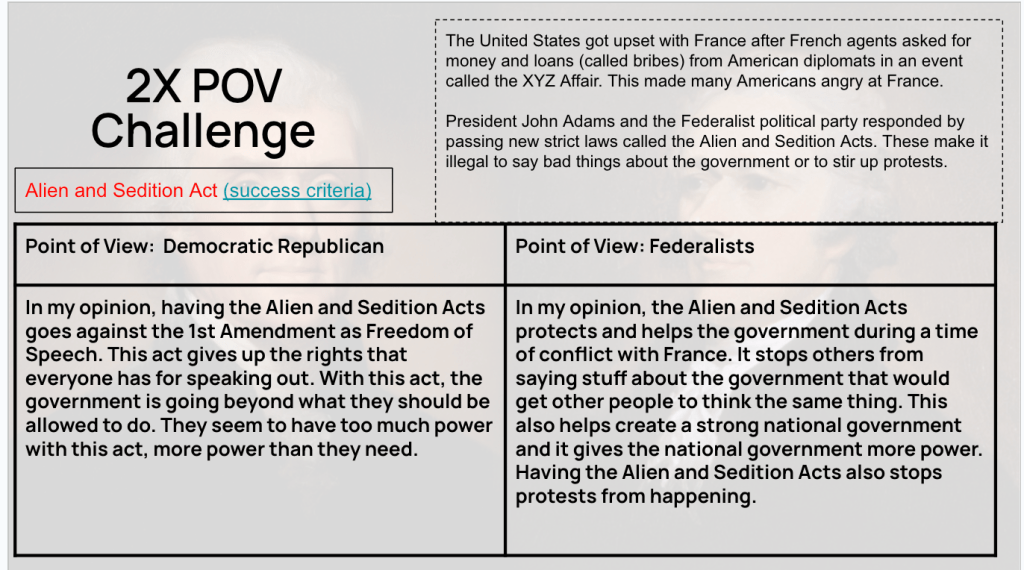
To synthesize their analysis, students wrote a short perspective 2xPOV from the vantage point of Federalists explaining why they strongly supported this law as necessary and proper.
In the last stage of the lesson, I flipped the script, having students write a rebuttal as Democratic-Republicans decrying the laws as hypocritical violations of constitutional liberties of speech, press and due process. By writing sequentially from contrasting political insider lenses, students gained a more balanced insight into the complex debate stirred by the Alien & Sedition Acts.
This multi-perspective analysis and writing task took up our entire Thursday class session. If time permitted by the end, we briefly revisited key concepts and historical figures from the week using the dice game as a quick closing review.
The XYZ Affair and Alien & Sedition Acts proved pivotal episodes in the Adams presidency that also encapsulated major themes of America’s early development. The inheriting tensions over centralized authority versus states’ rights, interpretations of checks and balances, and partisan efforts to control domestic dissent and international affairs resonate into modern U.S. politics. By enacting decisions Adams wrestled with using compelling primary sources and perspective-taking, students gained an enriched understanding of obstacles in governing a fragile new nation – insights equally relevant today.


 Moler's Musings