Introduction
Last Friday I wanted something easy and laid back – so we did a geography challenge where students labeled states and got an introduction to the New Republic unit. In the past years, I have done a blogging unit where students create a character who is part of the Federalist or Democratic Republican (DR) party. Then they learn about the first five presidents and blog about the presidents’ decisions from that party’s point of view. I decided to mix it up a bit this year but keep it somewhat similar. My essential unit question is, “How well did the major decisions under Washington, Adams, and Jefferson live up to the Federalist and Democratic-Republican visions for America?”
Monday – Federalists vs. DR, Gimkit
Tuesday – Hamilton and the Bank
Friday – Washington, Farewell Speech
Be sure to find the new EduProtocols Primary Edition from Jenn Dean and Ben Cogswell
Monday
To break down my unit, I first introduce the beliefs of the parties to the students. They learn about Jefferson and Hamilton. Next, I teach them about Hamilton and the national bank. Then we learn about Washington, Adams, and so on up until Monroe. On Monday, we began with a Fast and Curious where students completed a Gimkit about Federalists and DRs. The class averages ranged from 45% to 60%. The Gimkit had 12 basic questions.
Next, we followed up the Fast and Curious with a CyberSandwich where students read a one-page reading about Federalists and Democratic Republicans. Students read for 8 minutes and took notes. Then they compared their notes with a partner and thought of similarities. The differences were obvious. They struggled to think of similarities but they came up with: they were both political parties, they both had presidents representing their parties, and they both wanted what was best for America. Pretty good!.
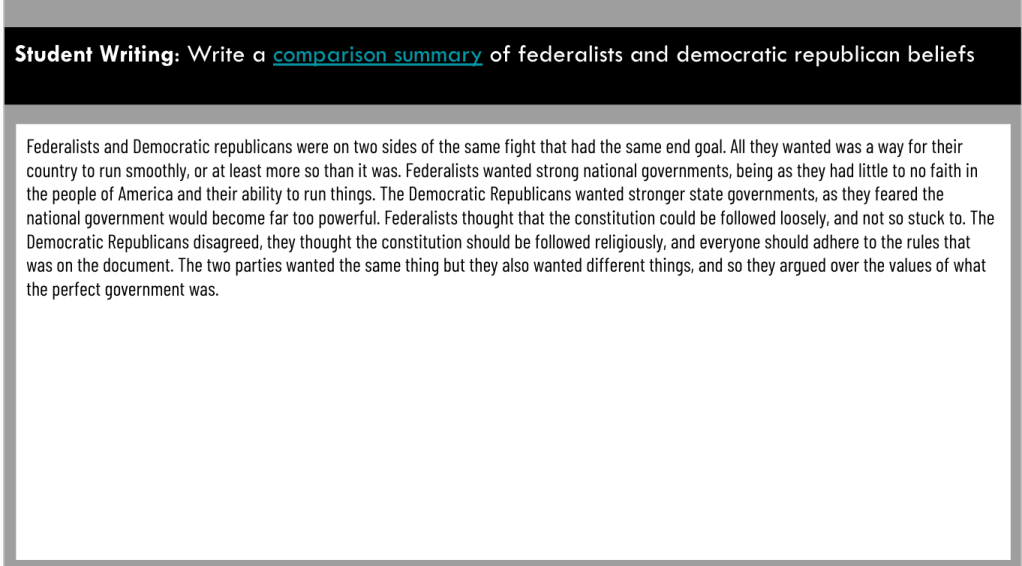
I decided to up the DOK level of the summary writing by asking the students to write their summary using a compare/contrast text structure. This built off a skill they were learning in Language Arts. I showed them they were getting great at writing paragraphs; now it was time to include transitional phrases that worked with a compare/contrast text structure.
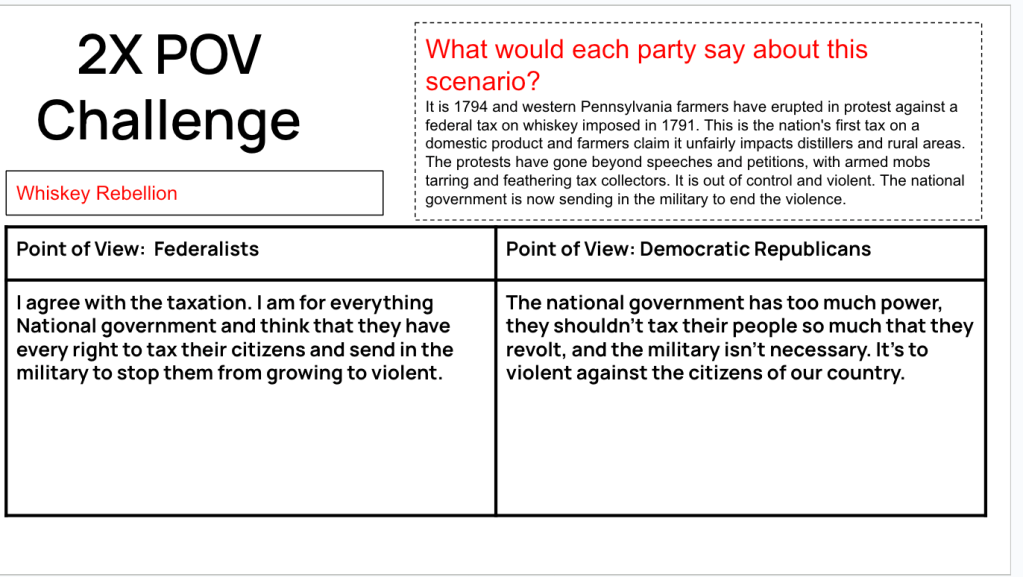
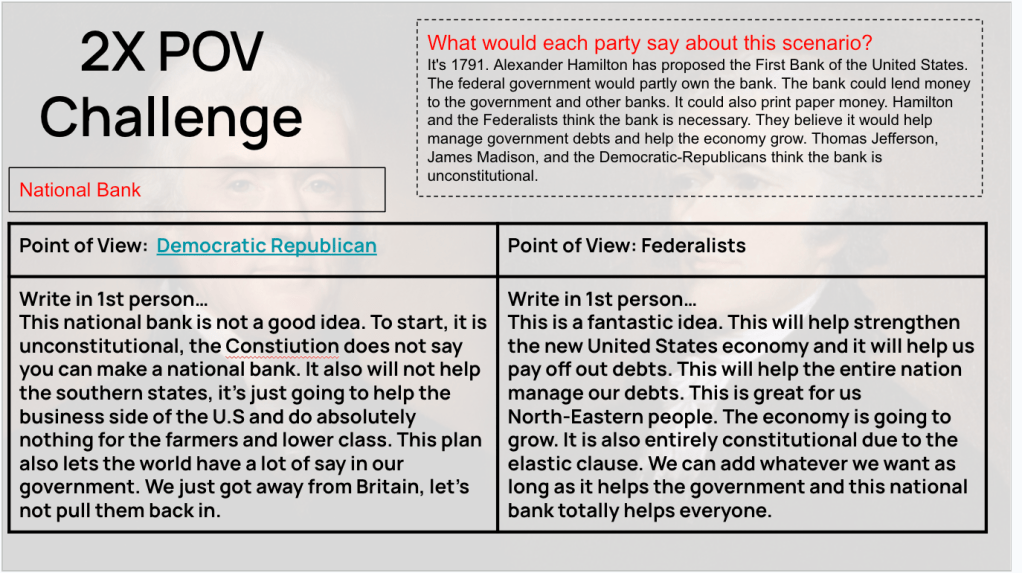
Lastly, we used a 2xPOV template from Josie Wozniak and I gave the students a scenario to practice writing from the perspective of a Federalist or Democratic Republican. I used Claude to generate a basic 3 sentence scenario about the Whiskey Rebellion. Students had to take the beliefs they learned about and apply them to understanding how a Federalist or Democratic Republican would respond to the Whiskey Rebellion. I was looking for responses that showed the Federalists wanted a stronger national government and that farmers needed to pay the tax. The Democratic Republican response I was looking for was that the government was too strong and the use of the military was too much for such a minor event. The students struggled with this a lot. I understand why………The start of this lesson with a Gimkit for recall was at a DOK 1 level. The concept sort and CyberSandwich are DOK 2. The 2xPOV is a DOK 3 level of learning, requiring strategic thinking and justification beyond factual recall. Students had to put themselves in the shoes of political party members to voice informed perspectives on an event. They would have to synthesize their understanding of party stances, priorities and fears to construct an argument around the Whiskey Rebellion from each viewpoint. So the students were struggling because sometimes classrooms fail to get past DOK 1 or 2. We ran out of time for another Fast and Curious activity.


Tuesday, Wednesday, and Thursday
We had an unusual schedule this week. I had a lesson on Alexander Hamilton with some Justin Unruh templates. The question for this lesson is: “Did Hamilton’s National Bank match the Federalists’ goals for the country’s economy?” The lesson for Alexander Hamilton had multiple parts:
- Archetype Four Square – Students watched a song from Hamilton the Musical or read a brief bio about Hamilton and applied an archetype to him. We use this for multiple reasons: to help students apply an archetype, making a claim and then using evidence from the video or reading to back up the claim. Then they make a connection to someone else in pop culture or history. Students are now making connections between people and/or events. The final reason we use this is that it helps with comprehension. When students can think of characters in terms of archetypes, it helps them predict behaviors and predict outcomes in a story.
- I provided context for the lesson, helping students understand that Hamilton was in charge of figuring out how to get the country out of debt after the Revolutionary War. I explained how he wanted to help people see the new government under the new Constitution was stronger and better and could resolve issues.
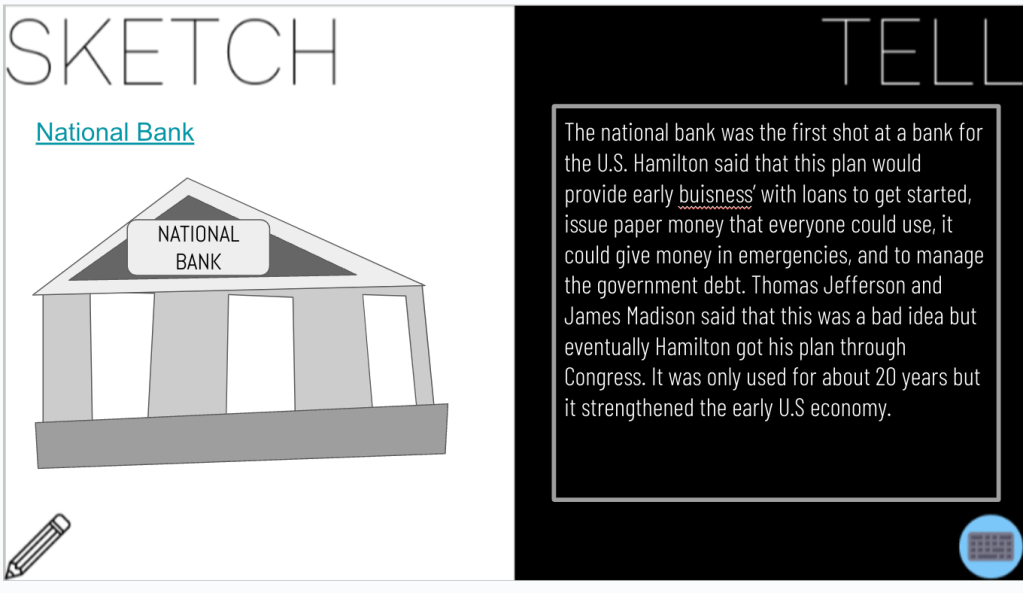
- Sketch and Tell – To help students understand Hamilton’s financial plan involving complex, abstract ideas like taxes and money, I had Claude AI create basic, quick readings about assuming debts, tariffs, excise taxes, and the national bank.
- I created a video explaining strict vs. loose interpretation and why Washington D.C. is located in the South between Virginia and Maryland.
- 2xPOV – Students completed another 2xPOV analyzing the bank from the perspective of a Federalist and a Democratic Republican.
Honestly, this lesson should not have taken over 3 days. But it did because my classes were all off schedule and I’m trying to get them closer together. For example, 2 of my classes are 2 days ahead of everyone. 2 classes are even in terms of scheduling and 1 class is 2 days behind.


Friday
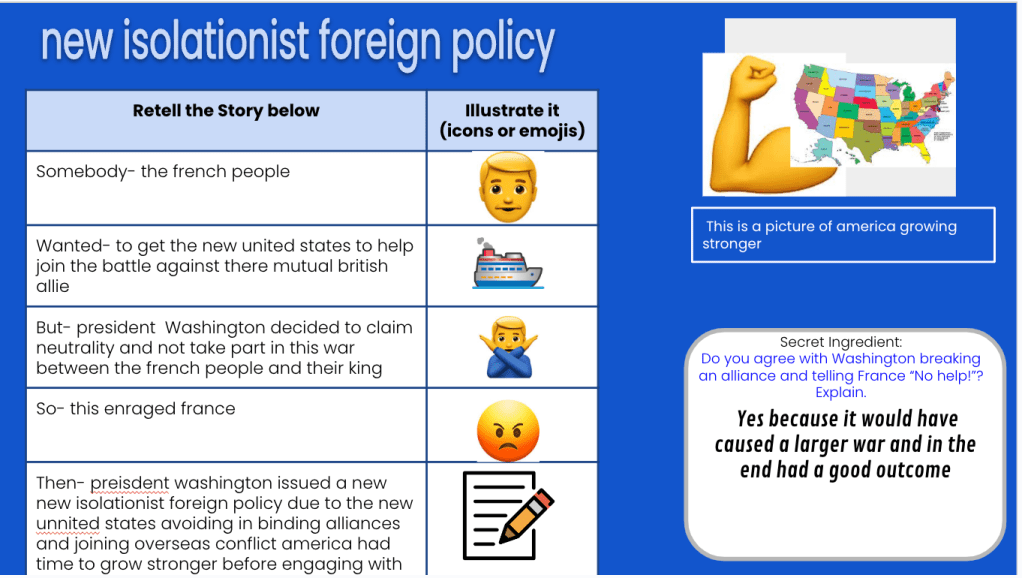
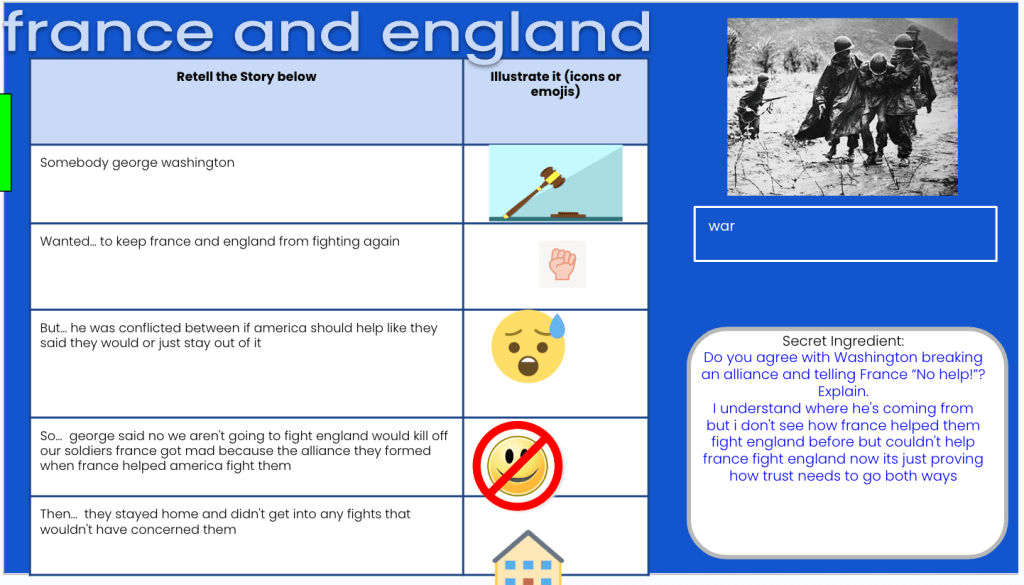
On Friday, we moved into Washington’s presidency. I asked: “Did Washington’s crackdown on the Whiskey Rebellion and neutrality stance favor the Federalists or Democratic-Republicans?” Students shared an Iron Chef slide with a partner. I explained if you can keep this “Somebody, Wanted, But, So, Then” framework in mind as you read, it will help you comprehend and remember what you read.
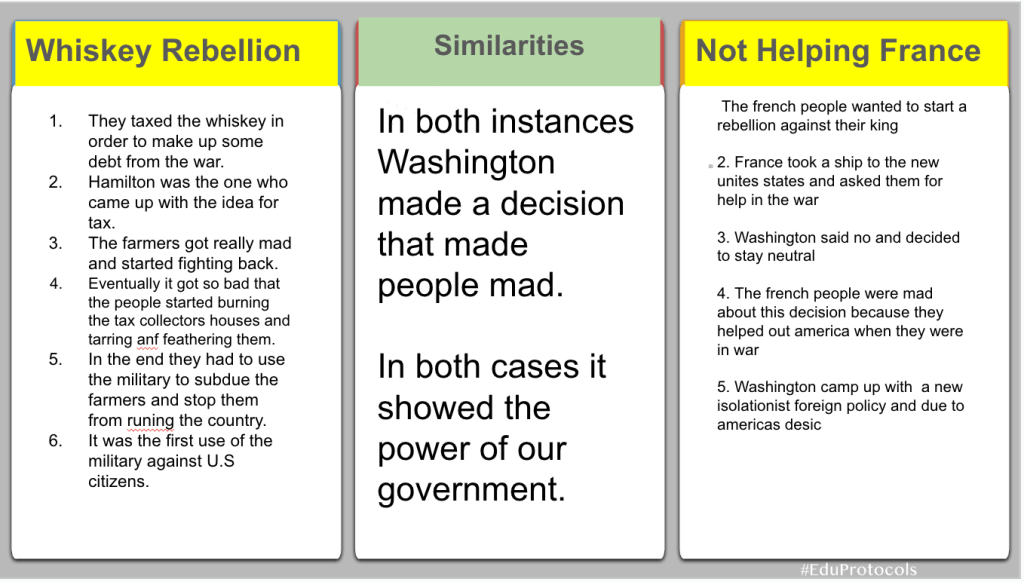
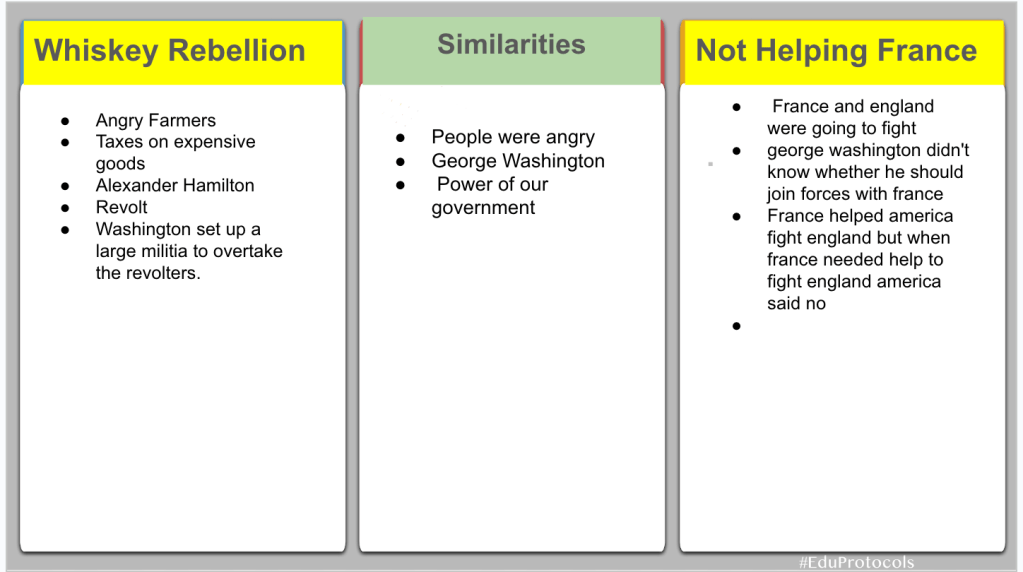
First, we discussed what a precedent is and what it meant. Then students had 3 minutes to find and share a precedent Washington set. Next, students shared a slide, with one reading and creating a slide about the Whiskey Rebellion and the other reading about neutrality. After 14 minutes, they taught each other their topics and compared the domestic (Whiskey Rebellion) and foreign policy (neutrality) issues.
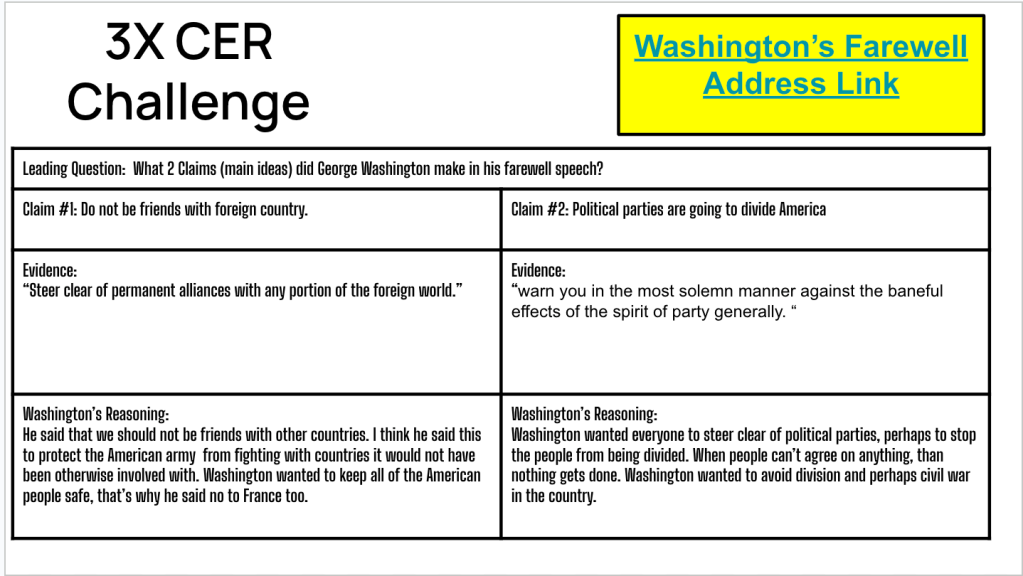
Finally, they completed a 2xPOV responding to either topic from the Federalist and Democratic Republican perspectives. For one class, we had 15 minutes left and completed a 3xCER about Washington’s Farewell Address, with students matching paraphrased parts to quotes from the speech. Then they used claim, evidence, and reasoning to answer: “What 2 main ideas did Washington make in his speech?” I was impressed!






 Moler's Musings