
Introduction
This week was a short school week due to the MLK Day holiday and a couple snow/cold weather days. We only had classes on Tuesday and Wednesday. This has prolonged our unit on the Constitution, but such is life sometimes.
I’ve been focusing lessons on the separation of powers and system of checks and balances between the three branches of government – legislative, executive, and judicial. Based on informal assessments, it seems many students are still struggling to grasp the distinct roles and powers of each branch.
When I asked my classes why they think they’re having trouble with this topic, here’s some of the feedback I received:
“It’s hard to relate to this old government stuff.” “The questions about what each branch does are confusing.” “Some of the test questions don’t seem to match what we talked about in class.”
I’m still puzzling over these challenges a bit. I tried to make the content more engaging and relatable by using a lesson that compared the branches of government to the Avengers. Students seem to connect better when there’s a pop culture hook. The quiz questions came straight from the readings and class discussions, using the same key terms and concepts. I aimed to keep the ideas basic and straightforward.
It’s possible the interrupted schedule lately disrupted continuity for learning. Or maybe this group of students just needs more concrete examples and connections to grasp the concepts. Every class has a different dynamic. I rarely teach the exact same way year to year since each group of kids comprehends ideas differently. While some concepts click right away with students, others require more refinement of lessons and activities over time. This is all part of the learning process!
Tuesday – Fast and Curious, 3 Truths and 1 Lie, Branches SuperHero
Thursday – Checks and Balances
Tuesday
On Tuesday, we returned from a long holiday weekend ready to get back into our Constitution unit. I started off classes by having students complete a Gimkit called “Fast and Curious” for the third time. The goal was to see if scores improved after more time spent learning the content. The class averages were 71%, 72%, 76%, 64%, 70% and 75%. There was a bit of a range, but overall the scores remained fairly consistent.
After that quick review, we went over the “3 Truths and 1 Lie” slides (template created by Dominic Helmstetter) about the branches of government that students completed last Friday. I compiled their work into an 11 slide deck that I displayed in slideshow mode. For each slide, students had to analyze the 4 statements and decide which one was the lie. They recorded their guess and reasoning on an organizer worksheet. Once everyone made their prediction, I advanced to the next slide that revealed the correct answer.
To wrap up class, students had time to finish up their “Branches of Government Superheroes” project. For this creative assignment, they chose one of the three branches and developed a superhero alter ego to represent that branch. Their job was to name their superhero, design costume accessories, and come up with 3 unique super powers connected to the roles and responsibilities of their branch.

Thursday
On Thursday, we took the “Fast and Curious” Constitution quiz yet again. I informed all classes that if we could get above 80% overall AND everyone answers at least 15 questions, we’d be done with the quiz for good. The class averages this time were: 81%, 83%, 84%, 74%, 81%, and 83%. Success!
Last year when we started checks and balances, I jumped right into an escape room activity. However, reflecting on that, I realized more scaffolding was needed first. So I put together a series of protocols using templates from Justin Unruh to build background knowledge.
- First students completed Frayers for the vocabulary words “impeach” and “override.” We reviewed the definition of a Frayer Model and why analyzing key terms helps reading comprehension. For both terms, students paraphrased meanings in their own words, provided examples, and demonstrated proper usage by writing original sentences. I emphasized that vocabulary knowledge aids retention of civic concepts.
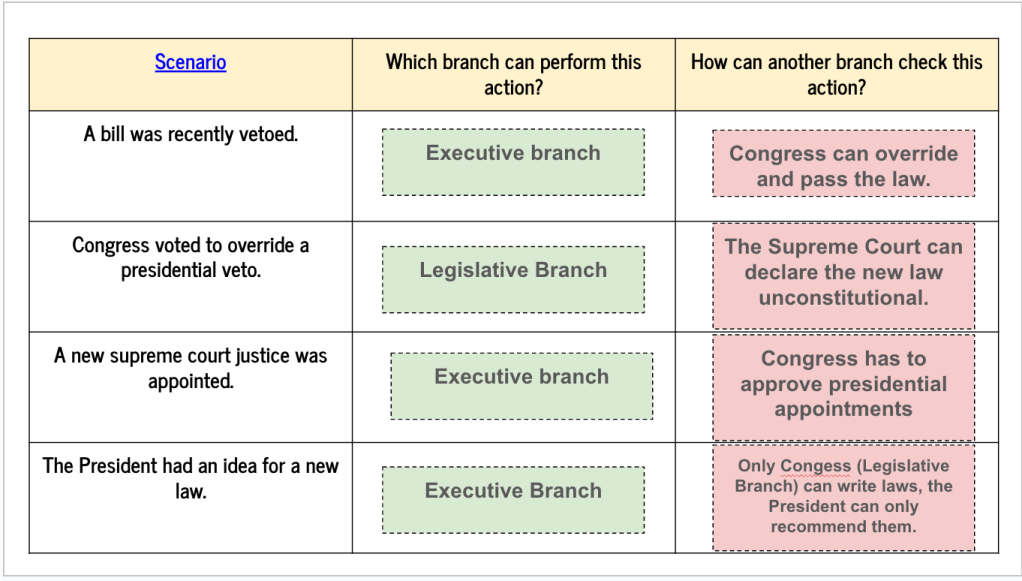
- Next, I gave each student a detailed checks and balances chart categorizing actions available to each government branch, alongside branches with checking power. Students read three basic scenarios that required inferring nuanced applications of checks and balances. For example, I had the scenario of, “A potential bill was vetoed.” Students ahd to figure out which branch of government could veto a bill. Then they had to figure out which branch of government could check that action.
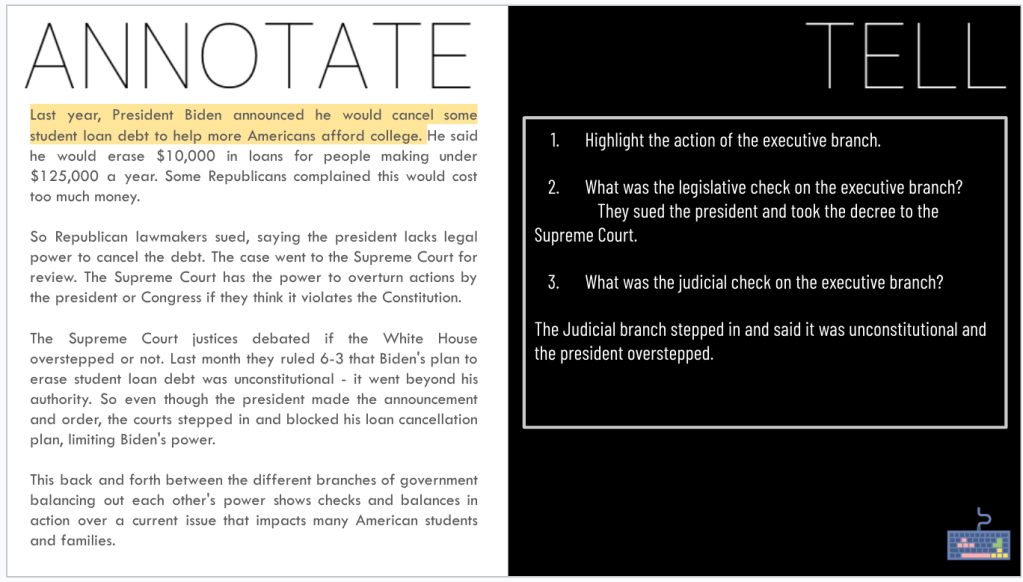
- Students then examined 3 AI-generated short stories based on recent controversies that activated checks and balances: Trump’s impeachment, Obama’s gun orders, and Biden exploring student debt cancellation. After annotating key executive actions, students completed analysis questions per story such as: How did the legislative branch check the president here?
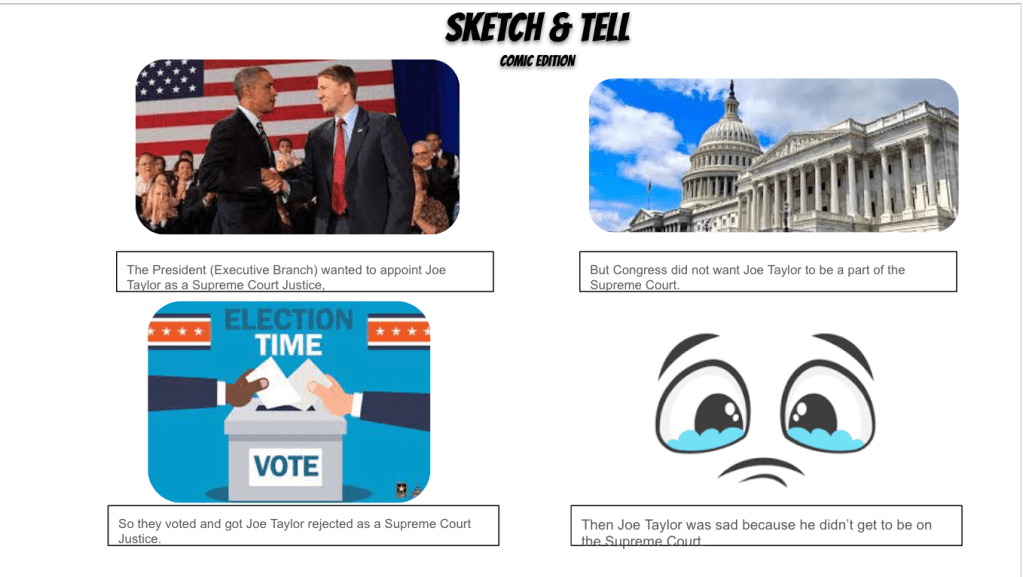
- Finally, I used a Sketch and Tell comic framed with “SWBST” (Somebody, Wanted, But, So, Then) storyboarding technique. Students illustrated either an original scenario demonstrating checks/balances or chose one AI generated story from the earlier activities to depict visually. As they shared out creations, they articulated detailed descriptions of multiple characters across branches interacting via through checks and balances.
I really liked how all the racked and stacked EduProtocols worked with each other. The vocabulary, sorting examples, and AI stories set them up to demonstrate understanding by creating their own check/balance tales. Everything intertwined for deeper comprehension.



 Moler's Musings