
Introduction
Thursday was our first day back from Winter Break. I wanted to ease my 8th graders back into learning while laying the groundwork for my favorite social studies unit on the Constitution and government. In this blog, I’ll reflect on the activities, assessments, and data from this first critical week back as we dive into the content that makes up the foundation of our democracy.
Thursday – Gimkit
Friday – Repuzzler, Frayer, Gimkit, Thin Slide Study Guide
Thursday
To welcome students back gently after break, I started with 10 questions from the citizenship and naturalization test related to the topics we’ll soon cover more deeply. I choose questions connected to what we learn about the Constitution, including:
- The idea of self-government is in the first three words of the Constitution. What are these words?
- What is an amendment?
- What do we call the first ten amendments to the Constitution?
I asked these 10 questions aloud at the beginning of class, and students wrote down their answers on paper. I let them know the goal was to try to get 6 or more questions correct. Out of my 129 students, only 7 managed to meet that 6 correct answer threshold. The average score was a 3.2 out of 10. This pre-assessment showed me we have a mountain of learning ahead in this unit! But I was not discouraged because I know from experience that scores tend to start low, leaving lots of room for growth.
In addition to the verbal quiz, I also asked students to rate 8 key vocabulary words as “Know It”, “Not Sure”, or “Don’t Know” on a Google Form. The words I included were: separation of powers, checks and balances, republic, federalism, veto, amendment, popular sovereignty, and limited government. These concepts represent the building blocks students must master to develop civic literacy and understand the structure of American democracy. The results from having students self-assess their grasp of vocabulary highlighted several areas of focus for my instruction going forward.
Friday
Armed with clear data on student pre-knowledge, I was able to design targeted instruction for the rest of the week. My goal was to directly address gaps while continuing to ease students back into learning through engaging, collaborative activities.
On Friday, I decided we would review some of the vocab words students rated as least familiar on the Google Form. To make it interactive and get students collaborating, I used a creative Repuzzler activity in small groups. Repuzzlers require piecing vocabulary words and definitions back together correctly, almost like a puzzle. The tactile, game-like nature of this strategy hooked students as they worked to match terms like federalism, separation of powers, popular sovereignty, checks and balances, and limited government accurately. The pieces students were matching together involved the word, definition, three connecting words, and a symbol. I rack and stacked Repuzzler with a Frayer and Fast and Curious.
After about 10 minutes of circulating to check understanding and give feedback, I transitioned the class into a digital Frayer Model template. This followed nicely from the Repuzzlers they had just completed sorting and defining. I utilized a Frayer Model template designed by Amanda Sandoval and the lesson within the Frayer was designed by Katie Cherney. (Find this information in the EduProtocols Facebook Group) In addition to the standard Frayer elements defining terms, 3 connecting terms, and historical context, I tweaked the template to also include an emoji representation of each concept along with a justification connecting the emoji back to the vocabulary word. Having students represent abstract government concepts with emojis encouraged creativity and forced deeper connections with the content. Each student was responsible for completing one section of the four-square Frayer template for each term. They chose which component they wanted to own at the beginning by selecting an assigned color. This made accountability built right in, as their part couldn’t be complete until they personally filled in their component across all five vocabulary word slides. My hope was students would paraphrase the definition and use the 3 connecting words from the Repuzzler cards at their desks.
To wrap up class, we closed with another fast-paced quiz review game using Gimkit. When comparing to their scores playing Gimkit on Thursday the scores dropped somewhat ranging from 68% to 79% correctness. Of course, these scores are likely skewed somewhat lower than they would have been if all my students had been there both days rather than having absences. But the activity served its motivating purpose to review key concepts at the end of a vocabulary-focused week.

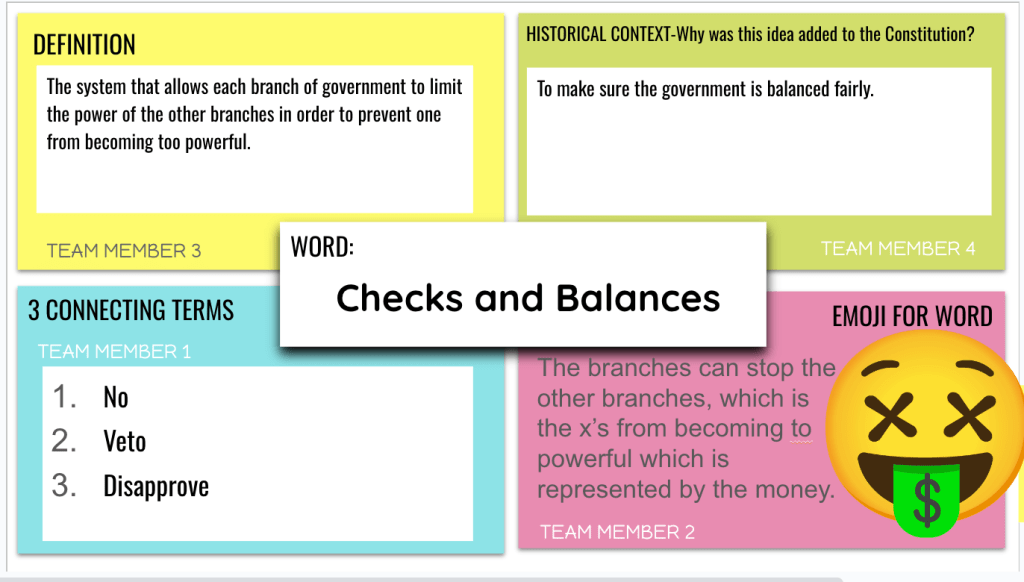

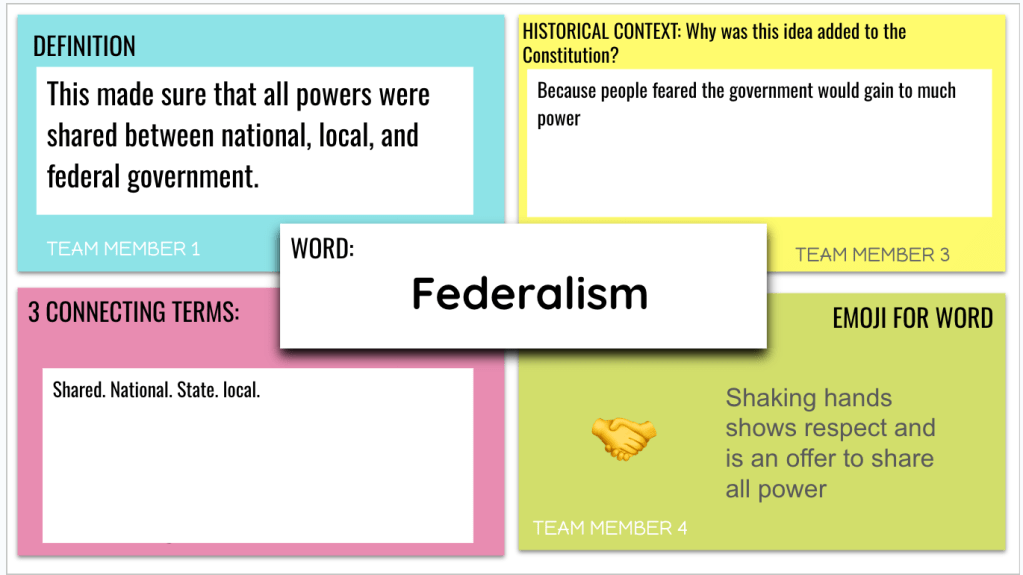
(In two of my classes, I am trying a Thin Slide Study Guide instead of the Frayer. With the Thin Slide Study Guide, students work in groups of three to four. The claim a slide, paraphrase a definition, and add a picture. After 3 minutes, they claim someone else’s slide and add a new definition, and new picture.)


Reflections on Week One
Stepping back to reflect on this first critical week of my favorite unit, I am pleased with how students eased back into learning while we established essential baseline knowledge to build on in the weeks ahead. Starting with informal verbal pre-assessments before diving into vocabulary self-evaluation and collaborative review activities aligned perfectly to target instruction to what my students needed most.
The concrete data I can extract from assessments like the 10 question Constitution quiz, vocabulary knowledge self-ratings, Repuzzler comprehension checks, and Gimkit review quizzes will empower my planning for next week’s lessons. I feel equipped to address gaps in prior knowledge while harnessing student energy to dig deeper into Constitutional concepts. My next step is developing activities crafted around the essential question my AI assistant Claude and I formulated over break: “How does the structure and content of the Constitution aim to prevent abuse of government power?” I can’t wait to further unpack the intricacies of checks and balances, separation of powers, federalism and more with my 8th graders in this vital unit on the underpinnings of American democracy!

 Moler's Musings
Did they complete the definitions and such before doing the repuzzler? Or did you have that done ahead of time & they just completed the repuzzler?
LikeLike
They completed definitions on the repuzzler – then paraphrased them again on the frayer
LikeLike
Thank you! I’ve used the repuzzler before & have really liked it!
LikeLike