This week was an unusual one. On Saturday evening I tested positive for COVID, so I knew I would be staying home. To make matters worse, it was an awkward time for teaching. Our last day before Christmas break is December 20th, so I couldn’t start a new unit only to then have 2 weeks off. The other option was to introduce some new EduProtocols with smart starts, but that works better when I’m actually in the classroom.
After contemplating options, I decided to put together some lessons on local history. I created a lesson about Utopia, Ohio, a small town about 25 minutes from our school that has always fascinated me. I also designed a 1794 newspaper analysis activity that connected to several topics we covered first semester. To wrap up the week, I used a fun Christmas sweater template shared with me by Katie Cherney. Despite the challenges, we made it through the week with some decent learning. I just took everything day by day, tried to communicate often and give feedback with Screencastify, and we got down whatever we could get done. The biggest takeaway from dealing with COVID over the past few years is this: It’s just school – it’ll be okay.
Monday – Thick Slide
Tuesday – Utopia, OH
Wednesday – Centinel News Lesson
Friday – Gimkit, Ugly Sweater Template
Monday
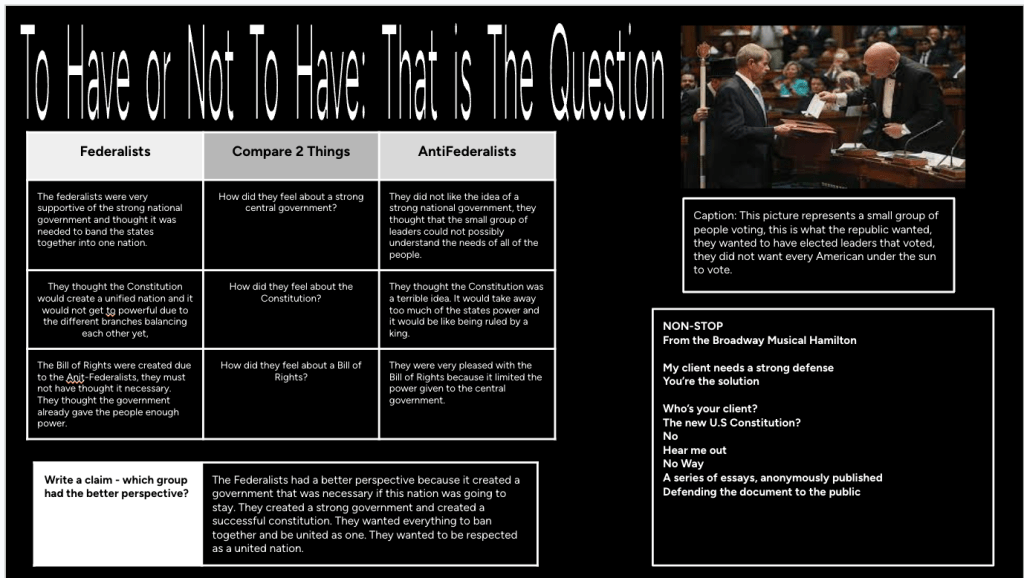
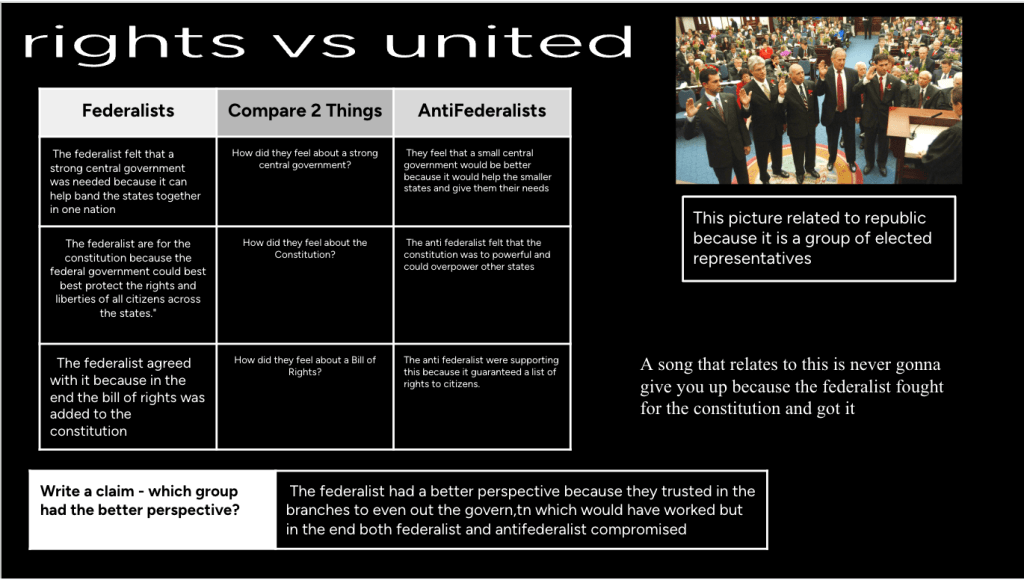
On Monday, students needed to finalize their analysis of the debates between Federalists and Anti-Federalists. Since I was isolated and struggling, I quickly pulled together a lesson using some of Justin Unruh’s EduProtocol templates. It consisted of an Annotate and Tell and a Parafly Smash where students read descriptions of Federalists and Anti-Federalists, highlighted textual evidence to answer a question, and then paraphrased their highlights.
The second part was a concept sort – students read quotes and decided whether a Federalist or Anti-Federalist would have said that. Finally, the assessment was a Thick Slide. I originally created a basic Thick Slide but then added more DOK 2 and 3 prompts to push critical thinking, such as:
- Create a title related to the main argument over ratifying the Constitution
- Compare the perspectives of Federalists and Anti-Federalists, develop a claim about which group had the better position, and use evidence from the chart to support your claim
- Find a picture that represents a republic and use the caption to explain how it connects to the idea of a republic
- Share a song that relates to a key belief or attitude held by Federalists or Anti-Federalists and explain the connection, providing specific evidence from the song
- You can read more about adding DOK 2 and 3 to Thick Slides Here
The song reference really puzzled some students and most didn’t attempt it, which is fine – sometimes I leave certain challenging things in to see who will step up and try it out. Overall I was very pleased with the Thick Slides they created.
Tuesday
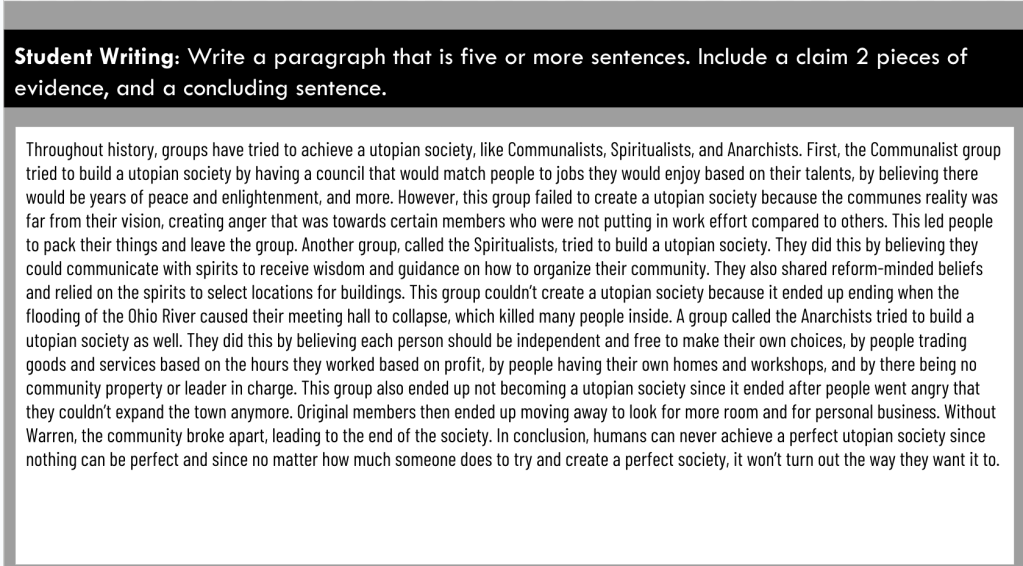
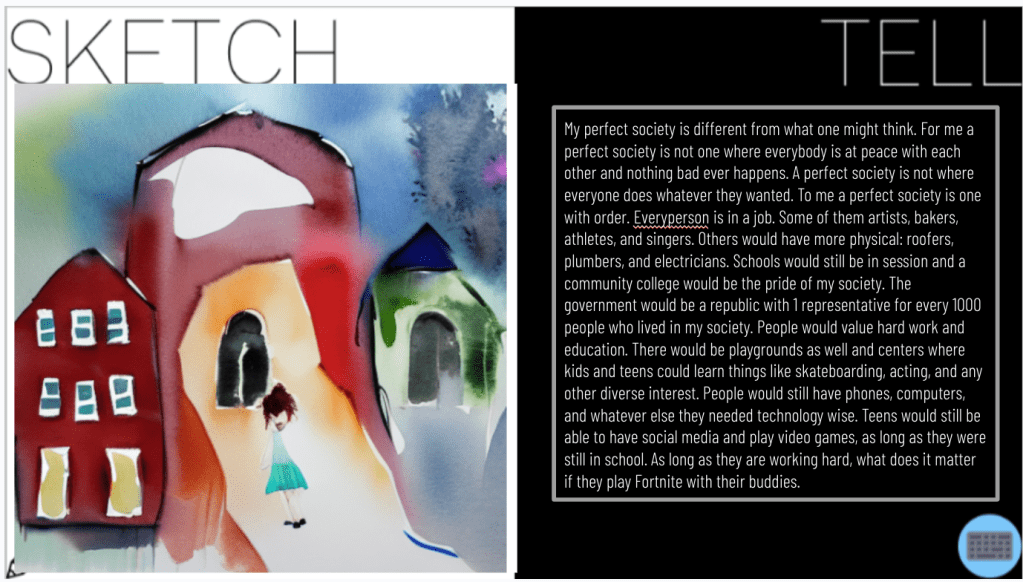
On Tuesday, I used the lesson I had developed over the summer about the history of Utopia, Ohio. I posed the question “Can humans ever achieve a perfect society?” My goal was to have students structure an answer using evidence from the stories about Utopia.
The lesson began with a Sketch and Tell where I asked students to design their vision of a perfect society using Scribble Diffusion or Google Shapes and then explain their creation. Next, they watched a short video giving historical background on Utopia. After that, they filled out Frayers on the three groups that attempted to build perfect communities in Utopia in the 1840s. I had AI generate ideas for the Frayer prompt boxes focused on defining each group, their characteristics, how they tried to create an ideal society, and why they ultimately failed.
I really enjoyed teaching this lesson and plan to use it for years to come. The connection to our local area made it engaging for students.




Wednesday – Thursday
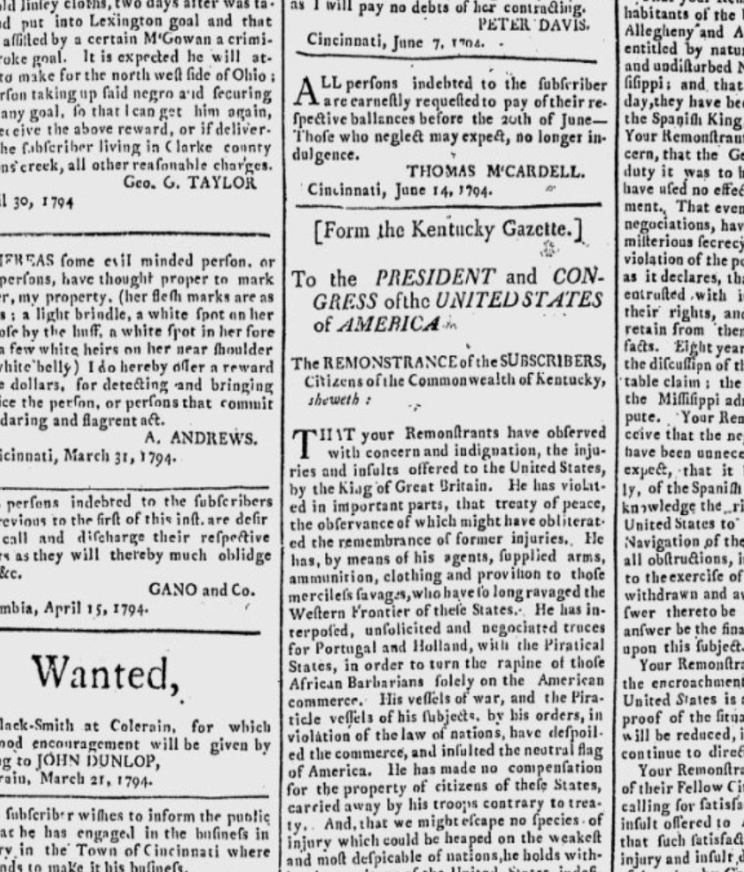
For my next activity, I leveraged the fact I recently learned that the first newspaper published in the Northwest Territory was printed near Cincinnati in 1793. The Centinel of the Northwestern Territory operated until 1800 and scans of the original issues still exist online. However, the text is difficult to read given the spelling, formatting, etc. So I used AI to translate a front page from July 21, 1794 for me:
- I took a screenshot of the front page
- Uploaded to Google Keep and used Grab Image Text
- Copied and pasted the text into Claude AI
- Asked Claude to summarize and explain the news stories
- HERE IS A VIDEO TO LEARN MORE ABOUT THIS
The translated stories covered a $10 reward for an escaped slave (freedom seeker), a husband publicly condemning his wife for leaving him, stolen and rebranded cattle, and Kentucky settlers angry that British settlers were supplying weapons to Native Americans and blocking access to the Mississippi River. All of these connected to things we’ve already studied in class.
For the lesson, I posed the question “What do the different social, political, and economic stories in this early newspaper suggest about life in Cincinnati in 1794?” Students read the stories and made Thick Slides, identifying one story and classifying it as social, political or economic, listing two details from each story, explaining what it revealed about life at that time, creating a related image and caption, putting four key events we’ve learned about in chronological order, connecting one of those events to a news story, and finally writing a paragraph answering the lesson question. This stimulated great thinking, although making connections between the news stories and class content was a stretch for them. I will keep this lesson to use again but make a few tweaks next year.


Friday
Returning to the classroom Friday, I had two goals – review first semester learning with a Gimkit game and then provide a fun holiday activity using an Ugly Christmas Sweater template shared by Katie Cherney. For the Gimkit, I told students that if the class average reached 80% everyone would earn a 100%. Below that thresholds were: 80-100% = 4/4, 70-79% = 3/4, 60-69% = 2/4, below 60% = 1/4. I always give 0.5 instead of 0 since I refuse to give zeros. The class averages were: 84%, 81%, 84%, 68%, 70%, 88% – pretty good!
We’ll finish customizing our historical event sweaters when we come back from break on Monday. Despite having to teach from home, it ended up being a pretty successful week of learning.

 Moler's Musings