
This week we wrapped up out unit on the Constitutional Convention. Starting with Monday, we dissected the Electoral College, sparking some questions. Tuesday and Wednesday were dedicated to a three-part assessment, integrating hexagonal learning on paper and 3xCER reflections.
Thursday introduced Federalists and Anti-Federalists, and here’s where EduProtocols played a pivotal role. We used a Gimkit Fast and Curious, 8pArts primary source analysis, Frayers, and a Sketch and Tell activity. The EduProtocols framework injected dynamism into our exploration.
Finally, on Friday, we navigated government preferences using EduProtocols like Frayers, a concept sort, and an annotate and tell session. Join me as we unravel the layers of each day and reflect on the effectiveness of our instructional choices.
Monday – Quizizz, Thick Slide
Tuesday – Hexagonal Learning, 3xCER, Quizizz
Thursday – EduProtocol Lesson Collection (ratifying the Constitution)
Friday – EduProtocol Lesson Collection (SHEG Lesson), Gimkit
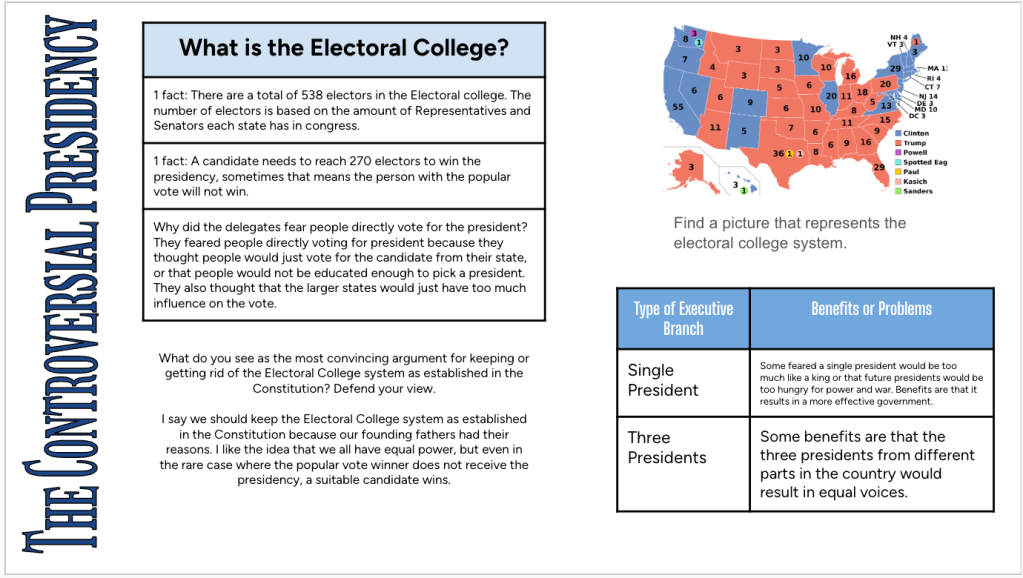
Monday: Decoding the Electoral College
Our week commenced with a focused exploration into the intricate workings of the electoral college. To kick things off, I presented a Thin Slide that posed a deceptively simple question: “Two people ran for president – Candidate 1 got 66 million votes for president. Candidate 2 got 63 million votes. Who should win the election and why?” The unanimous response from students was in favor of Candidate 1 due to their higher vote count.
However, the big reveal came when I showcased the 2016 election data from www.270towin.com, exposing the fact that Candidate 2 was Donald Trump, who secured the presidency despite receiving fewer popular votes. This revelation ignited curiosity and set the stage for a deeper dive into the electoral college.
We examined the electoral college map, prompting questions about the varying values assigned to different states and the origins of these values. I explained, “Different states are worth different amounts of points based on their number of representatives,” leading to a moment of connection for some students who grasped the analogy between losing representatives and losing electoral votes.
Capitalizing on this newfound interest, I encouraged students to predict why the founding fathers opted for an electoral college system. Subsequently, students delved into an article to validate or revise their predictions. Class concluded with a Thick Slide summarization and a Quizizz session incorporating questions related to the Great Compromise, 3/5ths compromise, and the Electoral College.
Monday was more than an introduction; it was a strategic unraveling of a complex system, leaving our students with both questions and a solid foundation to build upon in the days to come.

Tuesday and Wednesday: Assessing and Reflecting
In the midweek stretch, we transitioned into a comprehensive three-part assessment to gauge our understanding and encourage critical thinking. The assessment aimed to evaluate the success of the constitutional convention and provided an opportunity for students to reflect on their learning from the past six class periods.
Part 1: Hexagonal Learning on Paper
Tuesday kicked off with the first part of our assessment—a hexagonal learning activity on paper. Students were tasked with cutting out hexagons, arranging them, and adding missing details related to the unit. This hands-on approach aimed to reinforce connections between different concepts and promote a holistic understanding of the material.
Part 2: Evaluating the Constitutional Convention
Moving on to the second part of the assessment, students delved into the central question: “Should the constitutional convention be considered a success?” Using a 3xCER framework, they crafted one claim in favor of it being a success, one against, and finally, one expressing their personal opinion. The emphasis was on substantiating each claim with evidence drawn from lessons covered over the previous six classes.
Throughout this process, I encouraged students to ponder, “Whatever evidence you have that proves it to be a success—what makes it successful?” This critical reasoning added depth to their reflections. While the paper-based approach provided a tangible change, the logistical challenge of maintaining a uniform pace between the paper and Chromebook options surfaced.
Part 3: Quizizz – Recapitulating Six Days of Learning
The assessment concluded on Wednesday with a Quizizz session encompassing questions related to the entirety of our six-day journey. Covering topics such as the Great Compromise, 3/5ths compromise, and the Electoral College, this segment aimed to consolidate knowledge and reinforce key concepts.
This comprehensive Quizizz provided an opportunity for students to showcase their understanding of the intricate details we explored throughout the week. The results would not only serve as a measure of individual comprehension but also guide future instructional decisions as we ventured further into the complexities of our curriculum.
Thursday: Navigating Federalists and Anti-Federalists with EduProtocols
Thursday unfolded as a deep dive into the realms of Federalists and Anti-Federalists. To streamline the exploration, I drew inspiration from Justin Unruh’s EduProtocols templates, infusing engagement into our lesson plan.
Setting the Stage with a Compelling Question:
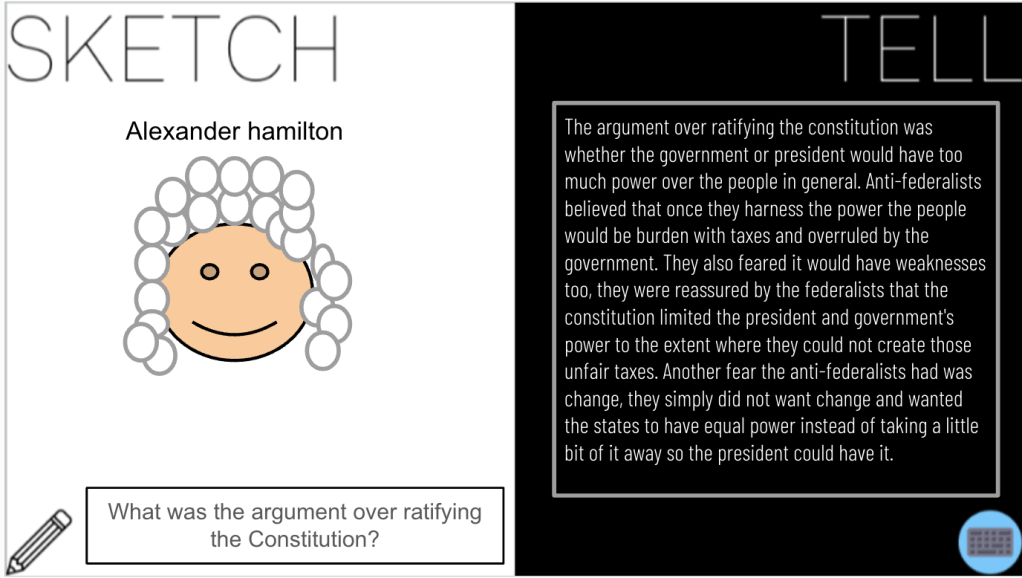
The day commenced with a pivotal question: “What was the argument over ratifying the Constitution?” This set the tone for a thought-provoking class.
Part 1: Gimkit – Igniting Interest:
To engage the students right from the start, we began with a Gimkit session. The initial class averages were noted as follows: 52%, 75%, 52%, 54%, and 63%. This interactive approach not only sparked interest but also served as a baseline for the progress we would see throughout the lesson.
Part 2: 8pArts Primary Source Analysis – Digging Deeper:
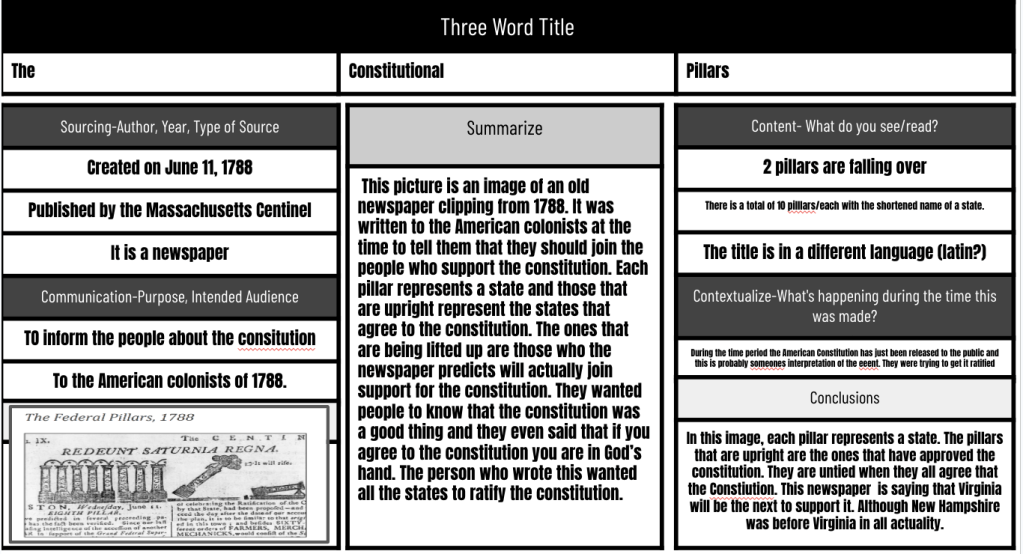
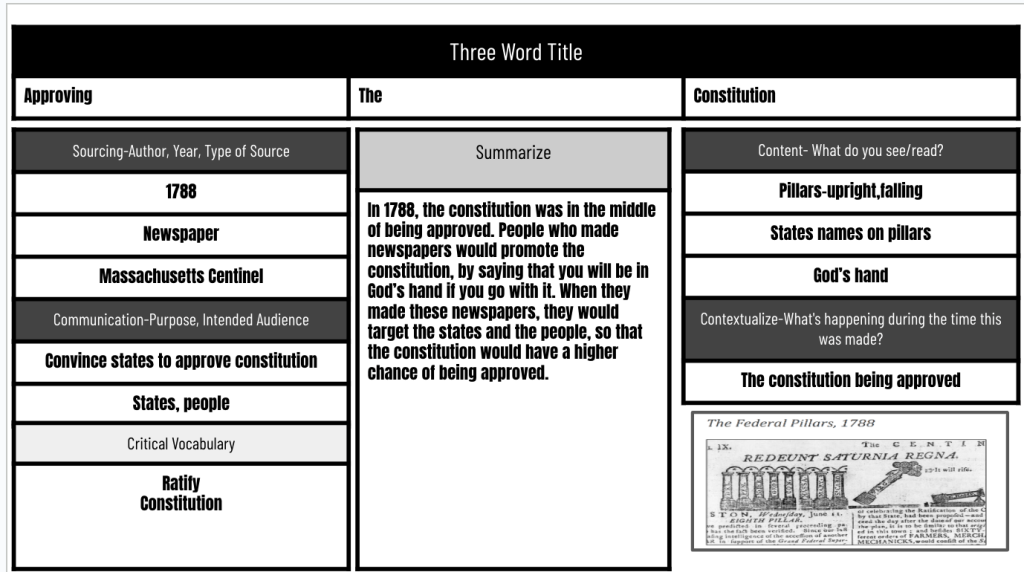
Building on the momentum, we delved into an 8pArts primary source analysis, focusing on the Federal Pillars image. I provided background information, emphasizing that nine states were needed to ratify the constitution, and some individuals expressed dissatisfaction with the final document. This visual analysis aimed to deepen our understanding of the sentiments surrounding the Constitution’s ratification.
Part 3: Frayers – Visualizing Federalists and Anti-Federalists:
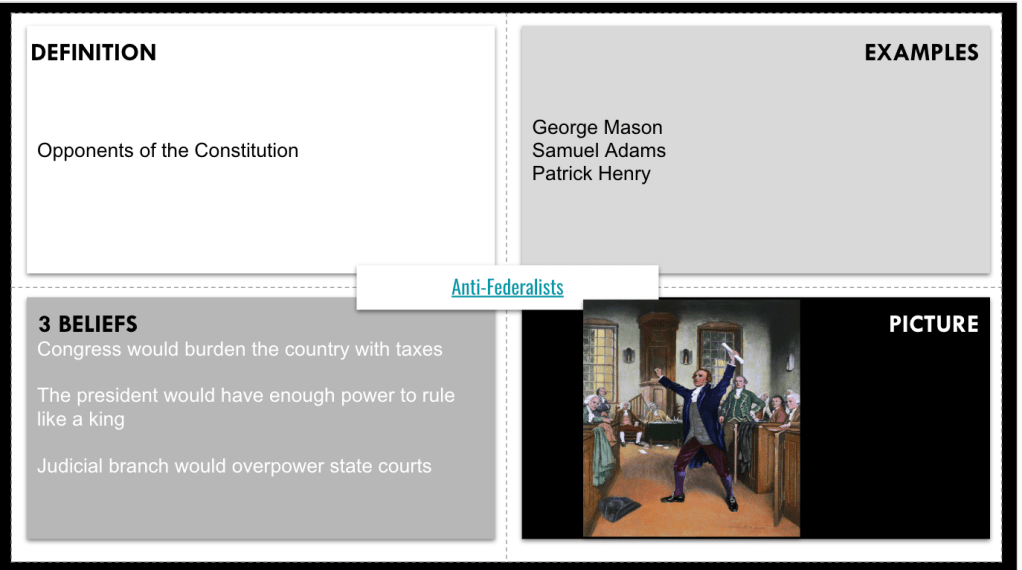
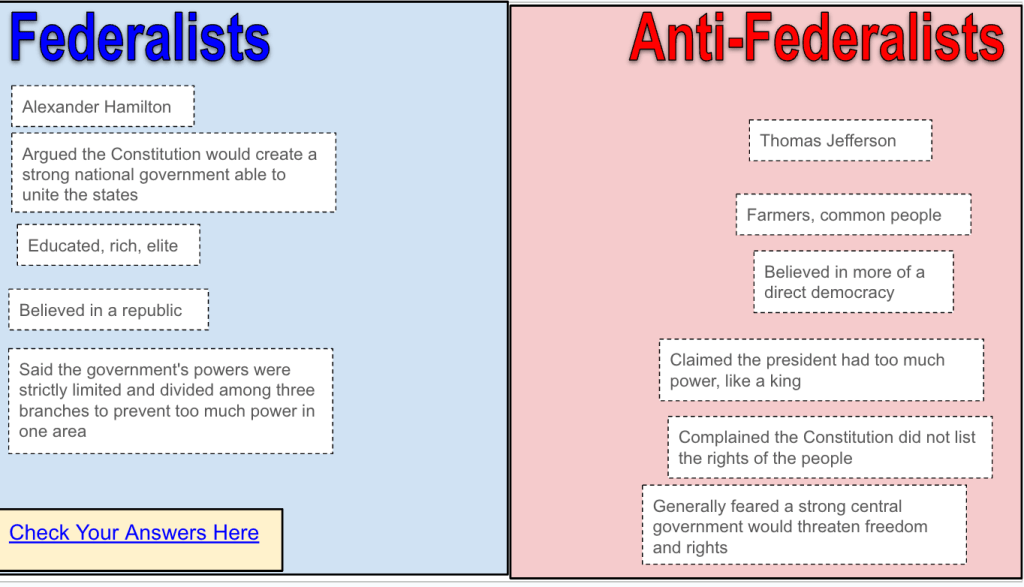
Next, we navigated through two Frayers, shedding light on Federalists and Anti-Federalists and encapsulating their respective beliefs. The visual and interactive nature of this EduProtocols activity offered a tangible representation of these historical figures, fostering a clearer comprehension of their ideologies.
Part 4: Sketch and Tell – Personal Reflections:
To wrap up the session, we engaged in a Sketch and Tell activity. Students sketched out and articulated their responses to the initial question, “What was the argument over ratifying the Constitution?” This not only encouraged creativity but also provided a platform for students to express their evolving understanding of the subject matter.
Closing with a Gimkit:
The day concluded with another Gimkit session, and the class averages showcased a remarkable improvement: 85%, 90%, 80%, 87%, and 93%. The interactive nature of EduProtocols, coupled with thoughtful discussions, not only elevated engagement but also reflected a deeper grasp of the content.
Thursday’s lesson demonstrated the effectiveness of EduProtocols in making complex topics accessible and engaging for our students. As we delved further into Federalists and Anti-Federalists, the groundwork laid on this day paved the way for nuanced discussions and a deeper exploration of historical ideologies.



Friday: Unraveling Government Preferences with SHEG and EduProtocols
Friday unfolded with a strategic combination of Justin Unruh’s templates and Stanford History Education Group (SHEG) lessons, creating a dynamic session that navigated the government preferences of Federalists and Anti-Federalists.
I began the day with a thought-provoking question: “What types of government did Federalists and Anti-Federalists prefer?” This central query laid the groundwork for our exploration into the perspectives held by these historical groups.
Part 1: Frayers – Understanding Republics and Direct Democracy:
To establish a foundational understanding, we began with two Frayers—one focused on Republics and the other on Direct Democracy. This visual exploration allowed students to dissect and internalize the key characteristics of these government systems, providing essential context for the day’s discussions.
Part 2: Concept Sort – Organizing Characteristics:
Students then engaged in a concept sort, organizing characteristics of Federalists and Anti-Federalists into the appropriate categories. This interactive exercise encouraged critical thinking and prompted students to draw connections between theoretical principles and the historical figures we were studying.
Part 3: Annotate and Tell – Analyzing Primary Source Letters:
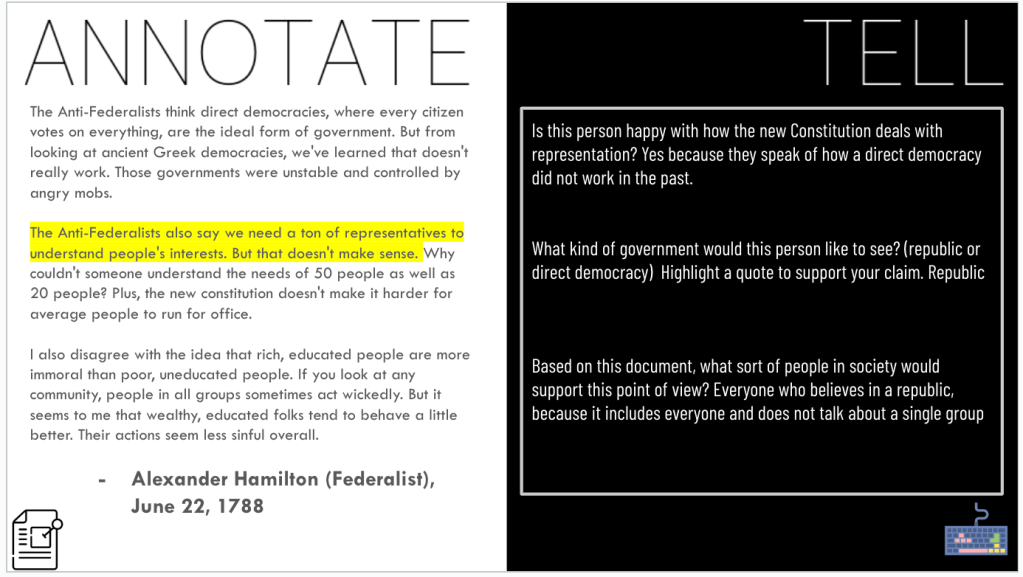
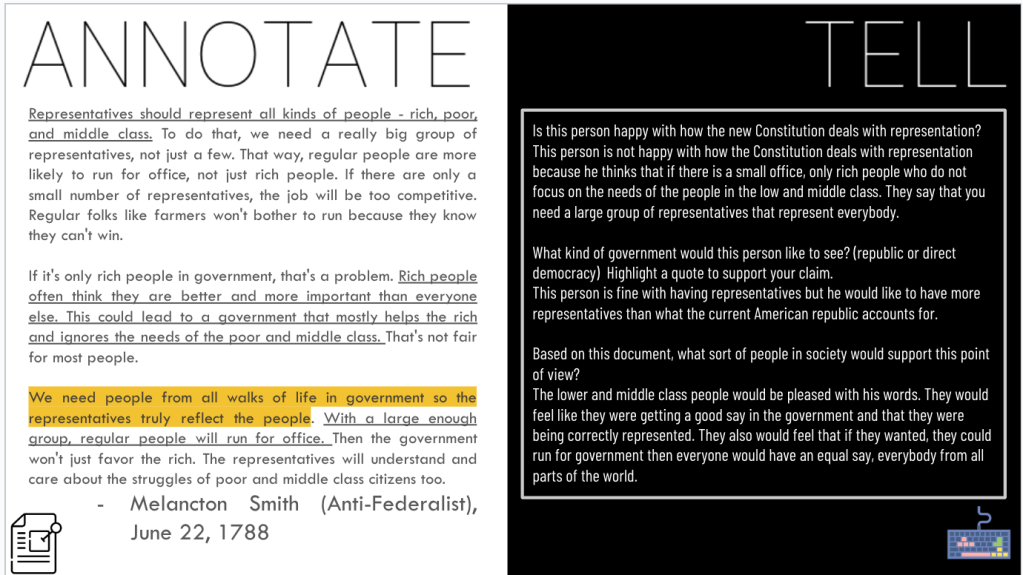
Our exploration involved an Annotate and Tell activity. Students read letters—one from an Anti-Federalist and another from a Federalist—and answered questions related to the content. The task included highlighting text evidence to support their responses.
This activity aimed not only to decipher the personal opinions and arguments of these historical figures but also to emphasize the stark contrast in their preferences. I wanted students to understand that Federalists supported a government where a few, rich, elite, and educated individuals could represent the masses, while Anti-Federalists leaned toward stronger local governments, almost resembling a direct democracy, but not quite.
Reflection on Government Preferences:
As we navigated through these primary sources, I left the students with a task—reflecting on the government preferences of Federalists and Anti-Federalists. I’m going to use Monday to explain that Anti-Federalists wanted a government with more common people involved. More representation among the people. Close to a direct democracy, but not quite.
Closing with a Gimkit:
To gauge understanding and reinforce key concepts, I set up a Gimkit for a check of comprehension. The overall average from the five classes came in at an impressive 83%.


 Moler's Musings