This week we continue the American Revolutionary War. After last Friday, leaving off with weaknesses and strengths of the continental and British armies, we searched ahead and learned about some battles. On Monday, it’s mentioned in the Ohio standards for eighth grade social studies that in terms of the Revolutionary War, students need to have an understanding of key battles and their significance, along with people that contributed to the American Revolutionary War. I guess I understand why battles and people are included here. It used to be that we would learn about the causes of the Revolutionary War, and there was no standard whatsoever about the war itself; it was kind of weird. But now they’ve incorporated having students understand battles and people, and part of me, I don’t know why, feels the need to cover some of these basics of battles and some of the groups of people that contributed to the war. So, on Monday I did a quick lesson on Nearpod about significant Revolutionary War battles.
On Tuesday, it was election day and we had no school. Wednesday we continued with groups of people that contributed to the Revolutionary War. These groups included women, African Americans, and Native Americans. We did a Cybersandwich eduprotocol with this. On Thursday, we did an awesome review game that I got from EMC2learning which involved having students make connections. Making connections between historical people and events is a really tough skill for students to be able to do, and that’s why I really like this review; it’s just a different version of hexagonal thinking—think of it as a gamified version of hexagonal thinking.
On Friday, I was not at school but I left a final assessment Thick Slide eduprotocol as their final assessment with the Revolutionary War unit. As I reflect on this unit, I was talking with my co-author Scott Petri, I feel like there’s so much in the American Revolution that it’s hard to pick out the important topics. I feel like if I narrow things down to a couple of questions to focus on, the students lack context with certain events and it would be hard for them to understand. Ultimately what ends up happening is I try to cover way too much and my unit ends up feeling disjointed and pieced together. I guess with it being another year, certain units are going to be like that and feel like that, but it’s a unit that I would like to eventually clean up in some way.
Monday – Nearpod
Wednesday – CyberSandwich
Thursday – Twelve Topic Stitch, Quizizz
Friday – Thick Slide
Monday
On Monday I put together a Nearpod which covers Revolutionary War battles. The battles covered in the Nearpod included Lexington and Concord, Battle of Bunker Hill, the Battle of Saratoga, the Battle of Trenton, and the Battle of Yorktown. The ultimate goal at the end of this lesson was for students to have an understanding of why each of these battles was significant during the Revolutionary War. The other goal of this lesson was just to be quick, simple and to the point; I wanted it to just be a one-day thing and then move on.
The Nearpod also included some questions to put things in context. For example, I asked the students what they remember about certain events leading up to the Revolutionary War. I also asked the students to label the 13 colonies on a map—just circle the 13 colonies, draw dots on the 13 colonies, a check mark, something—and this would help place the Revolutionary War in context and give them an understanding that the American Revolutionary War was actually fought in the 13 colonies.
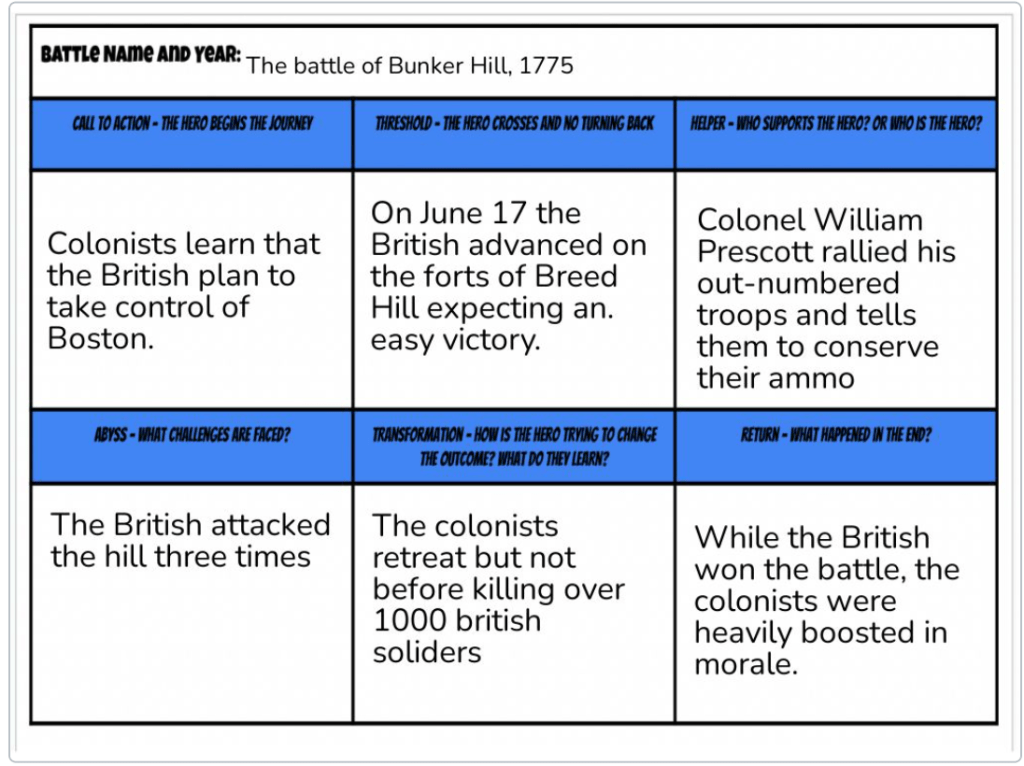
The Nearpod also included some awesome 360° panoramic, almost like Google Street View, pictures that took the students right to some of the battlefields where they could look around and look all around at where some of these battles took place. After the students looked around, I had a reading for each battle generated by ChatGPT using the hero’s journey format. I wanted the students to just choose one battle, map it out with the hero’s journey in the Nearpod, and be the expert on that battle.
The next thing is I didn’t want the students to get into groups and share out about their battle while other students took notes on a Frayer model. The students wrote down specific things such as when the battle took place, maybe who was involved, and obviously why the battle was significant.
The Nearpod also had a quiz built into it to test the knowledge of the students, and then we wrapped up the lesson for the day. I asked the students how they felt about their knowledge of American Revolutionary War battles on a scale of 1, 2 or 3; most of them put around a 2, some put a 3, and a few put a 1. I said the ultimate goal here is just to be able to know one battle from the Revolutionary War and have an understanding of why it was important—nothing more than that.

Wednesday
Wednesday I used as a day to teach the students about different groups of people that contributed to the Revolutionary War. These groups included women, African Americans, and Native Americans. The Ohio State Standards specifically says that students need to have an understanding of how these groups contributed to the Revolutionary War and the outcome of the Revolutionary War.
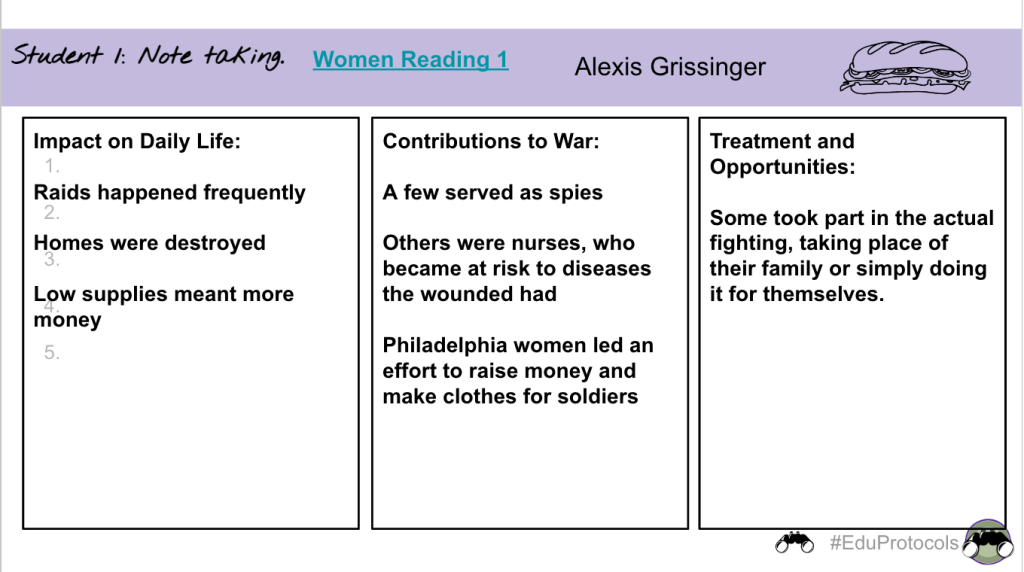
So I set up a CyberSandwich where students worked in groups of three—one student chose women, another student chose African Americans, and the other student chose Native Americans. I wanted to scaffold the note-taking, so I took all three textbook sections and copied and pasted them into ChatGPT and asked it to create three different categories of information that students could look for while reading. It came up with some categories based on commonalities between all textbook sections. The categories that came up to help scaffold the note taking on the CyberSandwich were Impact on Daily Life, Contributions to the War, and Treatment and Opportunities.
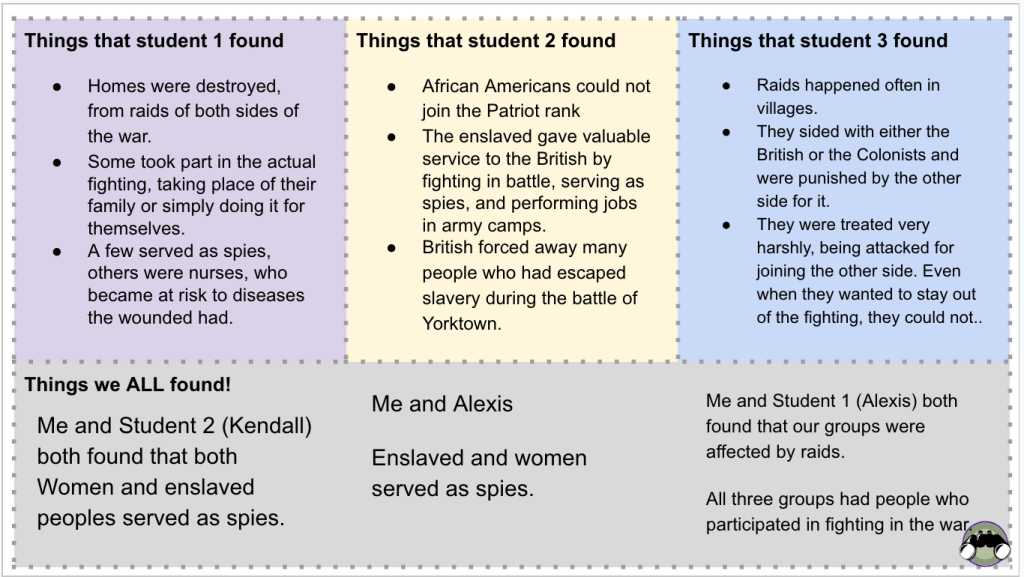
Students got into groups of three, one person shared the slide deck with everybody in the group, and they had 10 minutes to read and take notes. Next, the students all discussed things they found related to how these groups contributed to the Revolutionary War. Then I had each group share a Bazinga, or a fact that wowed them or surprised them. Or they could choose to just share a fact, or they could ask a question. The final step in the process was to write a summary comparing at least two groups and how they contributed to the American Revolutionary War.
With the time we had left over in class, we did a Quizizz Mastery Peak just to review the Revolutionary War unit.



Thursday
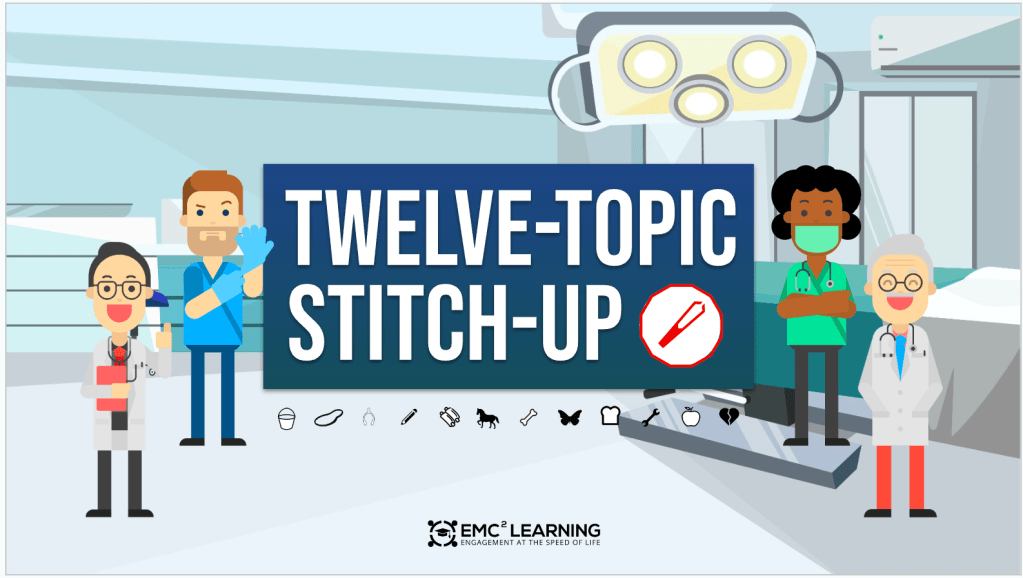
On Thursday I couldn’t decide if I wanted to just move ahead with a final assessment for the unit or if I wanted to do some sort of review. I settled on doing a review, but I also wanted to bring in and have the students work on the skill of making connections between historical people and events. This is where the 12 Topic Stitch Up comes in, which is an awesome lesson frame from the EMC2learning website. Because it is on this site I’m unable to share it with anybody, but please check out the EMC2learning site—there is so much awesome stuff available to everyone.
With the 12 Topic Stitch Up, it involves taking content that we’ve learned in the last 4 weeks and combining it with some gamification. Students got into groups of three or four, and I had 12 topics listed on the board. I gave each group a sheet divided up into 12 different segments, and the students chose one topic and had to find a way to connect four other topics from the list to that one topic. They could make one entire connection, so for example they could put the American Revolutionary War in the middle and they could connect the Quartering Act, Stamp Act, The Intolerable Acts, and Taxation Without Representation, and ultimately say that all four of those things connect to the American Revolutionary War because they made colonists mad and eventually led to that war. Or students could individually connect each topic back to the original one that they picked.
Once they discussed it as a group and brought the paper up to me to check and give feedback, if I accepted it they had a chance at trying to pull out a piece from the game Operation as a way to earn points for their team, but they only had one shot and if they made the guy’s nose turn red or make it buzz they lost their chance at getting points for that round.
I love this game because it creates discussions and has the students working on a skill that is tough for them, which is making connections between historical people and historical events. Plus it served as a great review before the final assessment that I put together for Friday.
With time left over in class, we did the same Quizizz from the day before using the Mastery Peak. This Quizizz would serve as part 1 of the assessment for the American Revolution unit. I always like to do two-part assessments where students have an opportunity to choose from answer choices and share their content knowledge, and then I always like to do a part two assessment where they create something to show their knowledge. They would have a chance to show their knowledge through creating a Thick Slide for Friday’s class.
Friday
On Friday I was presenting at the OMLA conference, which was a first for me, and I found my way to Sandusky, Ohio for the first time. This conference was awesome—it’s for middle school level educators and the vibe at both of my sessions was super awesome. Middle school educators are awesome. I presented two sessions, one on Eduprotocols and the other session was on harnessing the power of artificial intelligence to basically teach better and work less.
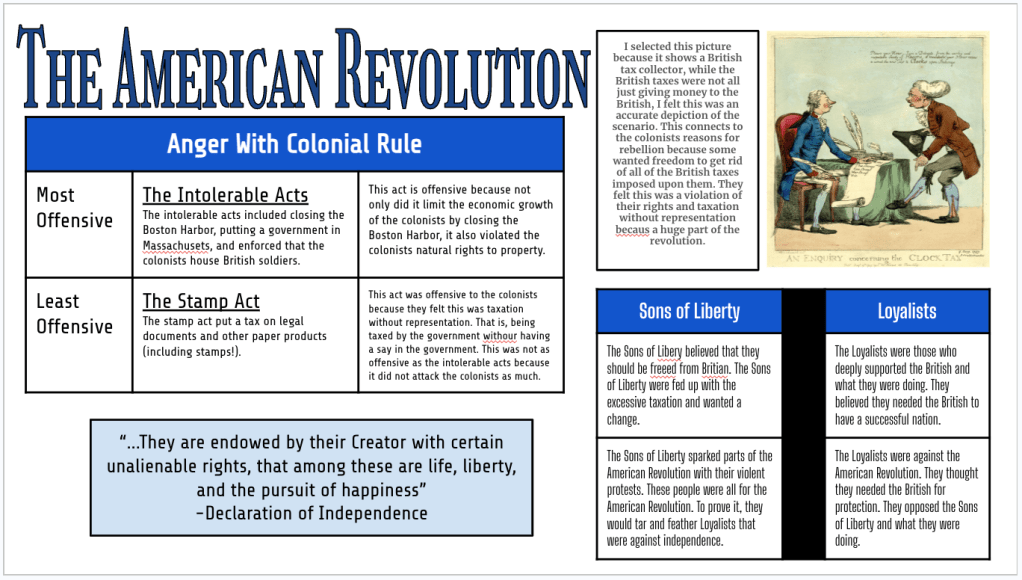
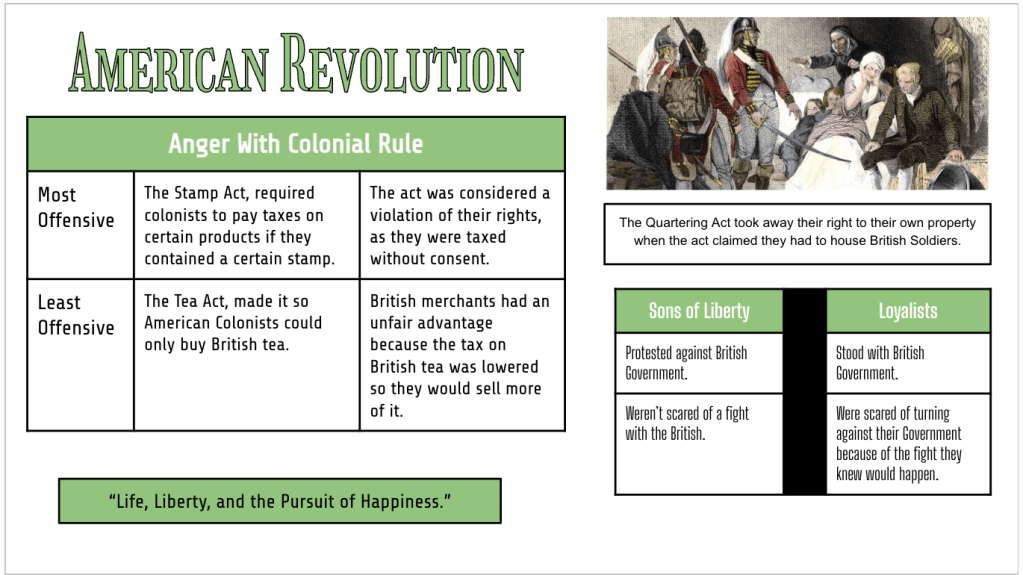
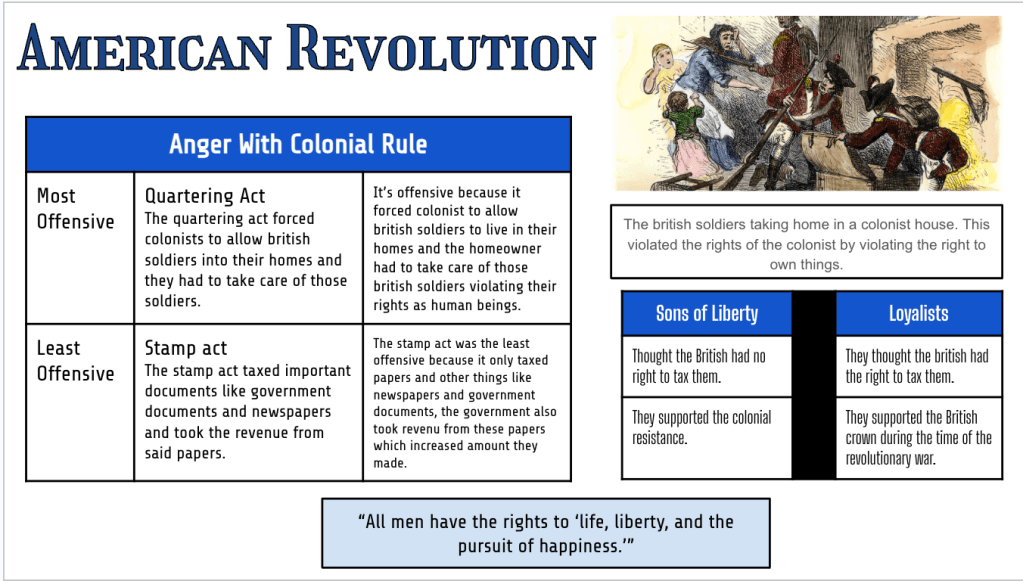
Since I was in Sandusky, I left an American Revolution final assessment for my students. Whenever I am gone I try to leave something familiar for them to do. This time I left a Thick Slide for the students to complete. I originally set it up so students could describe and identify two British Acts or taxes. I also wanted them to share a quote that showed natural rights. I wanted them to compare Loyalists to Sons of Liberty, and then I just wanted to add a picture.
However, the more I thought about it, the more I wanted it to be a little bit more in-depth. And so I went to Claude.ai and in my prompt I explained my American Revolution unit just a bit with the essential questions. I also explained the Thick Slide and what I wanted the students to do on the Thick Slide, and then I asked it to give me some ideas to make some of the Thick Slide parts be a depth of knowledge level 3. After Claude’s suggestions, I went back and changed the Thick Slide all around.
For example, instead of just describing and identifying two British Acts or taxes, I wanted them to evaluate that in terms of which Act or tax do you think was the most offensive and which one was the least offensive to the colonists, and why. Instead of just finding a quote related specifically to natural rights, I changed the wording up and asked the students to share a quote from the Declaration of Independence that showed an enlightenment idea related to John Locke, so then it left it open to more options.
Instead of just simply choosing a picture to add, I had the students find a picture that showed why the colonists were angry and rebelled against British rule, and the caption had to explain why they chose that picture and how it showed that. So AI is awesome at helping me take things more in-depth, because I think too often, myself included and others, we tend to stop at depth of knowledge level 2 and then move on. Simple little changes and shifts like this can make a huge impact at pushing students further with their thinking and creativity.
Since I was gone, about 120 students were at school, and 100 of them were engaged with this Thick Slide and either completed it or got 3/4 of it done, which is about 83% engagement on the day. This is why I love EduProtocols.

 Moler's Musings