
Introduction
As an educator, each week in the classroom presents a unique journey filled with both challenges and triumphs. In this reflective blog post, I will take you through my week of teaching 8th-grade social studies, offering an intimate glimpse into my classroom and my pedagogical approach.
Throughout this week, my central aim was to rekindle the spark of intentionality in my teaching. I had reached a point where it felt like I was engaging in a series of disconnected educational activities. The content was substantive, as we were diving deep into the American Revolution, covering topics ranging from the Enlightenment and British actions to the Sons of Liberty and the loyalists.
Yet, I sensed a lack of a unifying thread, a clear intent that would tie these elements together for my students. The fundamental question that nagged at me was, “How can I teach this material with a deliberate purpose, ensuring that my students not only absorb historical facts but also cultivate critical thinking and analytical skills?”
This blog will provide a day-by-day account of my week in the classroom, offering insights into the activities, challenges, and successes I encountered. The week’s primary focus was on cultivating skills related to claims, evidence, and reasoning, a crucial element in any social studies curriculum.
Join me as we delve into the specifics of each day, from Monday’s exploration of the Sons of Liberty and their complex role in history to Thursday’s playful introduction to the Declaration of Independence, replete with a fascinating experiment in working memory. The week concludes with a short Friday, featuring a Number Mania activity that prompts students to find textual evidence to support the claim that the Declaration of Independence was a thoughtful and deliberate endeavor by the Founding Fathers.
Monday and Tuesday – 3xCER, Quizizz, Thin Slide Swap
Wednesday – Nearpod with Loyalists
Friday – Number Mania
Monday: 3xCER
At the start of the week, I found myself deep in thought about my teaching approach. I had this nagging feeling that I was doing a lot of random things without a clear sense of intentionality. The content was solid – we were delving into the American Revolution, beginning with topics like the Enlightenment, British actions and taxes, resistance from the Sons of Liberty, and the loyalists. But my teaching lacked a coherent focus. So, my primary goal for the week was to regain that intentionality in my teaching.
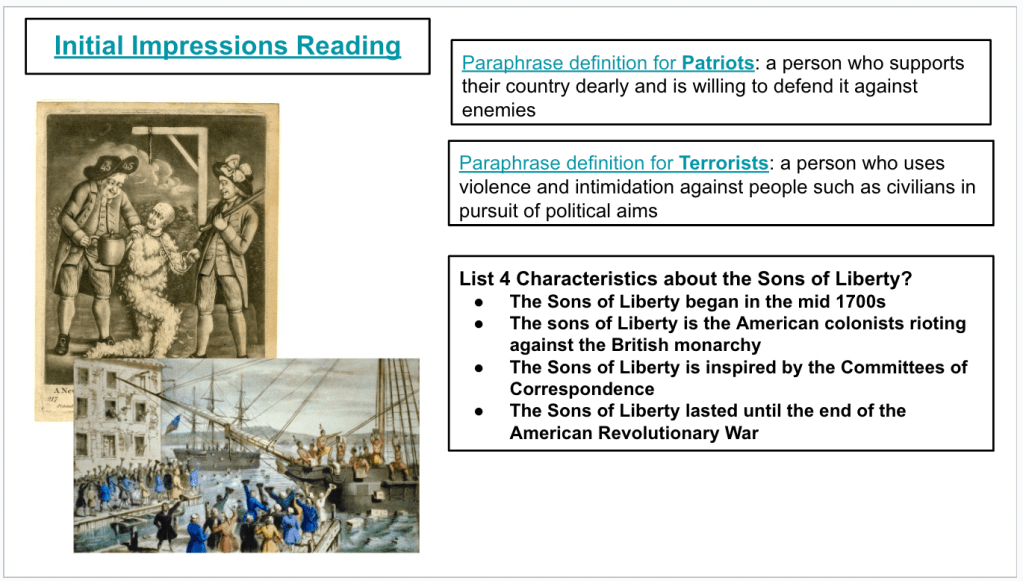
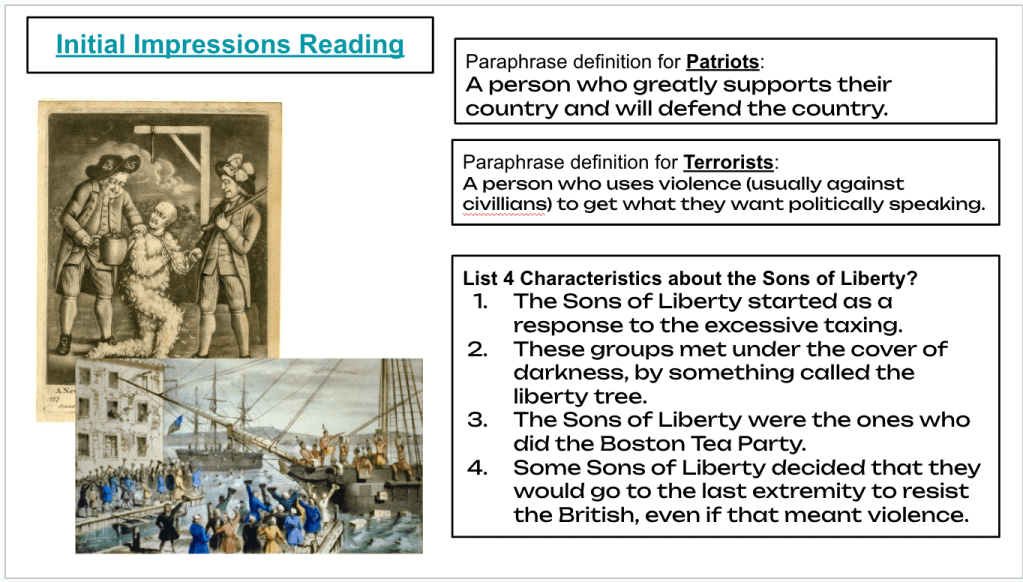
For Monday, our focus was on the Sons of Liberty and their various forms of resistance, and whether they could be classified as patriots or terrorists. To kick things off, I decided to provide my students with a foundational understanding of what distinguishes patriots from terrorists. I turned to ChatGPT for some assistance, asking it to generate lists of reasons why the Sons of Liberty might be considered patriots and terrorists. This generated discussion and helped students craft their own definitions of these terms.
I also wanted to ensure that my students had a solid background on the Sons of Liberty. We began by having them read about this group and identify four fundamental characteristics. This knowledge-building phase was critical for the subsequent analysis.
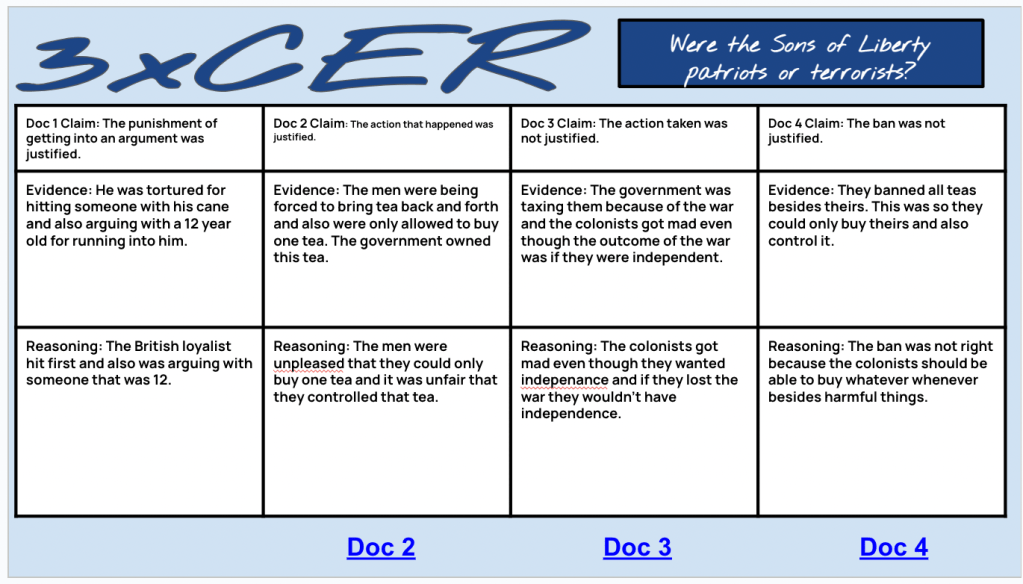
To truly understand the Sons of Liberty, we turned to a variety of documents, some primary and some secondary sources. Students were tasked with crafting claims about whether the Sons of Liberty were patriots or terrorists, backing up their claims with evidence from the documents, and then offering reasoning to support their positions. This process was facilitated by the 3xCER template. To gauge their understanding, we concluded the class with a Quizizz quiz, and I was pleased to see an improvement in student performance as they averaged 80%.

Tuesday: Exploring Sons of Liberty’s Forms of Resistance
On Tuesday, we continued our exploration of the Sons of Liberty, focusing on their forms of resistance. I introduced a Thin Slide Swap activity, a fresh approach to Thin Slide developed by Justin Unruh. The prompt was simple yet thought-provoking: “The Sons of Liberty and their forms of resistance.” This prompted some students to ask what “resistance” meant, leading to a productive classroom discussion.
The Thin Slide Swap allowed students to engage visually and collaboratively. They had two minutes to add an image and a single word or phrase related to the prompt. Afterward, they swapped computers and spent three minutes adding why they thought their partner had chosen the image and word.
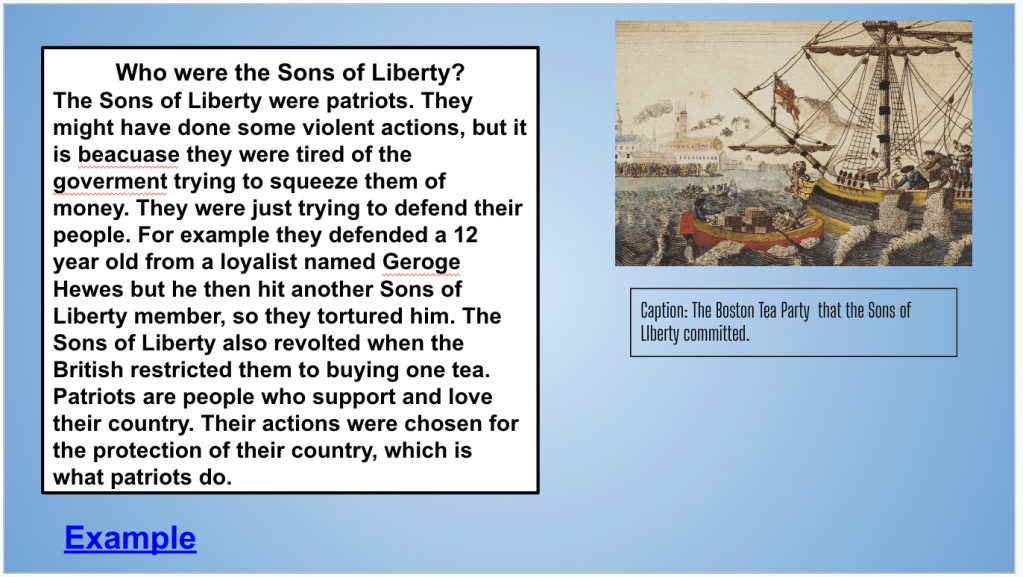
Continuing our focus on the Sons of Liberty, we dug into two more document analyses, allotting 15 minutes for students to complete them. The final step was to consolidate their findings and craft a paragraph presenting their claim regarding the Sons of Liberty’s status as patriots or terrorists. They had to incorporate evidence from the documents and ensure the presence of a clear transition. To wrap up, we once again measured their understanding with a Quizizz quiz, and the students averaged an impressive 85%.


Wednesday: Enhancing CER Skills and Introducing Loyalists
Wednesday was a day of refining students’ claims, evidence, and reasoning (CER) skills. I had previously created a rubric for CER paragraphs and enlisted the help of Claude.AI for consistent feedback. The primary takeaway from analyzing student paragraphs was the importance of effectively introducing evidence, referencing documents, authors, or titles. So, I focused on helping students use transitional phrases like “according to” or “the evidence from” to set up their evidence more smoothly.
We started the class with a review of my feedback on their CER paragraphs, with students making highlighted corrections to their claims, evidence, and reasoning. These components were assessed, with one point for the claim, one point for the use of evidence, and two points for reasoning.
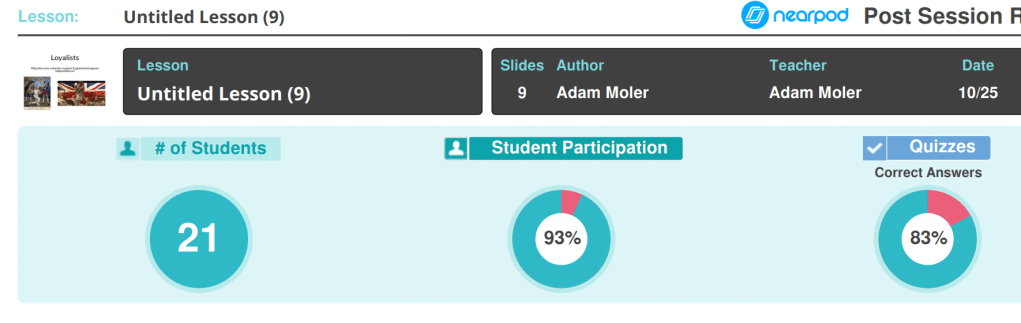
Then, we transitioned into a new topic: loyalists. I borrowed a lesson plan from the Stanford History Education Group on loyalists and adapted it for Nearpod. To begin, I had students predict why someone might have been a loyalist during the turbulent American Revolution. They were then tasked with close reading and sourcing two documents, followed by a brief quiz to test their contextual and close reading comprehension. The lesson concluded with students corroborating the documents and writing a claim supported by evidence, with a strong emphasis on the use of transitional phrases. If time allowed, we engaged in a “sketch and tell” activity to answer the initial question about loyalists. While not all students completed it, my primary focus was on their ability to craft claims and use evidence effectively, along with the inclusion of transitional statements.




Thursday: The “Breakup Letter” and the Declaration of Independence
Thursday’s class had a unique and playful start. I walked into the classroom about 20 seconds late, carrying various items I had collected while navigating through the 7th-grade locker area. Among the things I “found,” there was a breakup letter. The students were immediately engaged, some even appearing a bit anxious, thinking that this letter might have something to do with them. As I read the letter aloud, their excitement grew.
After building suspense, I revealed that I had written the letter, and it was signed with the initials “A.C.” – which, of course, stood for American Colonists. The purpose of this playful introduction was to connect it to a more serious historical document – the Declaration of Independence.
I explained to the students that Thomas Jefferson had written what could be considered the greatest “breakup letter” in history – the Declaration of Independence. This analogy was intended to help them relate to and better understand the significance of the document.
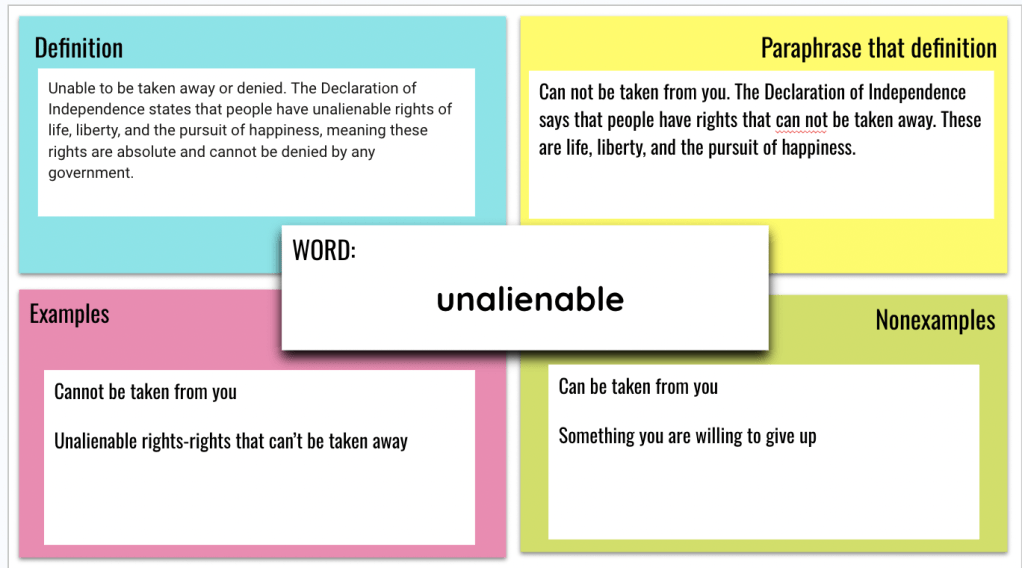
Following this engaging start, we transitioned to a Quizizz quiz that featured ten questions related to the Declaration of Independence. I decided to begin the class with a Number Mania Eduprotocol, directly tied to the background information about the Declaration. The quiz questions were cleverly interwoven with this background reading, incorporating vocabulary words such as “unalienable.”
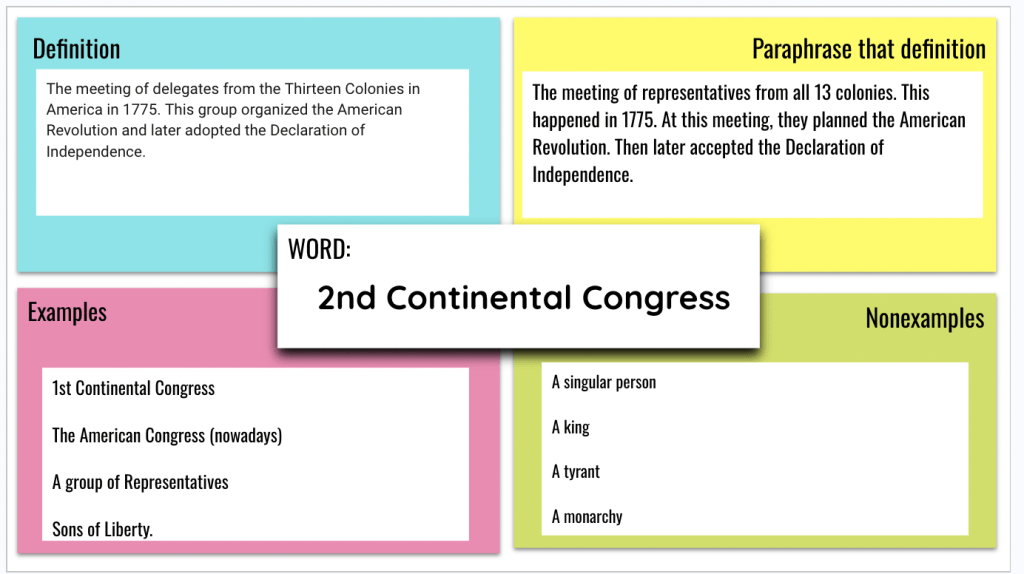
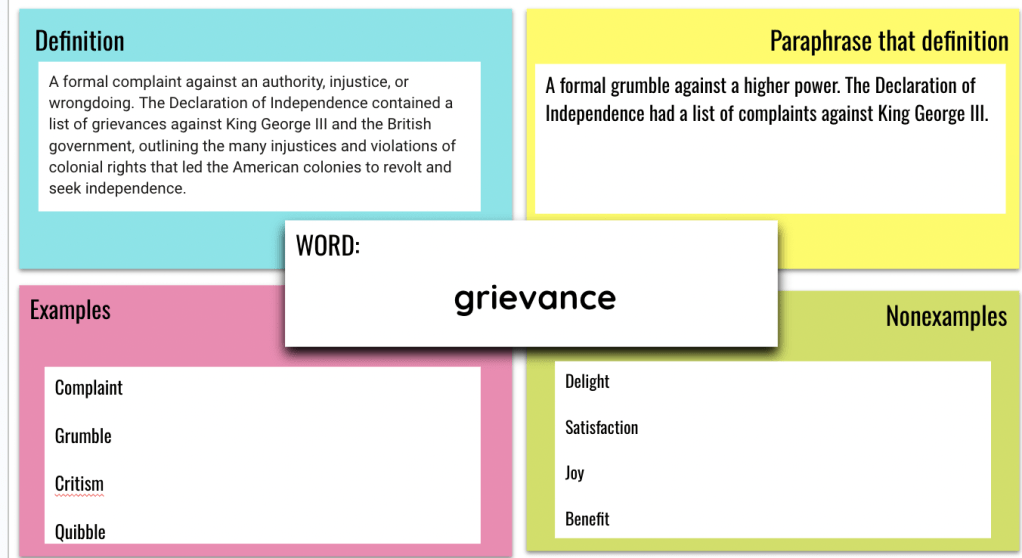
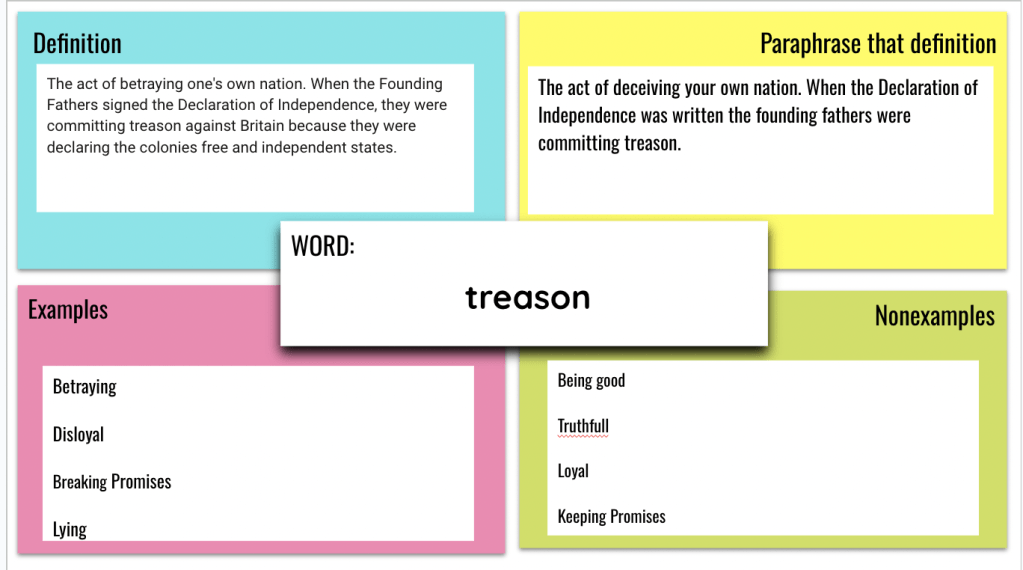
To ensure that students fully grasped the key vocabulary, we engaged in a “Frayer” activity. I provided them with 10th-grade level definitions and examples of important terms like “second Continental Congress,” “unalienable,” “treason,” and “grievance.” Their task was to simplify these definitions and create examples and non-examples for each term.
An intriguing experiment took place as we distributed the background reading, which contained a deliberate contradiction that I wanted the students to identify. To prompt their recognition of this discrepancy, I instructed them to place a check mark next to it. The contradiction in the text was the mention of the number of colonies – in one sentence, it stated there were 13 colonies, and in another sentence, it claimed there were 15 colonies.
The data collected from each class period regarding the students’ ability to spot this contradiction varied:
- In my first period, where both numbers (13 and 15) were written numerically, 18 out of 27 students found the contradiction.
- To further explore the impact of numerical presentation, I changed it for my other classes, writing out the numbers as words. The results were as follows:
- In my third period, four out of 13 students found the contradiction.
- In my fifth period, eight out of 20 students found the contradiction.
- In my sixth period, five out of 21 students found the contradiction.
- In my seventh period, eight out of 29 students found the contradiction.
- In my eighth period, only one out of 14 students found the contradiction.
This experiment not only served to work on students’ working memory but also provided insights into how they read and interpret information, showcasing the fascinating differences in each class’s response.
Friday: A Short Day and Number Mania
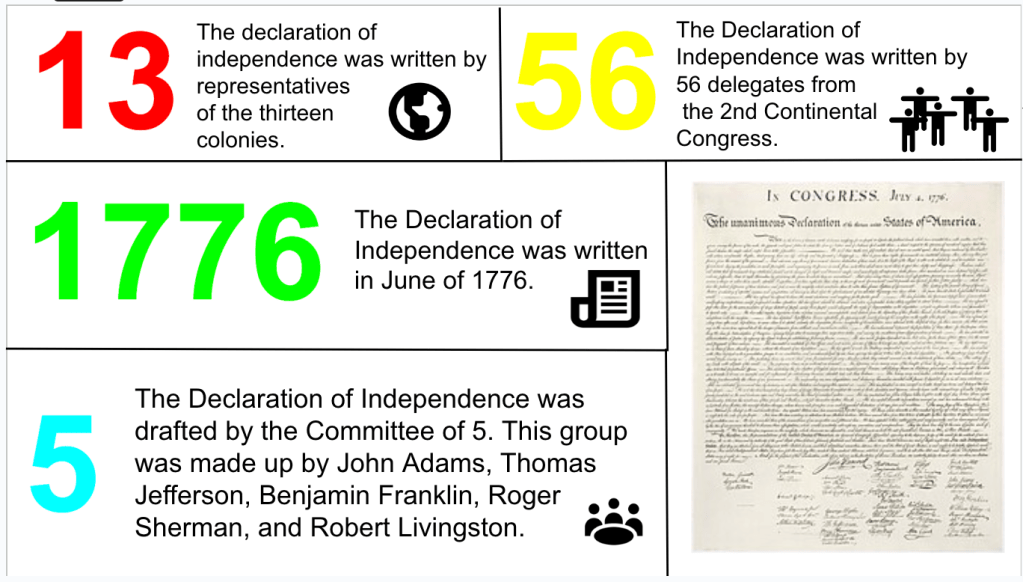
Friday marked a shorter day with Halloween celebrations on the horizon. While some classes engaged in the Number Mania, I recognized that it might not be as successful in others and didn’t press the issue. The objective of the Number Mania was to find textual evidence supporting the claim that “The creation of the Declaration of Independence was a thoughtful and deliberate process that involved significant time, effort, and sacrifice from the Founding Fathers.”
I find the Number Mania approach quite effective with middle school students, as it serves a purpose in teaching them how to select meaningful evidence from a text. It also fosters their ability to analyze and utilize evidence to support a statement.
Throughout the week, I strived to reintroduce intentionality into my teaching. Our main focus was on claims, evidence, and reasoning, and we approached it in various ways – from crafting paragraphs and analyzing sources to reading secondary materials and selecting evidence to align with specific statements.


 Moler's Musings