Introduction:
Teaching 8th-grade social studies is an ever-evolving adventure, filled with moments of inspiration, challenges, and growth. This week, we embarked on a new journey as we delved into a unit on the American Revolution.
Monday – Repuzzler, Vocabulary Words
Tuesday – CyberSandwich
Wednesday – Influencer Lesson
Monday: Setting the Stage for the American Revolution
The week commenced with an air of excitement as I introduced our new unit on the American Revolution. To frame our exploration, I presented the essential question: “How did the Enlightenment, and dissatisfaction with colonial rule, lead to the American Revolution?” It was imperative for my students to grasp two foundational elements: the Enlightenment and the sources of colonial discontent.
The Vocabulary Challenge: Resource Rumble Repuzzler (3 R’s)
To ignite their curiosity and engage them right from the start, I decided to tackle vocabulary in an innovative way. I merged the Resource Rumble, a classic lesson, with the Repuzzler EduProtocol, resulting in what I humorously called the “Resource Rumble Repuzzler” or the 3 R’s. For this activity, I selected eight crucial terms: enlightenment, revolution, natural rights, social contract, grievance, tyranny, liberty, and taxation without representation.
To create a rich learning experience, I turned to ChatGPT for assistance. It provided brief, clear explanations for each term. These explanations served as the foundation for students to develop their definitions, list three defining characteristics, and create a symbol that encapsulated the essence of each word.
However, the twist that added an element of fun and competition was this: I printed out each term’s explanation, cut them into pieces, and placed them in envelopes scattered around the classroom. The challenge for my students was to form groups of 3 or 4, locate these envelopes, and, using the provided explanations, complete their Repuzzler pages.
The Resource Rumble Repuzzler was not just a vocabulary exercise; it was a competition. The students’ energy levels rose as they moved about, collaborating to decipher these new words and their meanings. I won’t delve into all the details of the competition, as a portion of the activity is from EMC2Learning, a paid site. Nevertheless, the activity was a fantastic mix of movement, collaboration, and vocabulary building.
Tuesday: Unveiling the Enlightenment and Note-Taking Skills
On Tuesday, we continued our exploration of the Enlightenment. Building upon the foundation laid on Monday, I opted for a different approach to keep the momentum going.
Repuzzler Cards: Enhancing Collaboration and Discussion
To kickstart our class, I distributed Repuzzler cards to small groups of 2 to 3 students. These cards were compilations of seven to eight Repuzzlers created by the students themselves. The challenge was to piece together these cards, effectively engaging students in collaboration and discussion.
This activity served a dual purpose. Firstly, it reinforced the importance of collaboration and communication skills. As I traveled through the classroom, I had the opportunity to engage in conversations and provide valuable feedback to each group.
Secondly, it allowed me to gauge their understanding and grasp of the concepts we had discussed on Monday. This formative assessment gave me insights into the areas that needed further clarification.
CyberSandwich EduProtocol: An Introduction to the Enlightenment
Following the Repuzzler card activity, we transitioned into the CyberSandwich EduProtocol. The focus was on providing an introduction to the Enlightenment, a key era that would lay the groundwork for our understanding of the American Revolution.
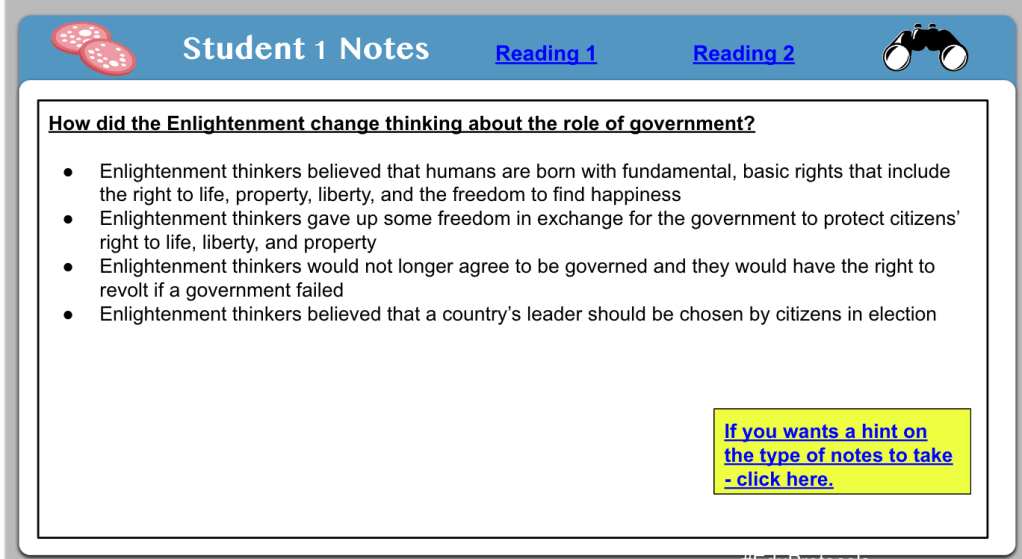
For this segment, I used a reading from iCivics that offered a straightforward overview of critical Enlightenment concepts such as the social contract, natural rights, and republicanism. In retrospect, I realized that “republicanism” should have been included as a vocabulary term, a note I made for future lessons.
As my students read the provided text for about 10 minutes, they were encouraged to take notes. However, I acknowledged the diverse reading preferences among my students. Some preferred physical copies, with a penchant for highlighting passages. To cater to their needs, I introduced them to a concept from the book “Outsmart Your Brain” by Dr. Daniel Willingham.
Note-Taking Reimagined: Skim, Set Goals, and Highlight with Purpose
I shared Dr. Willingham’s wisdom, suggesting that instead of passively reading and indiscriminately highlighting, they should start by skimming the passage to understand its structure and content. The next crucial step was setting goals. In this case, our overarching goal was to answer the question, “How did the Enlightenment change our understanding of government?”
With this goal in mind, I advised them to highlight only the information that directly contributed to answering that question. This strategic approach to reading and note-taking aimed to equip my students with a valuable skill that transcended this particular lesson.
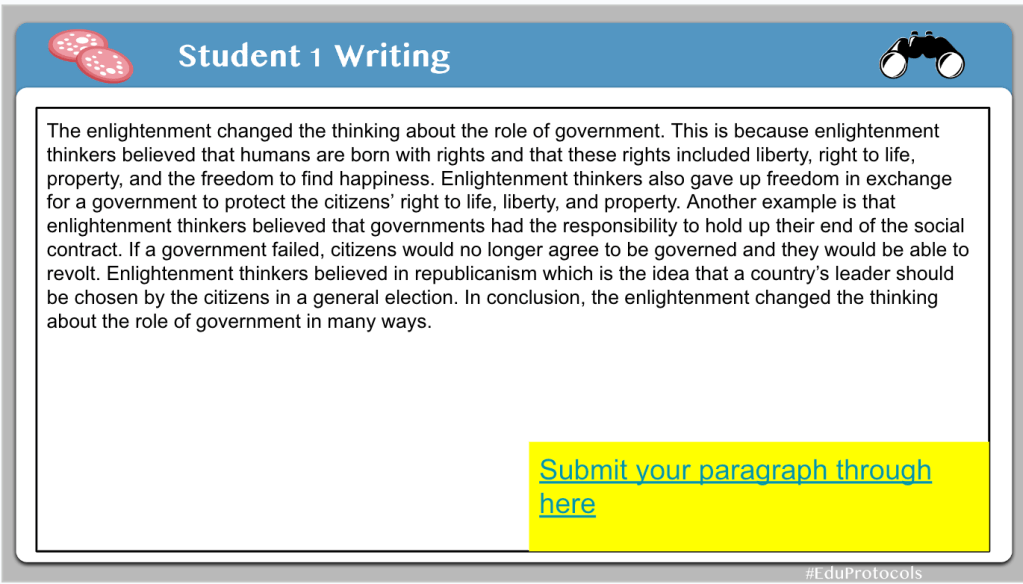
After their 10 minutes of reading and note-taking, students engaged in a pair-share activity. They shared their notes with a partner, fostering discussion and reinforcing their understanding of the material. Finally, they crafted a summary paragraph that addressed the central question, thus bringing our class to a productive close.


Wednesday and Thursday: The Influencer Lesson
Wednesday was a pivotal day as we ventured into a unique lesson plan inspired by Mr. Kevin Roughton’s “Influencer” lesson. This captivating and well-structured lesson had two primary components: a compatibility quiz and an exploration of Enlightenment thinkers.
The Compatibility Quiz: Exploring Beliefs and Values
Our day began with a compatibility quiz, which probed the students’ beliefs about true freedom and the purpose of government. This engaging activity encouraged introspection and set the stage for what was to come.
Getting to Know the Enlightenment Thinkers: A First-Person Perspective
The heart of this lesson was an in-depth exploration of Enlightenment thinkers, such as John Locke, Rousseau, Montesquieu, and three others. What made this experience unique was the use of first-person narratives in their profiles. To enrich these profiles, I collaborated with ChatGPT, which rewrote the biographies to include each thinker’s beliefs about the role of government and individual liberties.
The objective was clear: students were tasked with associating Enlightenment thinkers with their beliefs on government and personal freedoms. To facilitate this, I had prepared six profiles and distributed them around the room. Students worked in groups, adding valuable information to their Frayer models.
At this juncture, I emphasized the purpose of the lesson: to identify which Enlightenment thinkers resonated most with their own beliefs. I also stressed the broader importance of this exercise, as Enlightenment thought would be a recurring theme throughout their high school journey.
Once students had gathered notes and insights, they analyzed their findings in relation to the compatibility quiz. This comparison revealed which thinkers aligned most closely with their own values and philosophies. The lesson culminated with a “sketch and tell” activity, where students sketched a representation of their most compatible Enlightenment thinker and shared their beliefs with the class.


Friday: Out of Town
Friday marked the end of the school week, and I had a prior commitment that took me out of town on Thursday and Friday. However, this didn’t mean that my students were left without guidance. I had thoughtfully planned a lesson to keep them engaged.
Map Challenge: Contextualizing the American Revolution
For Friday’s lesson, I designed a map challenge that drew from our textbook. It was a straightforward assignment where students were tasked with labeling a map, providing essential context about the onset of the American Revolution. This task not only reinforced geography skills but also served as a natural segue into our upcoming discussion on the Seven Years’ War, scheduled for the following Monday.
Conclusion: A Week of Engagement, Exploration, and Growth
As I reflect on this week of teaching 8th-grade social studies, I am reminded of the dynamic nature of education. Each day brought new challenges and opportunities, and I strived to make the learning experience engaging and meaningful for my students.
We embarked on our journey into the American Revolution by first understanding the Enlightenment and the colonial discontent that fueled the revolution. The Resource Rumble Repuzzler brought vocabulary to life in a competitive and interactive manner.
On Tuesday, we honed our note-taking skills while diving deeper into Enlightenment concepts. The Repuzzler cards facilitated collaboration, ensuring that students were actively engaged in the learning process.
Wednesday and Thursday were highlighted by the “Influencer” lesson, where students explored the beliefs of Enlightenment thinkers. This exercise not only deepened their understanding of history but also encouraged introspection about their own values and beliefs.
Even on a day when I was out of town, I ensured that my students had a meaningful learning experience through the map challenge, providing them with the opportunity to apply their knowledge and contextualize historical events.

 Moler's Musings