This week started off with finishing the impact of the Industrial Revolution on the northern and southern United States. Some students had choice board activities to finish. Some began an annotated map as their final assessment. Other students were completely finished and onto the extension activity I created.
With the annotated map, I wanted students to show what they learned about the Industrial Revolution using icons, pictures, etc and how it impacted the northern and southern United States. I had questions next to the map that had them analyze the differences between north and south. I did this lesson last year and I liked it, so I decided to use it again. I rarely use the same lessons year to year. If I do use the same lessons, I make small changes. For this particular lesson, the only changes I made were to the choice board as I added a frayer and thick slide.
I have also been trying to incorporate more extension activities into lessons this year. These activities are more for the students who finish early. Sometimes I get caught up in the idea that ALL students need to do the extension activity. Then I begin thinking, some of these kids struggle to complete the basics and foundation of the lesson. I would prefer they focus on the basics.
Most of my extension activities has students relate history to our community of New Richmond. Or, the activity has students relating history to some current event today. The extension activity for the Industrial revolution, for example, had the students relating characteristics of the current Industrial Revolution 4.0 to America’s First Industrial Revolution.
The rest of the week we focused on abolitionism. I used a similar lesson to last year to introduce abolitionism. Then we followed that up by introducing abolitionists. Some of the abolitionists were local such as John Rankin and James G. Birney. Other abolitionists are more well known such as William Lloyd Garrison and Frederick Douglass.
The main goal with the lesson on abolitionism is to have students understand how people challenge the status quo and seek reform in society. A lot of the lesson s focuses on how these abolitionists used different methods, different motivations to create change all while facing conflict from other people.
Monday and Tuesday – Annotated Map, Fast and Curious
Wednesday – Frayer, CyberSandwich
Thursday and Friday – Fast and Curious, Abolitionist Thick Slide, Assessment Options
Please donate to Samantha Cain’s GoFundMe Page
Monday and Tuesday
Monday and Tuesday were used to finish up the impact of the Industrial revolution on the northern and southern United States. Students learned about the introduction of interchangeable parts, textile mills, the cotton gin, and how goods were being mass produced by machines rather than by hand. My hope was they would pick up on that cotton in the south and textile mills in the north made these two regions dependent on each other. Many didn’t make that connection until I explicitly stated it. After that, it all seemed to make sense and click.
On the annotated map, students had to label north and south. Then they added icons, pictures, etc to show the differences between north and south in terms of transportation, economy, and geography. They had to add a map title and analyze the information on the side. All in all, they did a good job. If I did it differently, I would focus more on the relationship between north and south with cotton and textiles mills. I would also focus more on how textile mills operated and worked. Lastly, I would try to find more charts, data, graphs that showed the impact of the industrial revolution on population size, etc.
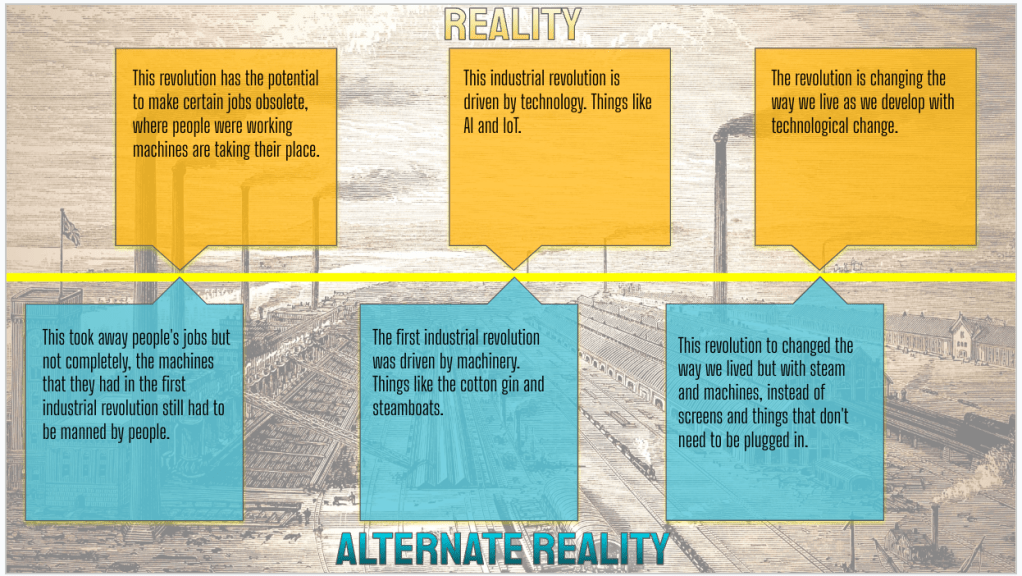
If students finished early, I had them complete an extension activity comparing America’s first industrial Revolution to the current Industrial Revolution 4.0. I had an idea to use Upside Down Learning from EMC2Learning to have students compare these revolutions. I also had ChatGPT create the article comparing the revolutions. I gave ChatGPT specific criteria about focusing on the characteristics of these revolutions and its impact on the United States.
With Upside Down Learning, students write the “reality” or tue details from the reading. Underneath, students write an alternate reality, or untruthful, statement. I had the idea of students writing Industrial revolution 4.0 on the top line and Industrial Revolution 1.0 underneath. They are similar and opposite in many ways. All in all, it worked out well.

In addition to the annotated map and extension activity, students had to complete the Fast and Curious about the Industrial Revolution. I like to do two-part assessments where students create something and answer some basic level questions using Gimkit or Quizizz.
Wednesday
On Wednesday, I started a new lesson on abolitionism. The main focuses of this lesson are understanding abolitionism, and analyzing the various ways people can reform and change society.
I began the lesson with a Frayer on abolitionism where students defined the word, added facts and characteristics, four connections words, and a picture. I like to mix up how I introduce vocabulary, and we haven’t done a frayer model in a while.
After the Frayer model was completed, we read an article on abolitionism. I found a CyberSandwich I used last year. The linked article gave a brief introduction to the abolitionist movement and mentioned the name of abolitionists we would be studying.
I ran a traditional CyberSandwich with a 10 minute read and note taking. With the notes I asked about the text structure and most students guessed correctly – chronological with a description. Then I had students discuss for 5 minutes and compare notes. Finally, students wrote their summaries for ten minutes. It was a pretty short and simple class – my favorite.
Thursday
For Thursday’s class, I began with a teacher-led Quizizz. I did this because recently the students haven’t been taking the first round of fast and curious seriously. To me, the first rep is important so the questions can be read, mistakes made, and learning why we made mistakes. This hasn’t been happening, especially the reading of the questions. The teacher-led Quizizz allowed me to control the pace and read the questions out loud. For Friday, I transferred the questions to a Gimkit.
The teacher-led Quizizz took the first 15 min of class which was entirely too much time. But, you have to give up a little to get a little I guess. After the Quizizz, I had students choose an abolitionist to create a Thick Slide.
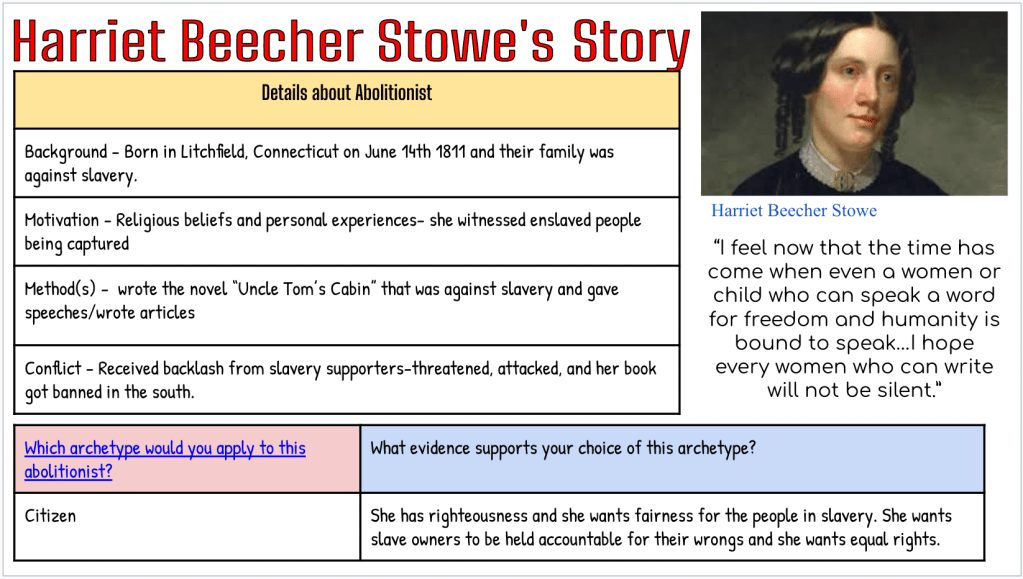
The Thick Slide was set up so students could write down background information, motivations, methods, and conflicts about their chosen abolitionist. I also included a place for them to apply and explain an archetype to the abolitionist. Finally, they had to insert an image and a quote. When their slide was complete, they shared a link through a Google Form.
On the Thick Slide, I included 7 different choices for abolitionist:
- Frederick Douglass
- William Lloyd Garrison
- Sarah Grimke
- Harriet Beecher Stowe – local Cincinnati ties, and her brother was a minister at a church in New Richmond.
- James G. Birney – local abolitionist who started an abolitionist newspaper, The Philanthropist, in New Richmond. He also ran for president twice.
- James Rankin – local minister who helped along the Underground Railroad.
- John Brown
I chose these people because they offered local connections and various methods for abolishing slavery. When I went back to the articles we used last year for each abolitionist, I was not impressed. So, I had ChatGPT write articles for each abolitionist. I prompted it with this: “I want you to write a detailed article on John Brown as an abolitionist. Include headings for the following: background information, motivations for abolishing slavery, methods for abolishing slavery, and conflicts he faced from other people.” It created a great, easy to follow, article for each abolitionist.


Friday
On Friday when students came, we began class with a Fast and Curious Gimkit. The average of all the scores from Thursday was around a 45%. The average for Friday’s scores was a 75%. After the Fast and Curious, students finished their Thick Slide from the previous day. Or, they began taking notes about 4 different abolitionist using a Frayer.
From the Google Form, I created a Google Sheet with links to everyone’s slides. I usually hand out a paper Frayer so students don’t copy and paste notes, but I took a chance and left the Frayer as a digital slide. Some students did it the right way and took their own notes. Others just copied and pasted.
I had several students ask me what kind of notes they should be taking. This is where I put up the I can statements and reminded the students the goal of the lesson – I can explain and analyze how people create change and reform in society. That seemed to help focus them.
After students took notes, they had 4 assessment options to choose from. Here are those options:
- Dinner Party – this was created by Amanda Sandoval. Which four abolitionists would sit next to each other? Why? What would they discuss?
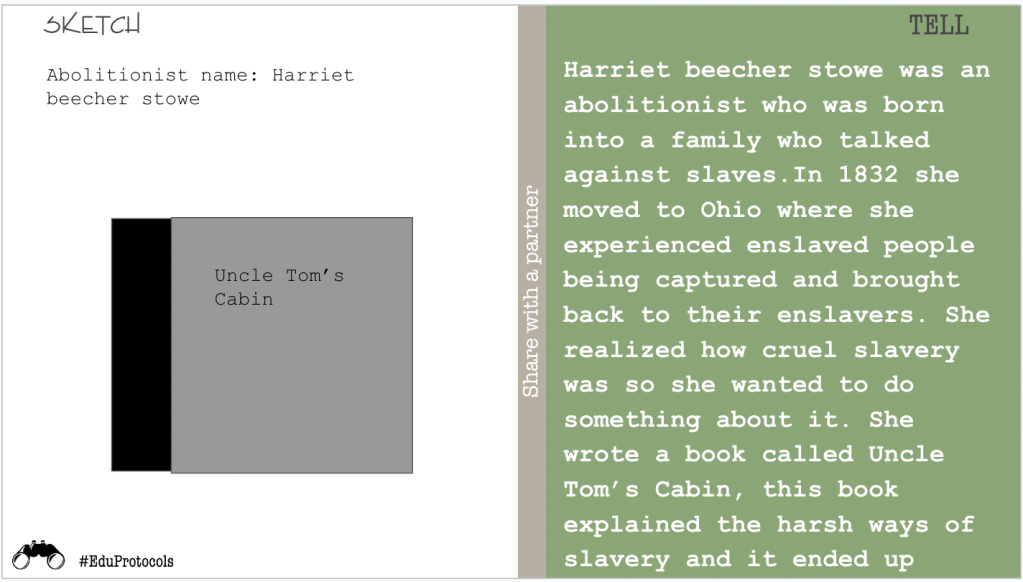
- Sketch and Tell – choose 2 abolitionists, sketch out their methods for ending slavery, and tell about it.
- Somebody, Wanted, But, So, Then – retell the story of an abolitionist.
- InstaStory – another Amanda Sandoval template. Highlight 3 abolitionist on an instastory, and summarize at the end.
By the end of class, some students were finished with everything. Most students, however, were just beginning the assessment. Now we start state testing next week……..


 Moler's Musings