
This week I asked myself this question, “Do I spend four to five days teaching about westward territorial expansion, or do I finish it in two to three days?” I opted for the two to three days. This is what I love about EduProtocols – students are familiar with the routines and we can get through some content faster.
One of my favorite ways to cover lots of content in a short time is with a Thick Slide and Frayer. Students create a slide with information, pictures, and quotes. Then students share the slide through a Google Form. Finally I hand out a Frayer that students fill out with notes and information as they read each other’s slides. Instead of a Frayer, students went from slide to slide and wrote summaries on their annotated maps.
We spent Tuesday and Wednesday finishing annotated maps. I forgot to take pictures of the completed maps (I’ll have some soon). The students did an excellent job! I shared an example of an annotated map when we first began the lesson and the most common response was, “Whoa, that’s a lot of work. I can’t do that.” In the end, they did it, they did it well, and basically wrote a six to seven paragraph essay.
After we learned how the United States used purchases, war, and treaties to expand westward, the next phase of the lesson is to learn about the people that went west. My ultimate goal for the lesson is to have students learn about the reasons people went west and compare that to reasons people settled in our community of New Richmond. I’ve never done this before but I’ve been planning it with our tech coach Jordan Petri who fors for Forward Edge.
The first lesson the students completed asked the question, “What inspired people to go west?” I took the opportunity to create a new rack and stack combo with EduProtocols. Students completed an 8pArts, 3xCER, and Sketch and Tell as we analyzed 4 sources and worked on writing paragraphs. All in all, it was a successful lesson.
Monday – Thick Slide, Fast and Curious
Tuesday – Annotated Map
Wednesday – Annotated Map
Friday – 3xCER, Sketch and Tell
Monday
Monday began with a Fast and Curious using Gimkit. I added questions about Oregon, the Mexican Cession, and the Gadsden Purchase. All classes did as I expected with new questions added to the old questions – 74% class average or higher.
As I mentioned up top, I didn’t want to spend four to five days covering the remaining territories of Oregon, Mexican Cession, and the Gadsden Purchase. I’ve seen other lessons, or mini-units, that cover all the territories in two to three days. I think that’s too short. At the same time, I didn’t want to drag out the lesson too long.
To help get through the final territories, I created a Thick Slide template. As I was developing this template, I knew the goal was to have students write summaries on their annotated maps explaining how we got these territories. At first I set up the Thick Slide notes with a sequencing organizer because the reading was written in sequence. However, I changed it for my later class period to a Somebody, Wanted, But…..organizer. I had one student comment they liked the Somebody, Wanted organizer because it was easy to follow and helped them process the reading better.
I also included on the Thick Slide a comparison chart where students compared the territory they chose (Oregon, Mexican cession, Gadsden Purchase) to another territory they learned about. At first the students were confused on what to compare, so I added in categories – who was president, how did we get it, and location. Lastly, I wanted students to include a quote from the reading about the impact of the territory on people or the United States as a country.
To begin this lesson after the Fast and Curious, I had students read for 5 minutes and highlight the parts of the organizer – Somebody, Wanted, etc. Then I gave students 20 to 25 minutes to create their slide and share. Here are some great examples:
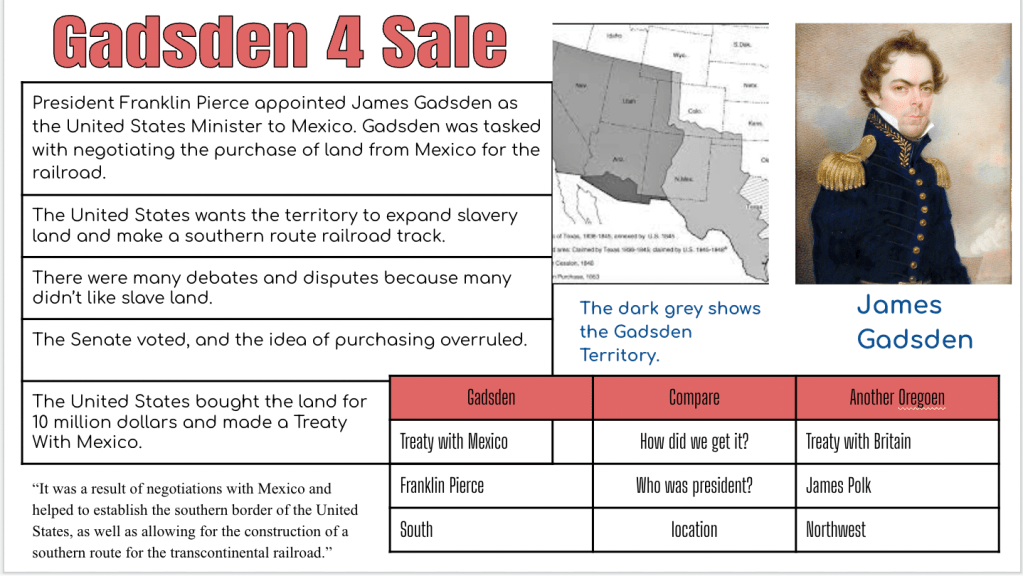
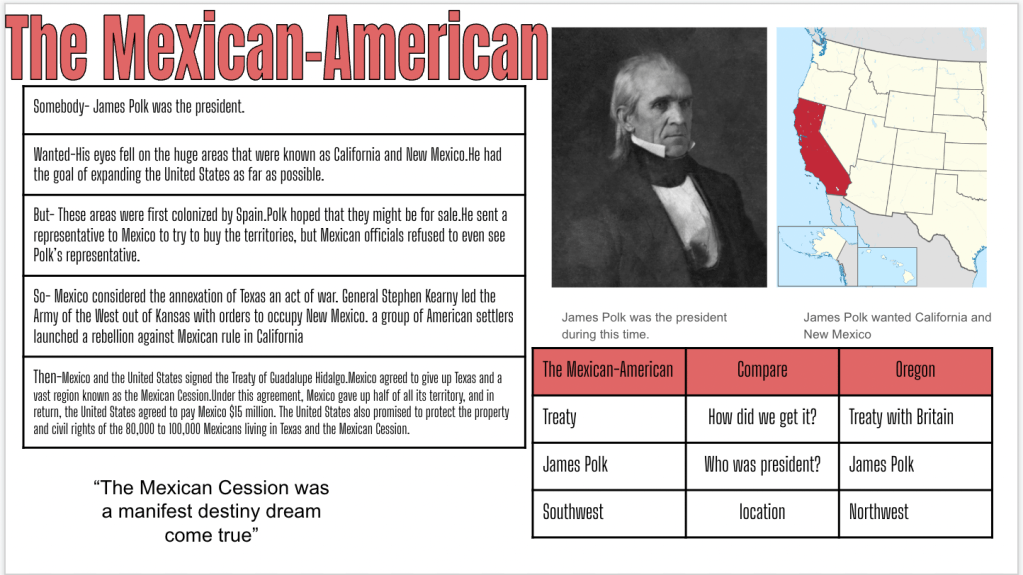

After students shared their slides, we finished class with a Fast and Curious one more time. This time class averages ranged from 84% to 95%. I like the Gimkit as a way to cover material that students might miss looking through student created slides. Maybe students didn’t pick up on important information about a territory – so the questions I include on the Gimkit have information I want the students to know.
Tuesday and Wednesday
Tuesday and Wednesday were devoted to finishing the annotated maps. The entire goal of an annotated map is to connect history with geography. Start with a question, in this case, it was, “How did manifest destiny drive westward expansion?” The students learned about manifest destiny as motivation from God and christians to spread American values. However, they also learned about it as a way to justify starting wars, spreading slavery, and displacing indigenous people.
Students started their maps with the question in mind, researched and learned about the territories, and they circled back to the original question. They struggled to answer the question because they weren’t making connections between what they learned about manifest destiny to what they learned about the territories. I directed them back to the 3xCER lesson from last week:
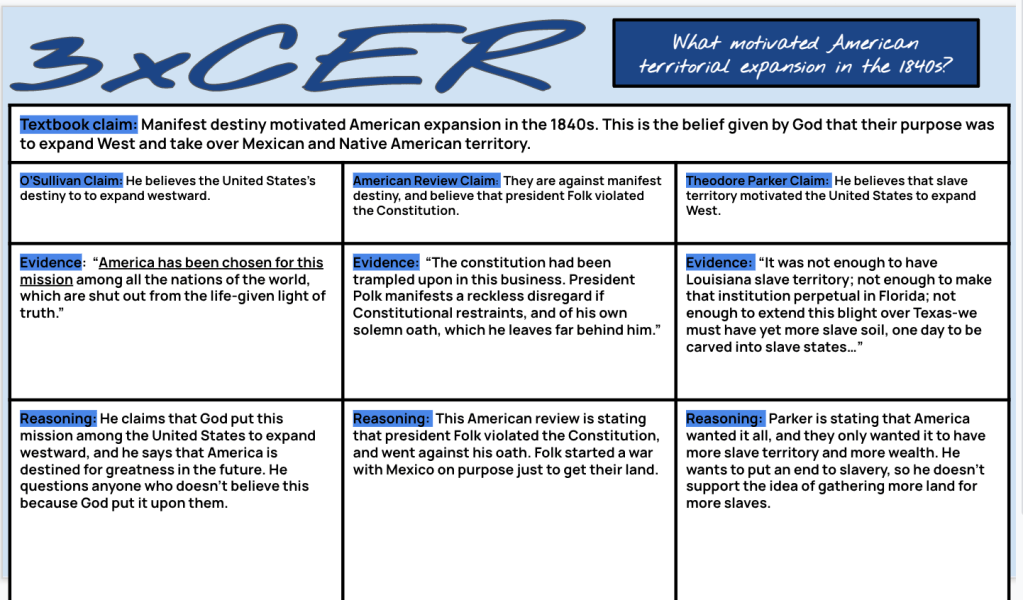
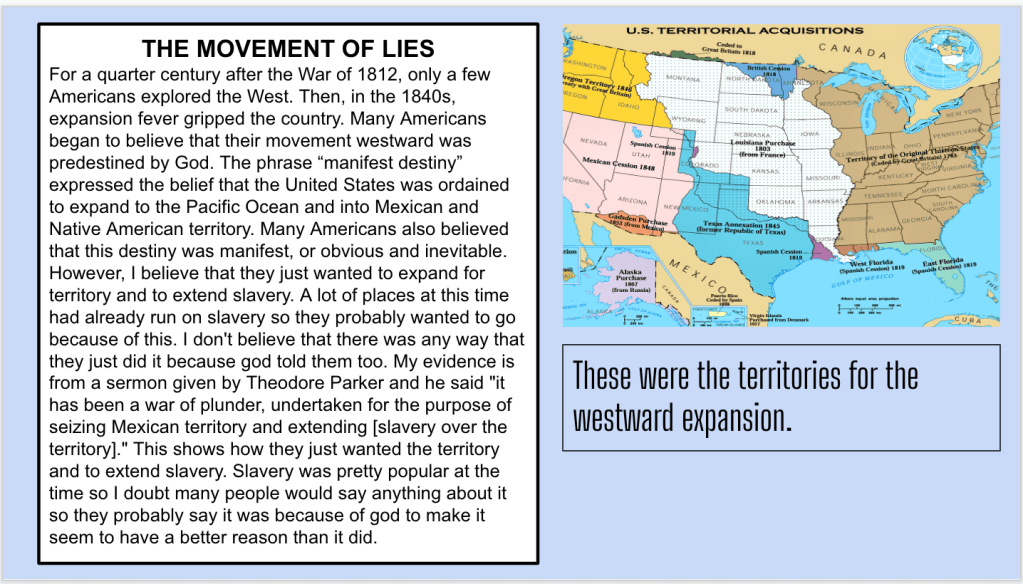
I had them use this past lesson and what they recently learned as a starting point to answer the original question. I have told my students since day one, “Everything we do serves a purpose. It’s intentional.” So many students go from one day to the next completing tasks, worksheets, etc with no purpose. When I reminded them to go back to this lesson, they said, “Oh yeah, now it makes sense.”
Overall, the students did a fantastic job on their annotated maps. Their maps and the Fast and Curious Gimkit served as their summative assessment. I will add pictures soon.
Thursday
Thursday we began a new lesson where the question was asked, “What inspired people to go west?” The lesson had some background knowledge readings and 4 sources for students to analyze. Here were the sources:
- A painting entitled, Westward the Course of Empire Takes Its Way.
- A letter written by Thomas Jefferson to Lewis and Clark.
- Two excerpts out of the book, Our Country: Its Possible Future and Its Present Crisis, written by Josiah Strong.
- Song Lyrics from the song, “I Go West,” by JP Barrett.
I set up this lesson to where I read the background information, then students analyzed the source. I don’t know why, but I only shared the sources with them and not the background information. Looking back on that, I made a mistake so I corrected it for Friday. I put all of the information and sources on one piece of paper – front and back.
The first source we looked at was the painting. I read the background information, pointed out certain images to look at, and students analyzed the painting with an 8pArts. Students filled out the nouns, adjectives, etc. in 7 minutes. They wrote their summaries in 3 minutes. Here are some examples:
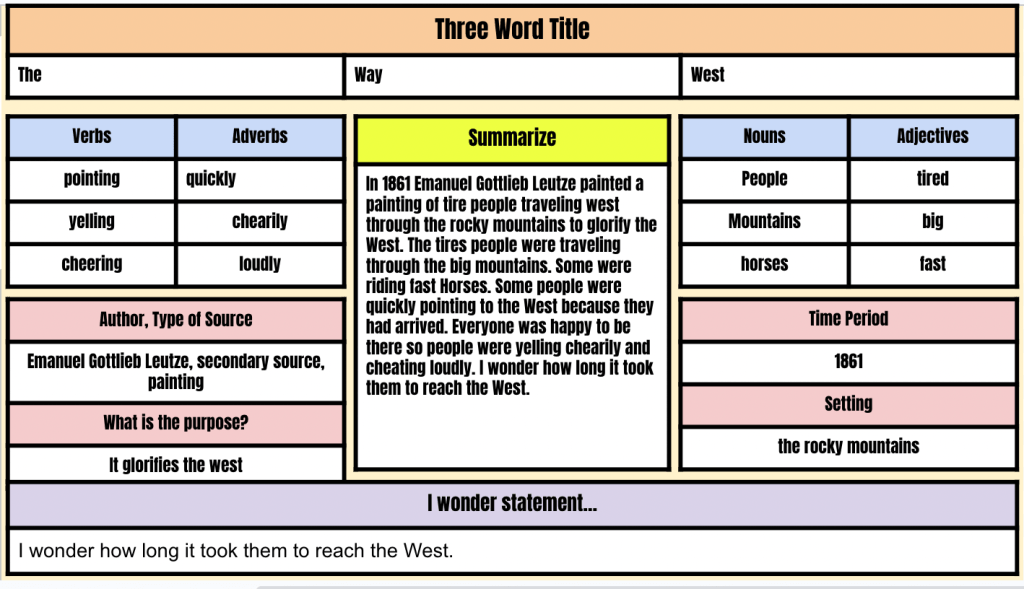
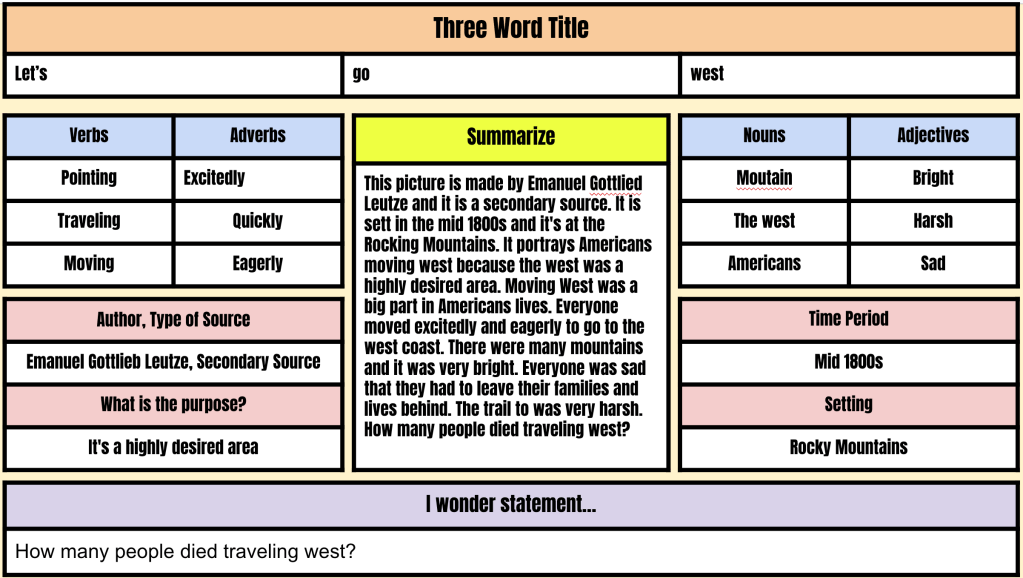
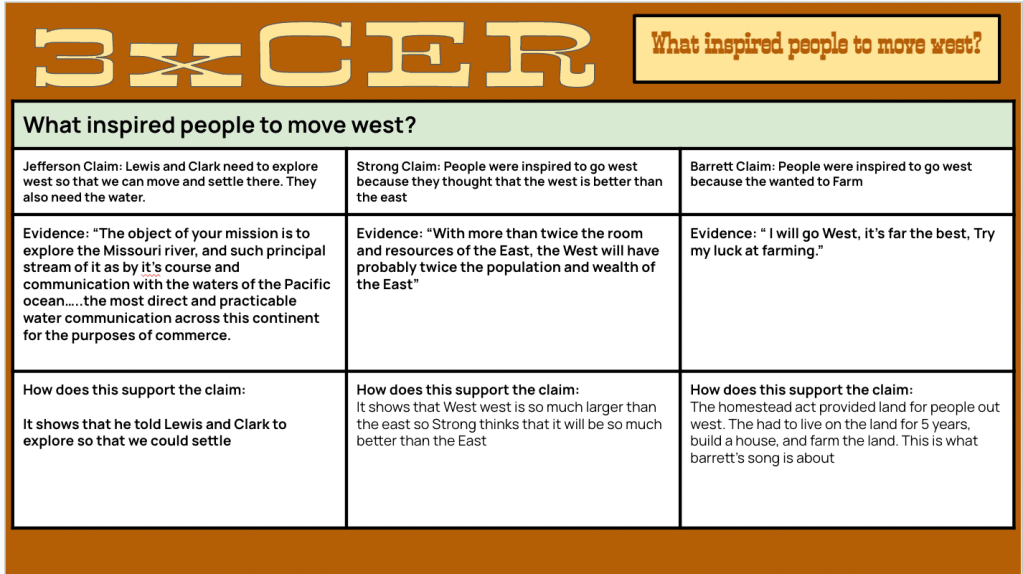
Then we followed up the 8pArts with a 3xCER. I would read the background information, and students read the source. I had two different versions of the sources – the original wording and a 5th grade level. I pasted the sources into ChatGPT and requested it keep the tone and meaning, but rewrite it for a 5th grade student. It did an excellent job.
As we did the 3xCER, I was teaching the students that a claim would restate the original question. The evidence would support the claim. Finally, instead of reasoning, I wrote it as a question, “How does the evidence support the claim?” I encouraged the students to include some background information here. Here are some examples:
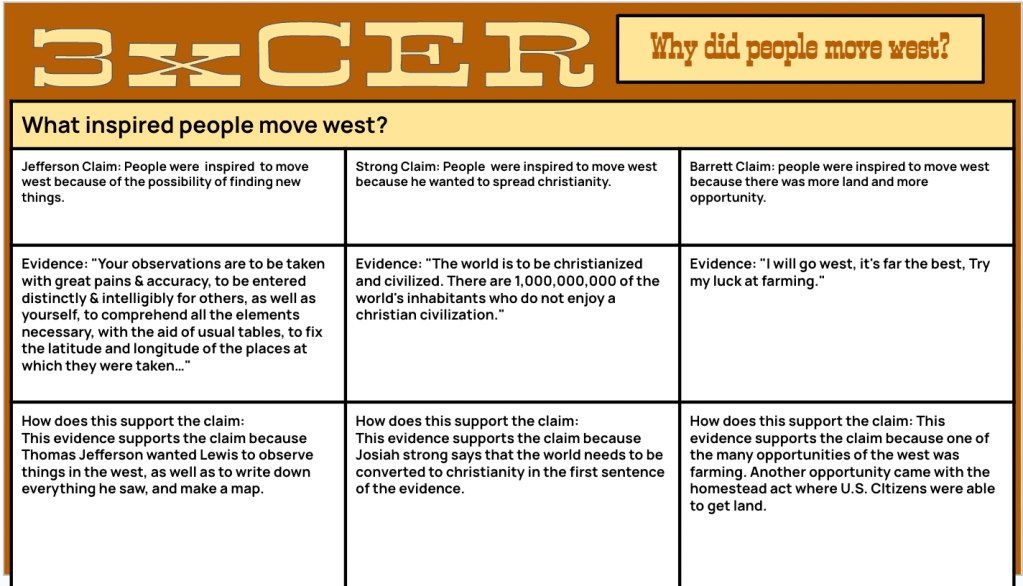
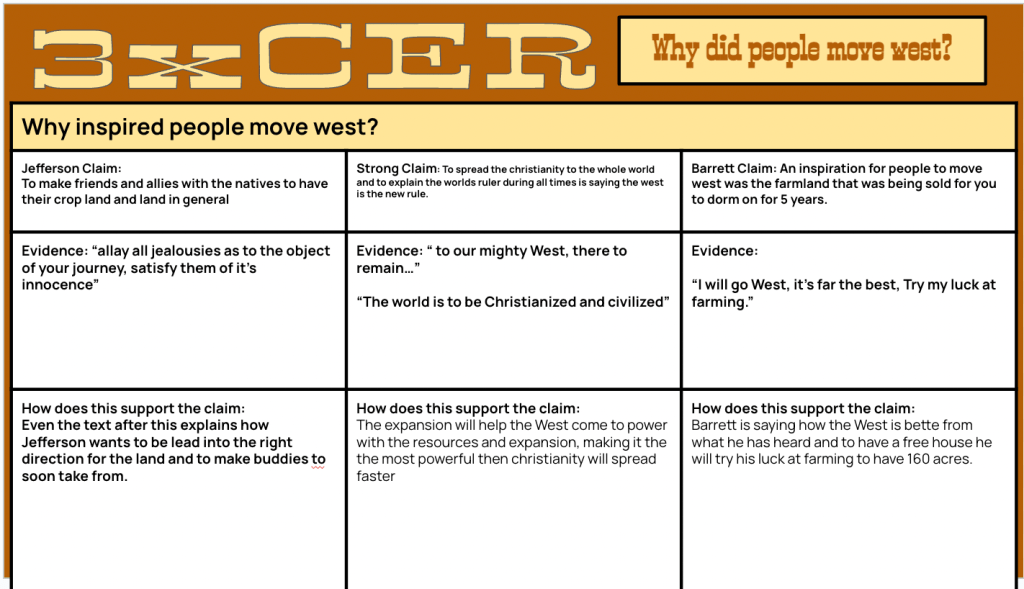
Friday
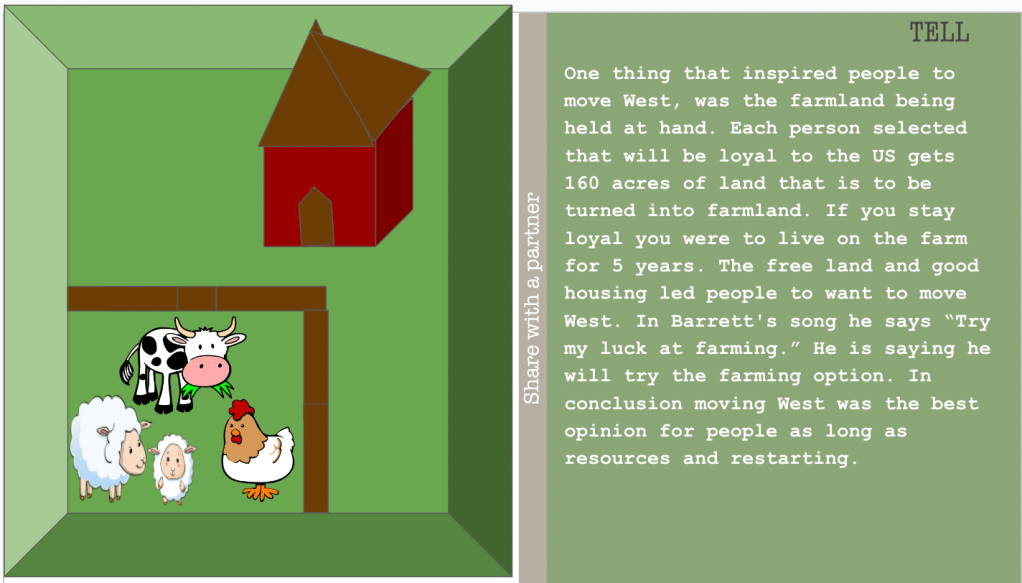
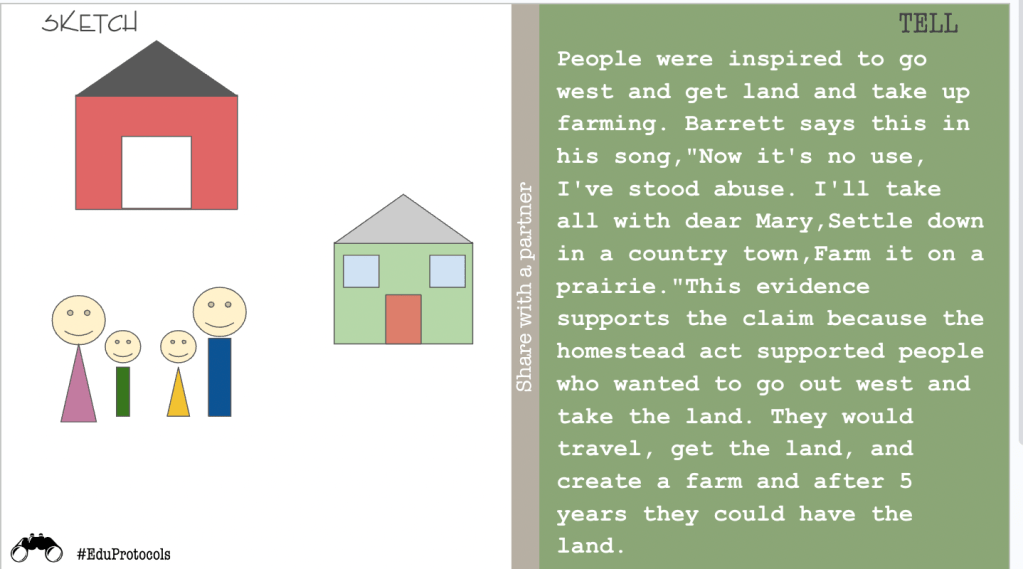
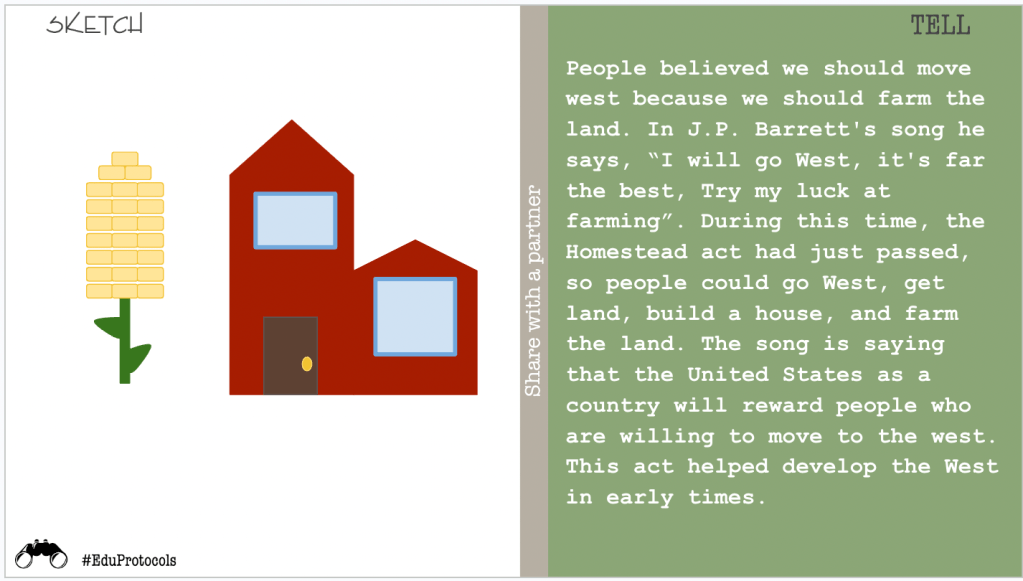
Friday was used to finish up the 3xCER, if necessary, and to take the information to finish a Sketch and Tell. The goal was to have students construct a paragraph with a claim, evidence, reasoning, and a concluding sentence. I don’t like to be like this, but I stated the paragraphs had to be four or more sentences.
I set up this Sketch and Tell from a UDL mindset of providing multiple ways for students to show what they learned. Students could create an image to answer the questions and/or write a paragraph with their 3xCER information.
Before students began writing, I informed them the 3xCER had to the structure of the paragraph already set up. Pick a column and start writing. Here are some awesome examples:




 Moler's Musings