Last week we learned about Manifest Destiny for our new unit on westward expansion. The main question for the first part of our unit is, “How did manifest destiny drive westward expansion?” We focused on manifest destiny because I remember a story from a book I read where the teacher taught a unit about immigration and during the final assessment, umerous students didn’t know the meaning of immigration. We spent two days on manifest destiny and the interpretations of the phrase.
This week we were learning how we acquired different territories to fill in the United States. I usually go in chronological order. We began with the Louisiana Purchase, Florida Cession, and the Texas Annexation. The focus is on how we acquired all these different territories.
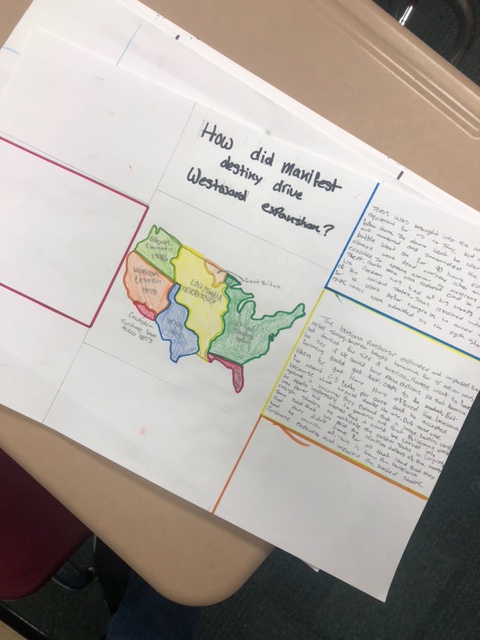
I usually do an annotated map with this unit. Last year I decided not to do the map. This year, I brought the map back. An annotated map contains a labeled hand drawn map, a question, and historical summaries surrounding the map. These maps are great for connecting geography to history.
During this week, we sued a variety of EduProtocols to learn about these territories. We used a CyberSandwich, 4xFlorida, and another Cybersandwich. Each one of these protocols I infused with some text structure material. For example, on the Cybersandwich, I included on the student notes section, “What text structure is the reading?” The students are starting to pick up that most informational texts we use in class are sequenced with some other structure such as cause/effect or compare/contrast.
Monday – Louisiana CyberSandwich, Gimkit
Tuesday – 4xFlorida, Roll Dice Writing Options, Gimkit
Wednesday – Annotated Map (still a work in progress)
Thursday – Texas CyberSandwich, Iron Chef/Archetype Smash (Brianna Davis creation)
Friday – Annotated Map, Retrieval Practice
Monday
As I was driving into work Monday morning, I was thinking about how to approach the week of teaching how the United States acquired it’s territories. Did I want to assign a territory to each students and have them share? Do I stack CyberSandwiches? The only thing I was sure of was using text structures within the lesson. With that in mind, the option became clear – a CyberSandwich.
On the CyberSandwich notes slide, I scaffolded the notes and added a question about the text structure. With the text structure question, around 50% of students got it correct – sequence and cause/effect structure. The scaffolded notes were broken up into different categories such as: people involved, why we wanted Louisiana, reasons for, and reasons against the purchase.
In a typical CyberSandwich, I gave students ten minutes to read and take notes. Then I had students write down four important facts on the compare/contrast slide. Next, we did three categories – bazinga, 3 facts, or questions. For the three categories, i had students get up and write their responses on one of three boards. Finally, I gave students 8 minutes to write a summary paragraph.
We finished class with a Fast and Curious Gimkit. So far, the Gimkit has 14 questions. I will add more as the unit progresses. As students start to master certain questions, I take them away. Every class was at an 80% average or higher.
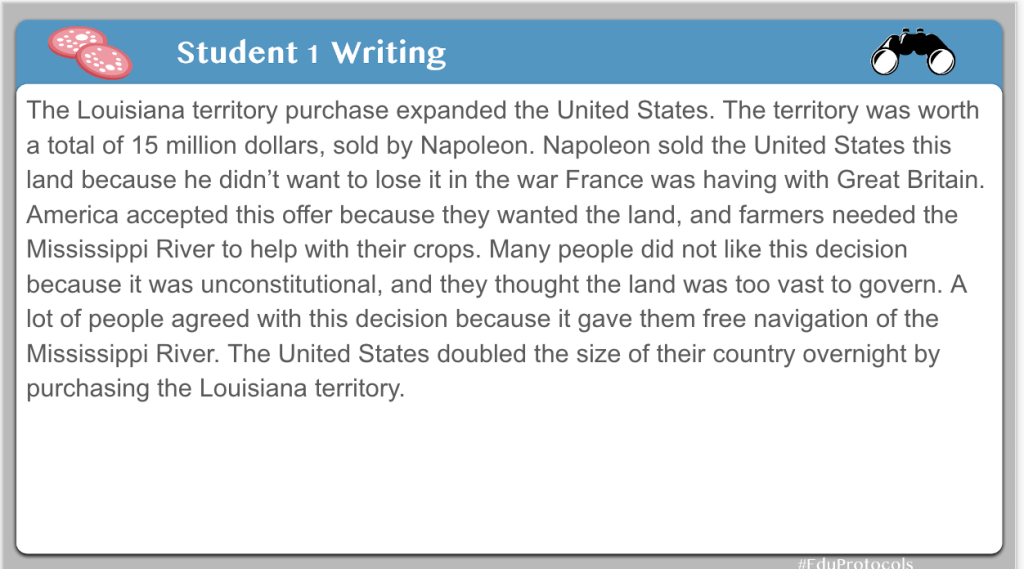
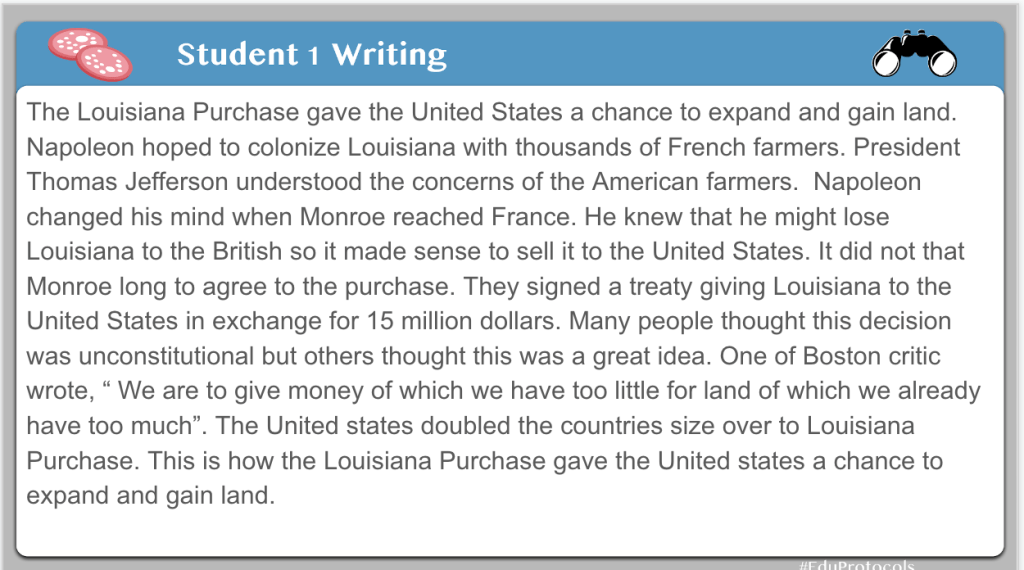
As I went home that evening, I read through the paragraphs written by the students. I used mote to give audio feedback. The biggest issue I noticed was a topic sentence with details that didn’t fit with the main idea of the paragraph. For example, the student might say, “The Louisiana Purchase was controversial,” and not mention any type of controversy surrounding the purchase.

Tuesday
Tuesday began with the students listening to the feedback on Mote. I gave whole class feedback on the issue mentioned above. Then I had students listen to their individual feedback. I gave them 10 minutes to revise, make changes, and highlight any changes.
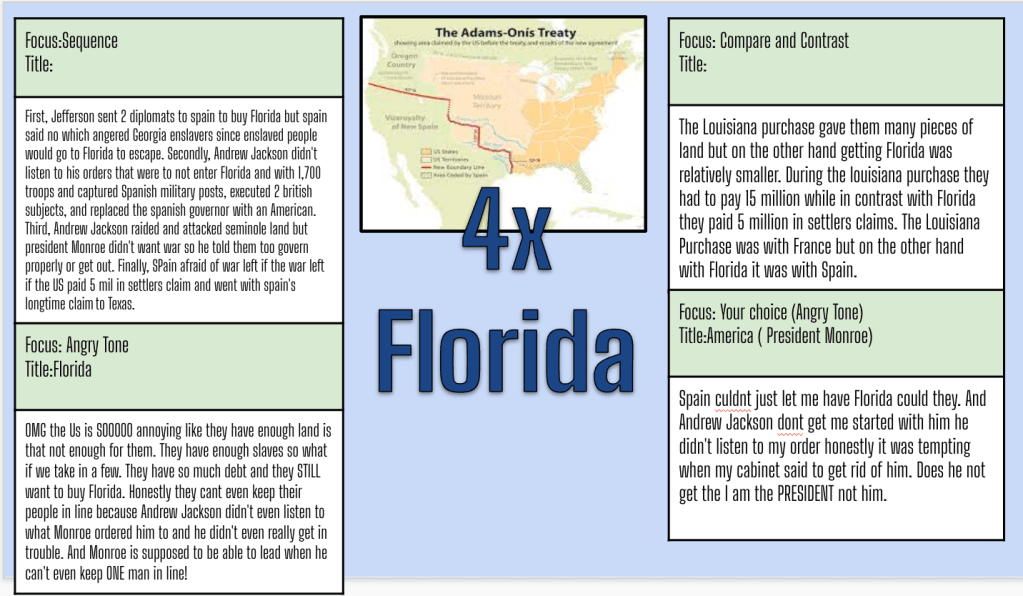
At the conclusion of 10 minutes, we moved into learning about Florida. I added a sequencing graphic organizer at the bottom of the page. Then I asked the students, “Based on the organizer, what is the text structure?” From the visual of the organizer, over 90% of the students got the structure correct.
I gave students 8 minutes to read and fill out the sequencing graphic organizer. I thought about doing a CyberSandwich stack, but I decided to switch it up. The 4xTextstruxture lesson entered my mind. I wanted a similar lesson. As a result, I created the 4xFlorida. I also created a sheet with 8 different styles of writing – sequencing, angry tone, compare/contrast, narrative, Spain’s perspective, etc. Any time dice is involved, it’s fun.
When it was time to summarize how we got Florida, I rolled the dice and gave students four minutes to write. Overall, the students did a great job as this was the 5th or 6th time we did this style of lesson this year.


Wednesday and Friday
I’m combining Wednesday and Friday into a single heading because students worked on their annotated maps. For Wednesday, I handed out 11×17 size sheets of paper and had students tracing/drawing maps of the United States. Here are the steps I left for them:
- Write the question at the top of the paper, “How did manifest destiny drive westward expansion?”
- Draw an outline of the United States and label these territories: Louisiana, Florida, Gadsden purchase, Mexican cession, Oregon, and Texas.
- Leave room around the map.
I offered for students to try Google My Maps and only 2 students took em up on that offer. Here is an example:

For the last 10 minutes of class son Wednesday, students completed a Fast and Curious Gimkit. This particular Gimkit was on U.S. territories and I added continent related questions to it. The students were asking if France was a continent. This prompted my decision to add continent questions.
On Friday, students were outlining, coloring, and adding information to their maps. I had them open their Louisiana CyberSandwich summaries and transfer their responses to the map. If they felt their summary was too long, I had them paraphrase.
When they were writing about Florida on their map, they asked me, “Which writing for Florida do we add?” I responded with, “Which writing do you think works best?” They quickly realized the sequence, narrative, or cause/effect writing worked best. It was not my intention to use the entire class period for Wednesday and Friday, but that’s the way it goes.
***In some of the classes, the students finished early and we did some retrieval practice the last 10 minutes of class. I made a new retrieval board and they did awesome!

Thursday
On Thursday, I decided to go back to a CyberSandwich for the Texas Revolution and annexation. There are many parts and people to the story of the Texas revolution. Before we began the CyberSandwich, students completed an Archetype/Iron Chef EduProtocol smash.
This year we have done archetypes once or twice, but never in the format of an Iron Chef. I know I should go with a low cognitive load, but I went for it anyway. I gave the students 4 people to read and write about – James Polk, General Santa Anna, Stephen Austin, and Sam Houston.
Here is how I ran the lesson:
- 12 to 15 minutes to read and design the slide.
- List 5 facts about the chosen person first.
- Choose an archetype and use evidence to justify the choice.
- Make a connection and list another person who fit the archetype (historiucal or modern person)
- Add an image.
- I had students share them in a single slide deck and gave students 5 minutes to read and look through the Texas Revolution characters.
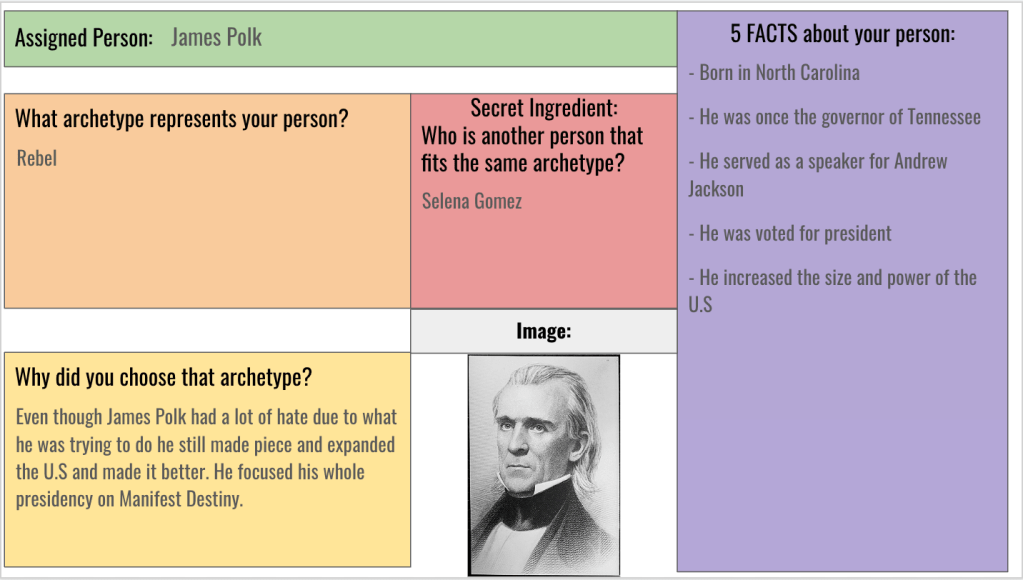
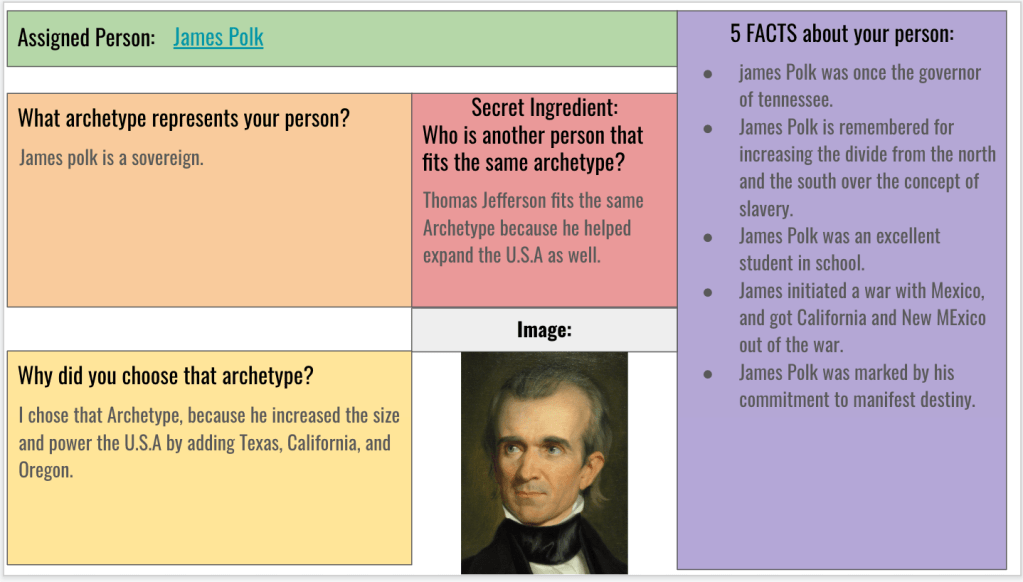
This lesson turned out okay…I should have started with a low cognitive load, but, that’s the way it goes. The main goal was to build some background knowledge for the Texas Revolution. I thought it was cool that students made comparisons between Sam Houston and Andrew jackson. They made comparisons between James Polk and Thomas Jefferson. Comparisons were made between James Polk and Selena Gomez – I don’t know?
We followed this lesson with a CyberSandwich. The reading paired with this was looooonger than normal. I created a CyberSandwich with a sequencing organizer on the note taking slide. I read the reading to the students, and offered some clarification after each section. At the end of each section, I paused and students filled out a box for the sequencing organizer. At the conclusion of the reading, students discussed and shared their organizers. On Friday, they directly wrote their summaries on their Annotated Maps.
Other Stuff
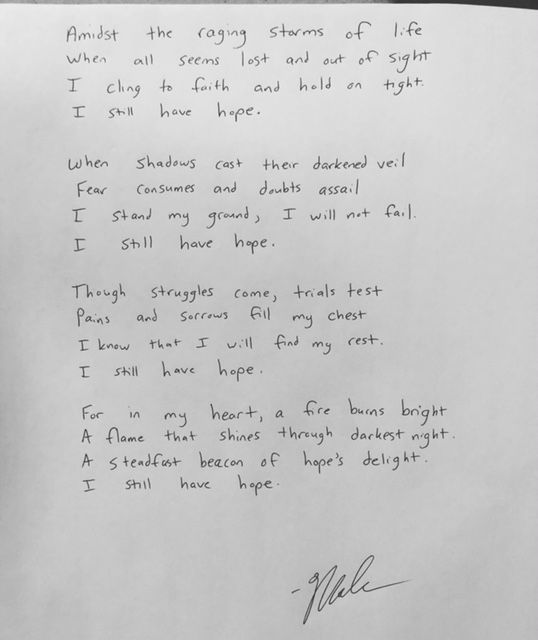
The pictures, notes, and random mess of stuff in my classroom has a story and serves a purpose. Sometimes I don’t quite know what the purpose is, but ultimately time let’s me know. In October at the Ohio District Teacher of the Year festivities, we had a banquet where former Ohio teacher of the Year Jonathan Jurivich gave us student made painting with inspirational quotes that we shared with him in July. My inspirational quote was from Monte Syrie, “Do. Reflect. Do better.” He also shared with us a quote from the 2022 Ohio and National teacher of the year, Kurt Russell, that said, “I still have hope.”
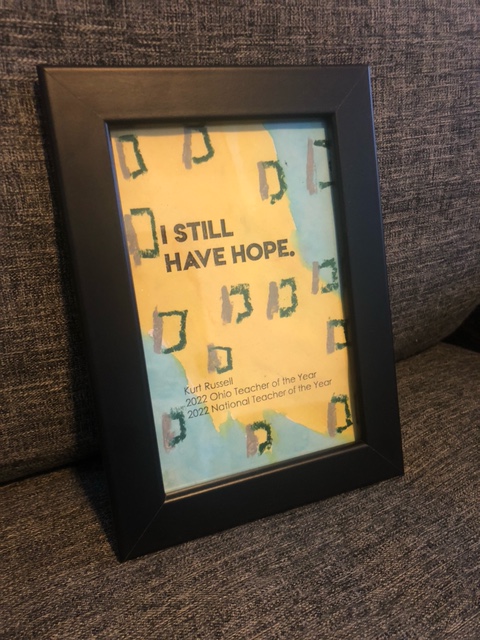
I’ve had the, “I still have hope,” picture up in my room since October. I didn’t know it’s purpose, or story, until this week. Two weeks ago we had a horrific tragedy happen in our community. An entire family was lost including one of our 7th grade middle school students. The lone survivor, the sister, was a former student of mine. The story and the purpose of that picture became clear to me – it’s not for me anymore. That picture is for her. That picture is for the new world she is entering on the other side of her recovery. If you feel like donating to her GoFundMe, please visit and donate by clicking here.
Through tough times, I need to write. Whether it’s a poem, story, anything, I need to write. I wanted to pair a poem with that picture. Most of the stories for the objects in room 505 are stored in my memory bank. However, the story for this picture needed to be put into words. When I arrived at school on Friday morning, I stared at that picture and wrote:
Other Writings


Podcast
Coming soon…..

 Moler's Musings