
This week we wrapped up the Age of Jackson with some new protocols and some new lesson ideas. I tend to get ideas and run with it because….why not? To me, education is one big experiment. I’m going to try stuff, see if it works, see if it’s engaging, and reflect. If something sucks, I’ll ask myself or the students why and try again.
This week I tried some new things with retrieval practice, a new EduProtocol (thank you Lauren Richardson, Ashley Morrison, and Jacob Carr), and a new use for ChatGPT. I love new ways to use technology to enhance the learning experience.
As I mentioned in my podcast last week, retrieval practice is often forgotten about. For some, maybe it’s the DOK 1 nature of the practice. For me, I get caught up in the day to day stuff of teaching and don’t make time. I have vowed to make more time.
The new protocol I tried came from jacob Carr’s brilliant mind – the Wicked Hydra. In seeing posts on Facebook, Twitter, and beyond it appears that Wicked Hydra can be used at the beginning of a unit or at the end of a unit. It’s an EduProtocol so it’s versatile.
With ChaGPT, I had it create arguments why Andrew Jackson is considered a good president and a bad president. I had a realization that it’s hard for students to write argumentatively when the argument is obvious. It’s easy to write about why Andrew Jackson could be a bad president. The good argument isn’t so obvious. As a result, ChatGPT spit out some some good arguments based on the prompt I typed out.
Near the end of the week, I was looking at some testing data and it showed up with the yearly trend – Informational Text craft, purpose, and structure. The data isn’t good. I decided that I’m going to address this problem with some mini lessons and infuse my future lessons with text structure prompts.
Monday – No School
Tuesday – Retrieval Practice, Number Mania
Wednesday – Argumentative Writing
Thursday – Wicked Hydra, Fast and Curious, Repuzzler
Friday – Fast and Curious, Resource Rumble
Tuesday
Tuesday’s class began with a retrieval practice grid. I learned this idea from Lauren Richardson and Ashley Morrison at the Pickerington Schools Conference. The grid has four columns, four rows with different colored boxes. Each box represents something from a different lesson throughout the school year. When I chose which questions to include, I thought about important information included in the standards.
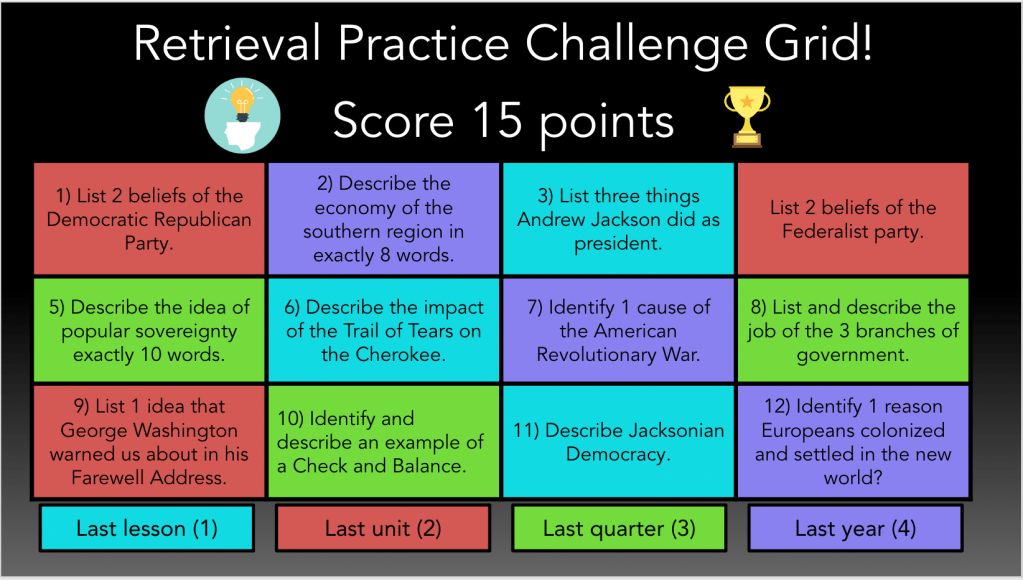
When students walked into 505, I had this grid posted on the screen. I didn’t want students using chromebooks, so I created a google doc that mirrored the grid you see above. I printed off the grid and handed it out to groups to avoid the chromebook fight. Students had 15 minutes to earn 15 OR MORE points.
At first, the students were struggling. It quickly turned around and they started coming up with answers. If you give students time to think, it will come back to them. Some people asked me some questions about this:
- “How do I check for accuracy?” – My students ask me to check on them and look at their work all the time. Plus, I had them turn their papers in to me so I could check the answers. Then I began thinking about this – why do I always need to check for accuracy?
- “What is the point of this?” – through social media, this seemed pretty direct and condescending. However, we don’t use retrieval practice enough. I will use it a lot between now and the end of the school year.
At the conclusion of the retrieval practice grid, I went back to the Trail of Tears lesson from last week. I left a long reading, and many students didn’t complete the lesson. As a result, I compromised and had students revisit the Number Mania slide. On the slide I left a statement from the article, “The trail of the exiles was a trail of death.” I asked the students to find 4 numbers and facts to support that statement.

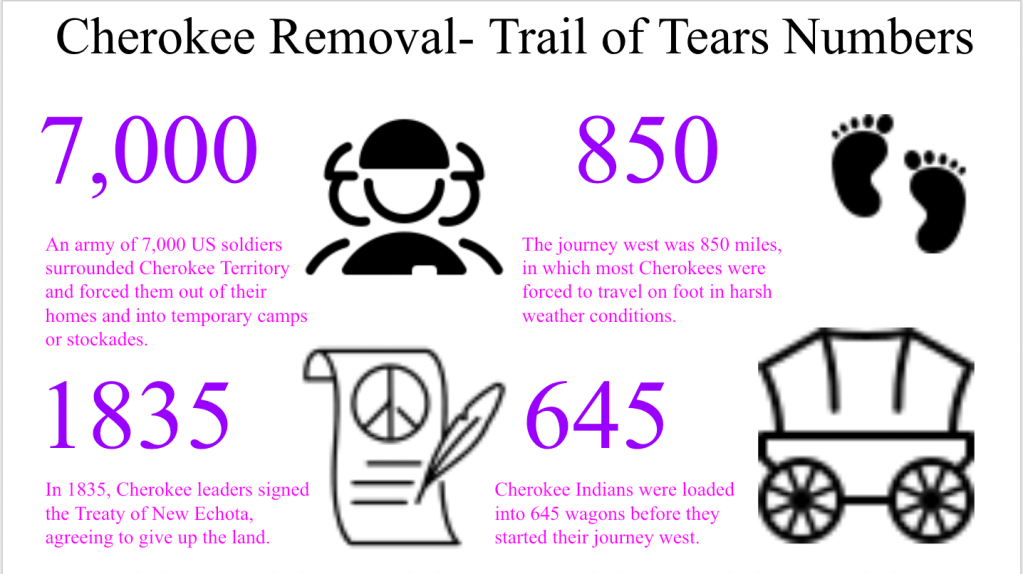

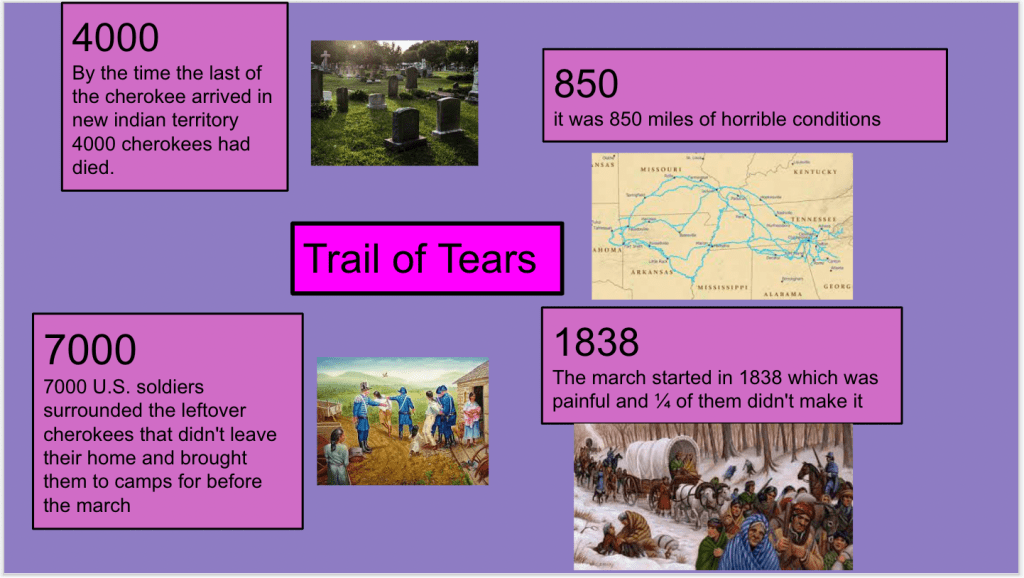
Lately, I have been all about finding a quote from a reading and having students use numbers and facts as textual evidence to support a statement. It focuses the students and helps focus my feedback. I know when I’m giving feedback if a student uses, “1830 – the Indian Removal Act,” it’s not necessarily supporting that statement.
For the students that were finished, I extended the activity to a Holocaust project they are doing in language arts. I threw out to the students it seemed Hitler’s lebensraum was influenced by America’s Indian removal policy. So, I had students compare the Trails of Tears to the Holocaust using a Venn diagram. The students did an exceptional job with their information.
I ended the last 10 minutes of class with the Fast and Curious Gimkit the students created throughout the unit. Every class was at 76% or higher.
Wednesday
I wanted to wrap up the unit on Andrew Jackson. It has been choppy with me being out and other interruptions of school. It was time to move on. With most of my summative assessments I like to use a Fast and Curious paired with a performance task.
At the start of the unit, I wanted to use the question, “Was Andrew Jackson good for democracy?” Then I realized I should have covered the word “democracy” and I didn’t. Knowing my students, it would have been a disaster. I’ll have to cover democracy later (even though they studied this word multiple times in the past). To keep things simple, I changed the question to, “Should Andrew Jackson be considered a good president or bad president?” Simple? Yes. Too simple? Maybe. It is what it is.
Arguing that Andrew Jackson is a bad president seems simple since we just studied the Trail of Tears. Sometimes we ask students to make arguments that seem so obvious that it’s hard to write about and make an argument. I know from experience. So, I went to ChatGPT for help.
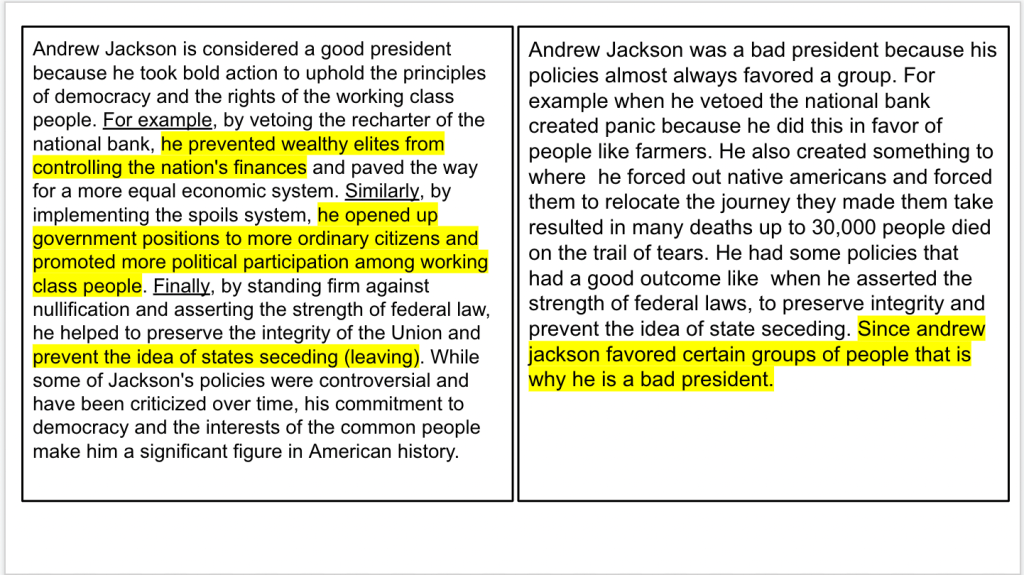
I asked ChatGPT, “Create a short argument why Andrew Jackson is a good president based on the nullification crisis, spoils system, and national bank.” It spit out a wonderful argument. I had to change a few words and it was good to go. Then I asked ChatGPT, “Create a short argument why Andrew Jackson is a bad president based on the nullification crisis, spoils system, national bank, and Trail of Tears.” Again, I changed a few words.
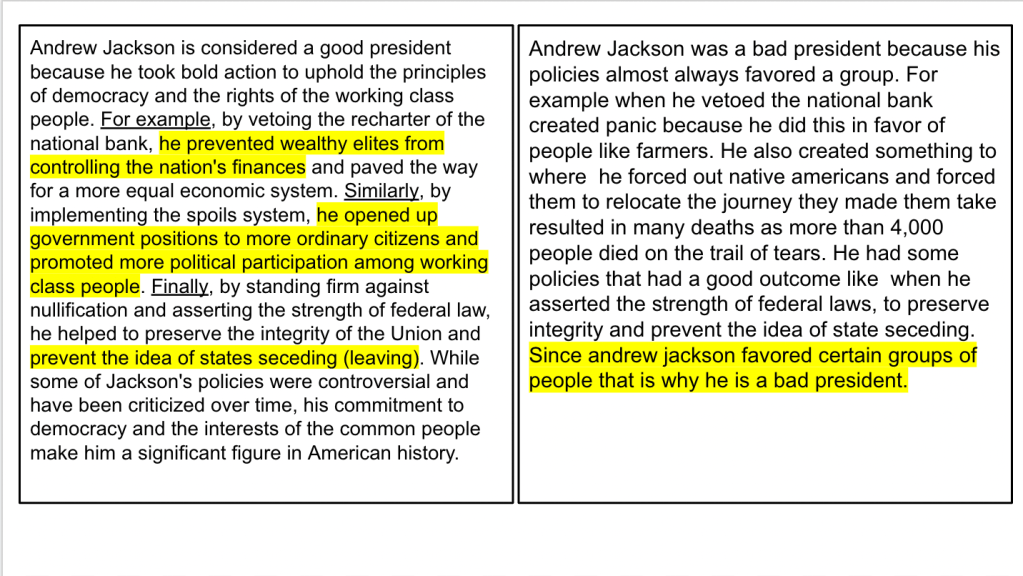
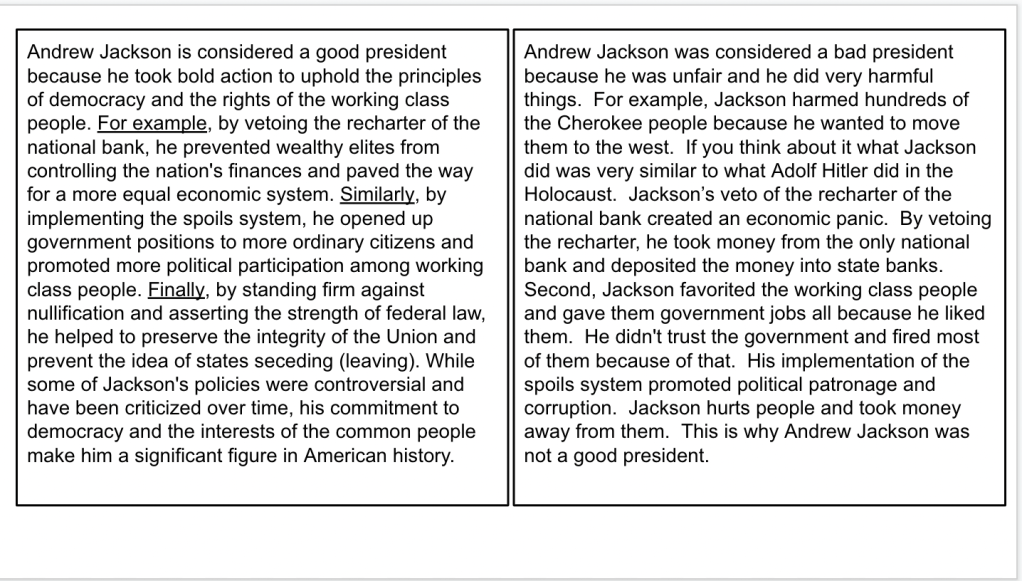
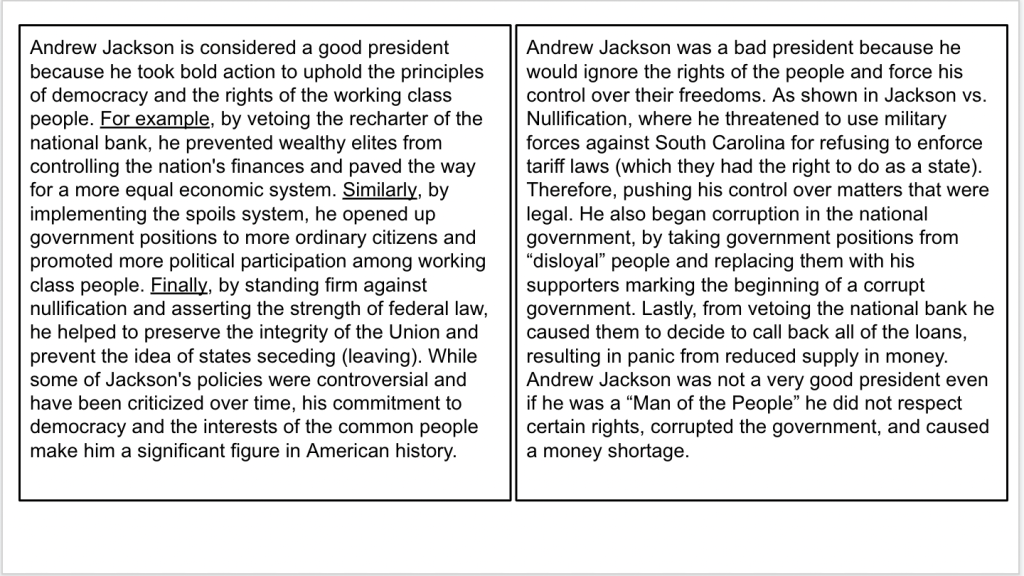
I copied both of the arguments to separate slides on the same slide deck and shared with students. Then I had students choose an argument and write a counterargument (I used the word rebuttal and we had a good laugh that I said butt – it’s middle school). I wanted the students to practice writing a claim, using evidence, and reasoning. In the counterargument I was hoping students would use information they learned in the unit.
My goal since the beginning of this year was getting better at writing a decent paragraph – argumentative or descriptive. I used Mote to give audio feedback to every student. The next day, I had students listen to my feedback and make corrections. We are getting better at writing! Here are some examples:



Thursday
I began Thursday by having students listen to my feedback from Mote and making corrections. I set a timer and gave them 10 minutes. Then I decided to have them highlight and revisions they made. When the timer sounded, we moved onto our new lesson.
This new lesson, I stopped and asked, “Hey, do you want to try something new?” They, of course, said, “Yes.” I busted out the Wicked Hydra. I don’t even know if I did it correctly, but I loved it. The students loved it.
Some of the periods I used the white boards because they are small classes. Other classes, I had huge pieces of paper. I had the students pair up based on rows and write, “Andrew Jackson,” in the middle of the board or paper. I gave students 7-8 minutes to write questions about Andrew Jackson – anything and everything – whether you know the answer or not – ask it, write it. When the timer went off, I had them rotate around the room to a new board or paper. I gave them 3 minutes to add new questions. Then we rotated again – repeat.
The students came up with questions related to topics they learned at the beginning of the unit that I completely forgot about. This was an awesome way to end the unit on Andrew Jackson. I learned two things from this:
- The students subtly shared things they learned that they didn’t include in their argumentative paragraph or the gimkit.
- Not every lesson, unit, activity needs closure.
After the Wicked Hydra I switched to a new lesson completely – Text Structures. Why Text Structures?
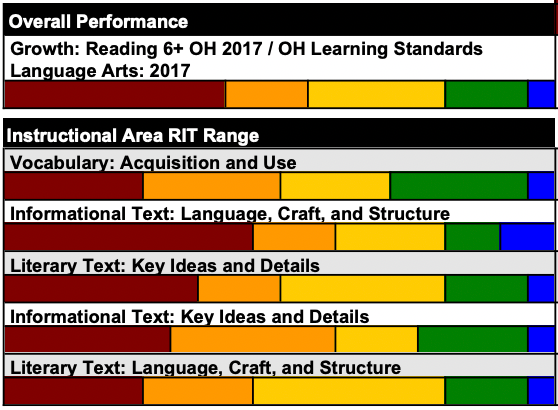
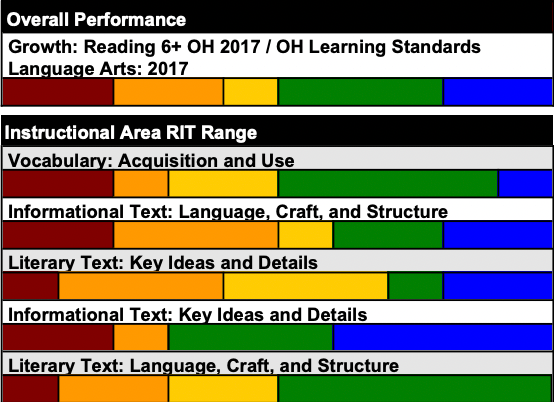
The data is telling me that I need to focus on text structures. I decided I’m going to take three days to focus on text structures and author’s purpose and infuse these ideas into future lessons. I’m willing to bet that the lack of text structure knowledge is contributing to the lack of key ideas and details knowledge.
I had the students do a Fast and Curious with text structures using Gimkit. The Gimkit had 17 questions about signal words, definitions, and passages dealing with informational text structures. I had the students play the Gimkit for 5 minutes. Then I went over the 3 most commonly missed questions, and set up another game to run for 4 minutes. The students love this format.
We followed up the Gimkit with students completing the slides for the Repuzzler. The students shared the slides and divided the work. Each slide had the students researching an individual text structure – a paragraph example, signal words, and a graphic organizer. This took about 10 minutes and class was over. A full class period bell to bell.
Friday
Friday we began class with a Fast and Curious Gimkit on text Structures. This was followed by a Repuzzler. Most of the students completed the Repuzzler in seven to ten minutes. Following the Repuzzler, we did a resource rumble with text structures.
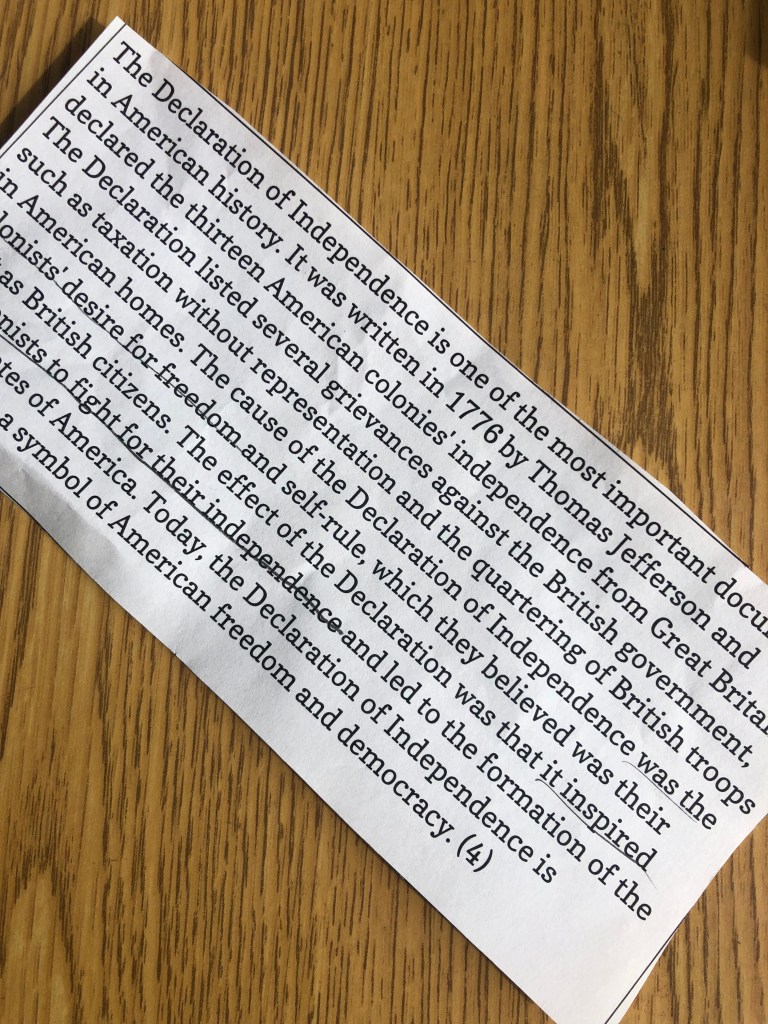
I went to ChatGPT to help me write eight different paragraphs, with different text structures, related to history. I asked ChatGPT, “Write a 5 sentence, 5th grade level paragraph about the Monroe Doctrine using a cause/effect text structure using cause/effect signal words.” Within seconds, it created a great paragraph. However, I should have done a better job at checking the paragraphs because one of them stated, “The American Revolution spilled over into Europe.” This was the only mistake I read.
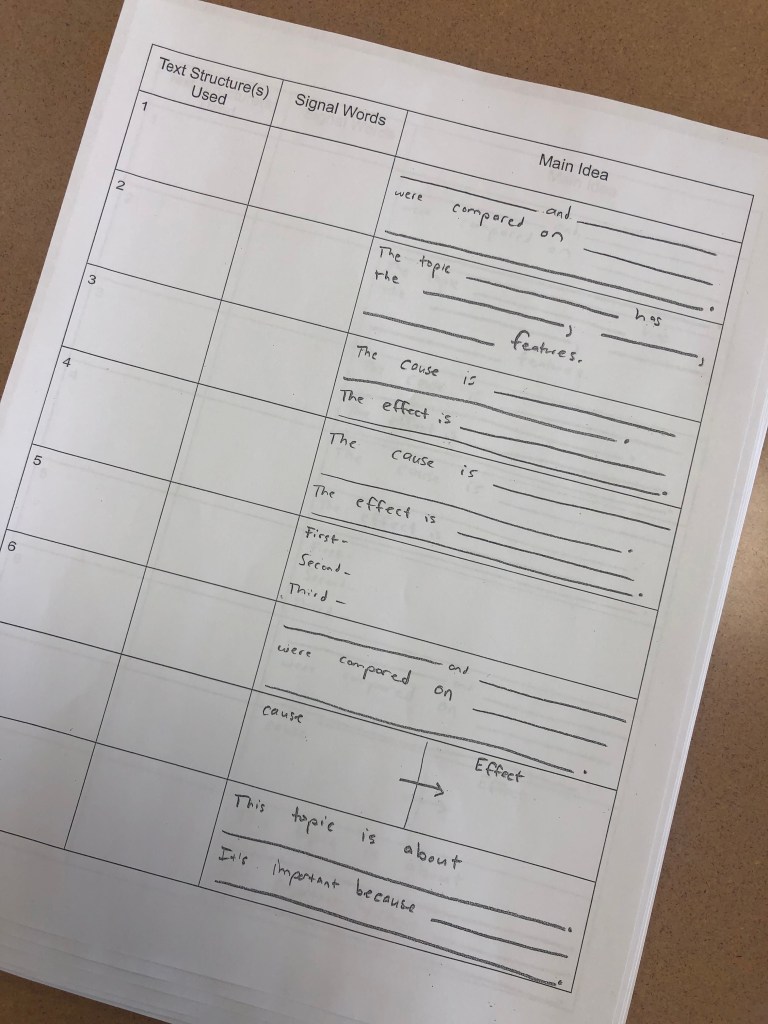
I placed each paragraph into an envelope around the classroom. Each paragraph I had ChatGPT create related to something from the retrieval practice grid from Monday – everything I do is intentional. I created an organizer for students to keep track of their information. They had to read the paragraph, guess the text structure, write down signal words, and fill out a prompt about the information in the paragraph. All in all, this was a fun lesson that got the students up and moving.

 Moler's Musings