
One thing we don’t do enough within our lessons is the use of retrieval practice. We spend so much time putting information into the students’ minds. As a result, we spend less time having them get that information back out. Retrieval practice is an aspect of my teaching I wanted to focus on this week.
Last week students watched an EdPuzzle about Andrew Jackson. This was followed by the creation of a thick slide featuring a “battle” that Andrew Jackson fought within government. Students shared their slides through a Google Form to created a curated bank of thick slides. Then I gave students a Frayer model to take notes from the other slides.
This week we finished up taking notes on Monday and started creating these fight posters about Andrew Jackson vs. someone or something. It was a nice. ix up because it was done on a paper. Yes, I’m a believer that it’s good to mix some paper into my lessons or units. However, paired with this was some retrieval practice strategies.
Near the end of the week, students finished up Jackson’s battles and we moved onto the Trail of Tears. I created a mini lesson paired with a reading. The reading I left was longer than normal, and it yielded some interesting results.
Monday – Jackson’s Battles (posters), Retrieval Practice, Fast and Curious
Tuesday – Career Planning
Wednesday – Trail of Tears Lesson with a Number Mania
Thursday – Finish stuff catch Up Day
Friday – PD Day
Monday
I’m going to just focus on the retrieval practice for Monday. If you want to learn more about the Jackson’s battles thick slide, please refer to last week’s blog post. When class began, I gave students 15 minutes to work on finishing notes on the Frayer or creating the fight poster. Then I followed this with students creating questions for our running Gimit. After students submitted some questions, we played the Gimkit for ten minutes. I started with the Frayer and poster work so it would feed into helping students create questions for the Gimkit.
After the Gimkit finished, I had groups get into pairs. Some students got into a group of three (not ideal, but okay). I handed out a dry erase marker to every group. At first they were confused and curious which is what I wanted. I then stated, “We are going to play the marker game.” I explained the rules:
- I read a true/false statement.
- Only grab the marker if you think the statement is true.
- If grab the marker, or touch the marker, and the statement is false – you lose a point.
- If you grab the marker, and the statement is true, you gain a point.
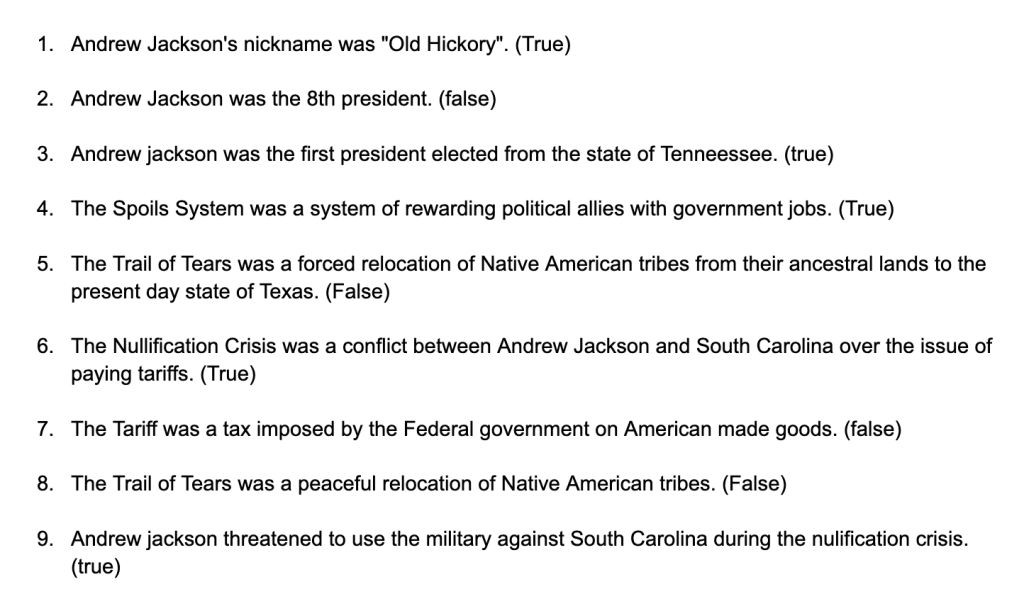
Pretty simple rules. No tech required. The students had a blast. I used ChatGPT to create true/false statements about Andrew Jackson. Some of the statements I had to change the wording to fit with the vocabulary I’ve been using, but they were good statements. Here are some of the true/false statements:
This was a great retrieval practice strategy I learned from Lauren Richardson and Ashley Morrison from the Pickerington Conference I recently attended. The students had a blast.
Wednesday
Tuesday was a lost day. However, I had a data team on Tuesday for a half day. It had an interesting conversation. The conversation included thoughts on reading stamina for map tests. Do we build reading stamina? Do we make reading basic article seem like a daunting task? For example, how often do we say, “I know this reading is long, but….” I’m guilty and never thought about it before. We also discussed if students realize how long it would take to read a longer passage.
Wednesday I was presenting some EduProtocols at OETC in Columbus, OH and I left a longer than normal reading passage about the Trail of Tears. I wanted to see who would take on the challenge of reading and completing a couple of slides. With the reading, here is what I did:
- I left printed copies of the reading.
- I had a digital version of the reading.
- I used Screencastify to record an audio of the reading. Then I linked the audio to the digital copy. (If students are listening to audio of a reading, and following along with a text, students can read and comprehend at grade level, or two levels above.)
- I used ChatGPT to rewrite the reading at a 5th grade level.
Needless to say, I covered my bases. Some students would challenge themselves. Some chose to listen to the audio. Some opted for the edit, fifth grade level. My engagement level is usually around 70-75% when I’m away. Again, I define engagement as opening the lesson and attempting to do something worthwhile. On Wednesday, my engagement level percentage was 50-55%.
The assignment I left with the reading was a Google Slide with three parts. My request for students was simple:
- LISTEN TO THE DIRECTIONS
- Read or listen to – The Trail Where They Cried.
- Complete the activities on 2 or more slides.
The three parts to this assignment were a sequential order slide (I used an Amanda Sandoval template for that slide), a conversation slide, and a Number Mania. I included the sequential order slide because I wanted to see how students would do with putting events in order.
I had a realization during our data team meeting on Tuesday – I need to do a better job with informational text structure and craft. The data from the informational text – key details and main idea wasn’t good either. However, this could be due to not understanding the structure of the text. It could also be due to students reading information text with no background knowledge or working memory of what they’re reading (this is a major problem I have with testing). Why not include readings on the ELA state tests that involve social studies topics we covered this year? It makes sense to me. My mini-rant is over.
Either way, I need to focus on teaching text structure and my mind is wandering that way. In looking at the sequential order slide I put together, the students didn’t do a good job with putting the events in order. It was scary. I need to do better.
On the Number Mania slide, I took this quote from the article, “…the sufferings of the Cherokees were awful. The trail of the exiles was a trail of death,” and wanted the students to create a slide with four numbers and facts to prove that statement true.
One thing I’ve been trying to get the students to think about are the numbers that aren’;t directly stated. For example, the article stated the forced march took place in “below freezing” temperatures. I encouraged the students to think about, “What’s a below freezing temperature?” That could be a number.
I’m trying to up my Number Mania game. Let’s use numbers and facts as textual evidence. Let’s also think beyond explicitly stated numbers and facts.


Thursday
Thursday was a day to finish Jackson fight posters. It was also a day to finish the Trail of Tears activities I left on Wednesday. I also used Thursday to ask students how long they thought it would take to read the Trail of Tears reading that I left. Here are the answers I got –
- 50% of students said 20 minutes.
- 30% said 30 to 40 minutes.
- 10% said 10-15 minutes.
- 10% said 5 minutes.
We were all over the place. This tied into helping students realize that long reading don’t take as long as they think. I told them the reading should take 10 to 15 minutes which is the same amount of time we read during SSR time last year. They were truly surprised to realize to make that connection, and have that realization.
I also shared with the students I had to take a remedial reading class in college because my reading scores were low. I seriously took a basic level, remedial reading class. At the time I was embarrassed. I shared that story to help them realize that if you practice reading, find things you life to ead, you can find better. One student asked me, dead serious, “Did you get better at reading?”
I’m stopping it there. 🤦 If you want to purchase my book, check it out on Amazon!

 Moler's Musings