
This week came and went so fast.
I find myself saying this many times throughout the school year. The students mention to me quite a bit, “This class flies by.” When we are jumping protocol to protocol – yes, it flies by.
This week I got a student teacher for a brief stint of five days. At one point I asked him, “Do you realize how much the students have done in these class periods?” I proceeded to map it out on the board:

We got after it this week studying the Age of Jackson. We learned important vocabulary with Repuzzler (a new EduProtocol from Jacob Carr). Students were collaborating and creating cards on Tuesday for a game on Wednesday.
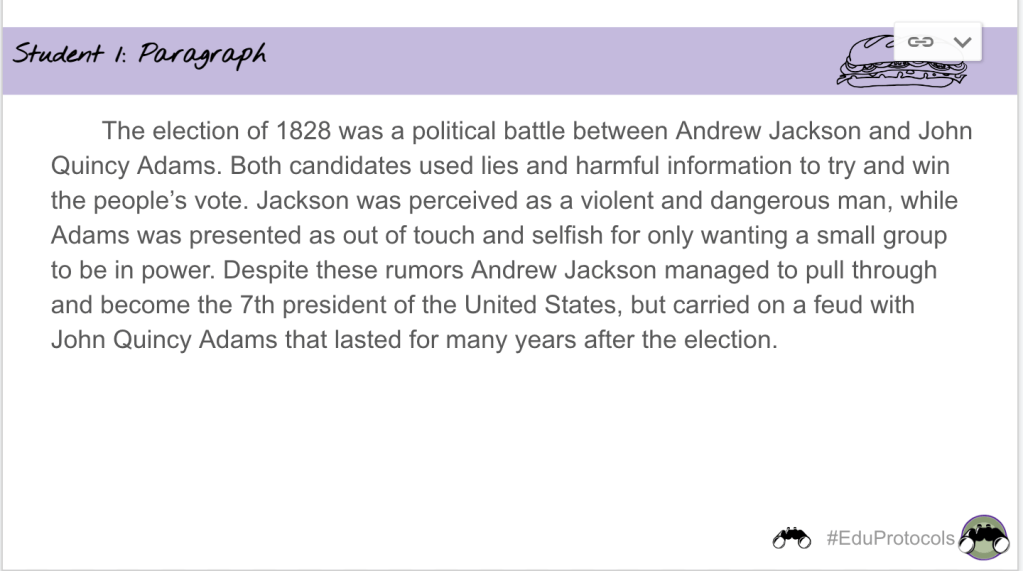
This was followed by a CyberSandwich to learn about the Election of 1828. Since Wednesday, I have been painting this picture of Andrew Jackson as a tough, stubborn, champion of common people. It was only fitting to learn how he became president.
I continued sticking with my theme during this unit – students will create their own questions. After the CyberSandwich, students made questions about the Election of 1828.
We continued into Wednesday with some vocabulary word practice with the Repuzzler cards made by the students. They created their own questions on Gimkit, and we played some Fast and Curious. We finished class with a Thin Slide – one picture, one word or phrase – What did you learn today?
I wanted to create a contributive learning lesson with Jackson’s battles. From this I learned that students thought he fought actual battles against these people and things 🤦. We started with an Edpuzzle video about Andrew Jackson. It was 4 minutes long with 7 questions. Next, students chose a topic: nullification, bank, indigenous people, or government officials. They read about their topic and created a Thick Slide.
Students shared their Thick Slide through a Google Form, and they used a Frayer to process the other topics.
Monday – career planning
Tuesday – Repuzzler, CyberSandwich
Wednesday – Repuzzler, Thin Slide
Thursday – Edpuzzle, Thick Slide
Friday – Frayer, Poster, Success Criteria, Examples
Tuesday
Last Saturday was the Catalina Lesson Mixer put on by EduProtocols+. I attended a virtual session, hosted by Jacob Carr, about Repuzzler. This is a new protocol coming out in his AP Language Arts book. From this session, I was inspired to try the Repuzzler on Tuesday.
When I walked into class, I asked the first student in each row to open the Repuzzler file and share it with everyone in the row. This was followed by, “What? How do I do that?” That was followed me saying, “You have 2 minutes to figure it out.” Guess what? They figured it out.
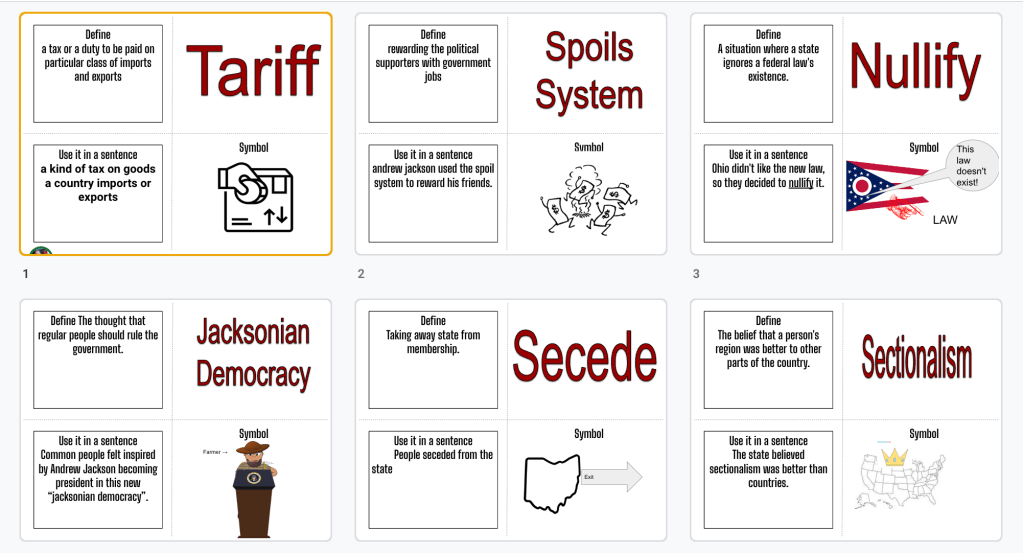
I gave the groups 10 minutes to complete the entire slidedeck. The Repuzzler had eight slides with each of the eight vocabulary words. The students had to add a definition, use it in a sentence, and add a symbol to represent the word. Last Friday students completed a TIP chart with vocabulary. I handed the TIP charts back to them for reference. After students completed the Repuzzler, they asked me, “What are we doing with those?” I responded, “You’ll see tomorrow.”
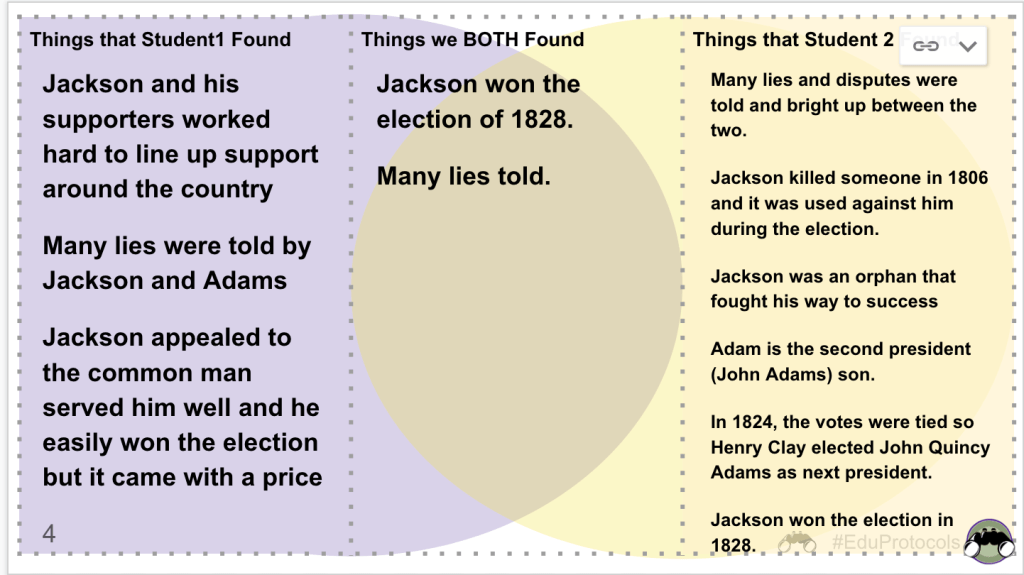
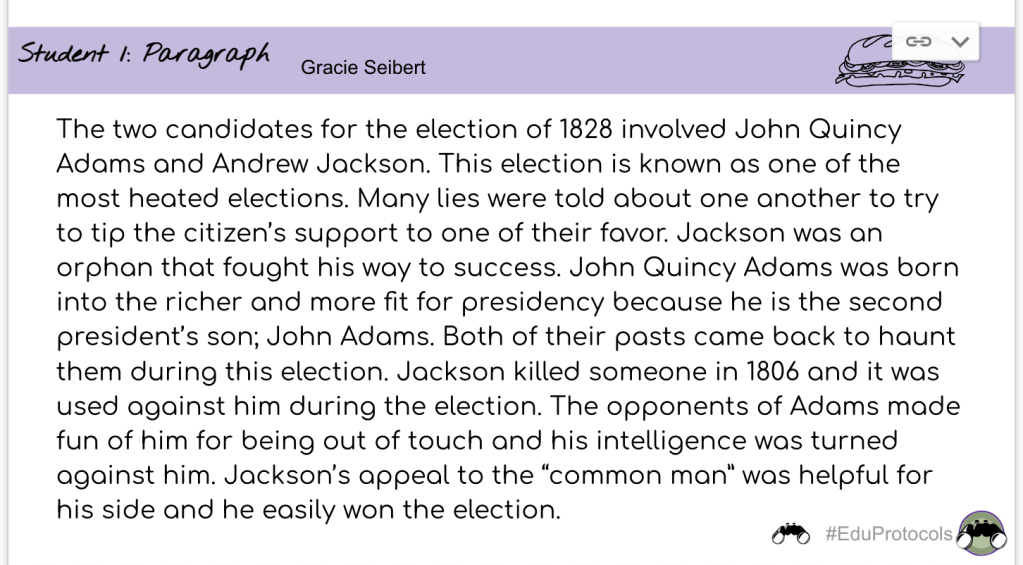
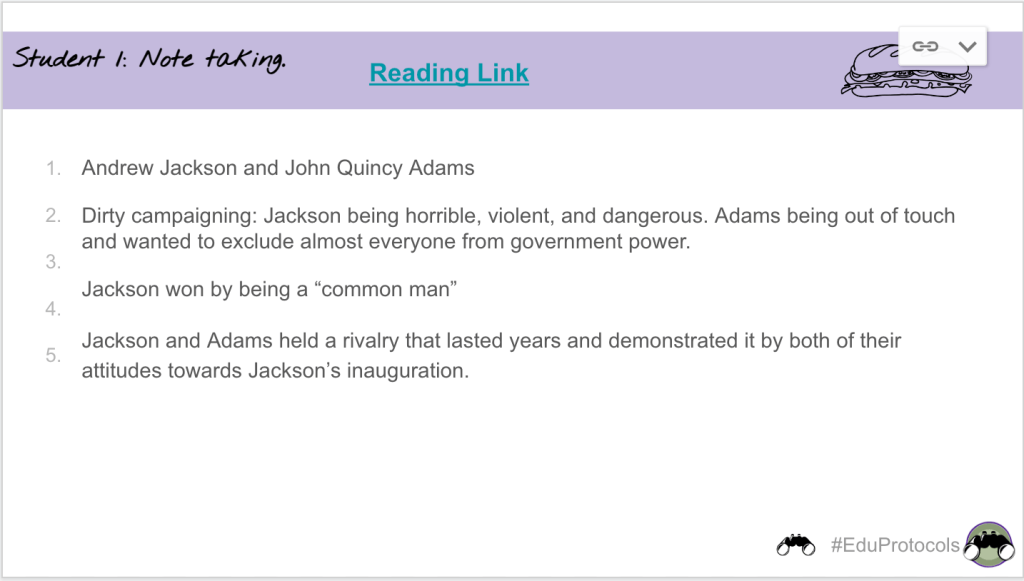
After the Repuzzler was a CyberSandwich. I found a NewsELA article on the Election of 1828. I created two different lexile levels of the article and linked it to the notes slide. The students had to describe the Election of 1828 and how Andrew jackson won. I ran a traditional CyberSandwich with a 10 minute read with notes, and a 5 minute discussion. However, I shortened the time for a summary down to 5 minutes and didn’t tell the students. They cranked out quality paragraphs in five minutes and didn’t realize it. Our reps are paying off!!
At the end of the CyberSandwich, students created questions, with Gimkit Kitcollab, about the Election of 1828. I LOVE the Kitcollab because I can give feedback to the students:
- Reword this question because….
- Change this word because…
- Add a question mark.
- Capitalize this or that….



Wednesday
On Wednesday morning, I went through all the Repuzzler slide decks. I chose the best decks, printed them, and cut them into fourths. I clipped the cards together and had them ready. Students came into class curious about the vocabulary cards they created on Tuesday. I had them get into groups of two to three, gave each group a different set of cards, and said, “Piece them back together. Have fun.”
This worked wonderfully! It was something new for 505. I loved it. The students loved it. Repuzzler worked for the first time because it was only 8 vocabulary terms (32 total cards to piece together).
The fastest finisher was around 10 minutes. Other finishers lasted between 15 to 20 minutes. Either way, when groups were finished, I had them use the cards to create questions for the Gimkit.
Following the question creation, we played some Fast and Curious. I set up the Gimkit to run for five minutes. When it ended, I went over the three most commonly missed questions. Then I set up the Gimkit again for four minutes. I challenged the groups to answer more questions and earn a higher class average. Most students thought this was impossible. However, every class beat the challenge.
To end class, I set up a Thin Slide that asked, “What did you learn today?” Students added 1 picture and 1 word. It was a great way to end class.
Thursday and Friday
Thursday and Friday we were building off of vocabulary and exploring Jackson’s battles. I added these “I can” statements to the activity:
- I can analyze the battles that Andrew Jackson fought within the government.
- I can analyze Jackson’s impact on democracy.
I wanted to create a contributive learning lesson with some EduProtocols. To help my student teacher, we planned the lesson out with a Madeline Hunter lesson design template.
Anticipatory Set – TedEd Edpuzzle video to build some background knowledge. The video puts Jackson on trial and discusses some of his battles and decisions he made for the country.
Objectives – Students will be able to analyze battles that Andrew Jackson faced within government. Students will be able to analyze Jackson’s impact on democracy.
Input – Repuzzler and Gimkit to build vocabulary knowledge.
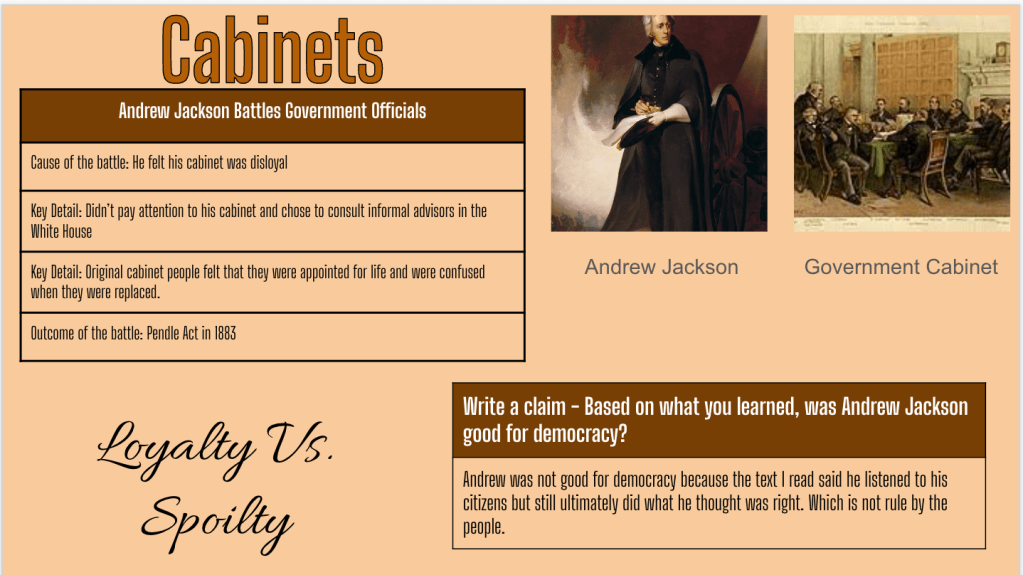
Guided Practice – Students will choose one of Jackson’s battles and create a Thick Slide. Students could choose from the following – Jackson vs. Banks, Jackson vs. Nullification, Jackson vs. Indigenous People, or Jackson vs. Government Officials. I set up the Thick slide so students could list the cause of the battle, two key details, and the outcome of the battle. They had to include two pictures, give the battle a catchy nickname, and write a claim analyzing Jackson as a president.
Once completed, students shared their slides through a Google Form. I converted the form data to a Google Sheet and shared the links. Then we handed out a Frayer model to the students. They went through the links collecting information about the three other topics they didn’t read about. They were writing down the cause, details, and the outcome for each.
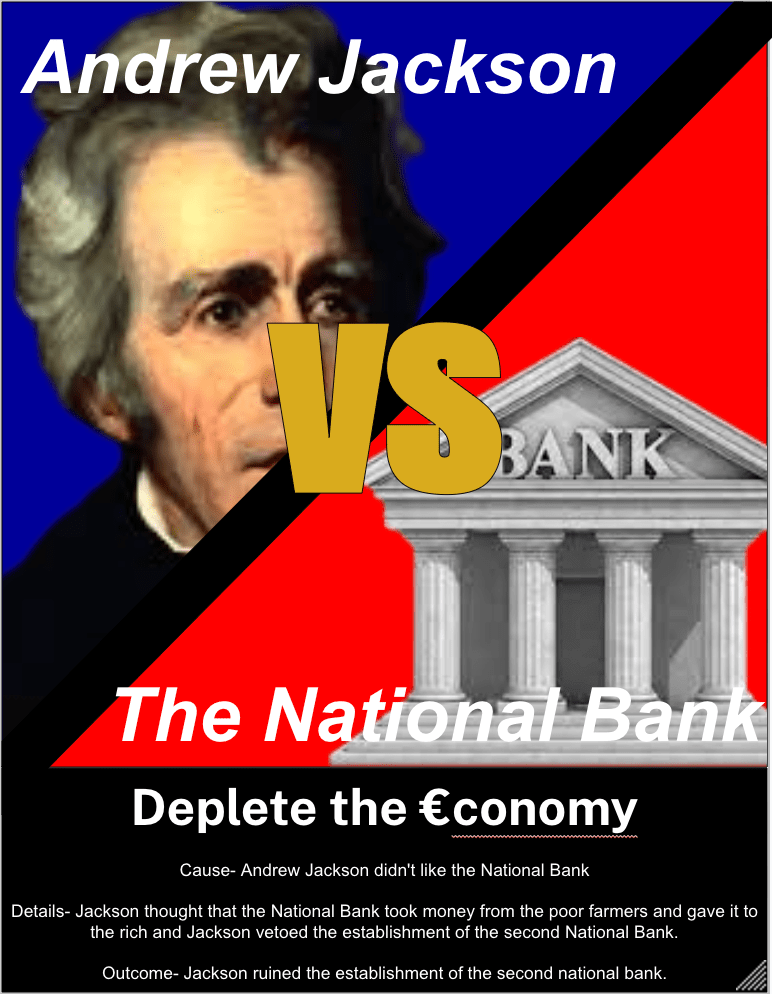
Independent Practice – Students were using their Thick Slide (or Frayer) and creating a battle “fight”poster. To do this, I created success criteria. The students had to include pictures, a catchy nickname for the fight, causes, and an outcome. Students have the option of completing the poster on paper or a Google Drawing.
Check for Understanding – Students used their Thick Slide and frayer to help create questions for the Gimkit. I asked them to focus on general understandings of the battles. For example: Why did Andrew jackson want to end the national bank?
Modeling – We provided several “fight” posters as examples. Any type of modeling is beneficial for student success.
This lesson is still in progress, but it’s quite successful so far. The Thick Slide format is familiar, Gimkit is familiar, the Frayer is familiar, and this is the third contributive lesson we have done this year. The reps are paying off.


One student completed a Google Drawing poster which is here:
Odds and Ends
I have a super challenging class and I will never forget this line Jon Corippo said to me, “They’re in your head. Get into their heads.” So, I did just that…
- We played a Fast and Curious and this class answered 370 questions in 7 minutes with a 67% class average. I lowered the time down to 4 minutes, had half the class close their Chromebooks. Then I challenged them to answer more questions and raise the class average. They answered 360 questions and got a 76% class average. They were screaming to play one more time because they wanted to beat the challenge. Guess what? They did it. They answered 500 questions with an 83% class average with only 10 chromebooks open with some teamwork.
- I played a retrieval practice game with this class called The Marker Game. I learned this at the Pickerington Local School District Conference in a session run by Lauren Richardson and Ashley Morrison. In the Marker game, students partner up and each pair puts a marker between them. I ask true/false questions. Students race to grab the marker first. If it’s true, the student who grabbed the marker gets a point. If it’s false, they lose a point. It was a BLAST!!
- I used a brain break in the middle of a lesson during this class, and they loved it! We played the Counting game. It works like this: the students collectively count to 50, but they can only count 1 at a time. When two students count at the same time, they have to start over at zero. The rules are – no talking and no gesturing. This game promotes emotional intelligence, and we celebrated each time we messed up. It was awesome.
Events
- I will presenting at OETC (Ohio EdTech Conference) on February 15th. I’m presenting EduProtocols to get students talking. I’m also presenting Retell in Rhyme.
- On February 16th, at 9:00 PM EST, Scott Petri and I will be hosting a live show on EduProtocols+. We will be discussing Thin Slides as we talk with Ben Harrington and Dominic Helmstetter.
- Jon Corippo and I were on a, EdPuzzle Live show discussing EduProtocols and EdPuzzle. It was a great show with some awesome insight and new ideas…

 Moler's Musings