This week we continued our study of the Early Republic. Last week I mentioned that I don’t have the energy to do the normal lesson I run – a blogging unit about the Early Republic. As a result, I decided to change how I teach this lesson to following the textbook structure paired with some EduProtocols.
The structure of the textbook for this lesson is okay. It seems disjointed. For example, it focuses on Washington and the Whiskey Rebellion with the Farewell Address. Then it switches to Federalists versus Democratic Republicans. The chapter concludes with John Adams.
The next lesson focuses on foreign involvement and goes back to Washington again. Then it discusses John Adams and the XYZ Affair. This is followed by Jefferson’s purchase of Louisiana, Madison’s War of 1812, and ends with the Monroe Doctrine. The set up is weird. I liked how I had my blogging unit set up – focusing on one president at a time. But, it is what it is.
This week we began with a lesson on Federalists and Democratic Republicans.Students focused on writing paragraphs about these two political parties. This was followed up with some review and a Peardeck lesson on John Adams. We reached the end of the unit with more review and a final assessment.
Monday – CyberSandwich (Federalists), Fast and Curious
Tuesday – CyberSandwich (Democratic-Republicans), Fast and Curious
Wednesday – John Adams Peardeck, Fast and Curious
Thursday – Review Day, Fast and Curious, Word Up Wednesday
Friday – Hexagonal Learning, Fast and Curious
Extra activities I created on the fly: Assessment Choices, John Adams Primary Source (adapted from Rosalie Metro), Frayer (@historysandoval template)
Monday
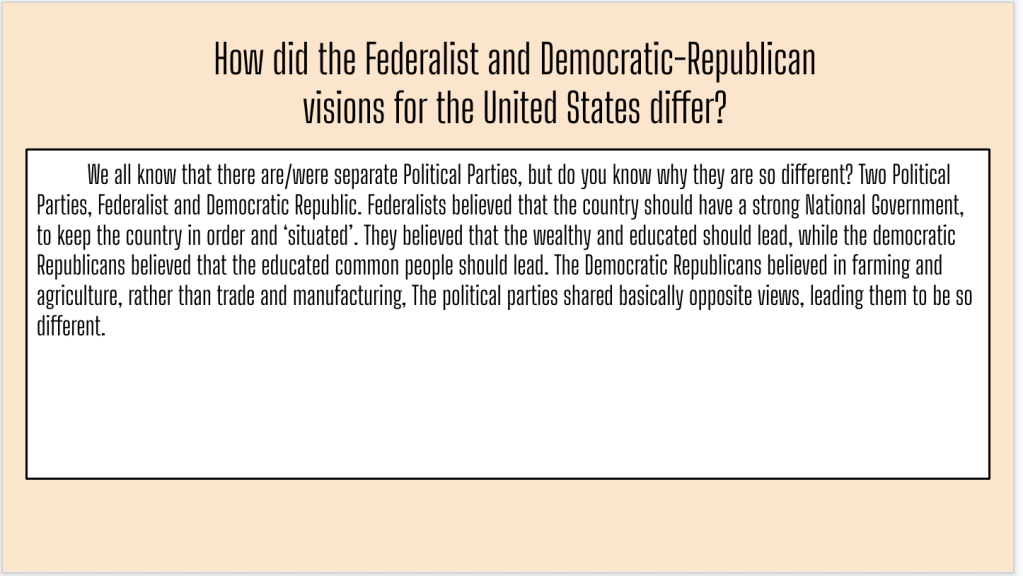
The main question for this unit is, “How did the Federalist and Democratic-Republican visions for the United States differ?” Last year, I created a choice board for the Federalists and Democratic-Republicans. This year, I divided up the political parties into two days as we did a CyberSandwich.
Before our CyberSandwich, I ran a five minute Fast and Curious with Gimkit. The Gimkit had basic vocabulary from last week and new questions related to content from this week. After five minutes, the class averages were: 47%, 67%, 72%, 52%, 74%. I gave some quick feedback and we transitioned to a CyberSandwich.
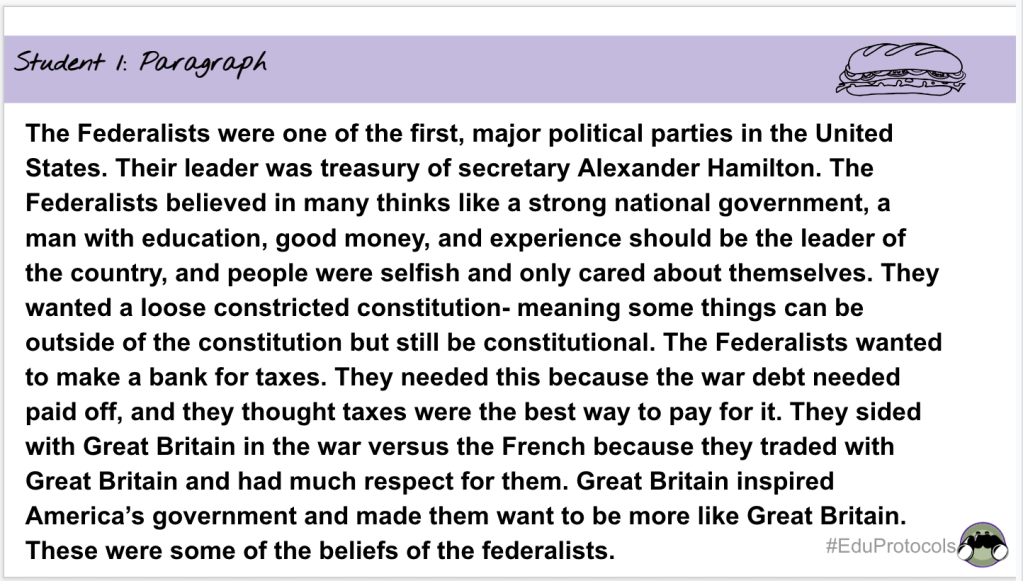
I ran a typical CyberSandwich with a 10 minute reading and notetaking. I had students write down four important facts (beliefs) from their notes and discuss with a partner. Then we focused on writing a basic paragraph with a topic sentence, details, and a concluding sentence.
One thing I changed this time was the use of Chat GPT. If you don’t know what that is, please visit my blog post about this amazing site. I used Chat GPT to change the reading level of the textbook section so a third grade student could understand it. I went to Chat GPT and literally type, “Convert this textbook section into something a 3rd grader could understand.” Within seconds, I differentiated for several students and copied the converted article to a Google Doc. AMAZING!
At the end of the CyberSandwich, I ran the same Gimkit again for five minutes. This time class averages went to: 72%, 70%, 80%, 65%, 83%.
As the day continued, I began to think about Chat GPT again. I wanted to know how I could use it for feedback. I began copying and pasting student paragraphs into the chatbot asking it, “Grade this paragraph on Federalists.” It spit out some great feedback. It was fairly consistent. However, I learned to be more specific with my requests.
I decided to change my requests to, “Give feedback about the paragraph based on the topic sentence, 3 key beliefs of Federalists, and a concluding sentence.” Amazingly, it gave incredible feedback. It even picked up on students only identifying one key belief of Federalists. I was able to get feedback for 90% of my students in less than an hour. I copied and pasted the feedback as a private comment into Google Classroom.
I also found commonalities in the feedback and used it for a teachable moment on Tuesday.

Tuesday
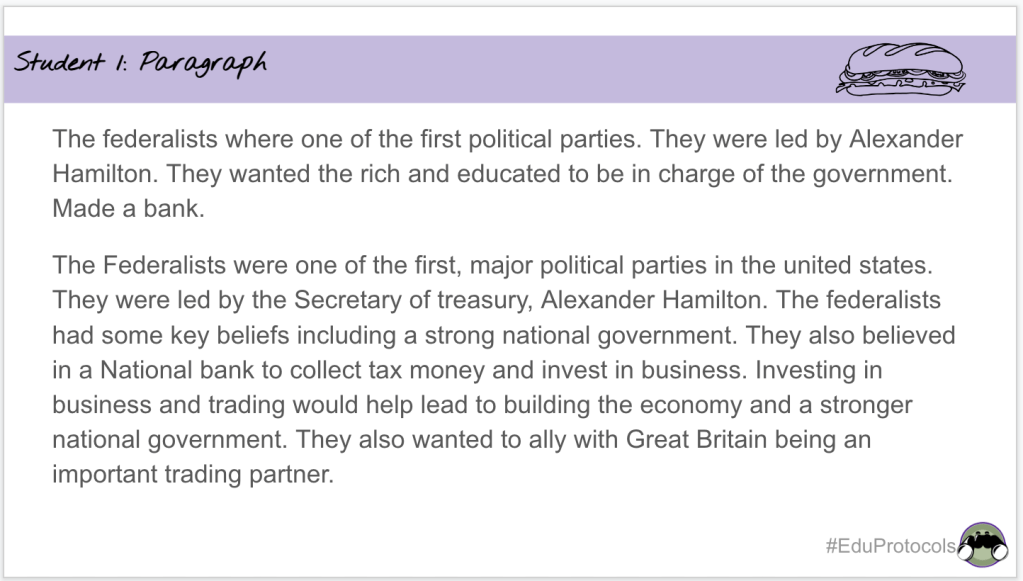
From Chat GPT, I found commonalities in the feedback with weak topic sentences and using more details. Before we began to do a CyberSandwich about Democratic-Republicans, I shared the feedback with students. We discussed writing topic sentences and including more details. I provided a model paragraph as an example.
The students are really great with including information right in front of them. For example, they are great at including three key beliefs. However, they are weak with adding their own thoughts, or more information. This same feedback would be said again on Friday with the Hexagonal Learning.
Again, I used Chat GPT to differentiate reading levels for the students. We ran a typical CyberSandwich with a 10 minute read, 5 minute discuss, and a 10 minute summary write. This time, however, I wanted students to focus on feedback to improve their paragraphs. I felt like the topic sentences and inclusion of more details was better after the feedback, example, and more reps.
After the CyberSandwich, I ran another Fast and Curious on Gimkit. The class averages were as follows: 81%, 81%, 80%, 71%, and 86%.


Wednesday
I hate lecturing. Sometimes it needs to be done. Sometimes I need to explicitly say why things happen, or explicitly say connections between historical events. Wednesday was reserved for a PearDeck. I prefer Nearpod, but I didn’t have time to convert my slides.
I had a PearDeck about John Adams and his presidency. It focused on the Election of 1796, XYZ Affair, Alien and Sedition Acts, and the Election of 1800.
The PearDeck was interactive with some Sketch and Tell built in. It contained some summary writing practice as well. Now, I don’t know how you view student engagement. I view students engagement as, “Enthusiasm, curiosity, optimism, motivation, or interest toward a lesson.” With my definition, student engagement is not great with PearDeck or Nearpod. If my definition of students engagement was: “Listening attentively, participating in discussions, turning in work on time, and following rules and directions,” then these tools are awesome. I had 88% student engagement throughout the day.
A quick Chat GPT note to add – I copied and pasted some of the paragraphs from the PearDeck slides into the chatbot. I requested it to, “Create a multiple choice question for this paragraph.” It was awesome because I suck at writing questions.
My last period of the day saw we were doing a PearDeck. They flipped out. It’s a small, good class. I don’t take offense to stuff like this. I simply asked them, “What do you want to do?” They responded, “Anything but a PearDeck.” Then I asked, “Does anyone want to do a PearDeck?” A few raised their hands. For the rest I created a new lesson with an EdPuzzle video and a primary source analysis. Everybody was happy. Some even mentioned, “I’ve never seen a teacher just completely change a lesson on the fly like that.” My response, “Never fear when Moler’s here.”
At the end of all the lessons, I had students complete the Fast and Curious Gimkit again. I added new questions about John Adams. This time scores took a dip. However, the scores were fascinating as EVERY class averaged a 76%. (76%, 76%, 76%, 76% and a 76%).
Thursday
I was feeling the Fast and Curious wasn’t enough to check for understanding. I created a bunch of review activities. Here is what I put together:
- Gimkit for Fast and Curious – same questions and the class averages were: 84%, 84%, 85%, 78%, and 87%.
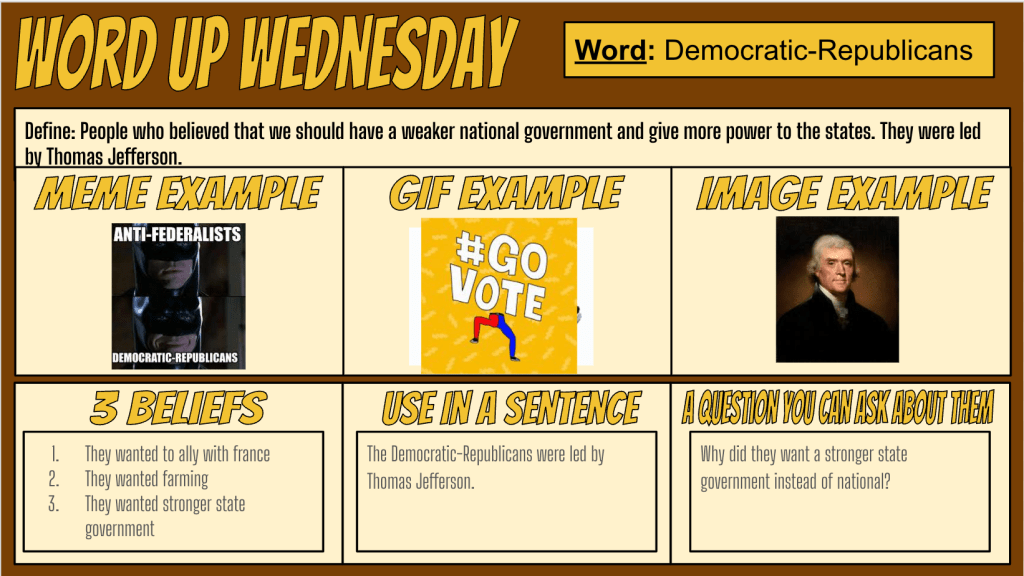
- Word Up Wednesday – students were still struggling with Federalists and Democratic-Republicans beliefs. I saw this on the Gimkit data. This worried me, and so I had students partner up to research the beliefs of the political parties, write definitions, and apply images.
- Frayers – one class really needed something different. I had them do the Gimkit and I took the most commonly missed questions and developed a series of Frayer Models. The most commonly missed questions related to: Federalists, Democratic Republicans, Washington’s Farewell Address, and the Alien and Sedition Acts.
- Find 6 errors – I asked Chat GPT, “Write a short, nonfiction text about the Alien and Sedition Acts and include 3 factual errors.” It wrote the article, I copied and pasted it to a Google Doc, and added in the errors myself from the Chat GPT suggestions. In the past, I would have done this myself and it would have taken an hour. With Chat GPT, it took 30 seconds. I had students get into groups and they had 8 to 10 minutes to find a correct the six factual errors in the article.
Overall, it was a good review day. Lots of different activities. One students even mentioned, “This class flies by.” Yes, when you’re doing multiple things in one class period, yes it does. When you’re working bell to bell, yes it does.


Friday
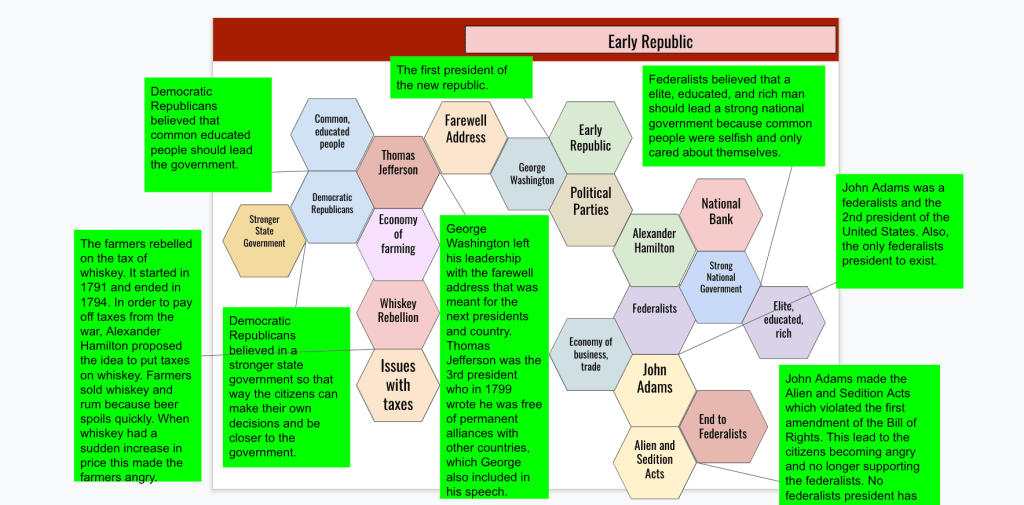
We used Friday as the day to wrap up the lesson about Federalists and Democratic-Republicans. I posted Hexagonal Learning which is a familiar lesson for the students. Hexagonal Learning was created by Betsy Potash (@betsypotash) and featured in Kim Voge’s (@kvoge71) book, Deploying EduProtocols. The template I used was designed by Stephanie Howell (@mrshowell24).
On Thursday, one group of students completed a Hexagonal Learning template. They turned it in, and I gave them some feedback. What appears to be awesome work was vague, and needed more details. Here is what they turned into me:

The students didn’t like my feedback, but it was helpful. I used their template as an example for my other classes. For every class, I posted this example (names removed) and had the students grade it on a 4 point scale. Most students gave this a 3 or a 4. I gave this a 2 or 1.5. My classes were surprised to learn this grade. However, I explained, “These students simply rewrote the information in the hexagons with a sentence. No extra information. No extra detail were added.” This analysis really helped the students with completing these activity. The discussions among partners was awesome too!!
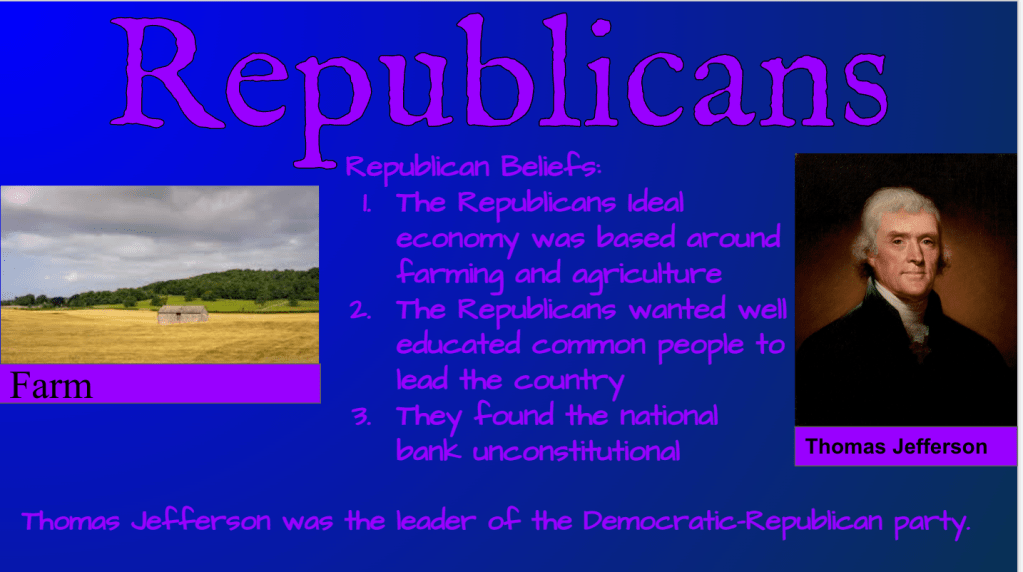
One of my classes (a different class from Thursday) started complaining about Hexagonal Learning. So, I put together a list of choices:
- A solo iron chef – design a slide about Federalists, design a slide about Democratic-Republicans, use the information to construct a paragraph answering the essential question. – by yourself
- Netflix – create a series about the fight (beliefs) between Federalists and Democratic-Republicans. Your series description should answer the essential question above. -by yourself
- Hexagonal Learning – Use and connect all the hexagons. Add in new/missing information for 8 connections. (an example in bright green is provided) – partner/2 people



This class was really appreciative of this change and addition of choices. Typically, I don’t get much from this class. BUT, most students finished their choice. It was awesome.
At the end of all classes, I ran a Gimkit for 7 minutes and took their average as a grade. I had one criterion – you must answer 22 or more questions. Anything less than 22 questions resulted in a 1 out of 10 grade in ProgressBook. The class averages were as follows: 87%, 87%, 87%, 84%, 91%. Overall, a successful week despite me feeling like this lesson is disjointed and not great.


More Chat GPT Stuff
I thought of two more ways to use Chat GPT:
- 2 Truth and 1 Lie – have it create a list of 2 truths and 1 lie related to social studies content. Absolutely amazing and a great way to get students thinking.
- Odd one out – have it create a list of 3 items with 1 item being one that doesn’t belong. This is great, but I wish the items were more closely related to create more a discussion and debate on the odd item out.


 Moler's Musings