
Back at it with a three day week and a new unit. We began the Early Republic unit where we focus on the first five presidents of the United States. I decided to make some changes to my unit this year.
In the past, I used this as a blogging unit. Students would learn about Federalists and Democratic-Republicans, create a character, and blog from that characters perspective. They would analyze the decisions of the presidents from their character’s perspective and party affiliation. I would infuse the lesson with EduProtocols, and it was awesome. However, I’m tired. I’m exhausted. I’m worn down. As much as I love this unit, and set up of the unit, I don’t have the energy to ready 115 blog posts. I don’t have the energy to motivate students to keep blogging and writing.
With that being said, I decided to use the lesson from our History Alive book and infuse it with EduProtocols. In my opinion, a regular textbook lesson, infused with EduProtocols, is just as effective and engaging as my blogging lesson.
The first lesson in my unit focuses on political divisions in the early republic. We look at the different viewpoints of Federalists and Democratic-Republicans. We also focus on George Washington, his cabinet, the Whiskey Rebellion and a growing divide between the political parties.
This week’s focus was on some vocabulary and the George Washington presidency. Here was our week of learning:
Wednesday – Thin Slide, Pile of Words Vocab, Fast and Curious
Thursday – Word Up Wednesday, Iron Chef, Fast and Curious
Friday – Nearpod Farewell Address, 3xCER, Fast and Curious
Wednesday
I’m always searching for better ways to introduce vocabulary. On Tuesday, I happened to see a Tweet from Stephanie Howell (@mrshowell24) referencing a blog post from Dr. Catlin Tucker (@Catlin_Tucker) about a vocabulary strategy called Pile of Words. When I dove into the blog post, I realized the strategy was created by Jay McTighe. As I read about this strategy I was intrigued and had to use it with my eighth graders. The strategy works like this:
- I looked through the lesson and compiled a list of the most important vocabulary words.
- I added the words to a slide deck.
- I had students partner up into groups of two or three and discuss the words they knew.
- The students made a list of the words they knew and wrote their own definitions. (5 minutes)
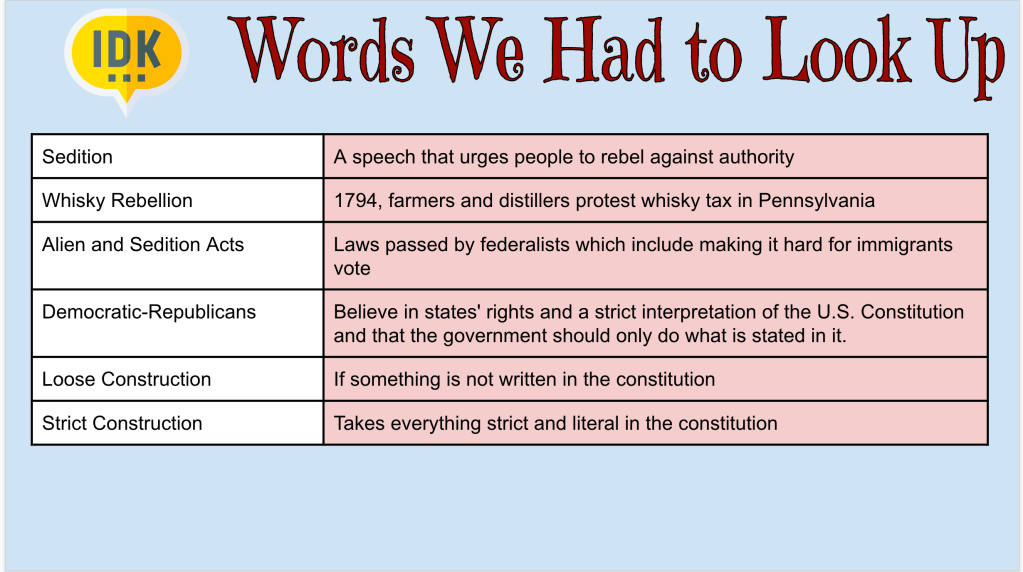
- Then students made a list of the words they didn’t know and looked up the definitions. (10 minutes)
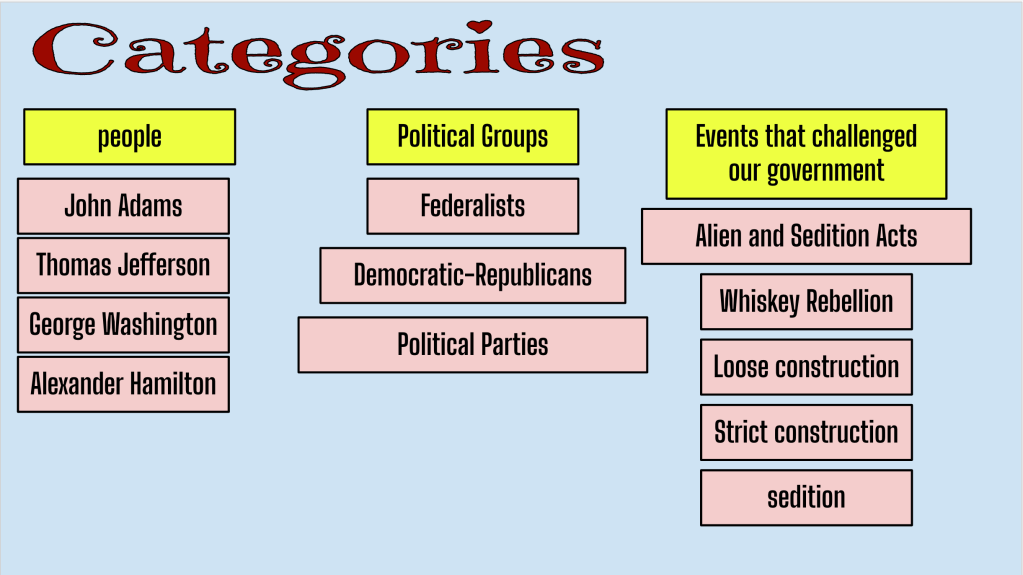
- Then students discussed what they learned and categorized their words. They created their own categories.
- As students discussed, I walked around asking questions.
- Finally, I had students predict what the lesson would be about.
I used this strategy with no context to the lesson. It was interesting to read some of their predictions. Some were great, Many were okay. The students need to get better at thinking beyond what’s in front of them. They need to get better at making connections. They need to get better at articulating their thoughts. Here are some responses:
- “I predict that this lesson will be about the first few presidents who had relations with the creation of the U.S. government, The different views that can be taken on the government and constitution such as loose and strict construction, and actions that were taken in revolt to certain things and what the government did in reaction to this.”
- “I can predict that in this unit we will be talking about people’s political beliefs and what people do in order to protect their rights. I can also predict that this unit will be about founding fathers and connecting to past lessons. Finally predict that we will be learning about new things about the government.”
- “I think this lesson will be about the government along with the political parties. We’ve heard many vocab words relating to this so i think that it makes sense for this lesson to be about government and political parties.”
- “This lesson will be about views on government, actions, and the people who were involved and their actions.”
- “I think that it will be about what happened after the constitution was written and after George Washington was elected.”
The last two responses listed reflect many responses. I’m trying to teach students to add more thought, and more details, to their writing. Either way, the main focus of this vocabulary strategy was engaging students with something new and building some background knowledge. Here is a group example from a class period:


After the completion of the Pile of Words strategy, we did a quick Thin Slide EduProtocol. I played a song entitled, Hail Columbia, and had students use one picture and one word to show the mood of the song. Many students mostly listed happy or proud for the mood. I timed the Thin Slide with song length – three minutes. At the conclusion of the song, students presented their slide. We finished class with a Gimkit fast and Curious with vocabulary and unit related questions. The initial class averages were as follows: 54%, 52%, 67%, 53%, and 63%.
Thursday
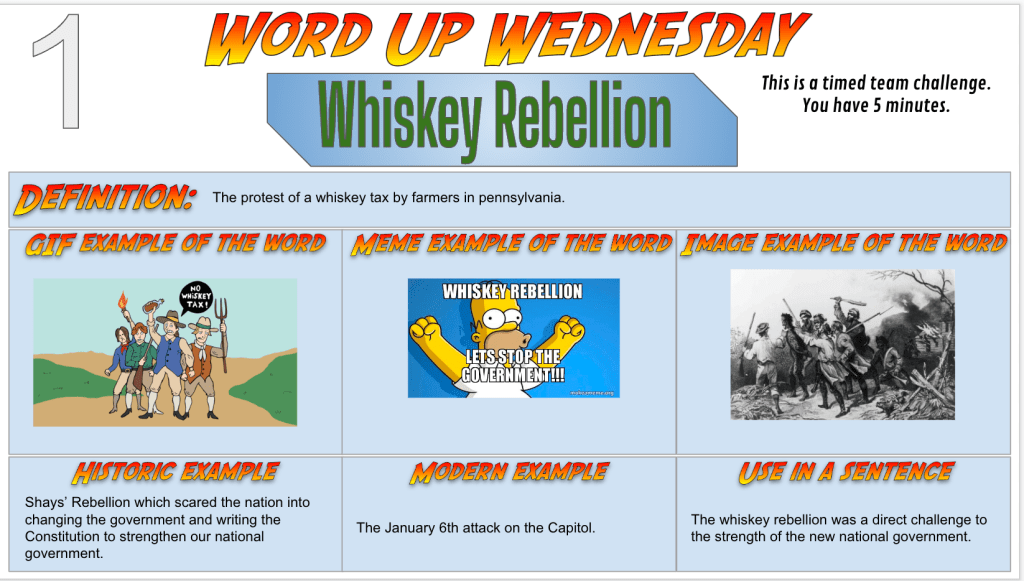
Thursday was another day to try something new. I reviewed the Gimkit data and determined the most commonly missed questions related to the presidential cabinet and the Whiskey Rebellion. As a result, I found a Word Up Wednesday template created by Shaun Moriarty (@MoriartyHistory). The original concept of Word Up Wednesday was created by Ryan Stephans (@Coach_Stephans).
Before the lesson began, I created two different slide decks. One slide deck contained the word Whiskey Rebellion. The other slide deck contained the word Presidential Cabinet. Here was my procedure for the lesson:
- Students got into groups of two to three.
- I timed the first round for six minutes.
- Students claimed a slide on the slide deck and began collaborating to complete their slide.
- Students had to define the term in their own words.
- Students had to find a GIF, meme, and image representation of the word.
- Students had to use the word in a sentence, find a historical example, and find a modern example.
The first round, students really struggled to complete the slide. However, most students quickly learned the importance of dividing and conquering together.
The students also struggled with finding historical and modern examples. I had to pause the timer at one point and show them how to find an example. Furthermore, I had to give some ideas for examples. I’m really trying to help them critically think….I really am 😩. At the end of it all, the students really enjoyed beginning class with Word Up Wednesday.

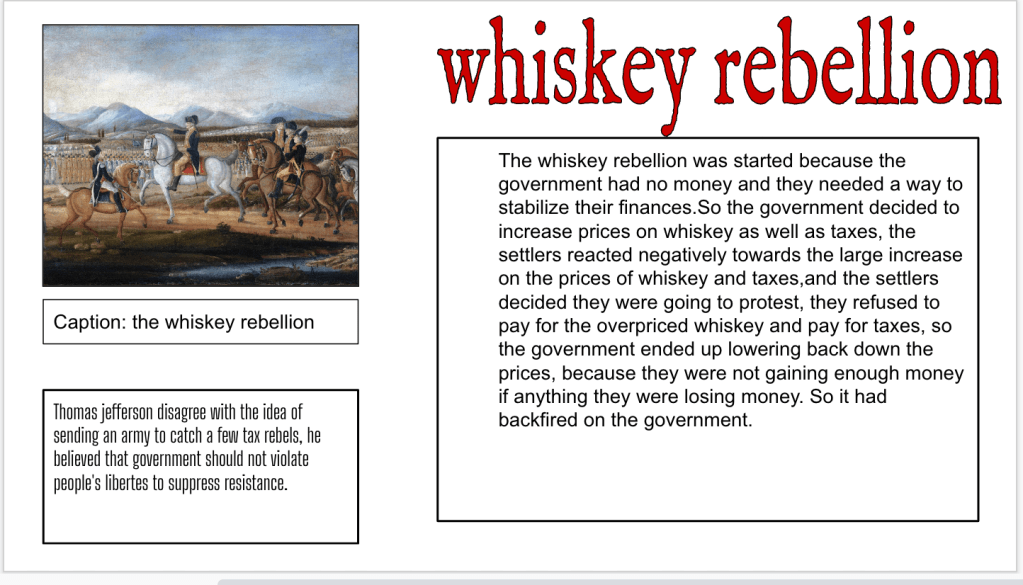
When transitioning to the Iron Chef, I made sure to mention the words from Word Up Wednesday were important because it was time to understand the historical significance of them. The Iron Chef for the day was about George Washington’s cabinet and the Whiskey rebellion. For the Iron Chef reading, I took two major sections from History Alive, condensed them down and use the important information.
I set a timer for 18 minutes to have the students complete their slides. They worked individually as they added pictures, changed the title, answered the questions, and completed the secret ingredient questions. Here are some examples:
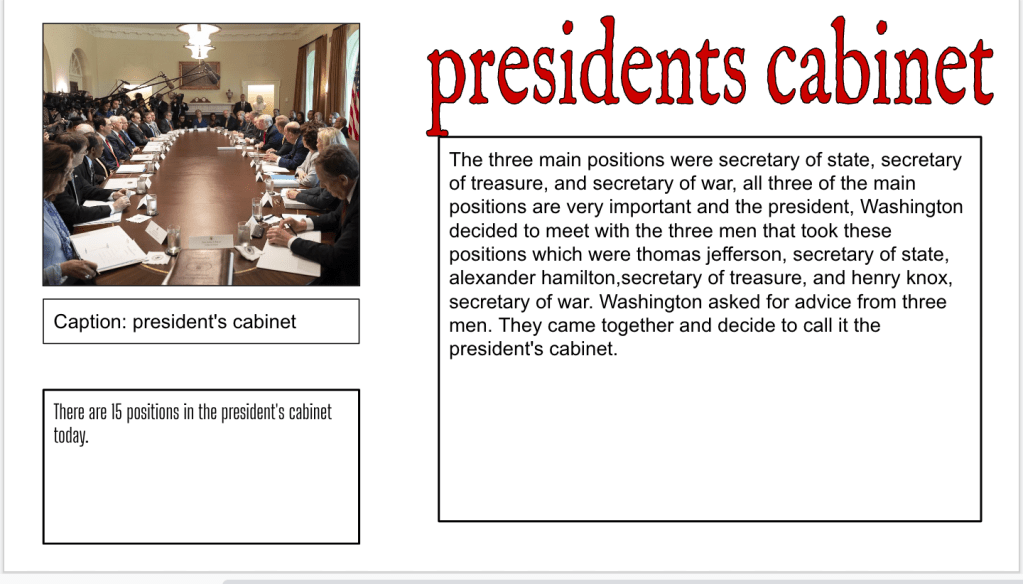
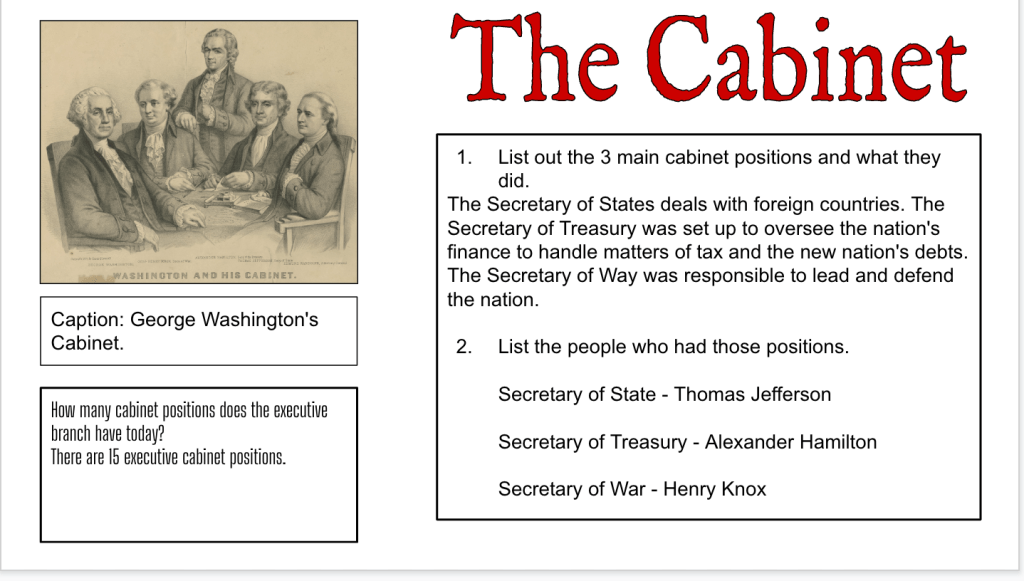


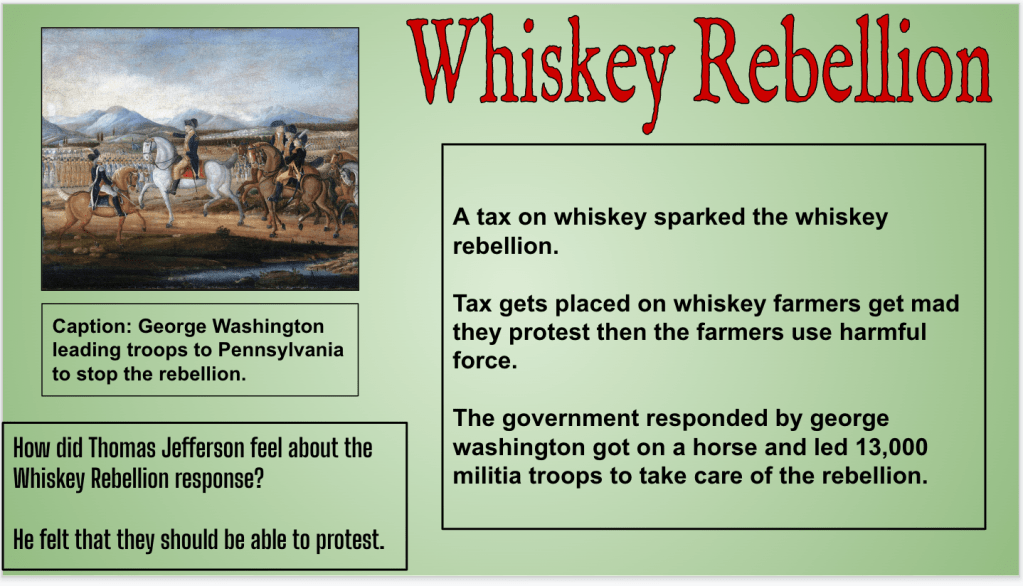
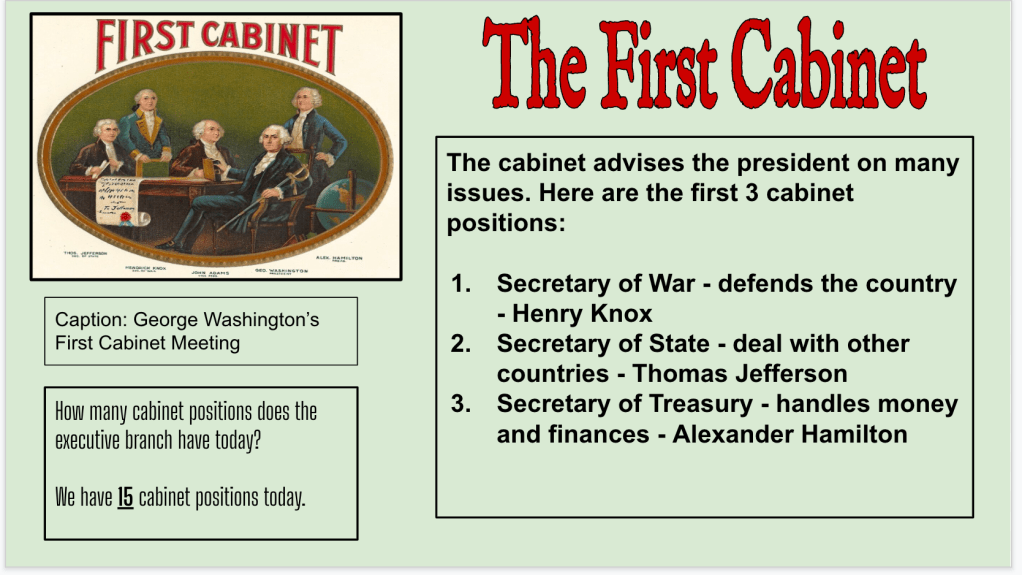
To wrap up class, we used the same Gimkit from Wednesday. I ran the Gimkit for 8 minutes. This time class averages were as follows: 67%, 65%, 73%, 58%, 76%.
Friday
Friday we transitioned to Washington’s Farewell Address. In years’ past, I usually began with Federalists, Democratic-Republicans, and Hamilton vs. Jefferson. This year, I used Washington’s warning about political parties to set up to for next week’s topic of Federalists vs. Democratic Republicans. Through this reflection, I like beginning with political parties better. It just makes more sense to me. The structure of my current lesson, however, is the path I chose so I’m sticking to it.
When students came in, I had a Nearpod code on the board. In the Nearpod, I put together some slides to help students make sense of Washington’s Farewell Address. Here was my setup:
- Slide 1 – intro slide
- Slide 2 – What do you know about George Washington? collaboration board.
- Slide 3 – two minute intro video on George Washington (this served as review of his cabinet and Whiskey Rebellion from Thursday).
- Slide 4 – context slide about the Farewell Address.
- Slide 5 and 6 – translate Washington’s Farewell Address drag and drop slide.
- Slide 7 – Washington’s main warnings – fill in the blank
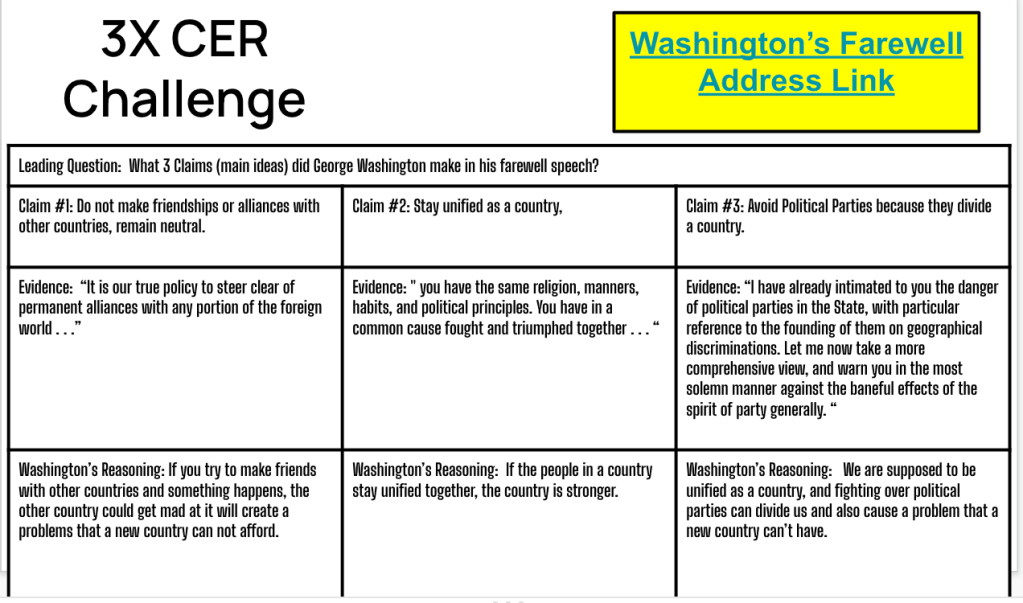
- Slide 8 – A link to a 3xCER slide deck.

It was important for me to help students translate Washington’s words into modern english. With the words translated, followed up with a fill in the blank summary of Washington’s warnings – it would only serve to help the students complete the 3xCER. If I didn’t have students translate his words, the 3xCER would have been a disaster.
I gave students 12 to 15 minutes to complete the 3xCER. They did an excellent job placing claims (Washington’s warnings) in their own words. They used quotes from the Farewell Address as evidence. Finally, I wanted them to think about Washington’s reasoning for the warnings. For the most, the students’ reasoning was okay. They still needed to add more detail and thought. Here are some examples:


To conclude class, we did a Fast and Curious with the same Gimkit. This time class averages were as follows: 72%, 75%, 78%, and 83%. Not all classes were able to do the Gimkit.

 Moler's Musings