
This week we continued our unit on the Constitution. I focus on the principles of the Constitution – separation of powers, checks and balances, individual rights, popular sovereignty, federalism, judicial review, and limited government.
This week’s focus was on individual rights and judicial review. I was hoping to get to popular sovereignty, but a calamity day and a sudden switch to remote learning changed my plans.
Overall, it was a good week. Teaching the Bill of Rights is one of my favorite lessons. I try to find ways to help students engage and connect with government.
With my judicial review lesson, I used to have students go through Supreme Court cases. However, I needed a change. I put together a lesson with some EduProtocols. I was able to lead one, 48 minute class through a Fast and Curious (twice), Frayers, and a reading paired with a Thick Slide. The rest of my classes, with my absence, struggled to get through a Fast and Curious and Frayers.
Monday – Bill of Rights lesson
Tuesday – A modified version of a Resource Rumble (EMC2Learning)
Wednesday – Fast and Curious, Frayer, Thick Slide
Thursday – Calamity Day
Friday – Review Gimkit
Monday
On Monday, I began with a Fast and Curious Quizizz with the Bill of Rights. Most people remember the first two amendments, then it goes downhill from there. My Quizizz is ten questions long. The beginning class averages were the following: 45%, 42%, 38%, 25%, and 51%.
Next, I handed out a paper I created using Google Docs – it contained ten empty boxes for students to take notes. I asked the students to number the boxes and they could write notes or draw pictures. Whatever helped them the most. Then I proceed to act out the first ten amendments. I give the students ways to remember the ten amendments. I received from Dave Burgess a long time ago. Here are two examples of what I do:
- 3rd amendment – I talk about the story Goldilocks and the Three Bears. Goldilocks made herself at home and the 3rd amendment prevents the quartering of soldiers.
- 6th amendment – I show a clip of a pick six interception by Mike Hilton against the Steelers from the 2021 Bengals season. Then I mention how you need to be speedy to get a pick six. This leads to a fair and speedy trial.
I can’t share the rest of this because it’s Dave’s lesson. This lesson is one of my favorites. It’s engaging, the students laugh, I laugh, and it works. As I’m acting out the amendments, I keep coaching the students and reminding the students how to remember the amendments.
At the conclusion of the lesson, I have the students put away their amendment notes. Then I start of the fast and curious Quizizz again. I listen for the students making connections as the questions come up. For example, 3 bears, no quartering of soldiers, 3rd amendment. The class averages were the following after the lesson: 83%, 83%, 91%, 97%, 100%.
Tuesday
The day after the Bill of Rights lesson, every class begins with that fast and curious Quizizz from the previous day. I gave the students 3-4 minutes to answer the ten questions. The class averages were as follows: 80%, 81%, 85%, 88%, 95%. A slight drop, but still awesome class averages.
Now that we learned about the Bill of Rights, I wanted students to be able to apply the amendments to real life Supreme Court cases. I found a bunch of cases involving students and schools. Here are some of the examples I found:
- West Virginia State Board of Education v. Barnette (1943) – Pledge of Allegiance
- Mahanoy Area School District v. B.L. (2021) – Freedom of Speech with Social Media
- Ingraham vs. Wright (1977) – School Punishment
Around the room, I had eight envelopes up. Six of the envelopes contained Supreme Court Cases. Two of the envelopes had some checking for understanding stuff – a Quizizz and EdPuzzle. The EdPuzzle was a quick 2 minute video on how a case gets to the Supreme Court.
The students worked in groups of three to four and had forty minutes to complete as many of the envelopes as possible. Each of the students had to do 2 things:
- Discuss and guess which amendment was in question with each of the Supreme Court cases.
- Guess how the court ruled in each case.
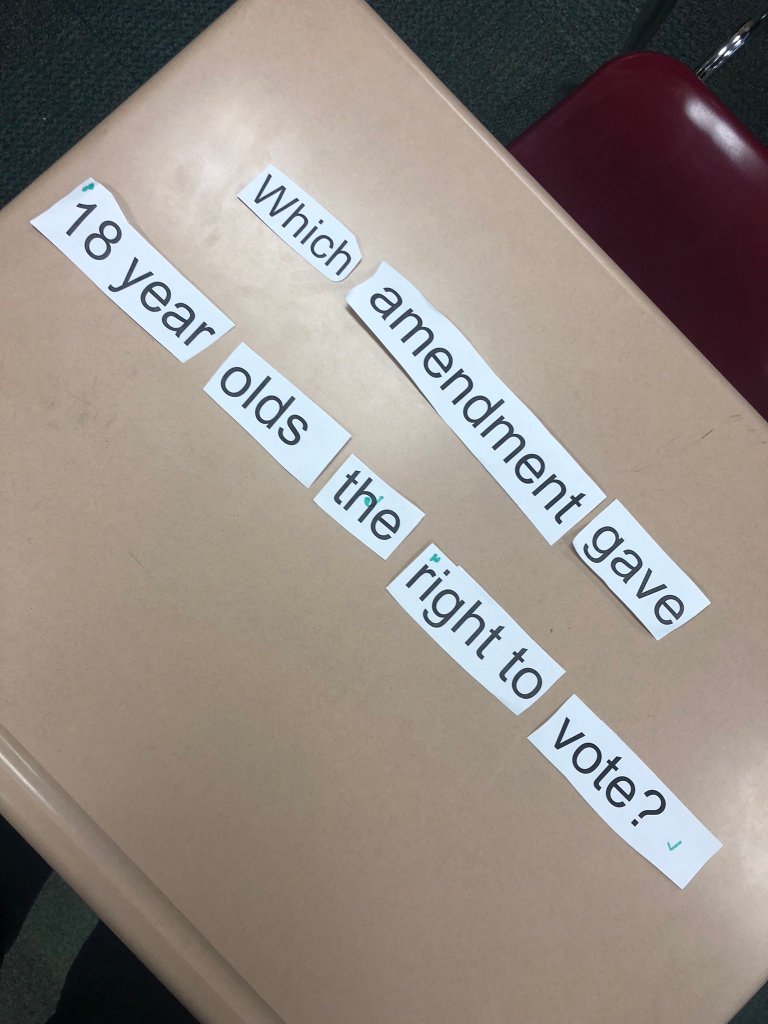
Each group brought their papers to me and they did a fantastic job guessing the amendments involved. They were all pretty surprised on how the Supreme Court ruled when I told them the results of each case. After I checked their papers, I gave each group a piece of a question. I typed out this question, “Which amendment gave 18 year olds the right to vote?” I cut the question into eight sections. The groups had to piece together the question, find the answer, and the answer unlocked a lockbox.
Inside the lockbox were ten QR codes. Nine of the QR codes were NOT winners. Only one QR code was the winner. Surprisingly, three groups actually chose the winning QR code. I have no clue how.
Now, eighth graders are pretty tricky and sneaky. I know they share my secrets. As a result, I changed the question and lock box code during the day. The other question I typed was, “Which amendment limits the president to two terms?”


Wednesday
The use of Supreme Court Cases on Tuesday leads to a lesson on judicial review. I found an article on iCivics about Marbury vs. Madison. The iCivics article was good, however, I put myself in my students’ shoes and realized I needed to clarify a few things. Basically, I took the articles and reworded some sentences, added a few sentences, and changed some words.
I don’t know why, but background information leading to Marbury vs. Madison is easy for me to understand. However, I have a hard time wrapping my mind around the ruling in the case. I had to read it a few times to process it, and figure out to explain it to 8th graders.
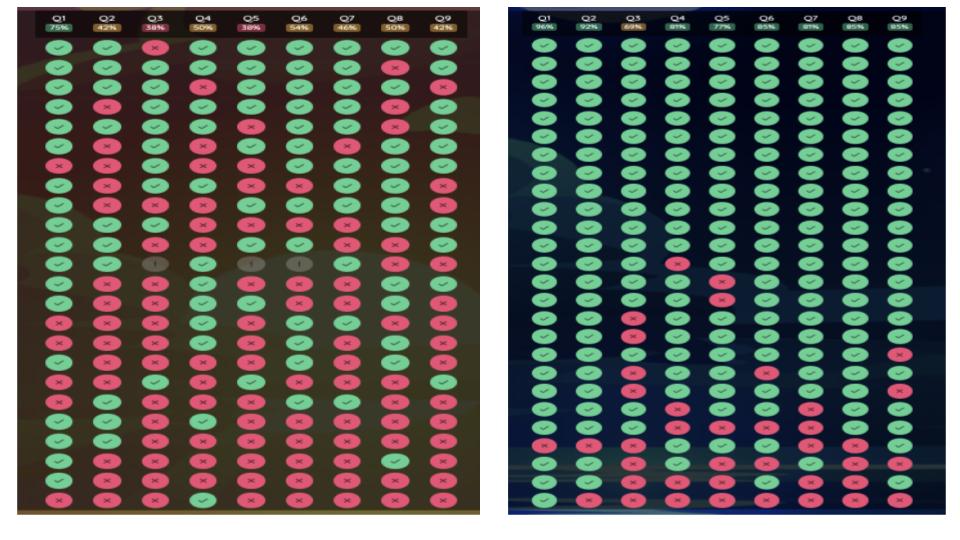
When students arrived in class, I had a Quizizz up on the board with 9 questions about Marbury vs. Madison. I’m only sharing one class in this post because I had to leave school early. The class average for the first quiz was 48%. I went over some important words and questions such as: writ of mandamus and judicial review.
Next, I had students use a Frayer with the Supreme Court and Judicial Review. They copied and pasted a Google definition, paraphrased that definition, added 4 characteristics, and added a meme or gif. The students had 8 minutes to complete both Frayers. I really liked how they used information from the EdPuzzle video about the Supreme Court. For example, many of them included that the Supreme Court only hears about 1% of cases that are submitted. Some included that nine justices serve for life.
Next I had the students read the article on Marbury vs. Madison. I also included a History Channel link to a 3 minute video on the case. Students had the option of reading or watching and listening. Many of them chose to do the reading.
The students read about Marbury vs. Madison, and highlighted, for 5 minutes. Then I challenged them to design a Thick Slide using recall with what they just read. Some of them answered the challenge, but most students did not. That’s okay. The Thick Slide had students sharing background information for the case, defining judicial review, including arguments, and decisions, and adding relevant pictures. Here are some samples:


After twenty minutes, we took the same Quizizz again and raised our class average to 83%. My main goal from this lesson was to have the students understand the importance of Marbury vs. Madison and understand Judicial Review. With understanding the importance of Marbury vs. Madison – 85% got that question correct. With understanding Judicial Review – 85% got that question correct as well.
Thursday
No school – calamity day. Staff had to report, but I had to stay home and take care of my daughter. This has been the month from hell with sickness – flu, pneumonia, coughing, and pink eye.
I used the opportunity to plan for our remote learning day on Friday.
Friday
Friday was a remote learning day. This means that I keep things simple. I put together a Constitution review Gimkit. The questions related to the branches of government, Bill of Rights, and the judicial review. For 2 weeks of material, the class averages were okay – 74%, 76%, 79%, 70%, and 84%. At the conclusion of the game, I reviewed the most commonly missed questions. The data was telling me, however, that I need to go back and reteach the Separation of Powers. I may have an Iron Chef or a Retell in Rhyme for next week.

 Moler's Musings