This week we began the Articles of Confederation, Shays Rebellion, and the Constitutional Convention. I love this unit. I saved a Google Classroom from last year that I often look at to reflect. I looked at last year’s lessons, and thought to myself, “How can I adjust this for the students this year?” I always think to myself, “How can I make it better?”
I started at the standards to revamp this unit. Here are those standards:
- Analyze how the problems arising under the Articles of Confederation led to debate over the adoption of the U.S. Constitution.
- Explain how participation in social and civic groups can lead to the attainment of individual and public goals.
After reviewing the standards, I broke the unit into 3 essential questions:
- Why did the United States want to create a stronger national government?
- Was the Constitutional Convention successful?
- What were the differences between Federalists and Anti-Federalists?
From here, I thought to myself, “How would my students need to think in order to answer those essential questions?” So I made a list of items:
- Students need to understand the Articles of Confederation was our first government to help us through the American Revolutionary War.
- Students need to understand that we have state level and national level government (federalism).
- It was intentionally made weak due to the abuses of power by King George III and the British Parliament.
- The weaknesses led to problems like Shays Rebellion which exposed the Articles of Confederation.
- The Northwest Ordinance was created under the Articles of Confederation – an ordinance is a law and helped territories become states (Ohio – 1803).
- The Constitutional Convention brought together many political leaders to strengthen our national government by creating 3 branches but limiting its power.
- From the Constitutional Convention, 2 groups emerged and ultimately created our first two political parties. The Federalists and Anti-federalists debated how strong the national government should be and how to protect people’s rights.
By doing this process, and looking at this unit through the eyes of a student, it helped me put together different activities, assessments, and questions with each lesson.
Monday – Fast and Curious Gimkit, Frayer Vocab
Tuesday – Iron Chef, Fast and Curious
Wednesday – Fast and Curious, Rolling Recap, Emoji Paragraphs
Thursday – CyberSandwich, Fast and Curious
Friday – Fast and Curious, Portfolio
Monday
For Monday, I began with a Gimkit of 15 questions about basic vocabulary related to the Articles of Confederation and Shays Rebellion. Many of the words relate to government and are unknown to most of the students. This was shown in the class averages of 52%, 54%, 50%, 33%, 58%.
At the conclusion of the Gimkit, I gave some feedback on most of the questions. We switched gears to a Frayer. I had students Frayer the word Articles of Confederation (@historysandoval Frayer template). Then I had them choose two other words they might have trouble remembering. Most students chose: ordinance, Northwest Ordinance, or central government.
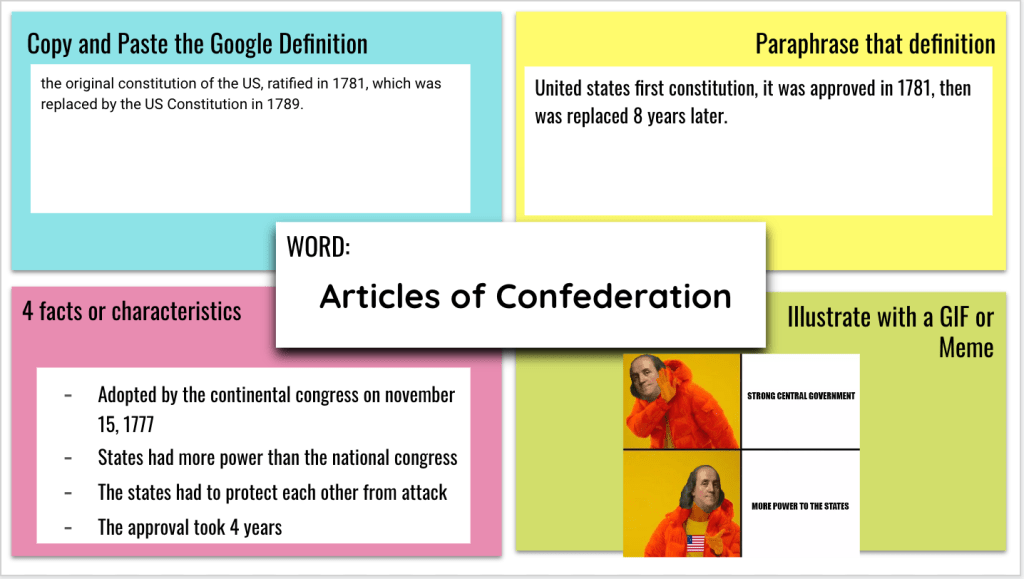
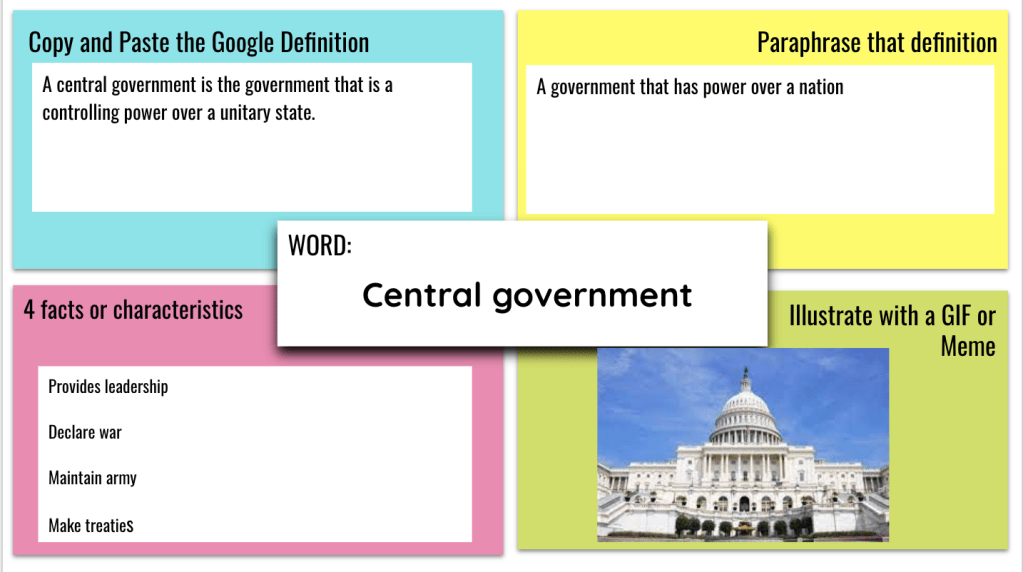

Students took 15 minutes to complete 3 slides for their Frayer. The last 10 minutes of class were used to take the Gimkit again. Most scores were raised to a 60% and one class raised their class average to a 70%.
Personally, I felt like their scores should have been higher. I had a conversation with them that I played a Gimkit the previous week about Halloween trivia. The first 19 questions I missed (no joke). However, I read the correct answers and didn’t miss a question after that. Using the time, and effort, to read and understand why a question was missed is soooo beneficial.
Tuesday
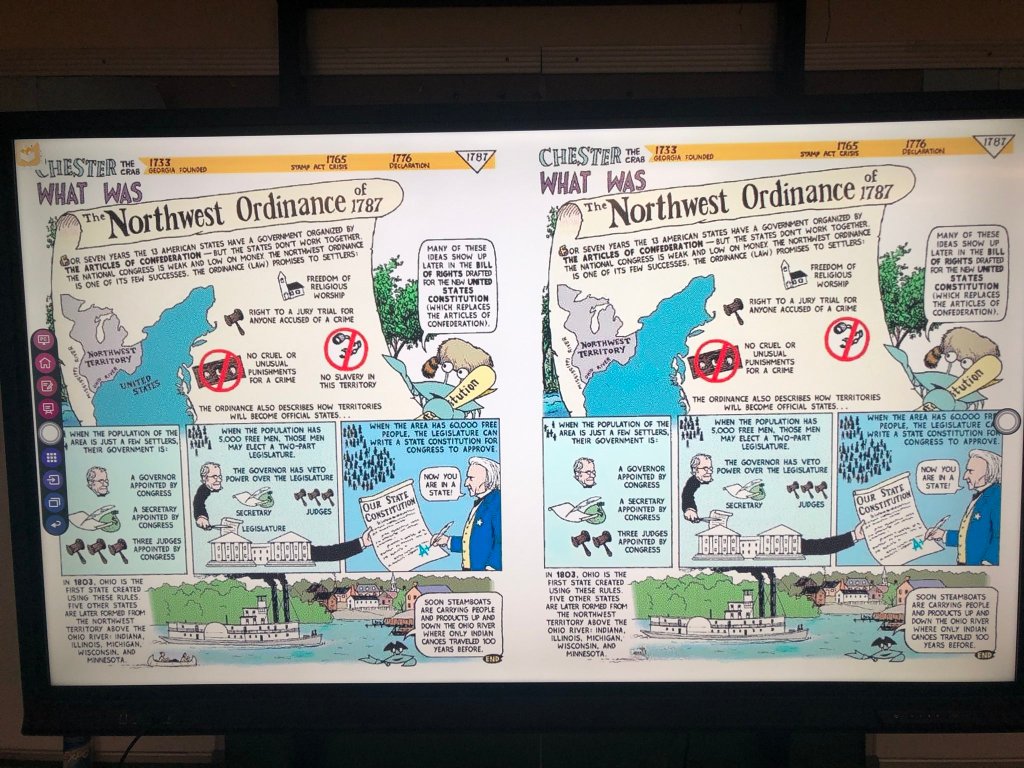
To begin class, I used this awesome strategy I learned from Dominic Helmstetter. At MassCUE, Dominic told me he uses a “spot the differences” in pictures to begin class sometimes. He uses a site called Cleanup Pictures to create the differences, or remove items, from a picture. So, I used a picture I found on Google related to the Northwest Ordinance. I removed important items related to the day’s lesson. It was awesome, and students got so into it!! Can you spot the differences?
Last year I had students do a solo Iron Chef to learn about the Articles of Confederation and Shay’s Rebellion. I had them read a textbook section and design a slide. We set aside 15 minutes for each slide. I kept my timer going, and switched them throughout the class. It was okay, but there was no discussion.
This year, I had students create groups of three and share a slidedeck. I printed off paper copies of the textbook sections and handed them out. Students had 12 minutes to read and design a slide.
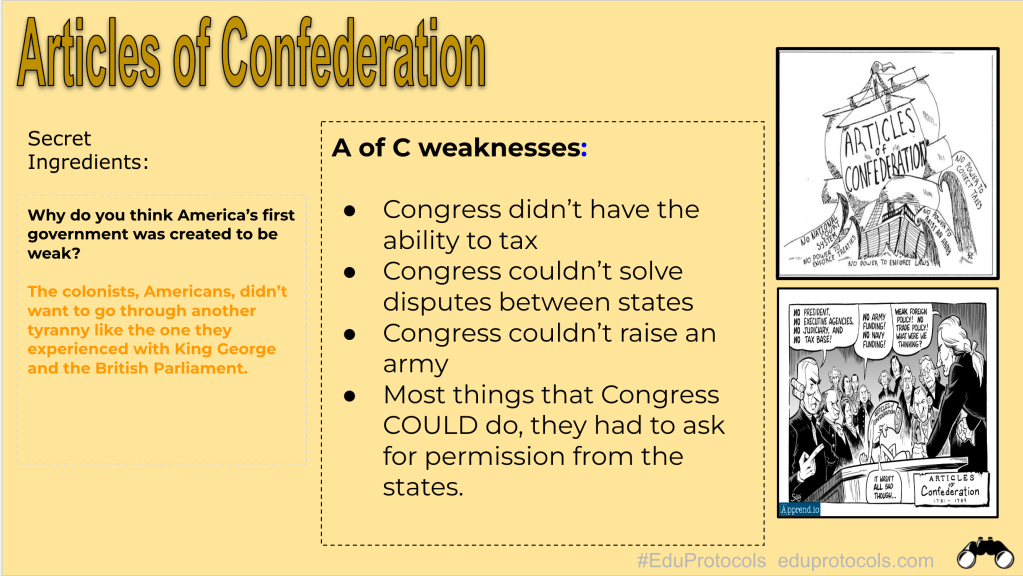


At the end of 12 minutes, I passed out a paper Frayer model to each student. Each box had a prompt for what I wanted the students to focus on in regards to the Articles of Confederation, Northwest Ordinance, and Shays Rebellion. I labeled each box with:
- What were 4 weaknesses of the Articles of Confederation?
- Describe the Northwest ordinance – territories becoming states and rules for the Northwest Territory.
- Describe the importance of Shays’ Rebellion.
- Five sentences – how did weaknesses of the Articles of Confederation lead to a new government?
I tried to have each student present their slide to a group – some did great, while most did not. But that’s okay. Some students like to work independently, work at their own pace, and write their own notes.
Some students complained about writing 5 sentences which gave me an idea for Wednesday’s class (stay tuned)…
Overall, for a 2nd Iron Chef, the students great. Awesome creativity, they were engaged, I may have went a bit too fast for some. However, there is always room for improvement. At the conclusion of class, we finished up with a Gimkit. The Gimkit results are a bit skewed, because I often keep adding new questions related to the content. Some class averages remained the same, and some went backwards.
I set up the Iron Chef differently for my 7th period class because I don’t fully trust them to share and work together cooperatively. As a result, I would read a textbook section to the class and added clarification along the way. Then I gave them 8 minutes to make their slide. Then I read another textbook section, and so on. Sometimes I am doing too much, but at the same time, I am saving my sanity and doing what I feel is right. It worked out much better for this class.
Wednesday
On Tuesday, I took the, “We can’t write 5 sentences,” as a challenge. I wanted to do some review of the Articles of Confederation, Northwest Ordinance, and Shays Rebellion. I also wanted to have a little fun.
To begin class, students did a 5 minute round of Gimkit. Class averages were okay. They ranged from the 57% to 80% range. After the Gimkit, we did more review with a Rolling Recap from EMC2Learning. I can’t really give this review activity away, but I roll four dice and ask random questions related to content. Students work together in groups of two to three and are totally engaged.
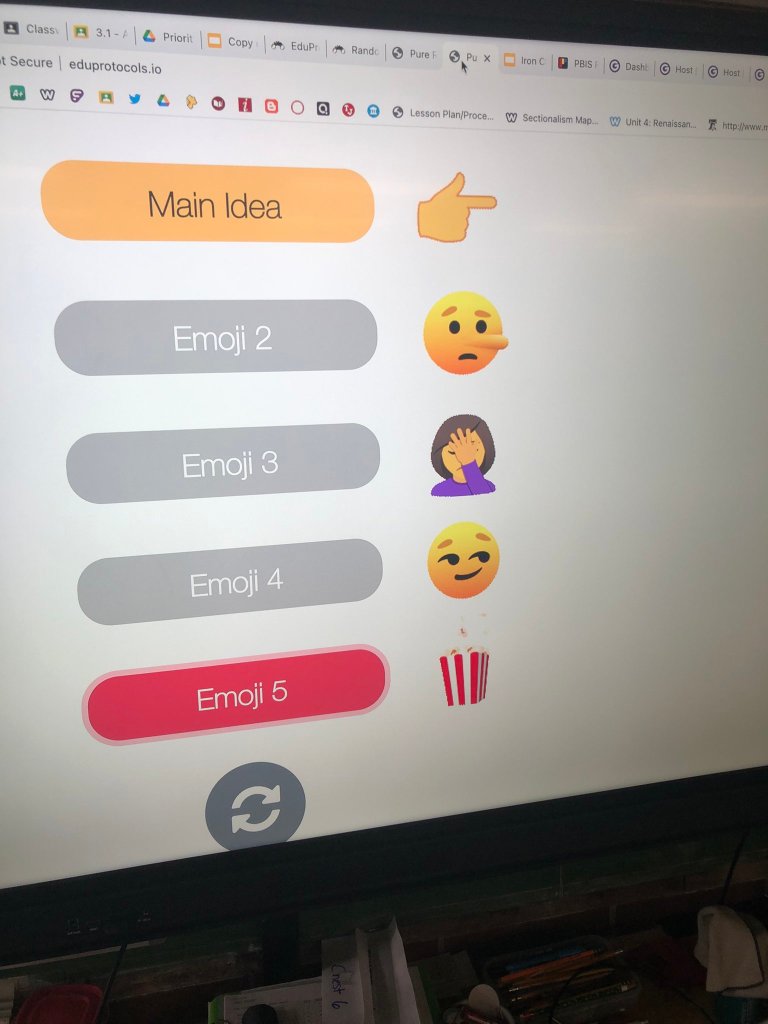
All of this review was working toward my big lesson of the day – Random Emoji Paragraph. The students said they couldn’t write five sentences, but they ended up writing 15 or more sentences by the end of class. Basically, they wrote three paragraphs. To access the Random E
I began the Emoji paragraph by having the random emoji generator on the board. If you want access to it, sign up for free at the EduProtocols website. This created intrigue and many questions. I explained the purpose of a paragraph – pursue an idea. Then we ran two practice rounds. The students loved it, couldn’t wait to share, and asked if we could do it again. Even if it’s not related to your content area, this is a great way to begin or end class to get students thinking, writing, and having fun.
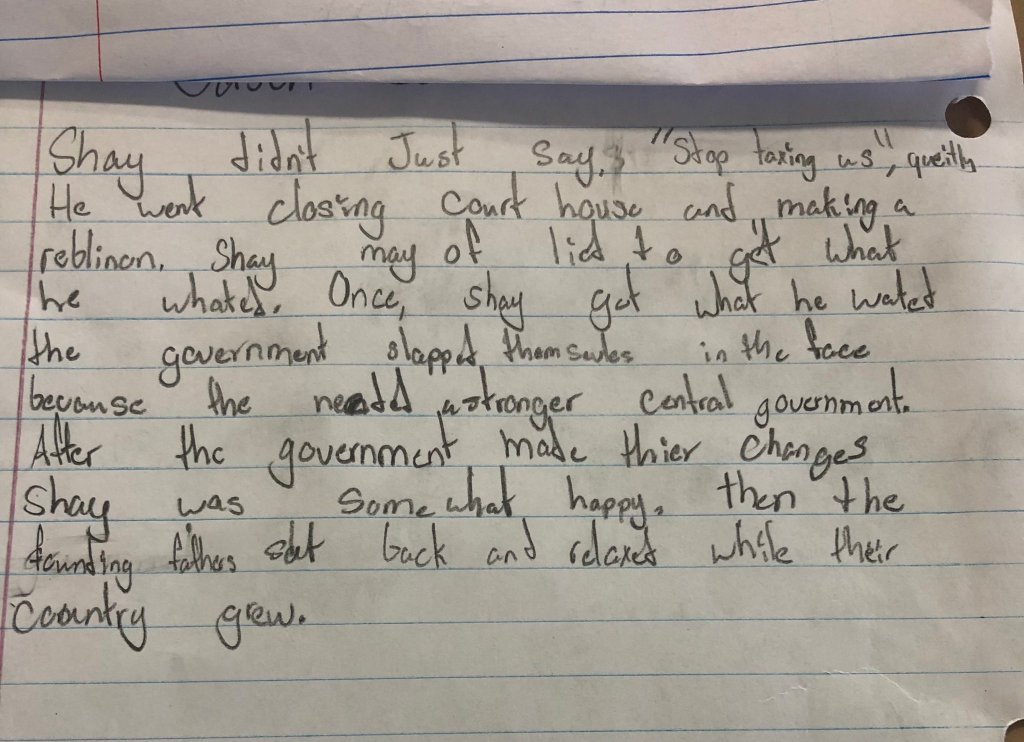
The last round of the Emoji paragraphs, I challenged the students to relate the emojis to the Articles of Confederation, Shays Rebellion, or both. If students did a great job with the Gimkit, Iron Chef, and Rolling Recap – this was no problem. The students that didn’t bother to do much, really struggled. Relating random emojis to describe a historical topic requires some special creative thinking. Most students did great. They were engaged and couldn’t wait to share. What they came up with was pretty amazing:


Thursday
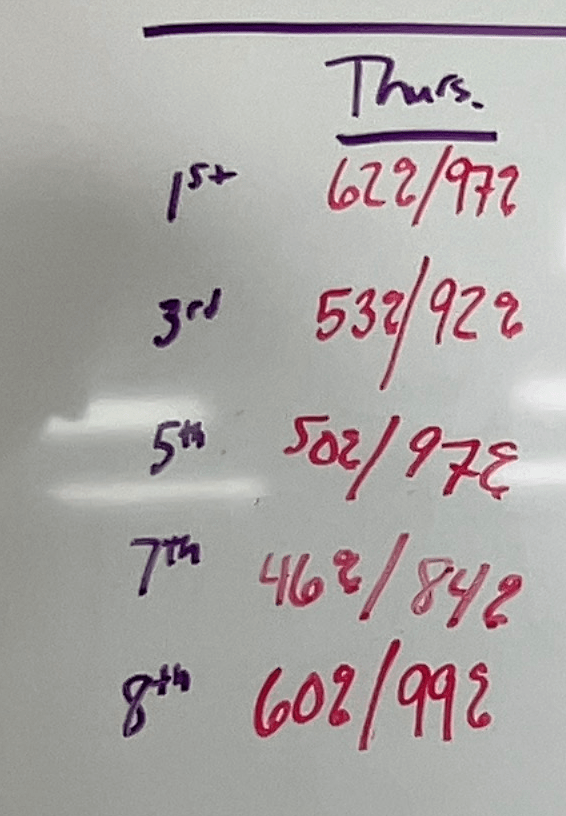
On Thursday, we were ready to move onto the Constitutional Convention. I used a Quizizz at the beginning of class. It was nine questions, and the class averages were as follows: 62%, 53%, 50%, 46%, and 60%. The Quizizz had basic questions about the Constitutional Convention.
Next, I had students read a section of the textbook and take notes using a Main Idea note taking strategy. I like this strategy for this particular CyberSandwich because it helps the students write their summary at the end.
The Main Idea note taking strategy has students turn the section title into a question. Then it has them write down who, when, where, why, and what. At the conclusion of the reading and note taking, I had the students select 4 of the most important facts they typed.
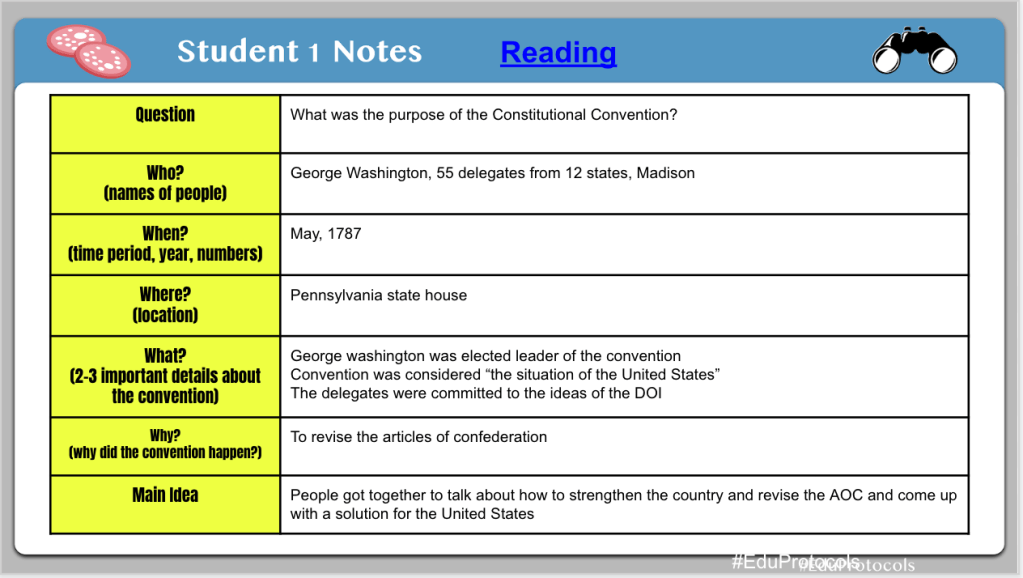


Choosing 4 important facts helps guide the discussion and comparison piece of a CyberSandwich. The discussion were MUCH better and organized with choosing 4 important facts. This also helped with the summaries at the end.
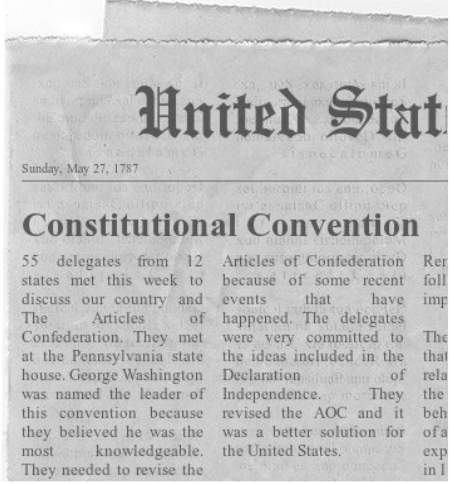
The summary for this particular CyberSandwich is a newspaper clipping the students create. They visit a newspaper clipping generator site and attempt to create a summary answering the question – What was the purpose of the Constitutional Convention? After students typed their summary, I had them check how many facts they had in their article using this self assessment doc. Here are some students samples:

At the conclusion of the lesson, we went back and did the same Quizizz again. This time, the scores went way up!
Friday
Friday was a weird schedule day. Each class was 30 minutes long. As a result, I had students complete the Friday Check In, Gimkit, and add to their Google Site Portfolio. I added the Thursday quizizz questions to the Gimkit.
For the Google Site Portfolio, I had students create a new page for the last unit – Unit 2 American Revolution. Then I had them select three items they created in unit 2 that they were proud of.


 Moler's Musings