
When I began teaching social studies, eight years ago, students seemed to have a good background and grasp of basic historical facts. Each year after that, the knowledge has been less and less. For example, I have some students who have never heard of George Washington, Ben Franklin, or John Adams. No joke.
I shared the above information because I feel like most of my lessons stay in the DOK 1, 2, and 3 range. The students are learning the background knowledge they lack, but sometimes I wish I could get to the DOK 4 level.
The units I have put together are structured, but I need to focus the essential questions more and tidy up the organization. I would like to get into more inquiry based lessons, PBL based lessons, but the lack of background knowledge trips me up. With that being said, it leads me to the end of the American Revolution Unit.
I needed an end to the American Revolution Unit, but it seemed like a conglomerate of lessons. As a result, I came up with a 2 part assessment that addressed all aspects of the unit. The next day we started a mini-unit on the Founding Fathers.
I created the mini-unit on the Founding Fathers because a student asked me if we could learn about them. Furthermore, it’s important for students to understand who some of these Founders were before diving into the Constitutional Convention. So, I put together some EduProtocols paired with some Emc2Learning materials. It ended up being a cool unit.
Monday – Resource Rumble for review
Tuesday – Final Assessment – American Revolution
Wednesday – Thin Slide, Fast and Curious Gimkit, Iron Chef/Archetype
Thursday – Frayer, NFL Draft Founding Fathers (emc2learning)
Friday – Fast and Curious, Finish up NFL Draft (Wasted day)
Quick Video Tip – Quickly change share settings for ALL students so they can see each other’s work.
Monday
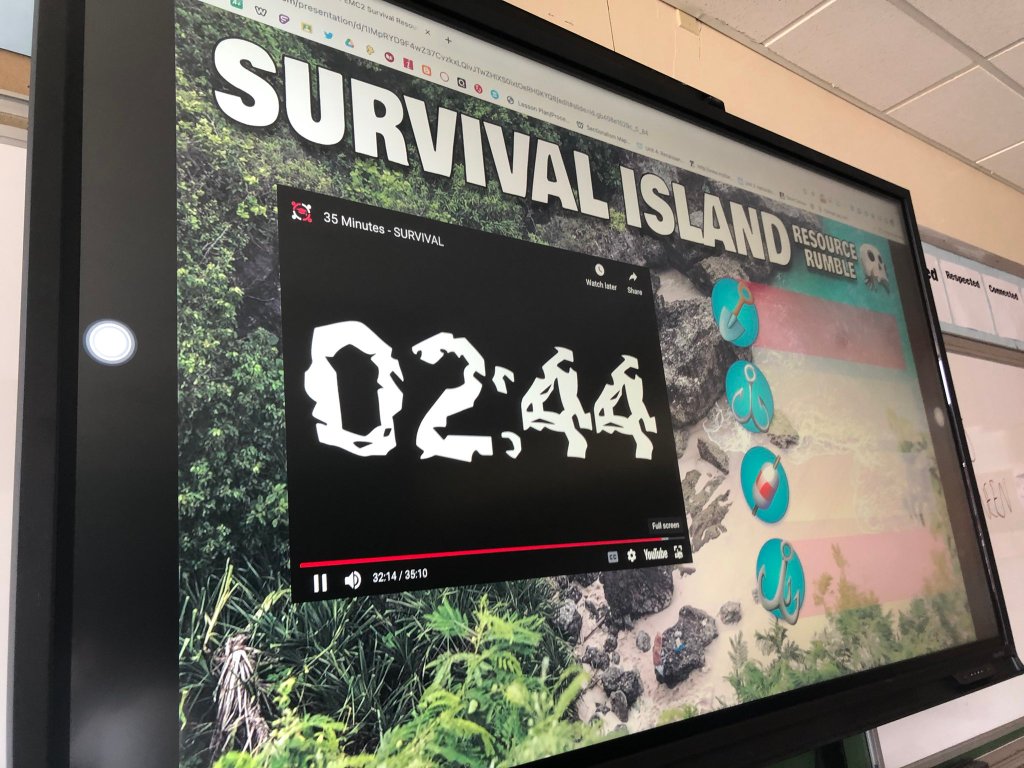
After returning from a long trip (I went to MassCUE at Gillette Stadium), I needed a review activity for the students. I took a chance and did a Resource Rumble with my classes. The Resource Rumble is an engaging review activity for students.
The students were placed into teams of 3 to 4. I posted 8 questions around the room related to the material they learned last – Declaration of Independence, American Revolutionary War battles, life of Continental Soldiers, Taxation without Representation, etc. I wanted students to use some recall and retrieval practice. Some examples of questions I posted:
- Write a Haiku about Taxation without Representation.
- Write 3 rhyming couplets about the Declaration of Independence.
- What are the natural rights listed in the Declaration?
- Identify the first and last battles fought in the Revolutionary War. Who won the last battle?
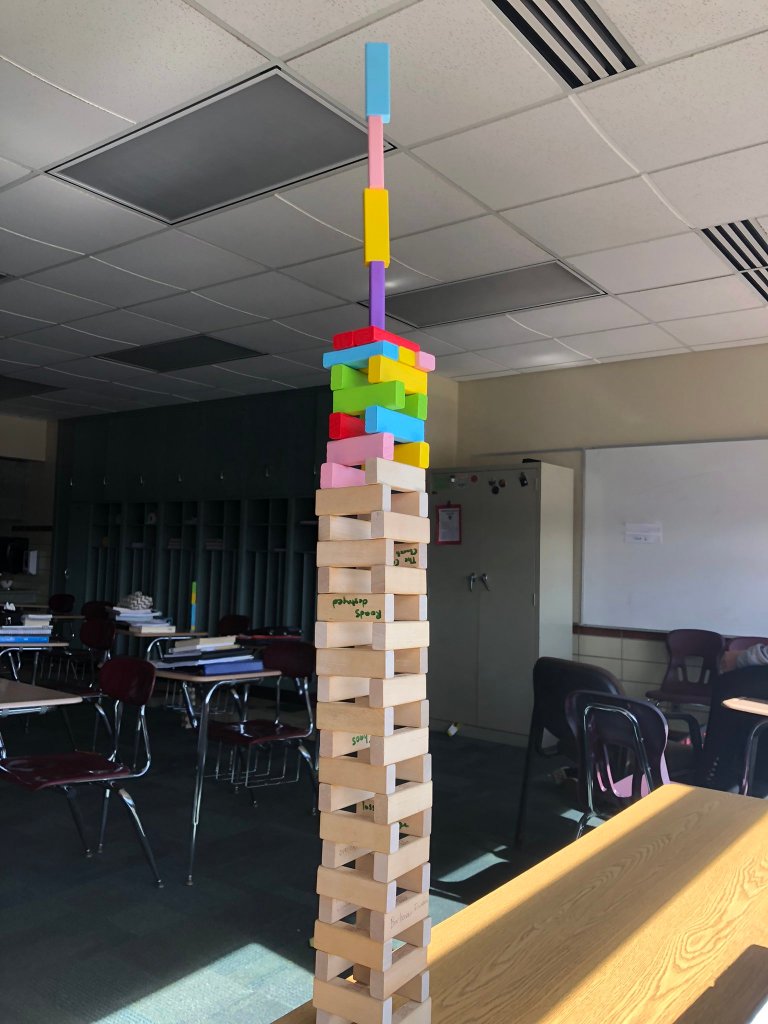
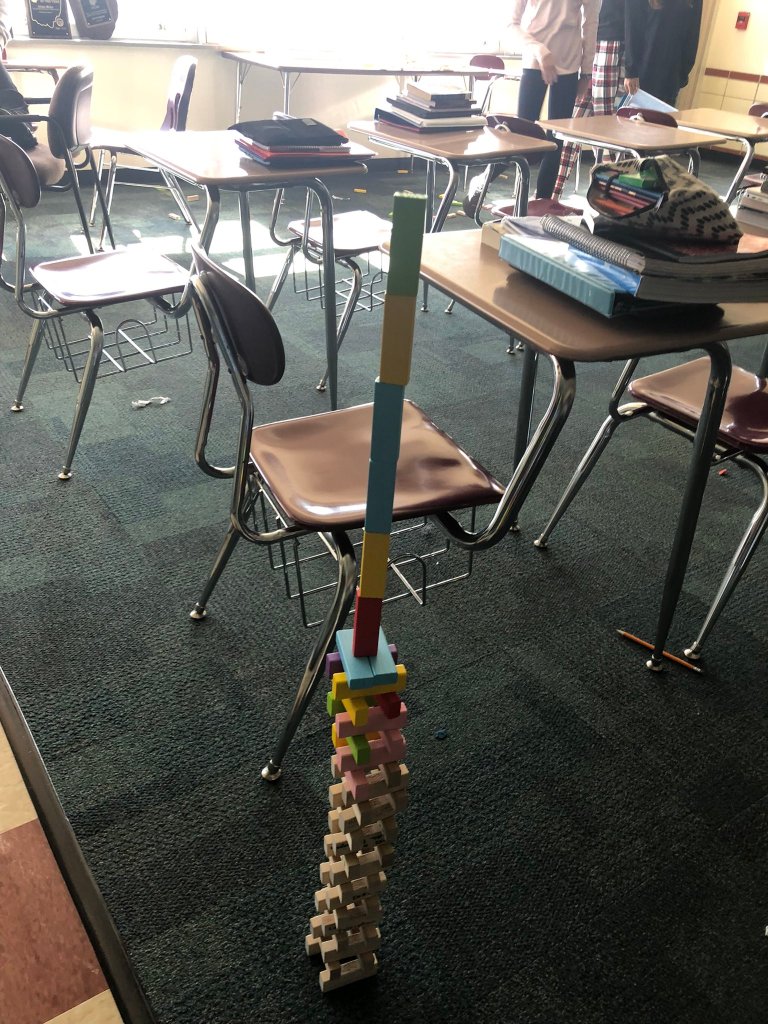
Students did well with the Resource Rumble. They loved getting up and moving around. After the groups answered the questions, they brought their responses to me to check. I added in a new twist this year – okay responses received a 6 sided dice. Great responses received the 8-sided dice. One student rolls the dice for the group, and collect that many blocks. In the end the groups compete to build the tallest, freestanding tower. The tallest tower of the day was 38″ tall. Here are some pics:
Tuesday
For Tuesday I needed an assessment to wrap up the American Revolution Unit. I often have a million ideas constantly running through my head. I can never make up my mind. I knew what the students needed to know and be able to do, I just couldn’t make up my mind on how they could do it.
As I was driving to school, the idea came to me – a 2 part assessment. The first part of the assessment was a Gimkit. The second part of the assessment was a choice of familiar activities – Hexagonal Learning or Story Cubes. I told the students they had to finish every part of the assessment in class. Here was my deal with them:
- 5 minute Gimkit. If everyone answered 25 or more questions, and the class average was 80% or higher, then everyone would a get a 10 out of 10 on that portion of the assessment.
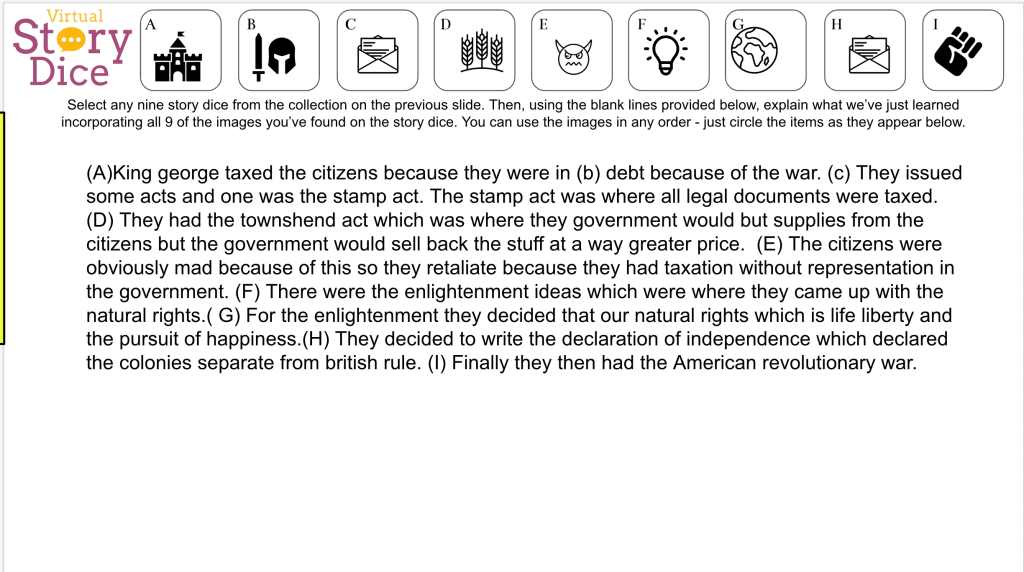
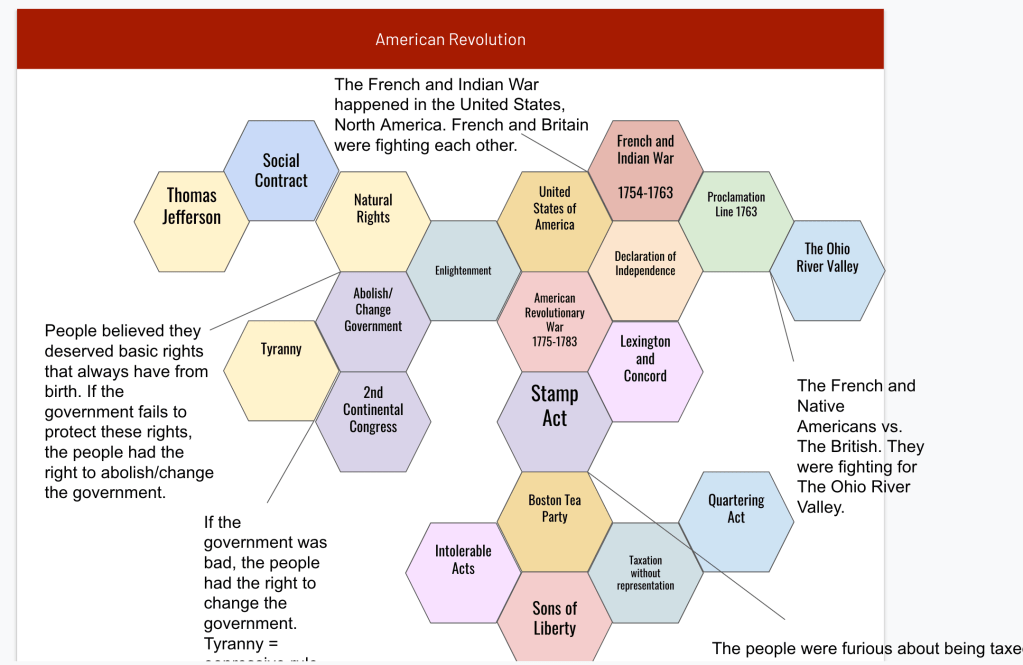
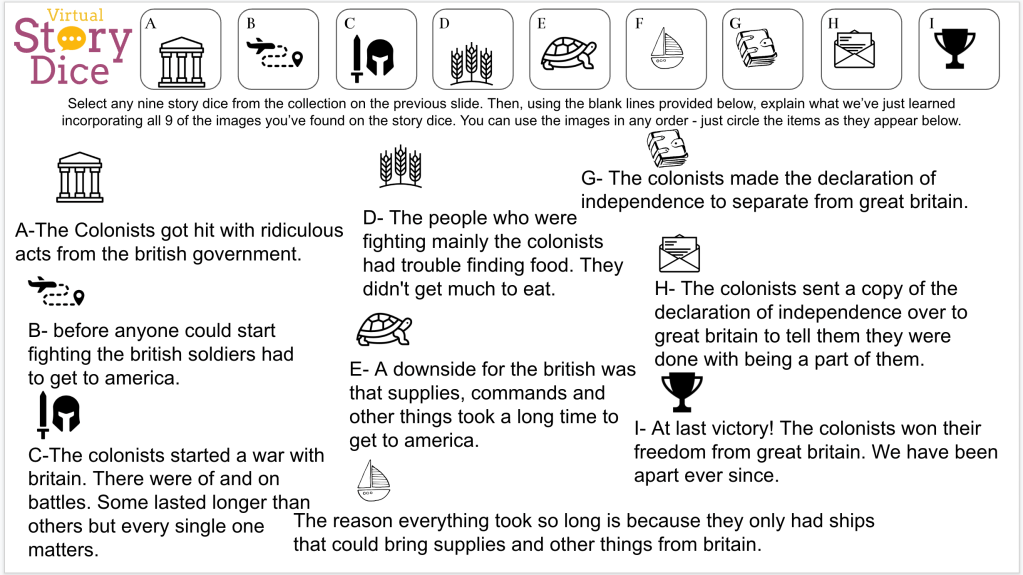
- The 2nd part of the assessment was a choice – Hexagonal Learning or Story Cubes. Hexagonal Learning could be with a partner or Story Cubes had to be individual.
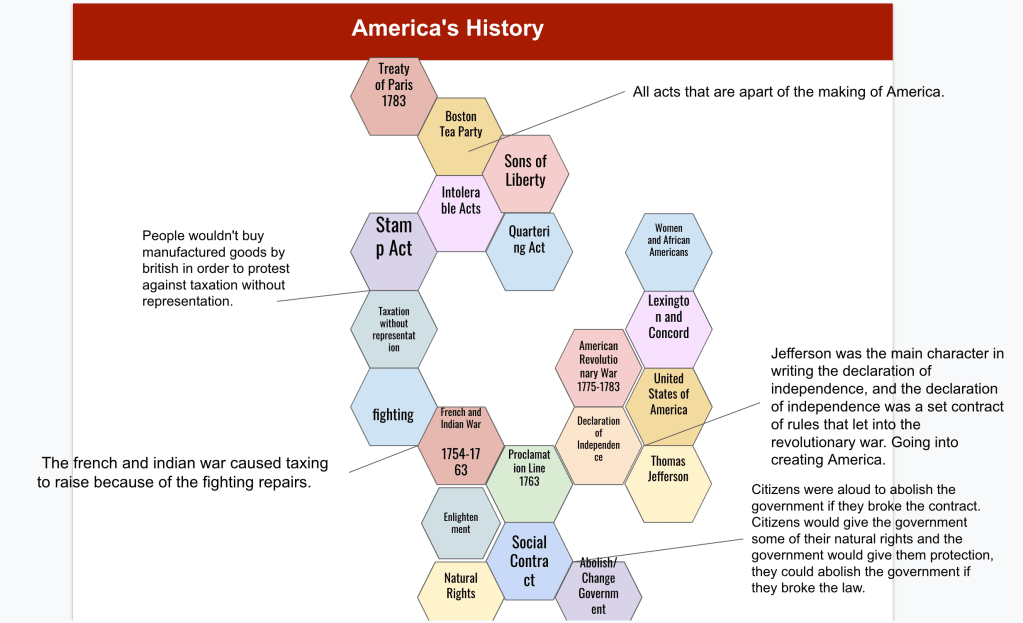
On the Gimkit, the students rose to the challenge. Four of my classes received these class averages: 80%, 82%, 85%, 90% and one class received a 70%. For the choice assessment, most students chose Hexagonal Learning. Here are some of the I Can statements I listed out:
- I can identify and describe 2 examples of taxation without representation that led to the Revolution.
- I can explain how the Enlightenment influenced the Declaration of Independence and the American Revolution (natural rights, social contract).
- I can explain why Thomas Jefferson wrote the Declaration of Independence.
- I can identify principles of government within the Declaration (consent of the people).
- I can identify, and explain, a group that contributed to the American Revolutionary War.
I shared my I can statements because I noticed some students were putting the Enlightenment, or natural rights with other ideas…….which is okay in some ways, I guess. However, I pointed out to the students the I Can statements. For example, I can statement number 2 literally has Enlightenment with the Declaration, natural rights, and social contract all in the same sentence. I asked, “Wouldn’t that clue you in to where those hexagons go?” I bring this up because I wonder how often I can statements are used and if students are taught to use them for guidance.
Along the lines of my assessment choices, I like these options for students because they are familiar with them. The Hexagonal Learning has the major concepts listed out for students to read. Whereas, the StoryCubes has students relating abstract images to concepts which leads to more recall and retrieval practice. Here are some examples:
Wednesday
Before beginning a new unit on the Constitutional Convention, I was inspired by a couple of students to create a mini-unit on the Founding Fathers. One student asked me if we could learn about the Founding Fathers. The other student that inspired me, way back in September, made a list of presidents that would make a great basketball team. He strategically placed them in different positions – point guard, shooting guard, etc. and began laughing. What he thought was a joke actually inspired my idea for this Founding Fathers unit.
To begin this unit (With EduProtocols, I planned this out, and created everything, in 10 minutes) I started with a Thin Slide. I simply asked the students look up a Founding Father, add their picture, add their name, add an accomplishment. They had 3 minutes to create their slide. When the timer went off, I shut down the editing rights and students presented their slide right from their desks. They included the usual suspects for Founding Fathers – Alexander Hamilton, George Washington, John Adams, Thomas Jefferson. Some students like to branch out and be different – those students shared John Jay (who apparently looks like me I guess).
The next step of the lesson was a Fast and Curious Gimkit. The Gimkit had fifteen questions about founding fathers. I added pictures to the questions with the lesser known Founding Fathers. The point of this Gimkit was to introduce more names to the students. The class averages were super low – 40% to 50% range. Students were confused by all the John’s, James’s, and George’s.
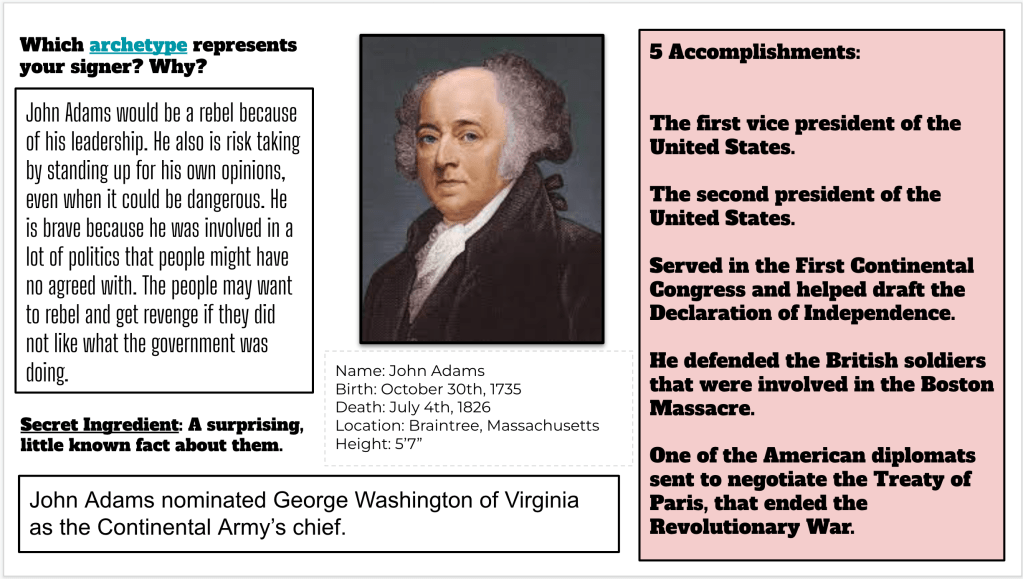
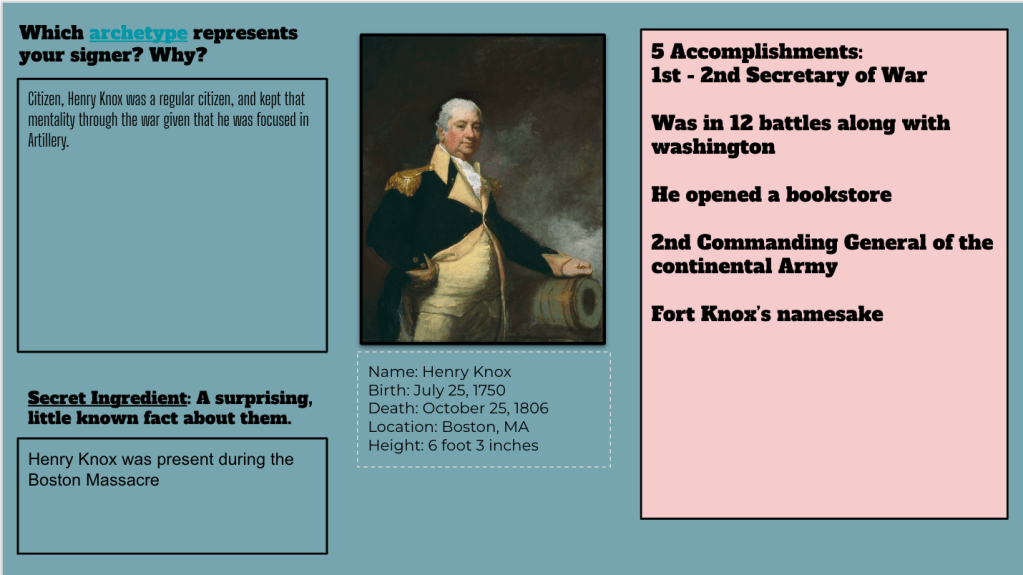
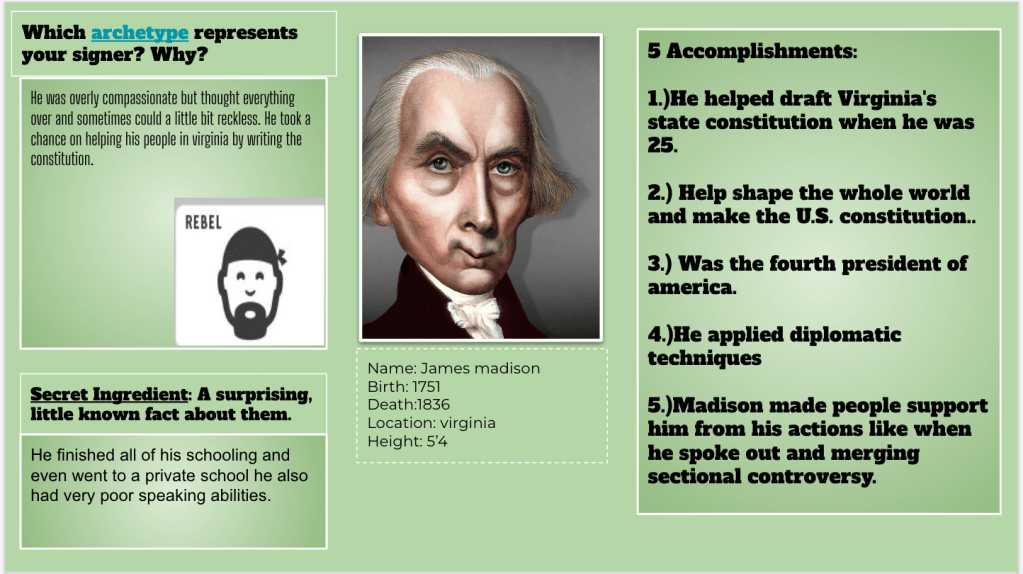
The last step involved the students choosing a Founding Father from a list of links I provided. I wanted them to design a slide about sa Founding Father with the following:
- Five acomplishments
- A picture
- Basic information – year born, year died, etc.
- One surprising fact
- Apply an archetype to that Founding Father – explain why with evidence.
The students had 22 minutes to finish their slide. I ran a timer for 15 minutes, paused, and went over the archetypes because this was a first for the students. I resumed the timer for another 7-8 minutes as they chose an archetype for their chosen Founding Father. Here are some examples:
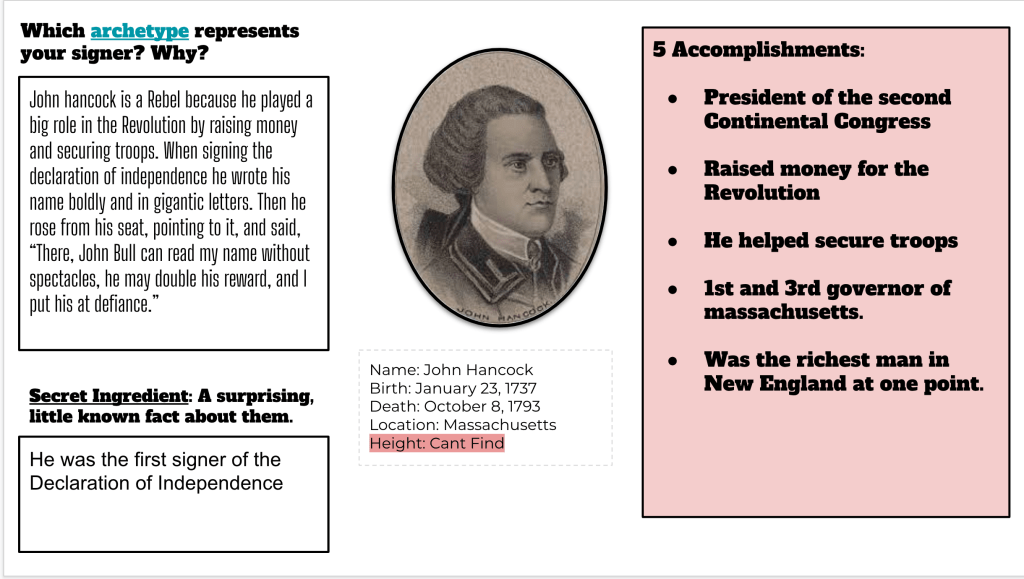
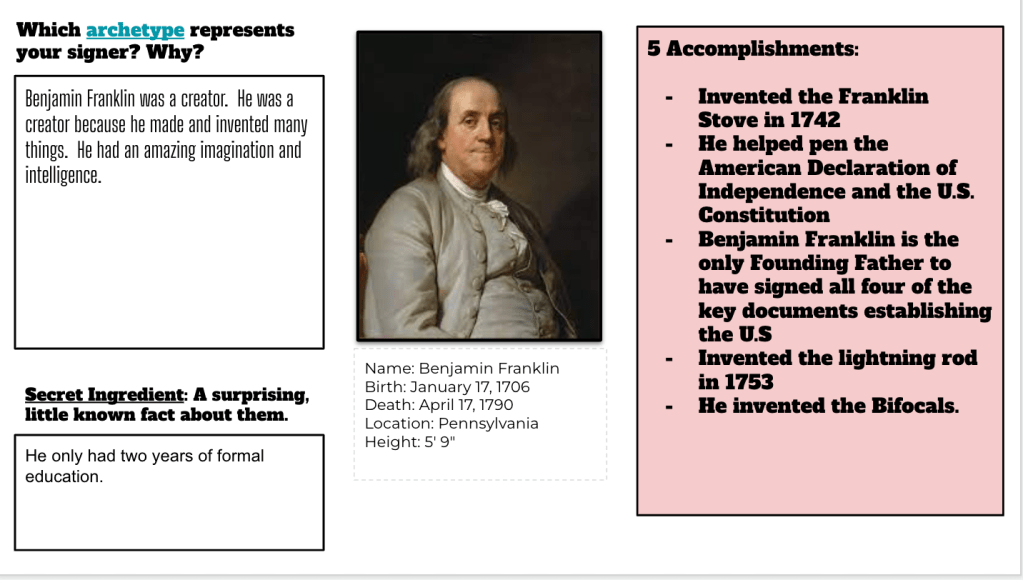
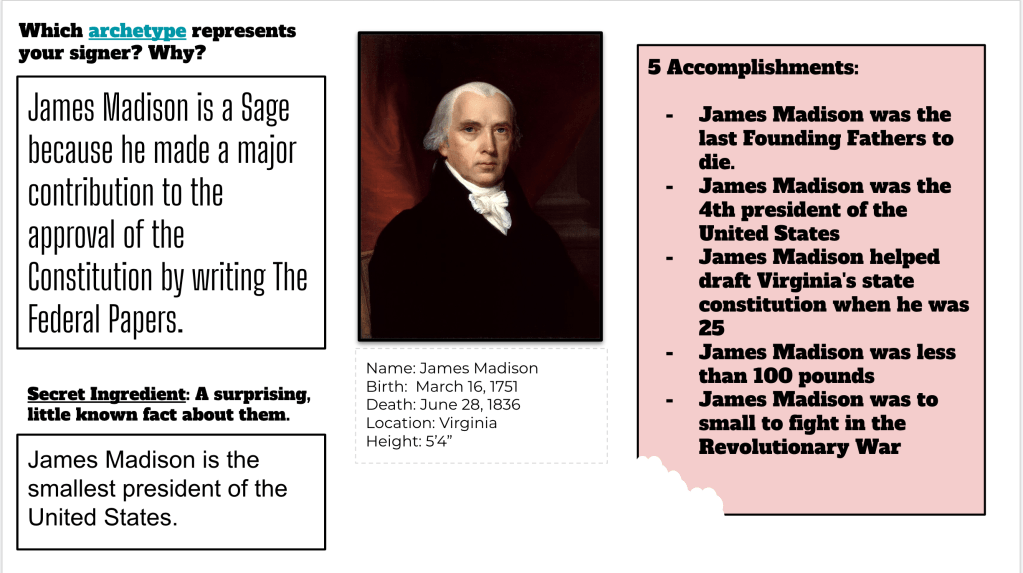
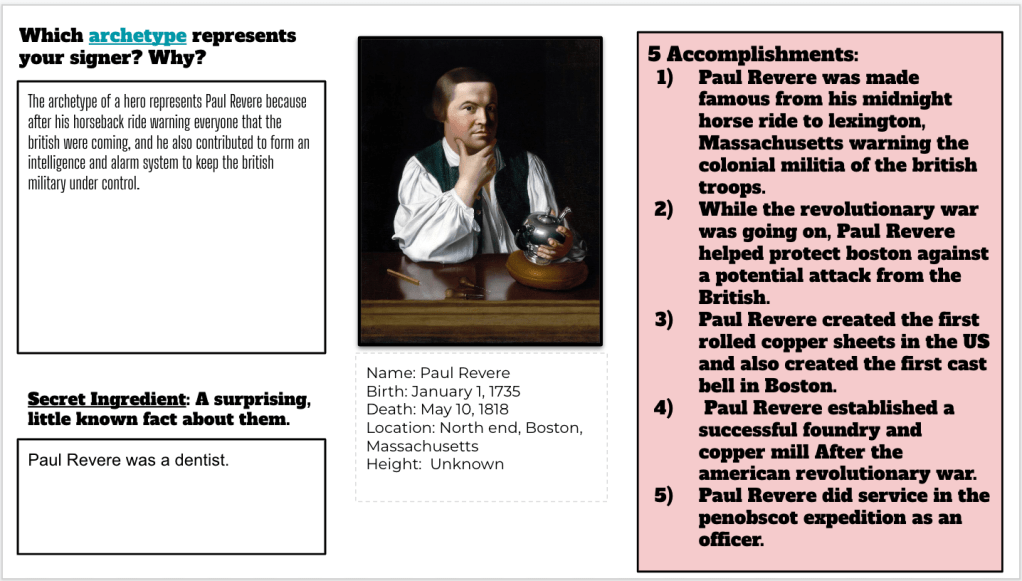
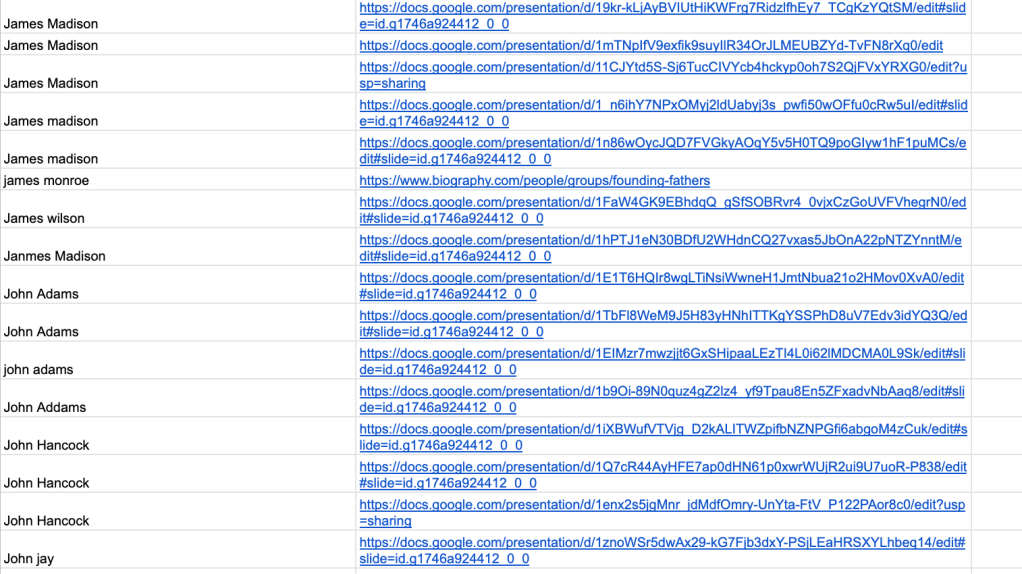
With the last 3 minutes of class, I had students share their slide through a Google Form. I converted the Google Form data and links into a spreadsheet. Then I added that spreadsheet to the assignment. See how to quickly change share settings so students can see each other’s work.
Thursday and Friday
Thursday rolled around and I worried that the students didn’t have enough background information for the final part of the Founding Fathers mini-unit. As it turned out, I was worried about nothing. The students made great slides and had good information. To begin class, I ran the same Gimkit again. This time class averages rose up to the 60% to 70% range.
While the Gimkit was running, I passed out paper Frayer models. When we share learning artifacts through Google Forms, I like it when students use paper and pencil to write notes from peer work. I think the students secretly like the paper and pencil too. Students had 15 minutes to write down 2 accomplishments, basic facts, a surprising fact, and the archetype for four different Founding fathers.
I gave them all a quick speech about writing down things they KNOW and UNDERSTAND. For example, I would have students write down, “He was foreign minister.” I will ask them, “What is that?” They always respond, “I don’t know??” I have really been striving to coach them to write down basic things they understand, Write down things in your own words.
Once students had their information, it was time to reflect on their learning. This is where I was inspired by the student who put together the presidential basketball team. On EMC2Learning, they have an NFL Draft template. I asked the students to think about who would be drafted in the first round based on their accomplishments. Who would be drafted in the second round and so on?
I cannot share the template, but here are some student samples:
Friday ended up being a wasted day because we had some special events going on. Some students finished up the NFL Draft templates. Some did not.

 Moler's Musings