This week was a shortened week with Labor Day on Monday. I also missed Tuesday to give myself one more day of recovery from Covid. I’m still not right and still trying to recover. Last week I was out as the students learned about the motivations and effects of European exploration. I wanted to review and build upon the theme of last week.
Last Thursday, while learning about the effects of European exploration, students completed a Frayer on the Columbian Exchange. Many students asked more questions about the Columbian Exchange on the Check-In form I share every Friday. I used that opportunity to find a Nearpod Lesson about the Columbian Exchange.
The Nearpod lesson was excellent as it had some ELL scaffolding built in, and it introduced the Transatlantic Slave Trade which is another topic I wanted to cover this week.
Monday – No School
Tuesday – Nearpod Lesson, finish Hexagonal Learning
Wednesday – Nearpod Lesson and questions
Thursday – Thick Slide, Gimkit
Friday – Gimkit, Monument Sketch and Tell, Primary Source Parts
Tuesday
As I mentioned above, many students asked questions about the Columbian Exchange. I try to respond to all the questions they ask. Sometimes, I just create (or find) a lesson to respond with. In this case, I found a great lesson on Nearpod about the Columbian Exchange. This lesson had ELL scaffolding built in, as well as some SEL-related questions. The lesson also introduced the Transatlantic Slave Trade.
I discovered the ELL version of the Columbian exchange lesson is for Nearpod premium users only. If you don’t have a premium account, then you will only see the regular version of the lesson here. This lesson doesn’t have the scaffolding such as sentence starters available for students.
With this lesson, since I wasn’t at school, I set it to student-paced mode. Students clicked the Nearpod link I shared on my Google Classroom, typed their name, and they were good to go. If they didn’t finish, it wasn’t a problem as their progress was saved. I also like Nearpod because all the data is saved in one spot.


Wednesday
I finally made my return to school. Whenever I’m out for a couple days, or more, I like to have a review and question day to get everyone on the same page. For the most part, the students did a nice job when I was out. It helped that they were familiar with Sketch and Tell and the Fast and Curious with Quizizz. I took a chance with with Hexagonal Learning last week. This was unfamiliar to the students, however, I provided an example slide and a Screencastify video of directions. Ironically, the students who struggled with the Hexagonal Learning were the students who never finished the Sketch and Tells and had low scores on the Fast and Curious.
With my return, some students were working on the Nearpod lesson with the Columbian Exchange. Some were finishing the Hexagonal Learning. In all classes, I had small groups working with students on Hexagonal Learning. I used a variety of question and recall strategies to help them make connections with the hexagons.
At the end of the day my goal was to ensure students finished the Sketch and Tells and the Hexagonal Learning. In regards to the Nearpod, it was okay if students did not finish the assignment. I had a plan for the next day.
Thursday
The end of the Nearpod lesson was an introduction to the Transatlantic Slave Trade. Most students didn’t get to that half of the Nearpod, so I reserved Thursday for a Gimkit and an introduction to a Thick Slide. I broke EduProtocols rules and introduced a Thick Slide with content. But, I like to take these chances because I have some awesome students.
When class began, I ran a Gimkit about the Transatlantic slave trade for five minutes. The class averages were 52%, 57%, 60%, 55%, and 68%. Please coach your students to understand that Gimkit, Blooket, or Quizizz is a learning tool and NOT JUST A REVIEW TOOL. Also coach the students that it’s not a race to answer thousands of questions in 5 minutes. The goal is too slow down, read, and learn.
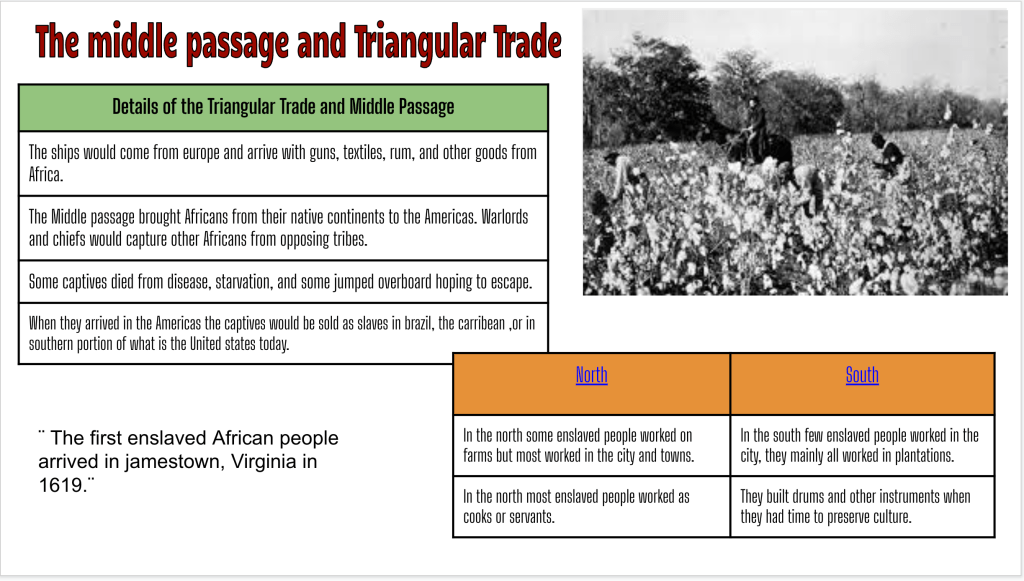
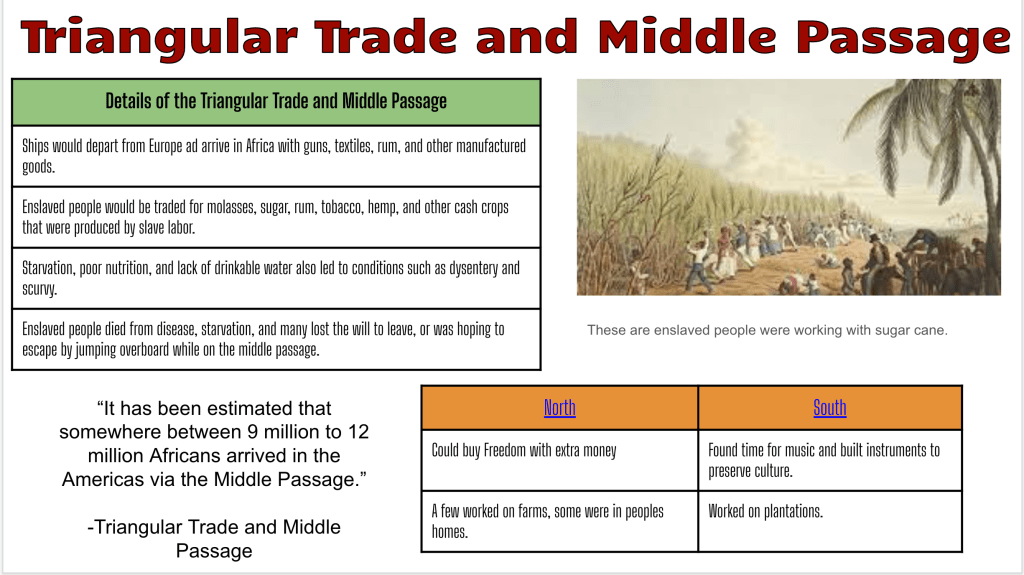
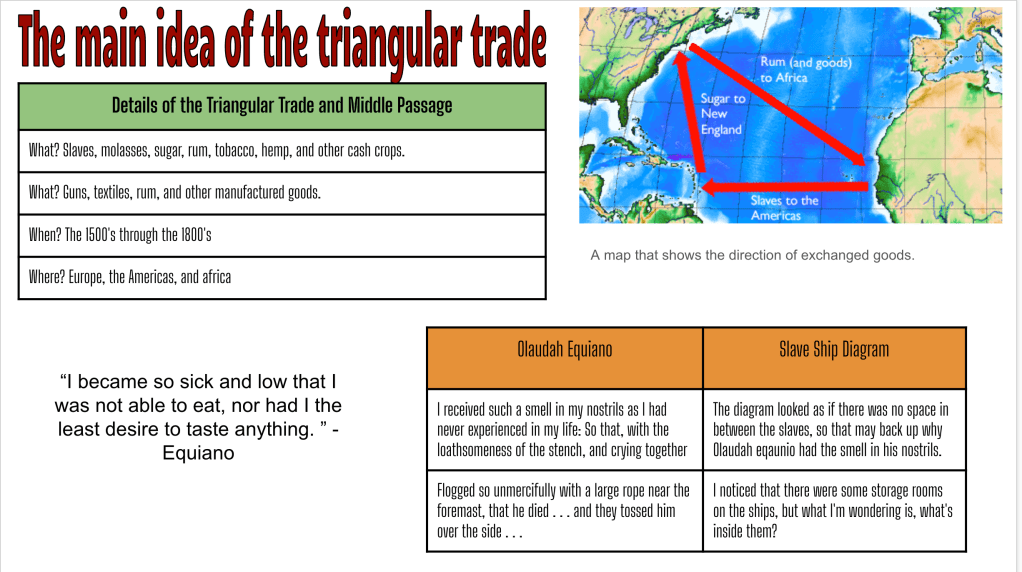
After the Gimkit, I introduced the Thick Slide to students. I had a reading on the Transatlantic Slave Trade and the Middle Passage. Here was my procedure as I gave the students 15-20 minutes to create their slide:
- Read and highlight four important facts.
- Add the 4 paraphrased facts to the slide.
- Change the Title.
- Add a relevant picture and caption.
- Compare slavery between the North and South.
- Add a quote that surprised you.
The students did really well with creating their Thick Slide. As students created, I walked around the room asking questions, offering suggestions, and offering technology tips. When time was up, every students was finished, and I had all the slides graded. In an effort to create a contribution learning atmosphere, I created a Nearpod collaborative slide and I had all the students share one fact from their slide. This helped students add more information to their slides and finish their slides. At the conclusion of the lesson, I ran the Gimkit again for 8 minutes and students raised their scores across all classes – 80%, 75%, 80%, 73%, and 88%.

Friday
For this day, I had a plan to run the Gimkit again. This time I added 6 new questions about Jamestown. I added these questions because we are getting into Jamestown and Plymouth next week. However, with the Gimkit, I did different stuff with all my classes…
1st and 8th Periods – Sketch and Tell Monuments
In these classes, the students can have a little more choice and less structure. The students all work super well together. So, I created a Team Gimkit and I said, “Whatever your team is will be your team the entire class.” Then I stated, “The first place team gets their own bin of Legos, 2nd place gets four handfuls of legos, 3rd place gets three handfuls of Legos, and so on.” At the conclusion of the Gimkit, students grabbed their Legos and I had them create a monument or some creation related to anything we learned about in the last 2 weeks. Students had 15 minutes to create. When the timer sounded, one student made a copy of the Sketch and Tell. I showed them all how to add a picture using their Chromebook camera. Then they discussed their creation as a group and wrote about their creation. Here are two examples:

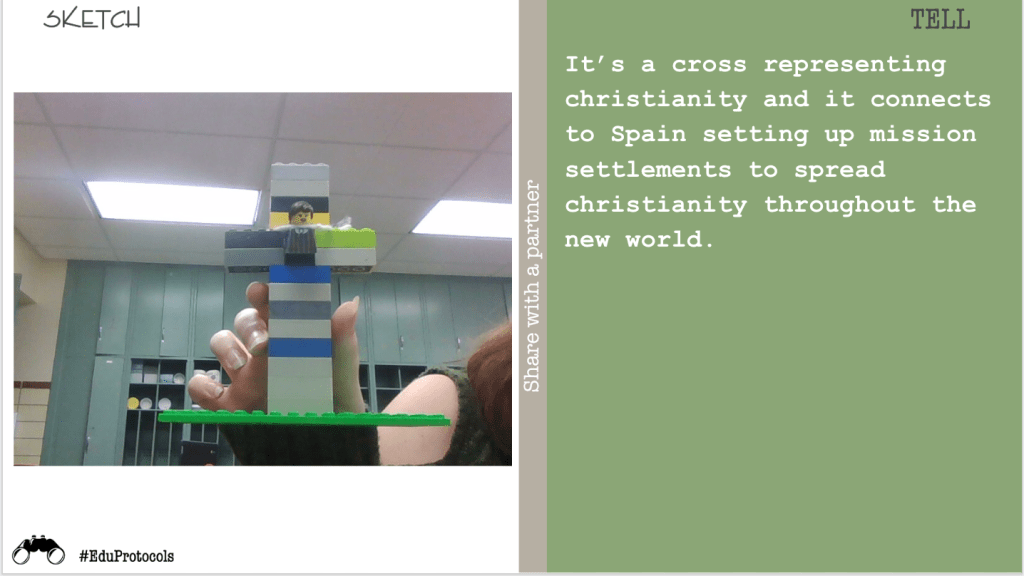
3rd and 5th Periods – Primary Source Parts
These classes need structure – one class has 29 students while the other class is right after lunch. I ran the same Gimkit as yesterday, but I ran Fishtopia mode. Fishtopia mode works best when it can run for 15-20 minutes. Students love this mode. After Fishtopia, we ran 2 primary sources through Primary Source Parts using SHEG’s historical thinking skills of sourcing, close reading, corroborating and contextualizing. In this instance, we corroborated a Slave Ship Diagram and Olaudah Equiano’s autobiography excerpt. It led to a nice discussion, we worked on historical thinking skills, and summarizing skills. Here are some examples:

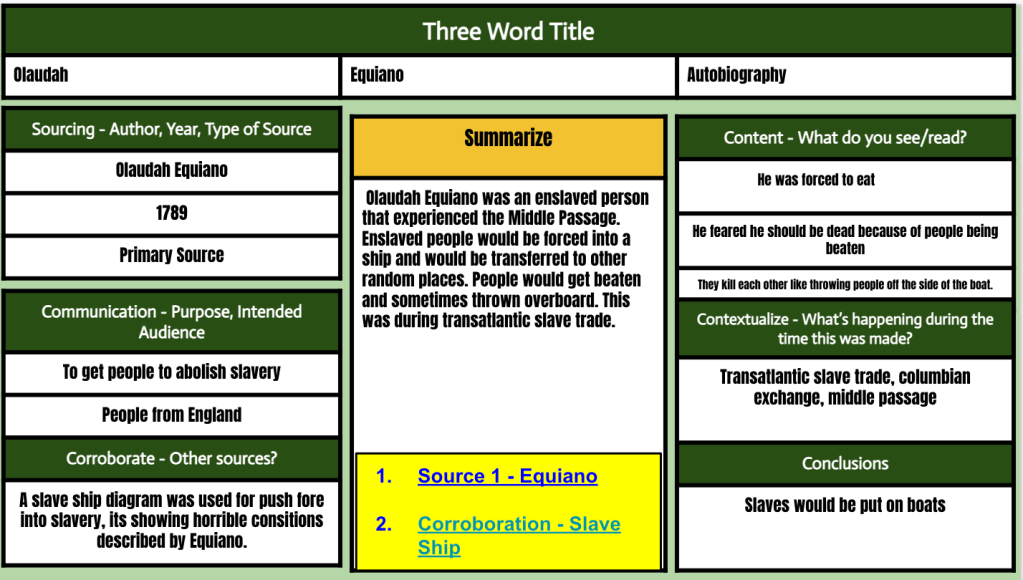
These still some need some work. Plus, I’m still trying to figure out what to do with this Primary Source Parts. For example – what do I want to read or have the students do with the summary part? Is there anything I need to add? It’s not perfect, but it’s a start in the right direction to helping the students make better sense of primary sources and practice their writing skills.
7th Period – Gimkit and Outside
I’m pretty good at getting a read on most situations and reading my classes. This class was done and wanted nothing to do with social studies. So, we played Gimkit Fishtopia mode for 20 minutes. Then we went outside to the cemetery behind the school. I discussed the difference between a cemetery and a graveyard, we talked about the gravestone of one of the founders of New Richmond, and we talked about the gravestones of Civil War Veterans. It was a nice mix-up and the students enjoyed it.

 Moler's Musings