Sorry for the late post – I have a lot going on right now:
- I had a small part in the school musical, Newsies.
- I am taking a gifted class.
- I am also taking another class on the T3 Framework.
- I am teaching tennis again.
- The ins and outs of teaching 8th grade.
That is my shortened list (not kidding). This week we continued state testing and we began a new unit on the causes of the Civil War. As I mentioned in my last post, I have a student teacher I have been working with since January. He really like the structure of a Group Playlist (inspired by Catlin Tucker and Amanda Sandoval). He also wanted the students to understand that slavery was a cause of the Civil War – not states’ rights, not secession. He also wanted to work in some local history because Harriet Beecher Stowe has ties to Cincinnati and the New Richmond area (her brother was a preacher in the New Richmond Village right down the hill from my school). The resources put together in the playlist represent these topics:
- Missouri Compromise and the Compromise of 1850.
- Kansas Nebraska Act
- Dred Scott
- Uncle Tom’s Cabin
This post will not follow the typical Monday, Tuesday pattern because each class started on a different day. With testing, field trips, and fun days planned, every class is off schedule. I was so excited to begin the Civil War in April because I usually start it in May. Starting in may means I rush through it and don’t have time for Reconstruction.
You would think since I started the Civil War on April 18th that I would have time to get to Reconstruction – nope. It’s not looking good. Think about that for a minute – 30 days of school left and I don’t have time to get through Causes of the Civil War, Civil War Battles, and Reconstruction. That’s how many interruptions take place the last days of school.
- The Causes of the Civil War Group PlayList (@historysandoval template)
- The Graphic Organizers
All Week
The student teacher I’ve been working with loves the idea of Group Playlists. He put a playlist together for the causes of the Civil War. With each playlist the students focused on reading, listening, and watching various sources to help them fill out graphic organizers. The students used their information to help them make connections between events related to the causes of the Civil War. Here are the questions for each playlist:
- How did the issue of western expansion and the extension of slavery help spark war ?
- What did popular sovereignty and the Kansas-Nebraska Act reveal about U.S. sectionalism?
- How did political divisions over slavery spark war?
- How did the exposure of slavery lead to war?
Directions
Let use Playlist #1 for this example – students read and watched about the Missouri Compromise and Compromise of 1850 as they took notes in a Venn Diagram. He also included a couple of questions for students to evaluate the topic of compromises. When students finished, they made a copy of the collaborative task which had them make connections between events. Students would discuss and summarize what they learned about the Compromises in the Playlist 1 box. Then they would move onto Playlist 2 (Kansas Nebraska Acts).
Students would complete the graphic organizers to learn about the Kansas Nebraska Act. Then they would go back to their collaborative task. Now they would discuss and summarize the Kansas and Nebraska Act in the Playlist 2 box. Now that students have 2 events summarize, they would find 1 to 2 connections between the events.
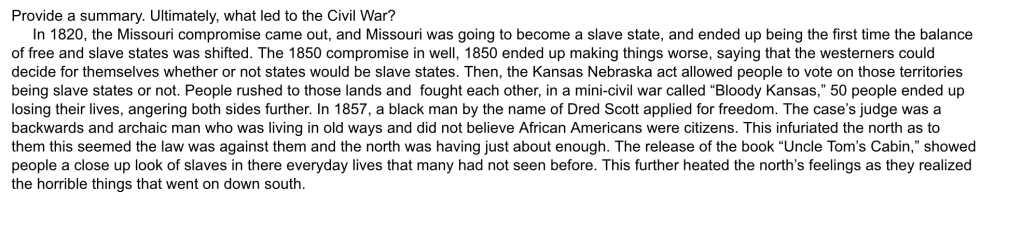
In the end, when the collaborative task was complete, and connections were made, students would use their information to respond to this prompt, “Provide a summary. Ultimately, what led to the Civil War?”
Here are some examples:


My Feedback
I personally liked the layout of the lesson. However, I would have mixed it up with more EduProtocols (I’m a protocols guy). For example, I would have added these protocols to each playlist question:
- CyberSandwich to compare the compromises – How did the issue of western expansion and the extension of slavery help spark war ?
- Thick Slide for info on one event – What did popular sovereignty and the Kansas-Nebraska Act reveal about U.S. sectionalism?
- Frayer – How did political divisions over slavery spark war?
- Iron Chef to create a slide about a chapter from Uncle Tom’s Cabin – How did the exposure of slavery lead to war?
OR run a stack:
- CyberSandwich – How did the issue of western expansion and the extension of slavery help spark war ?
- CyberSandwich – What did popular sovereignty and the Kansas-Nebraska Act reveal about U.S. sectionalism?
- CyberSandwich – How did political divisions over slavery spark war?
- CyberSandwich – How did the exposure of slavery lead to war?
I also gave feedback on question 2 with sectionalism. Many students finished the playlist not knowing what sectionalism meant. It would be good to throw it into a Fast and Curious or run a quick Frayer with it.
I also mentioned that I would drop 1 source from some of the individual tasks. It seemed overwhelming, or too much for some of the playlist. For example, either drop the Edpuzzle on the Kansas Nebraska Act or the reading.
My point with this feedback was simple – teaching and education is a constant reflective process. As Monte Syrie states, “Do. Reflect. Do Better.” I have embraced this quote and use it each day. Teaching and learning should be an ongoing reflective process class after class, day after day, year after year.

 Moler's Musings