
This week 505 continued Westbound and Down unit on Westward Expansion. My goal for this unit is for students to understand how we acquired territories in the United States, understand the concept Manifest Destiny, and understand what motivated groups of people to risk everything and travel west. These are the Ohio expectations for learning:
- Describe how the United States added to its territory through treaties and purchases. (Standard 10)
- Analyze debates over sectional issues, war with Mexico and the displacement of American Indians in relationship to westward expansion.(Standard 11)
- Describe the movement of people, products and ideas that resulted in new patterns of settlement and land use. (Standard 17)
Monday – Continuation of Traps and Treasures with a Gimkit
Tuesday – MAP testing round 3
Wednesday – MAP testing round 3
Thursday – Quizizz and Text Quest or Side Quest
Friday – Text Quest or Side Quest
Monday
Monday was a continuation of Traps and Treasures with learning about the different territories the United States acquired through purchases, treaties, and war. We had 2 rounds left to complete. A quick recap – I put different point totals and power ups in an envelope with readings about the territories. Students selected the territories at random. Then I collected and added points on the board. Surprisingly the team scores were super close.
We finished the game of traps and treasures with a chance game. Any student who thought the game was over was wrong. During the chance game students sent 1 team representative to the front of the room. Each representative had a choice: choose bananas from the Banana Blast game or select an envelope from the skull’s mouth. The risks involved:
- If a student pulled a banana and the monkey jumped on the first turn, they lost every point.
- If they pulled a banana and the monkey didn’t jump, they could lock in their point total. They could keep adding point with each subsequent banana pull.
- The skull’s mouth envelope selection could give negative points or a lot of points.
This was just a fun way to end the game. In the end, I gave each team some money for their Westward trip during our game.
After we finished the game, I began a Gimkit with questions related to the readings from Traps and Treasures. Based on the class averages, I was a bit disappointed. No class average was above 78%. I stopped to think about why…and I realized some of the students were engaged and discussing as a group while others were not. Some of the rounds were rushed and chaotic. As a result, I will get the point stuff out of the way at the beginning and then start the timer. I will also make the rounds a bit longer. Finally, I need to remind the students to stay focused, and on task during the game.
Thursday and Friday
After 2 days of MAP testing, we got back to westward expansion. I wanted to start a Text Quest which is another great lesson format from EMC2Learning. I cannot share this lesson or the files, but check out www.emc2learning.com.
Since the GimKit scores were low from Monday, I decided to go to Quizizz because I feel I get more accurate test results. Gimkit and Blooket are great for repetition of questions, however, after a while, students stop reading the questions. That’s where I step I explain why I use Blooket and Gimit and teach them the Forgetting Curve.
Before I had students take the Quizizz I explained to them what was riding on the quiz…
- An 80% or higher they could move on and join the Text Quest.
- Below an 80% they had to watch an EdPuzzle and retake the Quizizz.
As I tell all the students, “Failing is not an option in 505.” Out of 104 students, 24 students got below an 80%. The rest of the students got into their teams and we began the Text Quest.
The Text Quest began with a game called Odd One Out. I gave the students 3 pictures of territories (Mexican Cession, Louisiana Purchase, and Gadsden Purchase) and they talked with each other about which territory didn’t belong. I chose these territories to debate because there is not one right answer – only better answers. Students had 5 minutes to discuss and submit their answer through Socrative. At the end of time, I revealed the group responses, read them out loud, gave feedback and decided on 1st through 4th place. I also explained why I placed the responses the way I did. The reading and feedback are key to learning during this time. Here are some quick examples of student responses:
- “The Louisiana purchase does not belong. This is because both the Mexican Cession and the Gadsden purchase have states involved such as New Mexico and Arizona.”
- “We think that the Gadsden Purchase doesn’t belong because it was the smallest purchase brought compared to the Mexican Cession, and the Louisiana Purchase. We also think that the Gadsden Purchase doesn’t belong because the only reason that it was bought was that the land was needed to be able to finish a railroad that was being built.”
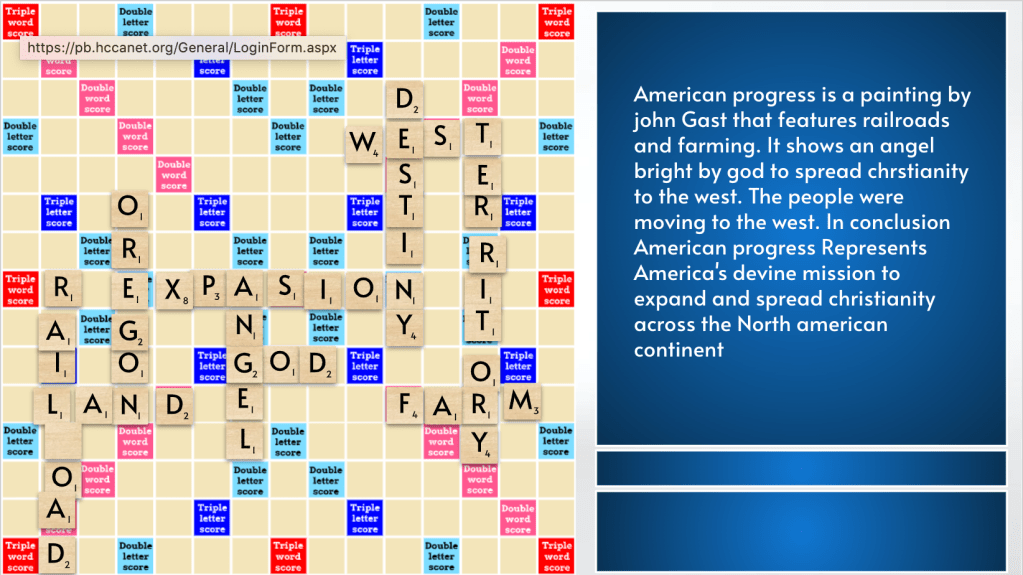
Next we moved into final piece of the Text Quest – analyzing the painting, American Progress by John Gast. I wanted to use an 8Parts to analyze it, but then I changed my mind at the last second. Instead, I used the Word Scramble from EMC2Learning (I cannot share this file). Here are the rules:
- 15 minutes – analyze the painting and work together to create as many relevant words as possible.
- Using your words, write a paragraph relating the painting to westward expansion and manifest destiny.
- There was a catch with the paragraph writing – Each person had to write a sentence. I set a timer for 45 seconds to write a sentence. Then they had to pass the chromebook. This got everyone writing and the teams were giving each other suggestions for writing. This was an awesome mix up. On the fly I decided to call it the Sentence Swing.
Here are some student examples:



Side Quests
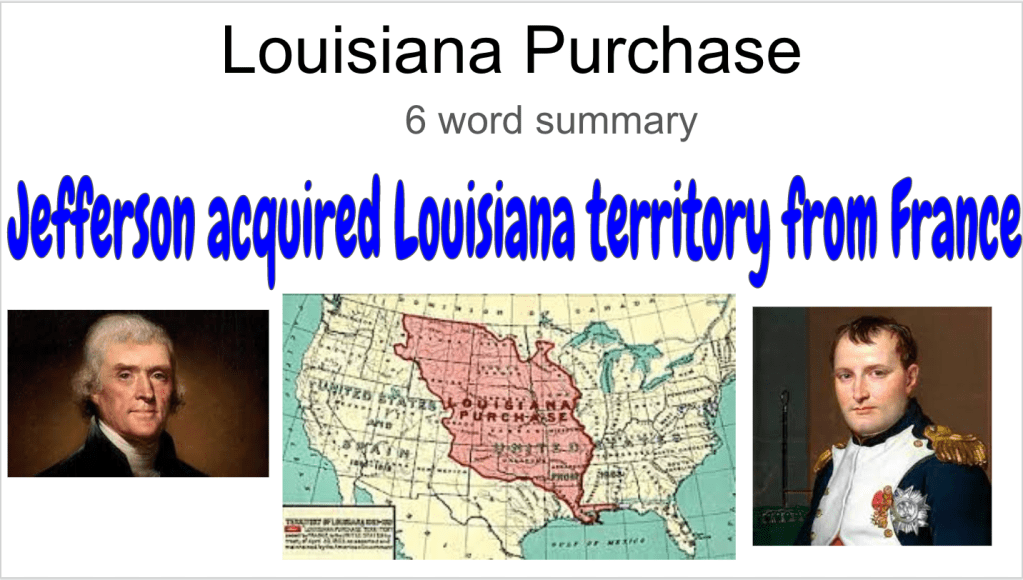
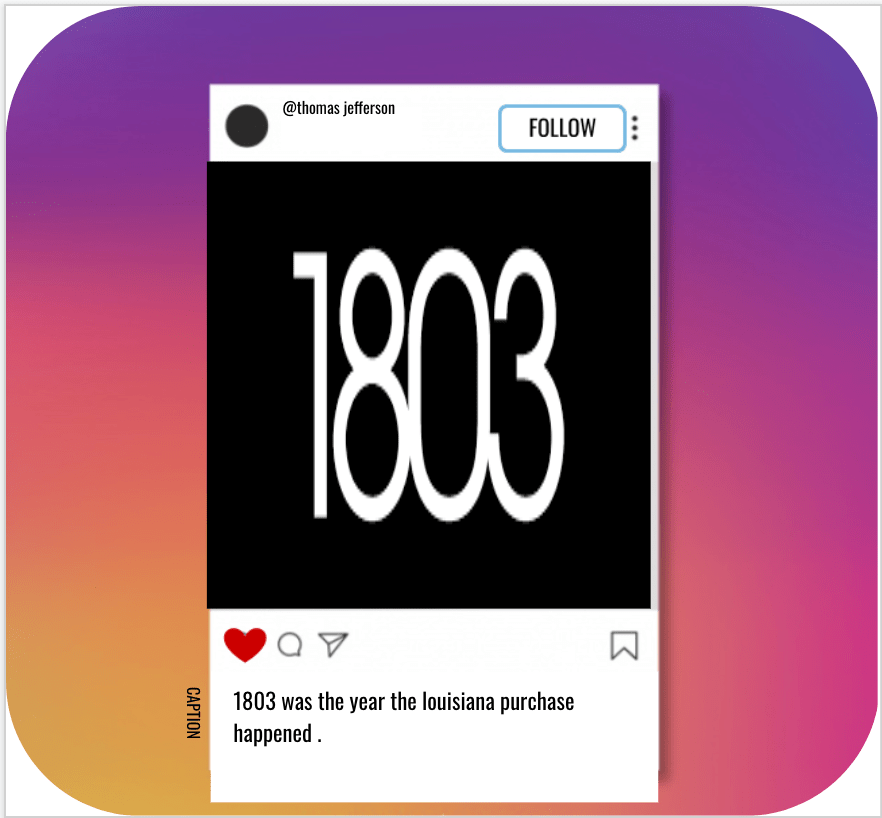
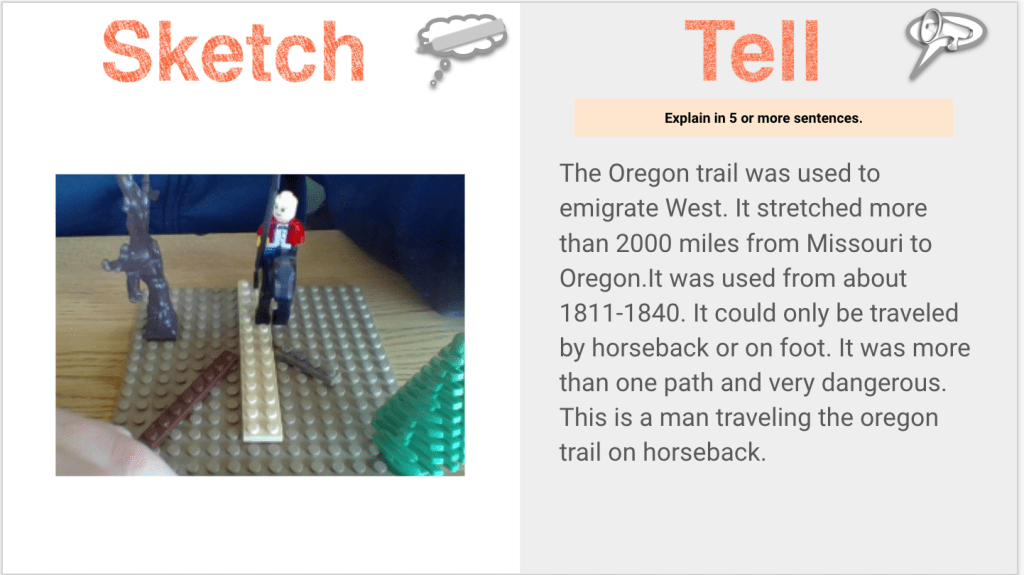
The other part to the Westward Expansion unit are Side Quests. Side Quests are a way to have students explore interests and create something, or they can use information they already learned and create something. I tried to include all different kinds of activities for Side Quests – some easy, some hard, music related projects, timeline creation projects, and I even throw in some EduProtocols (Sketch and Tell and Number Mania). The Side Quests are a way to earn extra supplies and badges.
During a Side Quest Day, students must create 1 or more Side Quests during a class. Students can even work on Side Quests at home, during learning period, or when they have extra time in class. Either way, all Side Quests are due by the end of the unit. So far, I have seen some awesome creations…



Exciting News
I’m excited to leave next Wednesday as I head out to Palm Springs, CA for Spring CUE to present with Dr. Scott Petri and Jon Corippo!


 Moler's Musings