
This week we are coming off a successful week of EduProtocols helping students organize information to write an essay. Many students liked the different ways we organized the information with a Research Protocol and Thick Slide. However, they were not fans of learning how to write an essay or actually writing an essay. We write ALL the time in my class because writing is important. However, last week was not a normal week for 505 – students are used to walking into the unknown. I try to create a different experience for everyone.
With that in mind, I needed to create a different experience with Westward Expansion. I needed something uplifting. I needed something fun. On Saturday, an idea hit me – create a gamified unit similar to an Oregon Trail like game. Saturday night, I slept on this idea and thought about it more. I needed to create a story, think of game elements to incorporate, and think of how to piece together the unit. When I plan a unit, I lay out the standards and work my way backwards…
The students need to know how the US acquired territories through purchases, wars, and treaties. The students also need to know the groups of people who went west – Mormons, 49er’s, and Oregon Pioneers. From this information, I put together the story, created a website, and Westbound and Down was born.
Here is the story I created:
The wild west. Gold. Resources. Riches. The United States keeps expanding and you want to follow suit. It’s time to pack up the family and see what the hype is all about. Oregon? California? Texas? You want to go, your family wants to go, but you must plan very carefully. You need to learn as much as you can about the territories out west – how did we acquire them and why? Your knowledge will earn you the necessary supplies to make the trip. The wagon needs to be carefully packed and supplies organized as you are about to embark on a long, treacherous journey out west!
Along with the story, I made supply badges students could earn throughout the unit. The badge creation is an ongoing process throughout the game. I like to create different twists and turns. Along with the supplies, I put together a spreadsheet to keep track of teams, money, and supplies. Here is the spreadsheet. The supplies are earned through mastery, through games, and I hid supplies around the school. For example, I took a Map badge, cut it in half and hid the halves in the school. I hid guidebooks throughout the school. However, one of the guidebooks was faulty just like the one the Donner Party had that got them lost. Here are the supplies I put together for students:
The last piece of the puzzle was creating Side Quests for students. Side Quests are ways for students to explore topics on their own, show off their creativity, and earn extra badges. Here is a Side Quest example link. I love these gamified units because they allow me to be creative. Anything goes. It build curiosity, builds teamwork, and builds motivation.
Monday – Monroe Doctrine Breakout
Tuesday – Introduced West Bound and Down, Great American Race.
Wednesday – Resource Rumble
Thursday – Traps and Treasures
Friday – Traps and Treasures
Monday
Monday was used for finishing the Monroe Doctrine essays and “breaking out” of the Monroe Doctrine into the next lesson. Around 5 years ago I created a Monroe Doctrine Breakout that used political cartoons. Students had to solve the locks by using my clues and using the political cartoons. I created a website to go along with this as well.
I gave students 30 minutes to work through the breakout which then led them to an empty locker in the school. My final clue stated, “You successfully completed the breakout! BUT…..there’s more to thee. The winning decided by whatever’s behind locker door 503.” Students had to find locker 503, open it, and inside was an introduction to the next unit.
The next unit introduction was an ABC chart where students had to list as many relevant words as possible related to westward expansion. As the clock was winding down, students turned in their ABC charts and I left the class with this, “The team with the most relevant words will gain an advantage in tomorrow’s class.”
This type of line leaves them with excitement and intrigue for the next day.
Tuesday
I began Tuesday and our new unit with the Great American Race EduProtocol. The advantage winning teams got from the previous class was 1 free answer with the Great American Race.
“This sounds easy. All we have to do is Google stuff?” – This is usually the quote when I explain the first Great American Race EduProtocol rep. Fast forward to our third rep of the year and the students are asking this question, “Can we have a word bank?” Students quickly learn there’s more to creating clues and researching answers with Google.
My first class I ran a Quizizz, ran a Great American Race, and then a Quizizz again. Here are the Great American Race instructions if you are familiar:
- Create an index card with a number on one side and a vocab term on the other side.
- The vocab term is the “answer” and instruct students to keep it a secret.
- Students had 10 minutes to design their own slide – add the card number to the slide, add clues for the vocab term, and a picture.
- To determine the amount of clues to add to the slide, I make it interesting and have 1 student roll a dice.
- As students work, I copy their slides, in order, to a large slide deck.
- I give feedback as they do this.
- Then students have the rest of time to figure out the answer for each slide. I give each students (sometimes each group) 1 paper with answer blanks.
Here are the Great American Race slides:
That’s it. The Great American race. In my opinion, though, my first period setup didn’t produce desirable results. Something needed to change. I opened up Explore Like a Pirate by Michael Matera and began the next class with some Graffiti.
Graffiti
Students walked into the classroom and saw textbooks laying on the desks. “What are these Mr. Moler?” “We haven’t used a textbook all year! I don’t like this.” I quickly correct the student(s), “We have used the textbook all year, you just didn’t realize it.”
I instructed the students to look at pages 276-315 – skim and preview. I had them find words they thought were important to understanding Westward Expansion. If students found a word, they had to raise their hand and I had to call on them to go. There were 2 catches:
- They couldn’t write the same words or phrases on the board.
- I added a “magic word” – a secret word that could instantly win the person who wrote it some money for their group. (Think of it like the secret word from Pee Wee’s PlayHouse show). The secret word was “Manifest Destiny” and every class had 1 student that wrote it.
Students had 6 minutes to skim and add words to the board. When we were finished, I summarized the information on the board and surprisingly, students listed 90% of the words I had on the Great American Race Cards. I took a picture of each board and added it to the picture to the Great American Race assignment as a word bank. THIS. WAS. AN. AWESOME. ADDITION. TO. GREAT. AMERICAN. RACE!!! Here are the boards:
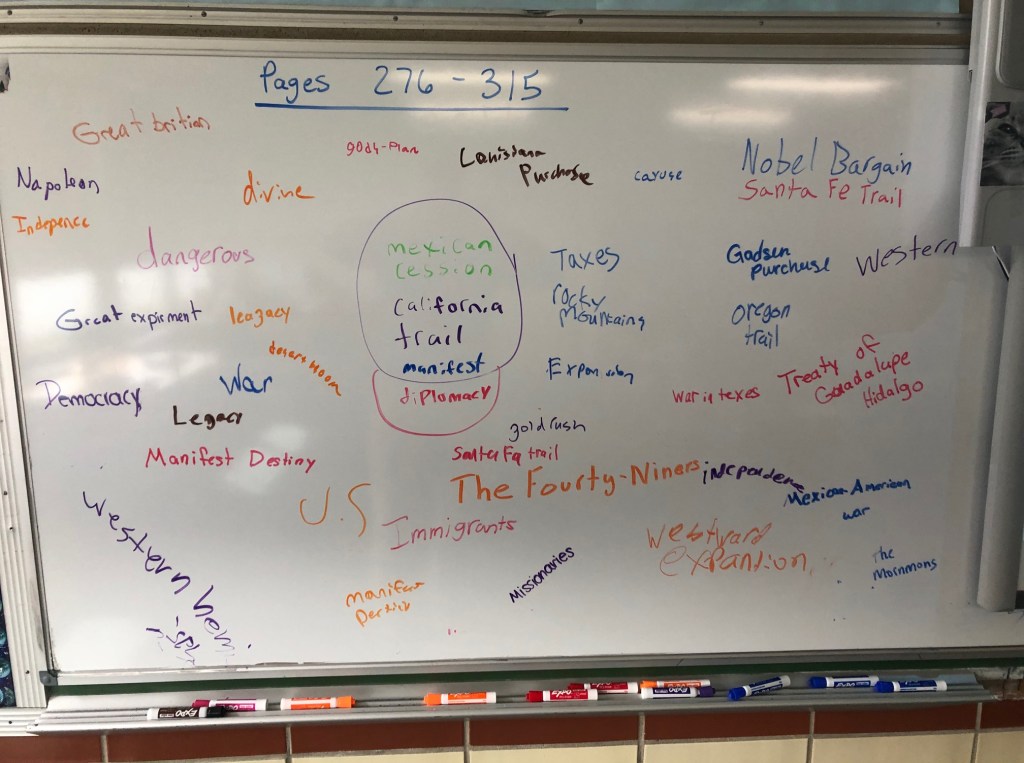
This was such a fun element to add to the Great American Race. Students wanted a word bank and so they created their own and fun doing it. The Great American Race results were much better with a word bank and the eneggament was tons better as well. Unfortunately, I didn’t have time a for a Quizizz.
Wednesday
Following the Great American Race was a Resource Rumble. I cannot share the slides because they are located on EMC2Learning. I wanted a way for students to learn vocabulary words related to the Great American Race from Tuesday’s class. I took the 8 most important words and put them into 8 different treasure chests, and taped them to my board. Teams had 35 minutes to complete a TIP Chart and collect Legos to win supplies for their western trip.
A TIP Chart is a vocabulary strategy that stands for Term, Information, and Picture. My TIP Chart is located here. The TIP Chart is a good vocabulary strategy to use it as an organizer and the picture element involves dual coding which helps students retain words and information (Think Sketch and Tell). Students worked together in teams to write down a term, they paraphrased a definition, and drew a picture (It was like a Parafly and Sketch and Tell combined). Before a team could roll dice and earn legos, they had to bring up their charts, say the term out loud and read their definition. I was amazed at how many students had trouble pronouncing words like: cession, annex, and diplomacy. Once approved, teams rolled dice and collected legos.
Near the end of time, students had to build a Lego creation related to a vocabulary word. I told them I should be able to look at the creation and guess the word. This helped the thought process and quality of Lego construction. All in all, this was a blast and the Resource Rumble is a hit.
Thursday and Friday
With vocabulary knowledge built up a bit, next we moved into learning how the United States obtained some of its territories. I wanted to try Traps and Treasures. I cannot share this file as it is on EMC2Learning.
To make Traps and Treasures happen, I collected sections from the Textbook and made copies – Louisiana, Florida, Texas, Oregon, and the Mexican Cession. Then I put together a Main Idea organizer to pair with the readings. My idea was that students would work in their teams, read for 10 minutes, take 5 minutes to discuss their notes, and take 5 minutes to write a paragraph. Most groups/students rose to the challenge and did a great job organizing a paragraph. However, this would take a lot of time. I changed this to a basic read and comprehend on Friday to make it go quicker.
When students came into the room, I had a map of the United States drawn on the whiteboard. Students got into their groups and got ready for the day. I took the readings from the Textbook and placed them in a large envelope. Then inside the large envelope was a smaller envelope which had a trap or treasure. The trap or treasure would give or take away points for each team. I also included some of the Power Up options into some of the envelopes. With each round, the points and power ups were changed to keep things interesting.
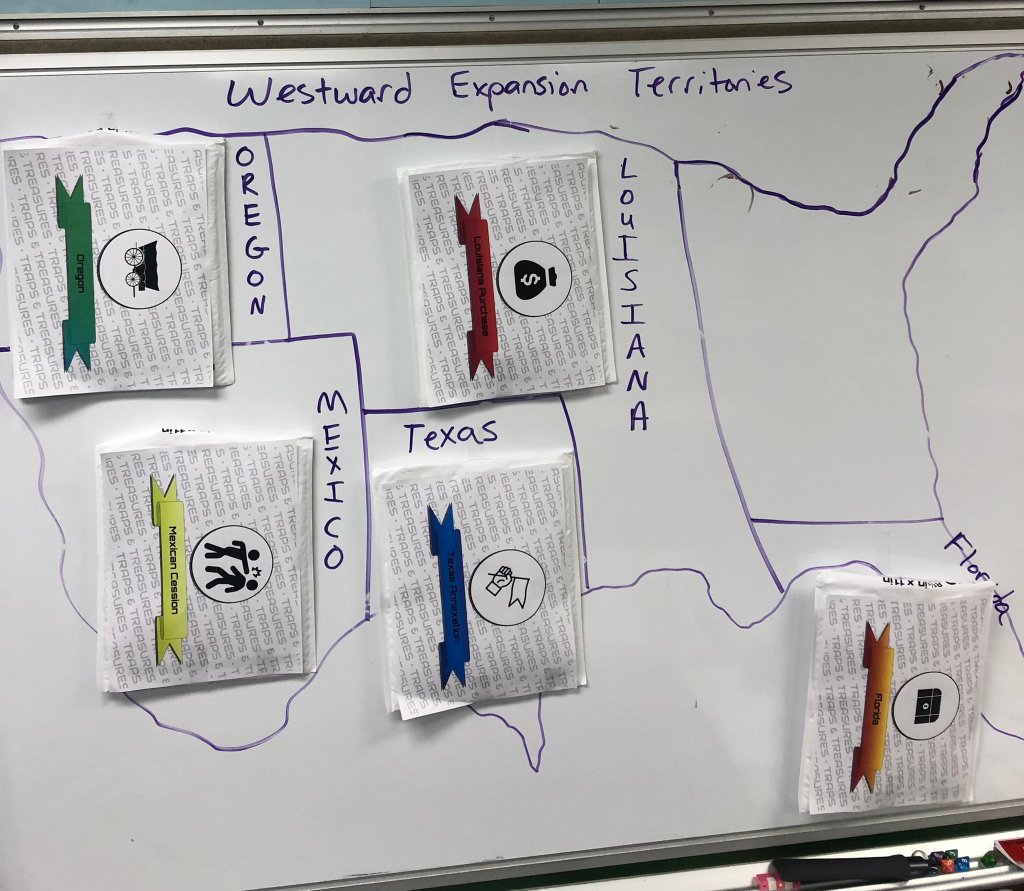
At the end of the class period, I threw in a twist. Each team had an option to add more points or lose them. I went to Walmart and purchased the game Banana Blast. Each team had a chance to go up to the monkey and pull a banana. If they pulled one banana, they solidified their team score for the day. If the monkey popped up ON the first pull, they lost ALL of their points. If the monkey popped up AFTER the first pull, the team lost the extra points they earned. Students could choose to stop pulling bananas at any moment. This was a simple way to add a new element to the game. At the end of both days we used a Gimkit to review information.
We are going to finish Traps and Treasures on Monday.

 Moler's Musings