
It was a decent Winter break and I returned to a teacher workday on Monday followed by students returning on Tuesday. I will fully admit right now – I was not prepared for Tuesday. However, I began a new unit.
The new unit I was starting is simply called, “The New Republic.” Despite my unpreparedness, I thought about this unit all winter break. I am my own worst enemy sometimes – I think too much. My ultimate goal is to create the best possible lesson I can for all students. As a result, I think of one way to teach a lesson, then I think of another, then I see another idea. Ultimately, I go down a rabbit hole of lesson planning and have nothing ready to go. Despite this, I do have a lot of resources I have collected over the years and I decided to fall back on a unit I created 5 years ago.
Five years ago I wanted to recreate how students learned about the first 5 presidents and the new republic. Rather than a typical president by president unit, I wanted something more engaging, something better. As a result, the Quest was born.
In short, the New Republic Quest is made up of 6 quests (not lessons). The first quest has students learning about the Federalists and Democratic-Republican parties. When the quest concludes, students design and create a character that belongs to one of these political parties. After students design a character, they blog from that characters perspective and create a backstory. Quests 2 through 6 have students using their character’s political party beliefs as they create a blog and critique decisions from the following presidents:
- George Washington – Whiskey Rebellion response
- John Adams – Alien and Sedition Acts
- Thomas Jefferson – Louisiana Purchase
- James Madison – War of 1812
- James Monroe – Monroe Doctrine
For example, if a student chose their character to be a Federalist they might say Jefferson’s Louisiana Territory Purchase makes him hypocritical as a strict constructionist. They also might say it weakens the national government because the United States is too big. Whereas, a student whose character is a Democratic-Republican would praise Jefferson’s Louisiana Territory purchase.
I love this unit and the creativity that can be used and adapted to the individual quests (lessons). You can build Eduprotocols or resources from Emc2Learning into each quest. This entire unit I described is located here.
Monday – teacher workday
Tuesday – Introduction to the New Republic Unit and Splashed Vocabulary
Wednesday – Choice Board
Thursday – Choice Board and Character Creation
Friday – Snow Day!!!
Tuesday
Tuesday I came in unprepared, but with Eduprotocols, lesson planning is a bit easy. To begin the unit on the New Republic, students listen to 2 songs – “Hail Columbia” and “Fair and Free Elections.” Students listened to these 2 songs and completed a Thin Slide – 1 picture and 1 word to reflect the mood of each song. Then I had students share what they thought changed in an 11 year period between the songs (1789-1800). Here is an example.
Following our Thin Slide, we switched to a splashed vocabulary activity. What this means is vocabulary words are “splashed” around a paper (slides, doc). The first step is having students pair up and look for words they might know. Take 5 minutes and have students predict what some of the words might mean. The second step in the process is having students drawing lines between vocabulary words they think are connected. This is followed by a class discussion. After the splashed vocabulary, I had students Frayer the words Democratic Republican and Federalist to help us transition to our first Quest with the new unit.
Wednesday and Thursday
Wednesday I was better prepared to begin Quest 1 – Join the Party. This quest had students comparing the Federalists to Democratic Republicans (Hamilton vs. Jefferson). In past years, I had a couple of lessons put together which were good, but I’m always searching for better.
My focus this year is on differentiating more and better organizing my units. To stay with this focus, I created a choice board for this unit. The choice board can be found here. When I make these choice boards, I just don’t think of random activities and throw them anywhere on the board. I sit and think about which activities meet the needs of different student processing tendencies to place in a row. The activities in the choice board include:
- Concept sort – hands on, manipulatives
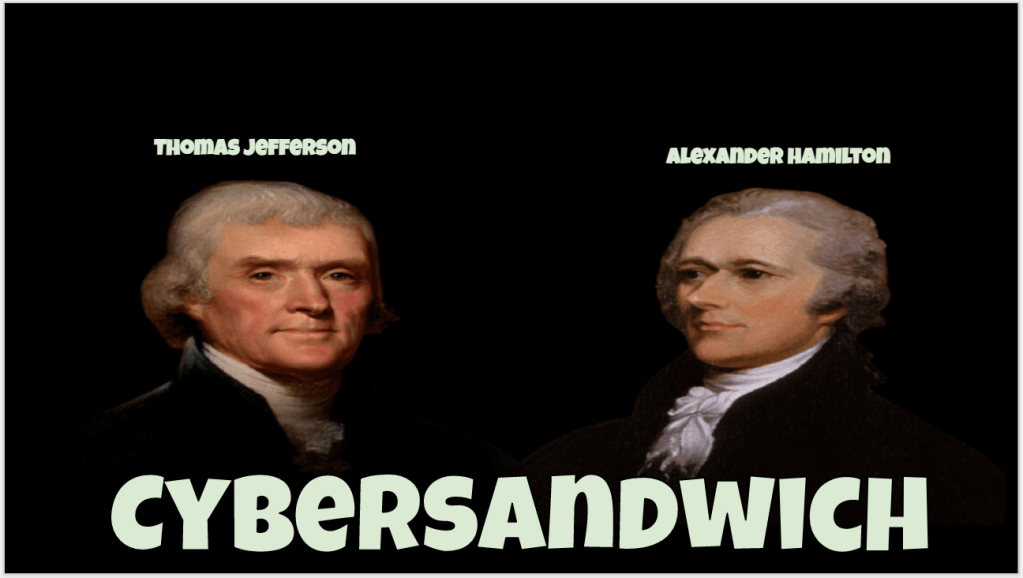
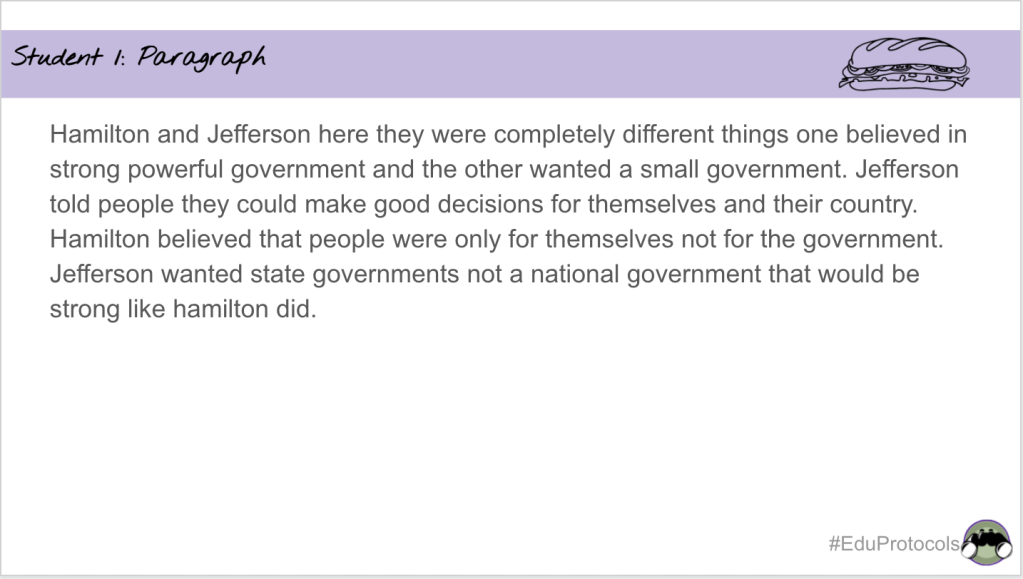
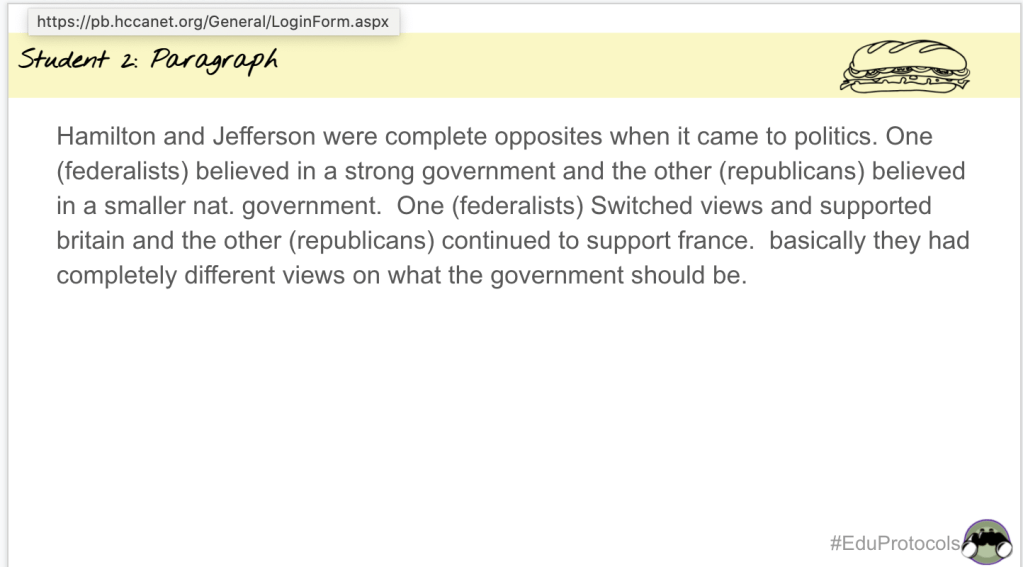
- CyberSandwich – a great Eduprotocol that allows students to work with each other and discuss the content.
- EdPuzzle video with 3 different note taking strategies (venn diagram, sketchnotes, or bubble map).
- Textbook – Read 2 sections and answer the questions for students who need more structure.
- Frayer model – Frayer a historical figure based on a video about Democratic Republicans and Federalists.
- Primary Sources – read 2 letters from Jefferson and Hamilton to get a sense of the differences between these two men.
- Fast and Curious – Quizizz that students can take up to 3 times.
- PearDeck – students paced Peardeck where students analyze Cabinet Battle #1 from the musical Hamilton.
Here are some student examples from the choice board:




Character Creation
After the choice board completion, students create their character. Some students reached this point in the lesson, while others had 1 activity left to complete from the choice board. In the past I would create a graphic organizer for students to create their character. However, I found the perfect activity from Emc2Learning for this – The Hero Builder.
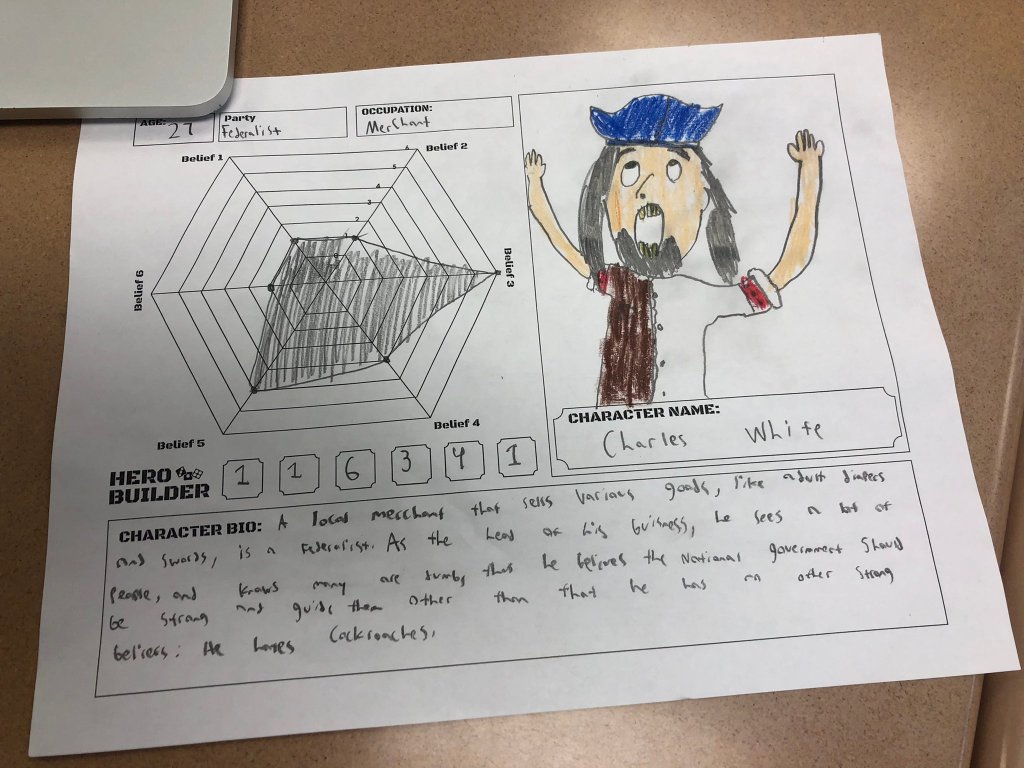
To keep this short and simple – students got a Hero Builder paper. They decided their characters age, name, occupation, and political party. Then students wrote their beliefs around a web graph. The goal was for students to refer to their notes when writing out their beliefs. Then students rolled a 6 sided dice six times – 4-6 meant strong belief with a 1-3 a weaker belief. Students had to decide which numbers to apply to their beliefs. I tried to make the point that not all Republicans and Democrats carry the same beliefs. For example, not all republicans support the 2nd amendment. Not all democrats support the right to choose.
All in all, this Hero Builder was much more engaging and the students loved creating their character this way. Students were looking up common jobs from the late 1700’s, and common names from the late 1700’s and 1800’s. The creativity was awesome and can be endless with the Hero Builder and this New Republic Quest unit. Here is one students example from Thursday:

The next step in this quest is writing a blog. Students will create a Google Site and blog from their character’s perspective. I also added 2 more options this year – creating a Facebook profile or writing a Yelp review from their characters perspective. These options fall in line with my focus this year – improving my lessons with more differentiation for students.

 Moler's Musings
Love this idea of a multi-lesson quest. I’ll use it as a sort of template for my Great Depression unit coming up. I am struggling right now, though, engaging students when most of my work is digital but they are in-person – any tips for motivating and encouraging kids when so much of class uses technology? I just feel like we’re all lost in our screens.
LikeLike
The best way to engage students (in my opinion) –
1. Have clear learning goals
2. Provide choice – yes, we get lost in our screens. Offer different paths to student learning. For example, if your class is learning about the New Deal – offer an edpuzzle video choice, listening to a podcast and sketchnoting, a gallery walk with an organizer. Then you hit on the students who want some tech, the creative students who want to draw, or students who want to get up and move.
3. Find more ways to incorporate some paper – for example, I sometimes have students do cybersandwiches completely on paper.
LikeLike