This week we began our 4th Unit, and my favorite, The Constitution. I love government, how governments function, and the Constitution. It reminds me of 7th and 8th grade year when I wanted to be a lawyer and a politician. I’ll never forget one Halloween my costume was a “Young Republican.” My goodness how times have changed.
The first thing I always mention to the students is this – “We will be discussing government with many abstract ideas. You will hear a lot of terms and phrases that are not used in everyday conversations. For example, you don’t say to someone – ‘Hey! how about those checks and balances!'” As a result, I try to make the Constitution unit hands on and as much fun as possible.
Throughout this unit, I like to focus on 6 principles of government in the Constitution:
- Popular Sovereignty
- Federalism
- Separation of Powers
- Checks and Balances
- Individual Rights
- Judicial Review
Throughout the unit, we focus on how these principles limit the power of government. Before I begin with principle, I give a Citizenship Test and ask 20 questions. Then I like to begin with the principles with Popular Sovereignty as it’s the basis of a democracy and found in the first 3 words of the Constitution – “We the people.” From there I let the students decide what to study next. However, I keep the Separation of Powers together with Checks and Balances. I also keep Individual Rights together with Judicial Review.
Monday – Citizenship Test – 20 questions
Tuesday – Parts of the Constitution (Resource Rumble or Choice Board)
Wednesday – Vocabulary Self-Assessment
Thursday – Popular Sovereignty (Fast and Curious, CyberSandwich with Sketch and Tell)
Friday – Bill of Rights (Mnemonic Device with Sketch Notes)
Monday
To begin the Constitution unit, I always ask questions from the U.S. Citizenship and Immigration Services civics test study guide. I verbally ask 20 questions related to our unit from the study guide and students write their responses. The goal is get 12 out of 20 correct (60%) – the same percentage required with the real citizenship test. After I ask the questions, I read the answers and students mark their tests. I usually have 2-3 students reach the required 60%, but the scores are usually not good. This year was no different – I had 3 students reach the 60%. At the conclusion of the test, I had students submit their correct number of responses through a Google Form and I calculated the class average. Here are those class averages: 24%, 20%, 24%, 30%, 26%.
Are the students frustrated? Yes. But, I remind them that it’s okay to not know things because we will learn them. I also remind them that everyone will reach the 60% (or higher) mark when we take the same citizenship test again at the end of the unit.
Tuesday
Before diving into the principles of the government and the Constitution, I feel it’s important for students to understand the Preamble and the Articles. I like to keep it simple and just have students focus on the Preamble and Articles 1, 2, and 3. These sections of the Constitution relate to the principles we will eventually discuss.
Teaching the sections of the Constitution is not exciting. However, I’m always thinking of ways to engage the students. I wanted to offer 2 options for students to earn the sections of the Constitution – a Resource Rumble or a Choice Board.
I cannot share the Resource Rumble because it’s a file on Emc2Learning. This is one of my favorite activities as it gets students up and moving and competing as they are learning. In short, I tape up 8 treasure chests around the room with questions with questions related to the sections of the Constitution. I paired this with a lesson from ICivics called, Anatomy of the Constitution. Students had 35 minutes to complete as many treasure chests as possible. After they completed the a chest, I would approve their answer which granted them access to roll dice and choose a specific number of legos from a bin. Students used their legos to build something related to the Constitution. When time was up, I had students explain how their Lego creation related to the Constitution and this is how I chose a winner. It’s a student favorite.
What about the students that weren’t feeling social or competitive? I had a choice board ready to go. This choice board contained the same ICivics reading and a video option. I also gave 3 types of graphic organizers with it – sketchnotes, Frayer model, or a bubble map. Finally, students had a choice of showing what they learned by creating a digital poster or a bento Box. The options available with this choice board helped with student engagement.
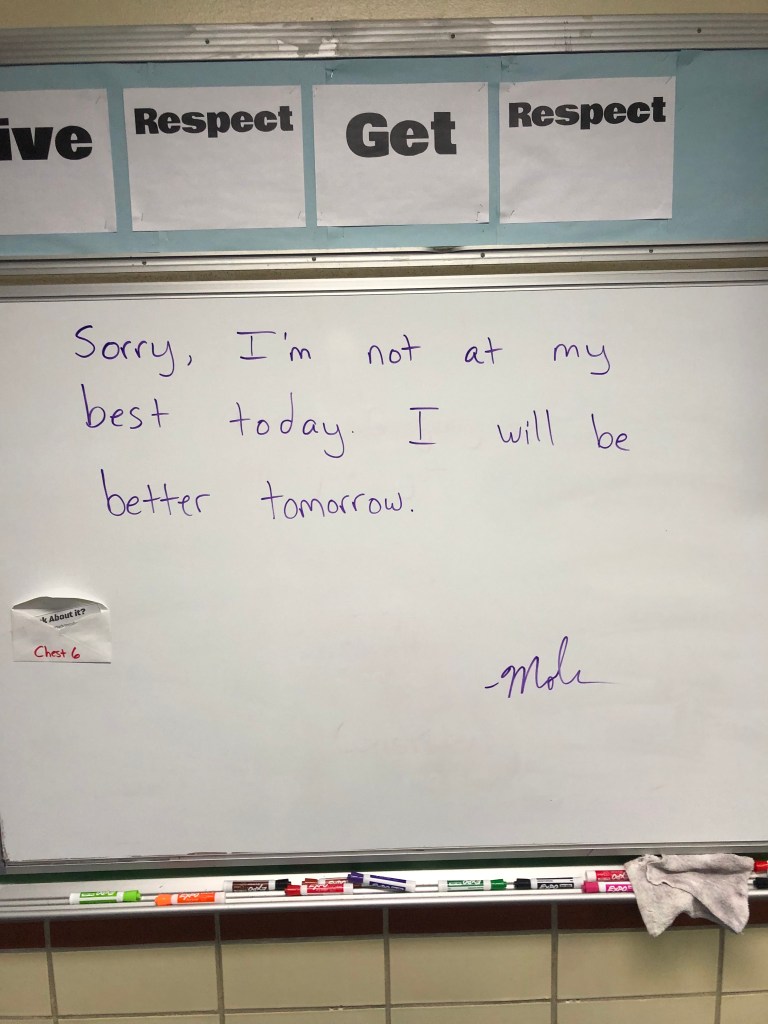
All in all this was an awesome day for me as all students had something they wanted to do – compete as a team and learn or be alone and learn. It worked out great as I noticed some students weren’t having the best of days – it’s middle school you know!
Wednesday
Wednesdays we run a 1 hour delay schedule so classes are 5-6 minutes shorter than normal. This was a perfect day to do a vocabulary self-assessment. I like to use vocabulary assignments we often refer back to where students create their own definitions based on their learning.
The vocabulary self-assessment, that I have linked at the top of this post, has all of our important words for the unit. I have students review the words and assess their knowledge of the words based on these 3 options:
- Know it – if students know a vocabulary word they should be able to write a definition, in their own words, in 10 seconds or less.
- Not sure – students have seen the word but they are unable to put a definition into words.
- Don’t Know it – students have never seen the word at all.
Students are genuinely honest when we do this exercise. After 5-10 minutes, I go through each word and take a survey. I do this to clear up any misconceptions. For example, I discovered that many students confused Federalism with Federalist. I also discovered that many students thought Checks and Balances dealt with money and balancing checkbooks. Nevertheless, this self assessment tool is a great way to begin a unit.
After this vocabulary activity, I wanted students to build background knowledge for the popular sovereignty CyberSandwich. I put together a quick activity called Keyword Predictor. To learn more about the Keyword Predictor, please visit this blog post I recently wrote.
Thursday
Thursday brought one of my favorite Eduprotocol smashes – a fast and curious Quizizz paired with a CyberSandwich followed up with one more rep of a fast and curious Quizizz. Popular Sovereignty is a hard concept for a students to understand, and here are the learning goals I posted:
- I can define popular sovereignty
- I can create a representation of popular sovereignty.
- I can explain how popular sovereignty limits the power of government.
- I can identify an example of popular sovereignty in a founding document (Constitution or Declaration).
The Quizizz I constructed had questions that focused on these I can statements. Everything I do is intentional – this is important for every class. Design lessons intentionally. When I ran the Quizizz for the first time the class averages were as follows: 53%, 56%, 64%, 69%, and 55%. The last 3 percentages are classes where they did the Keyword Prediction.
Next we went into a CyberSandwich combined with a Sketch and Tell. Students read an article from Annenberg Classroom – Popular Sovereignty. I really like this article because it covers all of the I Can statements listed above. A differentiation strategy I used with this article is I copied and pasted it to a Google Doc and added subheadings to create more organization and structure. Students read and took notes for 10 minutes, they completed a 5 minute discussion, and then completed a Sketch and Tell for the summary.
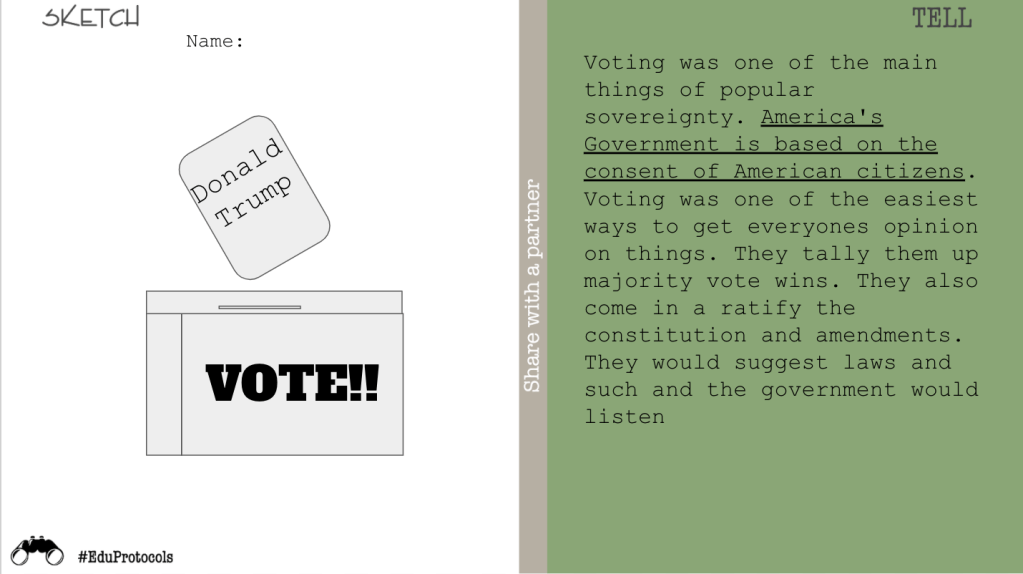
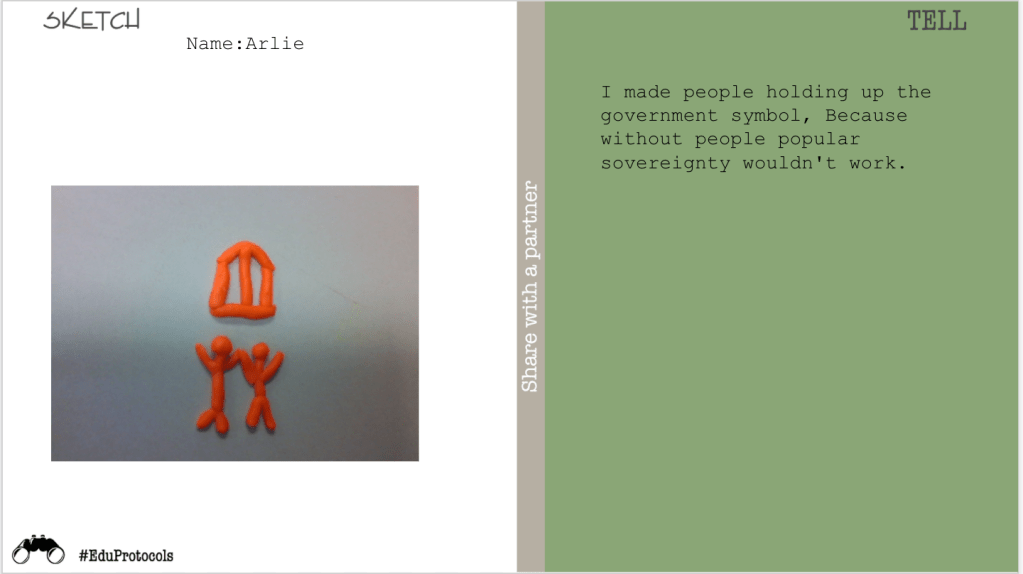
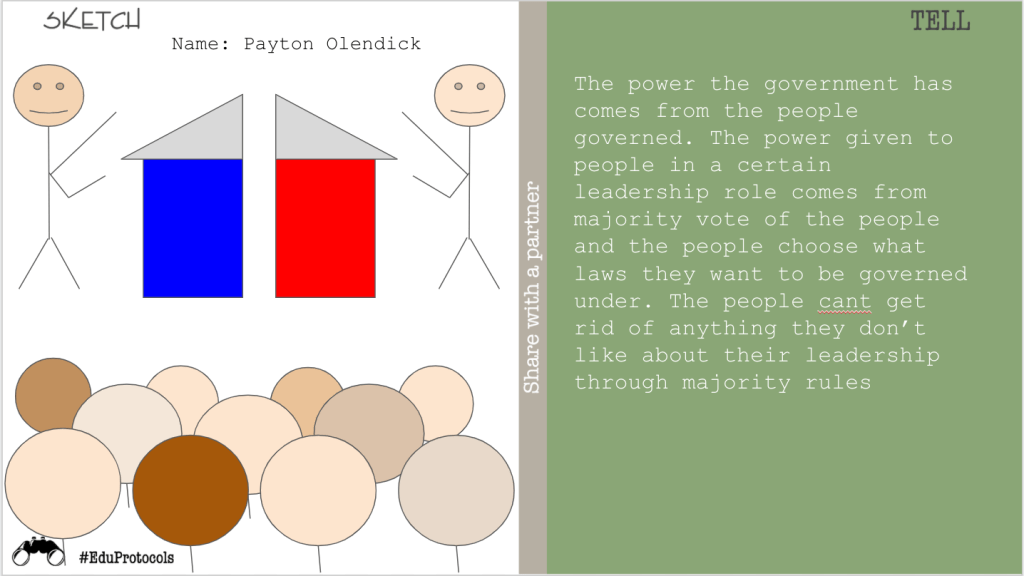
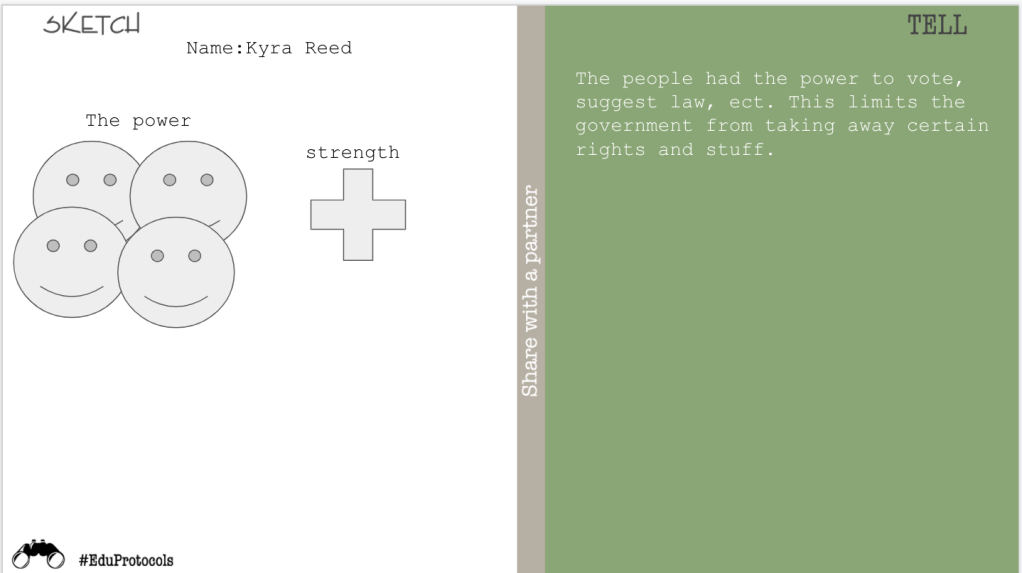
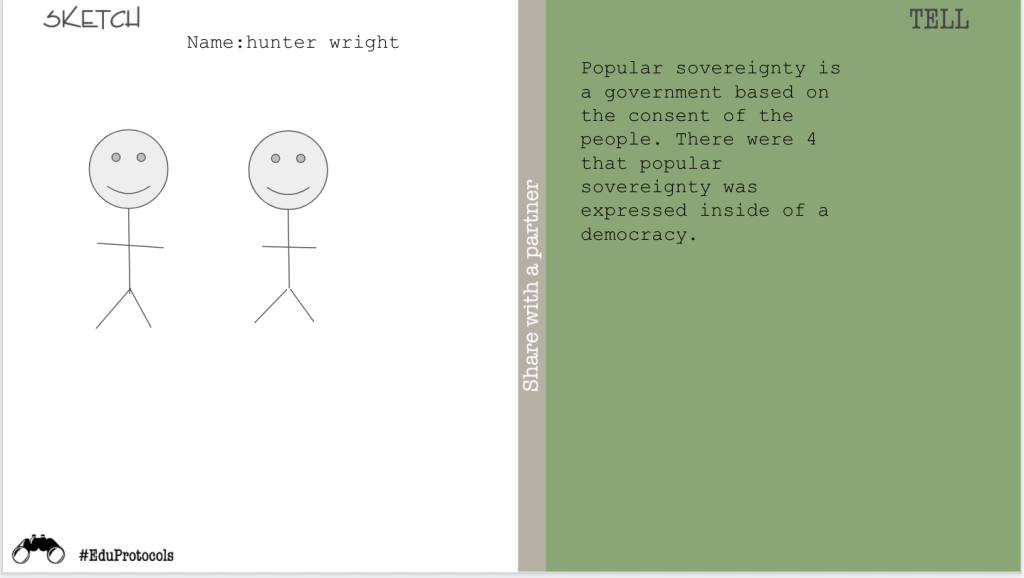
I like to use Sketch and Tell for some of these government concepts because students take the abstract and explain it with more concrete sentences. Students could use Legos, PlayDoh, or Google Shapes for their popular sovereignty creation. Here are some examples of students sketch and tells for popular sovereignty:
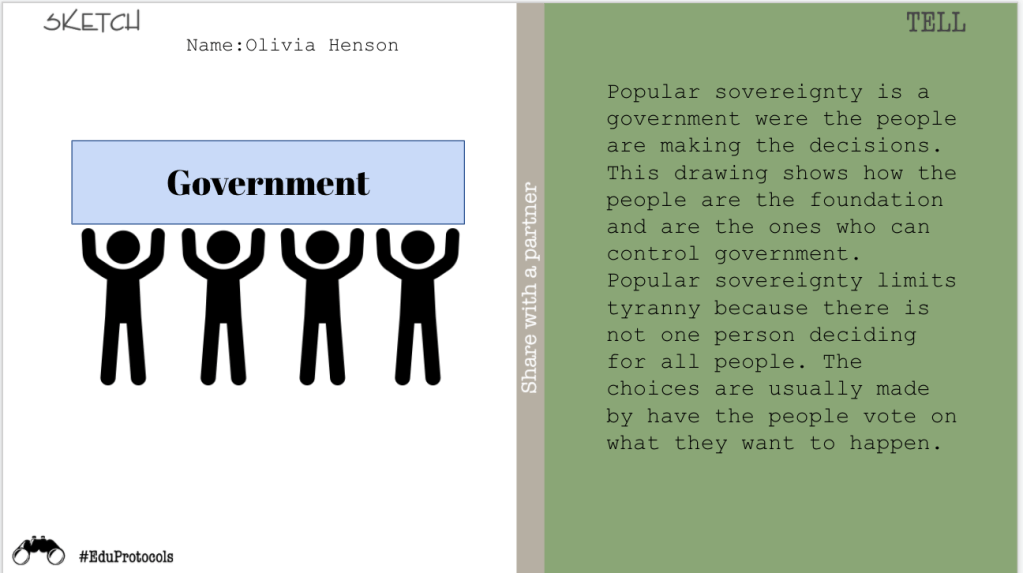
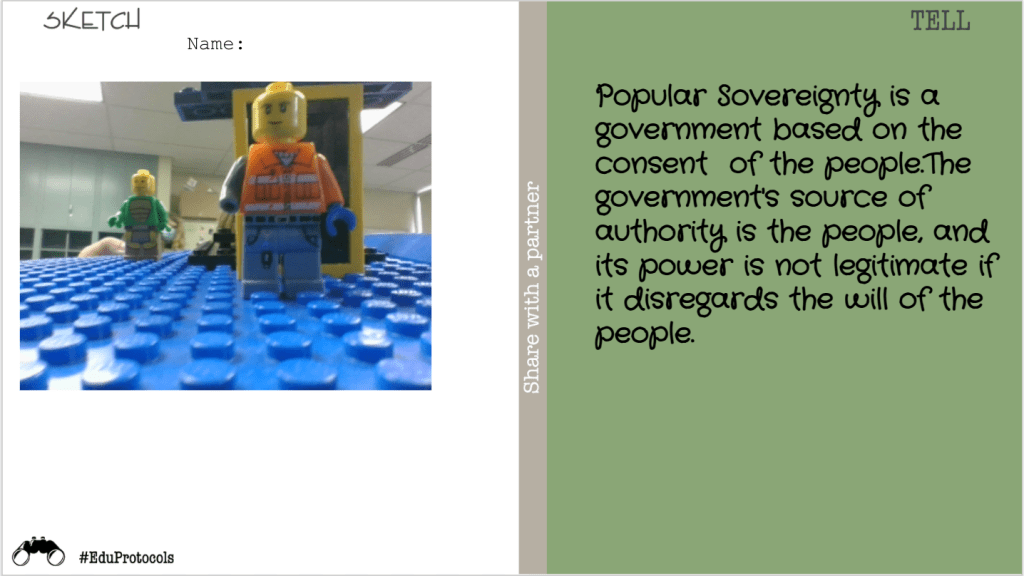
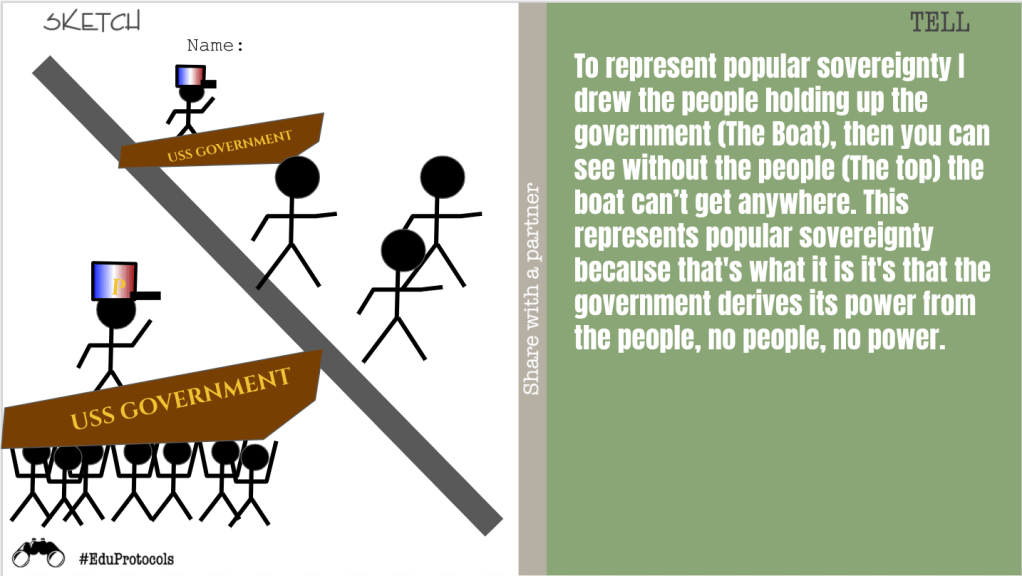
After 15-20 minutes, we took the Quizizz again and raised out scores across all classes. The class averages were: 86%, 80%, 87%, 91%, 75%. Here is a picture from the board:
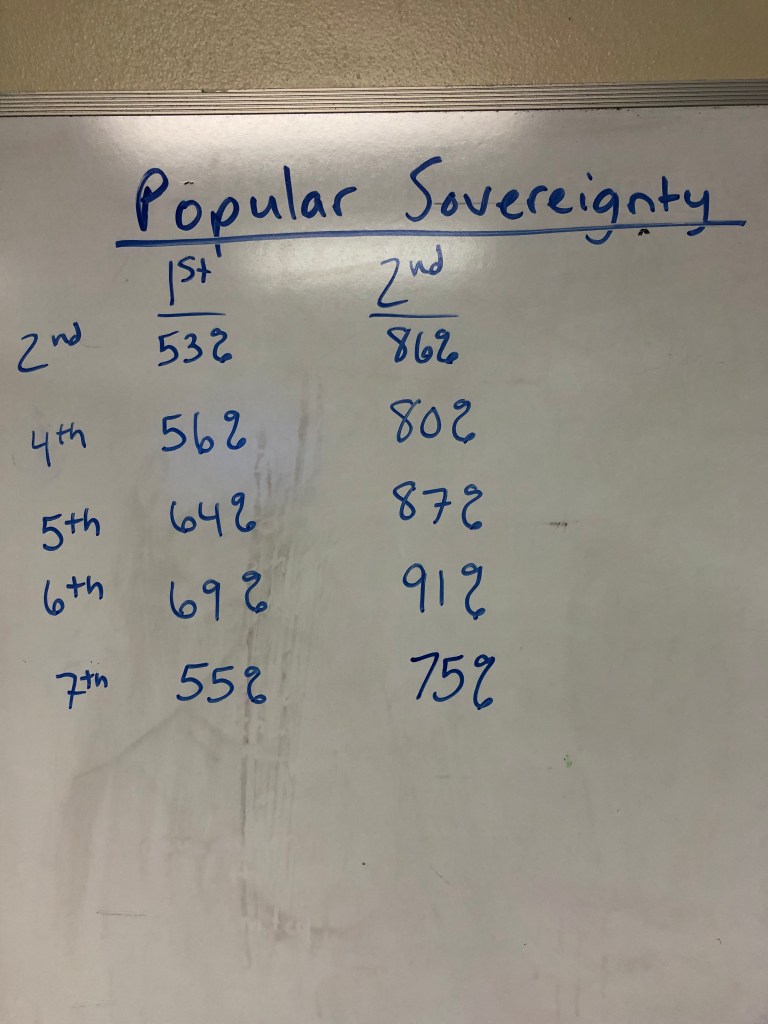
The class with a 75% average, I cut out the discussion piece from the CyberSandwich. I learned from that the discussion is piece is important Even if students discuss for 30-60 seconds, it’s important.
Friday
At the end of class on Thursday I let students vote, through Mentimeter which lesson they wanted to learn next. They chose my favorite lesson – The Bill of Rights. During this lesson I use a Mnemonic device to help students remember all 10 amendments and it’s pretty successful. I took some ideas from Dave Burgess and I added in some of my own mnemonic devices. Here is my presentation I share.
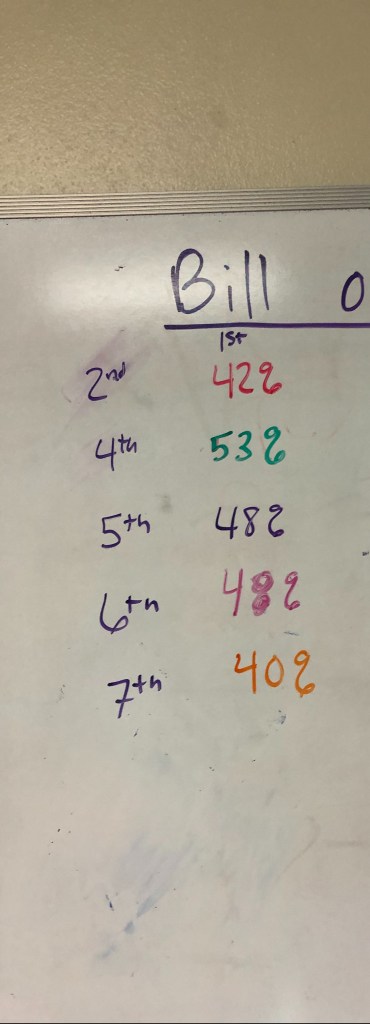
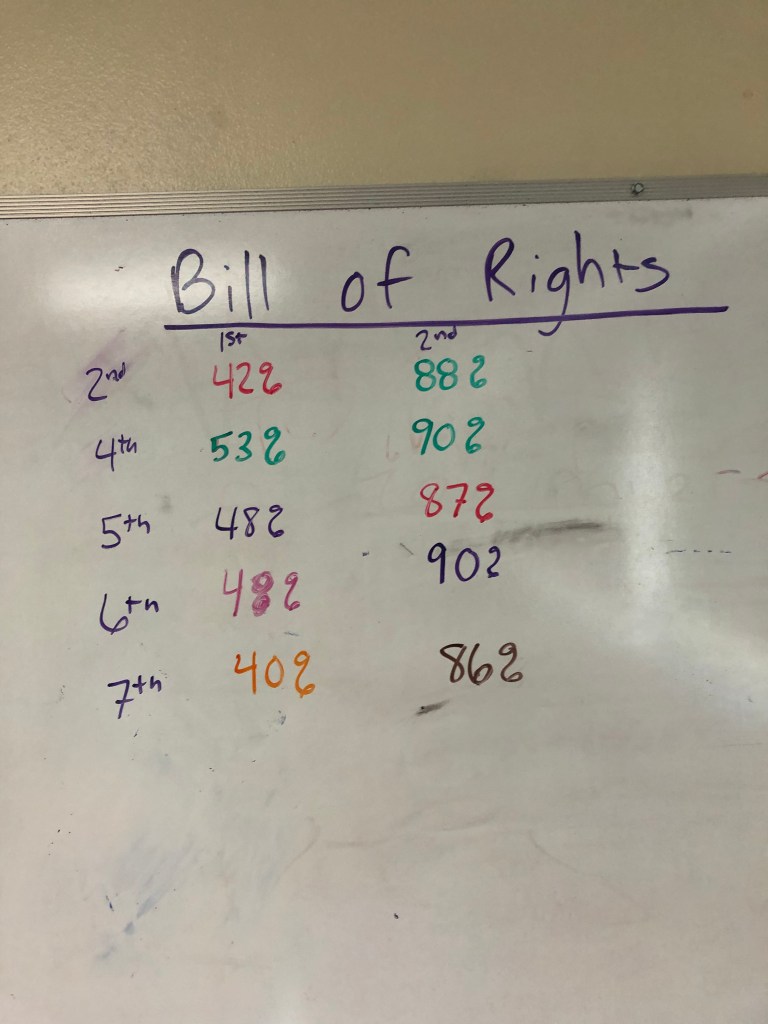
I post the I can statement, “I can identify all 10 amendments that make up the Bill of Rights.” Then I start off class with a Quizizz over the 10 amendments. Students usually get the first 2 amendments and it goes downhill from there as you can see:
I then act out all 10 amendments. It gets crazy. It gets goofy. But students are engaged as they are sketchnoting through the whole presentation. Then we take the Quizizz again and here are the results:
On Fridays I always do a Friday check in and ask how the students are doing. I also ask random questions – intentionally. This week I asked, “Write about a snowman.” They thought it was a weird question, but here are 2 examples of responses I got:
- They are made of snow, tall, have a carrot nose, sticks as arms, buttons, and are cold.
- A snowman was lost in the woods. He had been lost for years and years and couldn’t find his way out of the thick forest, until he met another snowman. The other snowman led him out of the forest so he wouldn’t be so lost anymore.
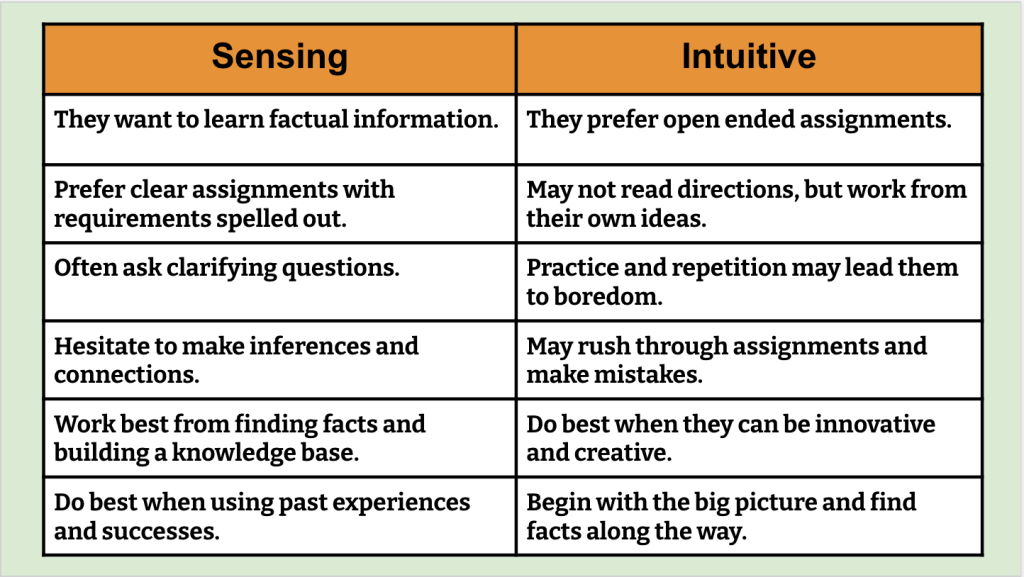
You will have 2 kinds of students – Sensing students who are to the point. Intuitive students who go the creative route. Next time you start to feel like students aren’t listening to directions, or you “told them 3 times,” REMEMBER, perhaps they are listening but it’s wherever their mind goes first that may take them another direction. We all think differently. This chart is why I asked students to write about a snowman:
My 505 Class Messages

 Moler's Musings