This week was a continuation of Unit 3 – The Constitutional Convention. The compelling question for the unit is: Should the Constitutional Convention be considered a success? The supporting questions for this week were:
- What was the purpose of the Constitutional Convention?
- What was the argument over representation for the states?
- What were compromises over slavery?
Last year when I did this unit, I had everything set up for virtual learning. The stuff I created looked appealing, looked engaging, but it was just okay. Those lessons can be found here. I easily could have said, “Here you go,” and assigned the lessons but that’s a recipe for disaster. These lessons needed something more, so I separated out the main parts of lessons and used some EduProtocols.
Monday – Purpose of the Convention – fast and curious with a Cyber Sandwich and Frayer
Tuesday – The Great Compromise – a fast and curious with a Thin Slide and Sketch and Tell
Wednesday – The Great Compromise – Sketch and Tell and Frayer
Thursday – Veteran’s Day Lesson
Friday – Compromises over Slavery – classes decided how they wanted to learn
Monday
Now that the Articles of Confederation concluded after a weird scheduling week, it was time to begin the Purpose of the Constitutional Convention. The supporting question with this lesson was: What was the purpose of the Constitutional Convention? Now that the students have an understanding of the weaknesses of the Articles of Confederation, and I hinted at why the convention was assembled, it was time to learn a bit more about who, when, where, and why the Constitutional Convention took place. With my original virtual lesson, every part of the lesson was included on a Google Slide. I wanted more out this lesson so I turned it into a fast and curious and Cyber Sandwich.
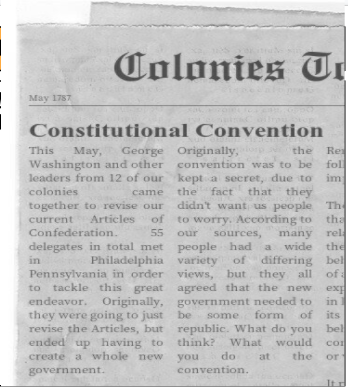
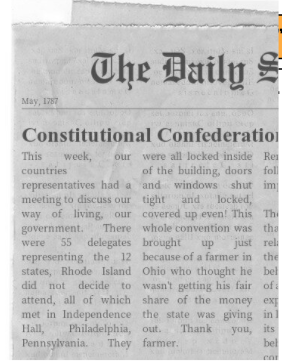
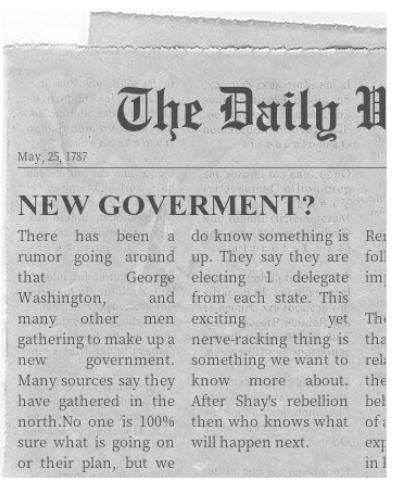
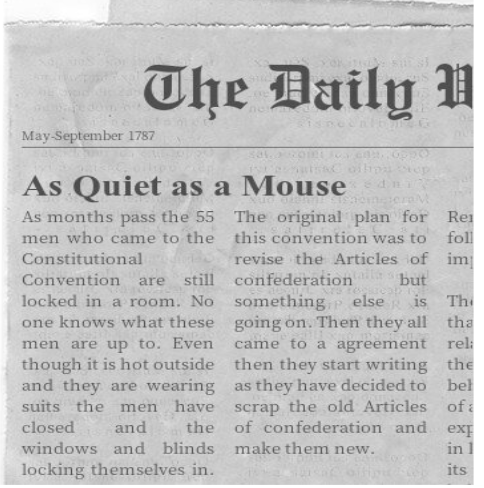
The fast and curious was set up as 10 questions, and the first rep had low class averages (63%, 60%, 68%, 63%, and 49%). Next, I set up the Cyber Sandwich with a Main Idea note taking literacy strategy. Students read for 10 minutes and took notes on who, where, when, why, and how. As always I had the reading linked on the notes slide and I had paper copies. After 10 minutes, students discussed their notes with each other and I shared my notes as well. Instead of a typical summary, students created a fake newspaper clipping about the purpose of the Constitutional Convention. The site I used for the newspaper clipping was www.fodey.com. Students can edit the paper title, headline, date, and article text.
I really liked the Main Idea note taking strategy as it really helped students include key details about the Constitutional Convention in their articles. The quality of the news articles was a lot better than in past years. We finished the class period with another fast and curious and scores went WAY up (99%, 98%, 95%, 96%, 88%).





Tuesday
One thing I have been doing throughout this unit is having students go back to the main vocabulary words on a Frayer model and writing their own definitions, own elaborations, characteristics, and including a picture. It has been good having them process their learning in their own ways. So, we began class on Tuesday by defining the Constitutional Convention on their Frayer model slides.


After 5 to 8 minutes we followed up the Frayer model with a Thin Slide to introduce the Great Compromise. The supporting question with the Great Compromise was: What was the argument over representation for the states? The Thin Slide I put together asked students to predict and answer the supporting question based on 2 documents: an excerpt of Article 1 of the Constitution and the 1790 Census. Here is the link to a completed class Thin Slide. Students did a great job with one word and one picture. However, they had a hard time explaining in words why they chose that word.
After the Thin Slide we shifted gears to a fast and curios with a Quizizz over the Great Compromise with some review. Class averages were: 60%, 68%, 74%, 72%, and 59%.
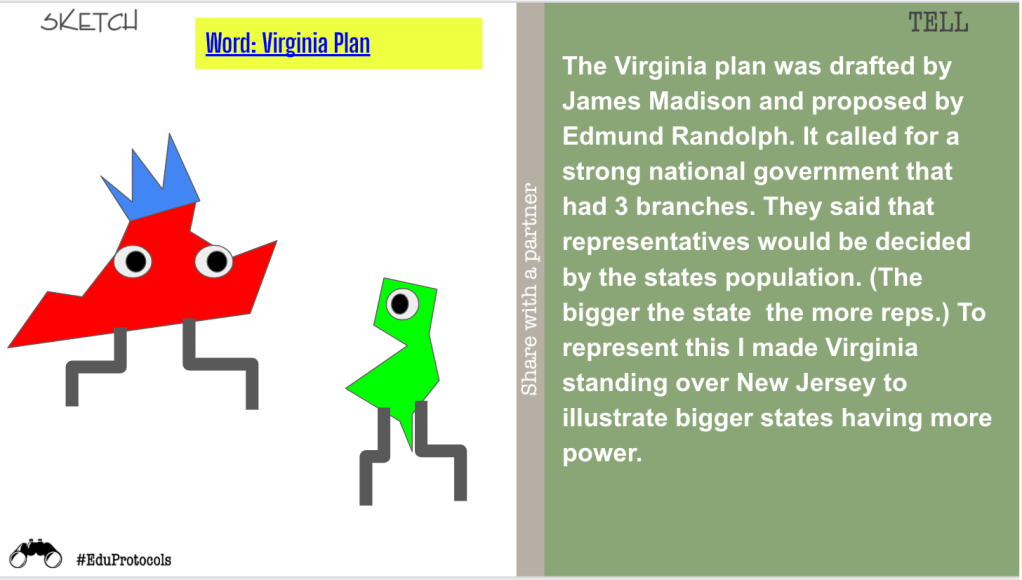
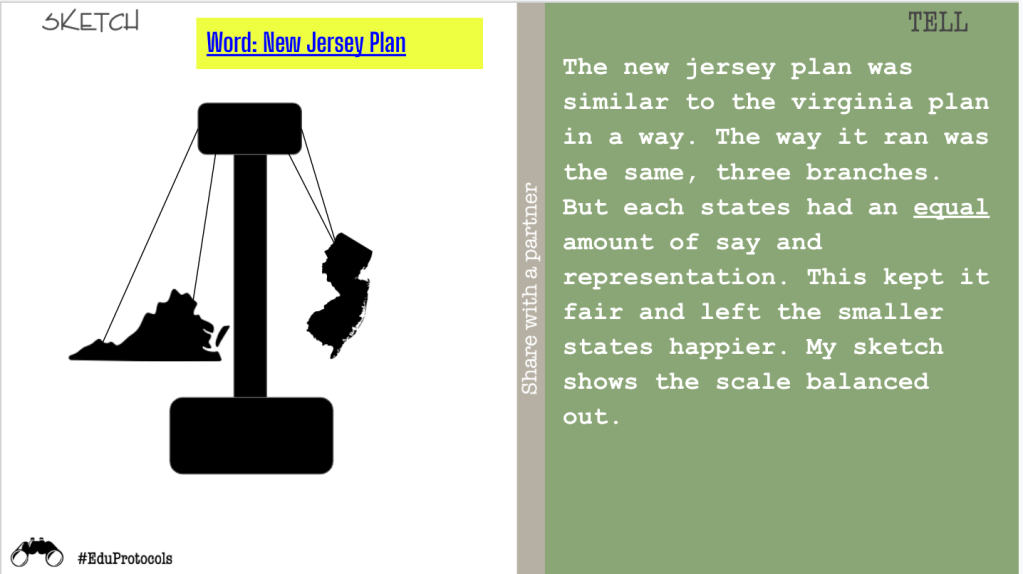
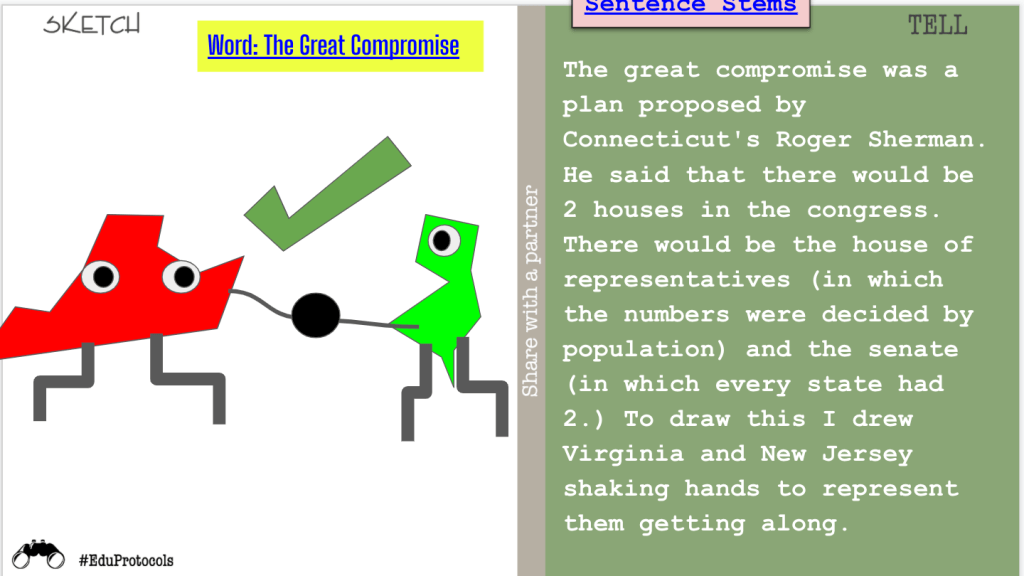
After the quiz was completed, we moved onto the Sketch and Tell where I asked students to create representations and explain the Virginia Plan, New Jersey Plan, and Great Compromise. I chose to do this because students have a hard time understanding these abstract ideas and sayings about representation, Houses, two bodies, Senate, etc. The Sketch and Tell is a perfect way for students to create abstract representations with a more concrete explanation of concepts.
Within the Sketch and Tell I chunked up a reading about the Plans and the Great Compromise and put separate links on all of the slides. My final thought with the Sketch and Tell was having students create representations with Play Dog, Legos, Google Shapes, or Noun Project Icons. Oh yeah, I even made two versions of my Sketch and Tell – one heavily scaffolded and one lightly scaffolded. What’s good for some, is good for all. After reviewing the completed work, for the most part, students did a nice job. I felt like I typed more comments than usual so I used Wednesday as a quick direct instruction day.
This original lesson was all on one Google Drawing slide (located in Unit 3). I decided to change that lesson to a Thin Slide – Sketch and Tell combination because I had a student do the original lesson and her responses about the Great Compromise showed me she was confused. I read through the lesson and the material just didn’t match up and jive. As a result, this lesson you just read about was created.
Wednesday
Wednesday was a shortened class period. I took time to do some direct instruction with these slides. I kept the instruction to under 10 minutes, or I tried to anyway because I love U.S. government related topics. After my direct instruction, students finished the Great Compromise Sketch and Tell and created definitions on their Frayer. Finally, we finished out the lesson with a Quizizz where class averages soared to: 88%, 75%, 93%, 97%, and 83%.
The one number that jumped out to me was that 75%. I began asking why and I dove into the student work a bit more. That particular class , out of 23 students, 14 had incomplete Sketch and Tells. Needless to say, we had a “Life Lessons with Mr. Moler” conversation.






Thursday
Thursday we put a halt to the Constitutional Convention and focused on Veteran’s Day. The lesson I do for Veteran’s Day I put together last year. The lesson worked out so well that I will continue to do it until something better happens, or is created.
I wanted students to do something meaningful for Veteran’s Day instead of a passive lesson followed by moving on with our lives. So, I stumbled upon this organization called A Million Thanks. The organization mails out letters out to Veterans and active duty members all over the world. Before students write letters I show them some great videos with Steve Hartman and veterans. Here is the lesson and order in which I do it (I stick with this order for the effect):
- I show this video about a WWII Veteran who wanted to learn how to read.
- Then I show this video about a Gulf War Veteran who wrote a letter to President Bush.
- Finally I show this video about a Vietnam War veteran who, years later, meets the girl that wrote him a letter when she was in 6th grade.
- This transitions us to writing a letter for a veteran or active duty member.
- I collect the letters and then we mail them out.
Between the videos and letter writing, some tears are shed. The students take this very seriously, and, to me, this lesson has meaning and purpose. I will continue to do this lesson for many years to come.
Friday
Friday, I began the day knowing it would be about constitutional compromises over slavery. The supporting question for this lesson is: What were compromises over slavery? I had a virtual lesson ready to go, but I didn’t want to do it. Instead I had this idea:
- Post this quote, “Most northern delegates agreed that enslaved people should be counted only as property,” and use Question Formulation Technique to let students create questions. Most students have knowledge that slavery existed in the North, but it became illegal through time. Most know that slavery was mainly in the South and continued through the south for an extensive period of time. This quote would surely create many questions.
- Students would discuss their questions and select the top 3 for their group.
- Then students would copy their questions to a Cyber Sandwich notes slide, read for 10 minutes, find the answers, discuss, and summarize.
I was excited. I created a new, higher level thinking design for notetaking with a Cyber Sandwich. I couldn’t wait to try out this lesson.
When 2nd period rolled in, I had it ready to go and a student said, “Are we making posters today!?” I replied, “No.” Then I proceeded to explain my awesome lesson idea. They were sad. BUT, I asked them, “How do you want to learn about compromises over slavery?”
The students all said they wanted to make a poster. I took 3 options for lessons, put them into a Mentimeter ranking tool, and the students decided between these 3 options:
- My virtual lesson – straightforward, organized, watch a video, read, identify 3 compromises, and take a Quizizz.
- Number Mania with a reading.
- Create questions, decided on best questions, complete a Cyber Sandwich with a partner.
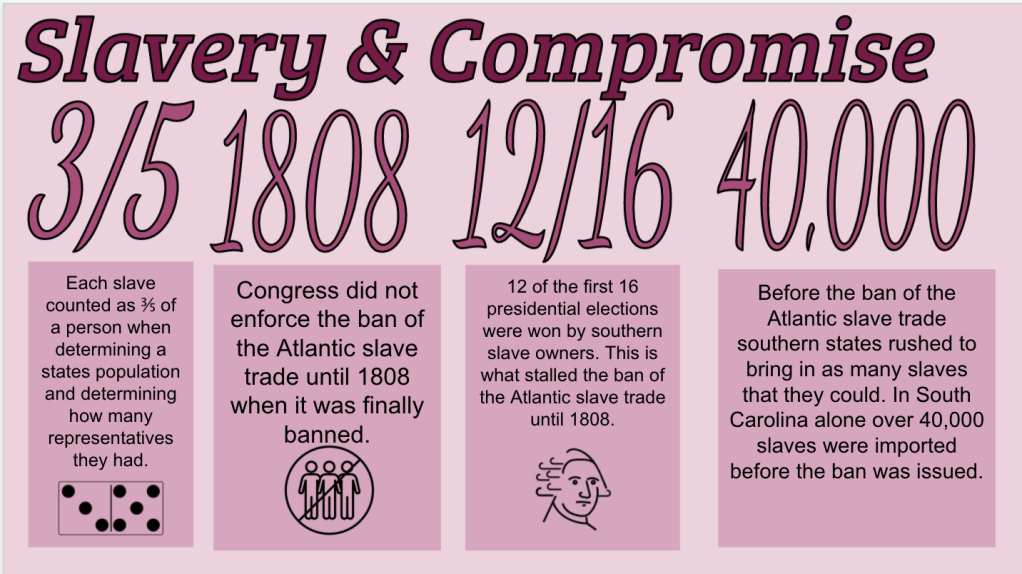
Students, overwhelmingly voted for the Number Mania. So, I had a students pass out the reading and I asked them to read for 10 minutes as they highlighted important numbers and facts. As they read, I created a Number Mania assignment and sent it out through Google Classroom. The common theme throughout the day was Number Mania as students really enjoy that EduProtocol. The common 2nd place finisher was my virtual lesson. As a result, some classes had multiple things going on – some students doing the Number Mania and some doing my virtual lesson.
The one thing I really took away from asking students how they wanted to learn was the processing styles of my students. The students who need structure and certainty are the ones who chose my virtual lesson. The students who are more vision and interpretation oriented chose the Number Mania. The students are more driven by question and connection chose the Question Formulation Technique. Differentiation was not my only goal when I asked students how they wanted to learn the material, I wanted a sense of the processing styles of the students.





 Moler's Musings